Rare 1910 Lincoln Wheat Penny Worth $45,000: There are few things more exciting in coin collecting than discovering that an ordinary-looking coin may have a much more interesting story than expected.
A 1910 Lincoln Wheat Penny is a perfect example.
At first glance, it is just an old one-cent coin. The date is more than a century old, the copper has usually changed color with age, and many surviving examples show the wear that comes from decades of circulation.
But among these old Lincoln cents are examples that stand apart from the crowd.
Some were preserved far better than most.
Some were made at a scarcer mint.
Some display recognized varieties.
And a very small number survived with exceptional surfaces, remarkable detail and original reddish copper color.
That is where the famous $45,000-plus valuation story begins.
An extraordinary 1910-S Lincoln Wheat Penny has reached a price around this level, showing just how far the market can move when a coin combines rarity, condition and outstanding visual quality.
However, there is an important point that every collector should understand before getting excited about a coin in an old jar or collection.
The $45,000 figure does not mean that every 1910 Lincoln cent is worth thousands of dollars.
It does not mean that every 1910-S is a five-figure coin.
And it certainly does not mean that simply finding the date 1910 guarantees a fortune.
The real story is much more interesting.
The value comes from the individual coin.
Its mint mark, grade, color, surfaces, strike, variety, authenticity and collector demand can completely change the outcome.
That is why examining a 1910 Lincoln Wheat Penny can become a fascinating treasure hunt.
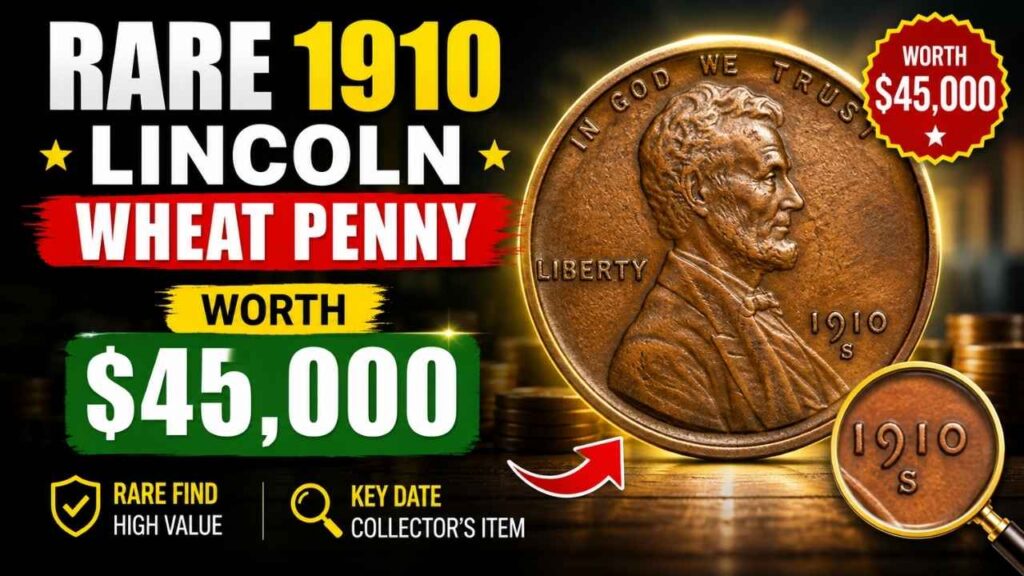
The Story Behind the Lincoln Wheat Penny
The Lincoln cent was introduced in 1909, making the 1910 issue part of the earliest generation of Lincoln pennies.
That alone gives the coin an important place in American numismatic history.
The obverse carries a portrait of Abraham Lincoln facing right. The design was created by Victor David Brenner.
On the reverse are two wheat ears, one on each side, surrounding the central lettering and denomination.
This reverse design is the reason collectors eventually gave these coins the popular name “Wheat Penny” or “Wheat Cent.”
The design remained in production for decades before the reverse was changed.
For collectors today, early Lincoln cents are particularly appealing because they connect the modern American penny with the beginning of the Lincoln series.
A 1910 cent is not merely an old copper coin.
It is a surviving piece from the early years of a design that became one of the most recognizable American coin types.
Quick Facts About the 1910 Lincoln Wheat Penny
Here are the basic characteristics collectors should know:
- Year: 1910
- Country: United States
- Denomination: One cent
- Series: Lincoln Wheat Cent
- Designer: Victor David Brenner
- Composition: primarily copper, with tin and zinc
- Weight: approximately 3.11 grams
- Diameter: approximately 19 millimeters
- Edge: plain
- Philadelphia issue: no mint mark
- San Francisco issue: S mint mark
- San Francisco production: approximately 6 million coins
- Obverse subject: Abraham Lincoln
- Reverse design: two wheat ears surrounding the central lettering
The small S beneath the date is one of the most important details to inspect.
A 1910 with no mint mark is associated with Philadelphia.
A 1910-S was produced at San Francisco.
For a casual observer, that tiny letter might seem insignificant.
For a collector, it can be one of the first clues that the coin deserves a closer examination.
Why the 1910-S Is Especially Interesting
The San Francisco version is the one that often attracts more attention because its production was much lower than the huge Philadelphia issue.
Approximately six million 1910-S Lincoln cents were made.
That does not make every surviving example rare in every grade.
However, it does make the date more important within the early Lincoln cent series.
The real challenge is finding desirable examples.
Circulated coins are much easier to encounter than coins that survived in excellent condition.
Think about what a penny experiences after entering circulation.
It can be dropped onto sidewalks.
It can rub against thousands of other coins.
It can spend years inside cash registers.
It can be exposed to moisture and dirt.
It can be handled repeatedly.
Over time, those experiences leave marks.
The finest examples escaped much of that treatment.
That difference is extremely important in the world of coin collecting.
The $45,000 Mystery
So how can a coin originally worth one cent become worth tens of thousands of dollars?
The answer is exceptional preservation.
Imagine finding two 1910-S pennies.
The first has a worn portrait. Lincoln’s hair is soft, the cheek shows circulation wear, the wheat ears are no longer sharply defined, and the surfaces contain numerous marks.
The second coin looks almost as though it spent very little time in circulation.
The details are sharp.
The surfaces are attractive.
The original reddish copper appearance remains.
There are very few distracting marks.
The strike is strong.
A professional grading service places the coin at an elite Mint State grade.
Now the two coins have completely different positions in the collector market.
The date is identical.
The mint mark is identical.
The denomination is identical.
But the quality of survival is dramatically different.
That is why the headline value of a spectacular 1910-S should never be applied to every coin carrying the same date.
Condition Can Change Everything
Condition is one of the most important factors in determining the value of an old Lincoln cent.
A circulated coin has experienced actual use.
The highest points of Lincoln’s portrait gradually lose detail.
The wheat ears on the reverse become less defined.
Fine lines disappear.
The original surface texture changes.
An uncirculated coin is different.
It has not experienced normal circulation wear, although it can still contain contact marks, scratches or other imperfections from storage and handling.
At high Mint State levels, tiny imperfections become much more important.
A mark that seems invisible to the naked eye can become significant when the coin is examined under magnification.
This is why grading an early copper coin is not simply a matter of asking whether it “looks old” or “looks nice.”
Professional grading considers multiple characteristics.
These can include wear, surface quality, luster, strike, marks, eye appeal and the overall state of preservation.
Understanding Brown, Red-Brown and Red Copper
Copper coins have another fascinating characteristic: color.
A newly struck copper cent has a bright reddish appearance.
Over decades, exposure to air and the environment can naturally change that color.
Collectors commonly describe copper coins using three broad color categories.
Brown is generally abbreviated BN.
Red-Brown is abbreviated RB.
Red is abbreviated RD.
A Brown coin has largely lost its original red appearance.
A Red-Brown example retains a mixture of reddish and brown coloration.
A Red example has preserved a significant amount of its original reddish color.
For early Lincoln cents, original Red color can be highly desirable, particularly when combined with an exceptional grade.
This is one reason a top-quality 1910-S Red cent can command dramatically more than a heavily circulated Brown example.
But color should never be considered in isolation.
A coin that has been artificially treated to appear brighter is not equivalent to a naturally preserved Red coin.
Originality matters.
What Does a 1910 Philadelphia Penny Look Like?
The Philadelphia 1910 Lincoln cent does not carry a mint mark.
This is normal.
Some new collectors see the missing letter and assume that something is wrong with the coin.
Nothing is wrong.
For this period, the absence of a mint mark identifies the Philadelphia production.
A normal circulated 1910 Philadelphia cent can show substantial wear.
Lincoln’s hair may have softened.
The lines around the face may have become less distinct.
The reverse wheat ears can lose detail.
The words UNITED STATES OF AMERICA and ONE CENT may still remain readable, but their sharpness depends on how much circulation the coin experienced.
A nice example with better preservation can be more attractive to collectors.
However, the year alone does not make the Philadelphia issue a five-figure coin.
That distinction is essential.
What Does a 1910-S Look Like?
The 1910-S is identified by the small letter S beneath the date.
The mint mark should be examined carefully.
It should appear as part of the coin’s original design rather than as a random scratch or surface impression.
Because the mint mark is tiny, photographs taken from different angles can make it look unusual.
This is why collectors should avoid declaring a rare variety based on a quick glance.
Use good lighting.
Use magnification.
Compare the shape and placement with reliable identification material.
And if the coin appears genuinely unusual, professional attribution can provide greater confidence.
Repunched Mint Mark Varieties
The 1910-S series also has documented repunched mint mark varieties.
A repunched mint mark can occur when the minting process results in evidence of more than one placement of the mint mark.
The result may look like extra contours, traces or unusual shapes around the primary S.
For collectors, these varieties can be much more interesting than a random damaged mint mark.
But identification requires caution.
A scratch is not a repunched mint mark.
A dent is not a repunched mint mark.
A corroded area is not a repunched mint mark.
Even a distorted photograph can make a normal mint mark appear strange.
The strongest approach is to compare the suspected feature with known characteristics of the recognized variety.
If the variety appears significant, authentication becomes especially important.
Genuine Mint Errors Versus Damage
The world of coin collecting is filled with photographs of unusual coins.
Some are genuine mint errors.
Others are simply damaged coins.
This distinction can make a huge difference.
A genuine mint error originates during the manufacturing process.
Post-mint damage happens after the coin has left the Mint.
For example, a coin might develop a dent after being dropped.
It might receive a scratch from another object.
It might become discolored because of environmental exposure.
It might develop unnatural surfaces after cleaning.
None of these automatically qualify as valuable mint errors.
Collectors should therefore be careful when someone describes an ordinary damaged penny as a “rare error.”
A professional evaluation is often the safest route when a suspected error appears potentially valuable.
The Importance of Original Surfaces
Original surfaces are extremely important for old copper coins.
Collectors want to know that the coin has not been heavily altered.
Cleaning is one of the biggest problems.
Someone may believe that removing dirt will make an old penny more attractive.
But aggressive cleaning can leave permanent evidence.
Fine hairline scratches can cover the fields.
The color can become unnatural.
The original texture can be disturbed.
Chemical treatments can also change the appearance of copper.
Once the original surface has been damaged, it cannot simply be restored by putting the coin back into a holder.
For that reason, an old Lincoln cent should generally be left exactly as it is until its potential value has been understood.
Never Polish a Potentially Valuable Penny
A shiny penny may look attractive to someone unfamiliar with numismatics.
Collectors often see things differently.
An artificially bright surface can be a warning sign.
The goal is not to make an old coin look new.
The goal is to preserve what remains of its original condition.
If you discover a 1910 Lincoln cent and wonder whether it could be valuable, don’t polish it first.
Don’t use household cleaners.
Don’t rub it with a cloth.
Don’t scrape away dark areas.
Don’t attempt to remove spots with chemicals.
The safest action is to preserve the coin and have it evaluated in its existing state.
How to Grade Your 1910 Penny at Home
You can perform an initial examination without expensive equipment.
Begin with clean hands and a safe working surface.
Hold the coin by its edges rather than repeatedly touching the main surfaces.
Use neutral lighting.
Then inspect the obverse.
Look at Lincoln’s hair.
Examine the cheek and jaw.
Look at the coat and surrounding fields.
Next, inspect the reverse.
Study the wheat ears.
Look at the lettering.
Check the central area around ONE CENT.
Then inspect the date and mint mark.
The goal is not to assign an exact professional grade immediately.
Instead, determine whether the coin appears heavily circulated, lightly circulated or potentially uncirculated.
That first classification can help you decide whether professional grading is worth considering.
What Does Mint State Mean?
The term Mint State generally refers to an uncirculated coin.
A Mint State coin can still have marks.
This is an important point.
Uncirculated does not mean perfect.
Coins can contact one another during production, transportation and storage.
Those contacts can leave small marks on the surfaces.
As the grade rises, the severity and number of imperfections become increasingly important.
At the very highest levels, a tiny flaw can separate one grade from another.
This is why elite examples can become so expensive.
Collectors competing for the best-known specimens are looking for extremely small differences.
Why High-Grade Copper Coins Are So Difficult
Copper presents a special challenge.
Its appearance changes over time.
Maintaining attractive original color for more than a century is not easy.
Storage conditions can influence the coin’s appearance.
Handling can create fingerprints or surface marks.
Environmental exposure can alter the color.
Even if a coin avoids circulation, it can still suffer from improper storage.
This is one reason high-grade Red Lincoln cents can be so appealing.
They combine age with preservation.
A 1910-S cent with strong detail and attractive original Red color represents a very different collecting opportunity from a heavily worn Brown coin.
Why Certification Can Matter
Professional certification can be useful when a coin appears potentially valuable.
A grading company can authenticate the coin and assign a grade.
The coin is then placed in a protective holder with identifying information.
For expensive coins, this can make transactions easier because buyers have an independent assessment to consider.
But certification is not free.
There are submission fees.
There may be shipping and insurance expenses.
Additional services can also increase the total cost.
Therefore, not every old penny needs to be submitted.
If the coin is obviously common and heavily worn, spending substantial money on grading may not make financial sense.
If the coin appears exceptional, the calculation can be different.
What Could Make a 1910 Penny Valuable?
Several characteristics can work together.
The mint mark is one.
A 1910-S is generally more interesting than an ordinary Philadelphia 1910.
Condition is another.
A sharply preserved example can be far more desirable than a heavily circulated one.
Color can matter.
An original Red copper coin can attract additional interest.
Varieties can matter.
A properly attributed repunched mint mark can create another layer of collector demand.
Strike quality matters as well.
A sharply struck coin can display the design with greater clarity.
Surface quality matters.
A coin covered with distracting marks is generally less appealing than one with cleaner original surfaces.
Certification can also affect marketability.
Finally, collector demand determines what buyers are actually prepared to pay.
A Realistic Way to Think About Value
Instead of asking, “How much is a 1910 penny worth?” ask several smaller questions.
Is it Philadelphia or San Francisco?
How much circulation wear does it have?
Is the copper Brown, Red-Brown or Red?
Does it have original surfaces?
Is there a recognized variety?
Is there a genuine mint error?
Does the coin appear authentic?
Has it been professionally graded?
What comparable coins have actually sold for?
These questions produce a much more realistic picture.
A coin’s value is not determined by the date alone.
Circulated 1910 Lincoln Pennies
Most coins that have spent significant time in circulation will show wear.
That does not make them worthless.
Early Lincoln cents remain popular with collectors, and many people enjoy building date-and-mint collections.
A circulated 1910-S can still be an attractive historical collectible.
However, a worn example should not be compared directly with a spectacular Mint State Red specimen.
They belong to different segments of the market.
The condition gap can be enormous.
Better Circulated Examples
Some circulated coins have retained more detail than others.
A lightly circulated penny can show a much sharper portrait.
The wheat ears may remain well defined.
The lettering can appear crisp.
The surfaces may still be relatively attractive.
These coins can be more desirable than heavily worn pieces.
However, the presence of a little wear does not automatically make a coin extremely valuable.
The overall combination of characteristics still matters.
About Uncirculated Examples
An About Uncirculated coin sits near the boundary between circulated and uncirculated condition.
It may have only slight evidence of wear on the highest points.
These coins can be attractive because they retain much of the original design.
However, they may still have contact marks or surface issues.
Collectors examine them carefully because small differences can influence desirability.
Uncirculated and High-Grade Examples
The most dramatic price differences often appear at the upper end of the condition scale.
An uncirculated coin with strong surfaces can be valuable.
A higher-grade coin can be considerably more desirable.
A very high-grade Red example can enter a completely different market.
At the top of the grading ladder, collectors may compete aggressively for a coin because there may be very few comparable examples available.
This is the environment where five-figure prices can occur.
Why Auction Results Can Be So Different
Coin prices are not fixed like the price printed on a supermarket shelf.
At auction, the final result depends on the people bidding at that moment.
If several serious collectors want the same coin, competition can push the price higher.
If only a few buyers are interested, the result may be lower.
The exact grade also matters.
Two coins with the same date and mint mark can have different grades.
Even two coins with the same grade can have different visual appeal.
One may have cleaner surfaces.
Another may have more attractive color.
One may have a stronger strike.
Another may show distracting marks.
That is why individual auction results should be treated as examples rather than guarantees.
Asking Price Versus Actual Selling Price
This is especially important when researching coins online.
Someone may list a 1910 penny for $10,000.
Another seller may list one for $50,000.
Those numbers do not automatically prove that buyers are paying those amounts.
An asking price is simply an asking price.
A completed transaction provides much stronger evidence.
Even then, one sale does not guarantee the same result for another coin.
The exact coin matters.
Its certification, grade, color, surfaces and eye appeal all influence the market.
How to Photograph Your 1910 Penny
Good photographs can make a huge difference when asking for an opinion.
Take a straight photograph of the obverse.
Make sure the entire coin is visible.
Then photograph the reverse.
Take a close-up of the date.
Take another close-up of the mint mark if it has an S.
If you believe there is a variety, photograph the suspected area clearly.
An edge photograph can also be useful when examining unusual characteristics.
Use even lighting.
Avoid filters.
Avoid artificial color enhancement.
Do not make the coin look brighter than it really is.
The best photograph is an honest photograph.
A Simple Home Inspection Checklist
If you discover a 1910 Lincoln cent, use this checklist:
- Confirm the date.
- Check whether there is an S mint mark.
- Examine Lincoln’s portrait.
- Study the wheat reverse.
- Look for obvious circulation wear.
- Check for scratches and dents.
- Examine the copper color.
- Look for signs of cleaning.
- Inspect the mint mark with magnification.
- Compare any suspected variety carefully.
- Photograph both sides.
- Consider professional evaluation if the coin appears exceptional.
This process can prevent many common mistakes.
When Professional Evaluation Makes Sense
Professional evaluation becomes especially useful when several positive characteristics appear together.
For example, suppose you find a 1910-S that appears almost completely uncirculated.
The surfaces are attractive.
The copper color is strongly reddish.
The strike looks sharp.
You don’t see obvious cleaning.
The coin appears significantly better than most examples you’ve encountered.
That is when professional authentication and grading may be worth considering.
On the other hand, if the coin is heavily worn, damaged and obviously ordinary, spending a large amount on grading may not be sensible.
Where to Sell a Valuable 1910 Penny
If professional evaluation confirms that your coin is important, you can consider several selling options.
A reputable coin dealer can provide a direct purchase offer.
A specialist coin shop may be interested in early Lincoln cents.
Coin shows allow you to meet multiple dealers in one place.
Specialized auctions can be useful for exceptional coins because multiple collectors may compete for them.
Online sales can also work, but sellers must understand fees and risks.
The right selling method depends on the quality of the coin.
A common circulated cent does not require the same selling strategy as a top-grade certified rarity.
Why You Should Compare Offers
Never assume the first offer is automatically the best.
A dealer is running a business.
If a dealer offers to buy your coin, the offer will normally be below the amount the dealer believes the coin could eventually sell for.
That difference covers business expenses, risk and potential profit.
An auction can potentially bring a stronger result if several buyers compete, but auctions may involve fees and uncertainty.
A private sale may produce another result.
Therefore, compare the entire transaction rather than focusing only on one headline number.
How Much Could You Actually Receive?
Suppose a coin has a published market value of a certain amount.
That does not guarantee that a dealer will offer exactly that amount.
The dealer may have to resell the coin.
The dealer may need to pay for authentication.
The coin may sit in inventory for months.
There may be market risk.
Auction selling also has costs.
Seller commissions and other charges can affect the amount the owner ultimately receives.
Online marketplaces can have listing, payment or transaction fees.
Shipping and insurance may add another expense.
The important number is not simply the highest price you see on a screen.
It is the realistic amount you can expect after considering the actual selling method and its costs.
How to Prepare a Coin for Evaluation
If you believe your 1910 penny could be valuable, preparation should be simple.
First, identify the date.
Second, determine whether it has an S mint mark.
Third, inspect both sides carefully.
Fourth, take high-quality photographs.
Fifth, avoid cleaning.
Sixth, document any unusual feature without touching or altering it.
Seventh, research professional evaluation or grading options.
Finally, understand the fees before submitting the coin.
Do not let excitement push you into an expensive decision.
Common Mistakes Collectors Make
One of the most common mistakes is cleaning.
Another is assuming every old coin is rare.
A third is confusing damage with a mint error.
A fourth is believing an online asking price is proof of value.
A fifth is assuming a famous auction result applies to every coin with the same date.
Another mistake is paying for professional grading without first considering whether the coin has enough potential value to justify the expense.
There is also a practical mistake that can be overlooked: poor storage.
Throwing old copper coins loose into a damp container can cause additional problems.
Proper storage can help protect the surfaces and appearance of collectible coins.
Safe Storage for an Old Lincoln Cent
A potentially valuable penny should not be stored loosely with hundreds of other coins.
Contact between coins can create scratches.
Improper materials can also cause problems over time.
Use an appropriate coin holder or storage system designed for collectible coins.
Keep the environment reasonably stable.
Avoid unnecessary handling.
When examining the coin, hold it by the edges.
The goal is simple: preserve the condition you already have.
Why the Internet Can Create Confusion
The internet has made coin collecting more accessible than ever.
That is a good thing.
Collectors can learn about varieties, grading and historical issues from around the world.
But viral headlines can also create unrealistic expectations.
A headline saying “This Penny Is Worth $45,000” can make someone believe that every penny with the same date is valuable.
That is not how the collectible coin market works.
Exceptional coins are exceptional precisely because they are not normal.
A spectacular high-grade example should not be used as the automatic price for an ordinary circulated coin.
The Difference Between Rarity and Age
Another important lesson is that old does not always mean rare.
A coin can be more than 100 years old and still survive in substantial numbers.
At the same time, a particular variety or grade can be difficult to find.
Age tells you when the coin was produced.
Rarity tells you how difficult it is to obtain a particular type or quality of example.
Those are not the same thing.
The 1910 Lincoln cent is old.
The challenge is identifying which individual examples have characteristics that collectors consider especially desirable.
Why Collectors Love Early Lincoln Cents
Early Lincoln cents have a special place in American collecting.
They are affordable enough for many collectors to study and collect by date.
They also offer a wide range of varieties, mint marks and condition levels.
A beginner can start with circulated examples.
An experienced collector can spend years searching for high-grade specimens.
The series therefore appeals to different levels of collecting experience.
The 1910 issue sits close to the beginning of that long history.
That makes it interesting even when the individual coin is not particularly rare.
What Collectors Should Look For
If you’re searching through old Lincoln cents, pay attention to several categories.
Look for early dates.
Look for lower-production mint-marked issues.
Study recognized varieties.
Learn how genuine mint errors differ from damage.
Pay attention to coins with unusually strong detail.
Watch for original copper surfaces.
Examine high-grade Red examples carefully.
And whenever a coin appears genuinely unusual, seek a knowledgeable opinion rather than relying entirely on a viral claim.
A 1910 Penny Treasure Hunt
One of the most enjoyable parts of coin collecting is the possibility of finding something unexpected.
You may open an old box and discover a group of Wheat Pennies.
Most could turn out to be ordinary.
But one might be significantly better preserved.
Another could have an interesting mint mark.
A third might have a recognized variety.
That uncertainty is what makes searching fun.
The goal should not be to assume that every old penny is a hidden fortune.
The goal is to learn enough to recognize when something deserves a closer look.
Could Your 1910 Penny Be the $45,000 Kind?
There is only one responsible answer without examining the actual coin: it is possible for an exceptional example to be extremely valuable, but the coin must prove that it belongs in that category.
Start with the mint mark.
A 1910-S deserves particular attention.
Then evaluate the condition.
Is there circulation wear?
Are the surfaces clean and original?
Does the coin retain attractive original color?
Are the details unusually sharp?
Is there a legitimate variety?
Could an unusual feature actually be a mint error?
Is the coin authentic?
Has it been professionally graded?
Only after answering those questions can you begin to estimate where the coin sits in the market.
The Most Important Lesson
The most important lesson from the 1910 Lincoln Wheat Penny is simple:
Don’t judge the coin only by its date.
The date gets your attention.
The details determine the story.
A common circulated 1910 cent and a spectacular high-grade 1910-S Red cent may look similar in a casual photograph.
To an experienced collector, however, the differences can be enormous.
The tiny S mint mark.
The amount of wear.
The quality of the surfaces.
The original color.
The sharpness of the strike.
The presence of a recognized variety.
The certification.
The overall eye appeal.
All of these factors can work together.
Final Checklist Before You Sell
Before selling a 1910 Lincoln Wheat Penny, go through this checklist:
- Is the date definitely 1910?
- Is there an S mint mark?
- What is the approximate condition?
- Does the coin show circulation wear?
- Is the copper Brown, Red-Brown or Red?
- Does it appear to have original surfaces?
- Has it been cleaned?
- Is there a recognized variety?
- Is there a possible genuine mint error?
- Have you taken clear photographs?
- Have you compared realistic market evidence?
- Would professional authentication be worthwhile?
- Have you compared more than one selling option?
- Do you understand dealer or auction fees?
- Are shipping and insurance being handled properly?
If the answers suggest that your coin is exceptional, slow down before selling it.
A little patience can be valuable when dealing with a potentially rare coin.
Final Thoughts on the 1910 Lincoln Wheat Penny
The 1910 Lincoln Wheat Penny is a fascinating reminder that value in coin collecting is rarely determined by age alone.
Millions of Lincoln cents were produced during the early years of the series, and many surviving coins have experienced heavy circulation.
Yet some individual pieces survived in remarkable condition.
The 1910-S is particularly interesting because of its lower production compared with the Philadelphia issue.
Recognized varieties can add another layer of collecting interest.
Exceptional Mint State coins with attractive original Red color can become especially desirable.
And at the very top of the market, a truly outstanding example can command a price measured in tens of thousands of dollars.
That is where the $45,000 mystery comes from.
It is not a promise that every 1910 Lincoln Wheat Penny is valuable.
It is a reminder that one extraordinary coin can be dramatically different from thousands of ordinary examples.
So if you have a 1910 penny, don’t immediately throw it into a common coin pile.
Take a closer look.
Check underneath the date.
Study the surfaces.
Examine the color.
Look for wear.
Pay attention to unusual details.
And if the coin appears unusually well preserved or has a legitimate variety, consider getting a professional evaluation.
If you’re in the United States and you have this coin and want to explore your selling or evaluation options, check the link in the comments. Click the link to learn how you can submit or send your coin for evaluation, explore the selling process, or contact me for more information.
Most importantly, don’t clean or alter the coin before you know what you have.
The true value of a 1910 Lincoln Wheat Penny depends on the individual coin, including its authenticity, mint mark, condition, color, surfaces, variety, possible error, certification and current collector demand.
Values can change over time, and an exceptional auction result should never be treated as a guaranteed price for another coin.
The best approach is to examine carefully, verify the important details and make a selling decision based on the actual characteristics of your coin.
That is what makes the 1910 Lincoln Wheat Penny so interesting.
It may be just one cent in denomination, but the right example can carry more than a century of American history—and, in extraordinary circumstances, a surprisingly high collector value.