The 1776-1976 Washington Bicentennial Quarter is one of the most recognizable United States coins ever produced.
Millions of Americans encountered these quarters during the country’s Bicentennial celebration. They were placed into everyday commerce, saved in family collections, pulled from change, and stored away as souvenirs of an important moment in American history.
Today, many people who find one wonder whether the quarter they have could be worth far more than its 25-cent face value.
That question is not as simple as looking at the date.
The 1776-1976 quarter was produced in enormous numbers, so most examples are common. However, certain varieties, mint errors, special finishes, unusual compositions, and exceptionally preserved examples can attract significantly more attention from collectors.
The most important thing to understand is that the famous high values associated with some Bicentennial quarters do not apply automatically to every coin dated 1776-1976.
A normal circulated quarter may have only a modest collector premium.
A special variety or genuine mint error can be considerably more interesting.
A superbly preserved specimen can also command more than an ordinary example.
That is what makes the Bicentennial quarter worth examining carefully.
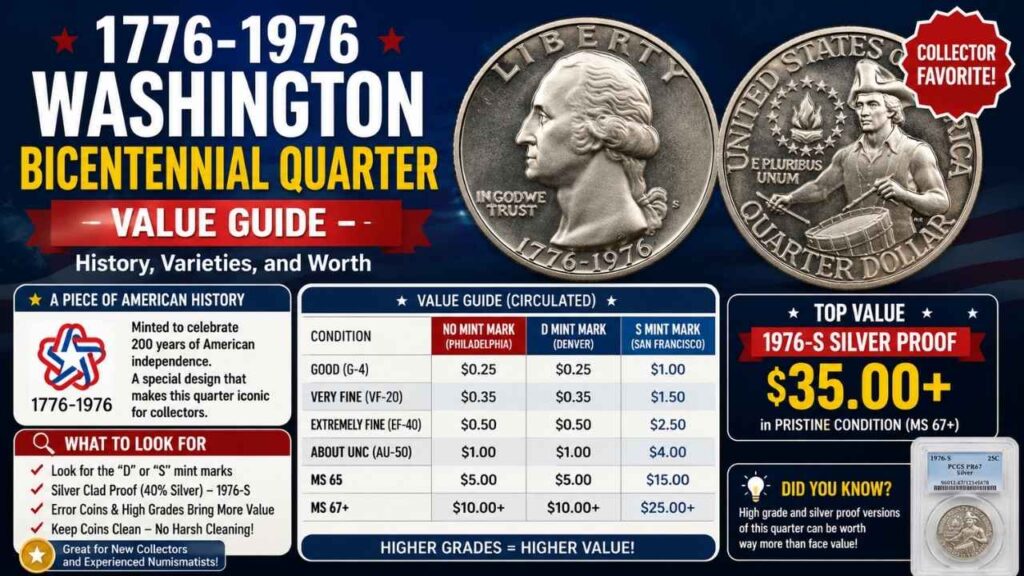
Why Does the Quarter Say 1776-1976?
The first thing that confuses many people is the unusual date.
Instead of showing one year, the coin displays 1776-1976.
This was done specifically for the American Bicentennial celebration.
The year 1776 represents the birth of the United States through the Declaration of Independence, while 1976 marked the 200th anniversary.
Rather than producing a normal quarter with only the year 1976, the United States Mint created a special dual-date design.
The design was used for the quarter, half dollar, and dollar during the Bicentennial program.
That makes these coins historically distinctive.
The quarter remained recognizable as a Washington quarter, but the reverse was temporarily redesigned to celebrate the anniversary.
The Famous Drummer Boy Reverse
The most noticeable feature of the Bicentennial quarter is the reverse design.
Instead of the traditional eagle that appeared on the regular Washington quarter, the Bicentennial quarter features a colonial drummer.
The drummer is shown facing left, with a torch and thirteen stars surrounding the scene.
The design was created by Jack L. Ahr.
The image was selected to give the coin a distinctly patriotic appearance while connecting it with the Revolutionary period.
The combination of the colonial drummer, torch, thirteen stars, and dual date made the coin visually different from ordinary Washington quarters.
That design is one of the main reasons these coins remain popular with collectors.
Quick Facts About the 1776-1976 Quarter
Here are the basic facts collectors should know:
- Country: United States
- Denomination: 25 cents
- Common name: Bicentennial Quarter
- Series: Washington Quarter
- Special date: 1776-1976
- Obverse design: George Washington
- Reverse design: Colonial drummer
- Obverse designer: John Flanagan’s Washington portrait was used for the series
- Reverse designer: Jack L. Ahr
- Edge: Reeded
- Composition: copper-nickel clad for many circulation issues, with special silver issues also produced
- Major mint marks: P, D, and S, depending on issue
- Philadelphia circulation coins: commonly identified by a P mint mark
- Denver circulation coins: D mint mark
- San Francisco: S mint mark on special collector issues
- Face value: 25 cents
Because several versions were produced, identifying the exact type of Bicentennial quarter is extremely important before estimating its value.
The Three Main Mint Locations to Know
The mint mark can tell you where a particular Bicentennial quarter was produced.
Look on the obverse, near the lower-right area of Washington’s portrait.
Depending on the issue, you may find a P, D, or S.
The P represents Philadelphia.
The D represents Denver.
The S represents San Francisco.
However, the mint mark alone does not determine whether the coin is rare.
A common mistake is to see an S and immediately assume that the coin must be valuable.
That is not necessarily true.
San Francisco produced special collector versions, including proof and silver-clad examples, so the exact type matters.
Philadelphia Bicentennial Quarters
Philadelphia produced a huge number of Bicentennial quarters for circulation.
These coins are generally copper-nickel clad and were intended to be used as normal money.
Many were saved because people recognized the unusual design.
That large production and widespread saving mean that ordinary Philadelphia Bicentennial quarters are not automatically rare.
Still, condition can make a difference.
A coin that spent years in circulation may have scratches, flattened details, dirt, and surface wear.
Another example might have spent decades protected in a collection.
The second coin can be much more attractive to collectors.
Denver Bicentennial Quarters
Denver also produced Bicentennial quarters for circulation.
These carry the D mint mark.
Like the Philadelphia issues, many Denver quarters entered everyday use.
Because so many examples were produced, the normal circulated coin generally does not command an enormous premium.
But high-grade examples and certain varieties can be more interesting.
If you have a 1776-1976-D quarter, the next step should not be to search for a huge price immediately.
Instead, determine its condition and inspect the coin carefully for legitimate characteristics.
San Francisco Bicentennial Quarters
San Francisco is particularly interesting because it produced collector-oriented versions of the Bicentennial quarter.
Some were struck in special silver-clad composition.
Others were proofs intended for collectors rather than everyday circulation.
This means that an S-mint Bicentennial quarter should be identified carefully.
Two S-mint coins can look similar while belonging to different categories.
The finish, composition, strike, and overall characteristics can help determine what type of coin you have.
The Silver Bicentennial Quarter
One of the most important distinctions is between the regular copper-nickel clad quarter and the special silver-clad version.
The silver Bicentennial quarter was produced for collectors.
It contains a silver alloy rather than the ordinary circulation composition.
That gives the coin an intrinsic metal component that ordinary clad examples do not have.
But even a silver Bicentennial quarter should not automatically be called extremely rare.
Collectors still consider condition, finish, authenticity, and market demand.
If you suspect that your coin is silver, avoid relying only on color.
Proper identification is better than guessing from appearance.
How to Tell Which Bicentennial Quarter You Have
Start with the date.
It should read 1776-1976.
Then examine the mint mark.
Next, consider the coin’s appearance and weight.
Special silver issues can have characteristics that differ from regular clad quarters.
If you have access to an accurate scale, weight can sometimes provide useful preliminary information.
However, weight alone should not be treated as absolute proof.
A worn coin can lose a small amount of material.
A damaged coin can also produce unusual measurements.
For an expensive or suspicious example, professional authentication is the safest approach.
Why Some Bicentennial Quarters Are Valuable
There are several different reasons a Bicentennial quarter can become collectible.
The first is a genuine mint error.
The second is a recognized die variety.
The third is an unusual composition.
The fourth is exceptionally high condition.
The fifth is a special proof or collector issue.
The sixth is strong demand for a particular variety or grade.
These factors can overlap.
A normal circulated quarter may be worth little beyond its face value.
A high-grade example with a desirable characteristic can be worth substantially more.
That difference is the heart of Bicentennial quarter collecting.
Genuine Mint Errors
Mint errors are among the most exciting possibilities.
A genuine error occurs during the manufacturing process.
The Mint uses multiple stages to prepare blanks, strike designs, inspect coins, and package them.
Problems can occasionally occur during these processes.
Depending on the type of error, a coin might show an unusual strike, missing design element, off-center appearance, wrong planchet, doubled design feature, or another recognized production abnormality.
However, not every strange-looking coin is a mint error.
This is extremely important.
Damage Is Not the Same as an Error
A quarter that has been hit, scratched, bent, scraped, chemically altered, or damaged by machinery after leaving the Mint can look unusual.
That does not make it a collectible mint error.
For example, a scratch across Washington’s portrait is normally just damage.
A dent around the edge is not automatically an error.
Discoloration is not automatically an error.
A coin that appears thicker because of damage should not immediately be described as a wrong-planchet error.
The origin of the unusual feature matters.
Collectors should always ask one basic question:
Could this characteristic have been created during the minting process?
If the answer is uncertain, professional evaluation is worthwhile before assigning a large value.
Doubled Designs and the Bicentennial Quarter
Another area that receives enormous attention is doubling.
Collectors often use the phrase “double die” loosely, but genuine doubled-die varieties have specific characteristics.
Mechanical doubling and other forms of strike-related distortion can look similar to an inexperienced eye.
A genuine doubled-die variety should show the appropriate type of design separation in the affected area.
Simply seeing a shadow around a letter does not prove a valuable doubled die.
If your quarter appears doubled, take clear photographs of the affected lettering or numbers and compare the feature carefully with known varieties.
The Importance of the Date
The dual date is what immediately identifies the Bicentennial issue.
The numbers 1776-1976 should be examined for clarity and unusual characteristics.
However, the date itself does not make the coin rare.
Millions of quarters carry the same dual date.
Therefore, the date is the starting point of the investigation, not the conclusion.
The collector needs to determine what kind of 1776-1976 quarter it is.
Condition and Grading
Condition can make an enormous difference.
A circulated quarter may have obvious wear across Washington’s portrait.
The hair details may be softer.
The high points may appear flattened.
The reverse drummer can also show wear.
An uncirculated coin should retain its original mint-state appearance without normal circulation wear.
But uncirculated does not mean flawless.
Coins can acquire marks from contact with other coins during production and handling.
This is why professional grading becomes increasingly important as potential value rises.
What Does MS Mean?
MS stands for Mint State.
It is used for coins that have not experienced normal circulation wear.
MS grades extend across several levels.
An MS coin can have contact marks, but the number and severity of those marks can influence its grade.
At the highest levels, collectors examine the surfaces extremely closely.
A coin with exceptional luster, strong strike, clean fields, and minimal contact marks can become much more desirable.
This is one reason a high-grade Bicentennial quarter can be worth more than the average example.
Proof Bicentennial Quarters
Proof coins are made specifically for collectors.
They are struck using specially prepared dies and planchets, producing a distinctive appearance.
The fields can appear highly reflective, while the design elements may have strong contrast.
Proof Bicentennial quarters are not the same thing as ordinary circulation strikes.
Many were preserved from the beginning, so simply finding an S-mint proof does not automatically make it an ultra-rare coin.
Nevertheless, proof examples are an important part of the Bicentennial collecting story.
Silver Proof Bicentennial Quarters
Silver proof Bicentennial quarters are another special category.
These were produced for collectors using silver-clad composition.
Their value can reflect both their numismatic appeal and the underlying precious-metal content.
Condition remains important.
A damaged silver proof is not equivalent to a pristine example.
Original surfaces and attractive preservation can make a major difference.
Collectors should also be cautious about altered or counterfeit silver examples.
When a coin is valuable enough, authentication becomes increasingly important.
What Makes a Bicentennial Quarter Rare?
Rarity can come from different sources.
A particular error might have occurred only a small number of times.
A recognized variety may be difficult to locate.
A specific high grade may be scarce.
A special composition may have limited production.
A particular proof or collector issue may have a smaller population at top grades.
Therefore, “rare” should always be followed by a more precise explanation.
Rare in what way?
Rare by date?
Rare by mint?
Rare by variety?
Rare by error?
Rare in a particular grade?
Rare with original surfaces?
This distinction helps prevent unrealistic valuations.
How Much Is a 1776-1976 Quarter Worth?
There is no single value for every Bicentennial quarter.
Most ordinary circulated copper-nickel examples are common.
Their collector value may be relatively small.
Uncirculated examples can be worth more depending on grade and demand.
Proof coins occupy another category.
Silver-clad coins can have additional value.
Genuine mint errors can be considerably more desirable.
Exceptional high-grade pieces may command stronger prices.
The rarest and most desirable examples can reach prices far beyond the normal value of a circulated Bicentennial quarter.
But you should never apply the highest price found online to an ordinary coin.
The exact coin has to match the characteristics that produced that price.
A Practical Value Guide
A useful way to think about Bicentennial quarter values is by category rather than one fixed number.
A normal circulated 1776-1976 clad quarter may remain close to its face value or carry only a small collector premium.
A nicer uncirculated example can be worth more.
A high-quality uncirculated specimen may attract stronger collector interest.
A proof example can have a different market value.
A silver-clad example can command more because of its composition and collector status.
A certified top-grade example may be considerably more valuable than an ordinary uncirculated coin.
A genuine and desirable mint error can potentially command a significant premium.
An exceptional recognized variety can also bring more than a normal example.
The exact amount depends on the specific coin and current market conditions.
Why Online Prices Can Be Misleading
Suppose you find someone advertising a Bicentennial quarter for $25,000.
That does not prove that the coin is worth $25,000.
The seller may simply be asking for that amount.
Another person might list a similar-looking quarter for $100,000.
Neither listing automatically establishes the true market value.
Actual completed sales are much more useful when evaluating a coin.
Even then, one sale should not be treated as a guaranteed price.
Coin markets change.
Different buyers have different interests.
Two apparently similar coins may receive different grades.
One may have better surfaces or stronger eye appeal.
Therefore, always examine the exact characteristics of the coin behind a high-value result.
What Is a Dealer Likely to Pay?
A dealer’s buying price is normally different from the retail price.
The dealer needs room to cover business costs and potential resale risk.
If a dealer believes a coin can eventually be sold for a certain amount, the initial offer may be lower.
This is normal.
It does not necessarily mean the dealer is trying to cheat the seller.
However, sellers should still compare offers when they believe they have something important.
Getting more than one opinion can help establish a reasonable range.
Selling Through an Auction
Auction selling can be useful for a genuinely rare Bicentennial quarter.
If multiple collectors want the same coin, competitive bidding can push the final result higher.
But auctions also involve costs.
There may be seller fees, commissions, shipping expenses, insurance requirements, or other terms.
Before consigning a coin, understand the agreement.
Ask what happens if the coin does not meet expectations.
Ask about the reserve, fees, insurance, payment schedule, and other conditions.
A high headline auction result is not the same thing as the amount that ultimately reaches the seller.
Selling Online
Online marketplaces can expose a coin to a large audience.
That can be useful.
But selling valuable coins online also requires caution.
You need clear photographs.
Accurate descriptions.
Secure packaging.
Appropriate shipping.
Insurance when appropriate.
A reliable payment process.
And a clear understanding of platform fees.
Never exaggerate a coin’s rarity simply to attract buyers.
An accurate listing is more likely to build trust with serious collectors.
When Should You Get the Coin Graded?
Not every Bicentennial quarter deserves professional grading.
If the coin is heavily circulated and ordinary, the grading cost may not make financial sense.
If the coin appears to be a superb uncirculated example, a significant error, a special composition, or another potentially valuable variety, professional grading can become more reasonable.
Grading is particularly useful when the difference between grades could mean a large difference in market value.
It can also provide authentication for a coin that may attract serious buyers.
How to Submit a Bicentennial Quarter for Evaluation
If you believe you have a valuable example, follow a simple process.
First, identify the exact coin.
Second, photograph both sides.
Third, photograph the mint mark.
Fourth, document any suspected error or variety.
Fifth, do not clean the coin.
Sixth, research the cost of professional authentication and grading.
Seventh, understand the shipping and insurance requirements.
Finally, compare the expected benefit with the cost of certification.
There is no reason to rush.
A potentially valuable coin should be handled carefully.
How to Examine Your Coin at Home
You can perform a detailed preliminary inspection with a few basic tools.
Good lighting is essential.
A simple magnifying glass can help.
An accurate digital scale can provide useful information.
A ruler or appropriate measuring tool can help with diameter.
A camera or smartphone can document unusual characteristics.
Begin with the obverse.
Study Washington’s portrait.
Then examine the date.
Look for the mint mark.
Turn the coin over and study the drummer.
Inspect the lettering and stars.
Finally, examine the edge.
The goal is to identify characteristics, not to modify the coin.
Do Not Perform Destructive Tests
If you suspect a coin is valuable, avoid experiments that can permanently alter it.
Do not drill it.
Do not cut it.
Do not scrape the surface.
Do not apply chemicals.
Do not bend it.
Do not scratch it to test the metal.
Do not try to remove discoloration.
Any of these actions could reduce the coin’s value or make authentication more difficult.
Preservation should always come first.
How to Photograph a Valuable Quarter
Take photographs of the entire obverse and reverse.
Make sure the date is readable.
Capture the mint mark clearly.
If there is a suspected error, take a close-up of that area.
If composition is in question, photograph the edge as well.
Use neutral lighting.
Avoid filters.
Avoid artificial color correction.
Do not increase contrast so dramatically that surface problems disappear.
A serious collector needs to see what the coin actually looks like.
What About a Bicentennial Quarter With No Mint Mark?
A missing mint mark can cause confusion.
But absence of a letter does not automatically mean the coin is an error.
Different production facilities and issues had different marking conventions.
Before calling a missing mint mark a mint error, determine which type of Bicentennial quarter you are examining.
If a mint mark should normally be present but appears genuinely absent due to a production-related problem, professional authentication is appropriate.
Do not rely on a viral photograph or a casual online comment.
Why Weight Can Be Useful
Weight can provide a helpful clue when identifying composition.
Different Bicentennial quarter types can have different specifications.
An accurate scale can therefore help separate possibilities.
But weight should be treated as evidence, not absolute proof.
A coin may have accumulated material.
It may have suffered damage.
Scales can also be inaccurate.
For a potentially high-value coin, authentication should involve more than one measurement.
The Role of Eye Appeal
Two coins with the same grade can still look different.
One may have attractive surfaces and balanced color.
Another may have distracting marks.
One may have a strong strike.
Another may appear slightly weaker.
Collectors often pay attention to overall eye appeal because the visual quality of a coin can influence demand.
This is especially important when comparing high-grade examples.
A coin that looks exceptional can stand out in a collection.
Why Original Condition Matters
A coin that has been preserved in its original state is generally more desirable than one that has been aggressively altered.
This is particularly important with proof coins.
Reflective surfaces can reveal hairlines from cleaning.
Harsh chemicals can change the appearance.
Improper storage can create spots or discoloration.
If your Bicentennial quarter has attractive original surfaces, leave it alone.
There is usually no benefit in trying to make it look newer.
The Historical Importance of the Bicentennial Quarter
Even an ordinary Bicentennial quarter has an interesting story.
The United States was preparing for the 200th anniversary of independence.
The country was filled with commemorative activities, celebrations, historical displays, and patriotic events.
The Mint’s special coin designs became part of that national celebration.
Millions of people handled these coins without necessarily realizing that they were carrying a piece of a major anniversary.
Today, the coins remain reminders of that period.
That historical connection gives the series lasting collector appeal.
Why the Quarter Is Still Popular Today
The Bicentennial quarter is easy to recognize.
It has an unusual date.
It has a distinctive reverse.
It represents an important American anniversary.
And millions of people remember seeing these coins in circulation.
That combination makes the series approachable for beginners.
You don’t need to be an advanced numismatist to begin looking at Bicentennial quarters.
The challenge is learning how to separate ordinary examples from genuinely unusual ones.
Collecting Bicentennial Quarters by Type
A collector can build an interesting Bicentennial collection by focusing on different categories.
For example, you could collect:
- Philadelphia circulation issues
- Denver circulation issues
- San Francisco proofs
- Silver-clad examples
- High-grade uncirculated coins
- Recognized varieties
- Genuine mint errors
- Different finishes and special issues
This gives collectors many ways to approach the series.
Someone with a modest budget can enjoy circulated examples.
A more advanced collector can search for elite grades or unusual varieties.
What Collectors Should Look For in Their Change
If you’re checking old quarters, don’t focus only on Bicentennial coins.
The same habit can be applied to other U.S. coins.
Look for unusual dates.
Check mint marks.
Watch for genuine errors.
Study varieties.
Look for coins with unusual compositions.
Pay attention to exceptional preservation.
And learn the difference between damage and an actual mint-made characteristic.
Knowledge is much more valuable than simply searching for a “rare coin.”
Common Mistakes Made by New Collectors
One of the biggest mistakes is assuming every Bicentennial quarter is rare.
Another is believing that all 1776-1976 quarters contain silver.
They do not.
Another mistake is assuming an S mint mark automatically means a coin is worth a large amount.
It doesn’t.
Some people also confuse post-mint damage with errors.
Others clean their coins before asking for an evaluation.
And many rely on the highest online asking price instead of studying realistic completed sales.
Avoiding these mistakes can save both time and money.
Don’t Assume a Coin Is Valuable Because It Is Old
The Bicentennial quarter is not particularly old compared with many classic U.S. coins.
More importantly, millions were produced and many were saved.
So age is not the main reason a normal example has value.
The interesting characteristics are type, condition, composition, variety, error status and demand.
This is a useful lesson for coin collecting in general.
A coin can be old and common.
Another can be younger but much scarcer in a particular condition.
The Difference Between Collectible and Rare
These words are often used interchangeably, but they don’t mean exactly the same thing.
A coin can be collectible because people enjoy owning it.
A coin can be rare because relatively few examples exist or because very few are available in a particular condition.
A normal Bicentennial quarter can be highly collectible without being genuinely rare.
A rare mint error can be both collectible and scarce.
Understanding that difference makes value discussions much more accurate.
How to Protect Your Bicentennial Quarter
If you believe your coin is worth keeping, store it properly.
Avoid loose storage where coins can rub against one another.
Use a suitable holder designed for collectible coins.
Keep the coin away from unnecessary moisture and extreme environmental conditions.
Handle it by the edges.
If the coin is already certified, leave it in its protective holder unless there is a specific reason to remove it.
Good storage does not make a common coin rare, but it can help preserve the condition of a coin that is already collectible.
A Simple Value-Checking Process
If you discover a 1776-1976 quarter, follow this order:
First, identify the mint mark.
Second, determine whether it appears to be a regular clad, proof, or silver-clad issue.
Third, inspect the condition.
Fourth, look for signs of cleaning or damage.
Fifth, examine possible varieties.
Sixth, investigate any suspected mint error.
Seventh, compare realistic sales of coins with the same characteristics.
Eighth, consider professional authentication if the potential value justifies the cost.
This method is much safer than starting with a huge price number.
When a Professional Opinion Is Worth It
Professional evaluation makes the most sense when the coin appears genuinely unusual.
For example, a quarter that seems to have an authentic minting error, an unusual planchet, an important variety, or extremely high-grade preservation may deserve closer examination.
A professional can help determine whether the unusual characteristic is real.
That can be especially important before spending money on grading or attempting to sell the coin.
How to Contact Me About Your Coin
If you are in the United States and you have a 1776-1976 Bicentennial quarter that you believe may be unusual or valuable, you can check the link provided in the comments.
Click the link to learn how you can submit or send your coin for evaluation, explore possible selling options, or contact me for more information about the next steps.
Before sending anything, make sure you understand the evaluation process, shipping requirements, insurance, fees, and any terms involved.
No coin should be sent simply because someone online promises a specific price.
What Price Could Your Bicentennial Quarter Really Bring?
The honest answer depends entirely on which version you have.
A normal circulated clad quarter may be worth only a small amount over face value.
A nice uncirculated example may bring more.
A proof or silver-clad example belongs to a different category.
A very high-grade certified specimen can be more desirable.
A legitimate mint error or recognized variety can potentially be worth considerably more.
The rarest combinations of characteristics are the ones that have the greatest potential for significant premiums.
But there is no universal $1,000, $5,000, $10,000, or $20,000 price that can be assigned to every Bicentennial quarter.
The coin must be evaluated individually.
Why the Exact Coin Matters
Imagine two quarters both marked 1776-1976-D.
One has been circulating for decades.
It is scratched and worn.
The other has been carefully preserved and shows outstanding uncirculated surfaces.
They have the same date.
They have the same mint mark.
But they are not equal.
Now imagine a third coin with a documented mint error.
That coin enters another category entirely.
This is why collectors examine the details rather than simply looking at the date.
The Biggest Lesson From the Bicentennial Quarter
The biggest lesson is simple:
Don’t assume.
Don’t assume every Bicentennial quarter is rare.
Don’t assume every S mint coin is valuable.
Don’t assume a strange mark is an error.
Don’t assume a large online asking price is a real market price.
Don’t assume a coin needs cleaning.
And don’t assume that one spectacular sale applies to every similar-looking coin.
Instead, identify the coin carefully.
That approach will give you a much better chance of understanding what you actually have.
Final Bicentennial Quarter Checklist
Before deciding whether your 1776-1976 quarter could be valuable, check all of the following:
- Confirm the 1776-1976 date.
- Locate the mint mark.
- Determine whether it is clad, proof, or silver-clad.
- Inspect Washington’s portrait.
- Examine the drummer reverse.
- Check the coin’s overall condition.
- Look for original surfaces.
- Look for signs of cleaning.
- Inspect the lettering and numbers.
- Examine unusual design features.
- Investigate suspected doubling carefully.
- Distinguish damage from genuine mint errors.
- Photograph both sides clearly.
- Photograph the mint mark.
- Photograph any suspected error.
- Consider professional authentication when appropriate.
- Compare realistic selling options.
- Understand dealer and auction fees.
- Protect the coin during storage and shipping.
- Never alter or clean a potentially valuable coin.
Final Thoughts
The 1776-1976 Washington Bicentennial Quarter is much more than an ordinary piece of pocket change.
It was created to celebrate two centuries of American independence, and its unusual dual date and colonial drummer design make it one of the most memorable modern U.S. quarter designs.
Most examples are not rare.
That fact should not discourage collectors.
The excitement comes from discovering the exceptions.
A special silver issue, an attractive proof, an exceptionally high-grade coin, a recognized variety, or a genuine mint error can make an individual Bicentennial quarter much more interesting.
The key is knowing exactly what you are looking at.
If you find one in an old collection or a box of coins, begin with the basics.
Check the mint mark.
Study the condition.
Determine the composition.
Examine the surfaces.
Look for legitimate varieties or mint errors.
And if something appears genuinely unusual, get a knowledgeable opinion before deciding what to do with it.
Most importantly, never clean or damage the coin in an attempt to increase its value.
The potential value of a Bicentennial quarter depends on the exact type, mint mark, composition, condition, variety, error status, authenticity, certification and current collector demand.
Prices can change, and an exceptional result for one coin does not guarantee the same result for another.
The real treasure is not simply finding a quarter with the date 1776-1976.
The real treasure is discovering exactly what makes your particular quarter different.