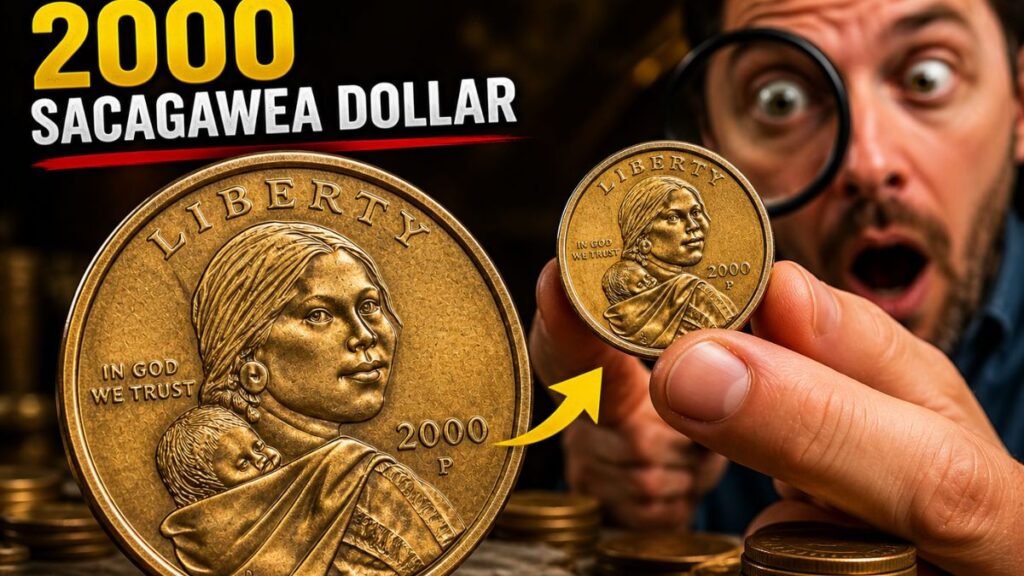
The 2000 Sacagawea Dollar is one of the most recognizable modern American dollar coins, but not every example from the first year of issue is equally interesting to collectors. Most 2000 Sacagawea Dollars are ordinary coins with values determined primarily by condition and collector demand. However, a very small number of unusual mint errors can be dramatically more valuable.
That is what makes the 2000 Sacagawea Dollar worth checking before you spend it.
The most famous error associated with the 2000 issue is the 2000-P Sacagawea Dollar mule. This unusual coin combines the reverse design of the Sacagawea Dollar with an obverse intended for a Washington Quarter. In other words, two designs that were never supposed to appear together were accidentally paired during the minting process.
For collectors, that mismatch is the critical clue.
A normal Sacagawea Dollar has its own distinctive obverse and reverse designs. A genuine mule does not follow that expected combination. Instead, it presents an extraordinary pairing that immediately separates it from an ordinary 2000 dollar coin.
Because genuine examples are exceptionally rare, the mule can command a substantial premium over a regular Sacagawea Dollar.
But there is an important point that should not be overlooked. Viral claims sometimes suggest that an ordinary 2000 Sacagawea Dollar could automatically be worth millions, with some exaggerated stories even placing a value around $10 million. That is not a responsible way to evaluate these coins.
A normal 2000 Sacagawea Dollar is not automatically a multimillion-dollar coin.
The exact error, authenticity, condition, and market demand all matter.
That means the right approach is not to assume that every 2000 dollar is valuable. Instead, collectors should learn what makes the famous mule different, inspect their coins carefully, and seek professional authentication if they discover something that appears to match the unusual design combination.
The Story Behind the 2000 Sacagawea Dollar
The Sacagawea Dollar was introduced in 2000 as a new U.S. dollar coin featuring Sacagawea, the Shoshone woman associated with the Lewis and Clark expedition.
The new coin represented a major change in the appearance of the American dollar coin. Its golden-colored surface immediately distinguished it from earlier circulating dollar coins.
The 2000 issue is particularly interesting because it represents the first year of the Sacagawea Dollar.
Whenever a new coin design enters production, collectors naturally pay close attention to its first-year issues. If an unusual mint error occurs during that period, it can become especially memorable.
The 2000 Sacagawea Dollar therefore has historical importance even before considering errors.
Millions of ordinary examples exist, but a tiny number of unusual pieces became important discoveries in the world of modern American numismatics.
The mule is the most famous example.
Its importance comes from the fact that the coin did not simply receive an imperfect strike or a minor surface defect. Instead, the wrong obverse and reverse dies were paired, producing a fundamentally incorrect design combination.
That makes the error visually identifiable once a collector knows exactly what to look for.
What Is a Mint Mule?
The word “mule” has a specific meaning in coin collecting.
A mule is a coin struck using dies that were not intended to be used together. The dies can come from different denominations, different coin types, or otherwise incompatible designs.
The result is a coin with an unusual combination that should not exist under normal production procedures.
The 2000-P Sacagawea Dollar mule is a particularly fascinating example because one side carries the Sacagawea Dollar reverse while the other side is associated with the Washington Quarter design.
This is why collectors should inspect both sides of a 2000 Sacagawea Dollar.
Looking only at the Sacagawea side is not enough.
The unusual feature is the combination.
A collector needs to examine the complete coin rather than focusing on one side in isolation.
That is also why knowledge is so important when searching for modern mint errors. A coin can look perfectly normal on one side while the other side contains the feature that makes it extraordinary.
What Makes the 2000-P Sacagawea Dollar Mule So Special?
The mule is special because it combines designs that were never intended to appear on the same coin.
The Sacagawea Dollar reverse belongs to the dollar coin.
The Washington Quarter obverse belongs to a different denomination.
Seeing those designs together creates the key diagnostic feature.
The “P” mint mark is also relevant because the famous mule is associated with the Philadelphia Mint.
For a collector examining a 2000 Sacagawea Dollar, the basic process is therefore straightforward.
First, identify the year.
Then examine the mint mark.
Next, inspect both sides of the coin.
Finally, compare the design combination with what should normally appear on a Sacagawea Dollar.
If the obverse appears to be the Washington Quarter design while the reverse is the Sacagawea Dollar reverse, the coin deserves serious attention.
However, even an apparent match should not be declared genuine simply from a photograph or casual inspection.
A rare coin with potentially significant value should be professionally authenticated.
Why the Design Mismatch Is the Biggest Clue
The most important thing to understand about the mule is that its rarity is not based simply on color, date, or general appearance.
The key is the combination of designs.
A normal Sacagawea Dollar should have the appropriate Sacagawea Dollar obverse and reverse.
The mule breaks that expected pairing.
That is why examining both sides is so important.
Imagine looking at the coin and seeing the familiar Sacagawea Dollar reverse. At first, nothing may seem unusual.
Then you turn the coin over.
Instead of the expected obverse design, you notice characteristics associated with a Washington Quarter.
That is the moment when further investigation becomes worthwhile.
The unusual pairing is much more meaningful than simply finding a scratched, discolored, or oddly shaped coin.
Why the 2000 Date Matters
The year 2000 is central to this particular error.
The Sacagawea Dollar was introduced in 2000, making the year the first issue of the series.
The mule associated with the famous error also carries the 2000 date.
That means collectors searching for this particular variety naturally focus their attention on 2000 Sacagawea Dollars.
However, simply finding a 2000 coin is not enough.
The date identifies the general issue, but the unusual design combination identifies the potential mule.
This distinction is crucial.
A collector should never reason that “2000 Sacagawea Dollar equals rare.”
Instead, the correct reasoning is:
“2000 Sacagawea Dollar plus the specific mule characteristics may indicate an extremely unusual coin.”
That is a much more accurate way to approach the search.
Why the Mint Mark Matters
Mint marks can provide important information about where a coin was produced.
For the famous 2000-P Sacagawea Dollar mule, the “P” designation is an important part of the identification.
Collectors should therefore inspect the coin carefully rather than assuming that all 2000 Sacagawea Dollars are the same.
A coin’s date, mint mark, design, and physical characteristics should be considered together.
If a coin appears to match the famous mule description, the presence of the appropriate mint mark can add another reason to seek expert examination.
But once again, the mint mark alone does not establish rarity.
The coin must be evaluated as a complete piece.
Most 2000 Sacagawea Dollars Are Not Rare Mules
This is one of the most important points for anyone reading about valuable Sacagawea Dollars.
The existence of a famous error does not make every coin from the same year rare.
The vast majority of 2000 Sacagawea Dollars are ordinary examples.
They were produced for circulation and collecting, and many remain available today.
A normal coin should not be described as a rare mule simply because it is dated 2000.
This is especially important because social media posts can sometimes present a dramatic headline without explaining the difference between a common coin and a genuine error.
A responsible collector should focus on the specific characteristics.
If the coin does not have the unusual mule design combination, there is no reason to assume it is one of these famous errors.
Why the Viral $10 Million Claim Is Misleading
The phrase “$10 million Sacagawea Dollar” can attract enormous attention online.
But collectors should be cautious with such claims.
A normal 2000 Sacagawea Dollar is not automatically worth $10 million.
The existence of a rare error does not transform every example of the denomination into a fortune.
Even genuine rare coins do not have one guaranteed price forever.
Auction results, collector demand, condition, authentication, provenance, and the exact characteristics of an individual coin all influence value.
Therefore, a headline claiming that every 2000 Sacagawea Dollar could be worth $10 million is misleading.
A better way to describe the situation is that certain extremely rare errors can command extraordinary premiums, while ordinary examples remain far more common.
This distinction protects collectors from unrealistic expectations.
How Much Could a Genuine Mule Be Worth?
A genuine 2000-P Sacagawea Dollar mule can be worth far more than an ordinary Sacagawea Dollar.
The exact market value depends on the individual coin.
Condition is important.
Authenticity is essential.
Professional certification can also affect buyer confidence.
The marketplace can change over time as collectors compete for rare examples.
For those reasons, it is better to avoid assigning one fixed value to every mule.
A rare coin’s value is not determined simply by an internet headline.
If you believe you have discovered one, the correct process is authentication first and valuation second.
That sequence matters because a potentially valuable coin should not be priced before its identity is established.
Why Authentication Is Essential
The famous mule is valuable precisely because it is exceptionally rare.
That also means it is the kind of coin that attracts counterfeiters and altered-coin attempts.
Someone may try to create the appearance of an unusual coin, manipulate a genuine coin, or sell an incorrect piece using an exaggerated description.
This is why professional authentication is so important.
An experienced numismatic authentication service can examine characteristics that are difficult to evaluate with the naked eye.
A genuine mule should be consistent with the appropriate Mint production characteristics.
The design combination must be genuine rather than artificially created.
Professional examination can provide a much stronger basis for determining whether a suspected coin is legitimate.
If a coin appears to be a genuine 2000-P Sacagawea Dollar mule, authentication should be considered essential before treating it as a high-value collectible.
Why You Should Not Alter a Suspected Error Coin
If you think you have found a rare mint error, the safest thing you can do is leave the coin alone.
Do not polish it.
Do not clean it.
Do not scratch the surfaces.
Do not attempt to remove marks.
Do not modify the edge.
Do not apply chemicals.
Do not try to “improve” the appearance.
Collectors value original surfaces, and alterations can damage the coin’s desirability.
More importantly, an alteration can interfere with professional examination.
If an expert needs to determine how the coin was produced, preserving its original state is extremely important.
The best strategy is simple: observe without modifying.
How to Inspect a 2000 Sacagawea Dollar
Start with a clean, well-lit environment.
Hold the coin carefully by its edges.
Look at the date.
Confirm that it is 2000.
Then examine the mint mark.
After that, inspect the obverse and reverse separately.
The reverse should show the familiar Sacagawea Dollar design.
The critical question is what appears on the other side.
Does it match the expected Sacagawea Dollar obverse?
Or does it appear to be a Washington Quarter obverse?
If the latter appears to be true, stop before doing anything else.
Do not attempt to prove it by scratching or chemically testing the coin.
Instead, preserve it and seek professional examination.
The purpose of home inspection is to identify a reason for further investigation, not to replace professional authentication.
Why Both Sides Must Be Examined
Coin collectors sometimes focus on the side that looks most attractive.
With the 2000 Sacagawea Dollar mule, that approach can lead to a missed discovery.
The reverse may look exactly like a normal Sacagawea Dollar.
The unusual feature becomes apparent only when the opposite side is examined.
That makes the mule an excellent example of why collectors should always inspect the entire coin.
A complete inspection includes:
The date.
The mint mark.
The obverse design.
The reverse design.
The relationship between the two designs.
The overall physical characteristics.
The condition of the surfaces.
Any signs of alteration.
Only after all these observations have been considered can a collector decide whether professional authentication is justified.
What the Normal Sacagawea Dollar Looks Like
Understanding the normal coin is essential before searching for an error.
The Sacagawea Dollar has a distinctive design created specifically for the new dollar denomination.
Its reverse features a bald eagle surrounded by stars, while the obverse features Sacagawea.
This expected pairing is what collectors should know before searching for the mule.
Once you understand the standard design, the unusual combination becomes much easier to recognize.
The goal is not to memorize every minor detail immediately.
Instead, become familiar with the basic appearance of an ordinary Sacagawea Dollar and then look for something fundamentally different.
The mule’s Washington Quarter obverse is not simply a tiny variety that requires advanced equipment to notice.
The central concept is the incompatible design pairing.
Why the Washington Quarter Obverse Matters
The Washington Quarter design is the key to understanding the mule.
A Washington Quarter and a Sacagawea Dollar are different denominations with different designs.
The fact that the Sacagawea reverse was paired with a Washington Quarter obverse creates the error.
That is why the coin is called a mule.
It combines dies that should not have been used together.
For someone searching through 2000 Sacagawea Dollars, recognizing the Washington Quarter design is therefore extremely important.
If the coin appears to have the wrong obverse, it should not simply be dismissed as a damaged or strange-looking dollar.
It may warrant professional examination.
Why Color Alone Cannot Identify the Mule
The golden appearance of Sacagawea Dollars is distinctive, but color does not establish whether a coin is a mule.
A normal 2000 Sacagawea Dollar can have the expected golden-colored appearance.
An error coin can also show similar coloration.
Therefore, color should not be treated as the diagnostic feature.
The design combination is much more important.
This is another reason why viral coin videos can sometimes create confusion.
A dramatic image may emphasize color, shine, scratches, or unusual surfaces even though those characteristics are not what make the famous mule valuable.
Collectors should learn to focus on the actual error.
Why Condition Still Matters
Even among rare coins, condition matters.
Two examples of the same error can have different market values depending on their preservation and overall quality.
A coin with strong details and attractive surfaces may be more desirable than one that has been heavily damaged.
For a rare mule, surface preservation is particularly important.
This gives collectors another reason not to clean their coins.
A polished or scratched coin may still be rare, but unnecessary damage can affect its desirability and market value.
If you suspect that you have an important error, preservation should come before appearance.
Why Professional Grading Can Help
Authentication and grading serve related but different purposes.
Authentication focuses on whether the coin is genuine and correctly identified.
Grading evaluates its condition according to established numismatic standards.
For an exceptionally rare coin, professional certification can provide important confidence to potential buyers.
A certified example is generally easier for serious collectors and dealers to evaluate than an uncertified coin accompanied only by a personal claim.
However, certification does not guarantee a specific selling price.
The market still determines value.
A certified rare coin may be offered at auction, through a dealer, or privately, and the final price can depend on buyer demand.
How Counterfeits Can Create Problems
The popularity of the 2000 Sacagawea Dollar mule means collectors should be careful when evaluating an apparent example.
Counterfeits do not always look obviously fake.
An altered coin may also appear convincing to someone who is unfamiliar with the characteristics of the genuine error.
This is why professional authentication is particularly important when the potential value is high.
Do not assume that a coin is genuine simply because:
It has a 2000 date.
It has a P mint mark.
It has the Sacagawea reverse.
It appears to have the Washington Quarter obverse.
Even when several clues appear to line up, professional examination is still the appropriate final step.
Why You Should Be Careful With Online Value Estimates
Online searches can produce wildly different values for the same coin.
One article might claim a coin is worth a few dollars.
Another might mention thousands.
A sensational post might claim millions.
These numbers can be difficult to interpret without understanding exactly what coin is being discussed.
The problem is that “2000 Sacagawea Dollar” is a broad description.
The ordinary coin, a certified high-grade example, a genuine mint error, and a famous mule are not interchangeable.
Their values can be dramatically different.
Therefore, when researching a suspected coin, always identify the exact variety or error before considering price.
The more precise the identification, the more meaningful the valuation becomes.
Why a Rare Error Can Be Worth Thousands While a Normal Coin Is Common
Coin values are often driven by scarcity.
If millions of ordinary coins exist, collectors have many opportunities to acquire them.
If only a very small number of coins contain a particular error, competition can become much stronger.
That scarcity can produce a large price difference.
The 2000-P Sacagawea Dollar mule illustrates this perfectly.
The denomination itself is not necessarily rare.
The particular minting mistake is rare.
Collectors are therefore paying for the extraordinary error, not simply for the fact that the coin is a 2000 Sacagawea Dollar.
This is an important principle that applies throughout coin collecting.
Why the Error Is Historically Interesting
The mule is not just valuable because collectors like unusual coins.
It also provides insight into the complexity of the Mint’s production process.
Modern coins are produced through highly controlled manufacturing systems involving dies, planchets, presses, inspection, and other processes.
A mule demonstrates that even complex production systems can occasionally produce an unexpected combination.
That makes the coin interesting from both a collecting and manufacturing perspective.
The fact that the incorrect dies were paired makes the error especially dramatic.
It is something that can be understood immediately once the two designs are recognized.
How a Collector Should Document a Suspected Mule
If your 2000 Sacagawea Dollar appears unusual, documenting it can be useful.
Record the date.
Record the mint mark.
Take clear photographs of both sides.
Photograph the edge if necessary.
Record the weight using an accurate scale.
Keep the coin safely stored.
Do not write directly on the coin or attach anything adhesive to its surfaces.
Documentation can help you communicate clearly with a professional.
It can also help preserve a record of the coin’s condition before authentication.
The more carefully you document the coin without altering it, the easier it becomes to explain what you discovered.
What If Your Coin Does Not Match the Mule?
If your 2000 Sacagawea Dollar has the normal Sacagawea obverse and reverse, it is not the famous mule simply because it is a first-year coin.
That does not mean the coin has no value.
Condition, collector demand, and other characteristics can still matter.
But the extraordinary premium associated with the famous mule should not be applied automatically.
This is an important reality check.
Coin collecting becomes much more rewarding when collectors learn to distinguish genuine rarity from ordinary examples.
The goal is not to turn every coin into a valuable error.
The goal is to identify the genuinely unusual pieces.
Why the Phrase “Rare Error Worth Big Money” Needs Context
The phrase is useful as a hook because the 2000-P mule really is a remarkable error.
But “big money” does not mean that every 2000 Sacagawea Dollar is valuable.
It refers to the rare error.
That distinction should remain clear whenever the coin is discussed.
A responsible collector should never advertise an ordinary coin as a rare mule merely because it has a 2000 date.
Likewise, a suspected mule should not be assigned a huge value before professional authentication.
The best combination is excitement and caution.
It is perfectly reasonable to be excited about a possible rare discovery.
It is equally important to verify the coin before making financial claims.
How to Store a Suspected Rare Coin
Until professional examination, the coin should be stored in a way that protects its surfaces.
A suitable non-abrasive coin holder can help prevent unnecessary handling.
Avoid loose storage where the coin can repeatedly rub against other coins.
Avoid containers that expose the coin to harsh chemicals or unstable materials.
Do not place tape directly on the coin.
Do not glue anything to it.
The objective is to preserve the coin’s current condition.
If the coin eventually proves to be ordinary, proper storage has caused no harm.
If it proves to be a rare mule, careful storage may help preserve its condition while authentication and valuation are completed.
Why You Should Not Assume a Strange Appearance Is a Mint Error
Coins can become damaged after leaving the Mint.
They can be scratched.
Bent.
Discolored.
Corroded.
Flattened.
Chemically altered.
Struck or damaged by machinery.
These conditions can create unusual appearances that have nothing to do with an original minting error.
A genuine mint error is something that occurred during the production process.
That is why professional examination is so valuable.
Experts can distinguish manufacturing characteristics from damage that occurred later.
This distinction can be the difference between an ordinary damaged coin and a major collectible rarity.
The Difference Between an Error and Damage
A true mint error generally originates during production.
Post-mint damage occurs after the coin has entered circulation or otherwise left the Mint.
This distinction matters enormously.
Suppose a 2000 Sacagawea Dollar has an unusual mark across the design.
That mark may look interesting, but it does not automatically represent a mint error.
Likewise, unusual discoloration does not prove that the coin is rare.
The mule is fundamentally different because the design combination itself reflects an incorrect pairing of dies.
That is why the mule is so much more significant than an ordinary damaged coin.
Why Collectors Should Learn the Basic Design
Knowledge is one of the most useful tools in coin hunting.
You do not need advanced numismatic training to begin.
Start by learning what a normal 2000 Sacagawea Dollar looks like.
Know which design belongs on the obverse.
Know which design belongs on the reverse.
Understand where the mint mark appears.
Then learn the unusual characteristics of the mule.
Once you understand the normal coin, deviations become easier to recognize.
This approach is more reliable than searching only for “valuable Sacagawea Dollar” and trying to identify a coin from a headline.
Why the 2000 Issue Is Especially Fun to Search
First-year coins naturally attract collectors.
The 2000 Sacagawea Dollar also has a memorable history because it introduced a new dollar design to the public.
When a famous error is connected to that first-year issue, the collecting story becomes even more interesting.
A collector searching a group of 2000 dollars is not simply looking for an old coin.
They are looking for an unusual piece from the beginning of an important modern U.S. coin series.
That makes the hunt appealing even when no rare error is discovered.
What Professional Authentication Can Tell You
A professional examination can help answer the questions that a home inspection cannot.
Is the coin genuine?
Is the design combination actually the famous mule?
Does the coin show evidence of alteration?
Are the physical characteristics consistent with a genuine Mint-produced piece?
What is the coin’s condition?
Does it warrant professional certification?
These questions are far more important than simply asking whether the coin “looks rare.”
Professional authentication replaces speculation with evidence.
For an exceptionally rare modern error, that evidence can be critical.
Why a Suspected Mule Should Be Treated Differently From an Ordinary Coin
Most coins can be handled casually.
A potentially rare mule should not be.
If you believe you have discovered one, immediately change your approach.
Handle it less.
Protect the surfaces.
Stop experimenting.
Document what you see.
Seek professional advice.
This cautious approach is worthwhile because the potential difference in value can be enormous.
There is no advantage to taking unnecessary risks with a coin that may be genuinely rare.
Frequently Asked Questions About the 2000 Sacagawea Dollar
What is the 2000-P Sacagawea Dollar mule?
It is an exceptionally rare mint error combining the Sacagawea Dollar reverse with an obverse designed for a Washington Quarter. The incompatible designs are the defining characteristic of the mule.
Is every 2000 Sacagawea Dollar rare?
No. Most 2000 Sacagawea Dollars are ordinary coins. The famous mule is an exceptionally rare error and should not be confused with a normal first-year issue.
What should I look for on a 2000 Sacagawea Dollar?
Check the date, mint mark, and both sides of the coin. The most important clue for the famous mule is the unusual pairing of the Sacagawea Dollar reverse with the Washington Quarter obverse.
Why is the Washington Quarter design important?
The Washington Quarter obverse was not supposed to be paired with the Sacagawea Dollar reverse. That incorrect combination is what makes the famous mule an extraordinary mint error.
Can a normal 2000 Sacagawea Dollar be worth $10 million?
There is no basis for assuming that an ordinary 2000 Sacagawea Dollar is automatically worth $10 million. Viral claims can exaggerate values. The exact coin, error, authenticity, condition, and market demand determine value.
How much can a genuine 2000-P mule be worth?
A genuine example can command a very large premium over an ordinary Sacagawea Dollar, potentially reaching thousands of dollars or substantially more depending on the individual coin and market conditions. A specific value requires authentication and evaluation.
Does the P mint mark prove that a coin is a mule?
No. The P mint mark is an important identification clue for the famous 2000-P mule, but the coin must also have the correct unusual design combination and pass professional authentication.
Should I clean a suspected Sacagawea Dollar mule?
No. Cleaning can damage the coin’s surfaces and potentially reduce its value. A suspected rare error should be preserved in its existing condition.
Can photographs prove that I have a mule?
No. Photographs can help show the design, but they cannot provide complete authentication. A potentially valuable example should be examined professionally.
Can a strange mark on my Sacagawea Dollar make it valuable?
Not necessarily. Damage that occurred after the coin left the Mint is different from a genuine mint error. The famous mule is valuable because of its incorrect die combination, not simply because it looks unusual.
Why should I examine both sides of the coin?
Because the famous mule is defined by the combination of two different designs. One side alone may look normal, while the opposite side reveals the unusual Washington Quarter/Sacagawea Dollar pairing.
What should I do if my 2000 Sacagawea Dollar appears to be a mule?
Do not clean, scratch, polish, or alter it. Handle it carefully, document the coin’s characteristics, and seek professional authentication.
Are all unusual Sacagawea Dollars valuable?
No. Some unusual-looking coins may simply have circulation damage, environmental discoloration, or other post-mint problems. Genuine mint errors are a specific category and require proper identification.
Why are mint errors valuable?
Certain errors are valuable because they are extremely rare and highly desirable to collectors. The rarity and significance of a particular error can create a substantial premium over an ordinary coin.
What is the biggest mistake collectors make with this coin?
One of the biggest mistakes is assuming that every 2000 Sacagawea Dollar is worth a fortune. The famous value belongs to specific rare errors, particularly the genuine mule, not to the entire 2000 issue.
Is professional authentication really necessary?
If a coin appears to be a genuine 2000-P Sacagawea Dollar mule, professional authentication is strongly recommended. Its rarity and potential value make expert verification especially important.
Why the 2000 Sacagawea Dollar Deserves a Careful Look
The 2000 Sacagawea Dollar is already historically interesting because it introduced a new American dollar design. But the discovery of the extremely rare 2000-P mule makes the first-year issue even more fascinating for collectors.
Most 2000 Sacagawea Dollars are ordinary.
A small number of mint errors, however, can be dramatically more desirable.
The famous mule is the one collectors should understand.
Its key characteristic is the pairing of a Sacagawea Dollar reverse with an obverse designed for a Washington Quarter. That mismatch is not something that should occur in normal production, which is precisely why the error is so important.
If you find a 2000 Sacagawea Dollar, check the date and mint mark, but do not stop there. Examine both sides carefully and learn what the normal design should look like.
If the coin appears to have the unusual Washington Quarter obverse and Sacagawea Dollar reverse combination, do not clean it, polish it, scratch it, or attempt destructive testing.
Protect it.
Document it.
Then have it professionally authenticated.
And remember the most important reality check: a normal 2000 Sacagawea Dollar is not automatically a million-dollar coin. Viral claims about $10 million examples should not be used as a general valuation rule. The exact error, authenticity, condition, and collector market determine what a particular coin may actually be worth.
That is what makes coin hunting so exciting. Sometimes an ordinary-looking coin really can hide an extraordinary story—but the difference between an ordinary dollar and a valuable mint error comes down to careful identification and trustworthy authentication.