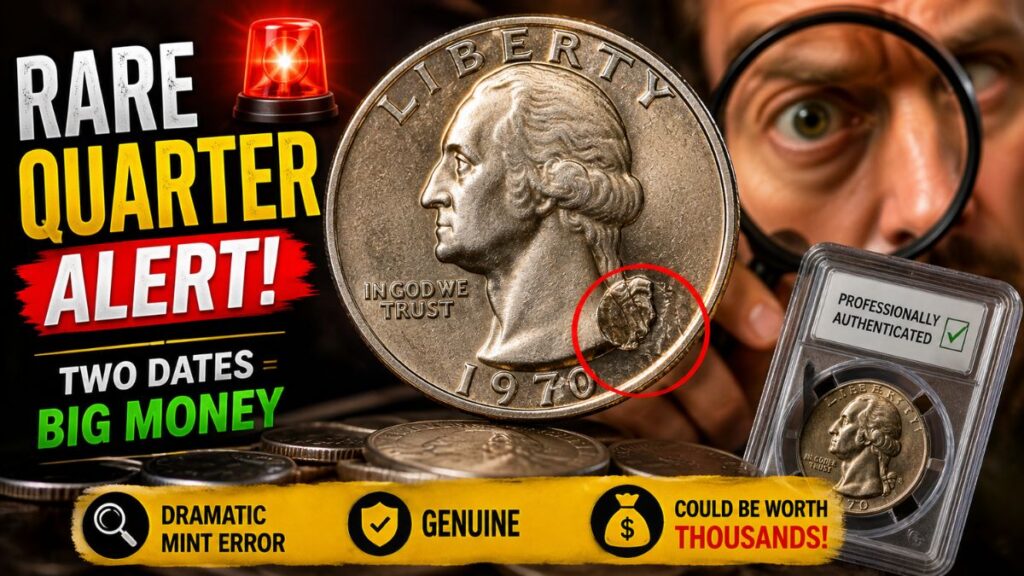
Stop and take a second look at that quarter. What appears to be an ordinary piece of pocket change could become much more interesting if you can clearly see two dates on the same coin.
A quarter showing what looks like a second date can immediately attract the attention of collectors because genuine multiple-struck coins are unusual mint errors. In the right circumstances, a dramatic error can be worth far more than the coin’s face value. Some major double-struck Washington quarter errors have sold for tens of thousands of dollars, although such results apply to specific authenticated coins and should never be treated as a guaranteed value for every unusual quarter.
The biggest question is not simply whether you can see something that resembles another date. The real question is whether that second date was created during the minting process.
That distinction matters enormously.
A genuine double-struck quarter can show a second impression that is displaced, rotated, or partially overlapping the original design. The duplicated features should make sense as another strike from the minting process. Random scratches, dents, corrosion, post-mint damage, or other surface marks can sometimes create shapes that look surprisingly similar to numbers.
That is why finding a possible two-date quarter should be exciting, but it should also be approached carefully.
If you think you have discovered one, do not clean it, polish it, scrape it, bend it, or otherwise attempt to improve the appearance. Preserve it exactly as you found it and examine it carefully. If the unusual feature appears convincing, professional examination can help determine whether you really have a mint error.
Why a Quarter With Two Dates Gets So Much Attention
The date is one of the easiest areas of a coin for people to recognize. When a collector notices what appears to be a second set of numbers, the unusual appearance immediately raises questions.
How did the second date get there?
Was the coin struck twice?
Did the coin move between strikes?
Could the second image actually be damage?
Could it be a different type of doubling?
These questions are important because several different conditions can make a coin look unusual without making it a valuable mint error.
A true double strike is associated with the manufacturing process. The coin receives an additional strike after the first strike has already occurred. If the coin moves before that second impact, the duplicated design may no longer line up perfectly with the original.
This can create an unmistakable visual effect.
The date may appear twice.
Letters may appear displaced.
Parts of the portrait may overlap.
Other design elements may be repeated.
The overall appearance can be dramatic enough that even someone with little collecting experience realizes that something is unusual.
That visual drama is one reason double-struck coins are so appealing to collectors.
But appearance alone does not establish authenticity.
What Is a Double-Struck Quarter?
A double-struck quarter is a coin that receives two strikes during the minting process rather than the intended single strike.
The first strike creates the normal design. Under certain circumstances, the coin can remain in the striking area instead of leaving the press as intended. If it is struck again, the second impact can create another impression.
The relationship between the two impressions depends on what happened to the coin between strikes.
If the coin stayed nearly in the same position, the second strike might overlap the first closely.
If the coin shifted, the second design can appear displaced.
If the coin rotated, the second impression may appear at a different angle.
The resulting coin can therefore have repeated features that are immediately noticeable.
When the second strike affects the date, the result can look like a quarter with two dates.
This is fundamentally different from simply having a damaged date.
A second impression produced by the minting process should have characteristics that correspond to the actual design of the coin. The duplicated numbers should not just resemble random marks. They should look like another impression of the date.
Why the Second Date Must Be Examined Carefully
Seeing something that looks like a second date is only the beginning of the investigation.
The next step is to determine whether the supposed second date has the characteristics of actual coin design.
Look closely at the shapes of the numbers.
Do they have recognizable outlines?
Do they resemble the original date?
Do they have consistent depth and form?
Are there other duplicated elements nearby?
Does the supposed second impression appear to follow the same orientation or a logical rotated orientation?
Does it seem integrated into the metal rather than sitting on top of the surface as a scratch?
These observations can help separate a possible mint error from damage.
A true second strike can produce multiple clues. The date may not be the only area affected. Other parts of the design can also show displacement or overlapping impressions.
That broader pattern is important.
A random scratch might cross one number and create a strange shape, but it generally will not reproduce the design relationships expected from another strike.
Not Every Coin With an Unusual Date Is Valuable
This point deserves special attention because coin collecting is full of exaggerated claims.
A strange-looking date does not automatically mean a coin is rare.
A second-looking mark does not automatically mean a double strike.
And a possible mint error does not automatically mean thousands of dollars.
There are many reasons a circulated quarter can develop unusual surface characteristics.
Coins constantly come into contact with other metal objects. They can be dropped, scratched, rubbed, dented, crushed, exposed to chemicals, or affected by environmental conditions.
A damaged coin can sometimes look surprisingly unusual.
This is why experienced collectors do not simply look for something strange. They try to determine why the characteristic exists.
The difference between a genuine mint error and post-mint damage is one of the most important concepts to understand before assigning a value to a coin.
The Difference Between a Mint Error and Post-Mint Damage
A mint error occurs during the manufacturing process.
Post-mint damage happens after the coin leaves the mint.
That distinction can be difficult to see at first.
Suppose a quarter has a line crossing the date. Depending on the lighting and angle, that line could make part of the date look duplicated.
However, if the line was caused by contact with another object after the coin entered circulation, it is damage rather than a double-strike error.
A genuine second strike should show evidence consistent with another impression from the dies.
The duplicated design should make sense.
For example, if the date appears displaced and other design elements are also displaced in a related way, that pattern may provide stronger evidence of a second strike.
A random scrape does not normally reproduce the geometry of the coin’s original design.
This is why the surrounding area of the date is so important.
Look at the Entire Quarter, Not Just the Date
One of the easiest mistakes a beginner can make is focusing exclusively on the unusual date.
Instead, examine the entire coin.
Look at the portrait.
Look at the lettering.
Look at the stars.
Look at the rim.
Look at other design elements around the suspected second impression.
If the coin really received another strike, additional parts of the design may have been affected.
This does not mean every genuine double strike will show the same amount of duplication everywhere. The exact appearance depends on how the coin moved and how the second strike occurred.
Nevertheless, additional evidence can make an interpretation much stronger.
A second date that exists completely by itself as a random surface mark is less convincing than a second date accompanied by other logically displaced design features.
How a Shifted Second Strike Can Create Two Dates
Imagine a quarter sitting beneath the dies.
The first strike creates the normal date and design.
Now imagine that the quarter does not leave the striking area correctly.
Before another strike occurs, the coin moves slightly to one side.
The second strike now lands in a different position.
The result can be a second impression that does not line up with the first.
If the movement is enough, the collector may see the original date and another impression of the same date nearby.
This is the basic visual concept behind many dramatic multiple-strike errors.
The exact appearance can vary significantly.
A small movement may create a tight overlap.
A larger movement can produce a much more obvious separation.
The direction of movement can also influence where the second image appears.
That is why two coins with multiple-strike errors can look completely different from one another.
How Rotation Can Affect the Appearance
Movement is not always limited to a straight shift.
A coin can also change orientation.
If the quarter rotates between strikes, the second impression may appear at an angle relative to the original.
This can make the error even easier to recognize.
A rotated second strike can cause parts of the design to cross areas where they normally would not appear. The date may therefore look especially unusual because the second set of numbers can intersect the first impression from a different direction.
Again, however, the presence of an angled mark is not enough by itself.
The important question is whether the mark corresponds to an actual feature of the quarter’s design.
A random scratch can be angled too.
The evidence must be considered as a whole.
Why Clearly Visible Numbers Matter
When discussing a possible two-date quarter, clarity is extremely important.
A faint line that might possibly resemble a number is difficult to evaluate.
A clearly recognizable second date is much more significant.
Collectors want to know exactly what they are looking at.
If the second impression can be identified as part of the coin’s actual design, the possibility of a genuine error becomes more interesting.
Clarity also helps when comparing the coin with known examples.
If a collector can clearly identify the duplicated numbers and other repeated features, it becomes easier for a professional to study the piece.
A vague surface anomaly, on the other hand, may not provide enough information to determine what happened.
This is why the strongest examples are often the ones where the error can be seen without excessive interpretation.
Why Double-Struck Errors Can Be Valuable
Coin collectors value unusual mint errors because they represent deviations from the normal production process.
A quarter is normally manufactured to be consistent with millions of other quarters.
When something goes wrong during production and a coin escapes quality control, the resulting piece can become collectible.
The more dramatic and clearly identifiable the error, the more attention it may receive.
A double-struck quarter with a visible second date can therefore be especially appealing.
The potential value comes from the combination of rarity, authenticity, visual impact, condition, and collector demand.
There is no universal price for every double-struck quarter.
Some errors are relatively minor.
Others are much more dramatic.
Some are difficult to authenticate.
Others show unmistakable evidence of a multiple strike.
Those differences matter.
Could a Two-Date Quarter Really Be Worth Thousands?
Yes, an authenticated and dramatic double-struck quarter can potentially be worth thousands of dollars.
Some exceptional Washington quarter errors have reached much higher levels, with certain dramatic examples selling for tens of thousands.
But this information needs to be interpreted correctly.
It does not mean that every quarter showing what appears to be two dates is worth thousands.
Auction results belong to individual coins.
A particular coin may have an especially dramatic error, excellent preservation, strong documentation, or other characteristics that distinguish it from another coin that merely looks similar.
Therefore, never assume that a quarter is worth a particular amount simply because you saw a photograph of another error coin selling for a large sum.
Identification must come first.
Valuation comes afterward.
The Date, Condition, and Strike All Matter
The potential value of a genuine error can depend on several factors.
The date is important because it identifies the coin.
The condition matters because collectors generally pay attention to the preservation of a piece.
The nature of the strike matters because different errors can have different levels of desirability.
The clarity of the second date matters because a dramatic, easily understood error can be more attractive than an extremely weak one.
The amount of displacement can also influence how visually impressive the coin appears.
A quarter with a clearly visible second impression can be much more compelling than one where the supposed second strike is almost impossible to see.
These factors should be considered together rather than separately.
Why Condition Still Matters Even With a Major Error
A dramatic error can be valuable even when the coin has circulated.
The error itself may be the primary attraction.
However, condition can still influence desirability.
A coin with heavy wear may have a less defined second impression. Scratches and other damage can also make authentication more complicated.
A better-preserved coin may retain sharper details and provide clearer evidence of the error.
This does not mean you should reject a circulated coin.
Quite the opposite.
If the error is genuine and dramatic, the coin can still be highly interesting.
The important point is that the error and the condition are separate characteristics that both need to be considered.
Why You Should Never Clean a Possible Error Coin
If you find a quarter with two apparent dates, your first instinct might be to clean it.
Do not.
Cleaning can damage a coin’s original surface.
Polishing can leave visible marks.
Chemical cleaners can alter the appearance of the metal.
Even attempts to gently remove dirt can affect surfaces that a specialist may want to examine.
More importantly, cleaning does not prove anything about the error.
If the second date is genuine, it was created during the minting process. Cleaning will not make it more authentic.
Instead, it can make the coin harder to evaluate and potentially reduce its desirability.
The safest approach is simple: leave it alone.
Do Not Scratch the Second Date
Another dangerous mistake is trying to “test” the unusual feature.
Some people may think that scraping the area will reveal whether the mark is raised or recessed.
This can permanently damage the coin.
The same applies to rubbing, sanding, polishing, or using a sharp object.
A coin should never be physically altered to prove an error.
If you believe the quarter is unusual, let its existing surface provide the evidence.
A professional can examine the coin without you damaging it first.
Do Not Try to Reproduce the Error
Never attempt to create a second strike yourself.
Hitting a quarter with another object will not prove that your coin was double-struck at the mint.
Instead, you will simply create damage.
The manufacturing process that creates a genuine mint error is highly specific. Recreating a similar-looking mark outside that process does not make a coin collectible.
The original condition of your quarter is much more valuable for investigation than an experiment performed after you found it.
How Lighting Can Change What You See
Metallic surfaces are highly reflective.
The appearance of a quarter can change significantly depending on the angle of light.
A mark that is nearly invisible from one direction may become much more obvious from another.
Likewise, a scratch can cast a shadow that resembles a number.
This is why examining a suspected two-date quarter under more than one lighting angle can be helpful.
You are not trying to make the coin look better.
You are trying to understand what is actually present on the surface.
A genuine second impression should remain structurally recognizable even when the lighting changes.
A simple reflection or shadow may disappear when the angle changes.
That difference can provide a useful clue, although it is not a substitute for professional authentication.
How Wear Can Create Confusing Shapes
Circulated quarters can become heavily worn.
The raised portions of the design are exposed to constant friction.
As the coin wears, sharp edges can become softer.
Some numbers may lose portions of their original shape.
At the same time, scratches and contact marks can appear across the surface.
The combination can create confusing patterns.
A worn quarter may therefore look like it has extra lines or partial numbers.
This is another reason why the complete design needs to be examined.
A professional evaluation can help determine whether the apparent second date is actually part of the original minting process.
Could It Be Doubling Instead of a Double Strike?
It is also important not to assume that every duplicated-looking feature represents a multiple strike.
Different forms of doubling can occur in coins, and they do not all have the same cause.
A collector might see a secondary outline around letters or numbers and immediately call it a double strike.
That conclusion may be incorrect.
A genuine double strike involves the coin being struck more than once.
Other forms of doubling can have different origins.
For someone who is not experienced with error varieties, it is often better to describe what is visible rather than immediately assigning a technical classification.
For example, saying that the quarter “appears to show a second date” is safer than declaring it a confirmed double strike.
The final classification should come from careful examination.
What Makes a Second Date More Convincing?
Several clues can strengthen the case for a genuine multiple strike.
The second date should look like an actual impression rather than a scratch.
Its shape should correspond to the original date.
The surrounding design may show related duplication.
The second impression may be shifted or rotated.
The metal around the feature should be consistent with an additional strike.
The overall pattern should make physical sense.
None of these clues should be considered in isolation.
The strongest evidence comes from the combination.
If multiple features point toward the same explanation, the coin becomes much more interesting.
What If Only Part of the Second Date Is Visible?
A partial second date can still be meaningful.
A second strike does not necessarily produce a perfectly complete second impression.
Depending on the movement and overlap, only some numbers may remain visible.
The problem is that partial features can be harder to interpret.
A small curved line might be part of a duplicated number.
It could also be a scratch.
Therefore, partial visibility increases the importance of examining nearby design elements.
If other parts of the coin show corresponding evidence, the interpretation becomes stronger.
If the supposed second date is completely isolated, caution is necessary.
What If the Second Date Is Very Clear?
A highly visible second date deserves serious attention.
If the numbers are clearly recognizable and the design appears to be duplicated in a logical way, the quarter may warrant professional examination.
The more obvious the error, the easier it may be to explain to a specialist.
A dramatic error can also be more attractive to collectors because it tells a clear visual story.
The coin appears to have been struck once, moved, and struck again.
That story is much easier to understand when the second impression is obvious.
Nevertheless, even the clearest appearance should be authenticated before assigning a large value.
Why Authentication Matters Before Selling
Suppose someone finds a quarter that appears to have two dates.
They might immediately search for similar coins and see prices of several thousand dollars.
It can be tempting to assume the coin has the same value.
That is risky.
Without authentication, there is no guarantee that the coin is the same type of error.
The apparent second date could have a different cause.
It could be damage.
It could be another form of doubling.
It could be a normal feature that is being misinterpreted.
Professional examination provides a much stronger foundation for determining what the coin actually is.
Only after identification should a serious valuation be considered.
What a Professional Examination Can Help Determine
A knowledgeable coin professional can examine the physical characteristics of the quarter.
They can study the date.
They can inspect the surrounding design.
They can look for evidence of displacement.
They can evaluate whether the unusual feature is consistent with a second strike.
They can distinguish characteristics created during minting from damage that happened later.
Depending on the coin and circumstances, formal authentication and certification may also become relevant if the piece appears genuinely significant.
The important thing is that the coin should be evaluated without altering it beforehand.
Why a Photograph Can Be Useful but Is Not Always Enough
Clear photographs can help someone understand why a quarter looks unusual.
Take a picture of the entire front.
Take a picture of the entire back.
Then take close-up photographs of the date and the suspected second impression.
Good lighting is important.
Avoid excessive glare.
Make sure the camera is focused.
Do not rely on an extremely cropped image that hides the surrounding design.
A professional may need to see the entire coin to understand how the suspected error fits into the overall design.
Photographs can be useful for an initial opinion, but physical examination can provide information that a photograph cannot.
What Information Should You Record?
If you believe you have a two-date quarter, record the basic details before doing anything else.
Write down the date.
Note the mint mark if you can identify one.
Describe where the second date appears.
Note whether it seems shifted.
Note whether it appears rotated.
Look for other duplicated features.
Record the general condition of the coin.
Take clear photographs.
This information can make a later evaluation more efficient.
Most importantly, preserve the coin exactly as you found it.
Why the Surrounding Design Is So Important
A second date does not exist in isolation.
The numbers are part of a larger design.
If the quarter was struck again, the second strike could affect nearby features.
That is why the area around the date deserves careful attention.
Look for repeated or displaced design elements.
Do not expect every feature to be equally clear.
The second strike may be stronger in one area and weaker in another.
Still, related evidence can help establish whether the unusual date belongs to a broader second impression.
This is one of the strongest reasons to inspect the entire coin rather than relying on one unusual mark.
Why the Edge and Rim Can Also Matter
The rim can provide additional context when examining a possible multiple-strike error.
A second strike can interact with the coin’s existing shape in ways that affect the appearance of the edge or surrounding design.
However, unusual rim characteristics can also be caused by damage.
A coin may become bent, flattened, or struck against another object during circulation.
Therefore, the rim should be considered as supporting evidence rather than automatic proof.
Again, the entire physical structure of the quarter matters.
Why Circulated Coins Can Still Be Valuable
A coin does not have to look brand new to be collectible.
A genuine mint error can remain desirable after years of circulation.
The error itself may be much more important than perfect surface preservation.
A dramatic double strike can remain obvious even on a worn quarter.
However, heavy circulation can complicate the evaluation.
If the second date is partially worn away, it may become harder to establish what happened.
That is why finding a circulated quarter with an unusually clear second date can be especially interesting.
Why You Should Be Careful With Online Price Claims
The internet contains many claims about rare coins.
Some are accurate.
Some are exaggerated.
Others may confuse a genuine rare error with a normal coin.
A headline saying that a quarter is worth a huge amount does not prove that every example is valuable.
The correct approach is to look at the actual characteristics of the specific coin.
Ask whether the example being discussed is genuinely comparable.
Was it authenticated?
Was the error the same type?
Was the second strike equally dramatic?
Was the condition similar?
Only then can a comparison become meaningful.
The Difference Between Asking Price and Actual Sale Price
Another important distinction is between a price someone hopes to receive and the amount a collector actually pays.
A person may list a coin online for a very high amount.
That does not mean the coin has sold for that amount.
Actual sales are more useful when trying to understand market interest.
Even then, one sale does not establish a universal value.
Coins are individual objects.
Two examples of the same broad error can differ in condition, visibility, authenticity, and presentation.
That is why valuation should always follow identification.
Why the Word “Rare” Should Be Used Carefully
A coin can look rare without actually being rare.
Likewise, an error can be unusual without having a huge market value.
The word “rare” should ideally refer to something that is genuinely uncommon and identifiable.
A quarter with a confirmed dramatic double strike may deserve that description.
A quarter with a mysterious scratch should not.
This distinction is important for both collectors and people who are simply curious about their pocket change.
The goal should be accurate identification rather than sensationalism.
Could You Find One in Everyday Change?
The possibility of finding an unusual coin in circulation is part of what makes coin hunting enjoyable.
Most quarters encountered in everyday transactions will be completely normal.
But occasionally, a coin may display an unusual characteristic.
That does not mean valuable errors are common.
Instead, it means that careful observation can sometimes uncover something worth investigating.
A person does not need an enormous collection to begin looking.
A few quarters and a good light can be enough to start learning.
The important thing is knowing what to look for and understanding the limits of what can be concluded from a quick visual inspection.
What Should You Do Immediately After Finding a Possible Two-Date Quarter?
The first step is simple: stop handling it unnecessarily.
Place the coin somewhere safe.
Do not clean it.
Do not polish it.
Do not scratch it.
Do not attempt to recreate the error.
Examine both sides carefully.
Use good lighting.
Take clear photographs.
Record the date and any other identifiable details.
Then consider having it examined by someone experienced in mint errors.
This approach protects the coin while allowing you to investigate its potential.
Why Preserving the Original Surface Is So Important
The surface of a coin contains information.
Marks can indicate how the coin was handled.
The appearance of the metal can help distinguish mint-created characteristics from later damage.
Cleaning can remove or alter some of that information.
Once the surface is changed, it may be impossible to restore it to its original condition.
For a potentially valuable error, preservation should therefore be the priority.
The best thing you can do after discovering a possible two-date quarter may be to do absolutely nothing to the coin itself.
How Collectors Look at Dramatic Errors
Collectors often appreciate errors that are easy to understand visually.
A dramatic second strike is a good example.
The coin can tell its own story.
The first impression is visible.
The second impression is also visible.
The two designs overlap or appear in different positions.
This kind of error can be fascinating because it provides a visible record of something that went wrong during manufacturing.
The clearer the story, the easier it can be for collectors to appreciate the piece.
Why Two Visible Dates Can Create a Strong Collector Appeal
A quarter with two clearly recognizable dates is unusual enough to capture attention immediately.
The feature is also relatively easy to explain.
Instead of needing to identify a microscopic difference, the collector can actually see the duplicated design.
That visual quality can make certain double-struck errors particularly desirable.
Of course, desirability does not automatically create a specific price.
The market still depends on authentication, rarity, condition, and demand.
But a dramatic and genuine error has the potential to attract serious collector interest.
What If You Are Not Sure What You Are Seeing?
That is completely normal.
Coin errors can be complicated.
Even experienced collectors sometimes need additional examination before making a final determination.
If the feature is confusing, do not force a conclusion.
You do not need to decide immediately that it is valuable.
Simply preserve the quarter and investigate.
A cautious statement such as “this appears to show a second date” is perfectly reasonable until the coin is examined.
Being uncertain is better than incorrectly labeling a damaged coin as a major mint error.
Why Patience Is Better Than Immediate Selling
Finding a strange coin can create excitement.
Someone might immediately offer to buy it.
Before accepting an offer, make sure you understand what you have.
If the coin is genuinely rare, selling it without proper identification could mean losing the opportunity to receive fair consideration.
On the other hand, if it turns out to be ordinary damage, you will have avoided unrealistic expectations.
Patience gives you time to determine the facts.
The goal is not simply to sell a strange-looking quarter.
The goal is to understand the coin.
Why a Professional Opinion Can Change Everything
A professional evaluation can take a confusing object and provide a much clearer explanation.
Instead of guessing whether a line is a scratch, you can learn whether it corresponds to an actual design feature.
Instead of wondering whether the date is doubled, you can determine whether there is evidence of a second strike.
And instead of relying on an internet price claim, you can begin with an accurate identification.
That is particularly important for a coin that could potentially be worth a substantial amount.
The Most Important Clues to Remember
When examining a quarter with two apparent dates, remember the following clues.
First, the second date should look like a genuine part of the coin’s design.
Second, the impression may be shifted or rotated.
Third, other design elements may show related duplication.
Fourth, random scratches and damage can imitate numbers.
Fifth, a clear second date is more significant than a vague mark.
Sixth, condition can influence the appearance and desirability of the error.
Seventh, the value cannot be determined from the date alone.
And finally, authentication is essential before assuming that the coin is worth thousands of dollars.
What Makes This Coin-Collecting Mystery So Exciting?
The excitement comes from the possibility.
A quarter normally has a familiar appearance.
When something appears twice, it immediately breaks that expectation.
The discovery encourages you to stop, look closer, and ask questions.
Could the coin have been struck twice?
Could the second impression have been displaced?
Could the apparent date actually be damage?
Those questions transform an ordinary piece of change into a small numismatic investigation.
And sometimes, that investigation can lead to a genuine discovery.
Frequently Asked Questions About Quarters With Two Dates
Can a quarter really have two visible dates?
Yes. A quarter can display what appears to be two dates when a genuine multiple-strike error causes a second impression of the design. However, apparent duplicate numbers can also result from damage or other forms of doubling.
Does seeing two dates automatically mean the quarter is valuable?
No. The two dates must first be determined to be the result of a genuine mint error. The coin’s specific error, condition, clarity, authenticity, and collector demand all influence its potential value.
How does a double-struck quarter happen?
A double strike can occur when a coin receives another impact during the minting process instead of leaving the striking area as intended. If the coin moves or rotates before the second strike, the resulting design can appear displaced or differently oriented.
Can a double-struck quarter be worth thousands of dollars?
Yes. Major and clearly visible double-struck errors can bring thousands of dollars, and certain dramatic Washington quarter errors have reached tens of thousands. These are specific examples, however, and do not establish a guaranteed value for every two-date quarter.
Should I clean a quarter that appears to have two dates?
No. Do not clean, polish, scrape, or chemically treat a potentially valuable error coin. Altering the surface can damage the piece and may make professional evaluation more difficult.
Could a scratch make a quarter look like it has two dates?
Yes. Scratches, dents, wear, corrosion, and other forms of post-mint damage can sometimes create shapes that resemble numbers. The surrounding design should therefore be examined carefully.
What should the second date look like?
A potentially genuine second date should resemble an additional impression of the coin’s actual design. It should not simply look like an arbitrary line or mark. Related duplicated design features can provide additional evidence.
Does the second strike have to be perfectly aligned?
No. In fact, movement between strikes can cause the second impression to be displaced or rotated. The unusual positioning is part of what can make a double-struck error recognizable.
Can only part of the second date be visible?
Yes. Depending on how the second strike occurred and how the two impressions overlap, only part of a second date may remain visible. Partial features can be harder to authenticate, so surrounding evidence becomes especially important.
Does coin condition affect the value?
It can. Condition influences how clearly the error can be seen and can affect collector interest. A circulated coin can still be valuable if it has an authentic and dramatic mint error.
Should I look only at the date?
No. Examine the entire coin. Other duplicated or displaced elements can help determine whether the supposed second date is part of a genuine second strike.
Can lighting make a coin look like it has two dates?
Yes. Reflections and shadows can make scratches or surface marks appear more prominent. Viewing the coin under different lighting angles can help reveal whether the feature is actually part of the metal’s design.
Is every type of doubling a double strike?
No. Different forms of doubling can have different causes. A collector should not automatically label every duplicated-looking number or letter as a double strike.
How can I protect the quarter while investigating it?
Keep the coin in its original condition. Avoid unnecessary handling, cleaning, scratching, polishing, bending, or other alterations. Clear photographs can document the feature while the coin remains untouched.
Should I sell the coin immediately if someone offers a large amount?
It is better to identify and authenticate the coin first. A professional evaluation can help determine whether the unusual feature is a genuine mint error and provide a more reliable basis for considering its potential value.
Can a quarter found in circulation really be a collectible error?
Yes. A mint error can enter circulation and eventually be discovered by an ordinary person. However, most quarters found in everyday transactions are normal, so an unusual feature still needs to be investigated carefully.
Why is professional authentication so important?
Because appearance alone can be misleading. A professional can help distinguish a genuine mint-created error from damage, doubling, or other abnormalities. Authentication is especially important when a coin appears valuable.
What is the biggest mistake to avoid?
The biggest mistake is altering the coin before it has been examined. Cleaning, scraping, polishing, or attempting to reproduce the supposed error can permanently damage a potentially valuable piece.
Could the same type of error have different values?
Yes. Two coins with broadly similar errors can have different values because their condition, clarity, degree of displacement, authenticity, and collector demand may differ.
What should I do if the second date is extremely clear?
Preserve the coin and have it examined. A clearly visible second date combined with other logical evidence of a second strike is exactly the kind of feature that deserves closer professional attention.
Final Thoughts on the Rare Two-Date Quarter
A quarter with two clearly visible dates is the kind of discovery that deserves a second look.
The possibility of a dramatic double-struck mint error is real, and authentic examples can be significantly more valuable than ordinary quarters. Some exceptional Washington quarter errors have reached prices in the thousands or even tens of thousands of dollars. But those figures belong to specific authenticated coins, not to every quarter that happens to look unusual.
The most important step is therefore not estimating a price.
It is identifying the cause of the second date.
If the additional numbers are clearly recognizable and appear to be part of another impression, examine the surrounding design. Look for other duplicated or displaced elements. Consider whether the second image could logically have been created by another strike during the minting process.
At the same time, remember that scratches, dents, wear, corrosion, and other post-mint damage can produce surprisingly convincing shapes.
That is why caution matters.
If your quarter really appears to have two dates, leave it exactly as you found it. Do not clean it. Do not polish it. Do not scrape the unusual area. Do not attempt to reproduce the feature. Preserve the coin and seek an informed professional examination.
The second date could turn out to be nothing more than damage.
But if it is a genuine second impression from the minting process, you may have discovered a fascinating error coin with serious collector interest.
So the next time a quarter catches your eye because something about its date looks unusual, don’t spend it immediately.
Stop.
Look again.
Check both sides.
Study the surrounding design.
And if you can clearly see two genuine-looking dates on the same quarter, that unusual second impression may be the clue that turns an ordinary piece of pocket change into a remarkable mint-error discovery.