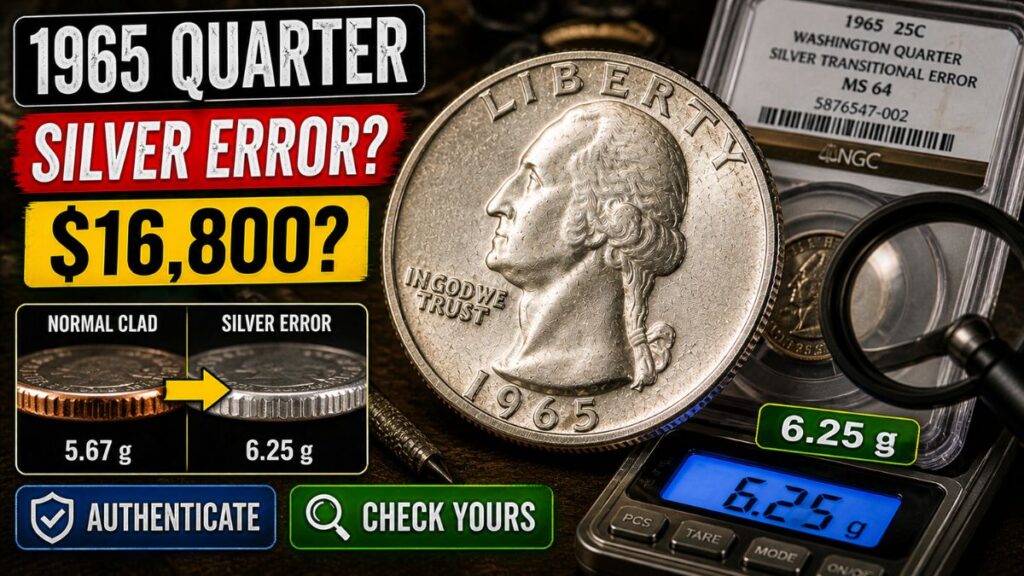
Could an ordinary-looking 1965 Washington quarter really be worth $16,800? In certain circumstances, the answer is yes. However, the important detail is that not every 1965 quarter is rare, and most examples are worth only their face value or a modest collector premium.
The valuable coins belong to a specific category known as transitional errors. These unusual quarters were struck during the United States Mint’s change from traditional silver coinage to copper-nickel clad coinage. A small number of leftover silver planchets may have been used accidentally with dies carrying the 1965 date.
The result was a coin with a 1965 date but an older 90% silver composition. This combination was not supposed to exist in regular production, making authenticated examples especially interesting to collectors.
One documented 1965 Washington quarter struck on a silver planchet, graded MS62 by PCGS, sold for $16,800 at auction. That sale demonstrates the potential of this error, but it does not mean every 1965 quarter is worth thousands of dollars.
The real challenge is identifying whether a coin is genuinely struck on a silver planchet, distinguishing it from an ordinary copper-nickel quarter, and obtaining professional authentication before assigning it a high value.
The Historical Background of the 1965 Washington Quarter
The Washington quarter has been part of American coinage since 1932. For many years, quarters were produced using a composition containing 90% silver and 10% copper. This silver composition continued through 1964.
By the middle of the 1960s, the rising price of silver and increasing demand for circulating coins created significant pressure on the nation’s coinage system. The United States Mint needed a less expensive alternative that could be produced in large quantities without relying on the same amount of silver.
The Coinage Act of 1965 introduced a new copper-nickel clad composition for dimes and quarters. Instead of being made from a solid silver alloy, the new coins used outer layers containing copper and nickel bonded to a copper core.
The regular 1965 Washington quarter was therefore an important transition-year coin. It marked the beginning of a new era in the composition of circulating quarters.
During this period, production systems had to handle different metals, planchets, dies, and manufacturing processes. Such changes created the possibility of mistakes involving leftover planchets from the earlier silver coinage.
What Is a Transitional Error?
A transitional error occurs when a coin is struck using a planchet or metal composition associated with a different stage of production.
In the case of the 1965 Washington quarter, the intended coin was a copper-nickel clad quarter. However, some coins were reportedly struck on silver planchets intended for earlier Washington quarters.
The dies used to strike the coin carried the 1965 date. The planchet, however, came from the previous silver composition.
This created a mismatch between the date and the metal. The coin was dated 1965 but contained the older 90% silver alloy.
Collectors often refer to this type of mistake as a silver planchet transitional error, wrong-planchet error, or wrong-metal error.
The term “transitional” is especially useful because the error occurred during the change from one coinage composition to another.
Why the 1965 Silver Planchet Error Is So Valuable
The value of a genuine 1965 silver transitional error comes from several factors.
First, the coin combines a well-known date with an incorrect composition. The 1965 date is expected to appear on a copper-nickel clad quarter, not on a traditional silver quarter planchet.
Second, the error is scarce compared with the enormous number of ordinary 1965 quarters produced. Collectors are often willing to pay substantial premiums for unusual coins that can be documented and authenticated.
Third, the condition of the coin influences its market value. A lightly circulated example may sell for several thousand dollars, while a well-preserved uncirculated coin can attract a much higher price.
Finally, certification plays a major role. A professionally authenticated coin provides buyers with confidence that the composition, error, and grade have been examined by an established grading service.
Without authentication, a coin that appears unusual may be difficult to sell for a premium.
The Documented $16,800 Auction Sale
One of the most frequently discussed examples is a 1965 Washington quarter struck on a silver planchet and graded MS62 by PCGS.
The coin sold for $16,800 at auction in December 2020. Its description identified it as a transitional error struck on a leftover silver planchet from the earlier coinage period.
This sale is important because it represents a documented result for a specific authenticated coin. It should not be treated as a guaranteed value for every 1965 quarter.
Auction prices depend on the coin’s authenticity, certification, grade, appearance, surface quality, buyer demand, and the circumstances of the sale.
A coin with the same date but a different condition may bring a substantially different amount. Similarly, an uncertified coin that merely resembles the auction example cannot automatically be valued at $16,800.
The auction record is best understood as evidence of the potential market value of a genuine example, not as a promise that every collector will receive the same amount.
Other Documented Values for 1965 Silver Transitional Errors
The $16,800 result is not the only significant sale involving a 1965 quarter struck on a silver planchet.
Other authenticated examples have sold for different amounts, including several thousand dollars. Some circulated or lightly worn coins have realized prices in the approximate range of $5,000 to more than $14,000, depending on grade and appearance.
For example, a 1965 quarter graded XF45 by PCGS sold for $5,462.50 in 2010. Another silver-planchet example graded AU53 sold for $7,050 in a later auction.
A different specimen graded AU58 realized more than $14,000 in a documented sale.
These results show why it is difficult to provide one fixed price for the error. A coin’s grade, surface quality, toning, scratches, circulation wear, and certification can all affect the final amount.
Collectors should also distinguish between realized auction prices and advertised asking prices. An owner may list a coin for a very high amount, but an asking price does not prove that someone has actually paid that amount.
How Much Is an Ordinary 1965 Washington Quarter Worth?
Most 1965 Washington quarters are common copper-nickel clad coins.
A circulated example without a major error or unusual variety generally has a value close to its face value of 25 cents. Some attractive uncirculated examples may bring a premium, especially when they have strong luster, minimal marks, and a high certified grade.
The presence of the 1965 date alone does not make a quarter rare. Millions of regular quarters were produced, and many remain available to collectors.
A coin should not be valued as a silver transitional error simply because it is old, shiny, or in good condition.
The important distinction is between:
- An ordinary copper-nickel clad quarter.
- A high-grade regular quarter.
- A recognized doubled-die variety.
- A major mint error.
- A genuine silver-planchet transitional error.
Each category has a different market and value range.
The Difference Between Clad and Silver Composition
Understanding the metal composition is essential when examining a 1965 quarter.
A normal 1965 quarter uses copper-nickel clad construction. Its overall composition is approximately 91.67% copper and 8.33% nickel. The coin has a copper core surrounded by copper-nickel outer layers.
The standard weight of a regular 1965 clad quarter is approximately 5.67 grams.
A traditional 90% silver Washington quarter from 1964 and earlier generally weighs approximately 6.25 grams. It is made from 90% silver and 10% copper.
This difference in weight can help collectors identify a possible transitional error.
A 1965 quarter that weighs close to 6.25 grams may deserve further examination. However, weight alone cannot prove that the coin is genuine silver or an authentic Mint error.
Wear, dirt, damage, scale accuracy, and other factors can influence the measurement. A coin that has been altered or plated may also produce confusing results.
Weight should therefore be treated as a preliminary screening method, not a final authentication test.
The Importance of the Coin’s Edge
The edge is one of the most useful areas to examine when checking a 1965 quarter.
A normal copper-nickel clad quarter generally shows a visible copper-colored line or stripe along the edge. This happens because the copper core is visible between the outer clad layers.
A silver planchet does not have the same layered construction. Its edge is generally more uniform in appearance and does not display the characteristic copper stripe found on a clad coin.
If a 1965 quarter has a consistently silver-colored edge without a visible copper core, it may deserve closer inspection.
However, lighting conditions, toning, dirt, wear, and photographs can make the edge difficult to interpret. Some ordinary coins may appear different depending on the angle and brightness of the light.
Do not assume that a uniform-looking edge proves the coin is silver. A professional grading service should verify the composition.
How to Weigh a 1965 Quarter Correctly
A digital scale capable of measuring to at least 0.01 gram is useful for preliminary examination.
Place the scale on a stable, flat surface. Make sure it is calibrated correctly and set to grams. Weigh the coin without adding holders, paper, dirt, or other objects.
A normal clad quarter should be close to 5.67 grams. A traditional silver planchet should generally be close to 6.25 grams.
If the coin weighs significantly more than the expected clad standard, record the result and avoid making any changes to the coin.
Do not file the edge, scrape the surface, drill the coin, or perform destructive testing. Such actions can permanently damage a potentially valuable specimen and may reduce its value.
A weight difference should lead to further professional examination rather than an immediate conclusion.
Why Color Alone Cannot Identify Silver
Many collectors make the mistake of judging a coin’s metal only by its color.
A 1965 clad quarter can appear silver-colored because its outer layers contain nickel. Depending on circulation, lighting, toning, and surface condition, it may resemble an older silver quarter.
At the same time, genuine silver coins can develop darker toning, yellowish areas, gray surfaces, or other color changes.
Therefore, color is not a reliable way to confirm composition.
A bright white coin is not automatically silver, and a darker coin is not automatically clad. The edge, weight, measurements, and professional testing are much more useful.
Collectors should avoid cleaning a coin to make it look brighter. Cleaning can leave scratches, unnatural surfaces, and chemical damage that may lower its collectible value.
The Date and Mint Mark on a 1965 Quarter
The date should be the first feature examined. Confirm that the coin clearly displays 1965 and that the digits have not been altered.
Regular 1965 quarters generally do not carry a mint mark. This was part of the Mint’s production practices during the period.
The absence of a mint mark is therefore not, by itself, evidence of a rare error.
Collectors should inspect both sides of the coin under good lighting. Look for signs of damage around the date, lettering, portrait, and rim.
Altered dates can create misleading appearances. A damaged or modified coin should not be confused with a genuine Mint-produced error.
A professional examination is especially important if the coin appears to have unusual surfaces, inconsistent details, or suspicious lettering.
What Does MS62 Mean?
The $16,800 example was graded MS62.
The abbreviation MS means Mint State. It is generally used for coins that show no normal circulation wear, although they may have marks, abrasions, weak strikes, or other imperfections.
The number 62 is part of the numerical grading scale used by professional grading services. It indicates an uncirculated coin with noticeable imperfections compared with higher Mint State grades.
A coin graded MS62 can still be valuable if it has a rare error. The error itself may be more important than the numerical grade.
A common 1965 quarter graded MS62 is not automatically worth thousands of dollars. The combination of a genuine silver-planchet error and the grade is what makes the documented example special.
Why Condition Influences the Price
Condition is one of the most important factors in coin collecting.
Two genuine 1965 silver transitional errors may have different values because one coin is heavily circulated while the other retains stronger surfaces and more original detail.
Collectors examine:
- Surface marks.
- Scratches.
- Rim damage.
- Strike quality.
- Luster.
- Toning.
- Signs of cleaning.
- Circulation wear.
- Overall visual appeal.
A coin with heavy damage may sell for less than a similar example with attractive surfaces.
However, the highest grade does not always guarantee the highest final price. Collectors may also consider the coin’s history, certification, rarity, and appearance.
The market is based on the complete package rather than a single number printed on a grading label.
Why Professional Authentication Matters
A genuine 1965 silver transitional error can be valuable enough that authentication is essential.
The coin should be examined by a recognized professional grading and authentication service. Experts can evaluate the planchet, composition, dimensions, weight, surfaces, and design details.
Professional certification helps protect both buyers and sellers. It reduces uncertainty and makes the coin easier to compare with other authenticated examples.
This is especially important because counterfeit, altered, plated, damaged, or incorrectly identified coins can appear convincing in photographs.
A seller’s description or online advertisement should not be accepted as proof of authenticity.
Before paying a substantial amount, buyers should confirm the certification information and ensure that the coin being offered matches the documented certification.
Common Coins That Can Be Mistaken for the Silver Error
Several ordinary conditions can cause confusion.
A clad quarter may have a dark edge because of dirt or environmental exposure. A coin may also appear heavier if it has material attached to its surface.
Some coins have been plated, chemically treated, or altered after leaving the Mint. These modifications do not make the coin a genuine transitional error.
A damaged edge may remove or conceal part of the copper stripe. Scratches, rim damage, and toning can also change the appearance of the planchet.
For this reason, no single visual clue should be used to make a final determination.
The most reliable approach is to combine careful observation with accurate measurement and professional authentication.
Do Not Clean a Potentially Rare Quarter
Cleaning is one of the most damaging mistakes a collector can make.
A person may believe that polishing a 1965 quarter will reveal its silver color or make the coin more attractive. In reality, cleaning can leave hairline scratches, unnatural brightness, chemical discoloration, or surface damage.
Professional graders can often identify cleaned coins, and a cleaned coin may receive a details designation instead of a standard numerical grade.
If you believe that your quarter could be a rare transitional error, leave it exactly as you found it.
Do not use:
- Metal polish.
- Jewelry cleaner.
- Vinegar.
- Abrasive cloths.
- Toothpaste.
- Scraping tools.
- Chemical dips.
- Sandpaper.
Handle the coin by its edges and store it in a safe, non-abrasive holder until it can be examined.
How to Store a Possible Error Coin
Storage is important because surface damage can affect the coin’s value.
Keep the quarter in a holder designed for collectible coins. Avoid loose storage with other coins, keys, jewelry, or metal objects that could scratch its surface.
Do not place adhesive tape directly on the coin. Avoid PVC-containing materials that can damage the metal over time.
Store the coin in a cool, dry environment away from excessive humidity, heat, and chemicals.
If the coin is not yet authenticated, label the holder with basic observations such as the date, weight, and reason for examination. Do not write directly on the coin or apply stickers to its surface.
Proper storage preserves the evidence that an expert may need to evaluate.
What to Do If Your Quarter Weighs Around 6.25 Grams
If your 1965 quarter weighs close to the traditional silver-quarter standard, do not immediately assume that you have discovered a $16,800 coin.
First, repeat the measurement using a reliable scale. Confirm that the scale is set to grams and that the coin is clean of loose dirt without being washed or chemically treated.
Next, examine the edge for the presence or absence of the copper stripe. Inspect the coin’s diameter, thickness, design, and surfaces.
Take clear photographs of both sides and the edge for your own records. Avoid relying on photographs alone for authentication.
The next step should be professional evaluation. A recognized grading service or experienced numismatic specialist can help determine whether the coin is genuinely struck on a silver planchet.
Do not sell the coin as an authenticated rarity until the composition and error have been verified.
Can a Magnet Confirm the Error?
A magnet is not a reliable way to confirm a 1965 silver transitional error.
Silver is not magnetic, but the absence of magnetic attraction does not prove that a coin is silver. Copper, nickel, plating, and other materials can produce confusing results.
A magnet test may be useful for certain types of coin examination, but it cannot replace professional analysis.
Similarly, household acid tests, electronic testing devices, and informal comparisons should not be treated as definitive evidence.
The goal is to identify the actual composition without damaging the coin.
Why Online Prices Can Be Misleading
Online marketplaces often contain high asking prices for unusual coins. These listings can create the impression that any 1965 quarter with a different appearance is worth thousands of dollars.
However, an asking price is not the same as a completed sale.
A coin may remain unsold for months or years at an inflated price. Other listings may contain incorrect descriptions, unverified claims, or photographs that do not show the important details.
Collectors should focus on documented auction results involving authenticated coins with clearly stated grades and error descriptions.
Even documented sales should be used carefully. The market changes over time, and a previous result does not guarantee the price of a future sale.
The condition and authenticity of the individual coin remain essential.
Factors That Can Increase the Value of a Genuine Example
Several factors may influence the value of a genuine 1965 silver transitional error.
The first is authentication. A certified coin generally provides more confidence than an uncertified example.
The second is condition. Coins with better preservation, attractive surfaces, and stronger details may appeal to more collectors.
The third is eye appeal. Toning, luster, surface quality, and strike characteristics can influence buyer interest.
The fourth is provenance or documented history. A coin with a reliable ownership and auction record may be easier to evaluate.
The fifth is market demand. Rare errors may attract competitive bidding when several collectors want the same specimen.
Even with these factors, no fixed price can be guaranteed. A professional appraisal and current market comparison are necessary before making a major financial decision.
How Sellers Should Prepare a Possible 1965 Error
If you plan to sell a possible silver transitional error, begin by documenting the coin carefully.
Record the date, weight, visible edge characteristics, and any unusual details. Avoid cleaning or altering the piece.
Consider submitting the coin to a reputable authentication and grading service. Certification can make it easier for potential buyers to understand what is being offered.
When describing the coin, use cautious and accurate language. If it has not been authenticated, describe it as a possible silver-planchet error rather than a confirmed rarity.
Do not guarantee a specific value based on the $16,800 auction result. That price applies to a particular certified coin, not every coin with a similar appearance.
Honest descriptions help protect the seller and build trust with collectors.
How Buyers Should Evaluate a Listed Coin
Buyers should be especially careful when an uncertified 1965 quarter is advertised as a valuable silver error.
Ask for clear photographs of the obverse, reverse, and edge. Request the weight and any available certification details.
Check whether the coin has been cleaned, damaged, plated, or altered. If the seller refuses to provide basic information, the purchase may involve unnecessary risk.
Compare the coin with documented examples, but remember that visual similarity is not proof of authenticity.
For a high-priced purchase, independent professional authentication is strongly recommended.
Do not rely solely on a seller’s claim that a coin is “rare,” “silver,” or “worth $16,800.”
Other Valuable 1965 Quarter Possibilities
The silver transitional error is one of the most famous possibilities associated with the 1965 Washington quarter, but it is not the only area collectors examine.
Some 1965 quarters may have recognized doubled-die varieties. These varieties involve design elements being doubled during the die-making process and should be distinguished from ordinary strike damage or mechanical doubling.
There are also other possible mint errors involving wrong planchets, off-center strikes, missing clad layers, and unusual striking problems.
Each error must be evaluated individually. A damaged coin is not automatically a Mint error, and a minor imperfection generally does not carry the same value as a major, authenticated mistake.
Collectors should avoid combining unrelated error categories when estimating a coin’s worth.
Why a 1965 Quarter Is Not Automatically a Silver Coin
The date 1965 is important because it represents the transition to clad coinage. However, most 1965 quarters were made using the new copper-nickel clad composition.
The majority of coins from that year are not silver. Their gray or silver-like appearance can create confusion, particularly among new collectors.
The valuable examples are exceptions that must be proven through examination.
A coin should not be called a silver quarter merely because it looks like one. The composition must be confirmed, and the connection between the 1965 date and the silver planchet must be established.
This distinction is critical when discussing values online or preparing a coin for sale.
Frequently Asked Questions About the 1965 Silver Quarter
Is Every 1965 Washington Quarter Worth $16,800?
No. Most 1965 Washington quarters are common copper-nickel clad coins worth approximately face value when circulated. The $16,800 result applies to a specific authenticated silver-planchet transitional error graded MS62.
What Makes a 1965 Quarter a Transitional Error?
A transitional error occurs when a coin is struck using a planchet from an earlier composition during a change in coinage production. In this case, a 1965-dated quarter was struck on a planchet associated with the earlier 90% silver coinage.
How Much Does a Normal 1965 Quarter Weigh?
A standard 1965 copper-nickel clad quarter weighs approximately 5.67 grams.
How Much Does a Traditional Silver Quarter Weigh?
A traditional 90% silver Washington quarter generally weighs approximately 6.25 grams. This difference can help identify a possible silver-planchet error, but weight alone is not definitive.
Can I Identify the Error by Looking at the Edge?
The edge can provide an important clue. A clad quarter generally shows a copper-colored stripe, while a silver planchet usually has a more uniform appearance. However, edge inspection alone cannot authenticate the coin.
Is a Silver-Colored 1965 Quarter Rare?
Not necessarily. Normal clad quarters can appear silver-colored because of their outer metal layers. Color alone does not establish that a coin is made from silver.
Should I Clean My 1965 Quarter?
No. Cleaning can damage the surface and reduce collectible value. If the coin may be rare, leave it in its original condition and seek professional advice.
Can a Magnet Prove That My Quarter Is Silver?
No. A magnet cannot definitively establish whether a 1965 quarter is a genuine silver transitional error. Professional composition testing is more reliable.
Does a No-Mint-Mark 1965 Quarter Have Extra Value?
The absence of a mint mark is normal for regular 1965 quarters and does not automatically indicate a valuable error.
Where Should I Authenticate a Possible Error?
Use a reputable professional coin grading and authentication service or consult an established numismatic specialist. Authentication is particularly important before assigning a high value or selling the coin.
Can a Damaged 1965 Quarter Still Be Valuable?
It is possible, but damage can reduce the value. The coin must first be proven genuine, and its final price will depend on the severity of the damage, the error, and collector demand.
Is the $16,800 Price Guaranteed for a Genuine Silver Error?
No. Auction records represent specific coins sold under particular conditions. A different example may sell for more or less depending on its grade, appearance, certification, and market demand.
Should I Sell My Coin Immediately If It Weighs 6.25 Grams?
No. A weight near 6.25 grams is only a preliminary clue. Verify the measurement, inspect the edge, protect the coin from damage, and seek professional authentication before making a selling decision.
Conclusion: Check Your 1965 Quarter Carefully
The 1965 Washington quarter is an important coin in American numismatic history because it represents the transition from traditional silver coinage to copper-nickel clad production.
Most 1965 quarters are ordinary coins with limited value beyond their face value. However, a small number of quarters struck on leftover silver planchets are recognized as rare transitional errors.
One authenticated example sold for $16,800, proving that the right coin can attract substantial collector interest. Other examples have realized several thousand dollars, depending on their condition, certification, and appearance.
If you have a 1965 quarter, examine the date, edge, weight, and overall surfaces carefully. A standard clad quarter should weigh approximately 5.67 grams, while a traditional silver planchet is generally closer to 6.25 grams. These measurements are useful clues but cannot replace professional authentication.
Never clean, scrape, polish, or alter a potentially valuable coin. Store it safely and seek expert evaluation if the evidence suggests an unusual composition.
The most important lesson is simple: do not assume that every 1965 quarter is rare, but do not dismiss an unusual example without examining it carefully. A genuine silver transitional error could be worth far more than 25 cents, while an ordinary quarter should be valued realistically and accurately.