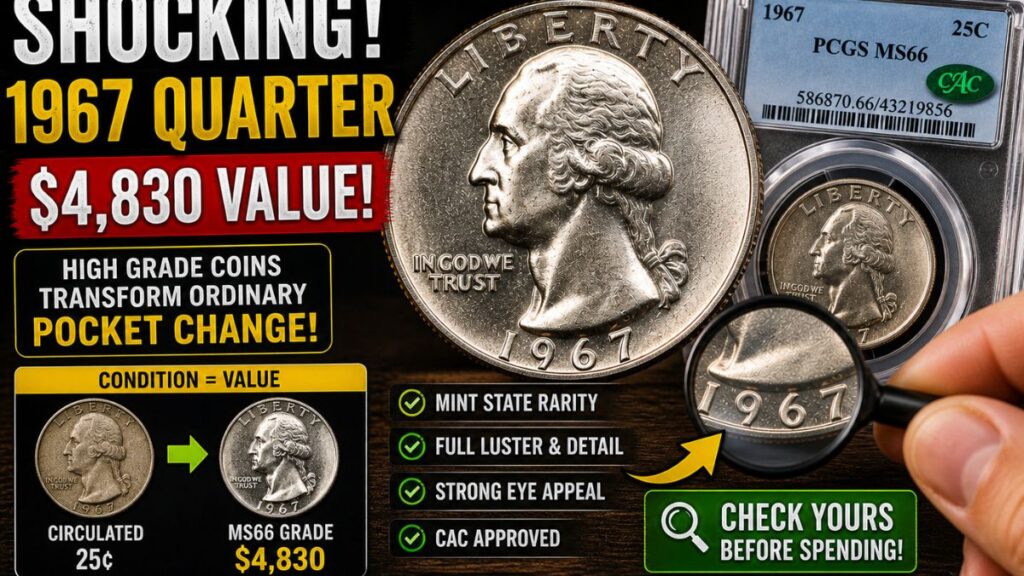
Could a 1967 Washington quarter sitting in an old coin jar be worth thousands of dollars? For most examples, the answer is no. However, a small number of exceptionally preserved coins can attract serious attention from collectors, particularly when they achieve an unusually high Mint State grade.
The 1967 Washington quarter is an interesting coin because it belongs to an important period in United States coinage. More than 1.5 billion quarters were produced during the year, and these coins were released without mint marks. Because of their large production numbers, most 1967 quarters are common and usually circulate at or near face value.
Yet, large production numbers do not mean every surviving example is identical. Some coins were preserved carefully, while others spent decades moving through cash registers, vending machines, pockets, drawers, and coin containers. Over time, contact marks, scratches, dirt, and circulation wear affected many of these pieces.
The difference between an ordinary circulated quarter and an exceptional Mint State example can be significant. A 1967 quarter graded MS68 reportedly reached an auction price of $4,830. This result illustrates how condition rarity can influence the value of a coin that was originally produced in enormous quantities.
However, the auction figure should be understood correctly. It does not mean that every 1967 quarter is worth hundreds or thousands of dollars. The value belongs to a specific coin with a particular grade, preservation level, and market history.
If you have a 1967 Washington quarter, the best approach is careful inspection rather than assuming that the date alone makes it valuable.
The Historical Importance of the 1967 Washington Quarter
The Washington quarter was introduced in 1932 to honor the 200th anniversary of George Washington’s birth. The design became one of the most recognizable images in American coinage.
By 1967, the quarter was already part of a major transformation in the country’s monetary system. Traditional silver quarters had been produced through 1964. Beginning in 1965, the United States Mint transitioned regular quarters to copper-nickel clad construction.
This change was connected to rising silver prices and the need to produce circulating coins more economically. Instead of using the earlier 90% silver composition, the new quarters used outer layers of copper and nickel bonded to a copper core.
The 1967 Washington quarter was therefore a copper-nickel clad coin. It was not part of the regular 90% silver quarter series.
The year also belongs to a period when the Mint produced coins without mint marks as part of its response to coin shortages and collecting activity. As a result, the absence of a mint mark on a 1967 quarter is normal and does not automatically indicate a rare variety.
Why 1967 Quarters Have No Mint Marks
Many collectors first look for a mint mark when examining an older United States coin. A mint mark can sometimes help identify where a coin was produced and whether it belongs to a scarce issue.
The 1967 Washington quarter is different because regular quarters from that year were produced without mint marks. This means that a 1967 quarter lacking a letter such as “D” or “S” is not automatically an error.
Collectors should avoid treating the absence of a mint mark as proof of rarity. The no-mint-mark characteristic applies broadly to the regular 1967 issue.
The value of a 1967 quarter generally depends more heavily on its condition, recognized varieties, major mint errors, and authentication than on the missing mint mark.
When examining your coin, focus on the date, design details, surfaces, edge, and overall preservation rather than assuming that the missing mint mark is unusual.
The Large Production Numbers of 1967 Quarters
More than 1.5 billion quarters were produced in 1967. Such a large mintage means that the coin is not generally scarce in circulated condition.
Many examples were used repeatedly in everyday transactions. They were placed in cash drawers, used in vending machines, carried in pockets, and stored in household containers.
Over several decades, most circulated examples developed scratches, dull surfaces, discoloration, rim marks, or other signs of handling.
Large mintages often make circulated examples easy to find. However, the number of coins originally produced is not the same as the number that survived in exceptional condition.
This is where condition rarity becomes important. A coin may be common in worn condition but difficult to locate in a very high grade.
The distinction between general availability and high-grade availability is one of the most important ideas in modern coin collecting.
What Is Condition Rarity?
Condition rarity describes a situation in which a coin is common overall but uncommon in an unusually high state of preservation.
A 1967 quarter may be easy to locate in circulated condition. Finding one with virtually no contact marks, strong original luster, sharp details, and excellent surfaces is much more difficult.
Coins made for circulation were not individually protected from contact with other coins. During production, transportation, packaging, and distribution, they could develop small marks even before entering circulation.
Once released, coins were exposed to additional wear and damage. As a result, only a small percentage of examples may remain suitable for the highest grades.
A condition rarity can therefore be valuable even when the original mintage was extremely large.
The reported $4,830 sale of a 1967 quarter graded MS68 is an example of how collectors may compete for exceptional preservation rather than simply for an old date.
Understanding the Meaning of MS68
The term MS stands for Mint State. It is used for coins that have not experienced normal circulation wear.
The number 68 represents a very high grade on the numerical grading scale. A coin at this level is expected to have excellent preservation, strong visual quality, and very few imperfections.
At high grades, even tiny contact marks can matter. A small scratch on a prominent area, a mark near the portrait, or a distracting surface defect may prevent a coin from receiving the highest possible grade.
The difference between MS67 and MS68 may appear small to a casual observer, but it can be important to collectors and grading specialists.
A coin’s grade is not based only on whether it looks shiny. Professional grading considers the entire coin, including surface preservation, strike, luster, marks, and overall appearance.
A 1967 quarter graded MS68 is therefore not simply an uncirculated coin. It is an example that has met demanding standards for exceptional condition.
Why a One-Point Grade Difference Can Matter
Coin grading is not always linear in terms of market value.
The difference between two grades may be only one point, but the number of available coins at each level can vary significantly. If collectors are seeking a particular high grade and very few examples qualify, competition can increase.
For instance, many 1967 quarters may survive in lower Mint State grades. Far fewer may remain attractive enough to receive an MS68 grade.
This scarcity at the top of the grading scale can create a substantial difference in market prices.
The same principle appears across many collectible coins. A common date may have limited value in circulated condition but become much more desirable when preserved at an exceptional grade.
Nevertheless, a grade increase does not guarantee a fixed price. Market demand, auction timing, certification, eye appeal, and the number of competing examples can all affect the result.
What Makes an MS68 1967 Quarter Special?
A 1967 quarter in MS68 condition must have survived more than five decades with extraordinary preservation.
The coin may retain bright original mint luster and show very few visible contact marks. Its surfaces should be examined carefully for scratches, abrasions, discoloration, and other imperfections.
The portrait of Washington, the lettering, the date, and the reverse design must also be evaluated. A strong strike can help the design appear clear and well-defined.
However, a coin does not need to look perfect to receive a high grade. Professional grading involves standards and judgments that go beyond casual inspection.
A coin can appear impressive under normal lighting but reveal marks under magnification or angled light. Conversely, natural toning does not automatically mean that a coin is damaged or low quality.
The combination of preservation, surface quality, luster, strike, and professional grading determines whether a coin qualifies for an exceptional grade.
The Role of Original Mint Luster
Mint luster is the natural reflective appearance created during the striking process.
On an uncirculated coin, the surface may display a distinctive glow or cartwheel effect when moved under a light source. This appearance can help collectors identify coins that retain original surface characteristics.
A 1967 quarter with strong original luster may be more attractive than a dull or heavily handled example. However, luster alone cannot establish a coin’s grade or value.
Some coins may have been cleaned or polished to create artificial brightness. Such treatment can damage the original surface and make the coin less desirable to collectors.
Natural luster should be evaluated alongside marks, strike quality, toning, and signs of circulation.
If your quarter appears unusually bright, avoid assuming that it is automatically valuable. Look for evidence of original surface quality rather than simply judging how reflective the coin appears.
Why Contact Marks Are Important
Contact marks are among the most important factors in grading high-quality coins.
During production and transportation, coins may touch one another. This can create small marks, abrasions, or scratches on the surface.
On a circulated coin, such marks may be expected. On a coin being considered for an extremely high Mint State grade, even minor marks can become important.
Collectors often pay close attention to open fields, the portrait, the lettering, and other prominent areas. A mark in a highly visible location may affect the coin’s appearance more than a similar mark in a less noticeable area.
A coin that has been stored separately since the 1960s may have a better chance of retaining its surfaces than one that spent decades loose in a jar.
However, storage history alone does not prove a high grade. The actual condition must be evaluated directly.
How Circulation Wear Affects a 1967 Quarter
Circulation wear occurs when a coin repeatedly moves through everyday transactions.
Friction gradually removes the original surface characteristics. High points of the design may become smooth, and the coin may lose its original luster.
A circulated 1967 quarter may show wear on Washington’s hair, cheek, lettering, and other raised details. The reverse design can also display smoothing and loss of detail.
A worn coin is generally not eligible for a standard Mint State grade. Even if it looks attractive, circulation wear distinguishes it from an uncirculated specimen.
Some coins may appear sharp because they were struck strongly, but sharp details do not necessarily mean that the coin has never circulated.
When evaluating a potential high-grade example, inspect the raised areas carefully and look for signs of friction.
How to Examine a 1967 Quarter at Home
You can perform a preliminary inspection at home without damaging the coin.
Begin by washing and drying your hands. Handle the coin by its edges to avoid transferring oils from your fingers to the surfaces.
Use a clean, soft surface and adequate lighting. A bright desk lamp can help reveal scratches and contact marks when the coin is tilted gently.
Examine both sides of the quarter. Look at the date, Washington’s portrait, lettering, rim, eagle, and other design elements.
Rotate the coin slowly under the light. Observe whether the luster moves naturally across the surface or whether the coin appears unusually dull or artificially polished.
A magnifying glass can help you inspect small marks, but avoid pressing tools against the coin.
Do not scrape the surface or attempt to remove discoloration. The purpose of the inspection is to preserve the coin while gathering useful observations.
Why You Should Avoid Cleaning the Coin
Cleaning can significantly reduce a coin’s collectible appeal.
Some people polish old quarters because they believe a brighter surface will increase the value. In professional numismatics, this assumption is often incorrect.
Cleaning can create hairline scratches, unnatural brightness, chemical discoloration, and other surface problems. These changes may be visible to professional graders and experienced collectors.
A coin with original toning or natural surface characteristics may be more desirable than a coin that has been aggressively cleaned.
Do not use household cleaners, metal polish, vinegar, baking soda, abrasive cloths, or chemical solutions on a possible high-grade 1967 quarter.
If the coin appears dirty, leave it in its existing condition. Professional specialists can provide guidance without requiring destructive treatment.
The Difference Between Toning and Damage
Toning is a change in a coin’s surface color that develops over time because of environmental exposure and chemical reactions.
A 1967 quarter may display gray, gold, brown, blue, or other tonal colors. Natural toning does not automatically mean that the coin is damaged.
However, artificial toning and chemical treatment can sometimes be used to change a coin’s appearance. Such treatments may negatively affect collector interest if they are discovered.
Damage can include scratches, corrosion, harsh cleaning, rim impacts, and other alterations.
The distinction between natural toning and artificial treatment may be difficult for beginners to make. This is one reason professional evaluation is important for coins that may have significant value.
Do not judge a coin solely by its color. Surface quality, originality, and preservation are more important than brightness alone.
How to Recognize a Potentially High-Grade Example
A potentially high-grade 1967 quarter may display several characteristics:
- Minimal or no visible circulation wear.
- Strong original mint luster.
- Very few contact marks.
- Clean, attractive surfaces.
- Clear design details.
- No obvious scratches or harsh cleaning.
- A pleasing overall appearance.
These characteristics are only preliminary indicators. They do not guarantee that a coin will receive MS68 or any other specific grade.
A coin may look excellent to an inexperienced collector but reveal imperfections under professional examination.
Likewise, a coin with attractive toning may still have marks that limit its grade.
The safest approach is to identify promising examples and then compare them with professionally graded coins or submit them for expert evaluation.
Why Most 1967 Quarters Are Not Worth Thousands
The large production total means that ordinary 1967 quarters are widely available.
Circulated examples commonly remain close to their face value unless they possess a recognized variety, significant error, or another collectible feature.
Even uncirculated coins are not automatically worth thousands of dollars. Many uncirculated examples exist in lower or middle Mint State grades.
The reported $4,830 result relates to a particular MS68 coin. It should not be used as a standard price for every uncirculated 1967 quarter.
A realistic valuation requires identifying the exact coin’s condition and determining whether it has been professionally certified.
Collectors should be cautious when online sellers use a high auction result to advertise ordinary examples at unrealistic prices.
What Is the Difference Between an Auction Record and a Guaranteed Value?
An auction record is the amount paid for a particular coin in a specific sale.
The result may depend on the coin’s grade, certification, appearance, auction venue, timing, buyer interest, and other factors.
A different 1967 quarter may sell for a lower amount even if it appears similar. It may have a lower grade, more marks, less attractive luster, or no certification.
A seller’s asking price is not the same as an auction result. A coin listed for $4,830 has not necessarily sold for that amount.
Collectors should separate documented sales from estimates, advertisements, and unverified online claims.
The $4,830 figure should therefore be viewed as a reference point for a specific high-grade example rather than a guaranteed value.
The Importance of Professional Coin Grading
Professional grading provides an independent assessment of a coin’s condition and authenticity.
A grading service examines the coin according to established standards and places it in a protective holder with a grade designation when accepted.
Certification can make it easier for buyers and sellers to compare coins. It also reduces uncertainty when a coin is described as a high-grade rarity.
However, certification does not guarantee a specific future selling price. Market demand can change, and buyers may value individual coins differently.
Before submitting a coin, consider whether the potential value justifies the grading and shipping costs. A common circulated quarter is generally not a suitable candidate for expensive certification.
A coin that appears exceptionally preserved may deserve further evaluation, particularly if it could qualify for a high Mint State grade.
How to Decide Whether Grading Is Worthwhile
Not every 1967 quarter should be submitted to a grading service.
Before considering certification, inspect the coin carefully. Look for signs of circulation, scratches, cleaning, rim damage, and other imperfections.
If the coin has obvious wear or damage, professional grading may not provide enough financial benefit to justify the cost.
If it appears unusually well-preserved and potentially qualifies for a high grade, certification may be worth considering.
The decision should depend on realistic expectations rather than the hope of receiving the highest possible grade.
Remember that grading fees, shipping costs, insurance, and processing time can affect the overall economics of submitting a coin.
A careful evaluation before submission can help prevent unnecessary expenses.
How to Protect a High-Grade 1967 Quarter
Proper storage is important for preserving a coin’s condition.
Keep a potentially valuable quarter in a holder designed for collectible coins. Avoid storing it loose with other coins, keys, jewelry, or objects that may scratch its surfaces.
Do not place adhesive tape directly on the coin. Avoid materials that may contain chemicals capable of damaging the metal over time.
Store the coin in a dry environment with stable temperatures. Excessive humidity and environmental exposure can affect the appearance of the surface.
If the coin is already certified, keep it inside its original protective holder unless there is a specific reason to have it examined or reholdered.
Good storage cannot improve a coin’s grade, but it can help protect existing condition.
Can a 1967 Quarter Have Other Valuable Features?
The high-grade MS68 example is the focus of this topic, but collectors may also examine 1967 quarters for recognized varieties and mint errors.
Potential categories include doubled dies, off-center strikes, planchet problems, and other unusual production mistakes.
However, not every irregularity is a valuable mint error. Damage occurring after the coin leaves the Mint can create shapes and marks that resemble errors.
Mechanical doubling, scratches, dents, and environmental damage should not automatically be classified as doubled dies or major errors.
Any unusual feature should be examined carefully and, when necessary, authenticated by a specialist.
The presence of an error may influence value, but the amount depends on the type, visibility, rarity, authenticity, and collector demand.
Why Beginners Often Misidentify Mint Errors
Many online videos and social media posts describe ordinary imperfections as rare errors.
A coin may have a flattened edge, a scratch, a stain, or a damaged letter. These features can appear unusual when viewed quickly.
True mint errors are produced during the manufacturing process. Post-mint damage occurs after the coin has entered circulation or storage.
Distinguishing between the two requires an understanding of how coins are struck and how damage develops.
Collectors should avoid making a final decision based on one photograph or a short online description.
If a suspected error appears important, preserve the coin and seek an informed opinion from a qualified numismatic professional.
How Lighting Can Change the Appearance of a Coin
Lighting has a major influence on how a coin looks.
Under bright direct light, scratches and contact marks may become more visible. Under soft lighting, the same coin may appear smoother and more attractive.
Tilting the coin can reveal luster patterns, hairlines, and surface disturbances that are not visible when the coin is held flat.
Photographs can also be misleading. A camera may hide marks, exaggerate shine, or alter the appearance of toning.
For a more reliable inspection, use multiple lighting angles and examine both sides of the coin.
Do not rely solely on a heavily edited photograph when estimating the value of a possible high-grade quarter.
Why High-Grade Coins Are Difficult to Preserve
A coin must pass through several stages before reaching a collector.
During striking, coins may contact machinery or other pieces. After production, they may be transported in bags, boxes, or rolls. Contact during these stages can create marks.
Once a coin enters circulation, it may be handled thousands of times. It can be dropped, carried with other objects, exposed to moisture, or stored improperly.
Even coins that were removed from circulation early may have been placed in unsuitable holders or containers.
For a 1967 quarter to remain in extraordinary condition for decades, it must avoid many opportunities for damage.
This explains why the highest grades can be difficult to achieve even for coins produced in very large quantities.
Why Original Storage History Can Matter
A coin’s storage history may help explain its condition, but it is not a substitute for direct examination.
A quarter kept in a protective holder from the time it was obtained may have avoided many contact marks. A coin stored loose in a jar may have experienced repeated friction against other coins.
However, a coin’s current condition is more important than the story surrounding it.
A collector may believe that a quarter was never circulated, but the surfaces could still show production marks or storage damage.
Similarly, a coin found in an old collection is not automatically high grade.
Use storage history as background information, while relying on physical evidence and professional grading for valuation.
What Collectors Should Look for on the Obverse
The obverse is the front side of the Washington quarter.
When examining a 1967 example, inspect Washington’s portrait, the date, the lettering, the rim, and the open fields.
Look for contact marks on the cheek, neck, hair, and surrounding areas. Marks in prominent locations may affect the coin’s overall appearance.
Check the date carefully for wear, scratches, or unusual damage. Also examine the rim for dents or impacts.
The absence of visible wear is important for a potential Mint State coin, but the coin must still be examined under appropriate lighting.
Do not use a sharp object to test the surface. Physical probing can leave permanent marks and reduce the coin’s value.
What Collectors Should Look for on the Reverse
The reverse displays the eagle and surrounding inscriptions.
Inspect the eagle’s feathers, lettering, rim, and open fields. Look for scratches, contact marks, discoloration, and evidence of cleaning.
A strong strike can help preserve detail, but strike quality and surface preservation are separate factors.
A coin may have clear feathers but still show numerous marks. Another coin may have attractive surfaces but weaker detail because of striking conditions.
Professional graders consider the entire coin rather than judging only one design element.
When examining the reverse, rotate the quarter slowly under the light and record any unusual features without touching the surface unnecessarily.
Why the Rim Should Not Be Ignored
The rim is an important part of a coin’s overall condition.
Rim dents, flattening, scratches, and impacts can reduce a coin’s visual quality. Such damage may also affect the coin’s eligibility for a high grade.
Because the rim is exposed during storage and handling, it can suffer damage even when the central design looks attractive.
Inspect the rim around the entire circumference. Do not assume that a beautiful portrait and reverse automatically mean the coin is in exceptional condition.
A professional examination includes the rim as well as the central fields and design details.
How Collectors Can Compare Their Coin With Graded Examples
Comparing your quarter with professionally graded examples can help you understand the differences between grades.
Look at the amount of surface marking, the strength of luster, the presence of wear, and the overall visual appeal.
However, online photographs may not show every imperfection. Camera angles, lighting, image quality, and editing can affect the comparison.
Use photographs as a learning tool rather than treating them as definitive evidence.
The most accurate way to determine the grade of a potentially valuable coin is to have it examined by a professional grading service.
Do not assign an MS68 grade simply because your coin appears shiny or has remained in a collection for many years.
The Role of Collector Demand
Value is influenced not only by rarity but also by collector demand.
A high-grade 1967 quarter may attract interest from collectors building complete Washington quarter sets, registry collections, or high-grade date collections.
When several buyers want a particular coin, competition may increase the final auction price.
Demand can vary over time. Some coins become more popular because of new research, collecting trends, or increased interest in condition rarity.
A strong auction result does not guarantee that every future sale will reach the same amount.
The coin’s grade, certification, appearance, and market environment all contribute to the final outcome.
Why You Should Be Careful With Viral Coin Claims
Rare-coin content often spreads quickly online because high prices attract attention.
A headline may claim that an ordinary coin is worth thousands of dollars, but the actual details may involve a specific grade, error, or certified example.
Readers should examine the wording carefully. A statement about one MS68 quarter should not be interpreted as a statement about every 1967 quarter.
Before believing a value claim, check whether it refers to a completed sale, an asking price, an uncertified coin, or a hypothetical estimate.
Responsible collecting requires separating documented information from exaggeration.
The best approach is to remain curious without assuming that every old coin is a major rarity.
How to Sell a Potentially Valuable 1967 Quarter
If your quarter appears to be in exceptional condition, avoid selling it immediately based on a headline.
First, inspect it carefully and consider professional grading. A certified grade can provide buyers with more confidence.
Keep records of the coin’s condition and any relevant information. Avoid cleaning or modifying the quarter before evaluation.
When discussing the coin with potential buyers, describe its condition honestly. Do not claim that it is MS68 unless it has received that grade from a recognized grading service.
If the coin is certified, confirm that the certification information matches the coin being offered.
A transparent description can help avoid disputes and make the selling process more reliable.
How to Buy a High-Grade 1967 Quarter
Buyers interested in a high-grade 1967 quarter should examine the certification, grade, photographs, and surface quality.
A high numerical grade is important, but eye appeal can also influence collector interest. Some coins with the same grade may look different because of toning, luster, marks, or strike quality.
Before purchasing, compare the asking price with documented sales of similar certified coins.
Do not assume that a high asking price is justified simply because the coin is described as rare.
For expensive purchases, consider independent advice from a knowledgeable numismatic professional.
The goal is to buy a coin based on verifiable information rather than excitement created by a sensational description.
Is the 1967 Quarter a Good Coin for Beginners?
The 1967 Washington quarter can be a useful coin for beginners because it teaches several important collecting principles.
It demonstrates the difference between mintage and condition rarity. It also helps collectors understand the transition from silver to clad coinage and the importance of professional grading.
Beginners can start by examining common examples and learning how wear, luster, marks, and toning affect appearance.
They should avoid spending large amounts based on unverified claims. Collecting knowledge develops through careful observation, research, and comparison with authenticated examples.
A common coin can still be valuable as a learning tool, even when its market value is limited.
The most important habit is to inspect coins carefully without damaging them.
Frequently Asked Questions About the 1967 Washington Quarter
Is a 1967 Washington Quarter Worth $4,830?
A specific 1967 quarter graded MS68 reportedly sold for $4,830. This does not mean that every 1967 quarter has the same value. Most circulated examples are worth close to face value.
Why Is the 1967 Quarter Considered a Condition Rarity?
The coin was produced in very large numbers, but relatively few examples may survive in exceptionally high condition. A high-grade specimen can therefore be much scarcer than an ordinary circulated quarter.
Does a 1967 Quarter Have a Mint Mark?
Regular 1967 Washington quarters were produced without mint marks. The absence of a mint mark is normal and does not automatically indicate an error.
Is the 1967 Quarter Made of Silver?
No. Regular 1967 Washington quarters were made using copper-nickel clad construction rather than the traditional 90% silver composition used through 1964.
What Does MS68 Mean?
MS68 means Mint State 68, a very high grade indicating exceptional preservation. The grade considers surface marks, luster, strike quality, and overall appearance.
Can a Circulated 1967 Quarter Be Worth Thousands?
A normal circulated 1967 quarter is generally not worth thousands of dollars. Significant value would require a special feature, such as an authenticated major error or another recognized rarity.
How Can I Tell Whether My Quarter Is Uncirculated?
Look for the absence of circulation wear, especially on raised design elements. However, a reliable grade requires professional examination because small marks and surface problems can be difficult to identify at home.
Should I Clean My 1967 Quarter Before Selling It?
No. Cleaning can damage the surface and reduce collectible value. Keep the coin in its original condition and seek professional guidance if it appears valuable.
Does Bright Luster Guarantee a High Grade?
No. Luster is only one factor. Contact marks, scratches, wear, strike quality, toning, and surface originality also influence the grade.
Can a 1967 Quarter Have a Valuable Mint Error?
Some 1967 quarters may have unusual production characteristics or recognized varieties. However, not every irregularity is a genuine mint error. Professional evaluation may be necessary.
Is an Online Asking Price the Same as an Auction Record?
No. An asking price is an amount a seller hopes to receive. An auction record reflects a completed transaction involving a particular coin under specific conditions.
Should I Have Every 1967 Quarter Professionally Graded?
No. Most circulated 1967 quarters are not valuable enough to justify grading costs. Certification may be more appropriate for an unusually well-preserved coin or a possible major error.
How Should I Store a Potentially Valuable Quarter?
Store it in a suitable protective holder and handle it by the edges. Keep it away from abrasive materials, moisture, chemicals, and other objects that could damage the surface.
Can a 1967 Quarter Be Valuable Without an Error?
Yes. A regular quarter may have value because of exceptional condition, particularly if it receives a very high certified grade. The reported MS68 example illustrates this possibility.
Does the $4,830 Sale Guarantee Future Prices?
No. Auction results vary according to grade, certification, appearance, demand, and market conditions. A previous sale should be treated as a reference rather than a guaranteed future value.
Conclusion: Inspect Your 1967 Quarter Before Dismissing It
The 1967 Washington quarter is a reminder that coin value is not always determined by age or mintage alone. More than 1.5 billion quarters were produced during the year, making ordinary circulated examples widely available.
Most 1967 quarters are worth close to face value. However, exceptionally preserved examples can attract collector interest because high-grade survivors are much more difficult to find.
A 1967 quarter graded MS68 reportedly sold for $4,830. This documented result highlights the potential of condition rarity, but it applies to a specific coin rather than every quarter dated 1967.
If you have one in your collection, examine the surfaces, date, rim, portrait, reverse, and luster carefully. Look for signs of circulation, contact marks, scratches, and cleaning. Do not polish or alter the coin in an attempt to increase its value.
Remember that a shiny appearance does not automatically mean a coin is worth thousands of dollars. Professional grading and authentication are essential when a coin may have significant value.
The next time you find a 1967 Washington quarter in an old collection or coin jar, take a moment to inspect it. It may be an ordinary piece of pocket change, or it could be an unusually well-preserved survivor deserving closer attention.