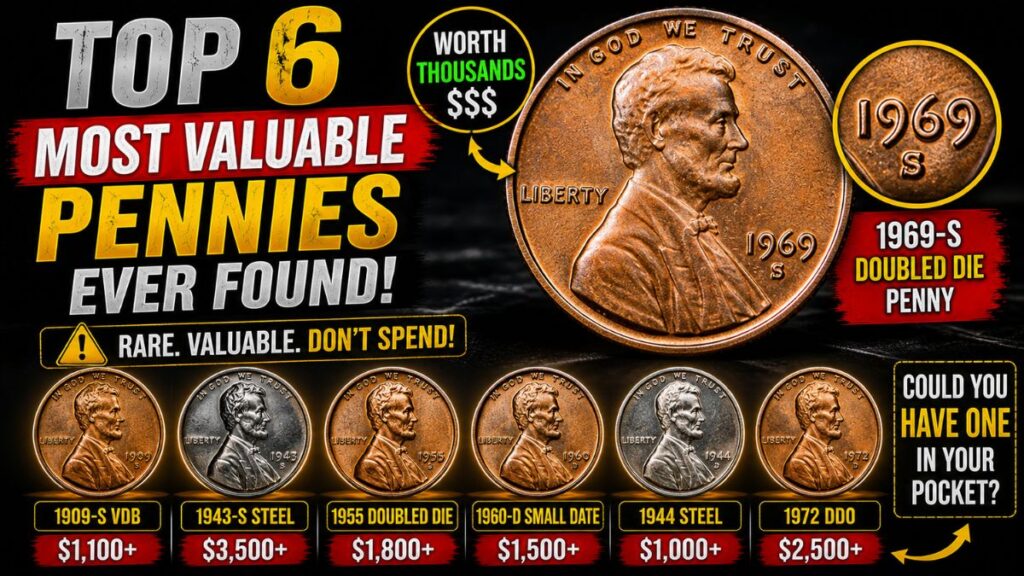
A penny is one of the smallest denominations in American coinage, but some Lincoln cents have reached values that are difficult to imagine when compared with their one-cent face value. The difference usually comes down to rarity, an unusual minting characteristic, condition, historical importance, and whether collectors can verify exactly what they are looking at.
That is why a penny sitting in an old jar, inherited collection, coin album, cash drawer, or box of loose change should not automatically be dismissed simply because it looks ordinary.
Among the most fascinating examples is the 1969-S Lincoln cent with a genuine doubled-die obverse. This particular variety is dramatically different from an ordinary 1969 penny because the doubling can be clearly visible on important parts of the design. Genuine examples are exceptionally scarce, and certified pieces have brought substantial prices at auction.
But the 1969-S doubled die is only one of several Lincoln cents that collectors watch closely.
Other famous rarities include the 1943 bronze cent, the 1944 steel cent, the 1955 Doubled Die Obverse, the 1909-S VDB, and the 1992 Close AM cent. Each has a different story, and each demonstrates why identifying a rare penny requires much more than simply finding an old date.
The important lesson is simple: do not assume every old penny is valuable, but do not casually spend a coin that shows the characteristics of a recognized rarity.
The following six Lincoln cents are especially important to understand if you are checking old pennies for hidden value.
The 1969-S Doubled Die Penny
The 1969-S Doubled Die Obverse Lincoln cent is the coin that makes the 1969 date particularly interesting to collectors.
At first glance, someone might simply see a normal Lincoln cent dated 1969 with an S mint mark. However, the rare doubled-die variety is dramatically different from a standard example.
The key is the obverse, or front, of the coin.
On genuine examples, noticeable doubling can appear in the date, LIBERTY, and the inscription IN GOD WE TRUST. The doubling is not simply a scratch, stain, or damage caused after the coin left the Mint. It is a feature created during the die-making process.
This distinction is extremely important.
A coin can become scratched, dented, flattened, or damaged after leaving the Mint. Those problems generally do not create a collectible doubled-die variety. A true doubled die originates from the production of the die itself and is therefore part of the design struck onto the coin.
The 1969-S example is especially famous because the doubling can be dramatic.
Collectors have reported that the date and lettering show strong separation, making the variety much easier to recognize than many subtle varieties. The rarity of genuine examples has made the coin one of the most desirable Lincoln cent varieties of the modern era.
Certified examples have sold for substantial amounts. Auction records include six-figure results for high-grade examples, demonstrating how dramatically condition can affect the market for an already rare coin.
One PCGS-recorded example graded MS64 Red sold for $126,500 in January 2008. Another MS64 Red example realized $126,000 in 2018. More recently, a 1969-S Doubled Die Obverse graded MS64+ Red sold for $97,600 in January 2026.
Those sales do not mean every 1969-S penny is worth thousands of dollars.
That is one of the biggest misunderstandings surrounding rare pennies.
The enormous prices belong to specific authenticated examples of the specific variety. An ordinary 1969 penny does not automatically become valuable because it carries the same date.
What Makes the 1969-S Doubled Die So Rare?
The rarity of the 1969-S doubled die is one of the main reasons collectors pay close attention to it.
The variety was recognized after the coins entered circulation, and its unusual appearance attracted attention. Over the years, specialists have studied genuine examples and established identifying characteristics that help distinguish the variety from ordinary coins and altered pieces.
The number of known genuine examples is very small compared with the enormous number of ordinary Lincoln cents produced during the series.
That difference is critical.
Millions of ordinary pennies can exist while only a tiny number of examples contain a particular die variety. In numismatics, rarity combined with collector demand can create a dramatic difference in value.
The 1969-S doubled die is a classic example.
It is also important to understand that population figures can change as additional coins are discovered, submitted, or reclassified. Certification populations should therefore be treated as records of certified coins rather than a perfect census of every surviving example.
A coin may exist without having been submitted to a grading service.
That means no population report can necessarily tell us the exact number of examples hidden in collections, estates, old rolls, or other locations.
How to Look at a 1969 Penny
If you discover a 1969 Lincoln cent, begin with the date.
Next, examine the mint mark.
The famous doubled-die variety is associated with the San Francisco Mint and carries an S mint mark.
Then carefully examine the obverse lettering.
The date is particularly important, but LIBERTY and IN GOD WE TRUST should also be inspected. Strong, structured doubling is what makes the variety interesting.
Use magnification if available.
A good coin loupe can make the examination much easier, but magnification alone cannot authenticate a rare coin.
This is where many inexperienced collectors make mistakes.
A damaged coin can sometimes look doubled under poor lighting or extreme magnification. Mechanical doubling can also create unusual-looking edges and shapes around letters and numbers.
True doubled-die characteristics have specific relationships within the design.
For an extremely valuable coin such as the 1969-S Doubled Die, visual comparison with authenticated examples and professional examination are far safer than relying on a quick internet photograph or an automatic coin-identification application.
Why You Should Never Clean a Possible 1969-S Doubled Die
If you think you have discovered a rare 1969-S penny, leave it exactly as you found it.
Do not polish it.
Do not scrub it.
Do not use chemicals.
Do not scrape the surface.
Do not attempt to make the copper brighter.
Collectors and grading services care about original surfaces. Cleaning can leave scratches, unnatural coloration, hairlines, or other evidence of alteration.
Even if the coin turns out not to be the rare variety, unnecessary cleaning can still reduce its desirability.
If the coin is potentially valuable, preservation is much more important than appearance.
A naturally aged brown coin is not automatically inferior to a bright red coin. Color designation is part of professional grading, and a coin’s surface condition must be considered together with its variety and grade.
The 1943 Bronze Lincoln Cent
The 1943 bronze cent is one of the most famous error coins in American numismatic history.
The story begins with World War II.
During 1943, the U.S. Mint changed the composition of the Lincoln cent to zinc-coated steel as part of wartime efforts to conserve copper.
That makes a genuine bronze 1943 cent extraordinarily interesting.
Instead of being struck on the normal 1943 steel planchet, a small number were accidentally struck on bronze planchets associated with the earlier composition.
The result was a coin with the 1943 date but a composition that should not normally have been used for that year’s circulation cents.
This is the kind of mistake collectors dream about finding.
The 1943 bronze cent has become one of the best-known examples of an accidental off-metal striking.
However, its fame has also produced enormous numbers of false claims.
A brown-colored 1943 cent is not automatically bronze.
Color is not enough.
Weight can provide a useful screening clue, but even weight by itself is not a complete authentication method. Altered coins, plated pieces, damaged examples, and other unusual cents can create misleading appearances.
A suspected 1943 bronze cent deserves professional authentication.
Genuine examples have brought very large prices. One PCGS-recorded 1943 bronze cent graded AU53 sold for $204,000 in 2019.
That result illustrates the enormous market difference between a normal 1943 steel cent and a genuine bronze example.
The date alone is not what creates the value.
The unusual composition combined with authentic manufacture, rarity, condition, and collector demand is what makes the coin exceptional.
How to Recognize the 1943 Bronze Cent
Begin by checking the date.
Then examine the overall appearance.
A normal 1943 circulation cent has a distinctive steel appearance because of its zinc coating. A genuine bronze example should have the characteristics expected of a bronze Lincoln cent from the period.
Weight can be used as an initial screening method.
Traditional bronze Lincoln cents from the period weigh approximately 3.11 grams, while the 1943 steel cents are approximately 2.70 grams.
But a household scale is not a substitute for authentication.
The difference between an authentic rare coin and an altered coin can involve details that cannot be established simply by placing a coin on a scale.
Collectors should also remember that some genuine 1943 bronze pieces have different appearances because of age, storage, handling, and environmental exposure.
Therefore, color should never be treated as proof.
If you believe you have found one, protect the coin and seek professional evaluation.
The 1944 Steel Penny
The 1944 steel cent is almost the mirror image of the 1943 bronze cent story.
After the Mint’s wartime experiment with steel cents in 1943, regular 1944 Lincoln cents returned to a bronze composition.
Yet a small number of 1944-dated cents were struck on steel planchets.
That created an extraordinary error.
A 1944 penny that is genuinely made from steel can be worth an enormous amount because it represents an extremely rare off-metal striking.
The rarity varies by mint, and surviving examples are exceptionally scarce.
One Philadelphia 1944 steel cent has a documented auction record of $180,000 for an MS64 example. A 1944-S steel cent has also achieved a very high auction result, with an MS66 example recorded at $408,000.
These numbers should not be interpreted as a standard price for every 1944 penny.
Most 1944 cents are ordinary bronze Lincoln cents and are not rare in the same way.
The valuable characteristic is the steel composition combined with the correct date and authentic Mint production.
That is why identification matters so much.
Why 1944 Steel Cents Are So Difficult to Find
The 1944 steel cents were not supposed to exist as normal circulation issues.
Possible explanations include leftover steel planchets from the previous year’s production being struck accidentally or foreign-coin blanks entering the wrong production stream.
Whatever the exact production path for a particular example, the important point for collectors is that genuine 1944 steel cents are recognized as extraordinary errors.
This is also why authentication is essential.
A magnet can sometimes provide an initial clue because steel is magnetic, but magnetism alone does not prove that a coin is a genuine 1944 steel cent.
An altered or fabricated coin can fool basic tests.
The surface, dimensions, weight, design characteristics, die characteristics, and manufacturing evidence all need to be considered.
If the coin appears potentially valuable, avoid experimenting with it.
Do not scratch the surface to test the metal.
Do not drill it.
Do not cut it.
Do not apply chemicals.
A valuable coin can be damaged permanently by an attempt to prove what it is.
The 1955 Doubled Die Obverse Cent
The 1955 Doubled Die Obverse is another legendary Lincoln cent variety.
It is one of the best-known doubled-die coins among collectors and remains an important piece of Lincoln cent history.
The doubling is visible on the obverse design, particularly around the date and lettering.
That makes the coin especially attractive to collectors because the variety can be recognized without requiring extremely advanced equipment.
But there is an important warning.
Not every 1955 penny showing unusual-looking lettering is the famous doubled die.
Machine doubling, die deterioration, scratches, and other forms of damage can create confusing appearances.
A genuine 1955 Doubled Die Obverse has established characteristics that separate it from ordinary coins.
The market history of the variety is also substantial. PCGS auction records include an MS65 Red example that sold for $33,100 in an earlier auction and an auction record of $114,000 for an MS65+ Red example sold in 2018.
Again, those figures belong to particular certified coins.
Condition matters tremendously.
Two coins with the same date and variety can have dramatically different market values because one may have been heavily circulated while the other retains exceptional mint-state surfaces.
What to Check on a 1955 Doubled Die
Start with the date.
Look closely at the digits.
Then inspect LIBERTY and IN GOD WE TRUST.
The doubling should appear as part of the design rather than as a random raised edge or surface disturbance.
Lighting can make a major difference during examination.
Tilting the coin slightly under a single light source can help reveal differences in the height and shape of lettering.
However, visual inspection should only be considered the beginning.
A potentially valuable 1955 Doubled Die should be authenticated before anyone assumes it is genuine.
This is particularly important because famous varieties are often copied, altered, or misidentified.
The more valuable the potential coin, the more important professional verification becomes.
The 1909-S VDB Lincoln Cent
The 1909-S VDB is one of the key coins in the early Lincoln cent series.
It has several features that make it historically important.
The coin dates from the first year of the Lincoln cent series, carries the S mint mark indicating San Francisco production, and contains the VDB initials associated with designer Victor David Brenner.
The initials appear on the reverse.
The story surrounding those initials helped make the coin famous among collectors.
The 1909-S VDB had a relatively small mintage compared with many other Lincoln cents, and it became one of the classic key dates for collectors assembling Lincoln cent collections.
It is important to distinguish the 1909-S VDB from an ordinary 1909 cent.
A 1909 cent without the S mint mark is a different coin.
A 1909-S without VDB is also different.
Collectors must examine both the mint mark and the reverse initials.
Because the 1909-S VDB is famous, it has also been a target for counterfeiting and alteration.
That is why professional authentication is especially important for expensive examples.
Recent auction records demonstrate that even circulated authenticated examples can sell for significant amounts, while higher-grade pieces can command substantially more.
The value depends on grade, color, surfaces, authenticity, and other characteristics rather than the date alone.
The 1992 Close AM Penny
The sixth coin is much newer than the classic early Lincoln cents.
It is the 1992 Close AM variety.
This coin demonstrates an important lesson in coin collecting: a valuable penny does not necessarily have to be more than a century old.
The 1992 Lincoln cent normally has a particular relationship between the letters A and M in AMERICA on the reverse.
The rare Close AM variety has the letters positioned unusually close together.
This design characteristic is associated with a reverse design intended for proof coins appearing on certain circulation strikes.
That difference is subtle compared with the dramatic doubling seen on the 1969-S cent.
But subtle does not mean unimportant.
The 1992 Close AM variety is extremely scarce.
PCGS records an auction record of $25,850 for a 1992 Close AM cent graded MS67 Red in 2017.
The 1992-D Close AM variety is also collectible and has produced substantial auction results.
The key lesson is that collectors should inspect the reverse carefully rather than focusing only on the date.
A normal 1992 penny is not automatically rare.
The specific Close AM characteristic is what makes the variety important.
How to Check a 1992 Close AM Penny
Turn the coin over to the reverse.
Find the word AMERICA.
Look closely at the A and M.
On the normal circulation design, the letters have a noticeable separation.
On a Close AM variety, the letters are much closer together.
Because the difference can be small, magnification is useful.
However, comparison with a verified example is recommended.
The 1992 Close AM variety is another situation where a collector can mistake a normal coin for a rare one.
Small design differences can be caused by photography, lighting, wear, or image distortion.
The safest approach is to inspect the physical coin under good lighting and then have a potentially valuable example professionally examined.
Why the 1969-S Penny Gets So Much Attention
Among the six coins discussed here, the 1969-S Doubled Die has an especially fascinating combination of rarity and visible design doubling.
It is not merely an old penny.
It is not valuable simply because the date is 1969.
The important combination is the San Francisco issue, the doubled-die characteristics, authenticity, and condition.
That distinction is essential.
A collector who finds a regular 1969 penny should not assume they have discovered a fortune.
But a collector who finds a 1969-S cent with strong, unusual doubling deserves to stop and investigate before spending it.
The same principle applies to the other coins.
A 1943 cent should not automatically be treated as a bronze rarity.
A 1944 cent should not automatically be treated as a steel error.
A 1955 cent should not automatically be treated as a doubled die.
A 1909-S cent should be checked carefully for the VDB initials.
A 1992 cent should be examined for the Close AM reverse.
Identification comes before valuation.
Why Condition Can Change the Value So Dramatically
Collectors often hear about a rare penny selling for tens or hundreds of thousands of dollars and then wonder why another example of the same date appears to be worth much less.
The answer is usually condition and quality.
Coin grading attempts to describe the amount of wear and the quality of preservation.
A heavily circulated coin can have scratches, contact marks, flattened details, discoloration, and other surface problems.
An uncirculated coin may retain much more original detail and surface quality.
For rare varieties, the difference can be enormous.
A high-grade example can attract competition from advanced collectors, registry-set participants, and specialists who want the finest available specimen.
That is why auction results must always be connected to the exact coin being sold.
A statement such as “a 1969 penny sold for over $100,000” is incomplete.
The meaningful statement is that a specific authenticated 1969-S Doubled Die Obverse cent in a specific grade and color designation achieved that price at a particular auction.
That level of detail prevents misleading conclusions.
Why Coin Color Can Be Misleading
Many penny collectors use terms such as Brown, Red-Brown, and Red when discussing condition.
These designations can be important, especially for copper Lincoln cents.
But color alone does not establish rarity.
A coin that looks bright red is not necessarily valuable.
A darker brown coin is not necessarily worthless.
Natural toning, environmental exposure, cleaning, chemicals, and storage conditions can all affect appearance.
This is another reason collectors should avoid polishing old pennies.
Trying to make a coin appear newer can actually damage the surface and reduce its desirability.
The original appearance is part of the coin’s history.
For rare coins, preservation is generally more important than cosmetic improvement.
Why Auction Prices Should Not Be Treated as Guaranteed Values
Auction records are useful because they demonstrate what collectors have actually paid for particular coins.
But an auction result is not a guaranteed price for another example.
The grade may be different.
The color may be different.
The coin may have different surface quality.
It may have a different certification.
The market may have changed.
Buyer demand can vary from one auction to another.
Even two coins with the same numerical grade can look different to experienced collectors.
Therefore, auction records should be treated as historical evidence of market activity rather than guaranteed appraisals.
This is particularly important when a headline claims that a penny is worth a certain huge amount.
The headline may refer to a rare variety that represents only a tiny fraction of coins carrying the same date.
The Difference Between a Doubled Die and Machine Doubling
This distinction is especially important for anyone searching for the 1969-S and 1955 varieties.
A true doubled die results from a problem during the creation of the die.
The die carries a doubled version of part of the design.
Coins struck from that die can therefore show the same characteristic doubling.
Machine doubling is different.
It can happen during the striking process when the die and planchet interact in a way that creates a flattened or shifted appearance.
Machine doubling can look exciting under magnification, but it generally does not carry the same rarity or value as a major doubled-die variety.
This is why simply seeing two edges around a number does not prove that you have discovered a valuable doubled die.
The shape, direction, location, and overall appearance of the doubling matter.
Collectors searching for the 1969-S doubled die should be particularly careful because the variety’s high value creates an incentive for misidentification and alteration.
Why Authentication Matters More for Famous Pennies
The more famous a rare coin becomes, the greater the chance that collectors will encounter questionable examples.
This does not mean every uncertified coin is fake.
It means that valuable coins deserve a higher level of verification.
Professional grading services can examine authenticity, variety attribution, condition, and other characteristics.
For a coin potentially worth a substantial amount, professional authentication can protect the owner from making a serious mistake.
It can also make the coin easier to sell because prospective buyers can evaluate an independently certified example.
Before paying a major amount for a rare penny, collectors should verify the certification and make sure the coin in the holder matches the certification information.
What Not to Do If You Find a Rare Penny
The first rule is simple: do nothing that could damage the coin.
Do not clean it.
Do not polish it.
Do not scrape it.
Do not test it by scratching the surface.
Do not drill it.
Do not bend it.
Do not apply acids or household chemicals.
Do not attempt to remove spots with abrasive materials.
A rare coin can lose substantial desirability because of improper cleaning or surface alteration.
Instead, handle it carefully by the edges.
Place it somewhere safe.
Avoid unnecessary touching of the surfaces.
If the coin appears to be a serious rarity, seek professional evaluation.
This approach is particularly important for a suspected 1969-S Doubled Die, 1943 bronze cent, 1944 steel cent, or other major rarity.
How to Search Your Penny Collection
You do not need expensive equipment to begin searching.
Start with good lighting.
Separate coins by date.
Look for mint marks.
Examine both sides.
Use a small magnifying glass or coin loupe when necessary.
Pay special attention to the six varieties discussed in this article.
For 1969 cents, check for the S mint mark and examine the obverse for strong doubling.
For 1943 cents, investigate unusual composition carefully.
For 1944 cents, look for potential steel examples.
For 1955 cents, examine the date and lettering for the recognized doubled-die characteristics.
For 1909 cents, look for the S mint mark and VDB initials.
For 1992 cents, examine AMERICA on the reverse for the Close AM configuration.
The goal is not to assume every unusual coin is valuable.
The goal is to identify coins that deserve further investigation.
Why Old Penny Jars Can Be Worth Checking
Many people have inherited containers of old coins without knowing what is inside.
A jar can contain ordinary pennies, but it can also contain coins that were never carefully sorted.
People often spend coins without examining them because they assume a penny is worth only one cent.
That assumption is usually reasonable for ordinary modern cents.
But rare varieties are exceptions.
A person who understands the identifying characteristics can separate potentially important coins from common ones.
The key is patience.
Coin collecting rewards careful observation.
You do not need to search through thousands of coins in one sitting.
Even a small collection can be examined systematically.
Sort by decade.
Then inspect dates and mint marks.
Finally, use magnification to check varieties that are known to be valuable.
Six Pennies Worth Remembering
The six examples in this article represent different reasons a Lincoln cent can become important.
The 1969-S Doubled Die is valuable because of a rare and dramatic doubled-die variety.
The 1943 bronze cent is famous because it was struck on a bronze planchet during a year when steel cents were being produced for circulation.
The 1944 steel cent is important because it represents an extremely rare off-metal striking during the return to bronze cents.
The 1955 Doubled Die Obverse is a famous and visually recognizable Lincoln cent variety.
The 1909-S VDB is a key early Lincoln cent distinguished by its date, San Francisco mint mark, and VDB initials.
The 1992 Close AM is a much newer rarity whose value comes from a specific reverse design variety.
These examples demonstrate why the word “penny” tells you almost nothing about actual collector value.
The details matter.
The 1969 Penny You Should Not Spend Too Quickly
If you have a 1969 penny, there is no reason to panic.
Most 1969 pennies are not the famous rarity.
But if the coin is a 1969-S and you notice unusual, strong doubling across the date and lettering, stop before putting it back into circulation.
That is the moment when further investigation becomes worthwhile.
The same principle applies to every rare coin.
Do not spend first and investigate later.
A coin that looks ordinary at a quick glance can sometimes deserve a closer examination.
At the same time, avoid assuming that every unusual-looking coin is a treasure.
The safest approach is evidence.
Check the date.
Check the mint mark.
Check the design.
Check the variety.
Check the condition.
Then verify authenticity.
Frequently Asked Questions About Valuable Pennies
Is every 1969 penny valuable?
No. Most 1969 Lincoln cents are ordinary coins. The major rarity associated with the year is the 1969-S Doubled Die Obverse, which has specific identifying characteristics.
What makes the 1969-S penny valuable?
The rare doubled-die obverse variety is the key feature. Genuine examples show strong doubling in areas including the date, LIBERTY, and IN GOD WE TRUST.
How much can a 1969-S Doubled Die penny be worth?
The value depends heavily on authenticity, grade, color, surface quality, and market conditions. Certified examples have achieved very high auction prices, including six-figure results, but those prices apply to specific coins rather than ordinary 1969 pennies.
How can I tell if my 1969 penny is the rare doubled die?
Check the S mint mark and carefully inspect the obverse for the recognized doubling characteristics. Because valuable examples are scarce and authentication is important, professional examination is recommended for a potentially significant coin.
Is a 1943 bronze penny really valuable?
Yes, genuine 1943 bronze Lincoln cents are exceptionally rare and have brought substantial prices. However, a brown-colored 1943 cent is not automatically bronze.
Can I use a scale to identify a 1943 bronze cent?
Weight can be useful as an initial screening tool, but it is not sufficient for authentication. Other physical characteristics must also be considered.
Why is the 1944 steel penny valuable?
A genuine 1944 steel cent represents an extremely rare off-metal striking from a year when regular Lincoln cents had returned to bronze composition.
Is every 1944 penny made of steel?
No. Ordinary 1944 Lincoln cents were made from bronze. Genuine steel examples are rare errors.
What is the 1955 Doubled Die penny?
It is a famous Lincoln cent variety with prominent doubling on the obverse, particularly involving the date and lettering.
What is the 1909-S VDB penny?
It is an early Lincoln cent dated 1909, struck at the San Francisco Mint, with VDB initials associated with designer Victor David Brenner on the reverse.
What is a 1992 Close AM penny?
It is a rare 1992 Lincoln cent variety identified by the unusually close positioning of the A and M in AMERICA on the reverse.
Should I clean a potentially valuable penny?
No. Cleaning, polishing, chemicals, or abrasive treatment can damage the coin’s surfaces and potentially reduce its desirability and value.
Should I sell a rare-looking penny immediately?
It is better to establish what the coin actually is before deciding what to do with it. Authentication and professional grading can be especially important when a coin appears to be a major rarity.
Are online asking prices reliable?
An asking price is not the same as a completed sale. Actual auction results provide stronger evidence of what buyers have paid for specific coins, but even auction records do not guarantee the value of another example.
Can a modern penny really be valuable?
Yes. The 1992 Close AM is a good example of a relatively modern Lincoln cent variety that can command significant collector interest.
What is the most important thing to check on a rare penny?
The exact identity of the coin comes first. Date, mint mark, variety, composition, condition, and authenticity all matter.
Final Thoughts on the Six Valuable Pennies
The biggest lesson from these six Lincoln cents is that valuable pennies are rarely valuable for a simple reason.
A date by itself is not enough.
An old appearance is not enough.
A strange color is not enough.
Even an unusual-looking design is not automatically enough.
The 1969-S Doubled Die shows how a specific minting variety can transform an ordinary-looking cent into a major numismatic rarity. The 1943 bronze and 1944 steel cents demonstrate how an unusual planchet can create extraordinary value. The 1955 Doubled Die shows the importance of dramatic die varieties, while the 1909-S VDB demonstrates the power of historical importance and scarcity. The 1992 Close AM proves that valuable varieties can also appear in relatively modern Lincoln cents.
So, if you have a box of old pennies, do not assume that everything inside is worthless.
But do not assume that every unusual penny is a fortune either.
Look carefully.
Compare the details.
Protect anything that appears promising.
Most importantly, never clean or alter a potentially rare coin before it has been examined.
The next time a 1969-S penny lands in your hands, take a second look at the date and lettering before spending it. That small moment of attention could be the difference between overlooking an interesting variety and recognizing a coin that deserves serious numismatic investigation.