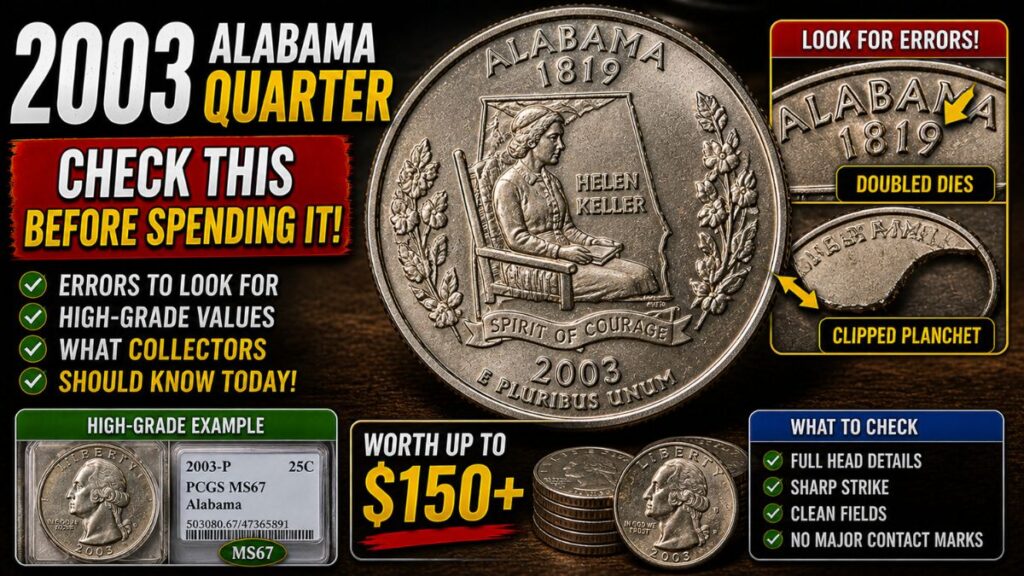
Finding a 2003 Alabama State Quarter in your pocket change can feel exciting, especially when you hear stories about ordinary-looking quarters selling for much more than their face value. But before assuming your coin is rare, there are a few details worth checking carefully.
The 2003 Alabama State Quarter is generally a common coin. Simply having the Alabama design and the 2003 date does not automatically make a quarter valuable. Millions were produced, and most surviving examples are worth close to their normal collector value unless they have an unusual characteristic.
That does not mean every 2003 Alabama quarter should be spent without looking at it.
The mint mark, condition, and possible minting errors can make a significant difference.
The Philadelphia version carries a P mint mark and had a reported mintage of about 225 million pieces. The Denver version carries a D mint mark, with about 232.4 million struck. Both normal versions weigh approximately 5.67 grams and use the standard copper-nickel clad composition.
Those numbers tell us something important: the 2003 Alabama quarter is not automatically rare simply because it is more than two decades old.
However, collectors do pay attention to unusual examples.
One documented 2003-P Alabama quarter was struck on an elliptical planchet and graded MS65. That unusual example sold for $63 at auction in 2018.
High-grade regular examples can also bring premiums. A reported auction result for a 2003-P Alabama quarter in MS65 is $173, while a 2003-D example in MS68 reached $282.
These figures belong to specific coins and should never be treated as the guaranteed value of every 2003 Alabama quarter.
So, if you have one, don’t spend it immediately. Start by checking the mint mark, examine the condition, and look carefully for genuine signs of a minting error.
Why the 2003 Alabama Quarter Gets Attention
The Alabama State Quarter was part of the United States Mint’s 50 State Quarters program, making it a familiar coin to millions of Americans.
Because state quarters were heavily circulated and widely collected, many people still have them in jars, drawers, albums, and old collections.
The Alabama design is therefore not rare simply because it belongs to a state quarter series.
This is an important distinction for anyone searching pocket change.
Collectors generally do not value every coin from the series equally. They may pay closer attention to coins with unusual errors, exceptional preservation, or other characteristics that make a particular example stand out.
The 2003 Alabama quarter provides a useful example of this principle.
The regular coins are common, but specific pieces can be more collectible.
That means your first goal should not be to determine whether every Alabama quarter is valuable.
Instead, you should determine whether your individual coin has something unusual.
The 2003 Alabama Quarter Mintage
Mintage is one of the first details collectors consider when evaluating a coin.
For the 2003 Alabama State Quarter, the Philadelphia issue had a reported mintage of about 225 million.
The Denver issue had approximately 232.4 million pieces struck.
Those are substantial production numbers.
When millions of examples are produced, simply finding the date does not establish rarity.
This is why a 2003 Alabama quarter found in ordinary circulation should not automatically be described as a rare coin.
At the same time, mintage numbers alone do not tell the entire story.
A coin can have a large mintage but become more interesting when a particular error is identified or when an exceptionally well-preserved example survives.
That is exactly what happens with many modern coins.
The date and design provide the starting point.
The individual characteristics determine whether further investigation is worthwhile.
The First Thing to Check: The Mint Mark
If you find a 2003 Alabama quarter, one of the easiest things to check is the mint mark.
The Philadelphia version has a P mint mark.
The Denver version has a D mint mark.
The mint mark helps identify which issue you have.
This matters because different issues can have different populations, condition availability, and auction records.
For example, the reported high-grade result for the 2003-P is different from the reported result for the 2003-D.
That does not mean one ordinary coin is automatically more valuable than another.
It simply demonstrates why identifying the exact issue is an important part of coin collecting.
Before searching for a value, confirm the mint mark.
Do not rely only on the year and design.
Why the Mint Mark Matters More Than You Might Think
Two 2003 Alabama quarters can look nearly identical at first glance.
Both may have the same state design.
Both may be in circulation.
Both may weigh approximately 5.67 grams.
Yet one could be a Philadelphia issue while the other is from Denver.
For collectors, that distinction can matter.
When researching a coin, the mint mark helps you compare your example with the correct population and known auction results.
It also prevents one of the most common mistakes in coin searching: applying the price of one issue to another.
A 2003-P auction result should not automatically be used as the value of a 2003-D coin.
The same rule applies to high-grade examples.
Always identify the exact issue before making a comparison.
What Should a Normal 2003 Alabama Quarter Weigh?
A normal 2003 Alabama State Quarter weighs approximately 5.67 grams.
That gives collectors a useful reference point.
If you own a 2003 Alabama quarter and want to examine it more closely, a precise digital scale can help confirm whether the coin is close to the expected weight.
A measurement around 5.67 grams is consistent with a normal quarter.
However, weight alone does not determine value.
A normal-weight coin can still be collectible because of condition or another feature, while a coin with an unusual weight may need additional examination before it can be identified as a genuine error.
This is particularly important because unusual measurements can have different explanations.
A coin may be damaged, worn, contaminated, or altered.
Therefore, a scale should be treated as a screening tool rather than a final authentication method.
The Standard Composition of the 2003 Alabama Quarter
Normal 2003 Alabama quarters use the standard copper-nickel clad composition.
The coin has a copper-nickel outer layer over a copper core.
This is the normal structure associated with the quarter.
Understanding the normal composition is useful because genuine minting errors can involve the wrong planchet or another unusual production characteristic.
If the physical characteristics of a coin appear inconsistent with a normal quarter, that may justify further investigation.
But collectors should not attempt to prove composition by damaging the coin.
Never scrape, cut, drill, file, or otherwise alter a potentially valuable quarter.
Professional examination is much safer.
What Makes the Elliptical Planchet Example Interesting?
The most notable error example in the supplied information is a 2003-P Alabama quarter struck on an elliptical planchet.
This is important because the unusual shape or planchet characteristic originated during the minting process rather than simply being damage caused after the coin entered circulation.
The documented example was graded MS65 and sold for $63 at Heritage in 2018.
That auction result demonstrates that a 2003 Alabama quarter can become more collectible when it has a documented minting error.
But it is essential to understand what the result does not mean.
It does not mean that every Alabama quarter with a strange shape is worth $63.
It does not mean that every 2003-P quarter is worth $63.
And it does not mean that an altered coin should be valued as a mint error.
The auction result applies to the specific authenticated example.
What Is an Elliptical Planchet?
A planchet is the prepared metal blank used to make a coin.
Normally, planchets are produced to specific dimensions and shapes appropriate for the intended denomination.
An elliptical planchet has an unusual elongated or elliptical shape.
When a quarter is struck on such a planchet, the resulting coin can have characteristics that are immediately different from a normal round quarter.
That is why planchet errors are important in error-coin collecting.
The key issue is whether the unusual shape existed as part of the minting process.
A coin that becomes distorted after leaving the mint is not automatically equivalent to a genuine elliptical-planchet error.
Damage and mint errors can sometimes look similar to an inexperienced observer.
That is why authentication is so important when a potentially valuable error is involved.
The $63 Auction Result: What It Really Means
The documented 2003-P Alabama quarter struck on an elliptical planchet sold for $63 in 2018.
The coin was graded MS65.
This is useful information because it provides a real example of a collectible 2003 Alabama quarter with an unusual minting characteristic.
However, auction results should always be interpreted in context.
The $63 price was associated with a particular coin.
That coin had a specific error and a specific grade.
Another coin with a different condition or different characteristics could sell for a different amount.
This is why collectors should avoid using a single auction price as a guaranteed value.
Instead, treat the result as evidence that genuine examples of unusual minting errors can command premiums over ordinary coins.
What Does MS65 Mean?
MS65 refers to a Mint State grade.
A coin receiving this grade is considered to have remained in uncirculated condition within the grading system.
For a modern state quarter, that distinction can be important.
Many quarters enter circulation and quickly acquire contact marks, scratches, wear, and other imperfections.
An MS65 coin is in much better condition than a typical circulated example.
The grade is therefore an important part of the description of the $63 elliptical-planchet example.
If your 2003 Alabama quarter is heavily circulated, you cannot automatically compare it with an MS65 error coin.
Condition needs to be considered independently.
High-Grade 2003-P Alabama Quarters Can Be Collectible
Errors are not the only reason a 2003 Alabama quarter might attract collector interest.
Extremely high-grade regular coins can also bring premiums.
The reported auction result for a 2003-P Alabama quarter in MS65 is $173.
That is considerably more than the face value of 25 cents.
But once again, the important detail is the grade.
A normal circulated 2003-P Alabama quarter should not automatically be valued at $173.
The auction result refers to a specific MS65 example.
This illustrates a broader principle in coin collecting: condition can make an enormous difference.
A common coin in circulation can be relatively ordinary, while a remarkably well-preserved example can attract collectors who are trying to complete high-grade sets.
The 2003-D Alabama Quarter and Its $282 Result
The Denver issue also has a notable reported auction result.
A 2003-D Alabama quarter in MS68 reached $282.
The MS68 grade is extremely high compared with the condition of a typical circulated quarter.
This again demonstrates the importance of condition.
If you find a 2003-D Alabama quarter in ordinary circulation, do not assume that it is worth $282.
Instead, look at its preservation.
Does it show significant wear?
Are there numerous contact marks?
Does the surface appear heavily scratched?
Or does it appear unusually fresh and well preserved?
Those observations help determine whether the coin deserves further evaluation.
Why High Grade Can Be More Important Than Age
Many people assume that an older coin must be more valuable than a newer coin.
Coin collecting does not work that way.
A 2003 quarter is relatively modern, but an exceptional example can still attract collectors.
The important factors can include rarity, condition, errors, demand, and authenticity.
This is why a high-grade 2003 Alabama quarter can bring more than face value.
Collectors who specialize in modern coins may seek examples with very high grades because those coins can be much harder to locate than ordinary circulated pieces.
Therefore, never dismiss a modern coin simply because it is not very old.
But also do not assume that every modern coin is valuable.
The individual characteristics still matter.
How to Examine the Condition of Your Alabama Quarter
Condition is one of the most important things to check after identifying the mint mark.
Start by examining the coin under good lighting.
Look at the major design elements.
Then inspect the open fields of the coin.
Look for scratches, contact marks, discoloration, wear, and other imperfections.
A circulated quarter will generally show signs of use.
An exceptionally preserved coin may have much sharper details and fewer signs of contact.
However, judging high grades accurately can be difficult for beginners.
A coin that looks perfect under ordinary room lighting may have small marks that become visible under magnification.
That is one reason professional grading exists.
If you believe your 2003 Alabama quarter could be an unusually high-grade example, professional evaluation may be worthwhile before relying on an online value claim.
Why You Should Not Clean a 2003 Alabama Quarter
Cleaning is one of the biggest mistakes a collector can make.
Someone might see a dirty or dull quarter and think that polishing it will make the coin more attractive.
For collectible coins, that can have the opposite effect.
Cleaning can leave scratches or unnatural surfaces.
It can also make a potentially valuable coin less desirable to collectors.
If your 2003 Alabama quarter appears unusual, leave it exactly as you found it.
Do not polish it.
Do not use chemicals.
Do not rub it aggressively.
Do not scrape the surface.
Do not try to improve its appearance before authentication.
Preservation is more important than making the coin look shiny.
How to Tell a Possible Mint Error From Damage
A genuine mint error occurs during the manufacturing process.
Damage usually occurs afterward.
This distinction is critical.
Suppose you find a quarter with an unusual shape.
That does not automatically mean it was struck on an elliptical planchet.
The coin could have been bent or damaged after leaving the mint.
Similarly, a strange-looking edge could result from circulation damage rather than a production error.
Collectors therefore look for evidence that the unusual characteristic is consistent with the minting process.
This can involve examining the shape, surfaces, strike, edge, dimensions, and other details.
If the evidence is uncertain, professional authentication is the safest route.
Why Photographs Are Not Always Enough
Online photographs can be useful for learning.
They can help you compare general designs and understand what certain errors look like.
But photographs have limitations.
They may not show the true weight.
They may not accurately reveal the edge.
They may not provide enough information about thickness or surface texture.
Lighting can also make a coin appear different from how it looks in person.
For that reason, a photograph alone should not be treated as definitive proof of a rare error.
If a coin appears potentially valuable, physical examination is more reliable.
Why the Mint Mark Should Be Checked Before the Value
Suppose someone tells you that a 2003 Alabama quarter is worth hundreds of dollars.
Your first response should not be excitement.
Your first response should be identification.
Check whether your coin has a P or D mint mark.
Then determine its condition.
Then inspect it for unusual characteristics.
Only after those steps should you compare it with documented examples.
This process helps prevent the common mistake of taking a price attached to one specific coin and applying it to every quarter from the same year.
The mint mark is one of the easiest details to verify.
Use it.
The Importance of Comparing Your Coin With a Normal Example
One of the simplest ways to spot something unusual is to compare your coin with an ordinary example.
If possible, place two 2003 Alabama quarters next to each other.
Compare the overall shape.
Compare the rims.
Compare the design placement.
Check the edge.
Weigh both coins using the same scale.
If one coin looks different, ask why.
A comparison does not prove an error, but it can make unusual characteristics easier to notice.
The key is to remain objective.
Do not search only for differences that support the idea that your coin is rare.
Look for evidence that could support either explanation.
What If Your 2003 Alabama Quarter Looks Normal?
If your coin looks completely normal, weighs approximately 5.67 grams, and shows ordinary circulation, there may be no reason to consider it a major rarity.
That is perfectly normal.
Most coins are not rare.
Coin collecting is not about finding a valuable coin every time.
The interesting part is learning how to recognize the exceptions.
A normal 2003 Alabama quarter can still be useful for learning about the series, mintmarks, grading, and error detection.
And if you are searching large numbers of state quarters, knowing what normal looks like is extremely valuable.
You cannot recognize an unusual coin unless you understand the normal coin first.
What If Your Coin Has a P Mint Mark?
A P mint mark identifies the Philadelphia issue.
The reported mintage was about 225 million.
A normal circulated P-mint quarter is therefore not automatically rare.
However, the 2003-P issue has both documented high-grade examples and a documented elliptical-planchet error.
That makes the mint mark worth checking carefully.
If you have a P-mint coin that appears unusually well preserved or physically unusual, it deserves more attention.
But again, identification must come before valuation.
What If Your Coin Has a D Mint Mark?
A D mint mark identifies the Denver issue.
Approximately 232.4 million were struck.
Like the P issue, the existence of the D mint mark does not automatically make the coin rare.
However, the reported MS68 auction result of $282 demonstrates that an exceptionally high-grade 2003-D Alabama quarter can be significantly more collectible than an ordinary circulated example.
Therefore, if you have a D-mint coin that appears remarkably well preserved, it may be worth examining more carefully.
Why Mintage Numbers Can Be Misleading
Mintage numbers are useful, but they do not tell you exactly how many collectible coins exist today.
A coin can have a large mintage and still be difficult to locate in exceptional condition.
Likewise, a coin with a lower mintage is not automatically valuable if collector demand is weak.
For the 2003 Alabama quarter, the large production numbers help explain why the date itself is common.
The documented errors and high-grade auction results demonstrate why the individual coin matters more than the date alone.
That is the key concept to remember.
What Makes an Error Coin More Interesting?
An error coin becomes interesting when its unusual characteristic can be traced to the minting process.
The 2003-P Alabama quarter struck on an elliptical planchet is a useful example.
The unusual planchet characteristic makes the coin different from a normal example.
But collectors still want to know that the error is genuine.
A coin altered after production does not have the same significance.
This is why professional authentication can be important.
When substantial money is involved, the difference between a genuine error and post-mint damage can be financially significant.
Why Authentication Protects Collectors
Authentication is not just about proving that a coin is rare.
It also protects collectors from making expensive mistakes.
If you believe you have found a major mint error, it can be tempting to rely on a photograph or an online comment.
But a professional examination can provide much stronger evidence.
This becomes particularly important when comparing your coin with an auction example.
The documented $63 elliptical-planchet coin was a specific authenticated example.
The reported $173 and $282 results also involved specific high-grade coins.
If your coin does not share the relevant characteristics, those prices do not automatically apply.
Authentication helps establish exactly what you have.
How to Store a Potentially Valuable Quarter
If your 2003 Alabama quarter appears unusual, store it carefully while you investigate it.
Avoid loose storage where the coin can rub against other coins.
Do not put it in a pocket with keys or other objects.
Do not handle the surfaces unnecessarily.
A suitable coin holder or protective storage method can help protect the coin from additional damage.
The goal is simple: preserve the condition you already have.
If the coin eventually turns out to be ordinary, careful storage has not harmed anything.
If it turns out to be valuable, preserving its original condition can be much more important.
How to Think About the $173 and $282 Results
The reported $173 result for a 2003-P MS65 and the $282 result for a 2003-D MS68 can easily create confusion.
Someone might see those numbers and conclude that all 2003 Alabama quarters are worth hundreds.
That conclusion would be incorrect.
The grades are essential.
MS65 and MS68 are not ordinary circulated conditions.
The auction records represent particular coins that achieved those grades.
If your coin has scratches, wear, or other circulation evidence, you cannot simply assign one of those prices to it.
This is why collectors should always read the complete description of an auction result rather than focusing only on the headline number.
Why Error and Condition Should Be Evaluated Separately
When examining a 2003 Alabama quarter, consider two separate questions.
First: does the coin have a genuine minting error?
Second: what is the condition of the coin?
These are different characteristics.
A coin can be an error in circulated condition.
Another coin can be perfectly normal but exceptionally high grade.
A third coin can be both unusual and well preserved.
The value of each can be different.
Separating these factors makes coin evaluation much easier.
It prevents the common mistake of assuming that one positive feature automatically guarantees a specific value.
What You Should Not Do With a Suspected Error Coin
If you suspect that your 2003 Alabama quarter has an unusual minting error, avoid experimenting with it.
Do not bend it.
Do not flatten it.
Do not reshape it.
Do not file the edge.
Do not remove metal.
Do not polish it.
Do not chemically clean it.
Do not scratch the surface to test its composition.
These actions can permanently damage the coin.
Instead, document what you observe and seek professional evaluation.
The best evidence is usually the original coin in its original condition.
Why Patience Is Important in Coin Collecting
Coin collecting rewards careful observation.
It can be tempting to rush when a coin appears unusual.
But rushing can lead to mistakes.
You might clean the coin.
You might misidentify damage as an error.
You might pay too much for an ordinary coin.
Or you might sell a potentially valuable piece before having it properly evaluated.
A better approach is to slow down.
Identify the date.
Check the mint mark.
Inspect the condition.
Measure the weight if appropriate.
Compare the coin with normal examples.
Then investigate any unusual characteristics.
That process is much more reliable than reacting to a headline.
A Simple Checklist for Your 2003 Alabama Quarter
If you want a quick inspection routine, start with the following steps.
Confirm that the date is 2003.
Identify whether the coin has a P or D mint mark.
Check whether the coin weighs approximately 5.67 grams.
Inspect the coin’s overall condition.
Look closely at the rims and design.
Examine the edge.
Look for an unusual planchet shape.
Compare the coin with a normal 2003 Alabama quarter.
Consider whether any unusual feature could have been caused by post-mint damage.
If the coin still appears unusual, consider professional authentication.
This approach keeps the process simple and prevents unnecessary conclusions.
What If You Find an Elliptical-Looking Quarter?
If your 2003 Alabama quarter appears elliptical or otherwise unusually shaped, do not immediately assume that it is the same as the documented error.
First, make sure the shape is actually part of the original coin.
Post-mint damage can distort coins.
Compare the coin with a normal example.
Examine the edge and surfaces.
Look for evidence that the unusual shape is consistent with a minting error.
Because the documented 2003-P example was struck on an elliptical planchet, a genuinely similar characteristic could be significant.
But the important word is “genuinely.”
Authentication remains the key.
Why the Exact Auction Date Matters
The documented elliptical-planchet example sold in 2018.
Auction prices are historical transactions.
They tell us what a particular coin achieved at that particular time.
They should not be treated as guaranteed future prices.
Market conditions can change.
Collector interest can change.
The condition and quality of the specific coin can also vary.
Therefore, the $63 result is useful as a documented example, not as a fixed price for all similar-looking coins.
This is another reason to avoid exaggerated value claims.
The Difference Between a Coin’s Face Value and Collector Value
Every 2003 Alabama quarter has a face value of 25 cents.
Collector value can be higher when a particular coin has characteristics that collectors want.
Those characteristics can include unusual minting errors or exceptional condition.
But not every coin receives a premium.
The majority of ordinary circulated examples remain common.
This distinction is important because it keeps expectations realistic.
If you find a 2003 Alabama quarter, you do not need to assume it is worth hundreds.
You simply need to determine whether it has characteristics that justify further investigation.
Why the 2003 Alabama Quarter Is Worth Checking Carefully
The 2003 Alabama quarter is an excellent example of how ordinary coins can contain unusual exceptions.
The P and D issues were produced in large numbers.
Normal examples weigh approximately 5.67 grams.
Most are common.
Yet one documented 2003-P example struck on an elliptical planchet sold for $63 in MS65.
Regular high-grade examples also reached reported auction results of $173 for a 2003-P MS65 and $282 for a 2003-D MS68.
These results show that the same date can have very different collector outcomes depending on the individual coin.
That is why careful inspection is worthwhile.
Frequently Asked Questions About the 2003 Alabama Quarter
Is the 2003 Alabama quarter rare?
Most 2003 Alabama quarters are common. The Philadelphia issue had about 225 million struck, while the Denver issue had approximately 232.4 million.
How much does a normal 2003 Alabama quarter weigh?
A normal 2003 Alabama quarter weighs approximately 5.67 grams.
What mint marks should I look for?
The Philadelphia issue carries a P mint mark, while the Denver issue carries a D mint mark.
Is a 2003-P Alabama quarter automatically valuable?
No. The 2003-P issue is generally common. Specific errors and exceptional high-grade examples can be more collectible.
Is a 2003-D Alabama quarter automatically valuable?
No. The 2003-D issue is also common. A particular coin may command a premium if it has an unusual error or exceptional condition.
What is unusual about the documented 2003-P error?
A documented 2003-P Alabama quarter was struck on an elliptical planchet. The MS65 example sold for $63 at auction in 2018.
Does the $63 auction result mean my Alabama quarter is worth $63?
No. The result applies to a specific authenticated example with a specific error and grade. It should not be used as a guaranteed value for every 2003 Alabama quarter.
Can a normal 2003 Alabama quarter be worth more than face value?
Yes, exceptionally high-grade examples can be more collectible. A reported 2003-P MS65 example reached $173, while a 2003-D MS68 example reached $282.
Does every MS65 Alabama quarter automatically sell for $173?
No. The reported $173 result refers to a specific 2003-P MS65 coin. Individual auction results should not be treated as guaranteed prices.
What does MS68 mean?
MS68 is an extremely high grade within the Mint State grading scale. It indicates exceptional preservation compared with ordinary circulated coins.
Should I clean my Alabama quarter before examining it?
No. Cleaning can damage the coin’s surfaces and potentially reduce its desirability. A potentially valuable coin should generally be preserved in its existing condition.
Can a strange-looking Alabama quarter be damaged instead of being an error?
Yes. Coins can be bent, scratched, distorted, or otherwise altered after leaving the mint. A genuine mint error must be distinguished from post-mint damage.
Can weight prove that a quarter is a mint error?
No. Weight is useful for screening but does not prove the origin of an unusual coin. Other physical characteristics and professional authentication may be necessary.
What should I do if my quarter looks unusually shaped?
Do not bend, reshape, scrape, or otherwise alter it. Compare it carefully with a normal example and consider professional authentication if the unusual shape appears consistent with a possible minting error.
Why is the mint mark important?
The mint mark identifies the production facility associated with the coin and helps you compare your example with the correct issue and relevant collector information.
Why does condition matter so much?
Condition can make a major difference because exceptionally well-preserved coins can be much more difficult to find than ordinary circulated examples.
Should I trust a claim that every 2003 Alabama quarter is worth hundreds?
No. Most are common. High values associated with specific auction results apply to particular coins, grades, or errors.
What is the best first step when checking a 2003 Alabama quarter?
Start by confirming the date and mint mark. Then examine the condition and look for unusual characteristics. If something appears abnormal, investigate further rather than assuming a value.
Final Thoughts
The 2003 Alabama State Quarter is a good example of why coin collecting requires more than simply looking at the year.
Millions of these coins were produced, including approximately 225 million Philadelphia examples and approximately 232.4 million Denver examples. Most ordinary 2003 Alabama quarters are common.
But individual coins can be different.
The mint mark is an important first clue because it tells you whether you have a P or D issue. The normal weight of approximately 5.67 grams provides another useful reference point. Condition can also matter, especially when a coin appears unusually well preserved.
Then there are genuine minting errors.
The documented 2003-P Alabama quarter struck on an elliptical planchet demonstrates how an unusual production characteristic can make a modern state quarter more collectible. That MS65 example sold for $63 in 2018.
The reported high-grade results provide another important lesson. A 2003-P MS65 example reached $173, while a 2003-D MS68 example reached $282. These are specific auction results for particular high-grade coins, not automatic prices for every Alabama quarter.
So, if you find a 2003 Alabama quarter, don’t assume it is rare simply because it is from 2003.
Check the mint mark.
Examine the condition.
Use a precise scale if you want to verify the weight.
Look closely for unusual characteristics.
Compare the coin with a normal example.
And if something genuinely unusual appears, avoid cleaning or altering the coin and consider professional authentication before trusting a major value claim.
The most important lesson is simple: the date gets your attention, but the individual characteristics determine whether the coin deserves a closer look.
So before you drop that 2003 Alabama quarter into a vending machine, cash register, or tip jar, take a moment to inspect it carefully. The vast majority will be ordinary, but the right combination of mint mark, condition, and genuine minting characteristics can make a particular example far more interesting to collectors.