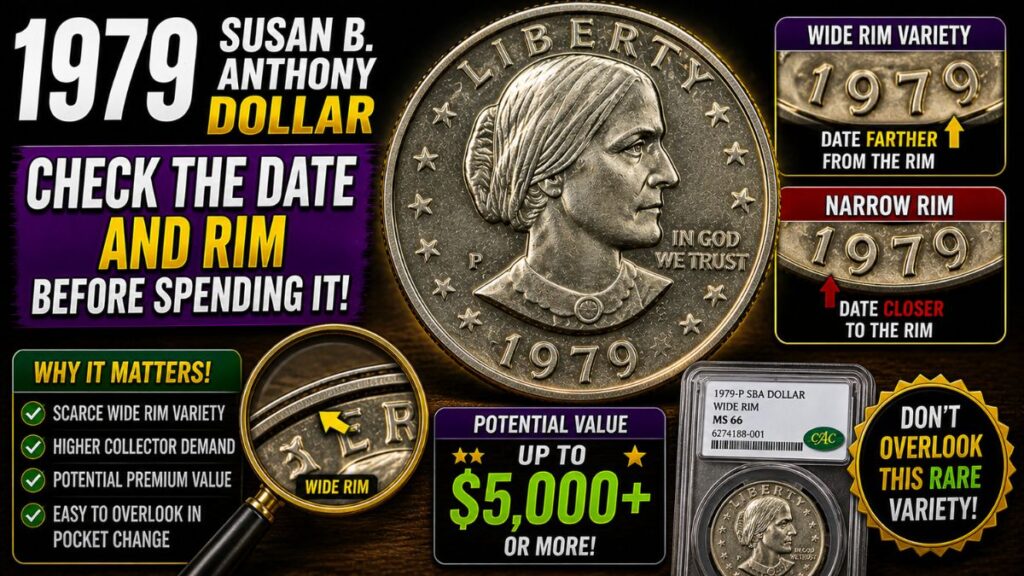
Before you spend a 1979 Susan B. Anthony dollar, take a moment to examine the date and the rim. This small detail could help you determine whether your coin is an ordinary example or a potentially scarce variety that collectors actively seek.
The 1979 Susan B. Anthony dollar is a familiar coin to many collectors. However, not every example has the same characteristics. One of the most interesting varieties from that year is known as the Wide Rim, also called the Near Date variety.
The difference may seem subtle at first, but it matters.
On the Wide Rim variety, the date sits noticeably closer to the outer rim than it does on the more common Narrow Rim version. That positioning is the main feature collectors examine when trying to identify this variety.
The distinction becomes especially important when condition enters the picture.
A certified 1979-P Wide Rim Susan B. Anthony dollar graded MS67+ sold for $8,268.75 in April 2025. That result demonstrates how a specific variety in exceptional condition can attract substantial collector interest.
But there is an important detail to understand: the auction price belongs to one particular coin with a specific variety and grade. It does not mean every 1979 Susan B. Anthony dollar is worth thousands of dollars.
Most examples are much more ordinary.
The key is to identify the exact variety, examine the coin’s condition, and establish its authenticity before making any assumptions about value.
If you have a 1979 Susan B. Anthony dollar, checking the date and rim is a practical first step. A careful inspection can help you determine whether your coin deserves further attention.
What Is the 1979 Susan B. Anthony Dollar?
The Susan B. Anthony dollar is a United States one-dollar coin featuring Susan B. Anthony, a prominent figure in the movement for women’s voting rights.
The coin introduced a smaller dollar format that was different from the large silver-colored dollars many people associated with earlier American coinage.
The 1979 issue is particularly interesting to collectors because it includes different varieties, including the Wide Rim and Narrow Rim designs.
Although these coins share the same year and general appearance, small differences in the design can influence their collectibility.
That is why the 1979 Susan B. Anthony dollar remains a popular subject among people who search through older coins.
The important point is that the year alone does not establish rarity.
A 1979 dollar must be examined individually to determine whether it has a variety or condition that makes it more desirable.
Understanding the Wide Rim and Narrow Rim Varieties
The two varieties most relevant to this discussion are the Wide Rim and Narrow Rim versions.
The Wide Rim is also known as the Near Date variety.
The distinction centers on the position of the date relative to the outer rim of the coin.
On the Wide Rim version, the date appears noticeably closer to the rim.
On the more common Narrow Rim version, the date sits farther away from the rim.
This difference can be subtle, especially if you are examining the coin for the first time.
However, learning to recognize the date position is one of the most useful skills for identifying a potential Wide Rim example.
The key is to compare the coin carefully rather than relying on a quick glance.
A genuine variety should be identified through its actual design characteristics, not simply because the date appears close to the edge in a photograph.
Why the Date Position Matters
The date is the central feature collectors examine when distinguishing the Wide Rim variety from the Narrow Rim version.
At first glance, both coins may look almost identical.
They share the same general design and the same year.
But the placement of the date relative to the rim provides an important visual clue.
On the Wide Rim variety, the date sits closer to the outer edge.
That is why the variety is also called the Near Date.
The distinction is not about the coin being physically larger or the date being altered after production.
It is about the original design characteristics of the coin.
When checking your 1979 Susan B. Anthony dollar, focus on the space between the date and the rim.
That space is the feature that makes the Wide Rim variety recognizable.
What Does “Near Date” Mean?
The term Near Date describes the appearance of the date on the Wide Rim variety.
The date is positioned closer to the rim than on the common Narrow Rim version.
This name is useful because it gives collectors a simple way to remember the main identifying feature.
However, the term should not be interpreted as meaning that the date was moved or modified after the coin was struck.
The variety is associated with the coin’s original design characteristics.
If you believe your coin has a Near Date appearance, compare it carefully with a confirmed example before deciding that it belongs to the Wide Rim category.
A visual impression alone may not be enough to establish the variety with confidence.
How to Check the Date and Rim on Your 1979 Dollar
Start by placing your coin on a flat surface under good lighting.
Look closely at the date.
Then examine the distance between the date and the outer rim.
The Wide Rim variety should show the date noticeably closer to the rim than the Narrow Rim version.
Do not focus only on one digit.
Instead, examine the date as a whole and consider its position in relation to the surrounding design.
A magnifying glass can help you see the details more clearly.
If possible, compare your coin with a confirmed Wide Rim example and a confirmed Narrow Rim example.
This side-by-side comparison can make the difference easier to recognize.
Remember that lighting, camera angles, and image distortion can make the date appear closer to the edge than it really is.
The coin itself should be examined carefully before reaching a conclusion.
Why the Wide Rim Variety Is Collectible
The Wide Rim variety attracts collector interest because it is less common than the Narrow Rim version.
Its distinct date placement makes it identifiable, while its relative scarcity gives it a place in collections focused on Susan B. Anthony dollars.
The important point is that not every 1979 dollar has the same level of collectibility.
A regular Narrow Rim coin may be common, while a genuine Wide Rim example can command a premium depending on its condition and other characteristics.
The exact value depends on the individual coin.
That is why identification is so important.
Before estimating a value, establish whether the coin is genuinely the Wide Rim variety.
Then consider its condition and whether professional authentication would be appropriate.
How Scarce Is the 1979 Wide Rim Dollar?
The Wide Rim variety is considered scarcer than the common Narrow Rim version.
PCGS estimates that approximately 20,000 Wide Rim examples survive.
That estimate helps explain why collectors pay attention to this variety.
However, a survival estimate should not be interpreted as a guarantee that every example is valuable.
Scarcity is only one part of a coin’s desirability.
Condition, authenticity, demand, and the specific characteristics of the coin also matter.
A circulated Wide Rim dollar and an exceptionally preserved Wide Rim dollar may attract very different levels of interest.
The survival estimate is therefore useful background information, but it does not establish a fixed price for every example.
What Is the 1979-P Wide Rim Dollar?
The 1979-P Wide Rim dollar is a Philadelphia-minted example of the Near Date variety.
The P mint mark identifies the Philadelphia issue.
When evaluating a possible Wide Rim coin, the mint mark is an important identifying detail, but the date position remains central to the variety’s identification.
The 1979-P Wide Rim has attracted attention because of its relative scarcity and the possibility of substantial premiums for exceptional examples.
The reported April 2025 auction result of $8,268.75 for an MS67+ example illustrates the potential collector interest in a high-grade coin.
But the mint mark alone does not make every 1979-P dollar rare.
The variety and condition must be established.
The $8,268.75 Auction Result: What It Means
A certified 1979-P Wide Rim Susan B. Anthony dollar graded MS67+ sold for $8,268.75 in April 2025.
This is a significant auction result for a coin from a modern dollar series.
However, it is essential to understand the circumstances behind the price.
The coin was identified as the Wide Rim variety.
It was professionally certified.
It received an MS67+ grade, indicating exceptional condition.
Those characteristics distinguish it from an ordinary circulated Susan B. Anthony dollar.
The price should not be applied to every 1979 dollar or even every Wide Rim example.
A circulated coin with the same variety may have a very different market value.
Likewise, another high-grade coin may not necessarily achieve the same result.
The auction price is best understood as a documented example of what one specific coin achieved.
Why the MS67+ Grade Matters
The grade is one of the most important parts of the auction result.
MS stands for Mint State.
A coin graded MS67+ is considered to be in exceptionally high condition within the grading system.
Such a coin has to meet demanding standards for preservation and overall appearance.
Even modern coins can be difficult to find in top grades because they may acquire contact marks, scratches, or other imperfections during production, handling, storage, or circulation.
That is why a coin with an MS67+ grade can be much more desirable than an ordinary circulated example.
The grade helps explain why the certified 1979-P Wide Rim dollar achieved a substantial auction price.
It is not simply the date or the variety alone.
The combination of variety and exceptional condition is important.
Why Every Wide Rim Dollar Is Not Worth Thousands
It is easy to see a high auction result and assume that every example of the same variety must be worth a similar amount.
That assumption can lead to unrealistic expectations.
The $8,268.75 result belongs to a specific 1979-P Wide Rim dollar graded MS67+.
A circulated Wide Rim dollar is not equivalent to that coin.
A coin with damage or questionable authenticity is not equivalent either.
Even two genuine Wide Rim dollars can differ significantly in condition.
That is why collectors should never treat the highest auction result as a universal price.
The correct approach is to identify the variety first and then evaluate the condition.
Only after those steps can a realistic valuation be considered.
How Condition Influences the Value of a 1979 Dollar
Condition can have a major effect on the desirability of a coin.
A circulated Susan B. Anthony dollar may show wear, contact marks, scratches, or other signs of use.
A better-preserved example may have sharper details and fewer visible imperfections.
At the highest grading levels, even small differences can matter.
This is particularly relevant to the 1979-P Wide Rim variety because the reported high auction result involved an MS67+ coin.
If you find a 1979 dollar, examine its surfaces carefully.
Look for signs of circulation.
Check the rims and design details.
Observe whether the coin appears unusually well preserved.
However, judging high grades accurately can be difficult without experience.
If your coin appears exceptionally well preserved and you believe it may be a genuine Wide Rim, professional grading may be worth considering.
What Does a Circulated Wide Rim Dollar Look Like?
A circulated Wide Rim dollar may show signs of normal handling and use.
Its surfaces may have scratches, contact marks, or other imperfections.
The important thing is that the Wide Rim variety is identified by the date’s position relative to the rim, not by whether the coin looks shiny or new.
A coin can be circulated and still belong to the Wide Rim variety.
However, its condition may affect its value.
This is why collectors should separate variety identification from grading.
First, determine whether the coin is Wide Rim or Narrow Rim.
Then evaluate its preservation.
That sequence helps prevent confusion.
Can a Worn Coin Still Be a Wide Rim?
Yes.
Wear does not automatically change a coin’s original variety.
A circulated 1979 dollar can still be a genuine Wide Rim example if its design characteristics match the variety.
However, wear can make some details more difficult to examine.
If the date and rim area are heavily worn, it may be harder to identify the variety confidently.
In that situation, compare the coin carefully with reliable reference examples or seek professional assistance.
Do not assume that a worn coin is a Narrow Rim simply because the date position is difficult to see.
At the same time, do not assume that every worn coin with a close-looking date is a Wide Rim.
The evidence must support the identification.
How to Distinguish a Genuine Wide Rim From a Misleading Appearance
A coin can appear to have a close date for several reasons.
The angle of a photograph can change how the space between the date and rim looks.
Lighting can create shadows that make the gap seem narrower.
A damaged or altered coin may also have an unusual appearance.
That is why collectors should not rely on a single photograph or a quick visual impression.
Examine the coin directly.
Look at the date and surrounding rim under consistent lighting.
Compare it with confirmed examples.
If the distinction remains uncertain, consider professional authentication.
The goal is to identify the original variety rather than interpret a misleading appearance.
Why You Should Compare Both Wide Rim and Narrow Rim Examples
One of the easiest ways to learn the difference is to compare confirmed examples of both varieties.
Look at the date position on each coin.
Pay attention to the amount of space between the date and the rim.
The Wide Rim variety should show the date noticeably closer to the edge.
The Narrow Rim version should have a more noticeable gap.
Repeated comparison can help you become more familiar with the difference.
However, comparison should be used as a learning tool rather than a substitute for authentication when a major value claim is involved.
A genuine coin’s variety should be supported by its actual design characteristics.
Why the Mint Mark Still Matters
Although the date position is the defining feature discussed here, the mint mark remains an important part of identifying a 1979 Susan B. Anthony dollar.
The 1979-P Wide Rim example is specifically associated with the Philadelphia issue.
When researching your coin, make sure you identify the correct mintmark and variety.
This prevents you from comparing your coin with an unrelated issue.
The exact identification is especially important when evaluating auction results.
A price for a specific 1979-P Wide Rim coin should not automatically be applied to every Susan B. Anthony dollar dated 1979.
The mint mark, variety, and condition all need to be considered together.
Why Professional Authentication Matters
Professional authentication can help establish whether a coin is genuinely the variety it appears to be.
This is especially important when a coin could potentially be worth a substantial amount.
A professional evaluation can consider the coin’s identifying characteristics and overall condition.
It can also help distinguish a genuine collectible variety from damage or alteration.
The $8,268.75 auction result involved a certified 1979-P Wide Rim dollar graded MS67+.
That certification and grade are important parts of the coin’s documented identity.
If your coin appears to be a Wide Rim example, authentication may be useful before making a major financial decision.
What Does Certification Mean?
Certification generally involves having a coin examined and graded by a professional grading service.
The coin is evaluated for authenticity and condition.
If it meets the service’s requirements, it may receive a grade and be placed in a protective holder.
Certification can help buyers and sellers communicate about a coin’s identity and condition.
However, certification does not guarantee that a coin will sell for a particular amount.
Market value can vary depending on demand, the specific coin, and the circumstances of a sale.
For the 1979-P Wide Rim dollar, certification helps explain the significance of the reported high-grade auction result.
Why You Should Not Clean Your Susan B. Anthony Dollar
If you believe you have a rare Wide Rim dollar, do not clean it.
Cleaning can leave scratches, damage the surfaces, or reduce the coin’s desirability.
A coin that appears dull or dirty may still have collectible value.
Polishing it can make the situation worse.
Instead, handle the coin carefully by its edges.
Avoid rubbing the date or rim.
Do not use chemicals, abrasive materials, or household cleaning products.
If you suspect that the coin is valuable, preserve it in its current condition until it can be evaluated.
How to Handle a Potentially Valuable 1979 Dollar
Careful handling is important when examining a possible Wide Rim dollar.
Hold the coin by its edges.
Avoid unnecessary contact with the front and back surfaces.
Place it on a soft, clean surface when inspecting it.
Do not bend it, scratch it, or attempt to modify its appearance.
If the coin appears to be a genuine Wide Rim example, store it in a suitable protective holder while you investigate further.
These simple precautions can help prevent avoidable damage.
Why Online Value Claims Can Be Misleading
Online videos and headlines often focus on the highest prices associated with rare coins.
That can make an ordinary coin appear much more valuable than it actually is.
For the 1979 Susan B. Anthony dollar, the reported $8,268.75 result is associated with a specific Wide Rim example graded MS67+.
It is not a price that applies to every 1979 dollar.
A circulated Narrow Rim coin is very different from a certified high-grade Wide Rim example.
When you see a claim about a coin’s value, look for the exact variety and grade.
Check whether the price refers to a completed sale or simply an asking price.
Most importantly, determine whether your coin actually matches the example being discussed.
The Difference Between an Auction Record and a Guaranteed Value
An auction record describes the price achieved by a particular coin in a specific sale.
It is not a guarantee of what another coin will sell for.
Even coins that share the same date and variety can differ in condition, appearance, and collector demand.
That is why the $8,268.75 result should be treated as a reference point rather than a fixed price.
A lower-grade Wide Rim dollar may have a different market value.
A coin with damage or uncertain authenticity may be worth much less.
The individual coin must be evaluated on its own characteristics.
Why the Wide Rim Variety Is Worth Learning About
The Wide Rim variety offers a practical lesson in coin identification.
The difference between two coins can be small but meaningful.
Instead of relying only on the year, collectors learn to examine specific design features.
In this case, the date’s position relative to the rim is the central clue.
That kind of careful observation is useful throughout coin collecting.
It helps collectors distinguish ordinary examples from varieties that may deserve closer attention.
The 1979 Susan B. Anthony dollar is therefore a useful coin for developing the habit of looking beyond the date.
Common Mistakes When Searching for the Wide Rim Variety
One common mistake is assuming that every 1979 Susan B. Anthony dollar is a Wide Rim.
Another is relying on a photograph without checking the coin directly.
Some collectors focus only on the date and ignore the surrounding rim.
Others confuse a high auction result with the value of an ordinary circulated example.
Cleaning the coin before identification is another mistake.
Finally, some people assume that a close-looking date automatically proves the variety.
The best way to avoid these mistakes is to examine the coin carefully, compare it with confirmed examples, and seek professional authentication when necessary.
A Simple Inspection Routine for Your 1979 Susan B. Anthony Dollar
If you find a 1979 Susan B. Anthony dollar, use a consistent process.
First, confirm the date.
Second, identify the mint mark.
Third, examine the date’s position relative to the rim.
Fourth, compare the coin with confirmed Wide Rim and Narrow Rim examples.
Fifth, inspect the coin’s condition.
Sixth, look for damage or alterations that might affect the appearance.
Seventh, avoid cleaning or polishing the coin.
Finally, if the coin appears to be a genuine Wide Rim example, consider professional authentication before relying on a high-value claim.
This routine helps you separate a possible collectible variety from an ordinary coin.
What If Your Coin Appears to Have the Wide Rim?
If the date on your 1979 dollar appears noticeably closer to the rim, you may have a reason to investigate further.
Do not immediately assume that the coin is rare or valuable.
Compare the date position with confirmed examples.
Check the mint mark.
Examine the coin’s condition.
Look for signs of damage or alteration.
If the evidence supports the Wide Rim identification, professional authentication can help establish the coin’s identity.
Only after the variety and condition are understood should you consider its potential market value.
What If Your Coin Has the Narrow Rim?
If your coin matches the common Narrow Rim variety, it may still be useful as a collectible or as part of a set.
However, it should not be treated as a Wide Rim dollar simply because it shares the same year.
The distinction matters because the two varieties have different levels of scarcity.
A normal Narrow Rim coin should not be assigned the auction price of a high-grade Wide Rim example.
Accurate identification helps keep expectations realistic.
Why the Date and Rim Should Be Checked Before Spending the Coin
The date and rim are the most important visual clues discussed in this article.
A quick inspection may help you determine whether the coin deserves closer attention.
If the date is noticeably closer to the rim, the Wide Rim variety may be worth investigating.
If the date sits farther away, the coin may be the common Narrow Rim version.
However, the distinction should be confirmed carefully.
Taking a moment to examine the coin before spending it can prevent you from overlooking a potentially collectible variety.
At the same time, it is important to remember that most 1979 Susan B. Anthony dollars are not automatically worth thousands.
The coin’s actual characteristics determine its significance.
Frequently Asked Questions About the 1979 Susan B. Anthony Dollar
What is the 1979 Susan B. Anthony Wide Rim dollar?
The Wide Rim dollar is a variety of the 1979 Susan B. Anthony dollar in which the date sits noticeably closer to the outer rim than on the common Narrow Rim version. It is also known as the Near Date variety.
How can I identify the Wide Rim variety?
Examine the date’s position relative to the rim. On the Wide Rim variety, the date appears noticeably closer to the edge than on the Narrow Rim version. Comparing confirmed examples can help.
What does Near Date mean?
Near Date is another name for the Wide Rim variety. It describes the closer position of the date relative to the coin’s outer rim.
How scarce is the Wide Rim variety?
PCGS estimates that approximately 20,000 Wide Rim examples survive. This estimate describes the variety’s estimated surviving population, not the value of every example.
How much did the 1979-P Wide Rim dollar sell for in April 2025?
A certified 1979-P Wide Rim dollar graded MS67+ sold for $8,268.75 in April 2025. That result applies to a specific high-grade example.
Is every 1979 Susan B. Anthony dollar worth thousands?
No. Most examples are much more ordinary. The high auction result applies to a specific Wide Rim coin in exceptional condition.
What does MS67+ mean?
MS67+ is a very high Mint State grade that indicates exceptional preservation within the grading system.
Does the mint mark matter when identifying a Wide Rim dollar?
Yes. The mint mark helps identify the exact issue. The 1979-P Wide Rim example discussed here is a Philadelphia-minted coin.
Can a circulated coin still be a Wide Rim?
Yes. Circulation does not change the coin’s original variety. However, wear can make the date position more difficult to examine and can affect the coin’s value.
Should I clean my 1979 Susan B. Anthony dollar?
No. Cleaning can damage the coin’s surfaces and reduce its desirability. Preserve the coin in its existing condition if you suspect it may be collectible.
Can a photograph prove that my coin is a Wide Rim?
A photograph can help with an initial comparison, but lighting and camera angles can be misleading. Examining the coin directly and comparing it with confirmed examples is more reliable.
Why does condition matter so much?
Condition can have a substantial effect on collector interest. A high-grade Wide Rim dollar can be much more desirable than a heavily circulated example of the same variety.
Should I get my Wide Rim dollar authenticated?
If the coin appears genuine and could have significant value, professional authentication can help establish its variety and condition.
Does the $8,268.75 auction result guarantee the same value for my coin?
No. The result belongs to a specific certified MS67+ example. Your coin’s variety, condition, authenticity, and market demand all affect its potential value.
What should I do if I think I found a Wide Rim dollar?
Check the date and rim carefully, identify the mint mark, examine the condition, and compare it with confirmed examples. Avoid cleaning it and consider professional authentication if the evidence is convincing.
Final Thoughts on the 1979 Susan B. Anthony Dollar
The 1979 Susan B. Anthony dollar is a reminder that small design differences can make a meaningful difference in coin collecting.
The Wide Rim, also called the Near Date variety, is identified by the date’s position closer to the outer rim than on the common Narrow Rim version.
That distinction is the first thing to check if you have a 1979 dollar.
The variety is considered scarce, with an estimated 20,000 examples surviving according to PCGS. Its collector appeal can become even greater when the coin is preserved in exceptional condition.
The reported April 2025 auction result of $8,268.75 for a certified 1979-P Wide Rim MS67+ demonstrates how valuable a specific high-grade example can become.
But the most important lesson is that this price does not apply to every 1979 Susan B. Anthony dollar.
The exact variety, condition, and authenticity matter.
If you find one, examine the date and rim carefully. Compare it with confirmed examples, identify the mint mark, and avoid cleaning or altering the coin.
If it appears to be a genuine Wide Rim example, professional authentication can help establish what you have before you make any major decision.
Most importantly, do not judge the coin by its date alone.
The date tells you the year.
The rim helps you identify the variety.
The condition and authenticity help determine its collector significance.
So before you spend your 1979 Susan B. Anthony dollar, take a closer look at the date and rim. That small inspection could help you discover whether your coin is an ordinary example or a variety worth investigating further.