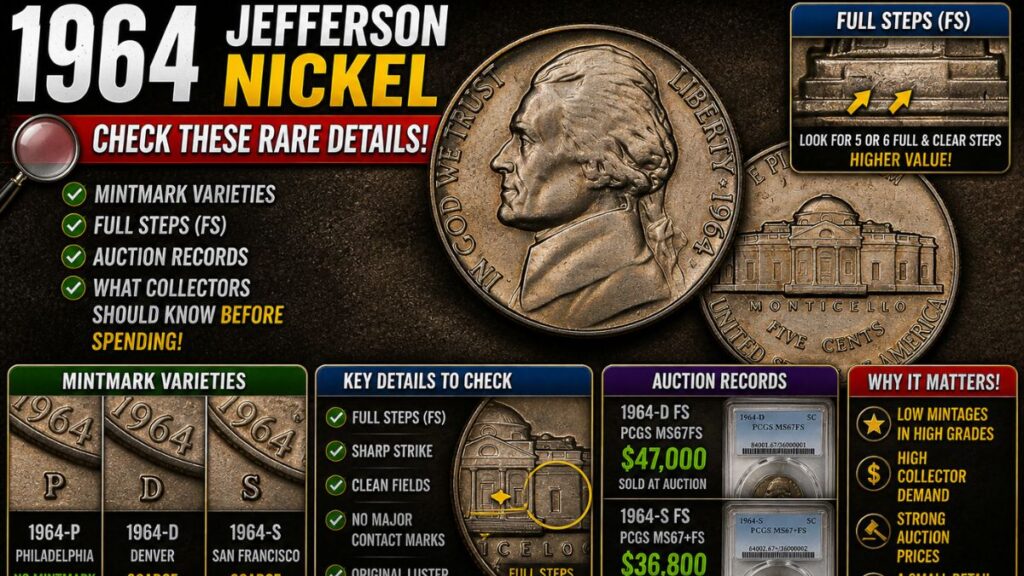
A 1964 Jefferson nickel might look like an ordinary five-cent coin, but a closer examination of its mintmark, reverse design, and overall condition could reveal details that make it especially interesting to collectors. While most 1964 Jefferson nickels are common and worth only a small amount above their face value, certain varieties and exceptionally well-preserved examples can command substantial premiums.
One of the most important details to examine is the reverse of the coin, particularly the steps beneath Monticello, the historic building featured on the back. Collectors pay close attention to these steps because a coin with five complete, clearly defined steps may qualify for the Full Steps designation, which can make a significant difference in its collectible value.
The 1964-D Jefferson nickel is particularly interesting because the Denver Mint produced more than 1.78 billion examples that year. Despite this enormous production, finding a coin with exceptional preservation and sharply defined steps can be challenging.
There are also varieties worth investigating. One notable example is the 1964-D/D FS-501 Repunched Mintmark, in which a second impression of the D mintmark can be seen beneath or beside the primary impression. This variety has attracted collector attention, especially in higher grades.
Auction records demonstrate how much collectors may pay for exceptional examples. A 1964-D graded MS67 Full Steps reportedly sold for $9,900 in 2025. A certified MS66 example of the 1964-D/D FS-501 Repunched Mintmark has a documented auction record of $19,800.
These figures are impressive, but they do not mean that every 1964 nickel is valuable. Most circulated examples remain ordinary coins, and even a coin with an interesting feature must be examined carefully before its value can be established.
Understanding the difference between a common coin, a scarce variety, and an exceptional-condition example is the key to identifying a potentially valuable 1964 Jefferson nickel.
Why the 1964 Jefferson Nickel Deserves a Closer Look
The 1964 Jefferson nickel is one of the most widely encountered coins in American circulation. Its familiar design, substantial production numbers, and long history make it a natural starting point for many coin collectors.
At first glance, there may seem to be little reason to examine one closely. The coin has the familiar portrait of Thomas Jefferson on the front and Monticello on the reverse. Its date is easy to recognize, and millions of examples were produced.
However, coins from the same year can differ significantly in condition, strike quality, and variety.
Some 1964 nickels show heavy wear from years of circulation. Others have been preserved in excellent condition, with much of their original surface detail intact. A smaller number display unusual minting characteristics that distinguish them from ordinary examples.
These differences matter because collectors do not value every coin solely according to its date.
A common coin in worn condition may be worth only its face value or a modest premium. An exceptionally well-preserved example with sharp details can be more desirable. A recognized variety may attract additional attention from specialists.
The 1964 Jefferson nickel brings these factors together in a particularly interesting way.
The enormous mintage means ordinary examples are plentiful, while the demand for sharply struck coins creates a separate collecting market. The possibility of a repunched mintmark adds another reason to inspect the coin carefully.
For someone examining a coin collection, an old jar of change, or a group of inherited coins, understanding these distinctions can prevent an interesting nickel from being overlooked.
It is equally important to avoid the opposite mistake: assuming that every 1964 nickel is rare simply because a few exceptional examples have sold for thousands of dollars.
The goal is to identify what makes a particular coin different and determine whether that difference has recognized collector significance.
Understanding the 1964 Jefferson Nickel Design
The Jefferson nickel features a portrait of Thomas Jefferson on the obverse, or front, and a depiction of Monticello on the reverse, or back.
The design was introduced in 1938 and remained a familiar part of American coinage for decades. The 1964 issue belongs to the traditional Jefferson nickel series, which is widely collected by date, mintmark, condition, and variety.
The obverse displays Jefferson’s profile, with the date positioned near the lower portion of the design. The mintmark, when present, is also an important feature to examine.
The reverse depicts Monticello, Jefferson’s historic home in Virginia. The building’s architectural details are especially important to collectors who evaluate the sharpness of a coin’s strike.
The steps leading to the entrance are among the most closely examined details.
On a sharply struck example, the individual steps can appear clearly separated, with distinct horizontal lines. On a weaker strike or a worn coin, some of those lines may be faint, merged, or missing.
This distinction is central to the Full Steps designation.
The coin’s design also provides several areas where wear, contact marks, and minting characteristics can be observed. The portrait, lettering, building, and steps all help reveal how the coin was produced and how it has been handled since leaving the mint.
A careful inspection of both sides is therefore more useful than focusing on the date alone.
The Massive Mintage of the 1964 Jefferson Nickel
The 1964 Jefferson nickel was produced in enormous quantities, making it one of the most common dates in the series.
The Denver Mint struck more than 1.78 billion examples. Such a large production total explains why ordinary 1964-D nickels are still widely encountered.
A high mintage generally means that a coin is not scarce simply because of its date. When millions or billions of examples survive, collectors have many opportunities to obtain a representative coin.
However, mintage figures do not tell the entire story.
A coin’s original production total is different from the number of examples that survive today in a particular condition.
Many coins were released into circulation and experienced years of handling. Their surfaces became worn, their details softened, and their original appearance changed.
Coins preserved in exceptional condition represent a much smaller portion of the original production.
This is particularly relevant for Jefferson nickels with sharply defined steps on Monticello. Although many coins were produced, not every example received an equally sharp strike or survived without damage.
Consequently, a coin from a high-mintage year can still be difficult to find in a narrowly defined condition.
That does not make every high-grade example automatically rare or valuable. Its desirability depends on the grade, the sharpness of the strike, collector demand, and the availability of comparable coins.
The enormous production of 1964 nickels is therefore best understood as the starting point for evaluating the coin, not the final answer.
1964-P and 1964-D: Understanding the Mintmarks
The mintmark is one of the first details to check when examining a 1964 Jefferson nickel.
A mintmark identifies the mint facility associated with the coin’s production. For the 1964 Jefferson nickel, the two primary circulation issues discussed by collectors are the Philadelphia issue and the Denver issue.
The Philadelphia issue is commonly identified as the 1964-P in collecting terminology, although the coin itself does not display a P mintmark.
The Denver issue carries a D mintmark.
This distinction is important because the two issues have different production histories and may have different availability in certain grades and strike-quality categories.
The D mintmark is particularly relevant when examining the 1964-D/D FS-501 Repunched Mintmark variety.
However, the presence of a D alone does not establish that a coin is rare.
Millions of ordinary 1964-D nickels carry the same mintmark. The variety must be identified by examining the specific characteristics of the lettering and determining whether the coin matches the recognized variety.
The mintmark should be inspected under good lighting and, if necessary, with magnification.
Look for unusual contours, overlapping impressions, or other details that may indicate a repunched mintmark. At the same time, be careful not to mistake ordinary marks, scratches, or damage for a genuine variety.
A mintmark can provide useful information, but it must be interpreted in the context of the entire coin.
What Is the 1964-D/D FS-501 Repunched Mintmark?
The 1964-D/D FS-501 Repunched Mintmark is a recognized variety that collectors may encounter while examining 1964-D Jefferson nickels.
The designation identifies a coin with a repunched D mintmark. In simple terms, the mintmark shows evidence of more than one impression, creating a distinctive appearance that differs from an ordinary D.
A repunched mintmark occurs when the mintmark is impressed more than once during the production of a working die, with the impressions not perfectly aligned.
The result can be a visible doubling or overlapping effect in the mintmark.
On a genuine example, the secondary impression may appear as an additional contour or partial outline near the primary D.
The exact appearance depends on the variety and the position of the impressions.
The FS-501 designation is useful because it identifies a specific variety rather than describing any coin that happens to show an unusual-looking mintmark.
That distinction matters.
Not every doubled-looking D is a recognized repunched mintmark variety. Damage, scratches, die deterioration, and other factors can produce visual effects that resemble doubling.
A collector should therefore compare the coin’s characteristics with reliable variety identification information before assuming that it is an FS-501.
The variety is especially interesting because it offers a reason to examine a coin that might otherwise be treated as an ordinary 1964-D nickel.
For collectors who specialize in Jefferson nickel varieties, such differences can be an important part of building a more complete collection.
How to Identify the Repunched Mintmark
Identifying a possible 1964-D/D FS-501 requires patience and careful observation.
The first step is to confirm that the coin is a 1964-D Jefferson nickel.
Once the date and mintmark have been established, examine the D closely.
Use a magnifying glass or a coin loupe if the details are difficult to see with the naked eye. A magnification of approximately 5× to 10× is often useful for examining small mintmark details.
Position the coin under a steady light source. Moving the light slightly can help reveal contours that may be difficult to see under direct illumination.
Look for a secondary impression around the D.
A genuine repunched mintmark may show an additional curve or edge that appears separate from the primary outline. The second impression may be more visible on one side than the other.
Do not assume that any extra line is evidence of a valuable variety.
A scratch can create a thin line across the surface. A contact mark may leave an irregular impression. Corrosion or damage can also alter the appearance of the mintmark.
These features are not equivalent to a recognized repunched mintmark.
The coin should be compared with documented images and diagnostic information for the FS-501 variety.
Pay attention to the position, shape, and orientation of the secondary impression. A genuine match should exhibit the expected characteristics rather than merely looking unusual.
If the coin appears promising, avoid cleaning it or attempting to improve the mintmark’s visibility through scraping or polishing.
Such actions can damage the surface and reduce collector interest.
For a potentially valuable example, professional attribution may be worthwhile.
Why the FS-501 Variety Attracts Collector Interest
Collectors often enjoy identifying coins that differ from ordinary examples in a meaningful and recognizable way.
A repunched mintmark offers a visible connection to the coin’s production process. It shows that the die used to strike the coin had a specific characteristic that carried through to the finished piece.
For specialists, such varieties can add depth to a collection.
Instead of collecting only one 1964 Jefferson nickel, a collector may seek the Philadelphia issue, the Denver issue, and recognized varieties associated with the year.
The FS-501 designation provides a specific target for collectors who want to study mintmark varieties.
Condition can influence its desirability as well.
A coin with a clearly visible variety and attractive preservation may be more appealing than a heavily worn example whose details are difficult to examine.
Authentication is especially important when the potential value is substantial.
A coin that appears to show a repunched mintmark must be correctly attributed before it can be treated as a genuine example of the variety.
The reported auction record of $19,800 for a certified MS66 example illustrates the potential collector interest in an exceptional specimen.
That figure should be understood as a specific documented result, not a standard price for every 1964-D nickel or every coin with a doubled-looking mintmark.
The grade, variety attribution, certification, and individual coin’s condition all matter.
What Does Full Steps Mean on a Jefferson Nickel?
Full Steps is a designation used for Jefferson nickels with exceptionally clear separation in the steps beneath Monticello.
The steps are among the most important reverse details for collectors who evaluate strike quality.
A coin with sharply defined steps shows that the design was transferred to the metal with a high level of detail in that area.
On many Jefferson nickels, the steps may appear incomplete because the strike was not strong enough to bring out every detail clearly. Wear and contact marks can also affect their appearance.
A Full Steps designation recognizes coins that meet specific standards for the completeness and separation of the step lines.
For the 1964 Jefferson nickel, the presence of five complete steps is an important feature to look for.
However, the exact standards for awarding a Full Steps designation depend on the grading service and its published criteria.
Collectors should not assume that a coin qualifies simply because five lines appear visible at a glance.
The lines must be sufficiently complete and distinct, and the coin must meet the applicable grading requirements.
Full Steps is not a separate mintmark or a different date.
It is a designation related to the quality and preservation of the reverse design.
For high-grade Jefferson nickel collectors, this distinction can make a substantial difference in desirability.
Where to Find the Steps on Monticello
The steps are located on the reverse of the 1964 Jefferson nickel, directly beneath the entrance of Monticello.
To inspect them, turn the coin over and focus on the central building.
The steps appear as a series of horizontal lines below the entrance.
On an ordinary example, some of these lines may be faint, merged, or interrupted.
On a sharply struck coin, the lines should be clearly separated, making the individual steps easier to distinguish.
The central area beneath the entrance is particularly important because it contains the details used to evaluate the step designation.
Start by examining the entire reverse.
Check the building’s columns, roofline, and surrounding lettering. Then move your attention to the steps.
Use good lighting to reveal the separation between the lines.
A loupe can help when the steps are small or when the coin’s surface has minor marks.
The goal is not simply to count visible lines. It is to determine whether the steps are complete and clearly separated according to the relevant grading standards.
A coin may show several distinct lines but still fail to qualify for Full Steps if the lines are incomplete or interrupted.
This is why a careful inspection is more reliable than a quick glance.
Why Five Complete Steps Matter
The five-step feature is central to the Full Steps designation discussed by Jefferson nickel collectors.
When the steps are sharply defined, they indicate that the reverse design was struck with enough detail to preserve the separation between the individual lines.
Coins that meet the applicable standard can be more desirable to collectors who focus on strike quality.
The distinction is especially meaningful for coins in high mint-state grades.
A coin may have very few contact marks and retain attractive surfaces, yet still lack the sharp step detail needed for Full Steps.
Conversely, a coin with clearly defined steps may attract additional attention if it also has strong overall preservation.
The combination of high grade and Full Steps designation can make a coin more difficult to find than its date and mintmark alone would suggest.
However, five visible lines do not automatically guarantee that the coin qualifies.
The lines must meet the relevant requirements for completeness and separation.
A small interruption can affect whether the coin receives the designation.
For this reason, collectors should distinguish between a coin that appears to have strong steps and one that has been officially certified with a Full Steps designation.
The difference is important when comparing auction records and market prices.
The Difference Between Strike Quality and Coin Condition
Strike quality and condition are related, but they are not the same thing.
Strike quality describes how effectively the coin’s design was transferred from the die to the metal during production.
Condition describes the coin’s state of preservation after it was struck.
A coin can have a strong strike but still show contact marks or other signs of handling.
Another coin may have relatively clean surfaces but weakly defined design details because of an incomplete strike.
This distinction is especially important when evaluating Jefferson nickels.
The steps beneath Monticello are a useful indicator of strike detail, but their appearance can also be affected by wear and damage.
A coin that has circulated extensively may lose some of its original detail.
A coin that has remained uncirculated may still have weak step definition if the original strike was not strong enough.
Therefore, the absence of Full Steps does not necessarily mean that the coin is heavily worn.
Likewise, sharp steps alone do not prove that the coin is in an exceptionally high grade.
A complete evaluation should consider both strike quality and preservation.
This helps explain why a 1964-D nickel with Full Steps can command a premium even though the date itself is common.
Understanding Mint State Grades
Coin grading provides a standardized way to describe a coin’s condition.
Mint State grades apply to coins that have not circulated, although they may still show marks from production, storage, or contact with other coins.
The numerical Mint State scale generally runs from MS60 through MS70.
Higher numbers indicate a higher overall grade within the mint-state category.
The grade takes into account several factors, including surface preservation, luster, eye appeal, and the quality of the strike.
A coin graded MS60 may show substantial marks or other imperfections despite having no evidence of circulation.
An MS65 coin generally has stronger overall preservation and appearance.
An MS67 coin represents a higher level of quality, with fewer distracting imperfections and strong visual appeal.
An MS66 coin falls between those two grades.
The exact grading outcome depends on the grading service’s standards and the characteristics of the individual coin.
Two coins with the same date and mintmark can receive different grades because their surfaces and design details differ.
The grade is not determined by age alone.
A 1964 nickel is not automatically valuable because it has survived for decades. Its condition must be assessed individually.
This is especially important when discussing auction records for high-grade coins.
A record for an MS67 Full Steps example cannot be applied directly to a circulated coin or even to every coin graded MS67.
The designation and individual condition matter.
Why High-Grade 1964-D Nickels Can Be Difficult to Find
The 1964-D nickel had an enormous mintage, but the number of examples preserved in exceptional condition is a separate question.
Many coins entered circulation, where they were exposed to friction, contact with other coins, and everyday handling.
Even coins that were not heavily circulated may have accumulated small marks during production, transportation, or storage.
The reverse steps can also be difficult to preserve in sharp detail.
A strong strike is not guaranteed simply because a coin is uncirculated.
As a result, collectors seeking a 1964-D nickel in a high mint-state grade with Full Steps may face a much narrower selection than the overall mintage suggests.
This is one reason high-grade examples can attract substantial premiums.
The combination of excellent surface preservation and complete step detail is more demanding than simply finding a coin from the correct year.
However, scarcity should always be considered in context.
A coin may be difficult to find in a specific grade without being rare in every grade.
The ordinary 1964-D nickel remains common, and most examples will not meet the requirements for exceptional-condition premiums.
The distinction between overall availability and availability in a narrow grade category is essential to understanding the market.
The Reported $9,900 Auction Record for a 1964-D MS67 Full Steps
A 1964-D Jefferson nickel graded MS67 Full Steps reportedly sold for $9,900 in 2025.
This result illustrates how strongly condition and strike quality can influence the value of a coin that was originally produced in enormous quantities.
The important details are the date, mintmark, grade, and Full Steps designation.
The coin was not simply an ordinary 1964-D nickel.
It represented an exceptional combination of preservation and reverse detail.
An auction result reflects the amount paid for a specific coin in a particular transaction.
It does not establish a guaranteed price for every coin with the same date and mintmark.
Even another coin graded MS67 Full Steps may differ in eye appeal, surface quality, certification, or other characteristics.
Market conditions can also change between sales.
The $9,900 figure should therefore be treated as a documented example of what a particular high-grade coin achieved, rather than as a standard valuation.
For someone examining a 1964-D nickel at home, the relevant question is whether the coin actually approaches the same level of quality.
A heavily worn coin with incomplete steps is not comparable to a certified MS67 Full Steps specimen.
The auction record demonstrates the importance of careful grading, not a promise that an ordinary coin will bring thousands of dollars.
The Reported $19,800 Auction Record for the FS-501 Variety
The 1964-D/D FS-501 Repunched Mintmark has also attracted significant collector attention.
A certified MS66 example reportedly has a documented auction record of $19,800.
This figure is notable because it highlights the potential value associated with a recognized variety in a high grade.
The coin’s appeal comes from more than its date.
Its repunched mintmark distinguishes it from ordinary 1964-D nickels, while its certified MS66 grade indicates a high level of preservation.
Both features contribute to its collector interest.
However, the record should not be interpreted as the expected value of every coin that appears to have a doubled D.
The variety must be genuine and correctly attributed.
The coin’s condition must also be established.
An uncertified coin with an unusual-looking mintmark may not be comparable to a certified example of the recognized FS-501 variety.
Even a genuine example can differ significantly in value depending on its grade and overall appearance.
The $19,800 result is therefore best understood as a specific auction record for a particular certified coin.
It demonstrates why the mintmark deserves close attention, but it does not mean that every 1964-D nickel has the potential to sell for that amount.
Why Auction Records Do Not Determine Every Coin’s Value
Auction records are useful because they show what buyers have paid for specific coins in actual transactions.
However, they are not universal price tags.
A record-setting sale may involve a coin with an unusually high grade, a recognized variety, exceptional eye appeal, or other characteristics that distinguish it from ordinary examples.
When evaluating another coin, those differences must be considered.
For example, a 1964-D nickel graded MS67 Full Steps is not equivalent to a circulated 1964-D nickel.
The two coins share a date and mintmark, but their condition and collector appeal are substantially different.
Similarly, a certified MS66 FS-501 variety is not comparable to a coin with an unverified mintmark anomaly.
A useful valuation process begins by identifying the coin accurately.
The next step is to determine its condition and whether it qualifies for a recognized variety or designation.
Only then can comparable sales provide meaningful guidance.
It is also important to distinguish between a completed auction sale and an advertised asking price.
An asking price represents what a seller hopes to receive. A completed sale records a transaction that actually occurred.
Neither guarantees what another coin will sell for in the future.
Collectors should use auction records as evidence of market interest, not as promises of profit.
How to Examine a 1964 Jefferson Nickel at Home
A careful home inspection can help determine whether a 1964 Jefferson nickel deserves further attention.
You do not need expensive equipment to begin.
A clean, well-lit workspace and a magnifying glass can be enough to identify the main features.
Start by placing the coin on a soft, clean surface.
Avoid rubbing it against a hard tabletop or handling it excessively.
Examine the obverse first.
Confirm the date and look for the mintmark.
If the coin carries a D, note its location and inspect the shape of the letter.
Then turn the coin over and examine Monticello.
Focus on the steps beneath the entrance.
Look for clearly separated horizontal lines and check whether the details appear complete.
After inspecting the steps, examine the coin’s overall condition.
Look for signs of circulation, including wear on the portrait and other raised design elements.
Check for scratches, dents, discoloration, and contact marks.
Do not assume that a coin is uncirculated simply because it looks shiny.
Some circulated coins can retain attractive surfaces, while some uncirculated coins may have marks from handling or storage.
If the mintmark appears unusual or the steps look exceptionally sharp, take clear photographs of both sides.
Photographs can help with preliminary comparisons, although they may not reveal every detail needed for authentication or grading.
The purpose of a home inspection is to identify promising characteristics without damaging the coin.
Step One: Confirm the Date
Begin by checking that the coin is dated 1964.
The date is located on the obverse, near the lower portion of Jefferson’s portrait.
Make sure the final digit is clearly a 4 and that the date has not been altered or misread.
A coin’s date establishes the starting point for identifying its issue.
However, the date alone does not establish rarity or value.
Many 1964 Jefferson nickels survive, and ordinary examples are common.
Once the date has been confirmed, move on to the mintmark and reverse details.
This simple first step prevents confusion with other Jefferson nickel issues that may have different mintmarks, varieties, or collecting characteristics.
Step Two: Check for the Denver Mintmark
Look for a D mintmark on the obverse.
The presence of a D identifies the Denver issue.
If the coin does not have a D, do not assume that it is an error or an incomplete coin. The Philadelphia issue does not carry a P mintmark on the coin.
For a 1964-D nickel, the mintmark is particularly important because it determines whether the FS-501 repunched mintmark variety is relevant.
Once the D has been identified, examine its shape closely.
Look for signs of a second impression or unusual overlapping contours.
If the D appears ordinary, that does not reduce the coin’s usefulness as a collectible. It simply means that the specific repunched mintmark variety has not been identified.
The coin may still be worth examining for condition and step detail.
Step Three: Inspect the D Mintmark for Repunching
Use magnification to inspect the D carefully.
A repunched mintmark may show a secondary outline that differs from the normal shape of the letter.
Look around the edges of the D rather than focusing only on its center.
A genuine secondary impression should have a recognizable relationship to the primary mintmark.
Compare the observed details with the known diagnostics of the 1964-D/D FS-501 variety.
Do not rely on a vague resemblance.
A scratch may cross the letter, and a contact mark can make the edge appear irregular.
Such damage does not establish a repunched mintmark.
If the coin seems to match the recognized variety, consider seeking an expert attribution.
Accurate identification is especially important when the potential value is significant.
Step Four: Examine the Monticello Steps
Turn the coin over and focus on the steps beneath Monticello.
The steps should be examined under good lighting, preferably with magnification.
Look for five complete, distinct step lines.
Check whether the lines are clearly separated and whether any appear interrupted.
Pay attention to the central area beneath the entrance, where the separation between the steps is especially important.
A coin with incomplete or merged lines may not qualify for Full Steps.
A coin with strong step detail may deserve closer evaluation, particularly if the rest of the coin is also well preserved.
Remember that a visual impression is not the same as an official designation.
The applicable grading standards must be met before a coin can be described as certified Full Steps.
Step Five: Evaluate the Coin’s Overall Condition
After checking the mintmark and steps, examine the coin’s overall preservation.
Look for wear on the raised areas of Jefferson’s portrait and the reverse design.
Inspect the fields, which are the relatively flat areas around the design.
Check for scratches, contact marks, discoloration, corrosion, and other surface problems.
These characteristics can affect the coin’s grade and desirability.
A coin with a recognized variety may still have limited value if it is heavily damaged.
Likewise, a coin with sharp steps may not be exceptional if its surfaces show significant imperfections.
The strongest candidates for high-grade premiums combine the relevant variety or designation with excellent overall preservation.
Step Six: Avoid Cleaning or Altering the Coin
Never clean a potentially collectible coin simply to make its details more visible.
Polishing, rubbing, scraping, and chemical cleaning can permanently alter the surface.
Even a coin that appears dirty may retain original surface characteristics that collectors value.
Cleaning can leave hairline scratches or unnatural changes in color and luster.
These alterations may reduce the coin’s desirability and complicate professional grading.
If dirt or residue makes the mintmark difficult to inspect, leave the coin untouched and seek advice from someone experienced in coin preservation.
The same principle applies to suspected varieties.
Do not scratch around the mintmark or attempt to deepen the steps.
Such actions can destroy evidence needed to determine whether the coin is genuine.
Preserving the coin in its current condition is the safest approach.
Step Seven: Consider Professional Authentication
Professional authentication may be appropriate when a coin appears to match a recognized variety or has unusually strong condition characteristics.
A reputable grading service can examine the coin’s authenticity, assign a grade, and determine whether it qualifies for a relevant designation.
For a possible FS-501 repunched mintmark, accurate attribution is especially important.
The service must determine whether the observed characteristics match the recognized variety rather than damage or another unrelated feature.
For a potential Full Steps coin, the reverse detail must meet the grading service’s requirements.
Professional grading can also help establish a more consistent basis for comparing the coin with other examples.
However, submitting a coin for grading involves costs, and not every 1964 nickel will justify the expense.
A common circulated coin is unlikely to benefit from an expensive certification process.
Before submitting a coin, consider its apparent condition, the strength of the variety evidence, and the potential value of comparable certified examples.
Which 1964 Jefferson Nickels Are Worth a Closer Inspection?
Several characteristics can make a 1964 Jefferson nickel worth examining more carefully.
The first is an apparent repunched mintmark on a Denver issue.
A coin that seems to show a secondary D impression may deserve comparison with the recognized FS-501 variety.
The second is exceptionally sharp reverse detail.
A coin with five complete, clearly separated steps beneath Monticello may be a candidate for Full Steps evaluation.
The third is strong overall preservation.
A coin with minimal wear and attractive surfaces may be more desirable than a heavily circulated example.
These characteristics can occur separately or together.
A coin might have strong steps but no recognized mintmark variety.
Another might have the FS-501 variety but show considerable wear.
A third might combine a recognized variety with exceptional condition.
Each situation requires its own evaluation.
The most important point is that the coin’s date alone is not enough to establish a substantial premium.
Collectors should focus on the characteristics that distinguish the individual example from the many ordinary coins produced in 1964.
Are All 1964-D Nickels Valuable?
No. Most 1964-D Jefferson nickels are common.
The Denver Mint produced more than 1.78 billion examples, and ordinary coins remain widely available.
A circulated 1964-D nickel without a recognized variety or exceptional condition generally does not command a major premium.
The high auction records associated with the date apply to specific coins with distinctive characteristics.
An MS67 Full Steps example is very different from a worn coin that has spent years in circulation.
Likewise, a certified FS-501 variety is different from an ordinary D-mintmark nickel.
It is important to avoid assuming that a coin is rare simply because it has a Denver mintmark.
The mintmark is useful for identifying the issue and determining which varieties may be relevant.
It is not proof of exceptional value by itself.
Are All 1964 Jefferson Nickels with Five Visible Steps Full Steps Coins?
Not necessarily.
Five visible lines are an important starting point, but the Full Steps designation depends on the completeness and separation of the steps under the applicable grading standards.
A coin may appear to show five lines while still having interruptions or merged areas that prevent it from qualifying.
Lighting can also affect how the steps appear.
A line that looks complete from one angle may reveal a gap when examined under different lighting.
This is why collectors should avoid assigning the designation solely on the basis of a quick visual inspection.
A coin that appears promising can be described as having strong step detail until its eligibility is confirmed.
Official certification provides a more reliable basis for identifying a coin as Full Steps.
Why Some 1964 Nickels Look Better Than Others
Coins from the same year and mint can differ in appearance for several reasons.
The quality of the original strike is one important factor.
A strong strike can bring out sharper design details, while a weaker strike may leave some features less defined.
The condition of the coin after production also matters.
Coins that circulated for years may show wear and contact marks.
Coins that were carefully stored may retain more of their original surface detail.
Storage conditions can influence appearance as well.
Exposure to environmental factors may affect a coin’s color or surface condition.
However, appearance alone does not establish a coin’s value.
A bright surface does not automatically indicate an uncirculated coin, and a darker surface does not necessarily mean that a coin is damaged.
The relevant questions are whether the coin is authentic, how well it is preserved, and whether it possesses a recognized variety or designation.
The Importance of Authentication for Valuable Varieties
Authentication is particularly important when a coin appears to have a rare or valuable variety.
A repunched mintmark can be difficult to distinguish from damage without careful examination.
A coin may show an unusual mark that resembles a second impression but does not match the recognized variety.
The distinction can have a substantial effect on collector interest.
Authentication helps establish whether the coin is genuine and whether its characteristics match the claimed variety.
For high-grade coins, certification can also provide a standardized description of condition.
This is useful when comparing a coin with auction records or considering a sale.
However, certification does not guarantee a particular market price.
The value still depends on the coin’s characteristics and the level of demand among collectors.
A certified coin may also be worth less than an auction record for a more desirable example of the same variety.
The role of authentication is to establish what the coin is, not to promise what it will sell for.
How Collector Demand Influences the Value of a 1964 Nickel
Collector demand is one of the factors that determines how much a coin may sell for.
A common coin with a large surviving population may be easy to obtain, limiting the premium that buyers are willing to pay.
A coin with a recognized variety or an unusually high grade may attract a narrower but more specialized group of collectors.
The 1964-D Full Steps nickel illustrates this difference.
Although the date is common, collectors seeking high-grade examples with sharp reverse detail may find that suitable coins are less readily available.
The FS-501 repunched mintmark variety offers another collecting target.
Collectors who specialize in mintmark varieties may place additional importance on identifying and acquiring a certified example.
Demand can change over time.
Interest may increase or decrease depending on the number of collectors pursuing a particular series, the availability of comparable coins, and broader market conditions.
For that reason, historical auction records should not be treated as fixed prices.
A coin’s value is influenced by its individual characteristics and the market at the time of sale.
How to Compare Your Coin with Auction Records
When comparing a 1964 Jefferson nickel with an auction result, begin by matching the basic identification details.
Confirm the date and mintmark.
Determine whether the coin is an ordinary issue or a recognized variety.
Then compare the grade and any special designation.
For example, the reported $9,900 sale involved a 1964-D MS67 Full Steps coin.
A coin with a lower grade or without the Full Steps designation is not directly comparable.
Similarly, the reported $19,800 record involved a certified MS66 example of the FS-501 repunched mintmark variety.
An ordinary 1964-D nickel does not share the same variety attribution.
The coin’s overall appearance also matters.
Surface quality, marks, luster, and eye appeal can distinguish two examples with similar grades.
When possible, compare multiple completed sales rather than relying on a single record.
A single unusually high sale may not reflect the typical market for the variety.
The most useful comparison is between coins that match as closely as possible in date, mintmark, variety, grade, and designation.
Common Mistakes to Avoid When Searching for a Valuable 1964 Nickel
One common mistake is assuming that every old nickel is rare.
The 1964 Jefferson nickel is decades old, but age alone does not make it scarce.
Another mistake is treating the enormous mintage as proof that every example is worthless.
High-grade coins and recognized varieties can still attract collector premiums.
The correct approach is to examine the individual coin rather than relying on a single generalization.
A third mistake is confusing damage with a minting variety.
Scratches and contact marks can create unusual shapes around the mintmark.
A genuine repunched mintmark must match the recognized characteristics of the variety.
A fourth mistake is assuming that five visible step lines automatically qualify a coin for Full Steps.
The lines must meet the applicable standards for completeness and separation.
A fifth mistake is treating an auction record as a guaranteed value.
The price paid for a specific certified coin does not establish the value of every coin from the same year.
Finally, avoid cleaning or altering a coin in an attempt to improve its appearance.
Preserving the original surface is important when determining its condition and collector appeal.
How to Store a 1964 Jefferson Nickel Safely
Proper storage helps protect a coin’s condition.
If you believe a 1964 nickel may have collector value, handle it carefully and avoid unnecessary contact with its surfaces.
Hold the coin by its edges rather than touching the front or back.
Skin oils and residue can affect the surface over time.
A suitable coin holder can help protect the coin from scratches and environmental exposure.
Avoid storing potentially valuable coins loose in containers where they can rub against other coins.
If the coin has already been certified, keep it in its original protective holder unless there is a specific reason to do otherwise.
For uncertified coins, choose storage materials designed for coin preservation.
Avoid materials that may react with the metal or leave residue.
Keep the coin in a stable environment and protect it from moisture and harsh chemicals.
These precautions are useful even if the coin turns out to be an ordinary example.
Careful storage preserves the opportunity for a more accurate future examination.
Should You Get Every 1964 Nickel Graded?
No. Professional grading is not necessary for every coin.
Most 1964 Jefferson nickels are common, and the cost of grading may exceed the coin’s potential value.
A circulated example with ordinary details is generally not a strong candidate for expensive certification.
Grading becomes more relevant when a coin appears to have a recognized variety, exceptional preservation, or unusually sharp step detail.
A possible FS-501 repunched mintmark may justify further examination if its characteristics appear convincing.
A high-grade coin with strong steps may also deserve consideration.
Before submitting a coin, compare its apparent characteristics with those of certified examples.
Consider whether the potential value is sufficient to justify the grading fee and other expenses.
If the coin’s identity is uncertain, preliminary expert advice may help determine whether formal certification is worthwhile.
The goal is to make an informed decision rather than submitting every coin simply because it has an interesting date.
What Makes a 1964 Nickel Different from an Ordinary Five-Cent Coin?
The difference lies in the characteristics of the individual coin.
An ordinary 1964 nickel is part of a widely produced issue.
A coin with a recognized variety, exceptional preservation, or a special designation may have additional collector interest.
The FS-501 repunched mintmark is one example of a distinctive variety.
Full Steps is another important feature for collectors who focus on strike quality.
A coin that combines a recognized variety with a high grade may be especially desirable.
However, these features should not be confused with ordinary differences in appearance.
Small scratches, discoloration, or unusual marks do not automatically create a valuable coin.
A meaningful distinction must be established through careful identification.
For most owners, the first step is simply to examine the mintmark and reverse.
If the coin appears ordinary, it may remain a useful piece of everyday currency or a modest addition to a collection.
If it shows unusual characteristics, further research and professional evaluation may be appropriate.
Building a 1964 Jefferson Nickel Collection
The 1964 Jefferson nickel can be an accessible starting point for a focused collecting project.
A collector might begin by obtaining representative examples of the Philadelphia and Denver issues.
From there, the collection can expand to include coins with different grades and strike characteristics.
A Full Steps example can provide a useful comparison with a coin that has less complete reverse detail.
Collectors interested in varieties may also seek a correctly attributed FS-501 repunched mintmark.
The goal does not have to be acquiring the most expensive example.
A collection can be organized around learning how coins differ in condition, strike quality, and minting characteristics.
Keeping notes about each coin’s date, mintmark, grade, and identifying features can help build a clearer understanding of the series.
Photographs can also be useful for tracking the condition of individual coins.
For a collection that includes valuable examples, appropriate storage and accurate documentation are important.
The 1964 issue offers an opportunity to study how a common date can contain meaningful differences in collector interest.
Is the 1964 Jefferson Nickel a Good Coin to Search for in Pocket Change?
Searching through pocket change can be an enjoyable way to learn about coin collecting.
The 1964 Jefferson nickel is recognizable and common enough that collectors may encounter examples in older coin collections or mixed groups of coins.
However, finding a coin with the characteristics associated with major auction records is a different matter.
Most circulated examples will show wear and will not have the preservation required for high mint-state grades.
The steps may be worn or incomplete, and the mintmark may be ordinary.
A possible repunched mintmark can be difficult to identify without careful inspection.
Even so, examining the coin can be educational.
You can learn to distinguish the mintmarks, recognize the reverse design, and understand the difference between a strong strike and a worn surface.
If you find a coin with unusual characteristics, set it aside for further examination rather than assuming it is valuable.
A careful, evidence-based approach makes the search more useful and helps prevent unrealistic expectations.
What to Do If You Think You Have a Valuable 1964 Jefferson Nickel
If your coin appears to have a repunched mintmark or exceptional step detail, begin by documenting what you see.
Take clear photographs of the obverse and reverse.
Use close-up images of the mintmark and the steps beneath Monticello.
Avoid excessive handling while taking photographs.
Next, compare the coin’s characteristics with recognized variety information and grading standards.
If the mintmark appears to match the FS-501 variety, seek a knowledgeable opinion before assigning a value.
If the steps appear complete, determine whether the coin’s overall condition is consistent with a high mint-state grade.
Do not assume that a coin is worth thousands of dollars merely because it resembles a record-setting example.
The variety and grade must be established.
If the coin appears promising, professional authentication may help clarify its identity and condition.
Keep the coin safely stored while you investigate.
A careful process protects both the coin and your understanding of its potential collector value.
Frequently Asked Questions About the 1964 Jefferson Nickel
Is a 1964 Jefferson nickel rare?
Most 1964 Jefferson nickels are common because they were produced in enormous quantities. Certain recognized varieties and exceptional-condition examples can be more difficult to find and may command premiums.
How much is a 1964-D Jefferson nickel worth?
The value depends on its condition, strike quality, and whether it has a recognized variety. Most circulated examples are common, while exceptional high-grade coins can be worth substantially more.
What is the 1964-D/D FS-501 variety?
It is a recognized repunched mintmark variety in which the D mintmark shows evidence of a second impression. A genuine example should match the documented characteristics of the FS-501 designation.
How can I identify a repunched mintmark?
Examine the D mintmark under magnification and look for a secondary impression or overlapping contours. Compare the details with the recognized variety’s diagnostics, and seek expert attribution if necessary.
What does Full Steps mean on a 1964 Jefferson nickel?
Full Steps is a designation for Jefferson nickels with exceptionally clear separation in the steps beneath Monticello. The coin must meet the applicable grading standards for completeness and separation.
How many steps should a Full Steps nickel show?
Five complete, clearly separated steps are an important feature for the designation discussed here. The coin must also satisfy the grading service’s specific criteria.
What is the reported auction record for a 1964-D MS67 Full Steps nickel?
A 1964-D graded MS67 Full Steps reportedly sold for $9,900 in 2025. This is a specific auction result, not a guaranteed value for other examples.
What is the reported auction record for the 1964-D/D FS-501 variety?
A certified MS66 example of the FS-501 repunched mintmark variety has a documented auction record of $19,800. Other examples may have substantially different values depending on their grade and condition.
Is every 1964-D nickel with a doubled-looking D valuable?
No. A doubled-looking mintmark may result from damage or other factors. The coin must match the characteristics of a recognized variety before it can be attributed as an FS-501.
Can a circulated 1964 nickel have Full Steps?
A circulated coin may retain some sharp step detail, but the Full Steps designation is generally associated with coins that meet the applicable strike-detail requirements. Circulation wear can affect the appearance of the steps and the coin’s grade.
Should I clean my 1964 Jefferson nickel before examining it?
No. Cleaning, polishing, or scraping can damage the coin’s surface and reduce its collector appeal. Examine it as it is and seek professional advice if necessary.
Should I send my 1964 nickel for professional grading?
Consider grading if the coin appears to have a recognized variety, exceptional preservation, or unusually sharp step detail. For common circulated examples, the cost of grading may not be justified.
Does a high mintage mean a coin cannot be valuable?
No. A high mintage means that many examples were originally produced, but the number surviving in exceptional condition or with a recognized variety may be much smaller.
Is the 1964-P Jefferson nickel also worth checking?
Yes. The Philadelphia issue can also be examined for condition and strike quality. However, the FS-501 repunched mintmark discussed here applies to the Denver issue.
How do I know whether my coin is genuinely valuable?
Begin by confirming the date and mintmark, inspecting the reverse steps, and checking for recognized varieties. Then evaluate the coin’s condition and compare it with closely matching certified examples and completed sales.
Conclusion: Check the Mintmark and Monticello Before Spending Your 1964 Nickel
The 1964 Jefferson nickel is a common coin with a few characteristics that can make certain examples especially interesting to collectors.
Its enormous production numbers mean that most examples are ordinary five-cent coins. However, a recognized repunched mintmark, exceptionally sharp reverse detail, or outstanding preservation can make an individual coin more desirable.
The 1964-D/D FS-501 Repunched Mintmark is one variety worth investigating. The Full Steps designation is another important feature, particularly for collectors seeking high-grade Jefferson nickels.
The reported auction records of $9,900 for a 1964-D MS67 Full Steps coin and $19,800 for a certified MS66 FS-501 example demonstrate the potential collector interest in exceptional specimens.
But those results apply to specific coins, not every nickel dated 1964.
If you have one, start with the mintmark. Look for a possible secondary impression on the D, then turn the coin over and inspect the steps beneath Monticello.
Pay attention to the coin’s overall condition, avoid cleaning it, and seek professional authentication if the features appear promising.
A careful examination can help you distinguish an ordinary nickel from a coin that deserves a closer look.