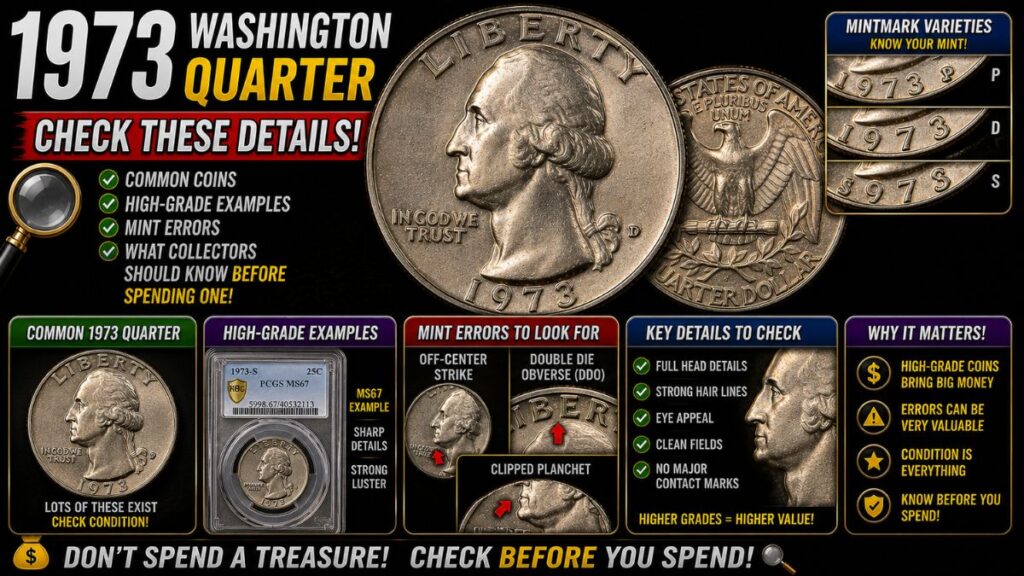
A 1973 Washington quarter may look like an ordinary 25-cent coin, but taking a closer look at its condition, mintmark, and possible minting errors could reveal something worth investigating. Although most 1973 quarters are common and generally worth their face value in circulated condition, certain high-grade examples and genuine mint errors can attract additional interest from collectors.
The key is understanding what makes one coin different from another.
A quarter from 1973 is not automatically rare simply because it is more than 50 years old. Millions of examples were produced, and many remain available today. However, coins preserved in exceptional condition can be more desirable, especially when they retain sharp details and attractive original surfaces.
Mint errors are another reason to examine a 1973 Washington quarter carefully. Errors that occur during the manufacturing process can create distinctive characteristics, such as off-center strikes, broadstrikes, clipped planchets, or doubled design elements. Some genuine errors are collectible, but ordinary damage and unusual-looking marks should not be mistaken for valuable minting mistakes.
The coin’s mintmark is also worth checking. The 1973 quarter was produced at different United States Mint facilities, and identifying the correct issue is an important first step when evaluating a coin.
Collectors should also pay attention to the overall condition of the coin. A well-preserved example with strong details may be more desirable than a heavily circulated one, while a recognized mint error may add a separate layer of collector interest.
This guide explains what to examine on a 1973 Washington quarter, how to recognize potentially interesting characteristics, why condition matters, and how to avoid common mistakes when estimating a coin’s value.
Why the 1973 Washington Quarter Is Worth Examining
The Washington quarter is one of the most familiar coins in American currency.
Its recognizable portrait of George Washington and its traditional reverse design make it easy to identify. The 1973 issue belongs to the long-running Washington quarter series, which has been collected by date, mintmark, condition, and variety.
At first glance, a 1973 quarter may appear no different from many other quarters produced during the same general period.
However, individual coins can vary considerably in quality.
Some have circulated for decades and show considerable wear. Others have been preserved with relatively clean surfaces and sharp details. A smaller number may display unusual characteristics caused by an error during production.
These differences are important because collectors do not value every quarter solely according to its date.
A circulated coin with ordinary characteristics is generally common. A coin in exceptional condition may attract additional interest, while a genuine mint error can appeal to collectors who specialize in unusual production characteristics.
The 1973 Washington quarter is therefore a useful example of how a common coin can still have collectible variations.
The most important thing is to identify the individual coin accurately rather than assuming that every example has the same value.
Understanding the 1973 Washington Quarter
The 1973 Washington quarter is part of the Washington quarter series introduced in 1932.
The coin features George Washington on the obverse, or front, and an eagle design on the reverse, or back.
The date appears on the obverse, making it easy to identify the year of production.
The mintmark, when present, identifies the mint facility associated with the coin’s production.
The reverse features an eagle with outstretched wings, surrounded by inscriptions and other design elements.
These details provide several areas to examine when checking a coin’s condition.
The portrait, lettering, eagle, and surrounding fields can reveal signs of circulation, contact marks, or unusual production characteristics.
The coin’s design also helps collectors distinguish between ordinary wear and possible minting errors.
For example, a doubled design element may require careful examination to determine whether it reflects a genuine die characteristic or simply damage.
Likewise, an unusual edge or incomplete design may be associated with a minting error, but it should not be assumed to be one without further investigation.
Understanding the basic design is the foundation for identifying a potentially collectible 1973 quarter.
Why Most 1973 Washington Quarters Are Common
The 1973 Washington quarter was produced in substantial quantities.
Large production numbers mean that ordinary examples are not generally scarce simply because of their date.
Many coins entered circulation and were used in everyday transactions. Others were saved by collectors or remained in storage.
As a result, examples can still be found in different conditions.
A coin’s original production total, however, is not the same as the number of examples that survive in a particular grade.
Many quarters experienced years of handling, resulting in worn surfaces and softened design details.
Coins that retain exceptionally clean surfaces and sharp details represent a narrower category than the overall population.
This distinction helps explain why a common date can still have collectible high-grade examples.
Nevertheless, a large mintage does not automatically make every example worthless, just as a coin’s age does not automatically make it rare.
The individual coin’s condition, authenticity, and characteristics determine whether it deserves a premium.
For most owners, the 1973 quarter will remain an ordinary coin worth its face value.
The exceptions are the examples that stand out because of their preservation, recognized varieties, or genuine mint errors.
The Different Mintmarks on 1973 Washington Quarters
The mintmark is one of the first details to check when examining a 1973 Washington quarter.
A mintmark identifies the facility associated with the coin’s production.
The 1973 quarter issues include coins struck at Philadelphia and Denver.
The Philadelphia issue is generally identified as the 1973-P in collecting terminology, although the coin itself does not carry a P mintmark.
The Denver issue carries a D mintmark.
Identifying the mintmark helps establish which issue you have and provides a starting point for comparing the coin with other examples.
However, the mintmark alone does not establish rarity.
A D mintmark does not automatically mean that a quarter is valuable, and the absence of a visible mintmark on a Philadelphia issue is not evidence of an error.
The mintmark should be examined carefully to make sure it has not been altered or confused with a surface mark.
Collectors should also remember that the value of a coin depends on more than its mint of origin.
Condition, strike quality, possible errors, and collector demand all influence desirability.
The mintmark is simply one important part of the identification process.
How to Identify the Mintmark on a 1973 Quarter
Begin by locating the date on the obverse.
Then examine the area around the date and the nearby design details for the mintmark.
Use good lighting so that the letter is easy to distinguish from the surrounding surface.
If the coin has a D mintmark, it is associated with the Denver issue.
If no mintmark is present, the coin may be the Philadelphia issue.
Do not assume that a missing or unclear mintmark is automatically an error.
A mintmark can be difficult to see because of wear, dirt, damage, or the condition of the coin’s surface.
If the area appears unusual, examine it under magnification before drawing a conclusion.
A genuine minting error must be distinguished from damage that occurred after the coin left the mint.
The mintmark is useful for identifying the issue, but it should be considered alongside the date, design, and overall condition.
Understanding the Composition of the 1973 Washington Quarter
The 1973 Washington quarter belongs to the copper-nickel clad era of American quarter production.
Unlike the earlier silver quarters produced before the composition change in 1965, the 1973 quarter is not a regular 90% silver circulation issue.
The coin has a layered construction, with a copper core and outer layers containing copper and nickel.
This composition is important when evaluating the coin’s appearance and physical characteristics.
A normal 1973 quarter should have the expected clad structure.
The exposed edge typically reveals a copper-colored core between the outer layers.
This feature can help distinguish a regular clad quarter from older silver issues.
However, the edge’s appearance alone is not enough to establish that a coin is genuine or identify a mint error.
Damage, corrosion, and other factors can affect the edge.
Collectors should avoid assuming that a copper-colored area or unusual edge automatically means a coin is rare.
The composition provides useful background for identifying the coin, but it does not create a premium by itself.
What Makes a 1973 Washington Quarter Valuable?
Several factors can influence the collectible value of a 1973 Washington quarter.
The most important are condition, minting characteristics, authenticity, and collector demand.
A coin in circulated condition generally has limited collector appeal unless it possesses a recognized variety or error.
An uncirculated coin with attractive surfaces may be more desirable.
A high-grade example with strong details and minimal distracting marks can attract additional interest from collectors who seek premium-quality coins.
Genuine mint errors can also add value.
An off-center strike, broadstrike, clipped planchet, or other recognized error may make a coin more interesting than an ordinary example.
However, not every unusual appearance is a mint error.
Damage that occurs after production generally does not have the same collector significance as a genuine manufacturing error.
The coin must be examined carefully to establish what actually happened.
The most important lesson is that a 1973 quarter’s date alone does not determine its value.
Its specific characteristics must be evaluated before a meaningful estimate can be made.
Why High-Grade 1973 Quarters Can Attract Collector Interest
Condition is one of the most important factors in coin collecting.
A quarter that has remained in excellent condition may be more desirable than one that has circulated extensively.
High-grade coins generally retain more of their original detail and surface quality.
The portrait of Washington may show strong definition, while the reverse design may retain sharp details in the eagle and surrounding lettering.
The fields may also be relatively free of distracting marks.
However, a coin can be uncirculated and still have imperfections.
Contact marks can occur during production, transportation, or storage.
A strong strike is also not guaranteed simply because a coin has never circulated.
These differences matter when evaluating coins at the upper end of the grading scale.
Collectors seeking exceptional examples often look for a combination of preservation, attractive appearance, and strong design detail.
A high grade does not automatically make a coin rare, but it can make an individual example more desirable within a common date.
What Does Mint State Mean?
Mint State is a grading category used for coins that show no evidence of circulation.
Mint State coins may still have marks or imperfections resulting from production, handling, or storage.
The numerical grading scale generally runs from MS60 through MS70.
Higher numbers indicate a higher overall grade within the Mint State category.
An MS60 coin may show noticeable marks and other imperfections despite having no circulation wear.
An MS65 coin generally has stronger overall preservation.
An MS67 coin represents a higher level of quality, with fewer distracting imperfections and strong visual appeal.
An MS70 coin is at the top of the scale and represents an exceptionally high standard of preservation.
The exact grade depends on the coin’s individual characteristics and the grading service’s standards.
A coin is not automatically MS because it looks shiny.
Some circulated coins retain attractive surfaces, while some uncirculated coins may show numerous contact marks.
Proper grading considers the overall condition rather than relying on one visual feature.
Why Surface Preservation Matters
Surface preservation is an important part of determining a coin’s condition.
The flat areas around the design are known as the fields.
On a well-preserved quarter, these areas may retain attractive original surfaces with relatively few distracting marks.
A coin that has been handled frequently may show scratches, abrasions, or contact marks.
Even minor imperfections can influence how collectors view an otherwise attractive high-grade coin.
This is particularly important when comparing two quarters with similar grades.
One may have a cleaner appearance and stronger eye appeal than the other.
Surface preservation also helps distinguish an original coin from one that has been cleaned or altered.
A polished coin may appear unusually bright but still have reduced collector appeal.
For this reason, collectors should focus on the coin’s original condition rather than simply looking for the brightest example.
Preserving the surface is essential when evaluating a potentially valuable quarter.
What Are Mint Errors on a 1973 Washington Quarter?
Mint errors are mistakes that occur during the coin manufacturing process.
They can happen when a planchet is prepared incorrectly, when a coin is struck improperly, or when equipment and production materials do not function as intended.
A genuine mint error can create a distinctive coin that differs from an ordinary example.
Some errors affect the position of the design.
Others involve the shape of the planchet, the striking process, or the relationship between the coin’s surfaces.
Collectors often find these errors interesting because they provide evidence of an unusual event during production.
However, mint errors must be distinguished from damage that occurs after a coin leaves the mint.
A quarter with a scratch, dent, or altered edge is not automatically an error coin.
The strongest candidates are those whose characteristics are consistent with a recognized minting process.
A careful examination is necessary before assigning a specific error type or estimating its value.
Off-Center Strike Errors
An off-center strike occurs when a planchet is not properly positioned between the dies during striking.
As a result, the design is impressed away from the center of the coin.
The finished coin may show a blank area where the design was not struck.
The amount of the off-center displacement can vary.
A minor displacement may be difficult to notice without close inspection.
A more dramatic off-center strike can leave a substantial portion of the coin without the normal design.
The date is an important consideration when evaluating an off-center coin.
If the date remains visible, it may be easier to identify the coin and establish its place in the series.
The appearance of the error, its severity, and the coin’s overall condition can influence collector interest.
However, an off-center-looking quarter is not automatically a genuine mint error.
Damage to the edge or surface can create an unusual appearance.
The coin should be examined carefully to determine whether the displacement occurred during the original striking process.
Broadstrike Errors
A broadstrike occurs when a coin is struck without the normal collar properly restraining the metal.
The collar helps control the coin’s diameter and edge during production.
When the collar is absent or does not function correctly, the metal can spread outward during striking.
The resulting coin may have a wider-than-normal appearance.
A broadstruck quarter can retain much of its design while showing an unusual shape or expanded edge.
The exact appearance depends on the circumstances of the error.
Broadstrikes are distinct from coins that have been flattened or expanded through post-mint damage.
A coin that has been mechanically altered after leaving the mint may appear wider, but that does not make it a genuine broadstrike.
The edge, design, and overall structure should be examined to determine whether the coin shows the characteristics of a minting error.
Clipped Planchet Errors
A clipped planchet error occurs when the metal blank used to produce a coin is missing a portion of its edge before striking.
The resulting quarter may have a curved or straight section missing from its outline.
The shape depends on how the blank was affected during the planchet preparation process.
A genuine clipped planchet error can show characteristics that distinguish it from damage caused by cutting or breaking the coin after production.
The edge and surrounding design are particularly important.
A genuine clip may affect the coin’s outline in a way consistent with the planchet manufacturing process.
Post-mint damage, on the other hand, may leave sharp or irregular surfaces that do not match the expected characteristics of a genuine error.
A clipped-looking quarter should therefore be examined carefully before it is described as a mint error.
The size, shape, and location of the missing portion can all influence collector interest.
Doubled Die Errors
A doubled die is created when a die receives misaligned impressions during its preparation.
The resulting die can transfer doubled design elements to coins struck from it.
This may produce visible doubling in lettering, numbers, or other design features.
A genuine doubled die is different from a coin that appears doubled because of movement during the striking process.
It is also different from damage that creates a second-looking outline around a letter or number.
Collectors must distinguish between a true doubled die and other forms of doubling.
The location and shape of the doubled features are important.
A genuine doubled die typically shows a consistent design characteristic rather than a random scratch or irregular surface mark.
A coin that appears to have doubling should be compared with recognized variety information.
Without a confirmed identification, it is better to describe the feature as apparent doubling rather than assume that it is a valuable variety.
Die Cracks and Die Cuds
Die cracks and die cuds are another category of minting characteristics that may appear on coins.
A die crack occurs when a die develops a crack during use.
The crack can leave a raised line on the coin’s surface.
The appearance depends on the position and shape of the crack.
A die cud generally involves a more substantial break at the edge of the die, often producing a raised area of metal on the coin.
These features are different from scratches or dents that occur after production.
A genuine die crack or cud reflects a characteristic of the die used to strike the coin.
Some examples attract collector interest, particularly when the feature is prominent and clearly identifiable.
However, not every raised line or unusual bump is a die error.
Post-mint damage and other manufacturing characteristics can produce similar appearances.
Careful examination is necessary to determine the likely cause.
Missing or Weak Design Details
A 1973 Washington quarter may show areas where the design appears weak or incomplete.
This can happen for several reasons.
The coin may have been struck with insufficient pressure or may have experienced uneven metal flow.
The die may also have been worn or otherwise affected.
Circulation wear can reduce the visibility of design details as well.
These possibilities must be distinguished from one another.
A weakly struck coin is not automatically a major mint error.
Likewise, a worn coin may appear to have missing design elements even though it was struck normally.
Collectors should examine the entire coin rather than focusing on one faint area.
The relationship between the affected detail and the surrounding design can provide clues about the cause.
If the feature appears unusual, expert examination may help determine whether it represents a recognized minting characteristic.
How to Distinguish a Genuine Mint Error from Damage
One of the most important skills in coin collecting is distinguishing a genuine mint error from damage that occurred after production.
A quarter may have scratches, dents, flattened edges, or unusual marks because it was handled roughly.
These features can sometimes resemble minting errors.
A genuine error should be consistent with a known manufacturing process.
For example, an off-center strike should show evidence that the design was struck away from the normal position.
A broadstrike should have characteristics consistent with the absence of proper collar restraint.
A clipped planchet should show an outline consistent with a missing portion of the original blank.
Damage, by contrast, often leaves irregular marks or altered surfaces that do not fit the expected pattern of a minting error.
The coin’s edge can be especially informative.
However, no single visual clue is always sufficient.
If a quarter appears unusual, compare it with examples of recognized errors and seek expert advice when necessary.
Avoid altering the coin in an attempt to reveal more details.
Why Not Every Error Coin Is Valuable
A genuine mint error can attract collector interest, but the existence of an error does not automatically guarantee a high value.
The type of error matters.
Its severity, visibility, and overall appearance can influence how desirable it is to collectors.
A dramatic error may attract more attention than a minor one.
The coin’s condition also matters.
A genuine error coin with strong preservation may be more appealing than a heavily damaged example.
Collector demand is another important factor.
Some error types are widely collected, while others may attract a smaller audience.
The identification must also be accurate.
A coin that is merely damaged or altered after production should not be treated as a genuine mint error.
For these reasons, there is no single value that applies to every 1973 quarter with an unusual appearance.
Each coin must be evaluated according to its specific characteristics.
How to Inspect a 1973 Washington Quarter at Home
A careful home inspection can help determine whether a 1973 quarter deserves further attention.
You do not need expensive equipment to begin.
A clean workspace, good lighting, and a magnifying glass can be enough for a preliminary examination.
Start by checking the date and mintmark.
Then examine the obverse and reverse for signs of wear, unusual features, and possible errors.
Look at the coin’s edge as well.
The edge can provide useful information about the coin’s composition and whether it has been altered.
After identifying the basic features, evaluate the overall condition.
Check the portrait, lettering, eagle, and fields for wear and contact marks.
If the coin appears to have an unusual characteristic, take clear photographs of both sides.
Close-up images of the area in question can help with comparisons.
However, photographs may not reveal every detail needed for authentication.
The goal of a home inspection is to identify potentially interesting characteristics without damaging the coin.
Step One: Confirm the Date
Begin by checking that the coin is dated 1973.
The date appears on the obverse, near the lower portion of Washington’s portrait.
Make sure the digits are clear and that the date has not been altered or misread.
The date establishes the starting point for identifying the coin.
However, the date alone does not determine rarity.
Most 1973 quarters are common, so further examination is needed to establish whether a particular example has additional collector interest.
Once the date has been confirmed, move on to the mintmark and overall condition.
Step Two: Identify the Mintmark
Examine the area around the date for the mintmark.
A D indicates the Denver issue.
The Philadelphia issue does not carry a P mintmark on the coin.
Make sure that any visible letter is part of the original coin rather than a mark caused by damage.
The mintmark can help establish which issue you have and make it easier to compare the coin with other examples.
However, a mintmark alone does not establish value.
An ordinary quarter with a D mintmark is not automatically rare.
The next step is to examine the coin’s condition and look for any unusual characteristics.
Step Three: Examine the Obverse
The obverse contains Washington’s portrait, the date, and the surrounding lettering.
Look for signs of wear on the raised areas of the portrait.
Check the hair, cheek, and other design details for softness or loss of definition.
Examine the lettering and fields for scratches or contact marks.
A coin that has circulated extensively may show flattened details and a less distinct appearance.
An uncirculated coin may retain more of its original detail, although it can still have marks from production or storage.
If you notice unusual doubling or another distinctive feature, examine it under magnification.
Do not assume that every extra line or irregular edge is a minting error.
The feature must be consistent with a recognized variety or error before it can be treated as collectible.
Step Four: Examine the Reverse
Turn the coin over and inspect the eagle design.
Look at the wings, feathers, lettering, and surrounding fields.
Check whether the details appear sharp or show signs of wear.
Pay attention to unusual features that seem inconsistent with the normal design.
A genuine mint error may affect part of the reverse, but damage can also alter the appearance.
Examine any suspicious area carefully and compare it with the rest of the coin.
If the feature appears to be a raised line, missing detail, or unusual shape, consider whether it could have resulted from the die or striking process.
A careful reverse inspection can help identify possible errors and assess the coin’s overall condition.
Step Five: Inspect the Edge
The edge of the 1973 Washington quarter is another useful area to examine.
A normal clad quarter typically shows a copper-colored core between its outer layers.
Look for unusual cuts, flattening, or other irregularities.
The edge can sometimes reveal evidence of damage or alteration.
However, an unusual edge does not automatically indicate a valuable mint error.
A coin may have been damaged after production, and the resulting appearance can be misleading.
If the edge seems abnormal, compare it with a normal quarter of the same general type.
Avoid scraping or cutting the coin to investigate its composition.
Such actions can permanently damage the coin and reduce its collector appeal.
Step Six: Evaluate the Overall Condition
After examining the design and edge, consider the coin’s overall condition.
Look for wear, scratches, contact marks, discoloration, and other surface imperfections.
Check whether the coin retains its original luster.
Remember that brightness alone does not establish an uncirculated grade.
A cleaned coin may appear shiny but have altered surfaces.
A naturally toned coin may have a darker appearance while retaining its original characteristics.
The overall condition should be evaluated using the coin’s design details and surface preservation.
If the coin appears exceptionally well preserved, it may deserve comparison with high-grade examples.
If it also has a possible mint error, accurate identification becomes especially important.
Step Seven: Preserve the Coin Carefully
If a 1973 quarter appears collectible, avoid cleaning or polishing it.
Cleaning can leave scratches, remove original surface characteristics, and reduce collector interest.
Do not scrape around a suspected mint error or try to make the design details more visible by rubbing the coin.
Handle it by the edges whenever possible.
Store it in a suitable coin holder to protect it from scratches and environmental exposure.
Avoid leaving potentially valuable coins loose in containers where they can rub against other coins.
Careful storage helps preserve the coin’s condition while you investigate its characteristics.
How to Compare Your Quarter with Other Examples
Comparing a coin with other examples can help you understand its characteristics.
Start by matching the date and mintmark.
Then compare the coin’s condition, strike quality, and any unusual features.
If you believe the quarter has a mint error, compare the feature with examples of the same recognized error type.
Do not compare a suspected error coin with an ordinary coin and assume that every difference is meaningful.
The feature must be understood in the context of the minting process.
For high-grade coins, compare examples with similar grades and surface quality.
A coin in excellent condition should be compared with other high-grade coins rather than with circulated examples.
The most useful comparisons are those that match the coin as closely as possible in date, mintmark, condition, and variety.
Understanding Auction Records and Coin Values
Auction records can provide useful information about the market for collectible coins.
A completed sale shows what a buyer paid for a specific coin at a particular time.
However, an auction result is not a universal price tag.
A high-grade 1973 quarter may be worth substantially more than an ordinary circulated example.
A genuine mint error may also attract a premium, depending on its characteristics and collector demand.
But a record-setting sale for one coin does not establish the value of every coin from the same year.
The grade, error type, condition, and authenticity must be considered.
It is also important to distinguish between a completed sale and an asking price.
An asking price represents what a seller hopes to receive, while a completed sale reflects an actual transaction.
Collectors should compare multiple relevant sales whenever possible.
A realistic estimate should be based on closely matching examples rather than a single unusually high result.
Why a Coin’s Age Does Not Guarantee Value
The 1973 Washington quarter is more than 50 years old, but age alone does not make it rare.
Many coins survive for decades in circulation, collections, and storage.
A coin can remain common even after a long period of time.
What matters is how many examples survive and how desirable they are to collectors.
A common coin in worn condition may have little value beyond its face value.
An exceptionally preserved coin or a genuine mint error may be more desirable.
This principle applies broadly to coin collecting.
The date is an important identification feature, but it is only one part of the evaluation process.
Collectors should avoid assuming that an old coin is automatically valuable.
Instead, examine its condition and look for characteristics that distinguish it from ordinary examples.
Common Mistakes to Avoid When Searching for a Valuable 1973 Quarter
One common mistake is assuming that every old quarter is rare.
The 1973 issue is widely available, and most examples are ordinary coins.
Another mistake is treating every unusual mark as a mint error.
Scratches, dents, and other damage can create unusual appearances without adding collector value.
A third mistake is assuming that a shiny quarter must be uncirculated.
Cleaning and polishing can make a coin look bright while reducing its collector appeal.
Another mistake is relying on a single auction record to estimate a coin’s value.
The price of an exceptional example does not apply automatically to ordinary coins.
Finally, avoid cleaning or altering a quarter in an attempt to improve its appearance.
The safest approach is to preserve the coin and seek reliable identification if it appears unusual.
Should You Get a 1973 Washington Quarter Professionally Graded?
Professional grading may be useful when a coin appears to have exceptional condition or a potentially significant mint error.
A grading service can examine the coin’s authenticity, assign a grade, and provide an assessment of its characteristics.
For a possible mint error, expert evaluation may help determine whether the feature is genuine.
For a high-grade coin, certification can provide a standardized description of condition.
However, grading involves costs.
Most ordinary circulated 1973 quarters are unlikely to justify an expensive certification process.
Before submitting a coin, consider its apparent condition, the strength of the error evidence, and the availability of comparable examples.
If the coin appears ordinary, professional grading may not be worthwhile.
If it has a distinctive characteristic, preliminary expert advice may help determine whether formal certification is appropriate.
How to Store a Potentially Valuable 1973 Quarter
Proper storage helps protect a coin’s condition.
If you believe your quarter may have collector value, handle it carefully and avoid unnecessary contact with its surfaces.
Hold it by the edges rather than touching the front or back.
Use a suitable coin holder to protect it from scratches and environmental exposure.
Avoid storing potentially valuable coins loose in containers where they can rub against one another.
Keep the coin away from moisture and harsh chemicals.
If the quarter has already been certified, preserve it in its original protective holder unless there is a specific reason to do otherwise.
These precautions can help maintain the coin’s condition while you investigate its characteristics.
Is the 1973 Washington Quarter Worth Keeping?
Whether a 1973 Washington quarter is worth keeping depends on your collecting goals and the coin’s characteristics.
A common circulated example may have little value beyond its face value.
However, it can still be useful as part of a date collection or as an example of American coinage from the early 1970s.
A high-grade coin may be more desirable to collectors who seek well-preserved examples.
A genuine mint error may also be worth setting aside for further examination.
If you enjoy collecting coins, keeping a representative 1973 quarter can be a simple way to build a collection organized by date and mintmark.
If your goal is to identify potentially valuable coins, focus on condition and recognizable characteristics rather than age alone.
The decision to keep a coin should be based on its actual features and your own collecting interests.
Frequently Asked Questions About the 1973 Washington Quarter
Is a 1973 Washington quarter rare?
Most 1973 Washington quarters are common. High-grade examples and genuine mint errors may be more desirable to collectors, depending on their specific characteristics.
How much is a 1973 Washington quarter worth?
The value depends on the coin’s condition, mintmark, and whether it has a recognized error or variety. Most circulated examples are worth their face value, while exceptional coins may command premiums.
Does a 1973 quarter have silver in it?
The regular 1973 Washington quarter is a copper-nickel clad coin, not a standard silver circulation quarter.
What mintmarks can appear on a 1973 Washington quarter?
The 1973 issues include Philadelphia and Denver coins. Denver quarters carry a D mintmark, while Philadelphia quarters do not carry a P mintmark.
Can a 1973 quarter be valuable because of a mint error?
Yes. A genuine mint error may attract collector interest, but its value depends on the type of error, its visibility, condition, and demand.
What are the most common types of mint errors to look for?
Examples of recognized error categories include off-center strikes, broadstrikes, clipped planchets, and certain doubled design characteristics. Each feature must be examined carefully to establish whether it is genuine.
How can I tell if my 1973 quarter has an off-center strike?
Look for a design that is visibly displaced from its normal position, often leaving a blank area. A genuine off-center strike should show characteristics consistent with the original striking process rather than post-mint damage.
Does a D mintmark make a 1973 quarter valuable?
No. A D mintmark identifies the Denver issue, but it does not automatically make the coin rare or valuable.
Is a shiny 1973 quarter worth more?
Not necessarily. Brightness alone does not establish a high grade. The coin’s preservation, originality, and other characteristics matter.
Should I clean my 1973 Washington quarter?
No. Cleaning or polishing can damage the surface and reduce collector interest. Leave the coin in its original condition.
Should I get my 1973 quarter professionally graded?
Consider professional grading if the coin appears to have exceptional preservation or a potentially significant mint error. Ordinary circulated examples generally do not justify the expense.
Can a damaged 1973 quarter be a valuable error coin?
Damage alone does not make a coin a mint error. The feature must be consistent with a genuine manufacturing mistake and should be properly identified.
Conclusion: Check These Details Before Spending Your 1973 Washington Quarter
The 1973 Washington quarter is a common coin, but certain examples can be more interesting to collectors because of their condition or unusual manufacturing characteristics.
Most circulated quarters are worth their face value. However, high-grade coins and genuine mint errors may attract additional collector interest.
The most useful details to examine are the date, mintmark, overall surface condition, and any unusual features on the obverse, reverse, or edge.
A genuine mint error must be distinguished from damage, and a high-grade coin must be evaluated according to its actual preservation rather than its brightness or age.
If you find a 1973 quarter that appears unusual, examine it carefully, avoid cleaning it, and compare it with reliable examples before assigning a value.
The key is to focus on what makes the individual coin different from an ordinary example.
A closer look may reveal an interesting collectible, but careful identification is essential before deciding whether it is worth more than 25 cents.