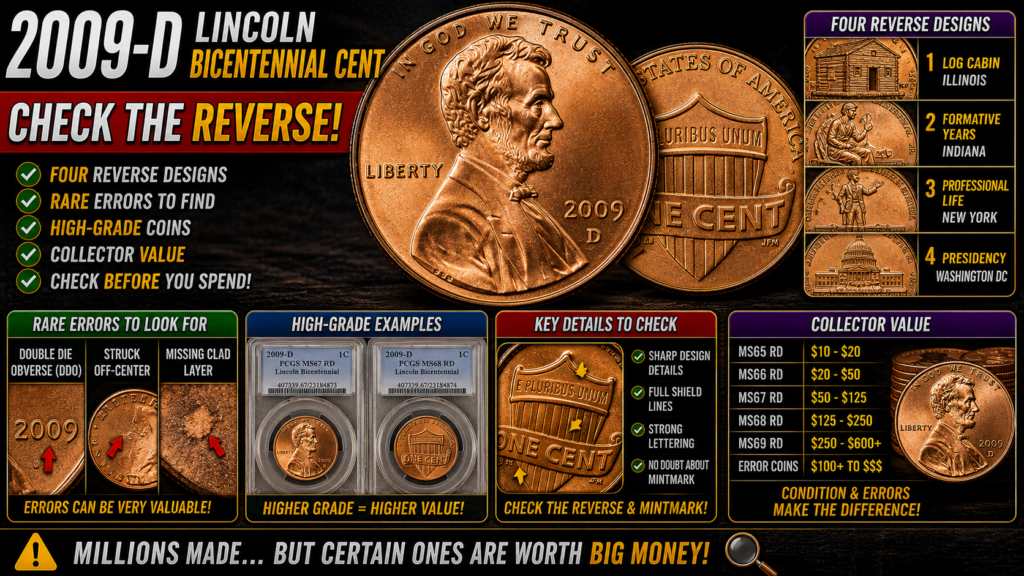
The 2009-D Lincoln Bicentennial cent is a fascinating coin for collectors because it features a special reverse design created to celebrate the 200th anniversary of Abraham Lincoln’s birth. Unlike ordinary Lincoln cents, the 2009 issue introduced four different reverse designs, each representing a different stage of Lincoln’s life.
If you have a 2009-D Lincoln cent, the first thing to do is turn it over and examine the reverse. The design can help you identify which of the four commemorative versions you have and understand why collectors pay attention to these coins.
Although millions of 2009-D cents were produced, not every example has the same collector appeal. Coins in exceptional certified condition can command premiums, while certain genuine mint errors may attract additional interest.
However, it is important to separate ordinary examples from genuinely unusual coins. A 2009-D cent is not automatically rare or valuable simply because it commemorates Lincoln’s bicentennial.
The most useful details to examine are the reverse design, the Denver mintmark, the coin’s condition, and any unusual characteristics that may indicate a minting error.
This guide explains the four 2009 Lincoln Bicentennial reverse designs, how to identify the Denver issue, what makes high-grade examples desirable, and how to evaluate a coin without relying on exaggerated price claims.
Why the 2009 Lincoln Bicentennial Cent Is Special
The year 2009 marked the 200th anniversary of Abraham Lincoln’s birth. To commemorate the occasion, the United States Mint introduced four new reverse designs for the Lincoln cent.
These designs replaced the familiar Lincoln Memorial reverse that had appeared on cents since 1959.
Each of the four designs represented a different chapter in Lincoln’s life, from his early years in Kentucky to his presidency in Washington, D.C.
The four designs were issued in chronological order, allowing collectors to follow Lincoln’s life through a series of coins.
The 2009-D versions were struck at the Denver Mint and carry a D mintmark.
The special designs make these coins distinct from ordinary Lincoln cents, but their collectible value depends on more than their historical significance.
Condition, mintmark, strike quality, and possible errors all play a role in determining whether a particular example deserves a premium.
The Four Reverse Designs of the 2009 Lincoln Cent
The 2009 Lincoln Bicentennial cent series includes four different reverse designs.
Each design represents a major period in Lincoln’s life and provides a visual connection to the historical events surrounding his rise from humble beginnings to the presidency.
The four designs are:
- Birth and Early Childhood in Kentucky.
- Formative Years in Indiana.
- Professional Life in Illinois.
- Presidency in Washington, D.C.
All four designs feature the familiar Lincoln portrait on the obverse.
The reverse is what distinguishes each commemorative issue.
When examining a 2009-D cent, identifying the reverse design is the first step toward understanding which version you have.
Birth and Early Childhood in Kentucky

The first design represents Lincoln’s birth and early childhood in Kentucky.
It depicts a log cabin, symbolizing the humble surroundings of his early years.
This design reflects the beginning of Lincoln’s life and the circumstances in which he grew up.
The cabin is the central feature of the reverse, making this version relatively easy to recognize.
Collectors can identify it by looking for the cabin structure rather than the more elaborate scenes featured on the other three designs.
The Kentucky design is the first of the four commemorative reverses and provides the starting point for a complete 2009 Lincoln cent collection.
Formative Years in Indiana
![2009 D [Formative Years] Lincoln Memorial Penny Prices | Ungraded, NGC, PCGS Values](https://images.openai.com/static-rsc-4/ZPW0K3zslugfT-NIwaiD5hTZsfjYfqDZVGKPFTqmuyBJQQRBXKh4wBa8P43otZLwkSzYYFCx8Yys-3arBjcfJGCrfJ35J5VawLuByp7BPPBEvxXUUz1vyKpKDACoHmI3yoOlh8K93GW700TsllgaQG9l-xcviNamlxGw245g1J8?purpose=inline)
The second reverse represents Lincoln’s formative years in Indiana.
The design depicts a young Lincoln reading while taking a break from manual labor.
It symbolizes the importance of education and self-improvement during his early life.
Unlike the log cabin design, this reverse features a human figure and a scene associated with learning.
The image represents Lincoln’s determination to educate himself despite the limitations of his circumstances.
Collectors can identify this design by examining the central figure and the surrounding details.
It is the second chronological design in the Bicentennial series.
Professional Life in Illinois

The third design represents Lincoln’s professional life in Illinois.
It depicts Lincoln standing in front of a building associated with the Illinois State Capitol.
This design reflects his years as a lawyer and politician before becoming president.
The image represents an important stage in his public career and the development of his political identity.
The Illinois design differs clearly from the cabin and reading scenes used for the first two reverses.
Collectors can identify it by looking for Lincoln standing beside the architectural background.
It is the third design in the commemorative sequence.
Presidency in Washington, D.C.

The fourth design represents Lincoln’s presidency in Washington, D.C.
It depicts the unfinished dome of the United States Capitol, symbolizing the challenges facing the nation during Lincoln’s presidency.
The design reflects the Civil War era and the effort to preserve the Union.
The Capitol dome is the most recognizable feature of this reverse.
It distinguishes the final design from the cabin, reading, and Illinois scenes used for the earlier issues.
This version completes the four-design sequence and represents the final chapter of Lincoln’s life covered by the Bicentennial series.
How to Identify a 2009-D Lincoln Bicentennial Cent
Identifying a 2009-D Lincoln Bicentennial cent begins with checking the date and mintmark.
The date 2009 appears on the obverse, beneath Lincoln’s portrait.
The D mintmark identifies the Denver Mint.
Once you have confirmed the date and mintmark, turn the coin over and identify the reverse design.
The four designs are visually distinct, making it possible to determine which commemorative version you have.
The reverse design is important because each version represents a different stage of Lincoln’s life.
However, identifying the design does not establish that the coin is rare.
All four designs were part of the official commemorative series.
A coin’s condition and any unusual minting characteristics must be evaluated separately.
Understanding the Denver Mintmark
The D mintmark is an important identifying feature of the 2009-D Lincoln cent.
It indicates that the coin was struck at the Denver Mint.
The mintmark is located on the obverse, near the date.
The 2009 Lincoln Bicentennial cents were also produced at Philadelphia, where the coins carry a P mintmark on the obverse.
The Denver issue is identified by the D.
This distinction matters when comparing coins from different mint facilities.
However, a D mintmark does not automatically make a coin valuable.
The Denver Mint produced large quantities of ordinary circulation cents, and most examples are common.
The mintmark is simply one part of the coin’s identity.
The Composition of the 2009-D Lincoln Cent
The 2009-D Lincoln Bicentennial cent belongs to the modern copper-plated zinc era of Lincoln cent production.
Regular circulation examples are primarily zinc with a thin copper coating.
This composition differs from the older bronze Lincoln cents produced before the composition change in 1982.
The copper-colored appearance of a 2009-D cent comes from its outer copper plating.
The coin’s composition is important when examining its weight, color, and physical condition.
However, the composition itself does not make a regular 2009-D cent rare.
Collectors should avoid assuming that unusual color or surface appearance automatically indicates a valuable error.
Damage, environmental exposure, and other factors can change a coin’s appearance.
Why Most 2009-D Lincoln Cents Are Common
The four commemorative designs were produced for circulation, and many examples remain available.
The 2009-D Lincoln cent is therefore not automatically scarce simply because it belongs to a special anniversary series.
Collectors can find examples of the four designs in different conditions.
Some coins circulated extensively and show wear.
Others were saved shortly after production and may retain more of their original detail.
A smaller number may survive in exceptionally high grades.
This distinction is important because the availability of a coin in ordinary condition is different from its availability in a narrowly defined high grade.
A common coin can still be difficult to find in exceptional condition.
However, high-grade status alone does not guarantee an extraordinary value.
The coin’s grade, eye appeal, and collector demand must all be considered.
What Makes a 2009-D Lincoln Cent Valuable?
Several factors can influence the collector value of a 2009-D Lincoln cent.
The most important include:
- The specific reverse design.
- The coin’s condition and grade.
- The quality of the original strike.
- The presence of a genuine mint error.
- Collector demand for the particular example.
A regular circulated coin generally has limited collector value beyond its face value.
An uncirculated example may be more desirable, especially if it has attractive surfaces and sharp details.
A certified coin in an exceptional grade may attract a premium from collectors seeking high-quality examples.
A genuine mint error can also make a coin more interesting.
However, not every unusual-looking coin is a mint error, and not every high-grade coin is rare.
The coin must be evaluated individually.
Why Exceptional Certified Examples Can Command Premiums
Professional grading provides a standardized assessment of a coin’s condition.
A certified coin has been examined by a grading service that assigns a grade and identifies relevant characteristics.
For modern Lincoln cents, high grades can attract collector interest because even small imperfections may affect the overall grade.
Coins that retain excellent surface preservation and strong design details can be more desirable than ordinary examples.
However, the difference between grades can be significant.
Two coins from the same year and mint may have different grades because of variations in surface quality, contact marks, and strike detail.
Certification can help collectors compare coins more consistently.
Still, certification does not guarantee a particular market value.
A coin’s desirability depends on its characteristics and the demand for comparable examples.
Understanding Mint State Grades
Mint State grades apply to coins that show no evidence of circulation.
The numerical grading scale generally runs from MS60 through MS70.
Higher numbers indicate a higher overall grade within the Mint State category.
An MS60 coin may have noticeable imperfections despite having no circulation wear.
An MS65 coin generally has stronger surface preservation.
An MS67 coin represents a higher level of quality, with fewer distracting imperfections.
Grades near the top of the scale require exceptionally strong preservation.
However, a coin’s grade is not determined by brightness alone.
A shiny coin may have been cleaned, while an original coin may have a darker appearance.
The grading process considers the overall condition and characteristics of the coin.
What Is a Mint Error?
A mint error is a mistake that occurs during the manufacturing process.
Errors can happen when a blank is prepared incorrectly, when the coin is struck improperly, or when production equipment does not function as intended.
A genuine error may create a distinctive feature that separates the coin from ordinary examples.
Some errors affect the position of the design.
Others involve the shape of the planchet or the relationship between the dies and the coin.
Collectors may find these characteristics interesting because they provide evidence of an unusual event during production.
However, damage that occurs after a coin leaves the mint is not the same as a mint error.
A scratch, dent, or altered edge does not automatically make a coin valuable.
Off-Center Strike Errors
An off-center strike occurs when a planchet is not properly positioned between the dies during striking.
The design is then impressed away from its normal position.
The finished coin may show a blank area where the design was not struck.
The degree of displacement can vary.
A minor off-center strike may be difficult to notice, while a more dramatic example can leave a large portion of the coin blank.
The visibility of the date and the overall appearance can influence collector interest.
However, an off-center-looking coin should be examined carefully to determine whether the feature is genuine.
Post-mint damage can also create unusual shapes or missing design areas.
Broadstrike Errors
A broadstrike occurs when a coin is struck without the normal collar properly restraining the metal.
The metal can spread outward during striking, producing a coin with a wider-than-normal appearance.
The design may remain visible even though the coin’s shape differs from an ordinary example.
A genuine broadstrike should show characteristics consistent with the minting process.
A coin that has been flattened or expanded after production is not a broadstrike.
The edge and overall structure should be examined carefully.
Doubled Die Errors
A doubled die occurs when a die receives misaligned impressions during its preparation.
The resulting die can transfer doubled design elements to coins struck from it.
The doubling may appear in lettering, numbers, or other design features.
However, not every doubled-looking detail is a doubled die.
Movement during striking, surface damage, and other factors can create similar visual effects.
A suspected doubled die should be compared with recognized variety information before it is described as a genuine variety.
Die Cracks and Die Cuds
A die crack occurs when a die develops a crack during use.
The crack can leave a raised line on the coin’s surface.
A die cud generally involves a more substantial break at the edge of the die, producing a raised area of metal.
These characteristics differ from scratches or dents caused after production.
Some die-related errors attract collector interest, particularly when they are prominent and clearly identifiable.
However, not every raised line or unusual bump is a genuine die error.
Careful examination is necessary to determine the cause.
How to Inspect the Reverse of a 2009-D Lincoln Cent
The reverse is the most important feature to examine when identifying the four Bicentennial designs.
Begin by turning the coin over and looking at the central image.
Determine whether it shows the Kentucky cabin, the Indiana reading scene, the Illinois professional-life scene, or the Washington Capitol dome.
Once the design is identified, examine the details.
Look for sharpness, wear, and unusual features.
Check the lettering and the surrounding fields for scratches or contact marks.
If the coin appears to have a missing design element or an unusual shape, inspect it carefully under magnification.
Do not assume that every irregularity is a mint error.
A genuine error should be consistent with a known manufacturing process.
How to Inspect the Obverse
The obverse features Lincoln’s portrait, the date, and the mintmark.
Confirm that the coin is dated 2009.
Then check for the D mintmark.
Look at the portrait for signs of wear, scratches, or contact marks.
Examine the lettering and fields for unusual characteristics.
If the coin appears to have doubling or another unusual feature, compare it with known examples before assuming that it is a variety.
The obverse can also provide useful information about the coin’s overall condition.
A well-preserved example may retain strong detail and attractive surfaces.
However, appearance alone does not establish a grade.
How to Evaluate the Coin’s Condition
Condition is one of the most important factors in determining collector interest.
A circulated coin may show wear on Lincoln’s portrait and other raised design elements.
An uncirculated coin may retain more of its original detail, although it can still have contact marks or other imperfections.
Examine the fields for scratches and abrasions.
Check the reverse design for sharpness.
Look for signs of cleaning or alteration.
A coin that appears unusually bright may have been polished, which can reduce its collector appeal.
The overall condition should be evaluated rather than relying on a single feature.
If the coin appears exceptionally well preserved, it may deserve comparison with certified high-grade examples.
How to Avoid Mistaking Damage for a Mint Error
One of the most common mistakes in coin collecting is confusing damage with a genuine mint error.
A coin may acquire scratches, dents, or unusual marks after leaving the mint.
These features can sometimes resemble manufacturing mistakes.
A genuine error should be consistent with the minting process.
For example, an off-center strike should show evidence that the design was impressed away from its normal position.
A broadstrike should have characteristics consistent with the absence of proper collar restraint.
A doubled die should show a recognizable doubled design characteristic rather than a random scratch.
If a feature seems unusual, compare it with recognized examples and seek expert advice when necessary.
Should You Get a 2009-D Lincoln Cent Professionally Graded?
Professional grading may be useful if the coin appears to have exceptional preservation or a potentially significant mint error.
A grading service can examine the coin’s authenticity, assign a grade, and identify relevant characteristics.
Certification can help establish a more consistent basis for comparing a coin with other examples.
However, grading involves costs.
Most ordinary circulated 2009-D cents are unlikely to justify an expensive certification process.
Before submitting a coin, consider its condition, the strength of any error evidence, and the availability of comparable examples.
If the coin appears ordinary, professional grading may not be worthwhile.
How to Store a Potentially Valuable 2009-D Cent
Proper storage helps protect a coin’s condition.
Handle the coin by its edges whenever possible.
Avoid touching the front and back unnecessarily.
Do not clean, polish, or scrape the coin.
Use a suitable coin holder to protect it from scratches and environmental exposure.
Avoid storing potentially valuable coins loose in containers where they can rub against one another.
If the coin is already certified, preserve it in its original protective holder unless there is a specific reason to do otherwise.
These precautions can help maintain the coin’s condition while you investigate its characteristics.
Common Mistakes to Avoid When Searching for a Valuable 2009-D Cent
One common mistake is assuming that every 2009 Lincoln cent is rare because it has a commemorative design.
The four reverse designs were issued as part of an official anniversary series, and ordinary examples are widely available.
Another mistake is assuming that a D mintmark automatically makes a coin valuable.
The mintmark identifies the Denver issue but does not establish rarity.
A third mistake is confusing damage with a mint error.
Scratches and altered surfaces can create unusual appearances without adding collector value.
Another mistake is treating a high-grade auction record as a guaranteed price for every 2009-D cent.
The value of an individual coin depends on its grade, design, authenticity, and other characteristics.
Finally, avoid cleaning or altering a coin to improve its appearance.
Preserving the original surface is important when evaluating a potentially collectible example.
Frequently Asked Questions About the 2009-D Lincoln Bicentennial Cent
What is the 2009-D Lincoln Bicentennial cent?
It is a Lincoln cent struck at the Denver Mint in 2009 to commemorate the 200th anniversary of Abraham Lincoln’s birth. It features one of four special reverse designs.
How many reverse designs were issued in 2009?
Four reverse designs were issued, representing Lincoln’s early childhood in Kentucky, formative years in Indiana, professional life in Illinois, and presidency in Washington, D.C.
How do I identify a 2009-D Lincoln cent?
Check the date on the obverse and look for the D mintmark. Then examine the reverse to identify which of the four commemorative designs appears on the coin.
Is every 2009-D Lincoln cent valuable?
No. Most ordinary examples are common. Exceptional certified coins and genuine mint errors may attract additional collector interest.
What makes a 2009-D Lincoln cent valuable?
Condition, grade, strike quality, recognized mint errors, and collector demand can influence its value.
Are the four reverse designs rare?
The four designs were part of the official 2009 commemorative series. Their existence alone does not make every example rare.
Can a 2009-D Lincoln cent have a mint error?
Yes. Like other coins, it can potentially exhibit genuine manufacturing errors. However, unusual marks must be examined carefully to distinguish errors from damage.
Should I clean my 2009-D Lincoln cent?
No. Cleaning or polishing can damage the coin’s surface and reduce its collector appeal.
Should I get my 2009-D cent professionally graded?
Consider professional grading if the coin appears to have exceptional preservation or a potentially significant mint error. Ordinary circulated examples generally do not justify the expense.
How should I store a potentially valuable 2009-D cent?
Keep it in a suitable coin holder, handle it by the edges, and protect it from scratches, moisture, and unnecessary contact.
Conclusion: Check the Reverse Before Spending Your 2009-D Lincoln Cent
The 2009-D Lincoln Bicentennial cent stands out because it celebrates Lincoln’s 200th birthday through four distinctive reverse designs.
Each design represents a different stage of his life, making the series interesting to collectors who appreciate both American history and coin collecting.
Most 2009-D cents are common, but exceptional certified examples and genuine mint errors may attract additional interest.
The most useful details to examine are the reverse design, the D mintmark, the coin’s condition, and any unusual characteristics that may indicate a genuine manufacturing error.
If you have a 2009-D Lincoln cent, turn it over and identify the reverse first. Then examine the coin carefully, avoid cleaning it, and compare it with reliable examples before estimating its value.
The key is to understand what makes your individual coin different from an ordinary example.