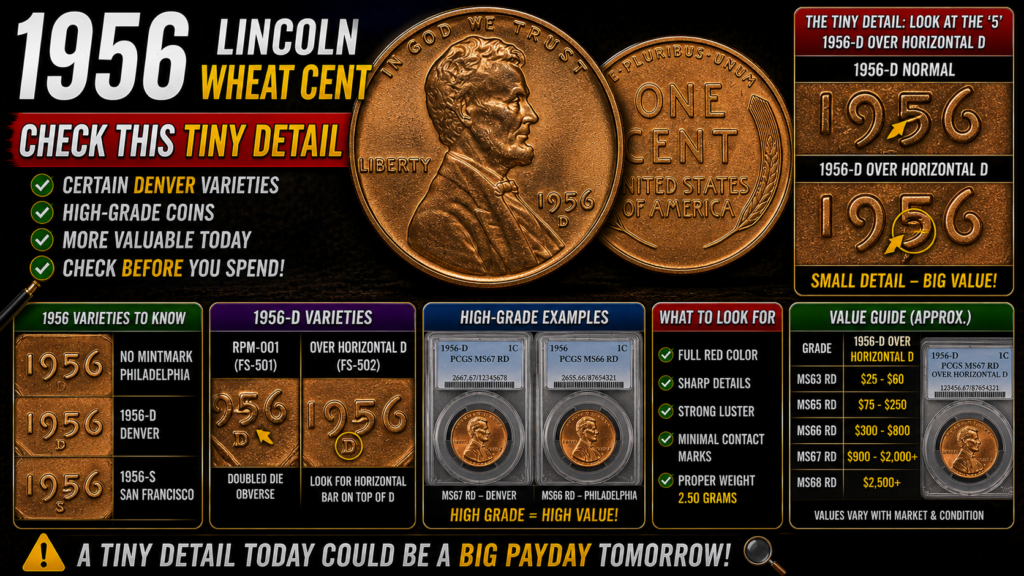
The 1956 Lincoln Wheat Cent may look like an ordinary old penny, but a closer look can reveal details that make certain examples more interesting to collectors. Although millions of these coins were produced, not every surviving cent has the same appeal. Small differences in mint marks, unusual manufacturing characteristics, condition, and overall eye appeal can influence how collectors evaluate individual examples.
For anyone who has discovered a 1956 Lincoln Wheat Cent in an old coin collection, a jar of pennies, or a family keepsake, the first question is often simple: Is this coin worth more than one cent?
The answer depends on several factors. Most circulated 1956 wheat cents are common and generally have modest collector value. However, certain Denver-minted varieties, coins with genuine minting errors, and exceptionally well-preserved examples can attract greater attention.
The key is knowing what to examine before assuming that a coin is rare or valuable.
A small mark near the date, an unusual feature in the lettering, or a coin that has retained much of its original mint luster may deserve a closer inspection. At the same time, many marks that appear unusual are simply the result of ordinary circulation, damage, or normal production processes.
Understanding these differences can help collectors avoid overestimating a coin’s value and recognize examples that may deserve professional examination.
This guide explores the 1956 Lincoln Wheat Cent, including its history, mint marks, varieties, condition, grading, possible errors, value factors, and practical identification methods. It also explains why some examples attract more collector interest than others and how to evaluate a coin carefully before deciding what to do with it.
Understanding the 1956 Lincoln Wheat Cent
The 1956 Lincoln Wheat Cent belongs to one of the most recognizable American coin series. Its familiar portrait of Abraham Lincoln and the wheat stalks on the reverse make it instantly recognizable to generations of collectors.
The coin was part of the Lincoln cent series introduced in 1909 to commemorate the 100th anniversary of Lincoln’s birth. The original design was created by sculptor Victor David Brenner, whose initials also became a recognizable feature of the coin.
By 1956, the wheat cent had already been in circulation for nearly five decades. Millions of Americans used these coins in everyday transactions, from buying groceries to paying for small household purchases.
Despite its long history, the 1956 issue was not an unusual or especially scarce date in the series. Large production quantities meant that many examples survived, and circulated specimens remain relatively accessible to collectors.
Nevertheless, the 1956 cent continues to attract attention because it combines historical significance, an attractive traditional design, and opportunities to explore differences between ordinary coins and more unusual examples.
Collectors may approach the coin in several ways. Some seek a complete set of Lincoln wheat cents, while others focus on particular mint marks, high-grade specimens, or varieties that show distinctive production characteristics.
For beginners, the 1956 issue offers an accessible introduction to coin collecting. It is familiar enough to identify easily, yet it provides useful opportunities to learn about grading, mint marks, die varieties, and preservation.
Why the 1956 Wheat Cent Still Attracts Collectors
The appeal of the 1956 Lincoln Wheat Cent comes from a combination of historical interest and the possibility of finding differences among individual examples.
Many collectors enjoy the wheat cent series because it represents an important period in American coinage. The design remained in use until 1958, making the final years of the series particularly interesting to people who enjoy collecting coins by date.
The 1956 cent is also attractive to collectors who prefer affordable historical coins. Ordinary circulated examples are generally much easier to obtain than rare early Lincoln cents.
Another reason for its continued popularity is the opportunity to examine coins for small details. The date, mint mark, lettering, surface condition, and overall strike can all help distinguish one example from another.
Some collectors enjoy searching through old collections for coins that have survived in unusually good condition. Others look for genuine die varieties or minting errors that make an individual coin different from standard examples.
However, collector interest does not automatically mean that every 1956 cent has a high market value.
A coin’s age alone does not establish rarity. Nor does a distinctive appearance necessarily indicate that the coin was produced incorrectly.
The most useful approach is to understand the normal characteristics of the 1956 cent first. Once those characteristics are familiar, unusual details become easier to recognize and evaluate.
The History Behind the Lincoln Wheat Cent
The Lincoln cent was introduced in 1909, replacing the Indian Head cent. Its introduction marked a major moment in American coin design because it placed a real historical figure on a circulating United States coin.
Abraham Lincoln’s portrait appeared on the obverse, while the reverse originally featured two wheat ears surrounding the words ONE CENT and UNITED STATES OF AMERICA.
The wheat design remained in use until 1958. In 1959, the reverse changed to the Lincoln Memorial design, beginning a new chapter in the series.
The 1956 cent therefore belongs to the final years of the wheat reverse design.
For collectors, this gives the coin a recognizable historical context. It represents a familiar design that was approaching the end of its production run.
The coin also reflects the materials and manufacturing methods used in the United States during the mid-20th century.
Although its design was simple compared with some other denominations, the Lincoln cent required careful preparation of dies, planchets, and striking equipment.
Small differences could develop during production. Some were ordinary variations in how a coin was struck, while others resulted from specific die characteristics or manufacturing mistakes.
These differences are part of what makes studying individual coins interesting.
What Makes the 1956 Lincoln Wheat Cent Different From Other Dates?
The 1956 Lincoln Wheat Cent shares its basic design with many earlier and later wheat cents. The obverse displays Lincoln’s portrait, while the reverse shows two wheat ears framing the denomination and country name.
Its date distinguishes it from other issues in the series.
The mint mark, when present, provides additional information about where the coin was produced. This detail can be particularly useful when organizing a collection or comparing coins from different mints.
The 1956 issue is not generally considered a key date in the Lincoln wheat cent series. Many examples were produced, and ordinary circulated coins are not difficult to find.
That does not mean every 1956 cent is identical in collector appeal.
Differences in preservation, strike quality, surface appearance, and possible die varieties can influence how individual examples are collected and valued.
For example, a coin that has circulated for decades may show substantial wear, while another example may retain much of its original mint finish.
Even when two coins share the same date and mint mark, their condition can make a meaningful difference.
Collectors therefore evaluate the complete coin rather than relying on the date alone.
Identifying the 1956 Lincoln Wheat Cent
Identifying a 1956 Lincoln Wheat Cent begins with checking the date on the obverse.
The date appears near the lower-right portion of Lincoln’s portrait. Under good lighting, the digits should be clear enough to distinguish the coin from nearby dates in the series.
Next, examine the area beneath the date for a mint mark.
A small letter can indicate that the coin was struck at a particular mint. For the 1956 cent, the most familiar mint-mark distinction is between Philadelphia and Denver.
A coin without a mint mark was struck in Philadelphia under the mint-mark conventions used for this issue. A coin bearing a D mint mark was struck in Denver.
The reverse should also be examined to confirm that the coin has the traditional wheat-ear design.
Check the overall appearance of the coin, including the portrait, lettering, wheat stalks, and rim.
A genuine 1956 wheat cent should have design details consistent with the established Lincoln cent series.
If the coin appears unusually thick, has an irregular edge, or displays suspicious lettering, further examination may be appropriate. However, damage and alterations can create appearances that resemble unusual production features.
Identification is the first step. Determining whether a coin has a collectible variety or meaningful premium requires a more detailed examination.
The Two Main Mint-Marked Types of 1956 Wheat Cents
The 1956 Lincoln Wheat Cent is commonly encountered in two basic mint-mark categories: Philadelphia and Denver.
The Philadelphia issue generally has no mint mark, while the Denver issue carries a D beneath the date.
These mint marks help collectors distinguish the production origin of the coin.
Although the mint mark is a small detail, it can be important when organizing a collection by date and mint.
A collector assembling a complete set of Lincoln wheat cents may want both the Philadelphia and Denver versions of the 1956 issue.
The mint mark can also help identify the appropriate reference information when researching a possible die variety.
However, the presence of a D mint mark does not automatically make a coin rare.
Denver produced large numbers of 1956 cents, and ordinary circulated examples are generally common.
The same principle applies to coins without a mint mark. A Philadelphia cent is not automatically valuable simply because it lacks a letter beneath the date.
The important distinction is between an ordinary example and a coin with a verified characteristic that gives collectors a reason to pay more.
The 1956 Philadelphia Wheat Cent
The Philadelphia 1956 Lincoln Wheat Cent is recognized by the absence of a mint mark beneath the date.
It belongs to the same general design and composition family as other Lincoln wheat cents of the period.
Ordinary examples circulated widely and are generally considered common.
A circulated Philadelphia cent may show wear on Lincoln’s hair, cheek, jawline, and other raised portions of the portrait. The wheat stalks on the reverse may also display flattened details.
The degree of wear depends on how long and how heavily the coin circulated.
Some examples retain relatively clear lettering and design details despite having visible signs of use.
Others show substantial wear, scratches, discoloration, or other surface changes.
For collectors, the Philadelphia issue can be useful when building a date-based set or comparing examples from different production locations.
Coins in unusually high grades may attract greater interest than heavily circulated examples.
However, a high-grade designation should be based on the coin’s actual condition rather than its age or visual brightness alone.
The 1956-D Denver Wheat Cent
The 1956-D Lincoln Wheat Cent is identified by the D mint mark beneath the date.
Denver produced large quantities of Lincoln cents during this period, and the 1956-D issue is generally considered a common date.
Most circulated examples have modest collector value.
Nevertheless, the Denver issue deserves attention from collectors who enjoy examining mint marks and searching for possible die varieties.
The D mint mark is a natural starting point because it helps distinguish the coin from the Philadelphia issue.
Collectors should examine the mint mark carefully, but they should avoid assuming that every unusual shape or extra line represents a valuable variety.
Mint marks can appear irregular because of wear, damage, lighting, or the condition of the coin’s surface.
A genuine die variety requires a specific, repeatable characteristic associated with the production die.
A coin that merely looks unusual under magnification does not automatically qualify.
For a 1956-D cent, the most useful approach is to compare the coin with reliable reference images and descriptions of documented varieties.
If the suspected feature is not clearly established, the coin should be described cautiously rather than labeled rare.
The Tiny Detail Collectors Should Check First
The small detail that deserves immediate attention is the area around the date and mint mark.
On a 1956-D cent, the D mint mark is particularly important because it identifies the Denver issue and provides a useful reference point for further examination.
Collectors interested in varieties should look closely at the mint mark’s shape, position, and surrounding surface.
The date should also be examined for unusual doubling, irregularities, or signs of alteration.
However, these features must be interpreted carefully.
A small extra-looking line may be caused by a scratch, a damaged die, or the way light reflects from a worn surface.
Likewise, a mint mark that appears thick or uneven is not necessarily evidence of a recognized variety.
A genuine variety should have identifiable characteristics that can be compared with established examples.
The tiny detail matters because it may help determine whether a coin is ordinary or worth further investigation.
It is not a guarantee of rarity or a promise of a higher selling price.
Understanding Die Varieties on the 1956 Wheat Cent
A die variety is a distinctive characteristic created during the preparation or use of a coin die.
Coin dies carry the design that is transferred to planchets during striking.
When a die is prepared or modified, small differences can sometimes occur. These differences may appear on every coin struck by that particular die.
Collectors study such features because they can identify a specific die or production variety.
Examples of die varieties across coinage include repunched design elements, doubled dies, and certain die-position differences.
However, not every unusual-looking feature is a die variety.
A genuine variety must be distinguishable from ordinary production characteristics, circulation damage, and later alterations.
For the 1956 Lincoln Wheat Cent, collectors may encounter references to Denver-related varieties or unusual mint-mark characteristics.
The important step is to verify the exact attribution before assigning a premium.
A coin should not be described as a rare variety merely because it has an extra-looking line or an unusual shape.
A reliable identification should explain what the feature is, where it appears, and how it differs from the normal design.
What Is a Repunched Mint Mark?
A repunched mint mark is a feature that can occur when a mint mark is applied to a working die more than once in slightly different positions.
Depending on the production method and the nature of the misalignment, the resulting coin may show overlapping or offset impressions of the mint-mark letter.
Such features can be of interest to collectors because they may distinguish one die from another.
However, not every doubled-looking mint mark is a repunched mint mark.
A genuine example should show a pattern consistent with the way the mint mark was applied to the die.
A scratch, dent, or damaged letter can produce a superficially similar appearance.
When examining a possible repunched D mint mark on a 1956-D cent, the collector should inspect the shape and edges of the letter under magnification.
The feature should also be compared with documented examples of the same variety.
Without that comparison, it is safer to describe the coin as having an unusual-looking mint mark rather than declaring it a confirmed repunched variety.
This distinction matters because collectors generally place greater confidence in established attributions than in unsupported claims.
What Is a Doubled Die?
A doubled die is created when a coin die receives misaligned impressions during the die-making process.
The result can be a visible doubling of parts of the design on coins struck from that die.
Depending on the type and strength of the doubling, the effect may appear on lettering, numbers, Lincoln’s portrait, or other design elements.
Doubled dies are different from machine doubling, which can occur during the striking process and often produces a flatter, shelf-like appearance.
This difference is important because machine doubling is frequently mistaken for a valuable doubled-die variety.
A true doubled die generally shows a distinct separation or duplication of design elements that is consistent with the underlying die.
Machine doubling usually does not create the same kind of raised, duplicated design.
Collectors examining a 1956 cent should not assume that every doubled-looking date or letter is a valuable variety.
The exact characteristic must be identified and compared with reliable references.
A confirmed doubled die may attract collector interest, but its market value depends on the specific variety, condition, demand, and other factors.
Machine Doubling Versus a Genuine Doubled Die
One of the most common sources of confusion in coin collecting is the difference between machine doubling and a genuine doubled die.
Machine doubling occurs during the striking process when the relationship between the die and the planchet changes in a way that creates a secondary-looking image.
The resulting feature often appears flat or shelf-like rather than showing a clearly separated duplicate design.
A doubled die, by contrast, originates during the creation of the die itself.
The difference can be subtle, particularly on small coins such as Lincoln cents.
Magnification can help reveal the shape of the feature, but magnification alone does not establish an attribution.
Lighting angle, surface wear, and coin damage can make ordinary details appear unusual.
Collectors should examine the feature from different angles and compare it with recognized examples.
If the distinction remains unclear, a specialist’s opinion may be helpful.
This is especially important when a coin is being advertised as a rare variety or when a seller is asking for a substantial premium.
How to Examine the Date on a 1956 Wheat Cent
The date is one of the first areas collectors should inspect.
Use a magnifier with moderate magnification and examine each digit separately.
Look for unusual doubling, missing portions, irregular edges, or evidence that the date has been altered.
A normal date should be consistent with the established design of the 1956 Lincoln cent.
Wear may soften the edges of the digits, while dirt or corrosion may obscure their shapes.
Scratches can also cross the date and create misleading lines.
A coin that has been cleaned or damaged may show unusual surface reflections around the numerals.
If a date appears altered, consider whether the feature could be the result of damage rather than a production characteristic.
A genuine variety should have a repeatable pattern that can be verified through comparison.
Collectors should avoid removing material or using abrasive tools to make the date easier to see.
Such treatment can damage the coin and reduce its collector appeal.
Examining the Mint Mark Under Magnification
The mint mark deserves a careful but measured inspection.
On a 1956-D cent, the D is located beneath the date.
Examine the letter’s outline, interior opening, and relationship to the surrounding surface.
Look for unusual features that appear to be part of the coin’s original design rather than later damage.
A genuine variety may show a specific pattern of overlapping impressions or another documented characteristic.
However, the mint mark can also be affected by circulation wear, corrosion, scratches, and contact with other objects.
These conditions may alter the appearance of the letter.
A coin with a damaged D should not automatically be considered a rare variety.
Collectors should compare the mint mark with examples of ordinary 1956-D cents and with reliable references for any suspected variety.
The goal is to determine whether the feature is genuinely distinctive, not simply whether it looks different.
Why Most 1956 Wheat Cents Are Common
The 1956 Lincoln Wheat Cent was produced in substantial quantities.
Large production numbers generally mean that many examples survive, particularly in circulated condition.
Coins used in everyday commerce may have become worn, but the sheer number produced means that ordinary examples remain accessible to collectors.
This helps explain why most 1956 cents do not command substantial premiums.
A coin’s age can make it historically interesting without making it scarce.
The same is true of a coin’s design. A familiar or attractive design may encourage collecting, but collector interest alone does not establish rarity.
The value of a common-date coin often depends heavily on its condition.
A heavily circulated example may be worth only a modest amount, while an exceptionally well-preserved specimen may be more desirable.
This difference reflects the fact that high-quality survivors can be less common than ordinary circulated coins, even when the date itself is plentiful.
Collectors should therefore separate the question of rarity from the question of condition.
How Condition Affects the Value of a 1956 Wheat Cent
Condition is one of the most important factors in determining the collector value of a 1956 Lincoln Wheat Cent.
A coin that has circulated for decades may show significant wear, while an uncirculated example may retain much of its original design detail.
Collectors generally evaluate the amount of wear, the sharpness of the strike, the quality of the surfaces, and the overall appearance.
A coin with clear details and minimal marks may be more desirable than one with substantial wear or damage.
However, condition is not determined by brightness alone.
A coin that appears shiny may have been cleaned, polished, or otherwise altered.
Such treatment can reduce its desirability among collectors.
A naturally preserved coin with original surfaces may be more appealing than a bright but damaged example.
The difference between grades can also be important for high-grade specimens.
Small variations in surface marks, luster, and strike quality may influence how a coin is classified.
Because the 1956 cent is a common date, condition can play a particularly significant role in distinguishing ordinary examples from more desirable ones.
What Does Circulated Mean?
A circulated coin is one that has been used in commerce and shows evidence of wear.
For a 1956 Lincoln Wheat Cent, circulation may flatten the highest parts of Lincoln’s portrait and soften details in the wheat stalks.
The hair above Lincoln’s ear, the cheek, and other raised features may show reduced detail.
On the reverse, the wheat ears and lettering may become less sharp.
Circulated coins may also develop scratches, contact marks, discoloration, or other surface changes.
The amount of wear varies considerably.
Some coins may have spent only a short time in circulation, while others may have passed through many hands over several decades.
A lightly circulated cent can still retain much of its design detail.
A heavily circulated example may show significant flattening and reduced definition.
Collectors often use standardized grading terminology to describe these differences.
Understanding circulation wear helps establish a realistic starting point when evaluating a coin’s condition and potential value.
What Does Uncirculated Mean?
An uncirculated coin is generally one that has not experienced ordinary circulation wear.
A 1956 Lincoln Wheat Cent in uncirculated condition may retain sharp design details and original mint luster.
However, uncirculated does not mean flawless.
Coins can acquire contact marks, scratches, or other imperfections during production, handling, storage, or transport.
An uncirculated cent may therefore have varying levels of surface quality.
Some examples display attractive luster and relatively few marks, while others have more noticeable imperfections.
The distinction between an uncirculated coin and a circulated coin is important when assessing collector value.
Nevertheless, a coin’s condition should be evaluated carefully.
A shiny surface does not automatically mean that the coin is uncirculated.
Cleaning, polishing, or other alterations can create an appearance that differs from the coin’s original state.
Collectors should look for a combination of surface characteristics, wear patterns, and overall preservation rather than relying on one visual feature.
Why High-Grade 1956 Wheat Cents Can Be More Valuable
High-grade 1956 Lincoln Wheat Cents can attract greater collector interest because they have survived in unusually good condition.
Although the date itself is common, finding an example with exceptional preservation may require more effort.
Collectors who specialize in Lincoln cents may seek coins with strong strikes, attractive luster, clean surfaces, and minimal contact marks.
These qualities can make an individual specimen more desirable than an ordinary circulated example.
High-grade coins may also appeal to collectors building registry-style sets or seeking particularly well-preserved examples of each date and mint.
However, the value of a high-grade coin depends on more than the grade number alone.
Eye appeal, surface quality, color, strike, and collector demand can all influence its market position.
A coin with a high numerical grade may still have less visual appeal than another coin with more attractive surfaces.
For this reason, collectors often examine both the assigned grade and the coin’s overall appearance.
Understanding the Lincoln Cent Grading Scale
Coin grading uses standardized descriptions to communicate a coin’s condition.
For Lincoln cents, the grading process generally considers wear, design detail, surface preservation, and other characteristics.
The scale includes circulated grades and uncirculated grades.
Circulated coins may be described using terms such as Good, Very Good, Fine, Very Fine, Extremely Fine, and About Uncirculated.
Uncirculated coins are commonly assigned numerical grades beginning at Mint State 60 and extending upward.
Higher numerical grades generally indicate fewer imperfections and better preservation within the relevant grading category.
However, the grading process is detailed and can involve subtle distinctions.
A coin’s strike quality, surface marks, luster, and overall appearance may influence its grade.
Collectors should avoid assigning a precise grade based only on a photograph.
Lighting, image quality, and camera angle can make a coin appear better or worse than it is.
For a potentially valuable 1956 cent, professional grading may provide a more reliable assessment.
What Is Mint State 60?
Mint State 60 is the lowest numerical grade in the standard Mint State grading range.
A coin graded MS-60 is considered uncirculated, meaning it does not show ordinary circulation wear.
However, it may have substantial contact marks, surface imperfections, or other shortcomings.
The coin’s overall appearance may be less attractive than that of a higher-grade example.
For a 1956 Lincoln Wheat Cent, an MS-60 designation indicates that the coin has retained an uncirculated status but may not have exceptional surface quality.
This distinction is useful because uncirculated coins are not all equally desirable.
Two cents that have never circulated can differ considerably in appearance and grade.
A coin with more attractive surfaces and fewer distracting marks may appeal more strongly to collectors.
The numerical grade helps describe condition, but it does not replace a careful examination of the individual coin.
What Is Mint State 65?
Mint State 65 is a higher uncirculated grade associated with stronger overall preservation.
A coin in this category generally has attractive luster, good eye appeal, and a relatively limited number of distracting marks.
However, the exact characteristics depend on the grading standards and the coin’s individual features.
For a 1956 Lincoln Wheat Cent, a high-grade example may show well-preserved details, attractive color, and a pleasing surface appearance.
Such coins can be more desirable than ordinary circulated examples.
Collectors should remember that an MS-65 designation does not guarantee a particular market value.
The coin’s date, mint mark, variety status, surface quality, and current demand still matter.
A high-grade coin may command a premium over a circulated example, but the size of that premium varies.
The most reliable assessment combines the assigned grade with a careful look at the coin itself.
What Is Mint State 67?
Mint State 67 is a very high uncirculated grade.
Coins in this category generally display exceptional preservation relative to other uncirculated examples.
They may have strong luster, attractive surfaces, and very few noticeable imperfections.
For a common-date coin such as the 1956 Lincoln Wheat Cent, an exceptionally high-grade example can attract interest from collectors who specialize in condition rarities.
However, such a grade should not be assigned casually.
Small marks, surface imperfections, strike characteristics, and other details can affect whether a coin qualifies for a particular grade.
A coin that looks flawless to the unaided eye may still have imperfections visible under magnification.
Likewise, a coin with a strong strike and attractive color may not necessarily receive the highest grade.
Professional grading can help establish whether a coin belongs in an exceptionally high condition category.
Why Original Mint Luster Matters
Mint luster is the distinctive surface appearance created during the striking process.
On a freshly struck copper-alloy cent, luster may appear as a pattern of light moving across the surface when the coin is tilted.
This appearance is different from the smooth shine produced by polishing.
Original luster is important because it can help indicate how well the coin’s original surface has been preserved.
A 1956 Lincoln Wheat Cent that retains attractive mint luster may be more desirable than a similar coin with heavily worn or altered surfaces.
However, luster alone does not determine grade or value.
A coin may have remaining luster but still show significant contact marks.
Another coin may retain a pleasing appearance but have been cleaned or otherwise altered.
Collectors should examine the surface carefully and consider the coin’s overall preservation.
Preserving original luster is one reason careful storage and handling are important for copper-alloy coins.
The Importance of Color on a 1956 Wheat Cent
Copper-alloy Lincoln cents can display different colors depending on their age, storage conditions, and surface history.
A 1956 cent may appear reddish, red-brown, or brown.
These colors reflect changes in the coin’s surface over time.
Collectors often pay attention to color when evaluating uncirculated copper cents.
A coin that retains much of its original red appearance may be more desirable to some collectors than a similar example that has turned mostly brown.
However, color should not be considered in isolation.
A coin’s surface quality, luster, grade, and overall appearance also matter.
Artificially brightened or chemically altered surfaces may look different from naturally preserved copper.
A bright red appearance does not automatically prove that a coin is original or valuable.
Collectors should evaluate color alongside other features and avoid using harsh cleaning methods to change a coin’s appearance.
Red, Red-Brown, and Brown Lincoln Cents
Copper-alloy cents can be described using color designations that reflect the amount of original red color remaining.
Red examples retain a high proportion of their original red appearance.
Red-brown coins show a combination of red and brown coloration.
Brown coins display predominantly brown surfaces.
These categories are particularly relevant when evaluating uncirculated copper cents.
A 1956 Lincoln Wheat Cent with attractive original red color may appeal to collectors seeking well-preserved examples.
However, color designations do not automatically determine a coin’s market value.
The grade, strike, surface quality, and demand for the specific coin remain important.
Color can also be affected by storage conditions and environmental exposure.
Collectors should be cautious when a coin appears unusually bright or has an inconsistent surface appearance.
A naturally toned coin may be more desirable than a coin whose color has been altered.
How Environmental Conditions Affect a 1956 Wheat Cent
Environmental conditions can influence the appearance and preservation of copper-alloy coins.
Exposure to moisture, chemicals, pollutants, and unsuitable storage materials may cause discoloration or surface damage.
A 1956 cent stored in a damp environment may develop spots, corrosion, or other changes.
Long-term exposure to certain materials can also affect the coin’s surface.
Even when a coin is not actively circulating, improper storage may reduce its collector appeal.
Collectors should store coins in materials designed for long-term coin preservation.
Avoid containers that may release harmful chemicals or trap moisture.
Coins should also be protected from unnecessary handling.
A coin’s appearance can change over time, and not all changes can be reversed safely.
Proper storage helps preserve the original surface and makes it easier to evaluate the coin accurately.
Genuine Mint Errors Versus Ordinary Damage
Mint errors occur when something goes wrong during the coin-production process.
Such errors can create distinctive features that may attract collector interest.
Examples across coinage include off-center strikes, broadstrikes, clipped planchets, and certain striking or planchet abnormalities.
However, not every unusual mark is a mint error.
Coins can be damaged after leaving the mint.
A cent may be scratched, bent, crushed, corroded, or altered through contact with tools or machinery.
These forms of damage can create appearances that resemble production errors.
For example, a damaged rim may look unusual without being a genuine minting error.
A coin with an irregular edge may have been altered after production rather than struck incorrectly.
Collectors should examine the shape, surface, and physical characteristics of a suspected error carefully.
A genuine mint error should be consistent with a recognized production process.
When the distinction is unclear, expert examination may help prevent an ordinary damaged coin from being misidentified.
What Is an Off-Center Strike?
An off-center strike occurs when a planchet is not properly positioned between the dies during striking.
The resulting coin may show part of the design missing from one side, with a blank area where the design was not transferred.
The appearance depends on how far the planchet was displaced and how much of the design was struck.
Off-center strikes can be of interest to collectors because they represent a genuine production error.
However, the degree of displacement and the presence of a complete date or other identifying features can affect collector appeal.
An ordinary 1956 cent with a damaged or irregular edge should not automatically be described as an off-center strike.
A genuine example should show characteristics consistent with an actual misaligned striking process.
The error should also be distinguished from post-mint damage caused by cutting, bending, or other alterations.
A confirmed off-center 1956 cent may attract attention, but its value depends on the specific error and collector demand.
What Is a Broadstrike?
A broadstrike occurs when a coin is struck without the normal collar restraining the planchet in the expected way.
The resulting coin may have a wider-than-normal appearance and an expanded edge.
Depending on the circumstances, the design may still be visible across the enlarged surface.
A broadstrike is different from a coin that has been flattened or spread through external pressure.
Collectors should examine the rim, diameter, design, and overall shape when assessing a suspected broadstrike.
The physical characteristics should be consistent with a genuine minting error.
An ordinary coin that has been damaged by machinery or other objects may appear unusually wide or flat.
Such damage does not establish that the coin was struck incorrectly.
A confirmed broadstrike can be collectible, but its value depends on the severity and authenticity of the error.
What Is a Clipped Planchet?
A clipped planchet occurs when a blank is cut improperly from the metal strip used to produce coins.
The resulting planchet may have a curved or straight section missing before the coin is struck.
When the coin is struck, the missing portion remains visible along the edge.
Clipped planchets can show different shapes depending on the nature of the cutting error.
However, not every missing piece of a coin is a genuine clipped-planchet error.
A coin may have been cut, chipped, or damaged after production.
The appearance of the edge and the surrounding design can help distinguish a genuine error from later damage.
Collectors should examine whether the missing section is consistent with the way planchets are produced.
A suspected clipped 1956 cent should be compared with recognized examples before being assigned an error designation.
Why a Coin’s Weight Can Matter
Weight can help collectors investigate certain unusual coins.
A standard 1956 Lincoln Wheat Cent was struck using a copper-alloy composition associated with the wheat cent series.
A coin that differs significantly from the expected weight may deserve further examination.
However, weight differences can result from several causes.
Wear, corrosion, damage, or inaccurate measuring equipment can affect the result.
A coin that weighs slightly less than expected is not automatically an error.
Likewise, an unusual weight does not prove that a coin was struck on an incorrect planchet.
Collectors should use a suitable scale and compare the measurement with established specifications for the issue.
If the weight is substantially different, additional examination may be appropriate.
Any conclusion should account for the coin’s condition and the possibility of damage or alteration.
The Standard Composition of the 1956 Wheat Cent
The 1956 Lincoln Wheat Cent belongs to the copper-alloy era of the Lincoln cent series.
Its standard composition was 95 percent copper and 5 percent zinc and tin combined.
The coin’s metallic composition is one reason it can develop different surface colors over time.
Copper-alloy surfaces may change through exposure to air, moisture, chemicals, and other environmental factors.
These changes can affect the coin’s appearance without necessarily indicating that it is counterfeit or unusual.
Collectors should be cautious when interpreting color differences as evidence of a special composition.
A cent that looks unusually bright or dark may simply have experienced different storage conditions or surface changes.
Composition should be assessed using reliable information and appropriate testing methods when necessary.
Visual appearance alone is not sufficient to establish a coin’s exact metal content.
Why the 1956 Wheat Cent Is Not Automatically Rare
The word rare is often used loosely in discussions about old coins.
A coin may be old, attractive, or difficult to find in a particular condition without being rare in the broader sense.
The 1956 Lincoln Wheat Cent was produced in substantial quantities.
As a result, ordinary examples remain relatively common.
A circulated cent from this year is not automatically a scarce collectible simply because it is several decades old.
Rarity must be considered in relation to the number of surviving examples and the specific category being collected.
A high-grade specimen may be less common than a worn example.
A documented die variety may be less common than the normal issue.
A genuine mint error may also be unusual.
These distinctions are important because the value of a coin depends on its specific characteristics rather than its age alone.
How to Identify a Potentially Valuable 1956 Wheat Cent
A careful examination can help determine whether a 1956 cent deserves further research.
Start by confirming the date and mint mark.
Next, examine the coin’s condition and determine whether it shows significant wear, surface damage, or original luster.
Then inspect the date, mint mark, lettering, and design details for unusual characteristics.
If a possible variety is suspected, compare the feature with established references.
Avoid relying on vague descriptions such as rare, doubled, or error coin without confirming the exact characteristic.
The coin’s overall condition should also be considered.
A common-date cent in ordinary circulated condition is generally less desirable than a well-preserved example or a confirmed variety.
If the coin appears unusually well preserved or has a distinctive feature, professional evaluation may be worthwhile.
A careful identification process is more reliable than assuming that every old cent has exceptional value.
A Step-by-Step Inspection Method for Beginners
Collectors can follow a simple process when examining a 1956 Lincoln Wheat Cent.
First, place the coin on a clean, soft surface under good lighting.
Look at the obverse and confirm the date.
Then inspect the area beneath the date to determine whether the coin has a D mint mark.
Turn the coin over and examine the wheat reverse.
Check the lettering, wheat stalks, rim, and overall design.
Next, assess the coin’s condition.
Look for signs of wear, scratches, discoloration, corrosion, or unusual surface changes.
If the coin appears to have a variety or error, examine the suspected feature with a magnifier.
Compare it with reliable examples of the same issue.
Finally, record the coin’s date, mint mark, condition, and any distinctive features.
This basic process helps collectors organize their observations and avoid making unsupported claims.
Common Mistakes When Evaluating a 1956 Wheat Cent
One common mistake is assuming that every old penny is valuable.
Age alone does not determine collector value.
Another mistake is treating a mint mark as proof of rarity.
The D mint mark identifies the Denver issue, but it does not automatically indicate a scarce variety.
Collectors may also mistake ordinary damage for a mint error.
Scratches, dents, corrosion, and post-mint alterations can create unusual-looking features.
A further mistake is confusing machine doubling with a genuine doubled die.
These characteristics are different and should not be treated as interchangeable.
Some collectors also clean coins in an attempt to improve their appearance.
Cleaning can damage the surface and reduce collector appeal.
Finally, relying on an asking price from an online listing can lead to unrealistic expectations.
An advertised price does not establish what a coin actually sells for.
A careful evaluation should consider authenticity, condition, documented varieties, and realistic market evidence.
Why Cleaning a 1956 Wheat Cent Can Reduce Its Value
Cleaning a coin may seem like a simple way to make it look more attractive.
However, cleaning can alter the original surface and reduce collector appeal.
Abrasive materials may leave fine scratches that are visible under magnification.
Polishing can remove natural surface characteristics and create an unnatural shine.
Chemical treatments may also affect the coin’s color or surface.
For copper-alloy cents, such changes can be particularly noticeable.
Collectors often prefer coins that retain their original surfaces, even when those surfaces show natural age-related changes.
A coin with attractive original preservation may be more desirable than one that has been cleaned aggressively.
If a 1956 cent appears dirty or discolored, avoid using household cleaners, metal polish, or abrasive tools.
When a coin may have meaningful collector value, professional advice is preferable to experimentation.
How to Store a 1956 Lincoln Wheat Cent Safely
Proper storage helps preserve a coin’s surface and condition.
A 1956 cent should be kept in a suitable coin holder or other material designed for long-term coin storage.
Avoid containers that may contain harmful chemicals or trap moisture.
Coins should be protected from unnecessary handling and contact with hard surfaces.
When handling a coin, hold it by the edges rather than touching the obverse or reverse.
Fingerprints can leave oils and other residues on the surface.
A clean, dry storage environment helps reduce the risk of corrosion and other damage.
Collectors should also avoid storing coins in damp locations or exposing them to household chemicals.
If a coin appears particularly valuable, professional storage recommendations may be appropriate.
Good storage practices can help preserve both the coin’s physical condition and its collector appeal.
How Much Is a 1956 Lincoln Wheat Cent Worth?
The value of a 1956 Lincoln Wheat Cent depends on its mint mark, condition, variety status, and market demand.
Most ordinary circulated examples have modest collector value.
The Philadelphia and Denver issues are both common dates in the Lincoln wheat cent series.
Coins in better condition may command higher prices than heavily worn examples.
Uncirculated specimens can be more desirable, especially when they have attractive surfaces and strong original luster.
A verified die variety or genuine mint error may also attract a premium.
However, no single value applies to every 1956 cent.
A coin’s market value can change depending on the buyer, seller, condition, and available supply.
A price advertised for an exceptional specimen should not be used as the expected value of an ordinary circulated coin.
Collectors should compare similar coins with the same date, mint mark, grade, and variety status.
Why Online Coin Prices Can Be Misleading
Online coin listings often display a wide range of asking prices.
Some listings may feature ordinary coins at unusually high prices, while others may show exceptional specimens with specialized characteristics.
An asking price is not the same as a completed sale.
A seller can list a common 1956 cent for almost any amount, but that does not mean a buyer will pay the requested price.
Collectors should distinguish between advertised prices and actual transaction evidence.
When comparing prices, use coins with similar condition, mint mark, and variety status.
A circulated 1956-D cent should not be compared directly with an exceptionally high-grade certified specimen.
Likewise, a confirmed error coin should not be treated as equivalent to a normal example.
Realistic valuation requires careful comparison rather than relying on the highest price found online.
How Auction Results Can Help Estimate Value
Auction results can provide useful information about collector demand.
However, the most relevant comparisons are completed sales of coins with similar characteristics.
A 1956 Lincoln Wheat Cent should be compared with examples that share its date, mint mark, grade, and variety status.
A coin with a documented die variety may need to be compared with other examples of the same variety.
High-grade coins should be evaluated separately from circulated examples.
Auction prices may also vary depending on the venue, timing, buyer interest, and condition of the coin.
A single sale does not establish a universal value.
Collectors should consider multiple relevant transactions when possible.
The goal is to develop a realistic estimate based on comparable examples rather than relying on an isolated result.
What Makes a 1956 Wheat Cent More Desirable?
Several characteristics can make an individual 1956 Lincoln Wheat Cent more desirable to collectors.
Exceptional preservation is one important factor.
A coin with strong detail, attractive luster, and minimal surface marks may stand out from ordinary examples.
A documented die variety can also increase collector interest.
Genuine mint errors may be desirable when the error is clearly identifiable and has an established collector market.
Original surfaces and attractive natural color may improve a coin’s appeal.
The presence of a complete date and clear mint mark can also help establish the coin’s identity.
However, desirability is not the same as guaranteed high value.
A coin may be interesting to a collector without commanding a substantial premium.
Market demand, condition, and authenticity all influence the final assessment.
The Difference Between Rarity and Value
Rarity and value are related, but they are not identical.
A coin may be scarce but have limited demand.
Another coin may be relatively common yet attract strong interest because of its design, condition, or collector popularity.
The 1956 Lincoln Wheat Cent illustrates this distinction.
Ordinary examples are common, but exceptionally preserved specimens may still attract collector attention.
A confirmed variety may also be more desirable than a normal example.
However, the value of a specific coin depends on how collectors view its characteristics and how many comparable examples are available.
A rare feature does not automatically guarantee a high selling price.
Likewise, a common date can have valuable individual specimens when condition or variety status distinguishes them from ordinary coins.
Understanding the difference between rarity and value helps collectors develop more realistic expectations.
Why Professional Grading May Be Worth Considering
Professional grading can help establish a coin’s condition and provide an opinion about its authenticity.
This may be useful when a 1956 cent appears unusually well preserved or has a suspected variety.
A grading service can evaluate the coin using established standards.
Depending on the service and the coin, the result may include a numerical grade and other information about its characteristics.
However, professional grading involves costs.
For an ordinary circulated 1956 cent, the expense may exceed the coin’s likely collector value.
Grading may be more relevant when a coin has exceptional preservation, a documented variety, or another characteristic that could justify the cost.
Collectors should compare the likely value of the coin with the total cost of submission, including any associated fees.
Professional grading is a tool for evaluation, not a guarantee of profit.
When Should You Get a 1956 Wheat Cent Authenticated?
Authentication may be useful when a coin has a potentially valuable feature that is difficult to identify.
Examples include suspected die varieties, unusual mint errors, or coins that appear to have been altered.
A professional examination can help determine whether the feature is genuine.
Authentication may also be worthwhile for an exceptionally well-preserved coin if its condition significantly affects its market value.
However, ordinary circulated examples generally do not require professional authentication.
The decision should depend on the coin’s characteristics and the potential benefit of a reliable assessment.
Collectors should avoid spending more on authentication and grading than the coin is reasonably likely to justify.
If the coin has a clear and documented variety, professional evaluation may provide additional confidence.
Building a 1956 Wheat Cent Collection
The 1956 Lincoln Wheat Cent can be a useful addition to a date-based collection.
Collectors may choose to include both the Philadelphia and Denver issues.
Some may focus on circulated examples, while others seek uncirculated coins.
A collector interested in varieties may also research documented differences associated with the date and mint mark.
The choice depends on the collector’s interests and budget.
A simple collection can begin with one example of each mint-mark type.
Over time, collectors may upgrade their coins to better-preserved examples.
Others may prefer to keep a range of grades to understand how condition affects appearance.
The 1956 issue can also be used to practice basic grading skills.
Comparing circulated and uncirculated examples helps develop an understanding of wear, luster, surface quality, and design detail.
How to Organize Your 1956 Wheat Cent Collection
Organizing a collection makes it easier to identify what you own and what you still need.
A simple record can include the date, mint mark, condition, and any unusual characteristics.
For a 1956 cent, record whether the coin is a Philadelphia issue or a Denver issue.
If the coin appears to have a variety, note the suspected feature and whether it has been verified.
It can also be useful to record where the coin was obtained and any professional grading information.
Photographs may help document the coin’s appearance over time.
Keep descriptions factual and avoid assigning a rare-variety label until the identification is supported.
A clear record helps prevent confusion between similar coins.
It also makes it easier to compare examples and track changes in the collection.
How to Photograph a 1956 Lincoln Wheat Cent
Clear photographs can help collectors document a coin and compare its features.
Use even lighting that reveals the design without creating excessive glare.
Photograph both the obverse and reverse.
A close-up of the date and mint mark can be useful when examining a possible variety.
Keep the camera steady and make sure the image is sharp.
Avoid using filters or editing tools that alter the coin’s actual appearance.
A photograph should represent the coin as accurately as possible.
When documenting a suspected error, include an image showing the surrounding design as well as a close-up of the feature.
Photographs can help with preliminary research, but they cannot always establish authenticity or grade.
A physical examination may still be necessary.
What to Look for When Buying a 1956 Wheat Cent
When buying a 1956 Lincoln Wheat Cent, begin by identifying the exact coin being offered.
Check the date and mint mark.
Review the coin’s condition and compare it with the seller’s description.
If the coin is advertised as a variety, ask for the exact attribution and supporting information.
A vague claim that the coin is rare is not enough to establish its value.
Examine photographs carefully, especially when the coin is being sold online.
Look for signs of cleaning, damage, corrosion, or altered surfaces.
For a high-grade coin, consider whether professional grading provides useful information.
Compare the asking price with similar examples rather than relying on an unusually high advertised price.
A careful buying process can help reduce the risk of paying a premium for an ordinary or misidentified coin.
What to Look for When Selling a 1956 Wheat Cent
Before selling a 1956 Lincoln Wheat Cent, identify its date, mint mark, and condition.
If the coin appears ordinary and circulated, it may have only modest collector value.
If it is exceptionally well preserved or has a suspected variety, further research may be worthwhile.
A clear description should explain the coin’s actual characteristics without exaggerating its rarity.
If the coin has been professionally graded, include the relevant grading information.
For an ungraded coin, avoid presenting a personal estimate as a guaranteed grade.
When comparing potential offers, look at similar coins rather than relying on asking prices.
Collectors should also consider selling costs and the difference between retail prices and the amount a seller may receive.
A realistic description helps buyers understand exactly what is being offered.
Why the Wheat Reverse Is Important to Collectors
The wheat reverse is one of the most recognizable features of the Lincoln cent series.
It shows two wheat ears framing the words ONE CENT and UNITED STATES OF AMERICA.
The design was used from 1909 through 1958.
The 1956 cent therefore belongs to the final years of the wheat reverse era.
Collectors often appreciate the design because it represents a familiar period in American coinage.
The wheat ears also provide useful details for evaluating the coin’s condition.
Wear may flatten the raised portions of the stalks and soften the surrounding lettering.
A well-preserved example may retain sharp wheat details and clear lettering.
The reverse should be examined alongside the obverse when assessing a coin’s overall condition.
How Wear Appears on the Wheat Ears
The wheat ears are useful reference points when evaluating circulation wear.
On a heavily circulated 1956 cent, the raised details may become flattened.
The wheat grains and surrounding lines may lose definition.
On a lightly circulated example, more of the original detail may remain visible.
An uncirculated coin may retain sharper features, although the quality of the original strike can also affect the appearance.
Collectors should compare the wheat ears with other parts of the design rather than relying on a single detail.
A coin may have a strong reverse but show wear on the obverse.
The overall grade reflects the complete coin.
Understanding how wear affects the wheat ears can help beginners distinguish heavily circulated coins from better-preserved examples.
How Wear Appears on Lincoln’s Portrait
Lincoln’s portrait contains several raised areas that can show wear during circulation.
The hair, cheek, jawline, and other high points may become smoother as the coin is handled.
A heavily circulated cent may show flattened details and reduced definition.
A lightly circulated example may retain much of the original portrait detail.
Uncirculated examples generally show no ordinary circulation wear, although they may have contact marks or other imperfections.
The sharpness of the portrait also depends on the quality of the original strike.
A weakly struck coin may have less detail even if it has not circulated.
Collectors should therefore distinguish between wear and strike quality.
The portrait is one part of the overall grading process, and it should be evaluated alongside the reverse and surface condition.
Strike Quality and Its Effect on Collector Appeal
Strike quality describes how clearly the coin’s design was transferred from the dies to the planchet.
A strong strike may show sharp details and well-defined lettering.
A weaker strike may have less definition in certain areas.
Strike quality can influence the appearance of a 1956 Lincoln Wheat Cent.
However, a weak strike does not automatically mean that a coin is damaged or unusual.
The striking process can produce differences in detail.
Collectors may prefer examples with sharp design features, especially when assembling high-grade sets.
Still, strike quality is only one part of the coin’s overall condition.
Surface marks, luster, color, and preservation also matter.
A coin with a strong strike may have significant contact marks, while another with a softer strike may have attractive surfaces.
A balanced evaluation considers all of these characteristics together.
How Lighting Can Help Reveal Coin Details
Lighting can make a significant difference when examining a small coin.
Even, diffuse light helps reveal the date, mint mark, lettering, and surface details.
A light positioned at a shallow angle may help show raised features and surface marks.
However, reflections can also create misleading appearances.
A scratch may look like doubling under certain lighting conditions.
A worn mint mark may appear unusually thick or irregular.
Collectors should examine the coin from several angles before drawing conclusions.
A magnifier can help reveal small details, but excessive magnification may make ordinary surface imperfections appear more significant than they are.
Good lighting and careful observation are useful tools for identifying possible varieties.
They should be combined with reliable references and a realistic understanding of normal coin characteristics.
Why Magnification Is Useful but Not Conclusive
Magnification helps collectors inspect small details that may be difficult to see with the unaided eye.
On a 1956 cent, it can reveal the shape of the mint mark, the edges of the date, and small surface features.
However, magnification does not automatically establish rarity.
A scratch may look like an extra line.
A damaged letter may resemble a repunched mint mark.
Machine doubling may appear more dramatic under strong magnification.
The important question is whether the feature matches a recognized production characteristic.
Collectors should use magnification as part of a broader identification process.
Comparing the coin with reliable reference examples is often more useful than simply increasing the magnification.
If a suspected variety cannot be confirmed, it should be described cautiously.
The Role of Collector Demand
Collector demand influences the market value of a coin.
Even when two coins have similar rarity, differences in popularity can affect what buyers are willing to pay.
The Lincoln wheat cent series has a broad collector audience.
Some collectors seek complete date-and-mint sets, while others focus on varieties or high-grade examples.
The 1956 cent may attract interest from people who want to complete the final years of the wheat reverse series.
High-grade specimens may also appeal to collectors seeking well-preserved examples.
However, demand can change over time.
A coin that attracts strong interest in one market may receive less attention in another.
The number of available examples and the condition of those examples also influence market behavior.
Collector demand is therefore an important factor, but it cannot be evaluated separately from condition and authenticity.
How Market Conditions Affect 1956 Wheat Cent Values
Coin values can change as collector preferences, supply, and economic conditions shift.
The market for a 1956 Lincoln Wheat Cent may differ depending on whether the coin is circulated, uncirculated, or a verified variety.
Common circulated examples generally have a different market from high-grade specimens.
A documented variety may attract a specialized group of buyers.
Exceptional coins may also be affected by competition among collectors.
The value of a coin should therefore be considered in the context of its specific category.
A price from one period may not accurately reflect the market at another time.
Collectors should seek recent information about comparable coins when making buying or selling decisions.
A realistic valuation recognizes that the market is not fixed and that individual coins can differ significantly.
Can a 1956 Wheat Cent Be Worth Thousands of Dollars?
A claim that an ordinary 1956 Lincoln Wheat Cent is worth thousands of dollars should be treated with caution.
Most circulated examples are common and generally have modest collector value.
Exceptional high-grade specimens or unusual, verified varieties may attract substantially greater interest.
However, an extraordinary price should be supported by clear evidence about the exact coin.
The date alone does not justify a high valuation.
Nor does a vague claim about a rare mint mark or unusual appearance.
A high asking price is not proof that a coin has sold for that amount.
Collectors should examine the coin’s grade, variety attribution, authenticity, and relevant sales evidence.
Without those details, a dramatic valuation is not reliable.
Can You Find a Valuable 1956 Wheat Cent in Pocket Change?
Finding a 1956 wheat cent in modern pocket change is possible, although such discoveries are less common than finding newer Lincoln cents.
Older coins may remain in collections, household containers, or occasional circulation.
A 1956 cent discovered in change is not automatically valuable.
Its condition and characteristics still matter.
A circulated example may show substantial wear and have modest collector value.
A coin that appears unusually well preserved or has a possible variety may deserve further examination.
Collectors should first confirm the date and mint mark.
Then assess the coin’s condition and look for documented unusual features.
Finding an old coin can be enjoyable, but realistic expectations are important.
Most ordinary 1956 cents are not rare simply because they have survived for decades.
Why Family Collections May Contain Better-Preserved Examples
Some 1956 Lincoln Wheat Cents have survived in collections rather than circulating for many years.
A coin stored in a collection may retain more original detail than one used frequently in commerce.
However, storage conditions can vary widely.
A coin kept in a suitable holder may remain well preserved.
Another coin stored in an unsuitable container may develop discoloration, corrosion, or surface damage.
A family collection may therefore contain coins in a wide range of conditions.
Collectors should examine each example individually.
A coin’s history can provide useful context, but it does not establish its grade or value.
The actual condition and characteristics of the coin remain the most important factors.
How to Compare Two 1956 Lincoln Wheat Cents
Comparing two coins can help collectors understand the effect of condition and preservation.
Start by confirming that both coins have the same date and mint mark.
Then compare the portrait, wheat reverse, and overall surface quality.
Look at the amount of wear on the raised design elements.
Examine the luster, color, contact marks, and any visible damage.
If one coin appears to have a variety, compare the suspected feature with reliable references.
A coin may look more attractive because of lighting or photography, so direct examination is preferable when possible.
Comparing similar coins helps establish a more realistic understanding of condition.
It also makes it easier to recognize features that are genuinely unusual rather than simply different in appearance.
How to Avoid Overpaying for a 1956 Wheat Cent
Avoiding overpayment begins with understanding what makes a particular coin desirable.
A common circulated cent should not be priced like a rare variety or a high-grade specimen.
Before buying, confirm the date, mint mark, and condition.
If the coin is advertised as a variety, ask for the exact attribution.
Compare the asking price with similar coins and look for evidence of completed sales.
Be cautious when a seller uses dramatic language without providing clear identification.
A coin described as extremely rare should have a specific, verifiable characteristic.
Do not assume that a high price proves a coin is valuable.
A careful comparison of condition, authenticity, and market evidence can help buyers make more informed decisions.
How to Avoid Undervaluing a Potentially Desirable Coin
While many 1956 cents are common, collectors should also avoid dismissing every example without inspection.
A coin with exceptional preservation may deserve a closer look.
A genuine die variety or mint error may also have collector interest.
The first step is to identify the coin correctly.
Then examine its condition and any unusual features.
If a distinctive characteristic appears consistent with a documented variety, further research may be worthwhile.
A professional opinion can help when the potential value justifies the expense.
Collectors should avoid cleaning the coin or making irreversible changes while investigating it.
Careful handling and accurate documentation help preserve the coin’s condition while its characteristics are evaluated.
The Importance of Accurate Coin Descriptions
Accurate descriptions are essential when buying, selling, or documenting a 1956 Lincoln Wheat Cent.
A description should identify the date and mint mark.
It should also explain the coin’s condition and any verified variety or error.
Avoid using terms such as rare, flawless, or valuable without supporting evidence.
If the coin has not been professionally graded, do not present an estimated grade as an official certification.
A suspected variety should be described as suspected until it is confirmed.
Clear descriptions help collectors understand what they are evaluating.
They also reduce confusion between ordinary coins, unusual varieties, and damaged examples.
Why the 1956 Wheat Cent Is Useful for Learning Coin Grading
The 1956 cent is a useful coin for beginners because ordinary examples are relatively accessible.
Collectors can compare circulated and uncirculated specimens without needing to acquire an especially rare date.
The coin’s familiar design provides several useful grading reference points.
Lincoln’s portrait shows how wear affects raised details.
The wheat reverse provides additional areas for examining design preservation.
The coin’s surface can also help beginners learn about luster, color, and contact marks.
Comparing different examples helps develop a more practical understanding of grading terminology.
The 1956 cent can therefore serve as a learning tool for collectors who want to build broader knowledge of the Lincoln wheat cent series.
A Practical Checklist Before Valuing Your 1956 Cent
Before estimating the value of a 1956 Lincoln Wheat Cent, review the following points:
- Confirm the date.
- Identify whether the coin has a D mint mark.
- Examine the portrait and wheat reverse for wear.
- Check the coin’s surface for scratches, corrosion, and other damage.
- Look for original luster and natural color.
- Inspect any suspected doubling or unusual mint-mark features.
- Compare possible varieties with documented examples.
- Consider whether professional grading or authentication is justified.
- Compare the coin with similar examples in comparable condition.
- Avoid relying on unsupported claims or unusually high asking prices.
This checklist can help collectors develop a more accurate understanding of the coin before making a buying, selling, or grading decision.
Frequently Asked Questions About the 1956 Lincoln Wheat Cent
Is the 1956 Lincoln Wheat Cent rare?
Most 1956 Lincoln Wheat Cents are common because they were produced in substantial quantities. Exceptional high-grade specimens and verified varieties may be more desirable.
What is the difference between a 1956 cent and a 1956-D cent?
A 1956 cent without a mint mark was struck in Philadelphia. A 1956-D cent has a D mint mark beneath the date and was struck in Denver.
Is the 1956-D Lincoln Wheat Cent valuable?
Most circulated 1956-D cents have modest collector value. High-grade examples and verified varieties may attract greater interest, depending on their condition and market demand.
What tiny detail should I check on a 1956-D cent?
Examine the D mint mark beneath the date, along with the date itself. Look for documented features that distinguish a genuine variety from ordinary wear or damage.
Can a 1956 Lincoln Wheat Cent have a doubled die?
A suspected doubled-die feature should be examined carefully and compared with reliable references. Not every doubled-looking letter or digit represents a genuine doubled die.
What is the difference between a doubled die and machine doubling?
A doubled die originates during die production and can create a duplicated design. Machine doubling occurs during striking and often produces a flatter, shelf-like appearance.
Does a 1956 wheat cent without a mint mark mean it is rare?
No. The absence of a mint mark identifies the Philadelphia issue. It does not automatically make the coin rare or valuable.
What metal is a 1956 Lincoln Wheat Cent made of?
The standard 1956 cent is made of an alloy containing 95 percent copper and 5 percent zinc and tin combined.
Can a 1956 wheat cent be worth more in uncirculated condition?
Yes. An uncirculated coin with attractive surfaces and strong luster may be more desirable than an ordinary circulated example. Its value depends on its grade and other characteristics.
Does a shiny 1956 cent mean it is uncirculated?
Not necessarily. Cleaning or polishing can create an unnatural shine. Original luster, wear, and surface condition should be evaluated together.
Should I clean my 1956 Lincoln Wheat Cent?
No. Cleaning can damage the original surface and reduce collector appeal. It is generally better to leave the coin in its existing condition.
Is a 1956 wheat cent with an unusual edge a mint error?
Not automatically. An unusual edge may result from damage or alteration. A genuine mint error should have characteristics consistent with the production process.
Should I get my 1956 cent professionally graded?
Professional grading may be useful for an exceptionally well-preserved coin or a suspected valuable variety. For an ordinary circulated example, the cost may not be justified.
How can I tell if my 1956-D cent has a repunched mint mark?
Examine the D mint mark for a specific, repeatable characteristic and compare it with documented examples. An unusual-looking letter alone does not establish a repunched mint mark.
Can a 1956 Lincoln Wheat Cent be worth thousands of dollars?
An ordinary circulated 1956 cent generally has modest collector value. Claims of exceptionally high values should be supported by evidence about the coin’s grade, authenticity, and exact variety.
Is the 1956 Lincoln Wheat Cent a good coin for beginners?
Yes. Its familiar design, accessible date, and differences in condition make it useful for learning about mint marks, grading, preservation, and varieties.
How should I store my 1956 wheat cent?
Keep it in a suitable coin holder in a clean, dry environment. Handle it by the edges and avoid unnecessary contact with the coin’s surfaces.
What is the most important factor when evaluating a 1956 wheat cent?
The most important factors include the coin’s condition, mint mark, authenticity, and any verified variety or error. The date alone does not determine its value.
Final Thoughts on the 1956 Lincoln Wheat Cent
The 1956 Lincoln Wheat Cent is a familiar coin from the final years of the wheat reverse design. Although most examples are common, individual coins can differ considerably in condition, appearance, and collector appeal.
The tiny details around the date and mint mark are worth examining, especially when investigating a possible Denver variety. However, unusual-looking features should always be compared with reliable references before being identified as genuine varieties.
Condition is equally important. A well-preserved coin with attractive luster and minimal wear may be more desirable than an ordinary circulated example.
Collectors should also remember that a high asking price does not establish a coin’s market value. Authenticity, grade, documented characteristics, and realistic comparisons all matter.
Whether you are examining a coin from an old collection, building a Lincoln wheat cent set, or learning about coin grading for the first time, the 1956 issue offers a practical opportunity to develop your skills.
The best approach is to inspect the coin carefully, preserve its original condition, and verify any unusual features before making a decision.
A small detail can make a coin more interesting, but accurate identification is what helps determine whether that detail truly matters.