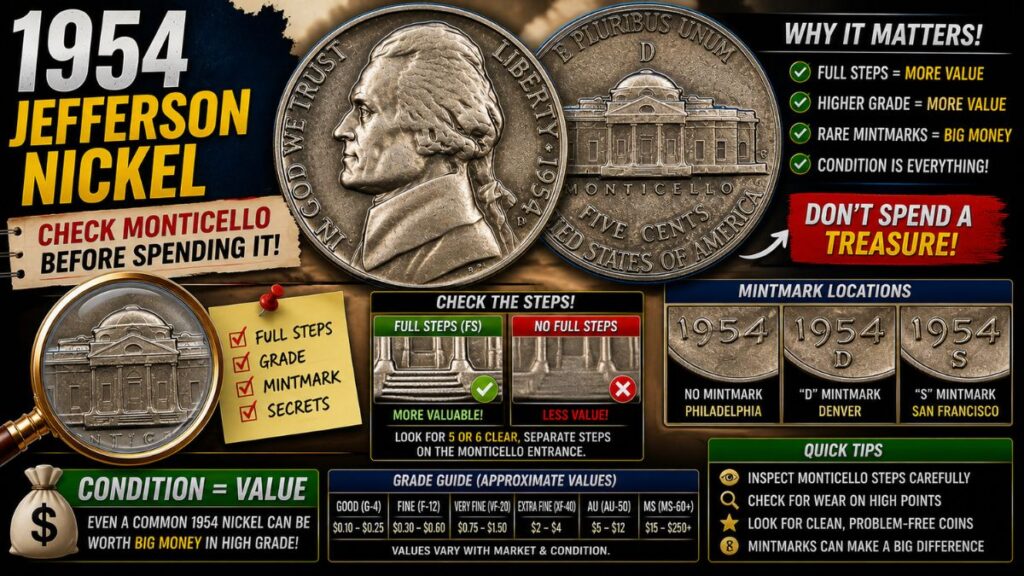
The 1954 Jefferson nickel may look like an ordinary five-cent coin, but one quick inspection of the reverse could tell you whether it deserves a second look before you spend it. Most 1954 Jefferson nickels are common, yet coins with exceptional preservation, strong Full Steps details on Monticello, and certain mintmark characteristics can attract significantly more collector interest.
That is what makes the 1954 nickel worth checking carefully.
The date alone does not make a 1954 Jefferson nickel rare. Millions were produced, and many surviving examples remain affordable. However, collectors do not judge every coin only by its date. Condition, strike quality, surface preservation, mint of origin, and especially the clarity of the steps beneath Monticello can make a major difference.
A circulated nickel with substantial wear may have modest collector value. A sharply preserved example with strong details can be considerably more desirable. And a high-grade coin showing complete, uninterrupted steps on Monticello can become especially interesting to Jefferson nickel specialists.
The important lesson is simple: do not spend a 1954 Jefferson nickel automatically just because it looks like an ordinary five-cent coin.
Take a moment to inspect Monticello, check the mintmark, examine the surfaces, and determine whether the coin has the characteristics collectors are looking for.
Why the 1954 Jefferson Nickel Deserves a Closer Look
The Jefferson nickel has been part of American coinage since 1938, and the 1954 issue belongs to the early decades of the series.
The coin features Thomas Jefferson on the obverse and Monticello, Jefferson’s Virginia estate, on the reverse. This familiar design remained in use for decades, making the Jefferson nickel one of the most recognizable U.S. coins.
The 1954 issue is not rare simply because it is old.
That distinction is important.
A coin can be more than 70 years old and still be relatively common. The real collectible interest comes from the combination of date, mintmark, condition, strike quality, and variety.
For Jefferson nickels, one of the most important condition-related characteristics is the appearance of the steps beneath Monticello.
Those steps can be surprisingly difficult to preserve.
Normal circulation wears away fine details. Weak strikes can prevent the steps from appearing sharply in the first place. Contact marks can interrupt them even when the rest of the coin looks impressive.
As a result, a 1954 nickel with exceptionally clear, uninterrupted steps can be much more interesting than an ordinary example.
What Is a 1954 Jefferson Nickel?
The 1954 Jefferson nickel is a five-cent U.S. coin featuring Thomas Jefferson on the obverse and Monticello on the reverse.
The coin was struck in the traditional Jefferson nickel composition used during this period, consisting primarily of copper and nickel.
Unlike wartime Jefferson nickels produced from 1942 through 1945, the 1954 issue does not belong to the silver-alloy wartime nickel group.
That difference is useful when identifying older Jefferson nickels.
The 1954 nickel is a regular copper-nickel issue, so its potential collectible premium is generally determined by numismatic factors rather than precious-metal content.
That makes condition especially important.
A typical circulated coin does not suddenly become valuable because of its age. A coin that has survived in exceptional condition, however, can become much more desirable to collectors.
The Monticello Design Is the Key to This Story
Turn a 1954 Jefferson nickel over and you will see Monticello.
The building is surrounded by inscriptions, with the denomination appearing below.
Beneath Monticello are the steps leading toward the building.
Those steps are one of the most closely watched areas on a high-grade Jefferson nickel.
Why?
Because they provide a useful indication of how well the coin was struck and how well its fine details have survived.
A circulated coin may have soft or completely worn steps.
A weakly struck uncirculated coin may also fail to show the steps clearly.
But an exceptionally well-preserved and sharply struck coin can display a much more complete staircase.
That is where the term Full Steps becomes important.
What Does Full Steps Mean?
Full Steps is a collector term used for Jefferson nickels that display unusually complete and uninterrupted detail across the steps of Monticello.
The exact requirements used by grading services can be specific, and collectors should understand that simply seeing several lines does not automatically qualify a coin as a Full Steps example.
The steps must show sufficient separation and continuity.
This is one reason photographs can sometimes be misleading.
A coin may appear to have complete steps when viewed casually, but magnification can reveal contact marks, weakness, or breaks that prevent it from qualifying for a Full Steps designation.
Conversely, a coin that looks ordinary under poor lighting may reveal much stronger detail when examined correctly.
The condition of the steps therefore deserves careful attention.
Why Full Steps Can Make Such a Big Difference
Jefferson nickel collectors often place a premium on coins that retain complete step details.
The reason is straightforward: Full Steps examples can be considerably scarcer than ordinary examples at the same general grade.
Millions of Jefferson nickels were struck, but the combination of a strong strike, minimal contact marks, and excellent preservation is much harder to achieve.
This creates an important distinction.
There is a difference between a 1954 nickel that is technically uncirculated and one that is both uncirculated and exceptionally sharp in the Monticello area.
A coin can have no obvious circulation wear but still lack complete steps.
That means grade alone does not tell the entire story.
For specialists, the details of the strike and the preservation of the reverse can matter enormously.
Why the Steps Can Be Weak
There are several reasons why Monticello’s steps may not appear complete.
The first is strike quality.
During the minting process, the design is transferred from dies to a blank metal planchet under pressure. If the strike is not strong enough in certain areas, fine details may not fully develop.
The second factor is die condition.
Dies experience wear as they are used to strike large quantities of coins. As dies deteriorate, certain design details can become less sharp.
The third factor is circulation.
Even a well-struck nickel can lose its finest details after years of use.
The fourth is contact damage.
Coins often came into contact with other coins during production, transportation, storage, and circulation. A small mark across the steps can interrupt an otherwise strong staircase.
This is why finding a 1954 nickel with genuinely complete and attractive steps can be exciting.
The 1954 Nickel Mintmarks
The mintmark is another important feature to inspect.
For the 1954 Jefferson nickel, coins were produced at Philadelphia, Denver, and San Francisco.
Philadelphia coins have no mintmark.
Denver coins carry a D mintmark.
San Francisco coins carry an S mintmark.
The mintmark appears on the reverse, to the right of Monticello.
Checking this location should be one of the first things you do when examining a 1954 Jefferson nickel.
A missing mintmark does not mean the coin is damaged or missing something.
For a 1954 nickel, no mintmark indicates Philadelphia production.
The presence of a D or S identifies the other two mints.
Mintmark varieties can have different levels of collector demand, so identifying the mint is an essential part of evaluating the coin.
Why the Mintmark Matters
The mintmark tells you where the coin was produced, but it can also help determine how collectors classify and compare the issue.
Collectors building date-and-mint sets need examples from different facilities.
The availability of a particular issue can vary depending on original production, survival, and especially the number of examples available in higher grades.
A coin with a particular mintmark is not automatically rare.
However, when combined with exceptional preservation or Full Steps, the mintmark can become much more important.
That is why it is not enough to say, “I have a 1954 nickel.”
You should identify whether it is a Philadelphia, Denver, or San Francisco issue.
What Makes a 1954 Nickel Valuable?
The value of a 1954 Jefferson nickel depends on several factors rather than a single feature.
The most important considerations include:
The mintmark.
The amount of circulation wear.
The grade.
The quality of the strike.
The condition of Monticello’s steps.
The presence or absence of distracting marks.
The quality of the surfaces.
The coin’s overall eye appeal.
Whether the coin has a recognized variety or unusual characteristic.
Collector demand.
These factors can overlap.
For example, a 1954 nickel may be uncirculated, but if the strike is weak and the steps are incomplete, it may not command the same premium as another uncirculated example with sharp Full Steps.
Similarly, a coin with excellent steps may have significant marks on the portrait that reduce its overall desirability.
The best examples combine multiple desirable characteristics.
Why Grade Matters
Coin grading describes the condition of a coin.
A heavily worn 1954 nickel may show flattened design details, scratches, and significant surface wear.
A lightly circulated coin retains more detail.
An uncirculated coin has not experienced normal circulation wear, although it can still have marks and imperfections from minting and handling.
At higher grades, tiny differences become increasingly important.
For example, two coins can both be uncirculated, yet one may have cleaner surfaces, stronger luster, better strike quality, and clearer Monticello steps.
Collectors may value those differences significantly.
This is particularly true for coins that fall into competitive registry-set collecting or other specialized areas of numismatics.
What Does an Uncirculated 1954 Nickel Look Like?
An uncirculated 1954 Jefferson nickel should not show the normal flattening associated with circulation.
Jefferson’s portrait should retain strong detail.
The lettering should remain crisp.
The reverse should show well-defined architectural details.
The surfaces may display original mint luster.
However, an uncirculated coin can still have contact marks.
These marks occur because freshly struck coins can bump against one another before reaching collectors.
Therefore, uncirculated does not mean perfect.
A coin can be uncirculated while still having numerous marks.
The number, size, and location of those marks can influence its grade and desirability.
The Importance of Surface Quality
Surface quality can make or break the appeal of a high-grade Jefferson nickel.
Examine the obverse for scratches, contact marks, discoloration, and other disturbances.
Then examine the reverse, paying special attention to the area around Monticello.
A coin may have excellent steps but still be less desirable if the rest of the reverse is heavily marked.
Likewise, an attractive obverse can be undermined by damage across the Monticello steps.
Collectors consider the entire coin.
That is why evaluating only one feature can lead to an inaccurate conclusion.
How to Inspect a 1954 Nickel Correctly
Begin with clean hands and a suitable work surface.
Hold the coin carefully by its edges.
Use good lighting.
Start with the obverse.
Confirm the date.
Inspect Jefferson’s portrait for wear.
Look at the fields surrounding the portrait.
Then turn the coin over.
Find the mintmark.
Study Monticello.
Most importantly, inspect the steps.
Move the coin under the light rather than holding it completely still.
Different angles can reveal details that are difficult to see under direct lighting.
A small magnifier can also help.
You do not need extremely powerful magnification to begin.
A modest loupe or magnifying glass can reveal whether the steps are interrupted, whether the surfaces show scratches, and whether the coin has noticeable contact marks.
How to Check the Monticello Steps
This is the part of the examination that gives the title its meaning.
Look directly beneath Monticello.
You should see horizontal step details.
Do not simply count visible lines.
Instead, look for continuity.
Are the lines clearly separated?
Do they run across the relevant area?
Are there interruptions caused by marks?
Does the strike appear strong?
Are some sections noticeably weaker than others?
A high-quality Full Steps candidate should have strong, uninterrupted step detail according to the relevant grading standards.
A coin that has only a few visible lines should not automatically be described as Full Steps.
The distinction is important because collectors use the term in a specific way.
Why a Tiny Mark Can Matter
Imagine two 1954 Jefferson nickels that otherwise appear nearly identical.
Both have strong strikes.
Both are uncirculated.
Both have attractive luster.
Both show excellent Monticello detail.
But one has a small contact mark across the steps.
That tiny mark may prevent the coin from qualifying for a Full Steps designation.
This illustrates why Jefferson nickel specialists inspect the reverse so carefully.
A tiny interruption can change how a coin is classified and how collectors view it.
At ordinary circulated grades, such a distinction may matter less.
At high grades, it can become much more important.
Full Steps Are Not the Same as High Grade
This is one of the most important things to understand.
Full Steps and numerical grade are related but not identical.
A coin can have a high numerical grade but lack Full Steps.
Another coin may have impressive step detail but have other condition problems that limit its overall grade.
The ideal combination is a high-grade coin with strong, complete steps and attractive surfaces.
This combination is what can generate substantial collector interest.
Therefore, if you discover a 1954 nickel that appears unusually well preserved, do not stop after deciding that it is “uncirculated.”
Continue examining the Monticello steps.
Why Strike Quality Is So Important
The strike refers to how effectively the design was transferred from the die onto the coin.
A strong strike produces sharp details.
A weak strike produces softer details.
For Jefferson nickels, the Monticello steps can be especially sensitive to strike quality.
This means that an otherwise attractive coin may not have Full Steps simply because the original strike was not strong enough.
Collectors cannot add those missing details later.
They are part of the coin’s original production characteristics.
That is why strong strikes are highly desirable in the Jefferson nickel series.
What Is Eye Appeal?
Eye appeal refers to how attractive a coin looks as a whole.
It can include the quality of the surfaces, luster, toning, strike, cleanliness of the design, and overall balance.
A coin with excellent technical characteristics can still have poor eye appeal if it has distracting marks or unattractive surface problems.
Conversely, a coin with attractive original surfaces can stand out even among other coins of similar grade.
When examining a 1954 Jefferson nickel, do not focus entirely on one feature.
Step back and consider the entire coin.
Does it look clean?
Does it have strong detail?
Does the luster appear natural?
Are there major marks?
Is Monticello sharply defined?
Does the coin appear original?
These questions can help determine whether it deserves further attention.
Why Cleaning Can Hurt a 1954 Nickel
Cleaning is one of the most common mistakes inexperienced collectors make.
A person may discover an old nickel and think that removing dirt or discoloration will make it more attractive.
Unfortunately, cleaning can damage the surface.
Polishing can create fine scratches.
Abrasion can remove the natural appearance of the metal.
Chemical treatments can alter the surface and color.
A coin that has been harshly cleaned may be worth less to collectors than an untouched coin with natural toning.
If you believe a 1954 nickel could be valuable, do not clean it before evaluation.
Preserve the coin in the condition in which you found it.
Natural Toning and the 1954 Jefferson Nickel
Older nickels can develop changes in color as their surfaces interact with the environment.
Collectors may describe these changes as toning.
Natural toning is not automatically a defect.
Some collectors appreciate attractive, original toning because it can contribute to the coin’s character.
However, not all discoloration is desirable.
Environmental damage, corrosion, staining, or artificial treatments can affect collector appeal differently.
The important principle is to avoid altering the coin before its condition has been evaluated.
If a coin appears unusual, originality is worth preserving.
Why Most 1954 Nickels Are Not Rare
The title may encourage you to check your 1954 nickel, but that does not mean every coin is valuable.
Most 1954 Jefferson nickels are common.
Large numbers were produced, and substantial quantities have survived.
Many examples circulated heavily and remain relatively ordinary from a collector’s perspective.
That is exactly why condition matters.
The collectible market is not simply about how old a coin is.
It is about supply and demand for specific characteristics.
Millions of ordinary examples can exist while a much smaller number of exceptional high-grade Full Steps examples remain available.
That difference is what creates opportunities for collectors.
Why High-Grade Coins Can Be Much Scarcer
Coins were originally made for commerce, not for future collectors.
Most 1954 nickels entered circulation.
They were handled, dropped, exchanged, carried, and stored.
Every transaction created opportunities for wear and damage.
Even coins that were not heavily circulated could develop contact marks during mint handling.
As a result, very high-quality surviving examples can be considerably less common than ordinary circulated pieces.
This is known as condition rarity.
The coin may not be rare in an absolute sense, but finding one in an exceptional condition can be difficult.
That distinction is crucial when evaluating older U.S. coins.
The Role of Mint Production
The three mint facilities that produced 1954 Jefferson nickels did not necessarily produce identical quantities.
Collectors therefore consider the individual mint issues separately.
The Philadelphia issue carries no mintmark.
The Denver issue carries a D.
The San Francisco issue carries an S.
Production totals can help establish historical context, but they do not tell the entire story of modern collectible availability.
A coin with a lower original production figure is not automatically the most valuable.
What matters is the number of desirable examples that survive and how much collectors want them.
High-grade survival can differ dramatically between issues.
Why a Mintmark Variety Can Matter
The word “variety” can refer to specific differences in dies or other production characteristics.
A mintmark itself is not necessarily a variety in the specialized sense.
However, collectors do compare mintmarked and Philadelphia issues separately, and different mint origins can carry different levels of demand.
If a 1954 nickel has an unusual mintmark appearance, do not automatically assume it is rare.
Mintmarks can show variations due to normal production processes, die characteristics, wear, or other factors.
A suspected unusual variety should be identified carefully.
How to Examine the Mintmark
Locate the area to the right of Monticello.
Use good lighting and magnification.
Confirm whether the coin has no mintmark, a D, or an S.
Look for obvious signs of alteration.
A mintmark should be examined as part of the coin rather than in isolation.
If something about the mintmark looks unusually different, compare it with known examples of the same issue.
Do not assume that a slightly unusual shape automatically indicates a rare variety.
Coin dies and individual strikes can produce small visual differences.
What About Errors?
A genuine mint error can increase collector interest.
However, it is important to distinguish a production error from damage that occurred after the coin left the mint.
For example, a nickel that was scratched, bent, hit, or chemically altered after leaving the mint is not automatically a mint error.
Collectors look for evidence that the unusual characteristic was created during the manufacturing process.
This is another area where authentication can become valuable if the potential premium is significant.
How to Tell a Potentially Valuable Coin From an Ordinary One
A simple evaluation process can help.
First, identify the date.
Second, identify the mint.
Third, determine whether the coin circulated.
Fourth, examine the surfaces.
Fifth, inspect Monticello and the steps.
Sixth, look for unusual varieties or errors.
Seventh, consider whether the coin appears exceptional enough to justify professional grading.
This process is more reliable than searching for a single “secret” feature.
There is no universal trick that turns every 1954 nickel into a valuable coin.
The value comes from the combination of characteristics.
What Makes a 1954 Nickel Worth More Than Face Value?
Nearly every collectible 1954 nickel is worth more than its original five-cent denomination in the sense that collectors may pay a premium for an identifiable collectible example.
But the size of that premium varies enormously.
A common circulated coin may have only a modest premium.
A well-preserved example may attract more interest.
A high-grade Full Steps coin can command a much stronger premium.
A rare or recognized variety can add another layer of desirability.
The important thing is to avoid thinking in terms of one fixed value.
There is no single price that applies to every 1954 Jefferson nickel.
Why Auction Prices Can Be Misleading
Collectors sometimes see a headline claiming that a 1954 nickel sold for an impressive amount.
That does not mean every 1954 nickel is worth the same amount.
High auction results generally involve coins with specific characteristics.
They may have exceptional grades, outstanding eye appeal, Full Steps, a recognized variety, or another desirable attribute.
A heavily circulated 1954 nickel cannot be compared directly with a top-condition certified example.
Before using a reported price as a guide, identify whether your coin actually matches the important characteristics of the example being discussed.
Why Professional Grading Can Help
Professional grading can provide authentication and a standardized assessment of condition.
This can be especially useful when a coin appears to be in an unusually high grade.
A professional holder can also protect the coin from handling damage.
For a common circulated nickel, grading may not be necessary.
The cost of professional grading should be considered in relation to the coin’s potential value.
However, if your 1954 Jefferson nickel appears to have exceptional preservation and strong Full Steps, professional evaluation may be worth considering.
The decision should be based on the coin’s characteristics rather than excitement alone.
What Does a Certified Full Steps Coin Mean?
When a grading service identifies a Jefferson nickel as having Full Steps, that designation communicates that the Monticello steps meet the service’s criteria.
This can be important because collectors often seek certified examples with that designation.
However, collectors should remember that not every grading service uses exactly the same terminology or standards.
When comparing coins, understand what the particular certification means.
The broader principle remains the same: complete, uninterrupted Monticello step detail is highly desirable among Jefferson nickel collectors.
How Lighting Can Change What You See
Lighting is surprisingly important when examining a 1954 nickel.
Under direct overhead light, certain marks may disappear.
Under angled light, the same surface may reveal scratches or breaks.
The steps of Monticello can also appear stronger or weaker depending on the viewing angle.
Move the coin slowly.
Tilt it from side to side.
Use a single bright light source when possible.
Do not mistake reflections for additional design details.
Good lighting can make the difference between an accurate inspection and a misleading first impression.
Why Magnification Should Be Used Carefully
Magnification is useful, but too much magnification can sometimes make ordinary surface imperfections appear dramatic.
A small mark can look enormous under extreme magnification.
Start with moderate magnification.
Use it to confirm what you see with the naked eye.
Examine the date, mintmark, steps, and major surfaces.
If something unusual appears, document exactly where it is and compare it with known examples.
The goal is accurate identification, not simply finding something that looks strange.
Should You Spend a 1954 Jefferson Nickel?
If you have a 1954 Jefferson nickel, it is worth taking a few seconds to inspect it before spending it.
Look at the mintmark.
Look at Monticello.
Look closely at the steps.
If the coin is heavily worn, it may be an ordinary example.
If it is sharply preserved, it deserves more attention.
If the steps appear unusually complete, take an even closer look.
The title’s warning to “check Monticello” is especially relevant because the reverse can contain one of the most important clues to the coin’s collectible quality.
A five-cent coin can be easy to overlook.
That is exactly why careful inspection matters.
Common Mistakes Collectors Make With 1954 Nickels
One common mistake is assuming that every old nickel is rare.
Another is assuming that every shiny coin is uncirculated.
A third is confusing visible steps with Full Steps.
Another mistake is ignoring the mintmark.
Some people also clean their coins, which can damage collectible surfaces.
Others assume that every unusual line or mark is a mint error.
Another frequent mistake is comparing a circulated coin with a high-grade auction example and expecting the same value.
Avoiding these mistakes makes the evaluation process much more realistic.
What Should You Do If Your 1954 Nickel Looks Exceptional?
If your coin appears unusually sharp, begin by protecting it.
Handle it by the edges.
Do not clean it.
Do not polish it.
Do not rub the surfaces with cloth.
Then inspect the coin carefully.
Confirm the date.
Identify the mintmark.
Examine Monticello.
Study the steps under magnification and good lighting.
Look for contact marks and other surface problems.
If the coin appears to have unusually strong Full Steps and high-grade surfaces, consider professional authentication and grading.
A careful evaluation is preferable to making assumptions based on appearance alone.
Why Preservation Is So Important
A coin’s condition is not something that can easily be restored.
Once a surface is scratched, polished, or damaged, the original appearance may be permanently altered.
That is particularly important for high-grade Jefferson nickels.
The difference between an ordinary uncirculated coin and an exceptional example can involve tiny details.
A careless cleaning attempt can eliminate some of the very characteristics that make the coin desirable.
For that reason, preservation should always come before experimentation.
The Historical Appeal of the 1954 Jefferson Nickel
The 1954 Jefferson nickel is a product of mid-20th-century American coinage.
It represents an era when nickels were everyday money, passing through stores, vending machines, banks, and households.
Most people who handled these coins never imagined that collectors decades later would examine their Monticello steps under magnification.
That historical journey adds another dimension to the hobby.
The coin is not merely a five-cent piece.
It is an artifact from a particular period in American history.
Its continued survival in exceptional condition can make it even more interesting.
Why Jefferson Nickel Collectors Pay Attention to Full Steps
Jefferson nickel collecting has developed a specialized interest in strike quality.
For many other coin series, collectors may focus primarily on overall grade, luster, rarity, and major varieties.
For Jefferson nickels, the Monticello steps provide an additional layer of evaluation.
A coin can be beautiful and highly graded while still lacking the specific step detail specialists want.
This creates a specialized market within the broader Jefferson nickel series.
Collectors who focus on Full Steps often seek coins with strong strikes and minimal interruptions.
That specialization is one of the main reasons a seemingly ordinary 1954 nickel deserves a closer inspection.
Why Most People Miss Valuable Nickels
The biggest reason is familiarity.
People see nickels every day and rarely inspect them.
A 1954 date may not immediately look special.
The coin is small.
The design is familiar.
And the denomination is only five cents.
But collectors know that the important clues can be subtle.
The difference between a common coin and a highly desirable example may be a small detail on the reverse.
That is why coin collecting rewards patience.
The person who checks carefully has a better chance of recognizing an unusual coin than someone who spends it without looking.
Frequently Asked Questions About the 1954 Jefferson Nickel
Is a 1954 Jefferson nickel rare?
Most 1954 Jefferson nickels are common. The date itself does not make the coin rare. Exceptional condition, Full Steps, specific mint issues, and recognized varieties can make individual examples much more desirable.
What should I check first on a 1954 nickel?
Start with the date and mintmark. Then examine the coin’s condition and turn your attention to Monticello’s steps. The steps are especially important when evaluating an uncirculated or high-grade example.
Where is the mintmark on a 1954 Jefferson nickel?
The mintmark is on the reverse, to the right of Monticello. Philadelphia coins have no mintmark, while Denver and San Francisco coins carry D and S mintmarks respectively.
What are Full Steps on a Jefferson nickel?
Full Steps refers to exceptionally complete and uninterrupted detail on the steps beneath Monticello. The exact requirements can depend on the grading standards being used.
Why are Full Steps important?
Full Steps can be scarce on high-grade Jefferson nickels because the steps can be affected by weak strikes, die wear, circulation, and contact marks. Collectors often pay a premium for coins that meet recognized Full Steps standards.
Does an uncirculated 1954 nickel automatically have Full Steps?
No. A coin can be uncirculated but still have weak or interrupted steps. Full Steps and numerical grade are separate characteristics.
Can a circulated 1954 nickel have Full Steps?
Strong step detail can survive to some degree, but Full Steps is primarily a consideration that becomes especially important when evaluating high-grade Jefferson nickels. Circulation normally wears down fine details.
Should I clean my 1954 nickel?
It is generally best not to clean it. Cleaning or polishing can damage the original surface and potentially reduce collector desirability.
Does a shiny 1954 nickel mean it is valuable?
Not necessarily. A shiny appearance may come from original luster, cleaning, polishing, or other surface treatment. Brightness alone does not establish a coin’s grade or value.
Are all 1954 mintmarks equally valuable?
No. Different mint issues can have different levels of collector demand and availability, particularly in high grades. However, a mintmark alone does not make a coin rare.
Can a 1954 Jefferson nickel have a valuable error?
A genuine minting error can attract collector interest. However, post-mint damage should not be confused with an authentic mint error. Unusual coins should be examined carefully before assuming they are valuable errors.
How can I inspect the Monticello steps?
Use good lighting and moderate magnification. Tilt the coin slowly and examine whether the horizontal step details are clearly separated and uninterrupted. Pay particular attention to contact marks and weak areas.
What if the steps look doubled or unusual?
Do not immediately assume you have found a valuable variety. Compare the feature carefully with known characteristics of the issue. Unusual-looking details can result from normal die characteristics, strike effects, damage, or other causes.
Is professional grading necessary?
Not for every 1954 nickel. A common circulated coin may not justify the expense. Professional grading can become more useful when a coin appears exceptionally preserved, has strong Full Steps, or may possess a significant variety or error.
Can a 1954 nickel be worth significantly more than five cents?
Yes. Collectible examples can sell for premiums above face value, with the amount depending on condition, mintmark, strike quality, Full Steps, varieties, and collector demand.
Why is condition so important?
Most 1954 nickels were made for circulation. Many became worn or marked. Exceptionally preserved examples are harder to find, especially when they also have strong strikes and complete Monticello steps.
What is the most important feature to check on the reverse?
For a potentially high-grade 1954 Jefferson nickel, Monticello’s steps deserve special attention. Their completeness and sharpness can help distinguish an ordinary example from a more desirable one.
Can two 1954 nickels have very different values?
Absolutely. Two coins can share the same date and mintmark but differ substantially in grade, surface quality, strike strength, Full Steps status, and eye appeal.
What should I do if I think I found a valuable 1954 nickel?
Protect the coin, avoid cleaning it, document the date and mintmark, inspect Monticello carefully, and consider professional evaluation if it appears unusually high grade or has potentially significant characteristics.
Final Thoughts on the 1954 Jefferson Nickel
The 1954 Jefferson nickel is a perfect example of why collectors look beyond the date.
Most examples are common, and there is nothing unusual about finding one in circulated condition. But that does not mean every 1954 nickel should be dismissed.
The real clues can be subtle.
Start with the mintmark.
Then examine the condition.
Look carefully at the surfaces.
And most importantly, check Monticello.
The steps beneath the building can tell you a great deal about the quality of the strike and preservation. A coin with exceptionally complete, uninterrupted steps can be considerably more desirable than a similar coin without that detail.
At the same time, remember that Full Steps is not simply another word for “uncirculated.” A high-grade nickel can lack complete steps, while a coin with strong steps still needs to be evaluated for its overall condition, surfaces, and eye appeal.
The same careful approach applies to mintmark varieties and possible errors. An unusual appearance should be investigated rather than immediately labeled rare.
Most importantly, do not clean the coin.
If a 1954 Jefferson nickel has survived for decades with attractive original surfaces, altering it could do more harm than good.
The next time you encounter a 1954 Jefferson nickel, resist the temptation to spend it immediately. Turn it over, find Monticello, and take a close look at those steps.
That small detail could be the difference between an ordinary old nickel and an example that deserves a place in a serious collection.