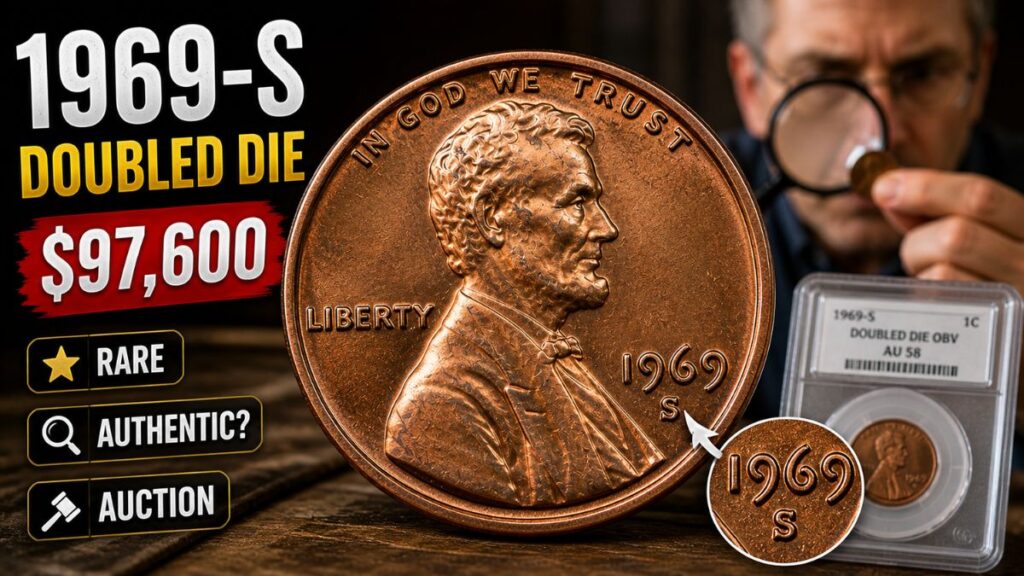
Finding an old Lincoln cent in a drawer, coin jar, inherited collection, or pocket change may seem like an ordinary experience. Most pennies are worth only their face value, while others may bring a modest premium because of their age, condition, mintmark, or unusual characteristics. However, a small number of Lincoln cents are genuinely rare, and the 1969-S Doubled Die Obverse is one of the most famous examples.
The 1969-S Doubled Die Lincoln cent has attracted collectors for decades because of its dramatic doubling, limited number of known examples, and impressive auction history. Unlike ordinary circulation wear or minor minting imperfections, a genuine doubled die is created during the die-making process before coins are struck. When the flawed die produces coins, the same distinctive doubling can appear across multiple examples.
The important point is that not every 1969-S penny with unusual lettering is valuable. Some coins show machine doubling, strike-related distortion, damage, or other characteristics that can look impressive but do not carry the same collector premium. Correct identification is therefore essential.
The 1969-S Doubled Die Obverse is particularly interesting because the doubling is usually visible on the date and major inscriptions, including LIBERTY and IN GOD WE TRUST. The mintmark is an important part of the examination because the original S mintmark was added separately to the working die and should not display the same type of hub doubling.
Some documented examples have sold for substantial amounts. A reported MS64+ Red example sold for $97,600 in January 2026, while another famous specimen reached $601,875 in 2023. These figures apply to specific authenticated coins and should never be interpreted as the guaranteed value of every 1969-S penny.
If you have a 1969-S Lincoln cent, careful examination may be worthwhile. You should avoid cleaning, polishing, scraping, or selling a potentially rare coin before its identity and authenticity have been properly evaluated.
What Makes the 1969-S Lincoln Cent Special?
The 1969-S Lincoln cent was produced at the San Francisco Mint and carries an S mintmark below the date on the obverse side. Most ordinary examples are common circulation coins and are not worth significantly more than one cent. The rare doubled-die variety is different because it contains a major minting characteristic that collectors actively seek.
The key variety is known as the 1969-S Doubled Die Obverse, often abbreviated as DDO. The term “obverse” refers to the front side of the coin, where the portrait of Abraham Lincoln appears. The doubled design is generally most noticeable in the date and lettering rather than in every part of the portrait.
A doubled die is not the same as a coin that was struck twice. The distinction is important. A genuine doubled die is created when the design is transferred incorrectly during the preparation of a die. The resulting die contains two impressions that are slightly misaligned. Every coin struck from that die may show the same underlying doubled design.
By contrast, machine doubling usually occurs during the striking process when the die or planchet shifts slightly. It often produces a flattened, shelf-like appearance rather than two clearly separated design images. Machine doubling can be visually interesting, but it generally does not create the substantial premium associated with a major doubled-die variety.
The 1969-S Doubled Die Obverse became famous because its doubling can be strong and distinct. This makes it easier to recognize than many minor varieties, although proper identification still requires experience and careful comparison.
Understanding the 1969-S Doubled Die Obverse
To understand the rarity of this coin, it helps to understand how a working die is created. A die contains the design used to strike coins. Historically, the design was transferred through a series of hubs and dies. If the design was impressed more than once in slightly different positions during the die-making process, a doubled image could remain on the finished die.
When the die strikes a planchet, the doubling is transferred to the coin. Because the doubling originates from the die itself, it is part of the design rather than a random scratch or post-mint defect.
On a genuine 1969-S Doubled Die Obverse cent, collectors commonly examine:
- The date 1969
- The word LIBERTY
- The phrase IN GOD WE TRUST
- The shape and separation of the doubled design
- The relationship between the doubling and the rest of the lettering
- The S mintmark and whether it appears separately applied
The strongest doubling is often seen in the date and inscriptions. The secondary design image may appear separated from the primary design, producing a clear doubled appearance. The exact visibility depends on the coin’s condition, strike quality, lighting, and surface preservation.
A coin does not need to show identical doubling in every letter to be genuine. Different portions of a design may display varying levels of separation. However, the observed characteristics should be consistent with the known variety rather than appearing random or caused by damage.
Where to Look for Doubling on a 1969-S Penny
The first area to inspect is the date. On a genuine 1969-S Doubled Die Obverse, the numerals may show clear separation or secondary design elements. Collectors should inspect the shapes of the digits individually instead of simply deciding that the date looks thick.
The number 9 can be especially useful during examination, but the entire date should be considered. Look for distinct design separation, not just a blurry outline or raised edge. Lighting from different angles may help reveal details, although harsh lighting can also create misleading shadows.
The word LIBERTY is another important area. Strong doubling may appear on one or more letters. Pay attention to the edges, vertical strokes, and curved portions of the letters. Genuine hub doubling tends to follow the design in a structured way.
The phrase IN GOD WE TRUST should also be examined. Depending on the coin and the strength of the variety, doubling may be visible in multiple letters. A magnifying glass or coin loupe can help, but magnification alone cannot prove authenticity.
Collectors should avoid relying on one isolated letter. The entire obverse should be assessed, and the coin should be compared with reliable reference images or a confirmed example when possible.
Why the S Mintmark Matters
The S mintmark is one of the most important diagnostic details associated with the 1969-S Doubled Die Obverse cent.
During the relevant period, mintmarks were added to working dies separately from the main design. Because the mintmark was applied independently, it should not show the same hub doubling found in the date and lettering.
This does not mean the mintmark can never display damage, distortion, or other irregularities. It means that the mintmark should not be expected to show the same genuine doubled-die characteristics as the primary obverse design.
If a coin appears to have doubling only on the mintmark, that observation does not establish that it is the famous 1969-S Doubled Die Obverse. A collector should focus on the recognized doubling in the date and inscriptions.
The mintmark also deserves inspection for signs of alteration. Because rare coins can command high prices, counterfeiters and altered-coin sellers may attempt to modify common coins. An apparently unusual mintmark should therefore be evaluated together with the rest of the coin.
Genuine Doubling Versus Machine Doubling
One of the biggest challenges for beginners is distinguishing genuine doubled-die varieties from machine doubling. The two can appear similar under casual examination, especially in photographs or poor lighting.
Genuine doubled-die characteristics generally show a second design impression that is part of the original die design. The separation may appear rounded, structured, and integrated into the letter or numeral.
Machine doubling often produces a flat, shelf-like extension. Instead of showing a clearly separated second design image, the affected area may look like one side of the design has been pushed or flattened. It may also affect only a portion of a letter or numeral.
Machine doubling is relatively common compared with major doubled-die varieties. It usually does not carry a large collector premium, even when it is visually dramatic.
The difference can be difficult to explain through a simple written description. Collectors should compare the coin with known examples and study the shape of the doubling under consistent magnification.
The following warning signs should encourage caution:
- Doubling appears only as a flat shelf
- The design looks damaged or scraped
- The doubling is inconsistent with the known variety
- The coin has unusual surfaces or altered color
- The apparent doubling is visible only under extreme lighting
- The doubling appears on areas that should not show the recognized variety
A professional attribution is especially important when a coin could be worth thousands of dollars or more.
How Rare Is the 1969-S Doubled Die?
The 1969-S Doubled Die Obverse is considered an extremely scarce Lincoln cent variety. A commonly cited estimate is approximately 100 known examples, although population estimates can change as new discoveries are reported, previously known coins are reexamined, and duplicate records are clarified.
The exact number of surviving examples is difficult to establish with absolute certainty. Some coins may remain in private collections, while others may not yet have been recognized. In addition, a population report from a grading service does not necessarily represent every example in existence.
Rarity is one reason the variety attracts so much attention. Collectors may spend years searching through Lincoln cents without encountering a genuine example. The combination of a famous date, dramatic doubling, San Francisco mintmark, and low known population creates strong demand.
However, rarity alone does not guarantee a specific price. The value of an authenticated example depends on several factors, including:
- Authenticity
- Grade
- Color designation
- Surface preservation
- Strike quality
- Eye appeal
- Provenance
- Certification
- Market demand
- Timing of the auction
Two genuine examples of the same variety can sell for very different amounts. A coin with a higher grade, attractive original color, and fewer surface problems may command a much stronger price than a lower-grade example.
Why Condition Has Such a Major Influence
Coin collectors use grading to describe the condition of a coin. A circulated example may show wear on Lincoln’s hair, cheek, jaw, and other raised design areas. An uncirculated coin has not experienced ordinary circulation wear, although it may still contain contact marks, spots, discoloration, or other imperfections.
The 1969-S Doubled Die Obverse is valuable enough that condition can make a major difference. A rare coin in a lower circulated grade may be worth substantially less than a high-grade example with strong original color and clean surfaces.
Grading is not based only on whether the coin looks old or shiny. Professional graders evaluate wear, marks, luster, strike, color, and other characteristics. Copper-based Lincoln cents may also receive color designations such as Red, Red-Brown, or Brown, depending on their appearance and preservation.
A Red designation generally indicates that the coin retains a significant amount of its original reddish copper color. Maintaining original color can be difficult because copper reacts to environmental conditions. Exposure to moisture, chemicals, heat, and improper storage can affect the surface.
A coin should never be polished to make it appear brighter. Artificially brightening a coin may damage its original surface and reduce collector appeal. A professional grading service can identify cleaning, environmental damage, and other problems that may affect value.
What Does MS64+ Red Mean?
The reported $97,600 sale involved an example described as MS64+ Red. Understanding this designation helps explain why the price of a particular coin should not be applied to every 1969-S penny.
“MS” stands for Mint State, meaning the coin is considered uncirculated. The number 64 represents a grade on the Sheldon grading scale. The plus symbol indicates that the coin was judged to be near the next grade level but did not fully qualify for it.
The Red designation refers to the coin’s copper color. Copper coins can change color over time, and original red color is often highly valued by collectors when it remains attractive and stable.
An MS64+ Red coin may still contain contact marks or small imperfections. It is not necessarily flawless. Nevertheless, a rare variety in a high mint-state grade can attract significant competition from collectors and investors.
The $97,600 figure should be understood as a documented result for a particular specimen. It does not mean every 1969-S Doubled Die cent is worth nearly $100,000. A circulated coin, a damaged coin, an uncertified coin, or a coin with questionable authenticity could have a very different value.
Understanding the Reported $601,875 Auction Result
Another famous example reportedly reached $601,875 in 2023. Such a result demonstrates the extraordinary level of demand that can exist for a rare and authenticated Lincoln cent variety.
High auction results often involve exceptional examples with desirable grades, strong visual characteristics, established provenance, or other factors that separate them from ordinary specimens. The price may also reflect competition among advanced collectors who specifically want a major rarity.
Auction prices are not fixed price guides. A result from one sale may not be repeated at another auction. Market conditions, publicity, the number of interested bidders, and the quality of the specimen can all influence the outcome.
Collectors should also distinguish between a realized auction price and an advertised asking price. A seller may list a coin for a very high amount, but that listing does not prove that buyers are willing to pay the same price.
The most useful approach is to examine confirmed sales of comparable examples, while considering differences in grade, color, certification, and overall quality.
Can an Ordinary 1969-S Penny Be Worth $97,600?
Most ordinary 1969-S Lincoln cents are not worth $97,600. The high figure is associated with a rare doubled-die variety and a specific high-quality example.
A standard 1969-S cent without the recognized doubled-die characteristics is generally a different collectible. It may have value based on condition or other unusual features, but it should not be treated as the famous rare variety merely because it carries an S mintmark.
This is an important distinction because online headlines can create confusion. A title suggesting that a 1969-S penny “could be worth” a large amount may be technically connected to a rare variety, but it does not mean every coin with the same date and mintmark has that value.
Before estimating a coin’s worth, the owner should establish:
- Whether the date is genuinely 1969
- Whether the mintmark is S
- Whether the doubling matches the recognized variety
- Whether the coin has been altered
- Whether the coin is genuine
- What grade and color designation may apply
Only after these questions are answered can a meaningful valuation discussion begin.
How to Examine Your 1969-S Penny Safely
If you discover a 1969-S cent, handle it carefully. Rare coins can be damaged by fingerprints, scratches, improper cleaning, or rough handling.
Begin by placing the coin on a clean, soft surface. Avoid rubbing the surface with a cloth or paper towel. Hold the coin by its edges whenever possible.
Use natural, diffused lighting or a soft lamp. Rotate the coin slowly and inspect the date and lettering from different angles. A 5x to 10x loupe may be helpful, although excessive magnification can make ordinary surface irregularities seem more important than they are.
Take clear photographs of both sides. Include close-up images of:
- The full obverse
- The date
- LIBERTY
- IN GOD WE TRUST
- The S mintmark
- The reverse
- Any suspicious surface marks
Do not use abrasive materials, chemicals, oils, or cleaning solutions. Even gentle polishing can permanently alter the surface.
If the coin appears to match the famous variety, keep it separate from ordinary coins and seek an evaluation from a qualified numismatic professional or recognized authentication and grading service.
Why You Should Never Clean a Potentially Rare Penny
Cleaning is one of the most common mistakes made by inexperienced coin owners. A person may believe that removing dirt or discoloration will make a coin more attractive. In reality, cleaning can leave scratches, unnatural shine, chemical residue, or altered surfaces.
Collectors generally prefer coins with original surfaces. A cleaned coin may receive a details designation rather than a normal numeric grade. This can reduce its desirability and market value.
Copper coins are particularly sensitive to chemical treatments. Dipping, polishing, rubbing, or applying household products can change the color and texture of the metal.
Even if a coin is not rare, unnecessary cleaning can destroy evidence about its history and condition. If a coin might be a 1969-S Doubled Die Obverse, the risk is much greater because authentication specialists need to inspect the original surfaces.
The safest rule is simple: do not clean a coin that may be valuable.
Could the Coin Be Altered or Counterfeit?
Because genuine 1969-S Doubled Die cents are valuable, altered and counterfeit examples deserve serious attention. Some ordinary coins may be modified to imitate rare varieties. Others may be damaged in ways that create the appearance of doubling.
Alteration can involve engraving, tooling, reshaping, adding material, or manipulating the mintmark. Counterfeit coins may be manufactured to imitate the appearance of genuine pieces.
A coin that looks unusual is not automatically counterfeit, but it should be examined carefully. Warning signs may include:
- Unnatural surfaces around the date
- Tool marks
- Scratches that follow the lettering
- Inconsistent color
- A suspicious mintmark
- Unusual texture
- Evidence of added or removed metal
- Doubling that does not match recognized examples
Weight and measurements may provide useful preliminary information, but they cannot independently establish authenticity. A counterfeit can sometimes be made with similar metal composition and dimensions.
Professional authentication is especially important when a coin has potentially substantial value.
The Role of Professional Authentication
Professional authentication helps determine whether a coin is genuine and whether it matches the recognized variety. Grading services may examine the coin’s design, surfaces, composition, minting characteristics, and overall condition.
A professional evaluation may identify whether the apparent doubling is genuine, mechanical, damaged, or altered. Specialists can also compare the coin with established references and known examples.
Authentication does not guarantee a specific selling price. It provides confidence about what the coin is and how it may be evaluated by the marketplace.
For a potentially valuable 1969-S Doubled Die cent, professional examination may be worthwhile even if the initial cost is significant. Selling an expensive rarity without authentication can expose the owner to confusion, disputes, or an unnecessarily low offer.
Owners should be cautious of anyone who immediately promises a huge price without carefully inspecting the coin. A trustworthy evaluation should explain the reasons behind the identification and clearly separate confirmed facts from estimates.
How Much Could a Genuine Example Be Worth?
There is no single guaranteed value for every genuine 1969-S Doubled Die Obverse cent. Market value depends heavily on the specific coin.
A circulated example with visible wear may sell for a different amount from a mint-state specimen. A coin with original red color may bring more than an example with brown color or environmental discoloration. Surface marks, spots, scratches, and cleaning can also influence the final result.
The reported sales of $97,600 and $601,875 show that exceptional examples can reach very high prices. However, these figures should not be used as automatic estimates for an ungraded discovery.
A realistic valuation process involves:
- Confirming the variety
- Confirming authenticity
- Determining the grade
- Evaluating the color designation
- Reviewing comparable auction results
- Considering current collector demand
- Choosing an appropriate sales method
An appraisal should be based on the actual coin rather than a headline or a photograph taken under uncertain conditions.
Why Auction History Matters
Auction history helps collectors understand how the market has treated similar coins. A documented sale can provide evidence of what buyers paid for a particular specimen at a particular time.
However, auction records must be interpreted carefully. The grade, certification, color, provenance, and quality of each coin matter. Two examples of the same variety may look similar in a short video but differ significantly under professional examination.
The date of the sale also matters. Coin markets can change over time. A result from 2023 may not represent the exact price a comparable coin would receive in 2026 or a later year.
Auction history is most useful when several comparable sales are reviewed rather than relying on a single dramatic result. Collectors should consider whether the comparison coin has a similar grade and appearance.
The strongest evidence comes from completed sales rather than speculative listings or social media claims.
How to Store a Potentially Valuable Lincoln Cent
Proper storage can help protect a coin’s original surfaces. A basic coin holder made from a suitable inert material is preferable to loose storage in a pocket, envelope, or plastic bag that may contain harmful chemicals.
Avoid exposing the coin to humidity, extreme temperatures, cleaning products, and direct handling. Fingerprints can leave oils and residue that may affect copper surfaces over time.
Do not place a rare-looking coin in a holder that presses against its surface or contains materials that may react with the metal. If the coin has already been placed in a holder, avoid removing it unnecessarily.
For a valuable authenticated coin, collectors may choose professional encapsulation. Encapsulation can provide physical protection and display the grading information, although it does not eliminate all environmental risks.
The main goal is to preserve the coin without changing its original appearance.
Common Mistakes Made by New Coin Collectors
New collectors often make understandable mistakes when they encounter a coin that looks unusual. The most common error is assuming that every form of doubling is valuable.
Another mistake is focusing only on the date. A 1969-S cent must have the correct recognized doubled-die characteristics to qualify as the famous variety.
Some collectors also assume that a coin’s age automatically makes it rare. Millions of Lincoln cents were produced during the twentieth century, and many older examples remain common.
Other common mistakes include:
- Cleaning the coin
- Scraping the date to reveal details
- Selling before authentication
- Trusting an online claim without comparison
- Assuming an asking price is a confirmed value
- Ignoring surface damage
- Failing to inspect both sides
- Believing that dramatic appearance always indicates rarity
A careful, patient approach is more useful than rushing toward a high valuation.
Why the 1969-S Doubled Die Remains Popular
The variety combines several qualities that attract collectors. It has a recognizable date, a major doubled-die characteristic, a limited known population, and a long history of interest within the Lincoln cent series.
Its appeal also comes from the possibility of discovery. Lincoln cents have circulated widely, meaning that people may encounter them in old collections, inherited coin jars, estate accumulations, or forgotten boxes.
The idea that an ordinary-looking penny could contain a major rarity makes the variety especially engaging. However, the excitement must be balanced with careful identification.
Collectors are drawn not only to the potential financial value but also to the manufacturing history behind the error. A doubled die provides evidence of how coins were made and how a small production mistake can create a distinctive collectible.
The variety is therefore important from both a financial and historical perspective.
Where You Might Find a 1969-S Penny
A 1969-S cent may appear in old collections, inherited coin accumulations, dealer inventories, or groups of circulated Lincoln cents. Finding the date itself is not particularly unusual, but finding a genuine doubled-die example is much less common.
Older family collections can be worth examining because coins may have been stored for many years without being studied closely. Coin jars and boxes can also contain interesting dates and varieties.
Nevertheless, most discoveries will not be major rarities. Collectors should approach the search as a learning activity rather than assuming that a valuable coin is guaranteed.
If you search through coins, handle each one carefully and avoid damaging the surfaces. Use a consistent process so that you can compare dates, mintmarks, and design details accurately.
The best results come from patience, education, and realistic expectations.
Is the 1969-S Doubled Die a Good Coin for Beginners?
The 1969-S Doubled Die can be an excellent subject for learning about mint errors and varieties, but beginners should not attempt to authenticate a potentially valuable example based on one photograph alone.
Studying the variety can teach several important numismatic skills:
- Recognizing the difference between a variety and damage
- Understanding how mintmarks were applied
- Examining lettering and numerals
- Using magnification properly
- Comparing known examples
- Understanding professional grading
- Evaluating auction records
- Avoiding exaggerated claims
Beginners should start by examining ordinary cents and learning how normal minting characteristics appear. This makes it easier to recognize when a coin truly differs from a standard example.
Reference materials, experienced collectors, coin clubs, and professional specialists can help improve identification skills. The goal should be accurate knowledge rather than a quick promise of wealth.
What You Should Do If You Think You Found One
If your 1969-S penny appears to show strong doubling, do not immediately place it for sale online. First, protect the coin and document what you see.
Take photographs without altering the surface. Record where you found the coin, if known, and keep any relevant collection information. Provenance is not always necessary for authentication, but it can sometimes provide useful background.
Next, compare the coin with established examples of the variety. Pay particular attention to the date, LIBERTY, and IN GOD WE TRUST. The appearance should be consistent with known examples rather than simply looking thick or blurry.
If the characteristics remain convincing, consult a qualified specialist or professional grading service. Avoid sending the coin to an unknown buyer who promises an immediate high payment.
A professional opinion may confirm that the coin is genuine, identify a different variety, or explain why the apparent doubling is not collectible. Each outcome is useful because it prevents an incorrect conclusion.
Selling a Genuine 1969-S Doubled Die Cent
If a coin is authenticated as a genuine 1969-S Doubled Die Obverse, the owner may consider several selling options. The appropriate method depends on the coin’s grade, certification, market demand, and personal circumstances.
A major auction may provide access to advanced collectors and competitive bidders. A reputable specialist dealer may offer a more direct transaction. Private sales are also possible, but they require careful documentation and an understanding of fair market value.
Before selling, obtain more than one professional opinion when practical. Compare the proposed offer with documented sales of similar examples. Consider the grading details, color designation, and overall condition of the coin.
A seller should also understand fees, insurance, shipping, payment terms, and return policies. A high headline price does not necessarily represent the amount the owner will receive after expenses.
Never allow urgency or pressure to determine the decision. A valuable coin should be sold only after the owner understands its identity and the terms of the transaction.
Why You Should Be Careful With Online Coin Claims
Social media videos and online articles often feature rare coin discoveries with extremely high valuations. Some reports are based on genuine auction results, while others may exaggerate the value of common coins.
A headline can leave out important details such as grade, certification, color, or variety. For example, a title mentioning a $97,600 penny may refer to one specific high-grade specimen rather than every coin with the same date.
Collectors should ask several questions:
- Was the coin authenticated?
- Was the sale completed?
- What was the grade?
- Was the coin the exact same variety?
- Was the price realized or merely requested?
- Were fees included?
- Is the source describing a confirmed example?
These questions help prevent unrealistic expectations. Accurate coin collecting requires evidence, not only excitement.
The Difference Between Face Value and Collector Value
Every Lincoln cent has a face value of one cent, but some coins carry additional collector value because of scarcity, condition, history, or unusual production characteristics.
The majority of 1969-S cents are not major rarities. Their collector value may depend on condition or other factors, but they should not automatically be compared with the famous doubled-die variety.
Collector value develops when buyers are willing to pay more than face value for a particular coin. Rarity, demand, and authenticity all influence that willingness.
A coin may be old but common. Another coin may be relatively modern but rare because of a specific error. The 1969-S Doubled Die demonstrates how a single production characteristic can separate a small number of coins from millions of ordinary examples.
This is why identification must come before valuation.
Frequently Asked Questions About the 1969-S Doubled Die Penny
What Is the 1969-S Doubled Die Obverse?
The 1969-S Doubled Die Obverse is a rare Lincoln cent variety produced from a die containing a doubled design. The doubling is usually visible on the date and inscriptions such as LIBERTY and IN GOD WE TRUST.
Is Every 1969-S Penny Valuable?
No. Most 1969-S Lincoln cents are ordinary coins. A substantial premium generally requires a recognized variety, unusual condition, or another documented collectible characteristic.
Where Should I Look for Doubling?
Inspect the date, LIBERTY, and IN GOD WE TRUST. The doubling should appear distinct and consistent with the known variety. The S mintmark should not be expected to show the same hub doubling because it was added separately.
How Can I Tell Genuine Doubling From Machine Doubling?
Genuine doubling usually appears as a structured secondary design image. Machine doubling often creates a flattened or shelf-like appearance. A professional examination is recommended when the coin may be valuable.
Why Is the S Mintmark Important?
The S mintmark helps identify the San Francisco issue. Because mintmarks were applied separately during the relevant production process, the mintmark should not show the same doubled-die characteristics as the main design.
How Many 1969-S Doubled Die Cents Are Known?
A commonly cited estimate is approximately 100 known examples. Population estimates may change as additional coins are discovered, reexamined, or recorded.
Can a 1969-S Doubled Die Penny Be Worth More Than $100,000?
Some exceptional examples have reached very high prices, including a reported $601,875 result in 2023. However, the value of an individual coin depends on authenticity, grade, color, surface quality, and market conditions.
What Was the Reported $97,600 Sale?
A reported MS64+ Red example sold for $97,600 in January 2026. That price applies to the specific authenticated specimen and should not be used as a guaranteed value for every 1969-S cent.
Should I Clean My Penny Before Having It Examined?
No. Cleaning, polishing, or rubbing may damage the original surface and reduce collector value. Keep the coin untouched and handle it carefully.
Should I Weigh the Coin?
Weight and other measurements may provide preliminary information, but they cannot confirm the doubled-die variety or prove authenticity. The design characteristics and professional evaluation are more important.
Can a Photograph Confirm the Variety?
A clear photograph may help with preliminary discussion, but it cannot always establish authenticity. Surface alterations, lighting, image quality, and camera angles can be misleading.
Where Should I Have the Coin Authenticated?
Consider a qualified numismatic specialist or a recognized professional authentication and grading service. Choose an evaluator with experience in major Lincoln cent varieties.
Is an Asking Price the Same as an Auction Result?
No. An asking price is what a seller hopes to receive. A completed auction result shows what a buyer actually paid under the terms of that sale, although fees and other conditions should still be considered.
What Should I Do If Someone Offers to Buy It Immediately?
Avoid rushing. Ask for a written explanation, obtain an independent opinion, and compare the coin with documented sales of similar authenticated examples before making a decision.
Can a Common Penny Be Altered to Look Like a Doubled Die?
Yes. Coins may be damaged or deliberately altered to imitate valuable varieties. This is one reason professional authentication is important for high-value claims.
Why Is the 1969-S Doubled Die So Famous?
It combines dramatic visible doubling, extreme scarcity, a recognizable Lincoln cent design, and strong documented collector demand. Its auction history has also contributed to its reputation.
Final Thoughts on the 1969-S Doubled Die Penny
The 1969-S Doubled Die Obverse is one of the most fascinating varieties in the Lincoln cent series. Its dramatic doubling, limited known population, and documented high auction results have made it a major target for collectors.
The reported $97,600 sale in January 2026 and the $601,875 result in 2023 demonstrate the potential value of exceptional authenticated examples. However, these prices belong to specific coins and should never be treated as automatic valuations for every 1969-S penny.
If you find a 1969-S cent, examine the date, LIBERTY, and IN GOD WE TRUST carefully. Look for strong, clearly separated doubling rather than flat machine doubling or damage. Remember that the S mintmark was applied separately and should not display the same hub doubling.
Most importantly, do not clean, polish, scrape, or sell a potentially rare coin in a hurry. Preserve the original surface, compare the design with reliable examples, and seek professional authentication when the evidence appears promising.
A small penny may hold an important place in numismatic history, but accurate identification is what separates an ordinary coin from a genuine rarity.