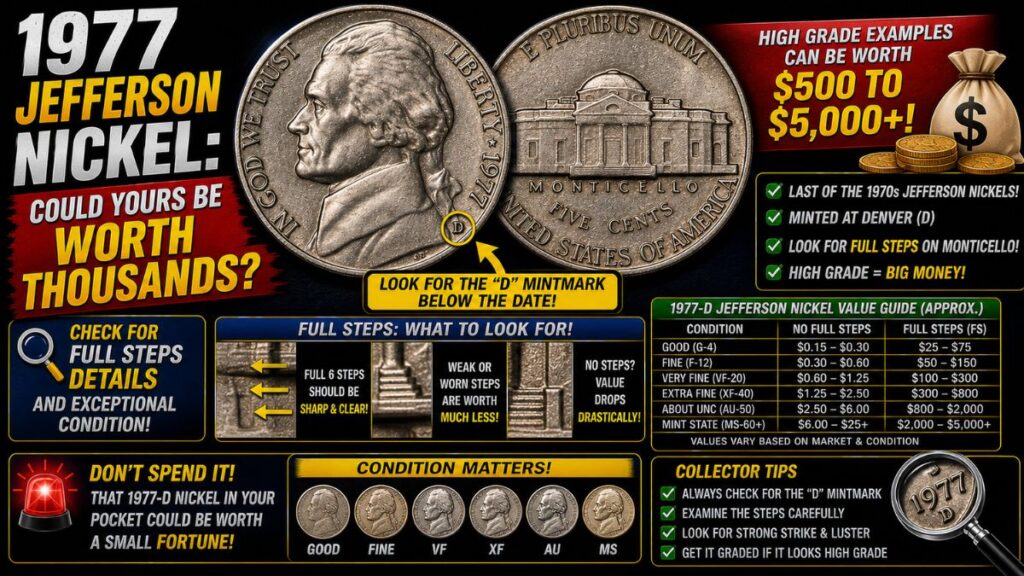
A 1977 Jefferson nickel might look like an ordinary five-cent coin, but some examples deserve a closer examination. While most nickels from this year are common and worth only a modest amount, exceptionally preserved coins with sharp design details can attract attention from serious collectors. One feature that matters particularly to specialists is the Full Steps designation on the reverse of the coin.
The 1977 Jefferson nickel belongs to a long-running American coin series featuring President Thomas Jefferson on the obverse and his home, Monticello, on the reverse. The design is familiar to generations of Americans, and nickels from the 1970s frequently turn up in old coin jars, collections, and everyday change.
The challenge is distinguishing an ordinary circulated coin from an example with characteristics that make it more desirable. A nickel with heavy wear, scratches, or weak details generally has limited collector appeal. A coin with strong original luster, minimal contact marks, and unusually complete architectural details may be more interesting.
This is where the steps of Monticello become important. The building’s staircase appears on the reverse, below the dome and columns. On many nickels, these steps are weakly struck or difficult to distinguish clearly. A coin showing sharply separated steps can stand out, especially when the rest of its surfaces are well preserved.
However, not every 1977 nickel with visible steps is rare, and the Full Steps designation does not automatically mean a coin is worth thousands of dollars. Value depends on the coin’s grade, strike quality, originality, scarcity in the relevant condition, and actual collector demand.
If you have a 1977 Jefferson nickel, a careful inspection can help you decide whether it is simply a common coin or an example worth researching further.
What Makes the 1977 Jefferson Nickel Interesting?
The Jefferson nickel series began in 1938, replacing the Buffalo nickel in regular American circulation. The original design was created by Felix Schlag, whose portrait of Thomas Jefferson appears on the obverse. The reverse depicts Monticello, Jefferson’s Virginia home.
The design remained familiar through 1977, although the coin’s production details and the condition of individual dies varied over time. The date is therefore not enough by itself to establish whether a coin is valuable.
Nickels dated 1977 were produced for ordinary circulation, and large numbers remain available. Many examples have been handled extensively, resulting in worn portraits, softened architectural details, and marks from contact with other coins.
The coins that attract the most attention are usually those that have survived in exceptional condition. They may retain strong mint luster and sharp details, or they may display a particularly complete strike on Monticello’s steps.
A well-preserved coin can be appealing even if it has no unusual error or variety. Collectors who assemble Jefferson nickels by date, mintmark, and grade often look for high-quality examples to improve their collections.
The 1977 issue can also be useful for learning about the difference between a coin’s mintage, grade, strike, and market value. These concepts are closely related, but they are not interchangeable.
A coin can be old without being rare, uncirculated without being flawless, and sharply struck without necessarily commanding a large premium. Understanding those differences is the first step toward evaluating a 1977 Jefferson nickel realistically.
How to Identify a Genuine 1977 Jefferson Nickel
Begin by examining the obverse, the side with Thomas Jefferson’s portrait. The date 1977 should appear near the lower portion of the design. Depending on the coin’s condition, the digits may be sharp or worn.
Next, inspect the reverse. A normal 1977 Jefferson nickel shows Monticello, with the building’s dome, columns, and staircase visible above the denomination FIVE CENTS. The words UNITED STATES OF AMERICA and E PLURIBUS UNUM also appear on this side.
Look for a mintmark near the area traditionally used for identifying the coin’s mint of origin. On regular 1977 Jefferson nickels, the relevant mintmark distinctions are generally associated with Philadelphia and Denver production. A D mintmark identifies Denver, while Philadelphia coins of this period normally do not carry a mintmark.
The absence of a mintmark on a 1977 nickel is not, by itself, evidence of an error. Collectors must consider the mintmark conventions used for the date rather than assuming that every coin should display a letter.
Also examine the coin’s color and surface. Jefferson nickels are made primarily from a copper-nickel alloy, so their normal appearance differs from the reddish-brown color commonly associated with copper cents.
If the coin has an unusual date, mintmark, shape, or surface feature, compare it with a reliable reference before deciding that it is rare. Alterations, scratches, corrosion, and damage can sometimes imitate unusual minting characteristics.
Understanding the Full Steps Designation
Full Steps is one of the most important condition-related features collectors examine on Jefferson nickels. It refers to the clarity and completeness of the horizontal steps at the base of Monticello on the reverse.
The staircase contains several narrow lines that can be difficult to strike sharply. If the dies do not transfer the design completely, some of the steps may appear merged, faint, or partially missing.
On a sharply struck coin, the step lines are more clearly separated. This allows collectors to see the individual levels of the staircase rather than a single indistinct band.
The Full Steps designation is associated with the quality of the strike and the preservation of the relevant details. It is most meaningful when the coin is also in an appropriate uncirculated condition, with surfaces that have not been worn down through circulation.
Different grading services may apply their own specific criteria for designating Full Steps, including requirements concerning the number of visible steps and the continuity of the lines. Consequently, a collector should not assume that a coin qualifies simply because several steps can be seen.
For a 1977 Jefferson nickel, sharply defined steps can make an otherwise ordinary date more interesting to specialists. However, the designation must be considered alongside the coin’s grade, surface quality, and market demand.
Full Steps is not a guarantee of a high price. It is a desirable characteristic whose importance depends on how scarce and attractive the coin is in the particular grade.
Why Monticello’s Steps Matter So Much
The staircase on Monticello is a small part of the overall design, but it can reveal a great deal about how clearly the coin was struck.
During production, a metal blank is placed between dies that carry the coin’s design. Under pressure, the metal flows into the recessed parts of the dies to create the raised details on the finished coin.
Fine architectural lines can be difficult to reproduce fully, especially when the dies have lost sharpness or when the striking conditions do not transfer every detail. As a result, two nickels with the same date and mintmark can show noticeably different step definition.
A coin with well-separated steps demonstrates that the staircase detail has been transferred clearly enough to preserve its individual lines. When the rest of the coin also has excellent surfaces, that feature can contribute to its desirability.
Collectors often use a magnifier to inspect the steps because the lines are narrow and may be obscured by small contact marks. A scratch crossing the staircase can interrupt a line and make an otherwise sharp coin less appealing.
The steps must also be distinguished from shadows and reflections. Changing the lighting angle can help reveal whether the lines are genuinely separated or merely appear that way because of contrast.
Although Full Steps is a familiar term among Jefferson nickel collectors, it should not be treated as a simple visual shortcut to a high value. It is one element in a broader assessment of quality and rarity.
Can a 1977 Jefferson Nickel Be Worth Thousands?
A 1977 Jefferson nickel can attract significant interest if it is exceptional in condition or has a genuinely unusual, authenticated characteristic. Nevertheless, the idea that an ordinary example could routinely be worth thousands of dollars is misleading.
Most 1977 nickels are common. Circulated examples generally have little premium beyond their face value unless they have a recognized collectible feature. Even many uncirculated coins are not especially valuable because numerous examples have survived.
High prices, when they occur, usually involve coins with unusual combinations of grade, strike quality, rarity, and collector demand. A coin that is exceptionally well preserved may compete in a very different market from an average nickel taken from circulation.
The Full Steps designation can improve a coin’s desirability, but the premium depends on the specific issue and grade. If examples with comparable quality are readily available, the designation may not create an extraordinary price.
Auction headlines can also give a distorted impression. A record result for one coin may reflect a particularly high grade, a rare variety, unusual eye appeal, or intense competition between buyers. It does not establish the value of every coin bearing the same date.
To judge a 1977 nickel fairly, identify its mint, evaluate its condition, determine whether it meets recognized Full Steps criteria, and compare it with actual sales of closely matching coins.
The possibility of finding an exceptional coin makes inspection worthwhile. It does not justify assuming that a nickel is valuable before its characteristics have been verified.
Why Most 1977 Nickels Are Common
The 1977 Jefferson nickel was produced for general circulation, not as a limited collectible issue. As a result, ordinary examples are not difficult to find.
Coins were used in shops, vending machines, public transportation, and everyday transactions. Many acquired scratches, dents, and wear through years of handling. Others were placed in jars, drawers, or informal collections and survived in better condition.
The continued availability of 1977 nickels is an important part of their market story. Scarcity is not determined simply by how many years have passed since a coin was issued. It also depends on how many examples remain available in a particular grade or with a specific desirable feature.
For example, a date may be common in circulated condition but much harder to find with exceptionally clean surfaces and sharp details. This difference explains why collectors sometimes pay premiums for coins that appear nearly identical at first glance.
Even so, a high grade does not automatically establish rarity. Many coins from common dates survive uncirculated, and the market may have plenty of examples available.
A collector should therefore consider the 1977 date as a starting point, not a conclusion. The coin’s individual characteristics matter more than the year alone.
How to Inspect a 1977 Nickel’s Full Steps
A close inspection is easiest when the coin is cleanly visible under steady light. You do not need to clean the coin itself; simply use a clear, well-lit viewing area.
Place the nickel on a soft, stable surface. A magnifier can help you see the narrow horizontal lines beneath Monticello, but avoid touching the staircase with a tool.
First, look at the steps from a normal viewing distance. Determine whether the staircase is clearly defined or whether the lines merge into a broad, indistinct area.
Then examine the coin through magnification. Look for separate horizontal lines and check whether they remain continuous across the visible width of the staircase. Pay attention to interruptions, contact marks, and areas where the lines appear weak.
Change the angle of the light. Side lighting can make the raised and recessed details easier to see, while direct overhead lighting may hide subtle features through reflection.
Inspect the rest of the reverse as well. Strong step detail is more persuasive when the building’s columns, dome, and surrounding lettering also show good definition.
Finally, examine the obverse. A coin with a sharp reverse but noticeable wear or damage elsewhere may not qualify for the highest condition designations.
If you are unsure whether the coin meets Full Steps standards, compare it with graded examples and the criteria used by established grading services. A visual impression alone cannot guarantee that a coin will receive the designation.
Full Steps Versus Full Bell Lines and Other Terms
Collectors use different descriptive terms for different coin designs, and it is important not to confuse them.
Full Steps refers to the staircase details on the reverse of Jefferson nickels. The term is associated with the degree to which those lines remain separated and complete.
Other American coins have different design features that collectors use to evaluate strike quality. For example, some coin series are assessed by the completeness of bell lines, bands, or other small design elements.
These terms are not interchangeable. A Jefferson nickel should be evaluated according to the characteristics of its own design and the grading standards relevant to that series.
Full Steps also differs from the overall numerical grade. A coin may receive a high uncirculated grade but fail to qualify for a Full Steps designation because its staircase details are weak or interrupted.
Conversely, clearly defined steps do not make a coin flawless. The coin may still have contact marks, surface imperfections, or other features that affect its grade.
The best way to understand the distinction is to treat grade, strike, and special designations as related but separate elements. Each answers a different question about the coin.
What Makes an Uncirculated 1977 Nickel Desirable?
An uncirculated coin has not experienced the normal wear associated with circulation, but that does not mean it is free of marks or imperfections.
Nickels can acquire contact marks while moving through minting equipment, bags, counting machines, or storage containers. These marks may be small, but they can become important when comparing coins at high grades.
Collectors also look at the sharpness of the design. On the obverse, the portrait and surrounding lettering should retain clear detail. On the reverse, Monticello and its steps should be well defined.
Original luster is another important characteristic. A fresh nickel may show a soft, moving sheen when tilted under light. This effect is different from the artificial brightness that can result from polishing or abrasive cleaning.
Surface quality matters as well. Scratches, spots, stains, and discoloration can reduce eye appeal. Their significance depends on their size, location, and severity.
A coin’s overall balance is often more important than one isolated feature. Strong steps can be attractive, but a coin with distracting marks or questionable surfaces may be less desirable than another example with slightly weaker steps and superior overall preservation.
The strongest candidates for serious collector attention combine excellent preservation, appealing surfaces, and a clear strike.
The Difference Between Grade and Strike Quality
Grade and strike quality are closely related in appearance, but they describe different aspects of a coin.
Grade primarily concerns the coin’s condition, including wear, surface marks, luster, and other characteristics. For an uncirculated coin, the number and severity of contact marks can have a substantial effect on its grade.
Strike quality describes how completely the design was transferred from the dies to the planchet. A sharply struck coin displays its details clearly, while a weakly struck coin may have soft or incomplete features even if it has never circulated.
This distinction is particularly relevant to Full Steps nickels. A coin can be uncirculated yet have weak steps because the design was not fully transferred during striking.
Likewise, a sharply struck nickel can have contact marks that reduce its overall grade. The coin may show complete steps but still be less desirable than an equally sharp example with cleaner surfaces.
Collectors who focus on high-grade Jefferson nickels therefore examine both aspects. They consider how much wear the coin has experienced and how clearly the original design appears.
Neither grade nor strike should be judged in isolation. The most useful assessment considers the entire coin, including its surfaces, details, color, and authenticity.
Mintmarks on 1977 Jefferson Nickels
Mintmarks identify where a coin was produced, and they are an important part of collecting Jefferson nickels by date and mint.
A 1977-D nickel carries a D mintmark indicating production at Denver. A 1977 nickel from Philadelphia normally has no mintmark, following the mintmark conventions used for this period.
The mintmark is a useful identification detail, but it does not by itself make a coin rare. The number of coins produced at each facility and the availability of surviving examples both influence collectibility.
When examining a possible mintmark variety, look closely at the letter’s shape and surrounding metal. An unusual-looking D may result from damage, a reflection, or a normal variation in appearance rather than a recognized die variety.
Do not assume that a missing mintmark is an error simply because other coins carry a letter. The correct interpretation depends on the date and the mintmark practices used for that issue.
If the mintmark appears altered or unusually shaped, compare it with authenticated examples. A reliable identification should be based on specific characteristics rather than a general impression that the letter looks different.
Could a 1977 Nickel Have a Valuable Mint Error?
Mint errors are coins that show an abnormality caused during the production process. Some can be collectible, but the type and severity of the error matter greatly.
Examples of recognized error categories across coinage include off-center strikes, broadstrikes, clipped planchets, and certain multiple-strike errors. These categories describe different production problems and should not be confused with damage acquired after a coin left the mint.
A genuine error may be valuable when it is visually distinctive, uncommon, and supported by collector demand. Minor irregularities or ambiguous marks usually attract less interest.
For a 1977 Jefferson nickel, an unusual appearance deserves investigation rather than an immediate claim of rarity. A bent edge, flattened lettering, or an apparent second outline could have several causes.
Look for signs that the feature was created during striking. The flow of metal, relationship between the design and the edge, and character of the affected surfaces may help an expert distinguish a mint error from post-mint damage.
If the coin seems unusual, preserve it as found and photograph both sides and the edge. Avoid cleaning or reshaping it, as those actions can destroy evidence needed for identification.
A professional opinion may be worthwhile if the error is dramatic or appears consistent with a recognized production anomaly.
Machine Doubling and Doubled Dies: What Is the Difference?
Doubled-looking lettering and numbers can attract attention, but not every example represents a valuable doubled-die variety.
A doubled die forms when a die receives misaligned impressions during the die-making process, creating a doubled design that can appear on coins struck from that die. The doubling is part of the die itself and may be repeated across multiple examples.
Machine doubling, by contrast, occurs during the striking process and often creates a flattened or shelf-like secondary outline. It is generally not valued in the same way as a recognized doubled-die variety.
The difference can be difficult to judge from a quick glance. Lighting, magnification, wear, and damage can all affect how a feature appears.
If the date, lettering, or Monticello design on a 1977 nickel looks doubled, inspect the feature carefully and compare it with documented examples. A visible second edge is not sufficient proof of a rare variety.
The coin’s overall condition should also be considered. A genuine variety may attract collector interest, but its market value still depends on scarcity, grade, and demand.
Avoid buying or selling a coin based on a dramatic label unless the attribution is supported by evidence.
Why Coin Cleaning Can Reduce Value
Cleaning a coin may seem like a way to make it more attractive, especially if it has dark spots or dull surfaces. In practice, cleaning can permanently change the coin and reduce its appeal to collectors.
Polishing can leave fine scratches that become obvious under magnification. Abrasive materials may remove or alter the original surface texture. Chemical treatments can change the coin’s color or produce uneven areas.
These problems matter for a 1977 nickel because collectors evaluating high-grade examples often pay close attention to surface quality and originality.
A coin that looks brighter after cleaning is not necessarily in better condition. Experienced collectors may recognize artificial shine or altered surfaces, and a cleaned coin may receive a details grade rather than a normal numerical grade.
If the nickel has dirt or discoloration, leave it alone unless a qualified professional recommends a suitable approach. Ordinary handling can also leave fingerprints, so hold the coin by its edges.
Preserving the existing surface is especially important when investigating possible Full Steps details or mint errors. Marks created during cleaning can obscure original features and complicate authentication.
The safest rule is simple: inspect the coin carefully, but do not try to improve its appearance through rubbing or polishing.
How to Estimate the Value of a 1977 Jefferson Nickel
The most reliable way to estimate value is to identify the coin accurately and compare it with similar coins that have actually sold.
Start by recording the date and mintmark. Determine whether the coin is circulated or uncirculated, then assess its surface condition and strike quality.
Next, examine the Monticello steps. If they appear complete, compare the coin with examples that have received a recognized Full Steps designation. Do not assume that a few visible lines are enough to qualify.
If the coin has a suspected mint error or die variety, establish whether the feature is genuine and recognized before using it to estimate value.
Then research completed sales for coins with comparable grades and characteristics. An ordinary 1977 nickel should be compared with ordinary examples, while a certified Full Steps coin should be compared with coins that have the same designation and similar overall quality.
Pay attention to the date of each sale and the details of the coin. A high price for a top-grade example does not establish the value of a lower-grade coin.
Remember that asking prices are not the same as completed sales. A seller may advertise a common coin for an ambitious amount without ever finding a buyer.
When the potential value is substantial, consider getting an independent assessment rather than relying on a single online estimate.
When Professional Grading Is Worth Considering
Professional grading can help establish a coin’s authenticity and condition, but it is not necessary for every nickel.
For an ordinary circulated 1977 coin, grading costs may exceed the likely market value. In that situation, careful identification and comparison with ordinary examples may be sufficient.
Professional grading becomes more relevant when a coin appears exceptionally well preserved, has potentially complete steps, or displays a suspected mint error or recognized variety.
A grading service can assess the coin’s condition using standardized criteria and may assign a special designation when the coin qualifies. However, not every coin with visible steps will receive Full Steps.
Before submitting the coin, consider the service fee, shipping, insurance, and the possibility that the final grade may be lower than expected. Certification can provide useful information, but it does not guarantee a particular selling price.
If the coin has a possible error, authentication may be especially valuable because it can help distinguish a genuine production abnormality from damage.
A knowledgeable coin dealer may also provide an initial opinion. For a coin that could be unusually valuable, obtaining more than one informed assessment can help reduce the risk of relying on an inaccurate attribution.
How to Store a Potentially Valuable Nickel
Proper storage helps protect a coin’s condition and preserve its collector appeal.
Avoid keeping a potentially valuable nickel loose with other coins. Repeated contact can cause scratches and small dents, particularly on coins with high-grade surfaces.
A suitable coin holder can help reduce handling and protect the coin from accidental damage. Choose materials intended for coin storage, and do not force the coin into a holder that is too tight.
Store the nickel in a dry environment with relatively stable conditions. Excessive moisture and unsuitable storage materials can contribute to staining or surface changes.
Handle the coin by its edges whenever possible. Fingerprints and skin oils can leave marks, especially on surfaces that have little wear.
Do not use cleaning products, polish, or abrasive materials. If the coin is being considered for professional evaluation, leaving its surfaces untouched is especially important.
If you believe the coin has Full Steps or a mint error, preserve it in its current condition until it has been examined. Original surfaces and undisturbed features make it easier to evaluate what is actually present.
Common Myths About the 1977 Jefferson Nickel
Several misconceptions can lead collectors to overestimate the value of an ordinary nickel.
One common myth is that every old coin is rare. The 1977 Jefferson nickel is several decades old, but many examples survive, so age alone does not establish scarcity.
Another misconception is that Full Steps automatically means thousands of dollars. The designation can improve desirability, but the premium depends on the specific coin’s grade, quality, availability, and demand.
Some collectors also assume that a shiny nickel must be uncirculated. A polished coin may look bright while having altered surfaces, so luster and originality need to be evaluated carefully.
A further mistake is confusing a weak strike with circulation wear. A coin can be uncirculated yet have soft details because of the way it was struck. Conversely, a coin may have strong design details but show wear from circulation.
Finally, an unusual mark is not necessarily a mint error. Damage after production can create shapes and lines that resemble manufacturing abnormalities.
The best way to avoid these mistakes is to identify the coin, inspect it carefully, and verify any unusual characteristic before assigning a rarity label or estimating a high value.
Is the 1977 Jefferson Nickel Worth Keeping?
Many collectors keep 1977 Jefferson nickels because they are useful additions to date-and-mintmark collections or because they offer a practical way to learn about grading and strike quality.
A circulated coin may have little financial premium, but it can still be historically interesting and useful for studying the design. A high-grade example can be more desirable, especially if it shows unusually sharp details and attractive surfaces.
The decision to keep a coin does not have to depend entirely on its market value. Some collectors enjoy completing a series, comparing different grades, or learning to recognize the characteristics of a well-struck coin.
If your nickel looks ordinary, there is no need to assume that you have overlooked a hidden fortune. If it appears exceptional, however, it is worth taking the time to inspect it and compare it with reliable references.
A simple coin folder can be a convenient way to organize common dates while protecting them from unnecessary handling. Potentially valuable examples should be stored separately in suitable holders.
The key is to make an informed decision based on the coin’s actual qualities rather than a headline promising extraordinary prices.
A Practical Checklist for Your 1977 Jefferson Nickel
Before deciding whether your coin deserves professional attention, work through the following steps.
First, confirm that the date reads 1977. Identify the mintmark, if present, and make sure the coin’s design matches a normal Jefferson nickel for that year.
Second, examine the obverse for wear, scratches, contact marks, and signs of cleaning. Look at Jefferson’s portrait and the surrounding lettering.
Third, turn the coin over and inspect Monticello. Look at the staircase under good lighting and magnification. Determine whether the horizontal lines are clearly separated and whether any marks interrupt them.
Fourth, assess the overall surface quality. Strong steps are only one factor; luster, preservation, and the absence of distracting marks also matter.
Fifth, investigate any suspected doubling, mintmark anomaly, or striking error. Compare the feature with documented examples instead of assuming that it is rare.
Sixth, research completed sales for coins with matching characteristics. Make sure the comparisons involve similar grades and the same special designation, if applicable.
Finally, consider professional grading or authentication only when the coin’s potential significance justifies the cost.
This process will not guarantee that you discover an exceptionally valuable nickel, but it will help you separate realistic collector interest from unsupported claims.
Frequently Asked Questions About the 1977 Jefferson Nickel
Is a 1977 Jefferson nickel rare?
Most 1977 Jefferson nickels are common. Examples with exceptional preservation, recognized varieties, or genuine mint errors may be more desirable, but the date alone does not make a coin rare.
What does Full Steps mean on a Jefferson nickel?
Full Steps describes sharply defined, clearly separated staircase details beneath Monticello on the reverse. Specific qualification criteria can vary by grading service.
Can a 1977 nickel be worth thousands of dollars?
Exceptional coins may attract high prices under the right circumstances, but ordinary 1977 nickels are not generally worth thousands. A high valuation requires evidence of exceptional quality, rarity, or a recognized collectible feature.
Where are the steps located?
The steps appear at the base of Monticello on the reverse, below the building’s columns and central structure.
Does every uncirculated 1977 nickel qualify for Full Steps?
No. An uncirculated coin may have weakly struck or incomplete steps. Full Steps depends on the clarity and completeness of the staircase details, not merely the absence of circulation wear.
Does Full Steps guarantee a high value?
No. It can increase collector interest, but value also depends on grade, surface quality, availability, and demand.
Should I clean my 1977 nickel?
No. Cleaning and polishing can alter the coin’s surfaces and reduce its desirability. It is generally best to preserve the coin as it is.
Is a missing mintmark on a 1977 nickel an error?
Not necessarily. Philadelphia nickels from this period normally do not carry a mintmark, so the absence of a letter is expected for that mint.
How do I know if my nickel has a mint error?
Look for a feature that appears consistent with a production abnormality rather than damage acquired later. If the feature is unusual or potentially valuable, seek an informed opinion before assigning an error designation.
Should I have my 1977 nickel professionally graded?
Professional grading may be worthwhile if the coin appears exceptionally preserved or has a potentially significant Full Steps designation or mint error. For ordinary circulated examples, grading costs may outweigh the benefit.
What is the best way to store a 1977 Jefferson nickel?
Keep it in a suitable coin holder, handle it by the edges, and store it in a dry environment. Avoid rubbing, polishing, or exposing it to harsh chemicals.
What should I check first if I find a 1977 nickel?
Confirm the date and mintmark, examine both sides, and inspect Monticello’s steps. Then evaluate the coin’s overall condition and research any unusual features before estimating its value.
Final Thoughts on the 1977 Jefferson Nickel
The 1977 Jefferson nickel is a good reminder that a coin’s value depends on much more than its date. Most examples are common, but coins with exceptional preservation and sharply defined Monticello steps can attract interest from specialists.
The Full Steps designation is worth understanding because it highlights a specific aspect of strike quality that can be difficult to find on some coins. However, visible steps do not automatically establish a recognized designation, and the designation itself does not guarantee a high price.
If you have a 1977 nickel, start by checking its date and mintmark, examining its surfaces, and looking closely at the staircase on the reverse. Use magnification and good lighting, but avoid cleaning or polishing the coin.
If the nickel appears unusually sharp, has remarkably clean surfaces, or shows a possible mint error, compare it with reliable examples and consider professional evaluation. Use completed sales of comparable coins to form a realistic estimate rather than relying on sensational online claims.
The most valuable step is careful identification. By understanding the difference between ordinary condition, exceptional strike quality, and genuine rarity, you can evaluate your 1977 Jefferson nickel with greater confidence and determine whether it deserves a closer look.