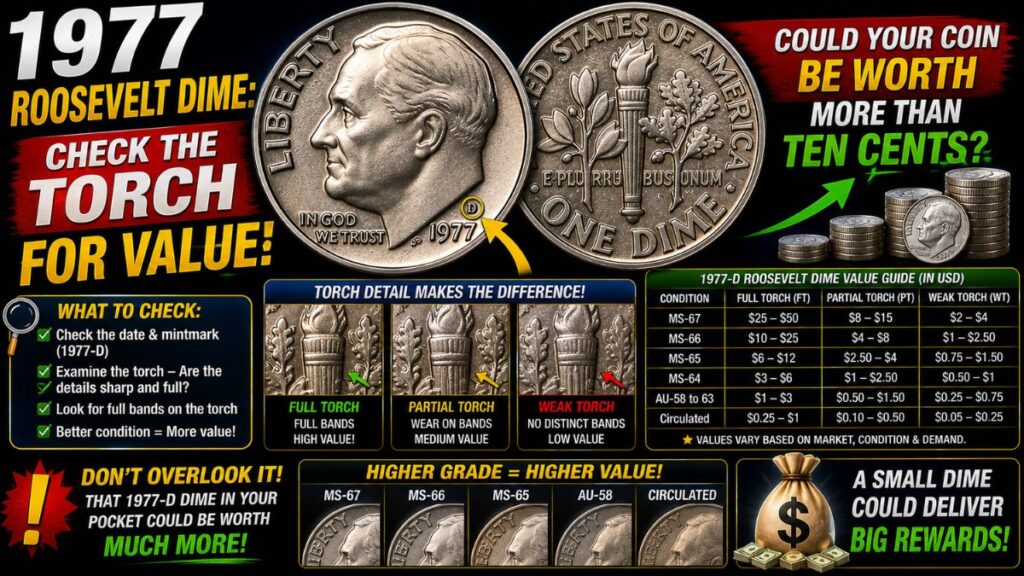
A 1977 Roosevelt dime might seem like an ordinary coin worth just ten cents, but collectors know that some everyday coins deserve a closer inspection before they are spent. If you have an old dime tucked inside a wallet, coin jar, drawer, or collection, the torch on its reverse is an excellent place to begin.
Most 1977 Roosevelt dimes are common and circulate for face value. They were produced in large quantities, and millions have survived. However, a coin’s condition, the sharpness of its design, and the presence of a genuine minting error can influence its appeal to collectors.
One detail that attracts particular attention is the torch on the reverse. Its central bands and surrounding design can help collectors assess how sharply the coin was struck. On especially well-preserved examples, clearly separated horizontal bands may contribute to collector interest.
That does not mean every 1977 dime with a visible torch is valuable. The important question is whether the coin has exceptional preservation, unusually sharp details, or a verifiable characteristic that distinguishes it from ordinary examples.
Understanding those differences can help you decide whether your dime is worth keeping, submitting for professional grading, or simply spending at its face value.
Understanding the 1977 Roosevelt Dime
The 1977 Roosevelt dime belongs to the long-running United States ten-cent coin series featuring President Franklin D. Roosevelt.
The dime’s obverse, or front, displays Roosevelt’s portrait. The reverse features a torch between an olive branch and an oak branch. These elements represent ideas commonly associated with liberty, peace, and strength.
Although the coin is small, its design contains several details that collectors examine closely. The portrait’s hair, facial features, lettering, date, rim, and reverse torch can all provide clues about the coin’s condition and strike quality.
The date is especially useful because it identifies the year the coin was struck. However, the date alone does not make a 1977 dime rare. Collectors must also consider the mint of origin, grade, preservation, and any unusual features.
The 1977 Roosevelt dime was struck during an era when copper-nickel clad coinage had replaced the silver composition used for circulating dimes before 1965. Consequently, an ordinary 1977 dime is not a silver coin.
This distinction matters when estimating value. A coin should not be assigned a silver premium simply because it looks old or has a bright, silvery appearance.
The standard 1977 dime has a copper core surrounded by outer layers containing copper and nickel. Its normal composition and widespread production make most examples inexpensive, especially when they show ordinary circulation wear.
Still, collectors sometimes pursue modern coins in exceptionally high grades. That is where a seemingly ordinary dime can become more interesting.
What Is the 1977 Roosevelt Dime Worth?
For most people, the first question is straightforward: how much is a 1977 Roosevelt dime worth today?
The most common answer is ten cents. A circulated example with normal wear, no unusual minting characteristics, and no exceptional collector appeal generally trades at face value.
Uncirculated examples may attract more interest, particularly when they have strong luster and minimal contact marks. Coins in exceptionally high certified grades can sometimes command premiums because fewer examples survive in comparable condition.
The reverse torch can also influence collector interest. Coins with sharply defined bands may be more desirable to specialists who focus on strike quality, although sharpness alone does not guarantee a high price.
Genuine mint errors can create another category of potential premium. Depending on the type, severity, authenticity, and condition of an error, a coin may be worth more than an ordinary 1977 dime.
There is no single reliable price that applies to every coin from this year. A heavily worn dime, an attractive uncirculated example, and a verified major mint error are three very different collectibles.
A realistic assessment should begin with the coin’s physical condition and then consider whether it has any characteristics that make it stand out.
It is also important to distinguish asking prices from actual selling prices. An online listing may advertise a coin for an ambitious amount, but that does not establish what a buyer has actually paid. Completed sales of comparable coins provide a more useful indication of market demand.
Why the Torch on the Reverse Matters
The reverse of the Roosevelt dime contains three principal design elements: a torch in the center, an olive branch on one side, and an oak branch on the other.
The torch is particularly important to collectors because its horizontal bands can reveal information about the quality of the strike.
When a coin is struck, metal flows into the recesses of the dies to reproduce the design. If the strike is strong and the dies are in suitable condition, small design details can appear clearly. If the strike is weaker in certain areas, some details may look flattened or less distinct.
The torch’s bands are useful because they provide a relatively easy-to-identify area for evaluating sharpness. Collectors may examine the separation between the upper, middle, and lower bands and look for clear definition rather than merging or indistinct lines.
However, the appearance of the bands is only one part of the assessment. Lighting, magnification, wear, surface damage, and the coin’s overall strike can influence what you see.
A torch that appears sharply defined under one lighting angle may look less distinct from another angle. For this reason, it is worth inspecting the coin under diffuse lighting as well as light directed from the side.
The goal is not simply to find a torch that looks attractive. It is to determine whether the coin has unusually strong detail for its issue and whether that characteristic is accompanied by excellent overall preservation.
What Are Full Bands on a Roosevelt Dime?
The phrase “Full Bands” is frequently used by Roosevelt dime collectors when discussing the sharpness of the torch on the reverse.
The term generally refers to the horizontal bands crossing the torch that are sharply separated and clearly defined. Depending on the grading service and its criteria, the required level of separation and completeness may differ.
This distinction is important because a coin can be uncirculated without qualifying for a Full Bands designation. Uncirculated means that the coin has not experienced ordinary circulation wear; it does not automatically mean that every design detail was struck sharply.
Likewise, a dime can have a reasonably attractive torch without meeting the specific standards used for a formal Full Bands designation.
For collectors, that difference can matter. A sharply struck example in a high grade may be more difficult to locate than a typical coin from the same year.
However, Full Bands should not be treated as a guaranteed shortcut to substantial value. The date, mint, grade, overall surface quality, and collector demand still matter.
A 1977 dime with impressive bands but numerous distracting marks may not be as desirable as a cleaner coin with a stronger overall appearance. The bands are one feature of a broader evaluation, not a replacement for it.
If your coin seems unusually sharp, compare it with other examples from the same date and mint. Look for clear separation across the bands and check whether the rest of the reverse also shows strong detail.
How to Examine the Torch Correctly
You do not need expensive equipment to begin inspecting a 1977 Roosevelt dime. A clean, well-lit area and a basic magnifier can help you identify details that are difficult to see with the naked eye.
Start by placing the coin on a soft, clean surface. Avoid rubbing it against a tabletop or sliding it across paper, since even small scratches can affect its appearance.
Use a magnifier with moderate magnification. Extremely high magnification is not necessary for an initial inspection and can make ordinary surface marks seem more significant than they are.
Look at the torch from several angles. Natural or diffuse light helps reveal the overall design, while light directed across the surface can make raised details and small marks easier to see.
Examine the horizontal bands individually. Ask whether the lines are distinct, whether the separations remain visible across their width, and whether any areas appear weak or merged.
Then inspect the surrounding torch and the branches on either side. A strong strike often produces a pleasing overall impression, although different parts of a coin may show different levels of detail.
Finally, rotate the coin and examine the portrait, date, lettering, and rim. An unusually sharp torch does not cancel out significant scratches, discoloration, cleaning damage, or other defects.
Do not attempt to improve the coin’s appearance by polishing or cleaning it. Even a coin that looks dirty may have an original surface that collectors prefer to preserve. Abrasive cleaning can permanently reduce its appeal.
The best first step is careful observation, not alteration.
Mint Marks on the 1977 Roosevelt Dime
The mint mark identifies the United States Mint facility associated with a coin’s production. On modern Roosevelt dimes, the mint mark is found on the obverse, near the date.
For a 1977 dime, check the area around and just above the date rather than searching the reverse torch for a mint mark.
The principal circulation issues for 1977 include coins struck at the Philadelphia and Denver facilities. Philadelphia coins from this period generally carry no mint mark, while Denver coins bear a “D.”
The absence of a mint mark on a 1977 dime is therefore not automatically evidence of a rare error. It is consistent with normal production at Philadelphia.
This is an important point because claims about valuable missing mint marks sometimes circulate among coin enthusiasts. A coin should not be classified as an error simply because it lacks a letter that was not normally required for that issue.
A useful first step is to identify the coin’s mint and then compare it with examples from the same year and mint. This provides a more meaningful basis for judging its strike, condition, and collector appeal.
The mint mark alone does not determine the price. A common coin in ordinary circulated condition generally remains inexpensive, regardless of whether it has a “D” or no mint mark.
Collectors may pay more for exceptional examples, but that premium depends on the complete coin rather than a single letter.
Philadelphia 1977 Roosevelt Dimes
Philadelphia-produced 1977 Roosevelt dimes are part of the regular circulation coinage issued that year.
Because these coins were made for everyday commerce, they were produced in large numbers. Many entered circulation, where handling and contact with other coins gradually caused scratches, flattened details, and reduced luster.
A typical circulated Philadelphia dime is not rare simply because it is several decades old. Coins from this issue can still be found in collections, accumulated change, and coin rolls.
The more interesting examples are those that have remained in unusually good condition. A coin with original mint luster, minimal contact marks, and a strong strike may attract collectors looking for high-grade representatives of the date.
Torch definition can be particularly relevant when comparing otherwise similar coins. A sharply struck example may stand out from one whose bands are less distinct.
Even so, an attractive Philadelphia dime should be evaluated carefully before assuming it deserves a significant premium. Collectors consider the full combination of grade, surfaces, strike, and market demand.
A coin that looks brilliant may have been cleaned, while another with a slightly subdued appearance may retain more desirable original surfaces. Appearance alone cannot always establish authenticity or grade.
For ordinary examples, face value remains the sensible starting point. A premium should be considered only when a specific, defensible reason supports it.
Denver 1977-D Roosevelt Dimes
The 1977-D Roosevelt dime was struck at the Denver Mint and carries a “D” mint mark near the date.
Like the Philadelphia issue, the Denver dime was produced for circulation rather than as a coin intended exclusively for collectors. Many examples consequently show the usual wear and contact marks associated with everyday use.
The “D” mint mark does not make a coin rare on its own. To evaluate a 1977-D dime, collectors look at the coin’s condition, strike quality, and any unusual characteristics that can be verified.
A well-preserved example may have greater collector appeal than a heavily worn coin. If the torch bands are especially clear, that feature may further interest collectors who specialize in Roosevelt dimes.
However, a high-grade coin is not automatically a valuable rarity. The number of comparable coins available and the willingness of collectors to pay a premium are important parts of the equation.
When comparing two 1977-D dimes, examine their surfaces under similar lighting. Look at the cheek and hair on Roosevelt’s portrait, the open fields around the design, and the reverse torch.
The better coin is not necessarily the shinier one. Original luster, limited contact marks, strong design details, and the absence of cleaning damage are all relevant.
As with Philadelphia examples, most circulated 1977-D dimes are worth their face value. Exceptional specimens require a more detailed assessment.
Is the 1977 Roosevelt Dime Made of Silver?
One of the most common sources of confusion is the difference between a coin’s silver-colored appearance and its actual metal composition.
Ordinary 1977 Roosevelt dimes are copper-nickel clad coins, not silver dimes. The outer layers contain copper and nickel, while the core is predominantly copper.
The United States had already ended regular production of circulating 90% silver dimes after 1964. Beginning in 1965, the standard circulating dime used a clad composition.
Consequently, a normal 1977 dime does not have the intrinsic silver value associated with earlier silver Roosevelt dimes.
This distinction is important when estimating a coin’s worth. A bright, reflective surface does not prove that a dime contains silver, and an old date does not automatically give a modern clad coin precious-metal value.
If a 1977 dime appears unusual in color, weight, or edge appearance, that difference may deserve investigation. However, discoloration, environmental damage, plating, or other alterations can create misleading visual clues.
A genuine composition error is possible in coin production, but it must be demonstrated rather than assumed. An unusual-looking coin is not automatically a wrong-metal error.
For a potential composition error, professional evaluation is safer than relying on color alone. Weight, dimensions, edge characteristics, and appropriate testing can help establish what the coin is made of.
Until there is reliable evidence of an unusual composition, the normal copper-nickel clad explanation is the appropriate starting point.
Why Condition Has Such a Big Influence on Value
Condition is one of the most important factors affecting the value of a 1977 Roosevelt dime.
Coins that circulated for years often develop small scratches, dull areas, flattened details, and marks from contact with other coins. These changes are normal and do not make the coin unusual.
An uncirculated example has avoided ordinary circulation wear. However, it may still contain contact marks from production, transport, or storage. Those marks can affect its grade and desirability.
A high-grade coin generally needs more than a bright appearance. Collectors look for original luster, strong detail, clean fields, and limited distracting marks.
The obverse deserves close attention. Roosevelt’s cheek and the open areas around his portrait can show contact marks that influence the overall impression.
On the reverse, inspect the torch, branches, lettering, and surrounding fields. Weak design details may indicate a less-than-strong strike, while scratches or damage can reduce the coin’s appeal.
The rim should also be checked for dents and other damage. A coin with a damaged edge or a serious scratch may be less desirable even if the central design looks sharp.
No single feature determines grade. Professional grading evaluates the coin as a whole, taking into account wear, surface preservation, strike, luster, and other characteristics.
For most circulated 1977 dimes, these distinctions will not create a meaningful premium. They become more important when a coin is being considered for a high-grade collection or a specialist market.
Circulated, About Uncirculated, and Uncirculated Examples
Understanding basic coin grades can help you avoid unrealistic value expectations.
A circulated 1977 dime shows evidence of ordinary use. The highest design points may be flattened, the original luster may be reduced, and the surfaces may contain numerous small marks.
Such a coin generally remains worth ten cents unless it has a genuine error or another unusual feature that attracts collectors.
An about-uncirculated coin has experienced very limited circulation. It may retain much of its original luster, although small areas of wear can be visible on the highest points.
These coins can be attractive, but a modest difference in condition does not necessarily produce a large increase in market value.
An uncirculated coin has not experienced normal circulation wear. It may still show marks from contact with other coins, and those marks can range from minor to distracting.
Within the uncirculated category, the highest grades are reserved for coins with particularly strong overall preservation. A coin with excellent luster, minimal marks, and sharp detail may be more desirable than a typical uncirculated specimen.
The difference between two high-grade coins can be subtle. That is why collectors often rely on professional grading when evaluating coins that may justify the expense.
For a 1977 dime, the practical lesson is simple: do not assume that a coin is valuable merely because it looks new. Assess its surfaces and strike, and compare it with the standards used by experienced collectors.
What Makes an Exceptional 1977 Dime Collectible?
A 1977 Roosevelt dime can become more interesting when several desirable qualities appear together.
First, the coin may have exceptional preservation. Original mint luster, clean surfaces, minimal contact marks, and no evidence of harsh cleaning can help it stand out.
Second, it may have a strong strike. A clearly defined torch with well-separated bands can be appealing to collectors who pay close attention to reverse detail.
Third, the coin may be difficult to find in a particular high grade. Even a common-date coin can attract interest when very few examples are available in comparable condition.
Fourth, it may possess a genuine minting error. An error that occurred during production can make an otherwise ordinary coin distinctive.
These characteristics should be evaluated independently rather than blended into a vague claim that the coin is rare.
For example, an uncirculated dime with sharp torch bands is not automatically a mint error. A coin with a strange-looking mark is not necessarily a valuable variety. A coin with an unusual color is not necessarily made from a precious metal.
The strongest case for a premium is one supported by observable characteristics, reliable identification, and evidence of actual collector demand.
That approach helps separate genuinely interesting coins from ordinary examples promoted with exaggerated descriptions.
Mint Errors That Could Make a 1977 Dime More Interesting
A mint error occurs when something goes wrong during the manufacturing process. Errors can affect a coin’s shape, design, composition, or striking characteristics.
Some errors are dramatic and easy to recognize. Others are subtle and require close examination to distinguish them from ordinary damage.
A genuine error on a 1977 Roosevelt dime may attract more collector interest than a normal coin. However, not every unusual feature is an error, and not every error has a high value.
The size, visibility, type, and authenticity of the error all matter. Condition and demand also influence what collectors may be willing to pay.
A coin that has been scratched, bent, squeezed, plated, or damaged after leaving the Mint should not be confused with an error created during production.
The following categories illustrate what to look for when examining a 1977 dime. They are possibilities to investigate, not claims that every variety exists for this date or that a particular example is valuable.
Off-Center Strikes
An off-center strike occurs when a coin blank is not positioned correctly between the dies during striking.
As a result, part of the design may be missing, and a portion of the coin may have a blank or unusually shaped area.
The amount of the design displaced can influence collector interest. A minor shift may be less dramatic, while a substantial off-center strike that still retains the date can be easier to identify and may appeal to error collectors.
When examining a possible off-center 1977 dime, look for a coherent design that appears displaced relative to the coin’s blank area. Check whether the rim and shape are consistent with the claimed error.
Damage can also distort a coin’s outline, so appearance alone is not always sufficient to prove that the Mint created the feature.
A genuine off-center strike is a manufacturing error, but its market value depends on the specific example. The percentage of displacement, the visibility of the date, the overall condition, and comparable sales can all matter.
Do not assume that every off-center appearance represents a valuable discovery. Verify the error before assigning a premium.
Broadstrikes and Missing-Rim Errors
A broadstrike can occur when a coin is struck without the normal collar that constrains its shape during the striking process.
The result may be a coin that is wider or flatter than a standard example, with an unusual rim or edge profile.
On a normal Roosevelt dime, the edge and overall shape follow the familiar dimensions of the denomination. A genuine broadstrike may look noticeably different, although the exact appearance depends on the circumstances of production.
It is important to distinguish a broadstrike from a coin that has been flattened, bent, or squeezed after manufacture. External pressure can change the coin’s shape, but that damage does not create a mint error.
Compare the coin’s dimensions, thickness, edge, and design with those of a normal dime. Avoid forcing the coin into measuring tools or performing tests that could scratch its surfaces.
If the shape appears unusual and the feature seems consistent with a production error, professional authentication can help determine whether it is genuine.
The value of a broadstrike is not fixed. Its appeal depends on the strength of the error, its condition, and the market for comparable examples.
Doubled Dies and Other Forms of Doubling
Doubled dies are among the minting varieties that attract attention from collectors.
A doubled die is created when a die receives misaligned impressions during its preparation, leaving a doubled image that can be transferred to coins struck by that die.
On a coin, genuine doubled-die characteristics may appear as distinct, repeated design elements. Depending on the variety, the effect can be visible on lettering, numbers, or other design features.
This is different from machine doubling, which can occur during the striking process and often appears as flattened or shelf-like secondary outlines. Machine doubling is generally not valued in the same way as a recognized doubled-die variety.
Damage can create additional misleading shapes. Scratches, reflections, die deterioration, and worn lettering can make ordinary features appear doubled under certain lighting conditions.
If you suspect doubling on a 1977 dime, use a magnifier and examine the same feature from several angles. Look for consistent separation in the design rather than an isolated mark that could have formed after the coin left the Mint.
Do not automatically describe the coin as a rare doubled die. The specific variety needs to be identified and supported by reliable comparison examples.
Without that confirmation, a visible secondary outline should be treated as an observation rather than proof of a valuable variety.
Clipped Planchets and Other Planchet Errors
A planchet is the metal blank that becomes a coin when struck by the dies.
Errors can occur before the blank is struck. One possible result is a clipped planchet, where a portion of the metal blank is missing.
A genuine clip may produce a distinctive curved or straight-edged area along the coin’s perimeter. Its appearance depends on the type of clip and how the blank was cut from the metal strip.
Not every missing section of a coin is a clipped-planchet error. A coin can be damaged by cutting tools, corrosion, or impact after production.
Collectors therefore look for characteristics consistent with the manufacturing process. The shape of the missing area, the surrounding rim, and other physical details can help distinguish a genuine error from post-mint damage.
Other planchet-related errors may involve unusual thickness, weight, or composition. However, these possibilities must be tested carefully before they are described as genuine.
A 1977 dime with an apparent planchet error should be weighed and examined without altering its surface. If the feature is significant, an experienced error-coin specialist or professional grading service may help establish its authenticity.
As with other errors, value depends on the specific characteristic rather than the general fact that the coin looks unusual.
Missing Clad Layers and Unusual Color
Because ordinary 1977 Roosevelt dimes use a copper-nickel clad composition, a genuine problem involving one of the metal layers may be of interest to error collectors.
A missing or incomplete clad layer can affect the coin’s appearance and may expose a different-looking surface. Depending on the circumstances, the coin might show unusual coloration or other visible differences.
However, color is not reliable proof by itself.
Environmental exposure, chemical reactions, heat, cleaning, plating, and other forms of post-mint alteration can change a coin’s appearance. A reddish, dark, yellowish, or unusually bright dime does not automatically contain a manufacturing error.
Weight and physical characteristics may provide additional clues, but even these observations need to be interpreted carefully.
If you suspect a missing clad layer, avoid scraping the surface or applying chemicals. Those actions can damage the coin and make authentication more difficult.
A qualified specialist can evaluate the coin’s composition and determine whether its appearance is consistent with a genuine mint error.
Until the cause is established, describe the coin as having an unusual appearance rather than assigning it a specific error designation.
Why Some Valuable-Sounding Errors Are Not Valuable
Coin descriptions often use terms such as “rare,” “double struck,” “wrong metal,” or “missing mint mark.” These phrases can attract attention, but they do not automatically establish authenticity or market value.
Some unusual marks are simply scratches or dents. Others are common effects of the striking process that have little or no premium in the collector market.
For example, machine doubling is often mistaken for a doubled die. A coin that has been struck off-center by an object after leaving the Mint may resemble an error, while discoloration can be mistaken for a composition problem.
The difference matters because a genuine mint error must result from the manufacturing process rather than ordinary handling or later damage.
A coin can also have a genuine error without being particularly valuable. Minor errors may be plentiful or may not attract much demand.
Before paying for grading or advertising a coin as rare, establish exactly what makes it different. A clear description supported by expert evaluation is more useful than an exaggerated claim.
This is especially important when a seller or online post suggests that a common 1977 dime is worth hundreds or thousands of dollars without showing convincing evidence.
The date alone does not justify such a price. The coin needs a specific, verifiable reason to command a premium.
Can a 1977 Roosevelt Dime Be Worth Hundreds or Thousands of Dollars?
Claims that an ordinary 1977 Roosevelt dime could be worth hundreds or thousands of dollars should be approached with caution.
A normal circulated dime is generally worth ten cents. Even an attractive uncirculated coin may have only a modest premium, depending on its grade and the availability of comparable examples.
Exceptional certified coins can sometimes bring higher prices, particularly when they occupy a desirable position in a specialized collection. Yet a high asking price does not prove that the market supports that amount.
Genuine mint errors can also command premiums, especially when the error is dramatic, easy to authenticate, and desirable to collectors. But the value varies considerably from one error to another.
There is no responsible way to assign a dramatic price to a 1977 dime solely because it has sharp torch bands or an unusual appearance.
If you encounter a claim of an extraordinary value, ask several questions:
- Is the coin’s date and mint correctly identified?
- Is the alleged error genuine and clearly documented?
- Has the coin been professionally authenticated, if necessary?
- Does the claimed price reflect an actual completed sale?
- Is the comparison coin similar in grade, error type, and overall condition?
A trustworthy estimate should answer these questions rather than rely on an eye-catching headline.
The possibility of finding an unusual coin can make collecting exciting. However, realistic expectations help prevent disappointment and reduce the risk of paying too much for an ordinary example.
How to Estimate Your 1977 Dime’s Value
Estimating value begins with identification. Before considering prices, establish what kind of coin you have.
First, confirm the date. Make sure the coin is a genuine 1977 Roosevelt dime rather than a different year that resembles it.
Second, identify the mint mark. Check the area near the date on the obverse. A “D” indicates Denver, while no mint mark is normal for the Philadelphia issue.
Third, assess the condition. Look for wear on the portrait, original luster, contact marks, scratches, rim damage, and signs of cleaning.
Fourth, examine the torch. Determine whether the horizontal bands are sharply separated and whether the rest of the reverse shows similarly strong detail.
Fifth, look for unusual features. If you notice doubling, a missing section, an abnormal shape, or a suspected composition problem, document the observation without immediately assuming it is an error.
Sixth, compare your coin with examples that closely match its date, mint, grade, and characteristics. General price guides can provide a starting point, but actual transactions for comparable coins are more informative.
Seventh, consider the cost of professional grading. Certification may be worthwhile for a potentially valuable coin, but grading fees, shipping, and insurance can exceed the value of an ordinary dime.
For a common circulated example, a complicated valuation process is rarely necessary. For a coin that appears exceptionally preserved or has a potentially significant error, a more detailed assessment may be justified.
Why Recent Comparable Sales Matter
Coin values are not permanently fixed. They can change as collector demand, availability, and market conditions shift.
A coin that attracted strong interest at one time may sell for less later. Conversely, a particularly desirable example can attract competitive bidding when several collectors want it.
That is why completed sales are more useful than unverified claims about what a coin “could be worth.”
When researching a 1977 Roosevelt dime, compare coins that match as closely as possible. A circulated Philadelphia coin should not be valued by looking at an exceptionally graded Denver example. Similarly, a normal dime should not be compared with a certified major mint error.
Pay attention to the date of each transaction, the coin’s grade, its certification status, and the precise characteristic that made it desirable.
Auction prices can also include buyer premiums or other costs, so the final amount may not represent what a seller actually received.
If there are few comparable sales, acknowledge the uncertainty rather than selecting the highest price you can find.
For an ordinary 1977 dime, this research may confirm that face value is the most realistic estimate. For an unusual specimen, it can help establish whether a premium is supported by actual demand.
Should You Get Your 1977 Dime Professionally Graded?
Professional grading can be helpful when a coin appears to have exceptional quality or a potentially valuable error.
A grading service examines the coin, assigns a grade under its standards, and may authenticate the coin or identify a recognized characteristic. Certification can make it easier for buyers and sellers to discuss the same coin using consistent terminology.
However, professional grading is not automatically worthwhile for every dime.
If your 1977 coin has ordinary circulation wear and no unusual features, the likely value may be too low to justify the cost. Fees, shipping, insurance, and other expenses can quickly exceed any potential premium.
Grading becomes more reasonable when the coin appears to be in an unusually high grade, has exceptionally sharp torch bands, or displays a significant error that requires expert authentication.
Before submitting it, research comparable certified examples and estimate a realistic market value. Consider whether the expected premium could justify the total cost.
Do not submit a coin simply because it looks shiny. A bright surface can result from cleaning or other alteration, and the coin’s overall quality matters more than a single visual feature.
If the coin’s potential value is uncertain, seek an initial opinion from a reputable coin dealer or specialist. A preliminary assessment may help you decide whether formal certification makes financial sense.
How to Protect a Potentially Valuable 1977 Dime
Proper storage helps preserve a coin’s condition and prevents avoidable damage.
Handle the dime by its edges whenever possible. Oils, moisture, and dirt from fingers can affect the surface over time, while dropping a coin can produce dents or scratches.
Avoid cleaning or polishing it. Even gentle rubbing can leave hairline scratches, and chemical cleaners may change the surface or cause discoloration.
Store the coin in an appropriate holder made for numismatic use. A suitable holder can reduce exposure to handling, abrasion, and environmental contaminants.
Keep coins away from excessive humidity and harsh chemicals. Avoid loose storage where coins can rub against one another, since contact can create marks that affect their appearance.
If the dime appears to be a significant mint error or a high-grade example, use a holder that protects it without requiring the coin to be forced into place.
Do not attempt home experiments involving acids, heat, scraping, or aggressive weighing and measuring techniques. These methods can damage the coin and complicate authentication.
Preservation is especially important for coins that may have original mint luster or unusually sharp detail. Once a surface has been damaged, the original condition cannot simply be restored.
The safest approach is to leave the coin as it is until you have determined whether it deserves further evaluation.
Common Mistakes When Searching for Valuable 1977 Dimes
The search for valuable coins can be enjoyable, but several common mistakes can lead to unrealistic expectations.
One mistake is assuming that age automatically creates rarity. A coin from 1977 is several decades old, but many examples remain available. Age alone does not establish collector value.
Another mistake is treating every bright coin as uncirculated. A coin may have been cleaned or polished, and a reflective surface does not prove that it retains its original finish.
A third mistake is confusing sharp design details with a mint error. A sharply struck torch can be desirable, but it is not itself evidence of a production mistake.
Collectors should also avoid assuming that every coin without a mint mark is rare. Philadelphia’s lack of a mint mark on this issue is normal.
Another common problem is relying on asking prices. A seller can request almost any amount, but a listing does not prove that a buyer will pay it.
Finally, avoid cleaning a coin in an attempt to increase its value. Removing tarnish or polishing the surface can make the coin less desirable to collectors who prefer original surfaces.
The best way to avoid these mistakes is to identify the coin accurately, examine its condition, and verify any unusual feature before assigning a premium.
Is a Full Bands Designation Enough to Make the Coin Rare?
A Full Bands designation can be an important point of interest, but it does not make every 1977 Roosevelt dime rare or expensive.
The designation relates to the sharpness and separation of the torch bands. It helps collectors distinguish certain sharply struck coins from examples with weaker details.
However, the coin must still be considered in context. Its date, mint, overall grade, surface quality, and availability all influence desirability.
A coin may have well-defined bands but also carry substantial contact marks. Another coin may be cleaner overall but have a slightly weaker strike. Collectors weigh these factors differently depending on their collecting goals.
The standards for formal designations also depend on the grading service. If a premium rests on a particular designation, it is important to understand whether the coin has actually received that designation or merely appears to have the relevant characteristics.
A collector’s visual impression is useful for screening coins, but it is not identical to a professional certification.
If you believe your dime has unusually sharp bands, compare it with certified examples and review recent sales of comparable coins. That will help you judge whether the feature is likely to make a meaningful difference in value.
How to Tell Original Mint Luster From Cleaning
Original mint luster is the characteristic sheen that develops from the way metal flows during the striking process. It can give an uncirculated coin a lively appearance when it is tilted under light.
Cleaning can change that appearance. Polishing, abrasive rubbing, or chemical treatment may leave the surface unnaturally bright, dull, or scratched.
A cleaned dime may still look attractive to an inexperienced observer, but collectors often consider cleaning damage a negative factor.
Under suitable lighting, original luster may appear to move across the surface as the coin is tilted. Fine hairline scratches or a uniform, mirror-like shine can sometimes indicate that a coin has been polished or otherwise altered.
These clues are not definitive on their own. Some marks may come from ordinary handling, while different storage conditions can affect a coin’s appearance.
Do not try to confirm suspected cleaning by rubbing the coin or applying a substance to it. Such tests can cause further damage.
If the coin appears to be an exceptionally high-grade example, a professional evaluation may help determine whether the surfaces are original.
This matters because condition premiums generally depend on more than brightness. Originality and surface preservation can be just as important as visual shine.
Building a Small Roosevelt Dime Collection
A 1977 Roosevelt dime can be a useful starting point for a collection even if it is worth only ten cents.
Some collectors build date-and-mintmark sets, seeking an example from each year and production facility. Others focus on condition, trying to assemble the sharpest and cleanest examples they can find.
A torch-focused collection can also be interesting. Collectors may compare strike quality and observe how the reverse bands appear on coins from different dates and mints.
Another approach is to collect genuine mint errors. This requires careful identification, because many apparent errors are actually forms of post-mint damage or ordinary striking effects.
You do not need to buy expensive coins to begin learning. Studying common examples can help you recognize normal features and understand why some coins stand out.
Keeping notes about dates, mint marks, condition, and observations can also improve your skills. Over time, you may become better at distinguishing ordinary coins from examples that merit closer examination.
The main benefit of a collection is not necessarily financial. Learning how coins are made, how their designs vary, and how collectors evaluate condition can be rewarding in its own right.
A 1977 dime may not be rare, but it can still be an informative piece of numismatic history.
A Practical Checklist Before Spending Your 1977 Dime
Before spending a 1977 Roosevelt dime, take a moment to inspect it. A short checklist can help you decide whether further research is worthwhile.
- Confirm that the date is 1977.
- Check the mint mark near the date.
- Look for normal circulation wear and surface damage.
- Examine the torch bands for clear separation.
- Inspect Roosevelt’s portrait and the surrounding fields for contact marks.
- Check for unusual shapes, missing metal, or other possible mint errors.
- Treat unusual color as a clue to investigate, not proof of a composition error.
- Avoid cleaning or polishing the coin.
- Compare any potentially exceptional example with similar coins and actual completed sales.
- Consider professional authentication only when the coin’s possible premium justifies the cost.
If the dime is worn, ordinary, and free of unusual characteristics, spending it at face value is generally reasonable.
If it has excellent preservation, unusually sharp details, or a feature that appears consistent with a genuine mint error, set it aside while you investigate.
This approach is simple, inexpensive, and more reliable than assuming that every old dime could be worth a fortune.
Frequently Asked Questions About the 1977 Roosevelt Dime
How much is a 1977 Roosevelt dime worth?
Most circulated 1977 Roosevelt dimes are worth their face value of ten cents. Uncirculated examples, especially those with exceptional preservation or sharply defined torch bands, may attract premiums. Genuine mint errors can also be worth more, depending on their characteristics and collector demand.
Is the 1977 Roosevelt dime rare?
The ordinary 1977 Roosevelt dime is not generally considered rare. The issue was produced in substantial quantities, and many examples survive. Coins in exceptional condition or with authenticated mint errors may be more difficult to find.
What should I look for on the torch?
Examine the horizontal bands crossing the torch on the reverse. Look for clear separation, strong definition, and an absence of wear that has flattened the details. The sharpness of the bands can be useful when evaluating the coin, but it does not guarantee a high value.
What does Full Bands mean on a Roosevelt dime?
Full Bands generally describes a sharply struck torch whose horizontal bands are clearly separated according to the applicable grading standards. The designation can be important to specialists, but its effect on value depends on the date, mint, grade, and demand for the coin.
Where is the mint mark on a 1977 dime?
The mint mark is on the obverse, near the date. A “D” indicates Denver, while a 1977 dime without a mint mark is consistent with normal Philadelphia production.
Is a 1977 dime made of silver?
No. A standard 1977 Roosevelt dime is a copper-nickel clad coin with a predominantly copper core. Its silvery appearance does not mean it contains silver.
Can a 1977-D dime be valuable?
Most circulated 1977-D dimes are worth ten cents. An exceptional high-grade example or a coin with a genuine mint error may attract a premium, but the mint mark alone does not make the coin rare.
Are 1977 Roosevelt dimes with no mint mark rare?
No. The absence of a mint mark is normal for Philadelphia-produced dimes of this issue. A missing mint mark should not be treated as an error without specific evidence that the coin was supposed to carry one.
Can a 1977 dime be worth hundreds of dollars?
An ordinary circulated dime generally is not worth hundreds of dollars. Exceptional certified examples or significant authenticated mint errors may command higher prices, but such values must be supported by comparable sales rather than asking prices or online claims.
How do I know whether my 1977 dime has a mint error?
Look for a feature that appears consistent with the manufacturing process, such as an off-center strike, an unusual planchet characteristic, or a distinctive doubled-die variety. Compare the coin with reliable examples and seek professional authentication if the potential value justifies it.
Does a shiny 1977 dime have a higher value?
Not necessarily. Brightness alone does not establish a high grade. A coin may have been cleaned or polished, and original luster, surface quality, strike, and contact marks all matter.
Should I clean my 1977 Roosevelt dime before selling it?
No. Cleaning or polishing can scratch the surface and reduce collector appeal. Leave the coin in its current condition and seek advice before making any changes.
Is professional grading worthwhile for a 1977 dime?
It may be worthwhile if the coin appears to be exceptionally well preserved or has a potentially significant mint error. For an ordinary circulated dime, grading costs are likely to exceed any possible premium.
Where can I sell an unusually valuable 1977 dime?
If your coin appears to be exceptional or has an authenticated error, consider a reputable coin dealer, a specialist in mint errors, or an established numismatic auction. Compare actual sales of similar coins and account for any selling fees before deciding on a price.
What is the most important feature to check first?
Start with the coin’s overall condition and the torch bands. Then identify the mint mark and investigate any unusual characteristics. A systematic examination is more useful than focusing on one detail in isolation.
Final Thoughts: Check the Torch, but Keep Your Expectations Realistic
The 1977 Roosevelt dime is a good reminder that an ordinary coin can still offer something interesting to examine. Although most examples remain worth ten cents, their condition, strike quality, and potential mint errors can make certain specimens more appealing to collectors.
The reverse torch is an especially useful place to begin. Sharply separated horizontal bands may indicate a strong strike and can attract the attention of Roosevelt dime specialists. However, the torch must be considered alongside the coin’s overall grade, surfaces, mint mark, and authenticity.
Do not assume that an unusual appearance proves a mint error, and do not rely on inflated asking prices when estimating value. Genuine errors and exceptional coins deserve careful identification and comparisons with actual sales.
If your 1977 dime is worn and ordinary, it is probably best treated as a ten-cent coin. If it has outstanding preservation, clearly defined torch bands, or a feature that appears consistent with a genuine minting error, it may be worth a closer look.
Check the date, inspect the torch, protect the surface, and verify anything unusual before making a decision. That simple process gives you the best chance of recognizing a genuinely collectible 1977 Roosevelt dime without mistaking an ordinary coin for a rare treasure.