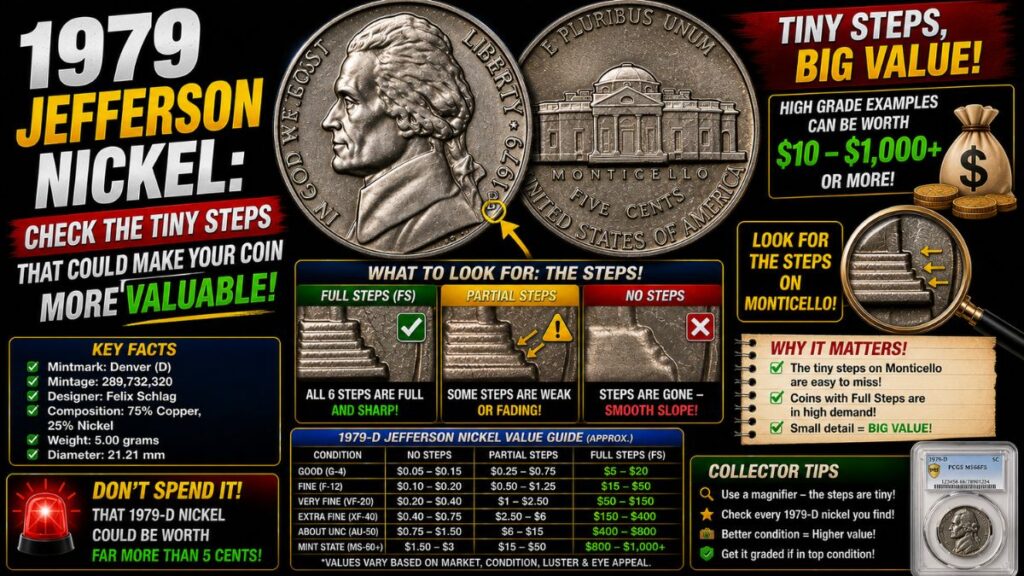
A 1979 Jefferson nickel might look like an ordinary five-cent coin, but a closer look at its smallest details can reveal why some examples attract more attention from collectors than others. While most 1979 nickels are common and worth little more than their face value, coins with exceptional preservation, sharp design details, and fully defined steps on the reverse can be more desirable.
The key is knowing exactly what to examine. The tiny staircase beneath Monticello, the historic building featured on the back of the coin, can make a significant difference when collectors evaluate a Jefferson nickel. These steps are easy to overlook, especially when a coin is worn, dirty, or viewed without magnification.
However, not every 1979 nickel with visible steps is rare, and not every attractive coin commands a premium. Condition, mint mark, strike quality, surface preservation, and collector demand all play important roles in determining value.
If you have a 1979 Jefferson nickel in a jar, coin album, or pocket change collection, take a closer look before setting it aside. Understanding the Full Steps designation can help you identify coins worth investigating further without assuming that every old nickel is a hidden treasure.
Why the 1979 Jefferson Nickel Deserves a Closer Look
The Jefferson nickel has been a familiar part of American coinage for decades. Introduced in 1938, the series features Thomas Jefferson on the obverse, or front, and Monticello on the reverse, or back.
The 1979 issue belongs to a long-running series that many collectors pursue by date, mint mark, condition, and special design characteristics. Because ordinary examples were produced for circulation, finding one is not particularly unusual. What makes certain specimens interesting is the quality of the design that remains visible on the coin.
The 1979 date is especially worth examining for collectors who enjoy studying small differences between coins. Two nickels from the same year can appear similar at first glance while showing different levels of detail under magnification.
One coin might have soft, indistinct steps beneath Monticello, while another may show a sharper staircase. A third might have attractive overall surfaces but small scratches, contact marks, or discoloration that affect its desirability.
These differences do not automatically make one coin rare. They do, however, demonstrate why condition and strike quality matter when evaluating collectible coins.
For someone searching through circulated nickels, the practical goal is to separate ordinary examples from coins with characteristics that deserve a second look.
Understanding the Design of the 1979 Jefferson Nickel
Before checking the tiny steps, it helps to understand the basic design of the coin.
The obverse features a portrait of Thomas Jefferson. The date appears near the lower portion of the design, and the inscriptions identify the country and denomination. Depending on the mint that produced the coin, a small mint mark may appear on the obverse.
The reverse depicts Monticello, Jefferson’s historic Virginia residence. The building is shown with its distinctive architectural features, including columns, a central entrance, a dome, and a staircase leading toward the building.
For Full Steps collectors, that staircase is particularly important.
The steps are small, and their clarity depends on several factors. A coin may have been struck with less-than-ideal pressure or with dies that did not transfer every detail sharply. Circulation can also wear down the raised portions of the design, gradually reducing the definition of the staircase.
Because the steps are relatively small, even minor differences can affect how clearly they appear.
A useful inspection begins with the entire reverse rather than the staircase alone. Look at the building’s columns, roofline, lettering, and surrounding fields. A coin with generally sharp detail may deserve closer examination, although overall sharpness does not guarantee that it qualifies for a Full Steps designation.
The objective is to understand how well the coin preserves its original design, not simply to find a staircase that is visible.
What Does Full Steps Mean on a Jefferson Nickel?
Full Steps is a collector and grading designation associated with the sharpness of the steps at the base of Monticello on Jefferson nickels.
The term describes coins whose stair details are sufficiently complete and clearly separated according to the standards used by a particular grading service. The designation is most relevant to coins with strong strikes and limited wear or damage in the critical area.
It is important to distinguish between visible steps and qualifying Full Steps detail.
A circulated nickel may show several staircase lines, but those lines might be worn, interrupted, weakly struck, or obscured by marks. Simply seeing multiple lines does not mean the coin meets a professional grading service’s Full Steps criteria.
Different grading services may apply specific requirements to the number of steps that must be visible and the degree of separation or interruption allowed. Collectors should check the criteria used by the service evaluating their coin rather than assuming that every service applies identical rules.
The general principle is straightforward: the more complete and clearly defined the staircase, the more interesting the coin may be to collectors who specialize in Jefferson nickels.
However, Full Steps is not a guarantee of rarity or high value by itself. The coin’s grade, surface quality, date, mint mark, and current market demand still matter.
How to Find the Tiny Steps on a 1979 Nickel
The staircase is located on the reverse, directly beneath the front of Monticello. Because the detail is small, a quick glance may not reveal enough information to judge its quality.
Begin by placing the coin under a bright, neutral light. Hold it at a slight angle and examine the staircase without pressing the coin against a hard surface.
A magnifying glass with moderate magnification can help reveal details that are difficult to see with the naked eye. A simple loupe is often sufficient for an initial inspection.
Look for horizontal lines that separate the individual steps. Ideally, the lines should appear clear and distinct rather than blending together into a single flat area.
Pay attention to the center of the staircase as well as its edges. A coin may show reasonably sharp detail on one side while the central steps are weak or interrupted.
Move the coin slightly under the light. Different angles can reveal shallow marks, wear, or areas where the design is less sharply defined.
Avoid relying on a single photograph taken under harsh lighting. Reflections can make lines appear more distinct than they are, while shadows may hide genuine detail.
If the staircase looks promising, inspect the rest of the coin. The overall condition will help you determine whether the coin deserves further research.
What Separates Clear Steps From Weak Steps?
The difference between clear and weak steps is often subtle, but understanding it can make coin hunting more productive.
On a sharply struck coin, the staircase may display distinct horizontal separations. Individual step levels can be identified without having to guess where one ends and another begins.
On a weakly struck coin, some of those lines may appear faint or incomplete. The steps can seem to blend into one another, even if the coin has experienced little circulation.
This distinction matters because weak design detail does not always mean that a coin is heavily worn.
A coin can be uncirculated yet have an incomplete staircase because the original strike did not fully bring out that part of the design. Conversely, a circulated coin may retain some attractive details while showing wear elsewhere.
Collectors therefore need to consider two separate questions:
- How sharply was the coin originally struck?
- How much wear, damage, or deterioration has occurred since it was struck?
These questions are related but not identical.
A strong strike helps preserve fine design features, while careful handling and storage help prevent those features from being damaged afterward.
When inspecting a 1979 Jefferson nickel, look for the quality of the step separations without assuming that every faint line indicates wear or that every sharp-looking line guarantees a qualifying designation.
Why the Condition of a 1979 Nickel Matters
Condition is one of the most important factors affecting a coin’s desirability.
A nickel that has circulated for years may have scratches, flattened details, small dents, and worn high points. These changes can reduce its appeal to collectors seeking coins in excellent condition.
An uncirculated example may retain much of its original surface and design detail. However, uncirculated does not necessarily mean flawless. Coins can acquire contact marks and other imperfections during production, transportation, or storage.
For Jefferson nickels, the staircase is a particularly sensitive area because its fine details can be lost through a weak strike, wear, or damage.
A coin with strong steps but numerous scratches may be less desirable than a similarly sharp coin with cleaner surfaces. Likewise, an attractive nickel with pristine-looking fields may still fail to meet Full Steps criteria if the staircase is incomplete.
Collectors generally evaluate the coin as a whole.
Important areas to examine include Jefferson’s cheek and jaw, the lettering, the date, Monticello’s architectural features, and the open surfaces surrounding the design.
Look for signs of rubbing on raised areas, unnatural discoloration, corrosion, and scratches that cross important details.
Do not clean a coin to make it look brighter. Cleaning can leave fine hairline scratches or alter the original surface, often reducing collector appeal. Even a coin that appears dull or dirty may be more desirable in its untouched condition.
The safest approach is to preserve the coin as you found it and evaluate its existing characteristics.
The Difference Between Circulated and Uncirculated Examples
A circulated coin has entered everyday use and may have accumulated wear through handling and contact with other objects.
A 1979 Jefferson nickel that has spent years in circulation may show softened lettering, reduced detail on Jefferson’s portrait, and less distinct steps beneath Monticello.
An uncirculated coin has not experienced ordinary circulation wear, although it can still have marks or imperfections from manufacturing and storage.
Uncirculated coins can be especially interesting to Full Steps collectors because they have a better chance of retaining sharp design details. Nevertheless, an uncirculated coin is not automatically a Full Steps example.
Strike quality remains important. If the dies did not transfer the staircase detail completely, the steps may remain weak even on a coin with no circulation wear.
When evaluating a possible collectible, avoid using brightness alone as a measure of condition. A naturally lustrous coin may have an attractive surface, but polished or cleaned coins can also appear unusually shiny.
Look for the combination of original-looking surfaces, sharp design features, and minimal evidence of wear or damage.
If a coin appears unusually well preserved, compare it with reliable grading photographs or examples of similar coins. This can help you develop a more consistent understanding of condition before deciding whether professional grading is worthwhile.
Does the Mint Mark Make a Difference?
The 1979 Jefferson nickel was produced at more than one United States Mint facility. The mint mark can help identify where an individual coin was struck.
For this issue, collectors commonly encounter Philadelphia and Denver nickels. Philadelphia coins from this period generally do not carry a mint mark, while Denver coins carry a small D.
On the 1979 nickel, check the obverse near the date area for a mint mark. Use good lighting and magnification if the mark is difficult to see.
The mint mark is useful because coins from different facilities can differ in availability, strike characteristics, and collector interest. However, the presence of a D or the absence of a mint mark does not automatically make a coin rare.
A mint mark should be treated as one part of the identification process, not as proof of exceptional value.
When comparing potential Full Steps examples, make sure you are comparing coins of the same date and mint designation whenever possible. This makes the comparison more meaningful.
It is also important to avoid assuming that one mint automatically produced valuable coins and another produced common ones. The condition and specific characteristics of an individual specimen can be more important than the mint mark alone.
For an ordinary 1979 nickel, the mint mark is primarily an identification detail. For a particularly sharp, well-preserved example, it becomes part of a more complete evaluation.
Why Some 1979 Nickels May Attract Collector Premiums
Most 1979 Jefferson nickels are common coins. Their age alone does not make them rare, and ordinary circulated examples usually do not command large premiums.
The situation can be different for exceptional specimens.
Collectors who pursue high-grade Jefferson nickels often look for coins with strong strikes, attractive surfaces, minimal marks, and excellent preservation. A coin that combines these characteristics may be more desirable than a typical example from circulation.
Full Steps detail can make the difference more noticeable.
Because the staircase is a small and sensitive part of the design, coins that preserve it exceptionally well may attract interest from collectors assembling high-quality date-and-mint-mark sets.
However, collector interest does not translate into a fixed value for every coin with clear steps. The price depends on the exact coin, its grade, the grading service’s designation, comparable sales, and the number of interested buyers.
A coin that looks impressive under a magnifying glass may still have limited market demand if its grade or other characteristics are not exceptional.
Likewise, an accurately certified coin with strong steps and excellent surfaces may attract a premium among specialized collectors.
The most useful question is not simply whether a 1979 nickel has steps. It is whether the coin has a combination of characteristics that distinguishes it from other examples of the same issue.
Can a 1979 Jefferson Nickel Be Worth Thousands?
Stories about valuable nickels can encourage people to inspect their change, but dramatic price claims need to be treated carefully.
A 1979 Jefferson nickel should not be assumed to be worth hundreds or thousands of dollars merely because it has a visible staircase or appears unusually shiny.
High prices in coin collecting are often associated with exceptional condition, recognized varieties, strong collector demand, or a combination of factors that make a specific specimen difficult to obtain.
A high auction result for one coin does not establish the value of every coin from the same year. Two coins with the same date and mint mark can differ significantly in grade, strike quality, surface preservation, and desirability.
When researching a potentially valuable 1979 nickel, look for completed sales of coins that closely match its characteristics. Pay particular attention to the date, mint mark, grade, and any documented Full Steps designation.
Asking prices are not the same as completed sale prices. A seller can list a coin for almost any amount, but that listing alone does not prove that buyers are willing to pay the requested price.
Be skeptical of headlines suggesting that ordinary pocket change is automatically worth a fortune. Without evidence tied to a specific coin, such claims can create unrealistic expectations.
The practical goal is to determine whether your nickel has genuine collectible qualities and whether the market recognizes those qualities with a premium.
How to Inspect the Reverse Without Damaging the Coin
Careful handling is essential when examining a coin that may have collector value.
Begin by choosing a clean, stable work surface. If possible, place a soft cloth beneath the area where you will inspect the coin. This reduces the risk of damage if the coin slips from your fingers.
Hold the nickel by its edges rather than touching the main design surfaces. Oils and residue from skin can leave marks, and repeated handling can affect delicate surfaces.
Use a magnifying glass or loupe to examine Monticello’s staircase. Keep the coin steady and move the light rather than repeatedly rubbing or repositioning the coin against another surface.
Avoid using metal tools, pins, or sharp objects to trace the steps. These can scratch the surface and permanently damage the design.
Do not scrape away dirt to expose the staircase. If material is stuck to the coin, leave it alone until you understand what it is and whether intervention could cause damage.
Also avoid polishing compounds, household cleaners, abrasive cloths, and chemical dips unless you have professional guidance appropriate to the coin. These methods can change the coin’s surface and lower its desirability.
A good inspection should reveal details without altering them. If the coin appears promising, document its condition with clear photographs and keep it safely stored while you conduct further research.
How Lighting Helps Reveal Full Steps Detail
Lighting can make a major difference when examining small design features.
A room with dim lighting may hide the fine lines beneath Monticello. Extremely harsh direct light, on the other hand, can create glare that makes it difficult to distinguish genuine detail from reflections.
A bright, neutral light source placed at a slight angle is often useful. It can help reveal the separation between individual steps and show where the design becomes weak or interrupted.
Try examining the coin from more than one angle. Tilt it gently so the light moves across the staircase. Areas with raised details may reflect light differently from flatter or worn areas.
Do not mistake shadows for missing details. A dark line may simply be a shadow created by the lighting angle rather than a clearly separated step.
Similarly, a bright reflection can make an incomplete line appear continuous. Adjust the light and check whether the detail remains visible.
If you photograph the coin, avoid excessive image sharpening or filters. Digital enhancement can exaggerate tiny marks and create an inaccurate impression of the coin’s condition.
For a meaningful evaluation, use photographs that show the actual surface as clearly as possible. Images of both sides can also help establish the overall condition and identify features that may not be visible in a close-up of the staircase alone.
What Can Make a Staircase Look Incomplete?
Several factors can affect the appearance of the steps on a Jefferson nickel.
The first is strike quality. During minting, metal flows into the design of the dies under pressure. If the strike does not fully transfer the finest details, parts of the staircase may appear weak or incomplete.
The second is circulation wear. As a coin moves through everyday use, its raised details can gradually flatten. The narrow separations between steps may become less distinct.
The third is contact damage. A scratch, nick, or small impact can interrupt a line that was originally present. Even a coin with otherwise strong detail may have a damaged section of the staircase.
The fourth is surface contamination or corrosion. Material on the coin can hide details, while corrosion can permanently alter the metal surface.
Finally, lighting and magnification can affect what you see. A step that appears missing under one lighting arrangement may become visible under another.
These possibilities explain why a simple visual check cannot always establish whether a coin qualifies for Full Steps recognition.
If the distinction is important to your collecting goals, compare the coin with recognized examples and the standards of a reputable grading service.
A careful evaluation considers both the appearance of the steps and the reasons their detail may be incomplete.
Could a Weakly Struck Nickel Still Be Collectible?
Yes. A weak strike does not automatically make a coin worthless or uninteresting.
Collectors appreciate different characteristics, and not everyone specializes in Full Steps examples. Some people collect Jefferson nickels by date and mint mark, while others focus on historical sets, attractive toning, unusual varieties, or coins with strong overall eye appeal.
A coin with a weak staircase may still be an appealing example if its other details are attractive and its surfaces are well preserved.
However, collectors specifically pursuing Full Steps coins generally place greater emphasis on the clarity and completeness of the staircase.
This distinction is important when deciding whether to keep a particular 1979 nickel. A coin that does not meet Full Steps criteria can still belong in a collection or serve as a useful comparison piece.
It can also help new collectors learn how strike quality differs from circulation wear.
Rather than judging a coin solely by one feature, evaluate its characteristics in the context of your collecting interests.
If you are building a high-grade Jefferson nickel set, staircase definition may be a central priority. If you are assembling a date collection, a well-preserved example without Full Steps detail may still serve your purpose.
How to Recognize Possible Errors on a 1979 Nickel
Coin errors are another reason collectors examine ordinary-looking nickels closely. Manufacturing mistakes can sometimes create distinctive features that attract interest.
However, it is important to separate genuine minting errors from ordinary damage, wear, and visual illusions.
A coin may have scratches, dents, discoloration, or unusual marks because of what happened to it after leaving the mint. These are generally not the same as errors created during production.
Some genuine errors can affect the coin’s shape, the placement of design elements, or the way the metal was struck. Their significance depends on the specific error and how convincingly it can be identified.
A small mark near the staircase does not automatically represent an error. Nor does an unusual-looking letter or date necessarily prove that the coin is a rare variety.
If you suspect a minting error, examine the coin carefully under magnification and compare it with normal examples of the same issue. Look for a clear, repeatable characteristic rather than relying on a vague resemblance.
Do not use tools to remove metal or alter the coin in an attempt to reveal an error. Such actions can destroy evidence needed for an accurate evaluation.
For unusual specimens that appear genuinely different, consider obtaining an opinion from an experienced numismatist or a recognized grading service.
The important principle is that unusual appearance deserves investigation, but a claim of rarity requires evidence.
Is There a Rare 1979 Jefferson Nickel Variety?
Collectors sometimes search for varieties that differ from the standard design or show identifiable characteristics associated with a particular die.
A variety is not simply a coin that looks unusual. It should have a recognizable feature that can be distinguished from normal manufacturing variation, circulation damage, or photographic distortion.
When researching a possible 1979 nickel variety, begin by identifying the coin’s mint mark and examining the area that appears different. Then compare that feature with reliable references or confirmed examples.
Avoid assuming that every doubled-looking letter, irregular line, or unusual mark represents a recognized variety. Lighting, wear, die deterioration, and post-mint damage can create appearances that resemble more significant features.
The Full Steps designation should also be distinguished from a die variety. Full Steps describes the quality and completeness of the staircase detail under Monticello, whereas a variety involves a specific, identifiable difference in the die or design.
A coin can have sharply defined steps without being a rare variety. Likewise, a recognized variety does not automatically qualify as Full Steps.
Keeping these categories separate helps prevent confusion when researching potential values.
For a 1979 Jefferson nickel, a sound evaluation begins with accurate identification and clear evidence, not an assumption that an unusual-looking detail must be rare.
How Much Is a 1979 Jefferson Nickel Worth?
There is no single value that applies to every 1979 Jefferson nickel.
Most circulated examples are common, and their value is generally modest. Coins in better condition may attract more interest, especially when they have strong design details and attractive surfaces.
Exceptional high-grade examples can be more desirable, and coins that meet a recognized Full Steps designation may command a premium among collectors who value that feature.
Nevertheless, the premium is not fixed. It can vary according to grade, mint mark, strike quality, surface preservation, and market demand.
The following general guide can help organize your expectations.
| Coin characteristic | General collector significance |
|---|---|
| Ordinary circulated condition | Usually common, with little premium |
| Uncirculated but weakly struck | May interest date-and-mint-mark collectors |
| Uncirculated with sharp design detail | Potentially more desirable, depending on grade |
| Clearly defined staircase | Worth closer inspection, but not automatic proof of Full Steps eligibility |
| Certified Full Steps example | May attract a premium depending on grade and demand |
| Suspected minting error | Requires identification and evidence before value can be assessed |
This table is a guide to relative interest, not a price list.
To estimate an individual coin’s value, compare it with recent completed sales of closely matching examples. If the coin has been professionally graded, make sure the comparison uses the same grade and designation where possible.
A circulated coin should not be compared directly with a certified high-grade specimen simply because both have the same date.
Likewise, a high asking price for an exceptional example should not be used to estimate the value of an ordinary nickel.
The most reliable valuation reflects the specific coin rather than the most exciting story associated with its year.
Why Professional Grading Can Matter
Professional grading can be useful when a coin appears to have exceptional condition, strong Full Steps detail, or another characteristic that may justify a premium.
A grading service examines factors such as wear, surface condition, strike quality, and other aspects of the coin. Depending on the service and the coin, it may also assign a numerical grade and recognize an applicable designation.
For a potential Full Steps nickel, professional evaluation can help clarify whether the staircase meets the service’s criteria.
This can make a difference when buyers and sellers need a consistent description of the coin.
However, professional grading costs money, and not every nickel is a good candidate.
Submitting an ordinary circulated 1979 nickel for grading will often be uneconomical because the coin’s likely value may not justify the expense. Even a coin that looks attractive to an inexperienced collector may not receive the grade or designation needed to command a meaningful premium.
Before submitting a coin, research comparable certified examples and consider the total costs involved. These can include submission fees, shipping, insurance, and other expenses.
If the potential value is uncertain, asking an experienced coin dealer or numismatist for an initial opinion may be a sensible first step.
Grading is most useful when the coin’s characteristics and market value make the cost reasonable. It should not be treated as a way to turn an ordinary coin into a valuable one.
How to Compare Your Coin With Auction Results
Once you have identified a promising 1979 nickel, researching comparable sales can help you determine whether it deserves further attention.
Start by matching the date and mint mark. A 1979 coin from one mint should not automatically be compared with a coin from another mint, especially when the examples differ in grade or designation.
Next, compare condition. A coin with noticeable circulation wear is not a reliable match for a high-grade uncirculated specimen.
Then look for the Full Steps designation. If your coin’s potential value depends on that feature, comparisons with ordinary examples may not provide a realistic picture of the market for qualifying specimens.
Pay attention to completed sales rather than relying solely on active listings. Completed transactions provide evidence that a buyer actually paid a particular amount, although each sale still reflects its own circumstances.
Check whether the reported price includes buyer’s premiums or other charges, when that information is available. Published prices may not always represent the amount a seller ultimately received.
It is also wise to examine several comparable sales instead of relying on a single result. One unusually high or low transaction may not reflect typical market demand.
If you cannot find closely matching sales, acknowledge that the value is uncertain. A rare grade or unusual designation can make direct comparisons difficult.
Good research should narrow the possibilities, not create an inflated estimate based on an unrelated coin.
Common Mistakes When Searching for Valuable Nickels
Coin hunting can be enjoyable, but a few common mistakes can lead to unrealistic expectations or accidental damage.
One mistake is assuming that age equals rarity. A coin from 1979 is decades old, but millions of coins can remain common long after their original year of issue.
Another mistake is treating any visible staircase as proof of Full Steps status. The relevant lines must meet the criteria used for the designation, and the condition of the entire coin still matters.
A third mistake is confusing weak strikes with wear. The two can look similar in small details, but they arise for different reasons.
Some collectors also overestimate value by comparing their coin with the most expensive example they can find. An exceptional auction result usually reflects characteristics that ordinary coins do not share.
Cleaning is another frequent error. Rubbing a coin to make it shine can leave fine scratches and reduce its desirability. Even harsh chemical treatments can change the surface in ways that are difficult to reverse.
Finally, be cautious about claims that every unusual mark is a minting error. Damage acquired after production is common, and not every irregularity has collectible significance.
A patient approach produces better results. Identify the coin, inspect it carefully, research comparable examples, and keep expectations aligned with the available evidence.
Should You Keep a 1979 Nickel With Sharp Steps?
Whether to keep a coin depends on your collecting interests and the coin’s actual characteristics.
If you enjoy building a Jefferson nickel date set, an attractive 1979 example may be worth keeping regardless of whether it meets Full Steps standards.
If you specialize in high-grade nickels, strong staircase definition may be a more important consideration. A coin with sharp details and clean surfaces could be a useful addition or a candidate for closer evaluation.
You may also want to retain a coin that appears unusual until you have researched it. Keeping it temporarily can give you time to compare it with recognized varieties and determine whether the feature is meaningful.
However, there is no need to keep every ordinary nickel in the hope that it will become valuable. Storage space, collecting goals, and realistic market value all matter.
If the coin appears common and has no special characteristics, it may be more practical to spend it or place it in a basic collection rather than pay for professional grading.
The best reason to keep a coin is that it fits your interests or has characteristics that justify further attention.
How to Store a Potentially Collectible 1979 Nickel
If you find a nickel with promising detail, proper storage can help protect its condition.
Use a holder designed for coins and made from materials suitable for long-term storage. Avoid containers that can trap moisture or expose the coin to damaging chemicals.
Store the coin in a cool, dry environment with relatively stable conditions. Excessive humidity and fluctuating temperatures can contribute to surface problems, particularly when coins are stored in unsuitable materials.
Do not place loose coins together in a container where they can rub against one another. Contact can create scratches and marks that reduce their visual appeal.
Handle the coin by its edges whenever possible. If you need to remove it from a holder for inspection, do so carefully over a soft surface.
Avoid repeatedly cleaning, polishing, or rubbing the staircase to make its details more visible. Original surfaces are generally preferable to surfaces altered through cleaning.
If you take photographs for research, record the date and mint mark and save clear images of both sides. These records can help you compare the coin with other examples without unnecessary handling.
Storage will not increase a coin’s grade or create Full Steps detail that was never present. Its purpose is to preserve the characteristics the coin already has.
A Simple Checklist for Examining a 1979 Jefferson Nickel
A structured inspection can help you avoid overlooking important details.
First, confirm the date. Make sure the coin is actually a 1979 Jefferson nickel and that the date is legible.
Second, identify the mint mark, if present. Check the obverse near the date area under good lighting.
Third, inspect the coin’s overall condition. Look for circulation wear, scratches, dents, corrosion, and signs of cleaning.
Fourth, examine Monticello on the reverse. Check the columns, roofline, and other architectural details to get an initial impression of the strike.
Fifth, focus on the staircase. Look for clearly separated horizontal lines and inspect the center as well as the edges.
Sixth, change the lighting angle. Confirm that the apparent step details remain visible and are not simply reflections or shadows.
Seventh, compare the coin with other 1979 nickels of similar condition and mint designation. This can help you recognize what is ordinary and what is unusually sharp.
Eighth, research completed sales if the coin appears exceptional. Use comparisons that match its grade and Full Steps status as closely as possible.
Finally, decide whether professional evaluation makes financial sense.
This checklist cannot replace formal grading, but it can help you make more informed decisions before spending money on certification or selling the coin.
Why Full Steps Collecting Appeals to Jefferson Nickel Enthusiasts
Full Steps collecting appeals to enthusiasts because it rewards close observation.
The staircase beneath Monticello is not the largest feature on the coin, yet it can reveal important differences in strike quality and preservation. Two nickels that look almost identical from a distance may appear quite different under magnification.
For collectors assembling high-quality sets, the challenge is finding coins that combine sharp detail with attractive surfaces and strong overall condition.
This makes the search more selective than simply finding a coin with the correct date.
Full Steps collectors also learn to distinguish between design detail, circulation wear, and damage. That knowledge can improve their ability to evaluate other coins throughout the Jefferson nickel series.
The process encourages patience and careful comparison rather than quick judgments based on a coin’s age or an exciting headline.
For beginners, the staircase offers an accessible place to start. A magnifying glass and a little practice can make the differences easier to recognize.
Even when a coin does not have exceptional steps, examining it can help build the skills needed to identify stronger examples in the future.
Are Bright or Shiny 1979 Nickels More Valuable?
Brightness alone does not determine a coin’s value.
An uncirculated Jefferson nickel may retain natural mint luster, which can contribute to its appeal. However, a coin can also become shiny through polishing or abrasive cleaning, and that treatment may reduce its desirability.
When examining a bright 1979 nickel, look for signs that the surface has been altered. Fine parallel scratches, unnatural reflectivity, or an unusual appearance may justify closer inspection.
Do not assume that a mirror-like surface indicates exceptional quality. Most ordinary nickels were not produced as special proof coins, and visual shine alone does not establish a special status.
Instead, assess the coin’s original-looking surface, strike quality, overall preservation, and staircase detail.
A naturally lustrous coin with minimal marks and sharp design features may be more desirable than a polished example that appears brighter but has damaged surfaces.
The same principle applies to coins with dark toning or uneven color. Appearance should be evaluated in context, and unusual color does not automatically indicate either rarity or damage.
When in doubt, compare the coin with known examples and avoid attempts to improve its appearance through cleaning.
What Beginners Should Know Before Selling a 1979 Nickel
If you believe your 1979 Jefferson nickel might be valuable, take time to establish what you actually have before accepting an offer.
Start with identification. Confirm the date and mint mark, then record the coin’s visible condition and any features that seem unusual.
Next, examine the staircase and decide whether the detail appears strong enough to justify additional research. Remember that visual inspection alone cannot guarantee a Full Steps designation.
Look for comparable completed sales. A useful comparison should match the coin’s date, mint mark, grade, and designation as closely as possible.
If you contact a coin dealer, provide clear photographs of both sides and close-ups of the staircase. Avoid making unsupported claims about rarity or value; a clear description will help the dealer assess the coin more effectively.
You can also ask whether professional grading is likely to be worthwhile. The answer should consider the coin’s potential market value and the total cost of certification.
Be wary of anyone who guarantees a large price without examining the coin or who pressures you to make a quick decision based on a sensational claim.
A reasonable sale begins with an informed estimate, realistic expectations, and an understanding of the coin’s actual condition.
Frequently Asked Questions About the 1979 Jefferson Nickel
What is special about the 1979 Jefferson nickel?
Most 1979 Jefferson nickels are common. Collectors may pay closer attention to examples with exceptional preservation, strong strikes, clearly defined steps beneath Monticello, or a genuine and identifiable variety.
Where are the steps on a 1979 Jefferson nickel?
The steps appear on the reverse, at the base of Monticello. They are small horizontal details beneath the building’s front entrance and can be examined with a magnifying glass.
What does Full Steps mean?
Full Steps is a designation for Jefferson nickels whose staircase detail meets specific criteria established by a grading service. The exact requirements depend on the service’s standards.
Does every 1979 nickel with visible steps qualify as Full Steps?
No. Visible staircase lines do not automatically meet Full Steps requirements. Their completeness, separation, and condition must satisfy the applicable grading criteria.
Are 1979 Jefferson nickels rare?
Most examples are common. Exceptional high-grade coins with strong steps may be more desirable, but rarity and value must be established from the specific coin’s characteristics and market evidence.
Can a 1979 nickel be worth thousands of dollars?
An ordinary 1979 nickel should not be assumed to have a high value. Any exceptional price claim needs to be supported by credible information about a specific coin, its grade, designation, and comparable sales.
How can I tell whether my nickel has Full Steps?
Use bright, neutral lighting and a magnifying glass to inspect the staircase beneath Monticello. Look for clear separation between the steps, then compare your coin with recognized examples and the relevant grading criteria.
Does the D mint mark make a 1979 nickel rare?
No. The D identifies a Denver-minted coin, but the mint mark alone does not establish rarity or value. Condition, strike quality, and collector demand also matter.
Can a circulated 1979 nickel have Full Steps?
Circulation wear can reduce staircase detail, making qualification more difficult. Whether an individual coin meets a particular grading service’s criteria depends on its actual condition and the completeness of its steps.
Should I clean my 1979 nickel before checking the steps?
No. Cleaning can scratch or alter the coin’s surface and may reduce its collector appeal. Inspect the coin as it is and seek professional advice if something appears stuck to the surface.
Is professional grading worth it for a 1979 Jefferson nickel?
It may be worthwhile for an exceptional coin with strong details and a realistic chance of a meaningful premium. For an ordinary circulated nickel, grading costs may exceed the coin’s likely value.
Are Full Steps and a rare variety the same thing?
No. Full Steps refers to the quality of the staircase detail, while a variety involves an identifiable difference associated with the die or design. A coin can have Full Steps without being a rare variety.
How should I store a potentially valuable 1979 nickel?
Keep it in a suitable coin holder, store it in a cool and dry place, and handle it by the edges. Avoid cleaning, polishing, or storing it loose with other coins.
What is the best way to estimate my nickel’s value?
Identify its date and mint mark, assess its condition, inspect the steps, and compare it with completed sales of closely matching coins. If the coin appears exceptional, consider an experienced numismatist’s opinion.
Final Thoughts: Check the Tiny Steps Before You Set It Aside
The 1979 Jefferson nickel is a good reminder that small details can matter in coin collecting. Most examples are ordinary coins with modest value, but exceptional preservation and sharply defined staircase details can make certain specimens more interesting to collectors.
The key is to look beyond the date. Examine Monticello’s steps under good lighting, use magnification when needed, and assess the entire coin rather than focusing on one attractive feature.
Remember that visible steps do not automatically qualify a coin for Full Steps recognition, and an unusual appearance does not guarantee a rare variety. Grade, mint mark, surface quality, and market demand all contribute to the final assessment.
If your nickel looks especially sharp, preserve it carefully and research comparable examples before deciding whether professional grading makes sense. Avoid cleaning it, and do not rely on sensational claims or inflated asking prices to estimate its worth.
The next time you come across a 1979 Jefferson nickel, take a moment to check the tiny steps beneath Monticello. You may discover an excellent example for your collection, learn something new about strike quality, or simply gain a better understanding of what makes one coin more desirable than another.