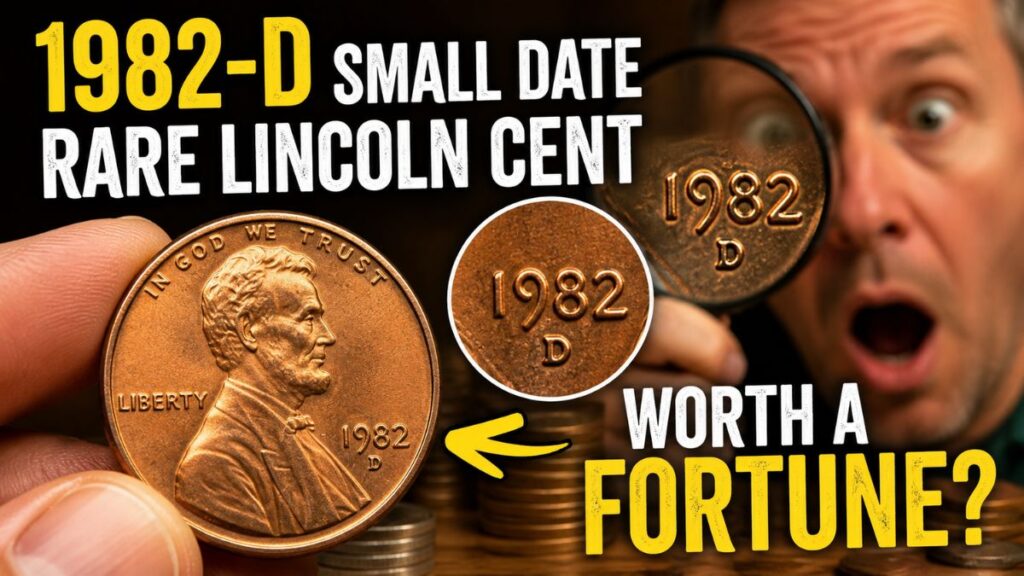
The 1982-D Small Date Copper Penny is one of the most intriguing coins in modern United States numismatics. At first glance, it looks like an ordinary Lincoln cent from the early 1980s. It carries the familiar portrait of Abraham Lincoln, the Denver “D” mintmark, and a date that millions of people would normally overlook.
But there is an extraordinary reason collectors pay attention to this particular combination.
The year 1982 was a major transition point for the Lincoln cent. The United States Mint changed the cent from its traditional copper composition to a copper-plated zinc composition during that year. Several different varieties were produced during the transition, including Large Date and Small Date versions, with both copper and zinc compositions represented.
That combination created an unusual collecting landscape.
Among the most famous possibilities is the 1982-D Small Date copper cent. A genuine example is exceptionally scarce, making authentication extremely important. The coin is not valuable simply because it says “1982-D Small Date.” The exact variety, composition, condition, weight, and authenticity all matter.
This is why a tiny difference in the shape of the date can turn an ordinary-looking Lincoln cent into a major numismatic discovery.
For collectors, the 1982-D Small Date copper penny represents something particularly exciting: a coin created during a historic transition that can be difficult to distinguish from much more common examples without careful examination.
Understanding what makes this penny special, how to identify the Small Date variety, why copper composition matters, what mistakes collectors commonly make, and how authentication affects value is essential before assigning any extraordinary price to one.
Why 1982 Was Such an Important Year for the Lincoln Cent
The story begins with the changing composition of the Lincoln cent.
For much of its history, the United States one-cent coin had been made primarily from copper. By the late 1970s and early 1980s, however, the rising cost of copper became an increasingly important issue.
Producing a cent containing a large amount of copper became more expensive.
The solution was to change the composition.
In 1982, the Mint transitioned to copper-plated zinc cents. The new coins used a zinc core covered by a thin layer of copper, substantially reducing the amount of copper contained in each cent.
The transition did not happen neatly at the beginning of the year.
Instead, both compositions appeared during 1982.
That is one of the reasons the year is so fascinating to Lincoln cent collectors.
A collector looking through a group of 1982 pennies can encounter coins that appear almost identical but have different compositions and different date varieties.
This created several distinct combinations.
The 1982 Lincoln cent varieties are generally identified by two date styles, Large Date and Small Date, combined with copper or zinc composition and the applicable mintmark.
The Denver Mint produced some of the combinations, making the 1982-D cents particularly interesting.
What Is the 1982-D Small Date Copper Penny?
The name itself contains the most important information.
“1982” identifies the year.
“D” indicates that the coin was struck at the Denver Mint.
“Small Date” refers to the style of the numerals used for the date.
“Copper” refers to the coin’s traditional bronze composition rather than the later copper-plated zinc composition.
This distinction is extremely important.
A 1982-D Small Date cent is not automatically a rare copper cent.
The composition has to be established separately.
Likewise, simply finding a 1982-D cent with a date that appears small does not prove that the coin is the rare variety.
Collectors need to examine the date carefully and determine the coin’s weight and composition before reaching a conclusion.
Why the Small Date Matters
The difference between Large Date and Small Date may seem insignificant to someone unfamiliar with Lincoln cent varieties.
After all, both coins carry the same year.
The difference is found in the design and proportions of the numerals.
This is exactly what makes the variety fascinating.
The Mint produced different date styles during 1982, and collectors learned to distinguish them through specific characteristics in the individual digits.
The Small Date has a noticeably different appearance when compared directly with the Large Date.
The most useful way to learn the difference is not by looking at one coin in isolation.
Place a suspected Small Date next to a known Large Date 1982 cent.
Compare the numerals closely.
Pay particular attention to the shape, spacing, height, and positioning of the digits.
The differences become much easier to appreciate when the two varieties are viewed together.
How to Recognize a Small Date
Identifying the Small Date variety requires patience.
The first step is to examine the entire date rather than focusing on only one digit.
The numerals on a Small Date generally have a different overall relationship to one another and to the surrounding design.
The “8” and “2” can be especially useful when comparing examples, but collectors should learn the characteristics of the complete date.
Lighting also matters.
A coin viewed under poor lighting can make the date appear different from how it actually looks.
A magnifying glass or a quality coin loupe can help, although extreme magnification is not necessary for an initial examination.
The goal is to identify the variety without damaging the coin.
Never scrape, polish, scratch, or otherwise alter the surface while trying to make the date easier to see.
The Most Important Question: Is It Really Copper?
Finding the Small Date is only part of the challenge.
The next question is composition.
A 1982-D Small Date coin made from copper is dramatically more interesting to collectors than a normal copper-plated zinc example.
The traditional copper cents from this era weigh approximately 3.11 grams.
The later copper-plated zinc cents weigh approximately 2.50 grams.
That difference is significant.
A digital scale capable of measuring to at least hundredths of a gram can therefore be a useful first screening tool.
However, weight alone should never be treated as absolute proof of authenticity or composition.
Coins can experience environmental damage, surface loss, corrosion, plating problems, or other conditions that affect their weight.
Likewise, counterfeit coins can sometimes be manufactured to mimic expected measurements.
Weight is a screening method, not the final answer.
Why a Copper 1982-D Small Date Is So Interesting
The rarity comes from the combination.
There are many 1982 Lincoln cents.
There are also many 1982-D Lincoln cents.
There are Small Date examples.
There are copper examples.
But combining the Denver mintmark, Small Date design, and copper composition creates a much more unusual category.
This is what makes the coin such an important target for variety collectors.
It is also why the market can react dramatically when a genuinely authenticated example appears.
A coin that looks ordinary to the average person can become extremely important when its variety and composition are correctly established.
The Copper Transition Created a Perfect Collecting Storm
The Mint’s change in composition is at the heart of the story.
Whenever a major coinage transition occurs, collectors naturally become interested in the boundary between the old and new systems.
The 1982 Lincoln cent is a textbook example.
Instead of having one simple 1982 cent, collectors have to consider several possibilities.
That makes the date far more interesting than an ordinary annual issue.
The transition also explains why collectors should never dismiss a 1982 penny simply because millions were produced.
A large mintage does not mean every variety or composition is equally common.
The important question is not merely how many cents were produced in 1982.
The important question is how many coins exist in the exact combination being sought.
Copper Versus Copper-Plated Zinc
The difference in composition can be confusing because zinc cents still have a copper-colored exterior.
This is one of the biggest reasons inexperienced collectors can make mistakes.
A copper-plated zinc penny can look like a copper penny.
Its outer surface contains copper.
That does not mean the entire coin is copper.
The underlying composition is different.
A traditional bronze Lincoln cent from the copper era contains substantially more copper throughout the coin.
A modern copper-plated zinc cent has a zinc core with a thin copper coating.
From a casual visual inspection, the two can appear nearly identical.
That is why collectors should not rely solely on color.
Can Color Prove That a Penny Is Copper?
No.
Color can provide clues, but it is not reliable enough to prove composition.
A copper cent may develop different shades over time depending on its storage conditions and environmental exposure.
It can become bright reddish, brown, dark brown, or develop other natural toning.
A zinc cent with copper plating can also appear different depending on wear and environmental conditions.
A coin that looks unusually red is not automatically valuable.
Likewise, a dark brown 1982 cent is not automatically common.
The correct approach is to combine visual variety identification with physical measurements and, when appropriate, professional authentication.
Why the Weight Test Is So Useful
The weight difference between traditional copper cents and copper-plated zinc cents is one of the easiest ways to screen a 1982 Lincoln cent.
A traditional copper composition is around 3.11 grams.
A copper-plated zinc cent is around 2.50 grams.
That is a difference of roughly 0.61 gram, which is substantial for such a small coin.
For collectors examining large quantities of cents, a precision scale can therefore save considerable time.
If a suspected 1982-D Small Date weighs close to the copper standard, it deserves additional attention.
If it weighs around the zinc standard, the coin is much less likely to be the famous copper combination being sought.
But again, weight does not replace authentication.
Why a Precise Scale Matters
A basic kitchen scale is not ideal for coin identification.
A numismatic scale should provide enough precision to distinguish approximately 3.11 grams from approximately 2.50 grams.
A scale that measures only whole grams is not useful for this purpose.
Collectors should also make sure the scale is properly calibrated and placed on a stable surface.
The coin should be weighed without dirt, debris, or other material attached to it.
If the result is unusual, repeat the measurement.
Consistency matters.
What Does the “D” Mintmark Tell You?
The “D” mintmark indicates Denver.
This is particularly important because different United States Mint facilities produced Lincoln cents during this period.
When discussing the rare 1982-D Small Date copper combination, the Denver mintmark is an essential part of the identification.
It is normally located below the date on the obverse of the Lincoln cent.
A collector should verify that the mintmark itself looks appropriate.
However, the presence of a “D” does not automatically make the coin rare.
There are many common 1982-D cents.
The significance comes from the specific combination of date style and composition.
Where Is the Small Date Located?
The Small Date is not a separate mintmark or additional symbol.
It is simply a different design style for the numerals making up the year.
This means the collector needs to study the date itself.
The mintmark and date should be examined together.
A genuine 1982-D Small Date should display the appropriate date style and Denver mintmark consistent with the variety.
This is why variety identification requires more attention than simply searching for the year and mintmark.
What Makes the 1982-D Small Date Different From an Ordinary 1982-D Penny?
An ordinary 1982-D cent can be relatively easy to overlook.
The 1982-D Small Date copper combination is different because it represents a rare intersection of characteristics.
Think of the process as three filters.
First: Is the coin actually dated 1982?
Second: Does it have the Denver “D” mintmark and the Small Date variety?
Third: Is it made from the copper composition rather than copper-plated zinc?
Only when those characteristics are properly established does the coin become a serious candidate for the famous rarity.
This is why collectors should resist the temptation to assign a huge value immediately.
Identification comes first.
Could Your 1982-D Penny Be Valuable?
It could be worth investigating, but the answer depends entirely on what you actually have.
Most 1982-D Lincoln cents are not extraordinary rarities.
A common example may be worth little beyond its normal collectible value, depending on condition.
A genuine 1982-D Small Date copper cent, however, belongs to a very different category.
Its rarity can make it extremely desirable to serious Lincoln cent collectors.
The challenge is proving that the coin is genuine and correctly identified.
This is where professional grading and authentication can become especially important.
Why Authentication Is So Important
Whenever a coin has potentially extraordinary value, authentication becomes critical.
Rare coins attract counterfeiters.
They also attract altered-coin attempts.
A common coin can sometimes be modified or manipulated in an attempt to make it appear to be a rarer variety.
For a coin as famous as the 1982-D Small Date copper cent, this is an important concern.
A professional authentication service can examine the coin’s physical characteristics, weight, composition, surfaces, die characteristics, and other diagnostic details.
If the coin is genuine and qualifies for certification, professional documentation can significantly increase buyer confidence.
Why You Should Not Clean the Coin
One of the most damaging mistakes a collector can make is cleaning a potentially valuable coin.
It may seem logical to remove dirt or discoloration to make the coin look better.
Unfortunately, cleaning can permanently alter the surface.
Scratches, polishing lines, chemical damage, unnatural brightness, and other problems can reduce collector appeal.
If you think you have found an important 1982-D Small Date copper cent, leave the coin alone.
Do not polish it.
Do not use household chemicals.
Do not rub it aggressively with cloth.
Do not attempt to remove discoloration.
Preserving the coin’s original surface is far more important than making it look shiny.
What Condition Does the Coin Need to Be In?
Condition matters, but rarity is the first issue.
A rare coin does not become common simply because it has circulated.
At the same time, a high-grade example can be dramatically more desirable to collectors.
Lincoln cents are graded according to the amount of wear, preservation of the original surfaces, luster, color, marks, and other characteristics.
A circulated coin may show noticeable wear on Lincoln’s hair, cheek, jaw, and other high points.
An uncirculated coin should retain the details and surface characteristics associated with a coin that did not experience normal circulation.
For a potentially important 1982-D Small Date copper cent, professional grading can help establish its condition.
Red, Red-Brown, and Brown Copper
Collectors of copper coins often pay attention to color classification.
Copper coins can exhibit different levels of original red coloration.
Broadly, collectors commonly encounter descriptions such as Red, Red-Brown, and Brown.
A coin retaining significant original red color can be more desirable than a heavily toned brown example, depending on the issue and grade.
But color should never be used to prove composition.
A copper-plated zinc coin can have a copper-colored appearance.
The composition must be established independently.
Why Original Surfaces Matter
A valuable copper cent should ideally retain natural surfaces.
Collectors look for signs of cleaning, artificial toning, corrosion, scratches, environmental damage, and other alterations.
A coin with original surfaces can be significantly more desirable than one that has been aggressively cleaned.
This is another reason to avoid experimenting with home restoration.
If you suspect a rare coin, preservation is the safest approach.
Could a Damaged Coin Still Be Important?
Yes.
If the coin is genuinely a rare variety and authentic, damage does not necessarily eliminate its significance.
However, damage can reduce its market value substantially.
The distinction is important.
Rarity determines whether the coin is fundamentally unusual.
Condition helps determine how desirable a particular example is compared with other genuine examples.
A damaged genuine rarity can still be fascinating and valuable, but it may not command the same level as an exceptional specimen.
How Much Is a 1982-D Small Date Copper Penny Worth?
This is where collectors should be especially careful.
There is no single universal value that can be assigned to every coin described as a “1982-D Small Date Copper Penny.”
A genuine example can be extraordinarily valuable because of its rarity, but the actual market value depends on authentication, grade, color, eye appeal, provenance, and the circumstances of a sale.
Unverified internet claims should not be treated as guaranteed prices.
A coin advertised for a huge amount is not necessarily worth that amount.
Likewise, a low asking price does not prove that the coin is common.
Auction results and authenticated examples are much more useful than speculative listings.
Why Internet Prices Can Be Misleading
Searching online for “1982-D Small Date Copper Penny value” can produce dramatically different numbers.
Some pages may publish enormous valuations.
Others may show ordinary 1982-D penny prices.
The confusion usually comes from mixing different coins.
A 1982-D Large Date copper cent is not the same as a 1982-D Small Date copper cent.
A 1982-D Small Date zinc cent is not the same as a copper example.
A damaged coin is not equivalent to a high-grade certified example.
And a coin merely described as rare by a seller is not necessarily rare.
Collectors should always identify the exact coin before considering price.
Is Every 1982 Small Date Penny Rare?
No.
This is an extremely important distinction.
The words “1982 Small Date” alone do not mean the coin is the famous rare copper variety.
The mintmark matters.
The composition matters.
The condition matters.
And the authenticity of the coin matters.
This is why a collector should never see a Small Date and immediately assume a life-changing discovery.
The correct reaction is to investigate.
What Should You Do If You Find One?
If you believe you have found a 1982-D Small Date copper penny, the best approach is simple.
Handle it carefully by the edges.
Do not clean it.
Record its weight using an accurate scale.
Take clear photographs of the obverse and reverse.
Compare the date with reliable variety references or known examples.
If the characteristics appear promising, seek professional authentication.
Avoid making permanent changes to the coin.
The more potentially valuable the coin appears, the more important professional evaluation becomes.
How to Photograph a Potentially Rare Penny
Good photographs can help during an initial examination.
Use natural or neutral lighting.
Avoid harsh reflections.
Take a clear photograph of the entire obverse.
Then photograph the reverse.
Take additional close-up images of the date and mintmark.
If possible, include an image of the coin on the scale showing its weight.
The photographs should be sharp enough to see the details of the numerals.
However, photographs cannot replace physical authentication.
They are simply a useful first step.
Why the Date Should Be Compared With Known Examples
Variety identification is easier when you have a reference coin.
If you have several 1982 cents, put them next to each other.
Compare the date styles.
Look carefully at the proportions of the numerals.
This side-by-side method is far more effective than trying to memorize every characteristic from a written description.
The differences may initially appear subtle.
After repeated comparisons, however, the Small Date and Large Date become easier to distinguish.
This is how many collectors develop their variety-identification skills.
Could a Magnet Identify the Copper Composition?
A magnet is not a reliable way to determine whether a Lincoln cent is copper.
Copper and zinc are both nonmagnetic under ordinary conditions.
A magnet therefore cannot provide the kind of definitive answer collectors need.
It is much more useful to rely on weight, visual examination, and professional testing when necessary.
Simple household tricks often produce more confusion than useful information.
Could a Metal Detector Find One?
Potentially, yes, but the challenge is identification.
Metal detecting can uncover old coins, including Lincoln cents, but the condition of a coin found underground can be poor.
Environmental exposure may cause corrosion or surface deterioration.
If a 1982-D cent were found while detecting, the same identification process would apply.
The date would need to be examined.
The mintmark would need to be confirmed.
The Small Date variety would need to be established.
And the composition would need to be evaluated.
Finding the coin is only the beginning.
Why Collectors Love Transitional Coins
Transitional coins are particularly fascinating because they document changes in the Mint’s production process.
They represent moments when one composition, design, or manufacturing method overlaps with another.
The 1982 Lincoln cent is a perfect example of why transitional years can become important in numismatics.
Collectors are not simply collecting an object.
They are collecting evidence of a change in American coin production.
That historical context gives the coin an additional layer of interest.
The Historical Appeal of the Lincoln Cent
The Lincoln cent itself has an extraordinary place in American coinage.
Lincoln first appeared on the cent in 1909, making the design one of the most recognizable images in United States currency.
By 1982, the Lincoln cent had already existed for more than seven decades.
The coin therefore carried considerable historical continuity.
The transition from copper to copper-plated zinc added another important chapter.
For collectors, a 1982 cent can therefore represent both the long history of the Lincoln design and a major change in coin composition.
Why the 1982-D Small Date Is a Collector’s Dream
Rare coins often become famous because they combine multiple unusual characteristics.
The 1982-D Small Date copper cent is fascinating for exactly this reason.
The date is correct.
The mintmark is correct.
The date style is specific.
The composition is significant.
The combination creates a coin that is dramatically more interesting than a normal pocket-change Lincoln cent.
That kind of discovery is what keeps people searching rolls, jars, old collections, and inherited coin boxes.
Could One Still Be Found in Circulation?
The possibility of encountering an important coin in circulation is one of the most exciting parts of coin collecting.
However, extremely rare examples are obviously much less likely to appear than ordinary 1982 cents.
Coins can remain in collections for decades.
Others can spend years in circulation before being removed.
A collector searching through cents should therefore understand that most finds will not be extraordinary.
The process is about knowing what to look for and recognizing an unusual coin when one appears.
Searching Bank Rolls for 1982 Pennies
Roll hunting can be an inexpensive way to learn about Lincoln cent varieties.
A collector can search rolls of cents and separate interesting dates and varieties.
The 1982 issue is particularly attractive because of the composition transition and date varieties.
When searching, organize the coins rather than examining them randomly.
Set aside 1982 examples.
Separate Denver-mint coins.
Compare Large Date and Small Date varieties.
Then investigate composition.
This systematic method reduces the chance of overlooking an important piece.
What Other 1982 Lincoln Cents Exist?
The 1982 Lincoln cent series is complicated because multiple combinations were produced.
Collectors commonly distinguish between Large Date and Small Date versions and between copper and zinc compositions.
The Philadelphia Mint produced cents without a mintmark, while Denver examples carry a “D.”
San Francisco also produced proof cents during the period, which are part of a different collecting category.
This variety landscape is exactly why the 1982 date deserves special attention.
It is not simply one coin.
It is a group of related varieties created during a major transition.
Why the Mintmark and Date Must Be Examined Together
Suppose someone finds a 1982 Small Date copper cent.
That does not automatically mean they have the famous Denver rarity.
If there is no “D,” it belongs to a different mint category.
If there is a “D,” the Denver connection is established.
This simple example demonstrates why coin identification must be precise.
Collectors should record the year, mintmark, date style, composition, and condition before discussing value.
Can a Coin Be Altered to Look Like a Small Date?
Alteration is one of the concerns in rare coin collecting.
Because a common coin can be worth dramatically less than a rare variety, there is an incentive for dishonest sellers to manipulate coins.
A date can potentially be altered or damaged in ways that confuse inexperienced collectors.
That is why the surface around the date deserves careful attention.
Professional authentication looks at more than the overall appearance.
Specialists can examine die characteristics and other physical evidence to determine whether a coin genuinely belongs to the claimed variety.
What Is Die Variety?
A die is the hardened tool used to strike a coin design.
Differences between dies can create collectible varieties.
Collectors can study minute characteristics of dies, including the placement and shape of design elements.
For a famous variety, these details can be extremely useful.
The 1982 Lincoln cent varieties are often discussed in terms of date styles, but serious authentication can involve much more detailed examination.
This is another reason why photographs and simple visual comparisons are useful for screening but not always enough for final identification.
Why Professional Grading Can Matter
Professional grading can provide two important services.
First, it can help authenticate the coin.
Second, it can assign a condition grade.
For an ordinary circulated cent, paying for professional grading may not make financial sense.
For a coin that could potentially be one of the rarest varieties associated with the 1982 transition, the situation is very different.
Authentication can provide confidence to future buyers and collectors.
It can also help establish the coin’s condition in a standardized way.
What Should You Look for on the Obverse?
Start with Abraham Lincoln’s portrait.
Then examine the date.
The date should be sharp enough to evaluate.
Look for signs of unusual alteration around the numerals.
Next, inspect the mintmark below the date.
The overall design should appear consistent with an authentic Lincoln cent from the period.
Do not focus exclusively on one digit.
A genuine coin should make sense as a complete object.
What Should You Look for on the Reverse?
The reverse of a 1982 Lincoln cent features the Lincoln Memorial design used during that era.
Examine the lettering and details.
Look for unusual surface texture, damage, or evidence of alteration.
The reverse can also help reveal whether a coin has been heavily cleaned or damaged.
A potential rarity should be evaluated on both sides.
Does the Color of the Edge Matter?
The edge can sometimes provide useful clues about composition.
A copper-plated zinc cent can show a different edge appearance from a traditional copper cent, especially if the plating has been damaged.
However, edge color alone should not be used as definitive evidence.
A coin can experience wear, corrosion, or environmental effects that alter its appearance.
Weight and professional analysis remain much more reliable.
Why You Should Keep Your 1982 Cents
Even if a particular coin turns out not to be rare, 1982 cents are historically interesting because of the composition transition.
Collectors can use them as a starting point for learning about coin varieties.
A collection of different 1982 examples can illustrate how the Mint transitioned from copper to copper-plated zinc.
This makes the year educational as well as potentially rewarding.
The best part is that many examples can still be found without spending much money.
What If Your Coin Weighs 3.11 Grams?
A weight around 3.11 grams is worth attention because it is consistent with the traditional copper composition.
But weight alone does not establish the rare variety.
The next step is to verify the date style.
Then verify the Denver mintmark.
Then consider authentication.
If all characteristics appear consistent with the 1982-D Small Date copper combination, professional examination becomes particularly important.
Do not assume that a 3.11-gram coin is automatically the famous rarity.
What If Your Coin Weighs 2.50 Grams?
A weight around 2.50 grams is consistent with a copper-plated zinc cent.
That generally makes it a different category from the traditional copper composition being sought.
However, the exact condition and variety can still make a 1982 cent collectible.
The important point is that the famous copper combination requires the appropriate composition.
Can Environmental Damage Change the Weight?
Yes.
Coins can accumulate or lose material through corrosion, dirt, deposits, and other environmental effects.
That is why a measurement slightly above or below a standard value should not automatically be interpreted as proof of anything.
A good scale provides a useful indication.
If the result is unusual, professional testing can provide greater certainty.
Why You Should Be Careful With Online Buyers
A potentially rare coin can attract unsolicited offers.
Collectors should be cautious if someone immediately offers a large amount of money without properly examining the coin.
A serious transaction should involve appropriate authentication and documentation when the stakes are high.
Do not rush because someone claims that the opportunity will disappear.
Rare coin collecting rewards patience.
The more valuable the potential coin, the more important it is to slow down and verify everything.
Could a 1982-D Small Date Copper Penny Be a Million-Dollar Coin?
Extraordinary claims about coin values should always be treated cautiously.
The 1982-D Small Date copper cent has gained enormous attention because of its rarity, but that does not mean every example is worth an arbitrary seven-figure amount.
Actual value depends on the authenticity of the coin, its condition, market demand, provenance, and the circumstances of a transaction.
A collector should never use a sensational headline as a substitute for professional valuation.
The real story is already fascinating without exaggerating the price.
Why Rarity and Value Are Not the Same Thing
Rarity is one factor in value.
Demand is another.
Condition is another.
Authentication is another.
Historical importance and collector interest also matter.
A coin can be extremely scarce but have limited demand.
Conversely, a coin with strong collector demand can command significant prices even when it is not uniquely rare.
The 1982-D Small Date copper cent combines rarity with a highly recognizable series, which is part of what makes it so interesting.
How to Store a Potentially Valuable Penny
If you suspect you have an important 1982-D Small Date copper cent, proper storage matters.
Avoid loose storage where the coin can rub against other coins.
Use an inert, coin-safe holder designed for long-term storage.
Keep it away from excessive humidity.
Avoid touching the surfaces unnecessarily.
When handling it, hold the coin by the edge.
These simple habits can help preserve its condition.
Why Fingerprints Matter
Copper coins can react to oils and contaminants from human skin.
Touching the surfaces repeatedly can leave fingerprints and contribute to long-term surface changes.
For an ordinary circulated cent, this may not be a major concern.
For a potentially rare and valuable coin, it is worth being careful.
Handle it by the edge and minimize unnecessary contact.
Should You Clean a 1982-D Small Date Copper Penny?
No.
If the coin might be valuable, cleaning is one of the worst things you can do.
Even a coin that looks dirty or unattractive may have valuable original surfaces.
Professional graders can recognize cleaning and other forms of surface alteration.
A shiny coin is not necessarily a valuable coin.
Originality is often much more important.
Why the Story of This Penny Continues to Attract Collectors
The appeal of the 1982-D Small Date copper penny is not simply its potential price.
It represents a moment of change in American coinage.
It shows how a small modification in production can create an entirely different collecting landscape.
It also demonstrates why careful observation matters.
Millions of Lincoln cents can pass through people’s hands without anyone examining the date closely.
Yet among those ordinary-looking coins, specific combinations can become highly collectible.
That is the magic of numismatics.
Could You Find One in an Old Coin Collection?
It is possible for older collections to contain overlooked varieties.
People sometimes collect coins by date without distinguishing varieties.
A collection assembled decades ago might therefore contain a coin that deserves modern examination.
This does not mean every inherited collection contains a rare 1982-D Small Date copper cent.
But it does mean that collectors should examine old holdings carefully before selling them as a bulk lot.
What About Old Jars of Pennies?
The same principle applies to jars and containers filled with old cents.
A jar may contain mostly common coins.
But sorting through it can reveal interesting dates, varieties, errors, or composition differences.
The 1982 cents are especially worth separating.
Rather than judging them by appearance alone, examine the date, mintmark, and weight.
A few minutes of careful checking can be far more useful than simply assuming every 1982 cent is ordinary.
Why Coin Collecting Rewards Patience
The 1982-D Small Date copper penny is an excellent example of why successful coin collecting is not simply about finding valuable objects.
It is about learning.
A collector who understands the difference between Large Date and Small Date has a significant advantage.
Someone who understands copper versus copper-plated zinc has another advantage.
Someone who knows how authentication works has an even greater advantage.
Over time, these skills make it easier to recognize genuinely unusual coins.
The Most Important Mistake to Avoid
The biggest mistake is confusing a possible discovery with a confirmed rarity.
Seeing “1982-D Small Date” on a coin does not finish the investigation.
The coin needs to be examined as a complete specimen.
Composition needs to be considered.
Weight needs to be checked.
Condition needs to be evaluated.
Potential alteration needs to be ruled out.
And when the evidence points toward the rare combination, professional authentication becomes the logical next step.
A Simple Identification Checklist
If you have a 1982 Lincoln cent, start with these questions:
Is the date 1982?
Does the coin have a Denver “D” mintmark?
Does the date appear to be the Small Date variety?
Does the weight correspond more closely to the traditional copper composition or copper-plated zinc?
Does the coin show signs of alteration?
Is the surface original?
If the answers point toward the rare combination, stop handling the coin unnecessarily and consider professional authentication.
What Makes a Genuine Example So Valuable to Collectors?
The answer is scarcity combined with historical context.
The coin comes from a major transition year.
The Denver mintmark narrows the category.
The Small Date variety narrows it further.
The copper composition narrows it again.
That combination creates an exceptional numismatic story.
A genuine example is therefore much more than a one-cent coin.
It is a documented piece of the transition from the traditional copper cent to the copper-plated zinc cent.
Is the 1982-D Small Date Copper Penny Worth Searching For?
Absolutely.
Even if the odds of finding the rarest combination are extremely low, the cost of examining a 1982 cent is minimal.
The process also teaches valuable collecting skills.
You learn how to identify varieties.
You learn how to use a precision scale.
You learn the difference between appearance and composition.
And you learn why authentication matters.
That makes the search worthwhile even when the coin turns out to be common.
Frequently Asked Questions About the 1982-D Small Date Copper Penny
What is a 1982-D Small Date copper penny?
It is a Lincoln cent dated 1982, struck at the Denver Mint, displaying the Small Date variety and made with the traditional copper composition associated with the earlier cents of the transition year.
Why is the 1982-D Small Date copper penny famous?
It is famous because the combination of the Denver mintmark, Small Date variety, and copper composition is exceptionally scarce compared with the many other 1982 Lincoln cent combinations.
How much does a 1982-D Small Date copper penny weigh?
A traditional copper Lincoln cent from this era is approximately 3.11 grams. A copper-plated zinc cent is approximately 2.50 grams. Weight is useful for screening but should not be treated as the only authentication test.
Does every 1982-D Small Date penny contain copper?
No. The date style and composition are separate characteristics. A Small Date cent can be copper-plated zinc, while the extremely scarce combination of interest is the Small Date Denver cent with the traditional copper composition.
How can I tell if my 1982-D penny is a Small Date?
Compare the date with a known 1982 Large Date example. Study the overall shape, spacing, and proportions of the numerals rather than relying on one digit alone.
Is a 1982-D penny automatically valuable?
No. Many 1982-D cents are common. The exact variety, composition, condition, and authenticity determine whether a particular example has unusual collector value.
Can the color prove that a 1982 penny is copper?
No. Copper-plated zinc cents also have a copper-colored outer layer. Color can provide clues but cannot reliably establish the coin’s composition.
Can I use a household magnet to test it?
A magnet is not a reliable test for distinguishing the copper and zinc compositions involved here. A precision weight measurement is much more useful as an initial screening method.
Should I clean a possible 1982-D Small Date copper penny?
No. Cleaning can permanently damage the surface and potentially reduce collector value. A potentially rare coin should be left in its original condition.
Should I have the coin professionally authenticated?
If your coin appears to match the rare 1982-D Small Date copper combination, professional authentication is strongly advisable. The potential significance of the coin makes certainty much more important than relying on visual inspection alone.
Can a 1982-D Small Date copper penny be counterfeit or altered?
Potentially. Valuable varieties can attract counterfeiting and alteration attempts. Professional authentication can help determine whether the coin is genuine and whether its characteristics are consistent with the claimed variety.
Does condition affect the value?
Yes. Once authenticity and variety are established, condition can have a major effect on desirability and market value. Surface preservation, wear, color, marks, and other characteristics all matter.
Is a brown 1982-D penny less valuable than a red one?
Color can influence collector demand for copper coins, but it should not be used to identify the composition. A coin’s overall grade, originality, authenticity, and variety are also important.
Could I still find a 1982-D Small Date copper penny today?
The possibility of discovering an overlooked example is part of the appeal of coin collecting, but an authenticated example of the rare combination is exceptionally difficult to encounter.
Where should I look for a 1982-D Small Date copper penny?
Collectors can examine old Lincoln cent collections, inherited coin holdings, jars of older pennies, and rolls of cents. The key is to examine the 1982 issues carefully rather than assuming they are all the same.
What should I do if my coin weighs around 3.11 grams?
Treat that as a reason to investigate further. Confirm the Small Date variety, verify the Denver mintmark, inspect the coin for alterations, and consider professional authentication if the characteristics appear promising.
What if my coin weighs around 2.50 grams?
That weight is consistent with the copper-plated zinc composition and generally indicates that the coin is not the traditional copper combination being sought. Other collectible characteristics may still be present.
Can I determine the exact value from an online price guide?
Not reliably without first identifying the exact variety, composition, condition, and authenticity. Online prices can mix common and rare 1982 cents, leading to very misleading conclusions.
Is the 1982-D Small Date copper penny a good coin to collect?
Yes. The 1982 Lincoln cent series is particularly interesting because of the transition in composition and the different date varieties. It offers collectors an excellent opportunity to learn about variety identification and transitional coinage.
The 1982-D Small Date Copper Penny Is More Than a One-Cent Coin
The 1982-D Small Date copper penny demonstrates why coin collecting can be so fascinating. What looks like an ordinary Lincoln cent can contain a story about a major change in United States coin production.
The year 1982 was unusual because the Mint transitioned from traditional copper cents to copper-plated zinc cents. During that transition, different date styles and compositions were produced, creating a group of varieties that collectors continue to study.
Among them, the 1982-D Small Date copper combination stands out because of its extraordinary scarcity.
But that rarity also creates a responsibility for collectors.
It is important not to confuse a normal 1982-D cent with the rare combination. It is equally important not to assume that the color of the coin proves its composition. Even weight, while extremely useful, should be treated as a screening tool rather than absolute proof.
The best approach is careful identification followed by professional authentication when the evidence looks promising.
If you have a 1982-D Lincoln cent, examine the date carefully. Compare it with known Large Date and Small Date examples. Check the mintmark. Weigh the coin accurately. Preserve the original surfaces. And never clean a coin simply because you think it might be valuable.
Most 1982-D pennies will not turn out to be extraordinary.
But that does not make the search pointless.
The excitement comes from knowing that a tiny difference in a date, combined with a specific mintmark and composition, can transform an ordinary-looking cent into an important piece of numismatic history.
That is the real appeal of the 1982-D Small Date copper penny: it reminds collectors that sometimes the most fascinating discoveries are hiding in plain sight.