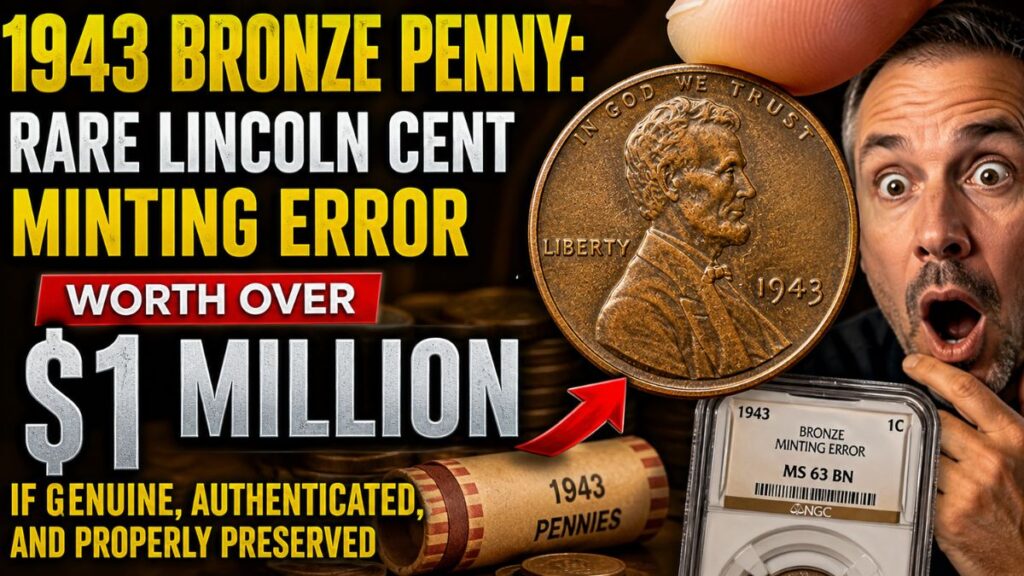
Few American coins have captured the imagination of collectors quite like the 1943 Bronze Lincoln cent. At first glance, it may look like an ordinary old penny. But if a genuine 1943 cent was accidentally struck on a bronze planchet instead of the steel planchets used for regular 1943 cents, it can represent one of the most remarkable minting errors in United States coinage.
That is why a 1943 Lincoln penny that appears copper-colored deserves careful attention. It should not automatically be treated as an ordinary one-cent coin, especially if it has the characteristics associated with a genuine bronze example.
The story begins during World War II. Copper was an important material for the war effort, and the United States Mint changed the composition of the Lincoln cent for 1943. Instead of using the traditional bronze composition, the Mint produced cents using steel coated with zinc. The resulting coins had a distinctive silver-gray appearance.
However, a small number of bronze planchets from the previous production process apparently remained in the Mint and were accidentally used to strike 1943-dated cents. Those accidental strikes created the famous 1943 Bronze Lincoln cents.
Their rarity is not simply about age. Millions of 1943 cents were produced, but the bronze versions are exceptionally scarce. Their unusual combination of the 1943 date and bronze composition is what makes them so desirable.
For someone who discovers an old 1943 Lincoln penny, the important lesson is simple: appearance alone is not enough to establish rarity, but an unusual 1943 cent should be investigated carefully.
A suspected example should never be cleaned, scratched, bent, polished, heated, chemically tested, or subjected to any other action that could damage its original surfaces. Even a potentially valuable coin can lose significant value if its condition is harmed.
The safest approach is to document what you have, examine it gently, weigh it accurately, and seek professional authentication if the basic characteristics appear promising.
The Wartime Story Behind the 1943 Lincoln Cent
The unusual 1943 cent exists because of wartime conditions.
Before 1943, Lincoln cents were traditionally produced using a bronze composition. Copper was an important component of that alloy. When the United States was fully involved in World War II, copper became strategically important for military production and other wartime uses.
The Mint therefore needed an alternative material for the one-cent coin.
For 1943, the solution was steel coated with zinc. These coins became known as 1943 steel cents. Their composition was dramatically different from the familiar bronze Lincoln cents that collectors had seen before.
The steel planchets gave the 1943 cents their unusual appearance. Instead of looking reddish-brown or copper-colored, normal 1943 cents generally appear gray or silver-colored when their zinc coating is intact.
This makes the 1943 Bronze cent especially interesting.
The date says 1943, but the metal is associated with the earlier bronze cents.
That combination should not normally have occurred.
The famous error appears to have happened because some bronze planchets were still present when 1943 cents were being produced. Those leftover planchets were accidentally struck with the new 1943 dies.
The resulting coins looked much more like traditional copper-colored Lincoln cents while carrying the 1943 date.
For collectors, this created an extraordinary historical combination.
It was not simply an unusual-looking penny. It was a physical record of a major transition in American coin production during wartime.
What Makes the 1943 Bronze Cent Different From a Normal 1943 Penny?
The easiest way to understand the rarity is to compare the two basic types.
A normal 1943 Lincoln cent was struck on a zinc-coated steel planchet. It has a silvery appearance and weighs approximately 2.70 grams.
A genuine 1943 Bronze Lincoln cent was struck on a bronze planchet. It should have the characteristics associated with the traditional bronze cents, including a weight of approximately 3.11 grams.
That difference in composition also creates an important difference in weight.
The approximately 3.11-gram weight is one of the first things collectors can check when examining a suspected 1943 Bronze cent.
However, weight is only a screening tool.
It is not proof of authenticity.
A coin can have an unusual weight for many reasons. Damage, corrosion, environmental exposure, planchet problems, alterations, or other circumstances can affect measurements. A counterfeit can also be manufactured to imitate the expected weight.
Therefore, a coin that weighs approximately 3.11 grams should not automatically be declared a genuine 1943 Bronze cent.
Likewise, a coin that does not weigh exactly 3.11 grams should not immediately be dismissed without considering measurement accuracy and condition.
The important point is that weight can help determine whether further investigation is justified.
Why the Copper Color Gets So Much Attention
The copper or bronze color is usually the first feature that attracts attention.
A normal 1943 steel cent is noticeably different in appearance from the bronze Lincoln cents produced before the wartime composition change. That makes color an obvious clue when searching through an old collection, inherited coin group, jar of pennies, or accumulation of circulated coins.
A 1943 penny that looks distinctly copper-colored can therefore be intriguing.
But color is not enough.
This is one of the most important facts for anyone searching for a 1943 Bronze cent.
Coins can change color over time.
Steel cents can become discolored through environmental exposure. Copper-colored coatings, artificial toning, chemical treatments, or alterations can also create misleading appearances.
A coin that looks copper does not necessarily contain the bronze composition associated with a genuine 1943 Bronze cent.
This is why experienced collectors do not rely on color alone.
Instead, they consider several characteristics together, including the date, appearance, weight, physical condition, surfaces, and ultimately professional authentication.
The strongest approach is not to ask, “Does this penny look copper?”
The better question is, “Does this penny have the characteristics expected of a genuine 1943 Bronze cent?”
That distinction can prevent costly mistakes.
The Importance of the 1943 Date
The date is another critical feature.
The famous error specifically involves a 1943-dated Lincoln cent struck on a bronze planchet. Therefore, a coin must first be examined carefully to determine whether the date is actually 1943.
Old coins can have worn or damaged dates, making the numbers difficult to interpret.
A collector should use good lighting and magnification when necessary, but should avoid aggressive cleaning or rubbing.
If the date is unclear, it may be tempting to polish the surface to make the digits easier to see.
That is a mistake.
Cleaning a potentially valuable collectible can permanently change its surface.
Instead, examine the coin gently under different lighting angles. A magnifying glass or appropriate coin loupe can help reveal details without physically altering the coin.
If the date clearly appears to be 1943 and the coin has an unusual bronze appearance, the next step is to consider its weight and other characteristics.
The 3.11-Gram Clue
One of the most useful preliminary checks is weight.
A traditional bronze Lincoln cent has a nominal weight of about 3.11 grams, while the standard 1943 steel cent weighs approximately 2.70 grams.
That difference may appear small, but for coin collectors it can be highly informative.
A precise digital scale capable of measuring to at least hundredths of a gram can be useful for an initial check.
The coin should be weighed carefully on a clean, stable surface. The scale should be properly calibrated according to its instructions.
If a suspected 1943 cent weighs around 2.70 grams, that is consistent with a normal steel cent.
If it weighs around 3.11 grams and also has a copper or bronze appearance, the coin becomes much more interesting.
But again, this is not a final authentication test.
Counterfeiters know that collectors look for specific weights and appearances. A sophisticated counterfeit may be designed to imitate the expected characteristics.
That is why a potentially rare coin should move from home inspection to professional authentication rather than being declared genuine based on a household scale.
Why You Should Never Clean a Suspected 1943 Bronze Penny
Cleaning is one of the biggest mistakes a new collector can make.
Someone who discovers a dirty old penny may naturally want to make it look brighter. With an ordinary common coin, the financial consequences might be limited.
With a potentially rare coin, the consequences can be much more serious.
Cleaning can leave scratches, hairlines, discoloration, unnatural brightness, or chemical damage. Collectors generally value original surfaces, and an improperly cleaned coin can be worth substantially less than an otherwise comparable coin with undisturbed surfaces.
This is particularly important for a suspected 1943 Bronze cent.
If the coin really is an authentic example, its rarity is already extraordinary. There is no reason to risk damaging it.
Do not use metal polish.
Do not use abrasive materials.
Do not scrape the surface.
Do not rub it aggressively with a cloth.
Do not use household chemicals.
Do not attempt to remove dark areas or stains.
Do not try to make the coin look “new.”
The best thing to do is preserve the coin exactly as you found it while arranging for appropriate professional evaluation.
Why a Magnet Can Be Misleading
People searching for a 1943 Bronze cent often hear about magnet testing because normal 1943 cents were made from steel.
A steel cent is magnetic, while bronze is not magnetic in the same way.
That can make a magnet seem like an easy way to separate the two.
However, magnet behavior should not be treated as definitive authentication.
A counterfeit, altered coin, plated coin, or unusual composition can produce confusing results. A home magnet test cannot establish whether a coin was genuinely struck at the United States Mint on an authentic bronze planchet.
There is also a danger in repeatedly handling an important coin during testing.
The safest strategy is to use non-destructive observations as preliminary clues and then have a promising specimen professionally authenticated.
A magnet might provide additional information, but it should never be the reason someone announces that they have found a genuine 1943 Bronze cent.
Why Professional Authentication Matters
A genuine 1943 Bronze Lincoln cent can be extraordinarily valuable.
That makes the coin a natural target for counterfeiters and altered-coin operations.
Professional authentication is therefore essential.
An experienced grading and authentication service can examine characteristics that are difficult for an ordinary collector to evaluate. These may include the coin’s surfaces, metal composition, planchet characteristics, strike details, dimensions, weight, and evidence of alteration.
Authentication is especially important before a suspected rare coin is sold.
A buyer is unlikely to pay a major premium simply because someone claims that a copper-colored 1943 penny is a Bronze cent.
Serious collectors and dealers want confidence that the coin is genuine.
A professionally authenticated coin has a much stronger foundation for valuation and sale.
This is particularly important when the potential value can reach hundreds of thousands of dollars or more.
How Counterfeit and Altered Coins Create Confusion
The fame of the 1943 Bronze cent naturally attracts counterfeiters.
There are several broad ways an incorrect coin might be made to appear more valuable.
A date can potentially be altered.
A coin can potentially be plated or coated.
A genuine coin can potentially be manipulated.
A counterfeit can potentially be manufactured from scratch.
These possibilities explain why visual inspection alone is insufficient.
A copper-colored 1943 cent may immediately attract attention, but an expert must determine whether the underlying coin is actually a genuine Mint-produced bronze cent.
This is why collectors should avoid making permanent changes during their own investigation.
Once a coin is damaged or altered, that condition cannot simply be reversed.
The best strategy is preservation first and authentication second.
The Difference Between a Rare Error and an Ordinary 1943 Steel Cent
Not every 1943 Lincoln cent is rare.
Millions of normal 1943 steel cents were produced, and they are historically interesting because of their wartime composition.
A normal steel cent can still be collectible, particularly in attractive condition or with other desirable characteristics. But its value is completely different from the extraordinary rarity associated with a genuine 1943 Bronze cent.
This distinction is important because online discussions can sometimes make it appear that every 1943 penny is potentially worth a fortune.
That is not the case.
The vast majority of 1943 cents are steel cents.
The famous rarity comes from the unusual bronze planchets used with the 1943 dies.
Therefore, a collector should not assume that simply owning a 1943 Lincoln cent means owning a six-figure or seven-figure coin.
The vast majority do not qualify.
The objective is to determine whether the coin has the characteristics associated with the rare bronze error.
How to Examine a 1943 Penny Safely
If you have a 1943 Lincoln cent and are wondering whether it could be unusual, start with a gentle inspection.
First, look at the date.
Confirm that the final digit is actually a 3 and that the date is 1943.
Next, look at the overall color.
Does it appear silver-gray like a typical steel cent, or does it have a genuine copper or bronze appearance?
Then inspect the surfaces.
Look for signs of unusual plating, scratches, artificial coloring, corrosion, or other abnormalities.
After that, weigh the coin carefully.
A normal steel cent should be around 2.70 grams.
A suspected bronze cent should be around 3.11 grams.
These measurements can help decide whether professional examination is worthwhile.
If the coin has a 1943 date, a bronze appearance, and a weight around 3.11 grams, treat it with particular care.
At that point, avoid additional experiments that could damage the coin.
Professional authentication becomes the appropriate next step.
Why Weight Should Be Combined With Other Evidence
It is tempting to treat the scale as the final answer.
It is not.
Suppose a coin weighs 3.11 grams.
That does not automatically mean it is a 1943 Bronze cent.
Similarly, suppose a coin weighs slightly differently because of wear or measurement limitations. That alone does not provide enough information to establish authenticity.
The weight becomes powerful when it is considered alongside other characteristics.
Think of the investigation as a series of questions:
Is the date actually 1943?
Does the coin have the expected bronze appearance?
Does the weight approximately match a bronze cent?
Does the coin exhibit normal Mint characteristics?
Are there signs of alteration or fabrication?
Does professional testing confirm the metal and authenticity?
Only after those questions have been properly addressed should the coin be considered a genuine 1943 Bronze Lincoln cent.
Why the Error Happened
The historical circumstances surrounding the error are central to the coin’s story.
The Mint was transitioning from bronze cents to zinc-coated steel cents because of wartime copper demands.
That transition created an unusual production environment.
Bronze planchets from the earlier cent production process remained available at the Mint. A tiny number apparently entered the production stream for 1943 cents.
When those bronze planchets were struck with 1943 dies, the result was a coin that should not normally have existed.
The Mint intended to make steel cents for 1943.
Instead, a few bronze planchets received the new date.
That accidental combination transformed ordinary manufacturing material into an extraordinary numismatic rarity.
The error is therefore directly connected to a specific moment in American history.
It represents both a wartime material change and an accidental minting event.
The Historical Appeal of the Lincoln Cent
The Lincoln cent has been part of American coinage since the early twentieth century and is one of the most recognizable U.S. coins.
That familiarity makes unusual Lincoln cents particularly fascinating.
People encounter pennies every day.
Most are ordinary.
But occasionally, a coin carries a story that is far more significant than its face value.
The 1943 Bronze cent is an extreme example.
It connects a common denomination with wartime manufacturing, material conservation, Mint production, collecting history, and extraordinary rarity.
That combination explains why the coin continues to attract attention decades after it was struck.
Why the 1943 Bronze Cent Is Considered a Famous Minting Error
Mint errors occur when a coin is produced differently from the intended specification.
The 1943 Bronze cent is famous because the error involves the wrong planchet being paired with the 1943 production.
The intended 1943 cent was supposed to be made from zinc-coated steel.
A bronze planchet was an unintended leftover from the previous composition.
When the 1943 dies struck that bronze planchet, the resulting coin became an extraordinary wrong-planchet error.
The rarity of the event is a major part of its appeal.
It is not merely a coin with a strange scratch or an unusual mark.
The fundamental material used to make the coin was different from what the Mint intended for 1943.
That makes the error especially significant.
Why Some Examples Have Reached Extremely High Prices
The value of a genuine 1943 Bronze cent can be enormous.
Some examples have sold for hundreds of thousands of dollars, and certain examples have achieved prices exceeding $1 million.
However, it is important not to interpret those headline prices as a guaranteed value for every suspected 1943 Bronze cent.
Rare coin prices depend on many factors.
Authenticity is the first requirement.
Condition also matters.
Surface quality, originality, eye appeal, provenance, certification, and the circumstances of a particular sale can all influence the final price.
A genuine specimen in exceptional condition can command a dramatically different price from another example with significant problems.
This is why articles and videos about million-dollar pennies should be viewed carefully.
The possibility of an extremely valuable coin is real, but the vast majority of 1943 cents are not worth anything close to that level.
Why Condition Matters Even for a Rare Error
Rarity does not completely eliminate the importance of condition.
Collectors care about how a coin has survived.
A coin with strong details, attractive original surfaces, minimal damage, and good overall preservation may be more desirable than a heavily worn or damaged example.
For a coin as rare as a genuine 1943 Bronze cent, every detail can become important.
A scratch might affect the grade.
Improper cleaning can affect desirability.
Environmental damage can reduce eye appeal.
Corrosion or surface problems can influence how the coin is evaluated.
This is another reason not to clean a suspected example.
The collector’s job is not to improve the coin.
The collector’s job is to preserve it.
What You Should Do If You Find One
If you believe you have discovered a possible 1943 Bronze cent, remain calm.
Do not immediately sell it to the first person who expresses interest.
Do not mail it to an unknown buyer without understanding who is receiving it.
Do not clean it.
Do not attempt destructive tests.
Instead, protect the coin in a suitable holder that does not require rubbing or forcing the coin into place.
Record the coin’s basic characteristics.
Note the date.
Note the apparent color.
Note the weight.
Take clear photographs if needed, but avoid excessive handling.
Then seek professional authentication from a recognized numismatic grading and authentication service or an established expert in rare U.S. coins.
A professional examination is particularly important because the potential value is so high.
Why You Should Not Rush to Sell a Suspected Example
Excitement can lead to poor decisions.
Imagine discovering a copper-colored 1943 penny and immediately hearing that similar coins have sold for more than $1 million.
It would be easy to assume that you have suddenly found a fortune.
But before any financial decision is made, authenticity must be established.
A buyer who knows the market will also want authentication.
Selling too quickly can create unnecessary risk.
A collector may accept a small fraction of the potential value because they are uncertain about the coin.
A professional evaluation can provide a much clearer understanding of what the coin actually is.
Patience is especially important with potentially rare coins.
The more valuable the potential discovery, the more important careful verification becomes.
Common Mistakes People Make With 1943 Pennies
One of the most common mistakes is assuming that every copper-colored 1943 penny is valuable.
That is not correct.
Another mistake is believing that a specific weight proves authenticity.
It does not.
A third mistake is cleaning the coin to make its color more attractive.
That can damage the surface.
Another common mistake is relying entirely on internet photographs.
Photographs can be useful for comparison, but they cannot replace professional authentication.
Some people also assume that a magnet test alone can determine whether a coin is genuine.
Again, it cannot.
Finally, some collectors become convinced by dramatic claims about a “million-dollar penny” without checking the actual characteristics of their coin.
The safest approach is evidence rather than excitement.
What the Coin Should Not Be Compared With
A 1943 Bronze cent should not be confused with an ordinary bronze Lincoln cent from another year.
Traditional copper-colored Lincoln cents exist in many years.
The extraordinary characteristic is the combination of the 1943 date with the bronze composition.
Likewise, a 1943 steel cent should not be treated as an error simply because it looks unusual compared with modern copper-colored cents.
The wartime steel cent was the intended coin for 1943.
Its silver-gray appearance is normal.
The unusual coin is the bronze example.
Understanding that distinction helps prevent confusion when searching through old pennies.
The Role of Professional Coin Grading
Once a suspected coin has been authenticated, professional grading can provide another important layer of information.
Grading evaluates the condition and characteristics of a coin according to established numismatic standards.
For a rare coin, certification can be particularly important because buyers want confidence that the piece has been professionally examined.
A certified rare coin can be easier for collectors and dealers to evaluate than an uncertified coin accompanied only by a seller’s description.
However, collectors should understand that certification does not automatically mean a coin is worth a particular amount.
Market value still depends on the coin’s individual characteristics and current demand.
The certification establishes an important foundation, but the marketplace determines what a buyer is ultimately willing to pay.
Why Provenance Can Matter
The history of a rare coin can sometimes add confidence and interest.
If a coin has been documented through previous collections, auctions, or professional examinations, that history can help establish provenance.
Not every genuine coin has a long documented history, so lack of provenance does not automatically make a coin suspicious.
Nevertheless, when dealing with an exceptionally valuable rarity, documented ownership and previous authentication can become useful pieces of the overall picture.
The key is to preserve any legitimate documentation associated with the coin.
Do not alter the coin itself in an attempt to create a more impressive appearance.
Authenticity and documentation are much more important than cosmetic changes.
Why a 1943 Bronze Penny Is More Than Just a Valuable Coin
The fascination with the 1943 Bronze cent goes beyond its possible market value.
It tells a story about a country at war.
Copper was needed for important wartime purposes.
The Mint responded by changing the composition of the one-cent coin.
Steel coated with zinc became the temporary solution.
Yet a small number of older bronze planchets remained in the production environment.
That accidental overlap produced one of the most famous error coins in American numismatics.
In that sense, the coin is a historical artifact.
It preserves evidence of a specific manufacturing transition that occurred during an extraordinary period in American history.
For collectors, owning such a coin is not simply about possessing a rare object.
It is about possessing a physical reminder of a moment when American coinage changed because of wartime necessity.
How Collectors Can Search Their Old Pennies
Searching old coins can be enjoyable, but it should be approached realistically.
If you have a collection of older Lincoln cents, inherited coins, or miscellaneous pennies, you can separate coins by year.
When you encounter a 1943 cent, examine its appearance carefully.
A normal 1943 steel cent will generally have the familiar steel-and-zinc appearance.
A copper-looking 1943 cent deserves additional attention.
Use accurate weighing equipment if available.
Keep your expectations realistic.
Most 1943 cents will not be the famous bronze error.
The purpose of searching is not to assume that every unusual coin is valuable. It is to identify pieces that have characteristics worthy of professional examination.
That mindset makes the hobby both more enjoyable and more responsible.
Why Old Coins Can Be Misleading
Age alone does not guarantee rarity.
A coin can be more than eighty years old and still be relatively common.
Conversely, a rare minting error can be extraordinarily valuable even though it is the same denomination as millions of ordinary coins.
This is one of the most important lessons in coin collecting.
Value comes from a combination of rarity, demand, condition, authenticity, historical significance, and other characteristics.
The 1943 Bronze cent is valuable because it combines an unusual date, an unintended composition, extreme scarcity, and strong collector demand.
The fact that it is an old penny is only part of the story.
Why the 1943 Date Creates Such a Strong Clue
The 1943 date is important because it marks the year of the steel cent experiment.
The Mint’s wartime decision created a clear dividing line between the traditional bronze cents and the new steel cents.
Therefore, when a collector encounters a 1943 cent that appears to be made from bronze, the contradiction immediately becomes interesting.
The date suggests steel.
The appearance suggests bronze.
The weight may provide additional evidence.
That unusual combination is precisely what prompts further investigation.
It is the contradiction between what the coin was supposed to be and what it appears to be that makes the discovery potentially extraordinary.
What a Collector Should Look for Under Magnification
Magnification can help with basic examination.
Look closely at the date.
Inspect the lettering and numerals.
Examine the surfaces for scratches, unusual plating, or signs of alteration.
Look at the overall strike quality.
Check whether the coin appears consistent with a genuine Mint-produced Lincoln cent.
However, magnification should be used to observe, not modify.
Do not scrape away a suspicious area.
Do not scratch the surface to see what metal lies underneath.
Do not file the edge.
Do not drill or cut the coin.
Any destructive test could permanently reduce the coin’s value and may destroy important evidence.
Professional equipment exists for a reason.
A potentially rare coin should be examined using appropriate numismatic methods rather than household experimentation.
Why the Edge Can Be Interesting but Should Not Be Altered
The edge of a coin can sometimes provide useful information about thickness, surfaces, and possible alterations.
However, the edge should only be observed.
A collector should never sand, scrape, cut, or otherwise manipulate the edge to determine composition.
Such actions can permanently damage the coin.
If an expert needs additional information about the edge or planchet, they can use professional techniques that are appropriate for valuable numismatic material.
Preservation should always come before curiosity.
Why Modern Technology Makes Authentication More Reliable
Professional coin authentication can involve far more than looking at a coin under a magnifying glass.
Experts can examine the coin’s dimensions, weight, surfaces, strike characteristics, and metal composition using appropriate equipment.
That matters because the 1943 Bronze cent is valuable enough to attract sophisticated counterfeits.
A coin can look convincing to an inexperienced collector while still being incorrect.
Modern authentication methods help distinguish genuine Mint-produced pieces from altered or counterfeit examples.
For that reason, professional testing is the final step in any serious investigation.
What “Worth Over $1 Million” Really Means
The phrase “worth over $1 million” can attract enormous attention, but it needs context.
Certain genuine 1943 Bronze Lincoln cents have reached extraordinarily high prices in the marketplace.
That does not mean every coin that looks like one is worth $1 million.
It also does not mean that every genuine example automatically sells for more than $1 million.
Auction prices can vary depending on condition, certification, provenance, buyer competition, market conditions, and the individual characteristics of the coin.
A responsible collector should therefore treat million-dollar figures as examples of the potential of an authenticated rarity, not as a guaranteed valuation.
The first question is always authenticity.
The second is condition.
Only then does it make sense to discuss market value.
Why Online Photos Cannot Confirm Your Coin
A photograph can show color and general appearance, but it cannot reliably establish composition.
Lighting can change the appearance of metal.
Digital cameras can alter colors.
Backgrounds can influence how a coin appears.
Surface reflections can make steel appear warmer or bronze appear different.
A photograph also cannot reliably establish weight or metal composition.
Therefore, if someone posts a photograph of a copper-colored 1943 penny online, the correct response is not necessarily, “That is a million-dollar coin.”
The correct response is that the coin may deserve further examination.
That distinction is important because responsible collecting depends on evidence.
The Importance of Handling the Coin Properly
If you have a potentially valuable coin, handle it carefully.
Avoid touching the main surfaces unnecessarily.
Natural oils from fingers can leave residues on coins.
Hold the coin carefully by its edges when possible.
Keep it away from harsh chemicals and abrasive materials.
Do not repeatedly move it from one container to another.
The goal is simple: preserve the coin in the condition in which it was discovered.
If it turns out to be ordinary, little has been lost.
If it turns out to be an extremely rare error, careful handling may have helped preserve its collectible value.
How to Think About the Discovery Rationally
Finding a copper-colored 1943 penny can be exciting.
But excitement should be followed by verification.
Think of the process as a sequence.
First, identify.
Second, inspect.
Third, weigh.
Fourth, preserve.
Fifth, authenticate.
Sixth, evaluate.
This prevents a common problem in coin collecting: jumping directly from “unusual” to “valuable.”
An unusual coin is not necessarily a rare coin.
A rare-looking coin is not necessarily genuine.
And a genuine rare coin still needs proper evaluation before its market value can be understood.
The 1943 Bronze cent deserves exactly this careful approach.
What Makes the Error So Memorable
The 1943 Bronze cent has all the ingredients of a great numismatic story.
It involves a major historical event.
It involves a change in coin composition.
It involves an accidental production mistake.
It involves an extremely small number of surviving examples.
It involves one of America’s most recognizable coins.
And it can involve extraordinary market values.
That combination has made the coin one of the most famous error coins in American collecting.
Even people who do not normally collect coins may have heard stories about a valuable 1943 penny.
The story persists because the basic idea is so compelling: a normal-looking one-cent coin could potentially be worth an extraordinary amount because the wrong metal was used during a wartime production transition.
Should You Check Your 1943 Lincoln Pennies?
Yes, if you have old 1943 Lincoln cents, there is no harm in examining them carefully.
The important thing is to keep expectations realistic.
Start by identifying the date.
Look at the color.
Compare the appearance with a typical steel 1943 cent.
Weigh the coin accurately if possible.
If the coin is clearly copper-colored and weighs around 3.11 grams, do not assume it is genuine, but do take the possibility seriously enough to seek professional evaluation.
The potential difference between an ordinary steel cent and a genuine bronze rarity is enormous.
That is precisely why authentication matters.
What Not to Do During Your Search
There are several things you should never do to a suspected 1943 Bronze cent.
Do not clean it.
Do not polish it.
Do not scratch it.
Do not scrape the edge.
Do not cut it.
Do not drill it.
Do not apply chemicals.
Do not heat it.
Do not attempt to remove the date or alter the surfaces.
Do not sell it immediately to an unknown buyer.
Do not advertise it as a million-dollar coin before authentication.
Do not rely on a single test.
Instead, preserve the coin and document its characteristics.
A careful approach protects both the coin and your potential financial interests.
Frequently Asked Questions About the 1943 Bronze Penny
What is a 1943 Bronze Lincoln Penny?
A 1943 Bronze Lincoln penny is a rare error coin produced when a bronze planchet was accidentally struck with dies intended for 1943 cents. Normal 1943 cents were made from zinc-coated steel because copper was needed for wartime purposes.
How much does a normal 1943 steel cent weigh?
A standard 1943 steel cent weighs approximately 2.70 grams.
How much should a genuine 1943 Bronze cent weigh?
A genuine bronze example should have a weight associated with traditional bronze Lincoln cents, approximately 3.11 grams.
Why is a copper-colored 1943 penny interesting?
Normal 1943 cents were produced using zinc-coated steel and generally have a silver-gray appearance. A 1943 cent with a genuine bronze appearance can therefore be unusual and may deserve further investigation.
Is every copper-colored 1943 penny valuable?
No. Color alone does not prove that a coin is a genuine 1943 Bronze cent. Coins can be altered, discolored, plated, or otherwise made to appear copper-colored.
Can a magnet prove that my 1943 penny is genuine?
No. Magnet behavior can provide a preliminary clue, but it cannot establish authenticity. Professional examination is necessary for a serious determination.
Should I clean my 1943 penny before getting it authenticated?
No. Do not clean a suspected rare coin. Cleaning can damage the surfaces and potentially reduce its collectible value.
Can a 1943 Bronze penny really be worth more than $1 million?
Yes, certain genuine examples have achieved prices exceeding $1 million. However, that does not mean every suspected example is worth that amount. Authenticity, condition, certification, and market circumstances are critical.
How do I know if my 1943 penny is worth investigating?
A 1943 date combined with a distinctly bronze appearance and a weight around 3.11 grams makes a coin worthy of professional investigation. These characteristics are clues, not proof.
Why were 1943 cents made from steel?
Copper was needed for the war effort during World War II, so the United States Mint used zinc-coated steel for the 1943 cent instead of the traditional bronze composition.
How did the bronze 1943 error happen?
A small number of bronze planchets from the earlier cent production apparently remained at the Mint and were accidentally struck with 1943 dies.
Are 1943 steel pennies rare?
Normal 1943 steel cents were produced in large quantities. They are historically interesting and collectible, but they should not be confused with the extremely rare 1943 Bronze error cents.
Is weight enough to authenticate a 1943 Bronze cent?
No. Weight is an important preliminary clue, but it cannot independently prove authenticity. Professional authentication is essential for a coin with potentially extraordinary value.
Can I sell a suspected 1943 Bronze cent without authentication?
You can attempt to sell an uncertified coin, but professional authentication is strongly advisable. A serious buyer will want confidence that the coin is genuine, particularly given the potential value.
What should I do if my 1943 penny looks copper and weighs about 3.11 grams?
Handle it carefully, do not clean or damage it, document its characteristics, and seek professional authentication. Those characteristics make further investigation worthwhile, but they do not by themselves prove that the coin is genuine.
Why are genuine 1943 Bronze cents so valuable?
Their value comes from their extreme rarity, historical significance, unusual composition, famous error status, and strong collector demand. Exceptional examples can command extraordinarily high prices.
Can a counterfeit 1943 Bronze cent look convincing?
Yes. Because of the coin’s fame and value, counterfeit and altered examples are a serious concern. That is why professional authentication is so important.
Is the 1943 Bronze cent one of the most famous U.S. coin errors?
Yes. Its combination of wartime history, wrong-planchet production, extreme scarcity, and potentially enormous value has made it one of the best-known U.S. minting errors.
What Is the Most Important Lesson for Collectors?
The biggest lesson is that an unusual 1943 penny should be investigated carefully rather than immediately celebrated as a fortune.
The famous 1943 Bronze Lincoln cent is genuinely extraordinary. Most cents dated 1943 were made from zinc-coated steel, giving them the familiar silver-gray appearance associated with the wartime issue. A tiny number of bronze planchets were accidentally struck with the 1943 date, creating a rare and historically significant error.
If you discover a 1943 penny that appears copper-colored, start with the basics.
Confirm the date.
Examine the color.
Check the weight.
A normal steel cent should weigh approximately 2.70 grams, while a bronze cent should be around 3.11 grams.
But do not stop there.
Color is not proof.
Weight is not proof.
A magnet is not proof.
A photograph is not proof.
Professional authentication is the critical step.
Most importantly, do not clean or damage the coin while investigating it. A potentially rare coin should be preserved exactly as found until an expert has had an opportunity to examine it.
The possibility of finding a genuine 1943 Bronze Lincoln penny is what makes searching old coins so exciting. A small copper-colored disc that appears to be nothing more than an old penny can, in exceptionally rare circumstances, represent one of the most fascinating minting mistakes in American coin history.
And that is why, if you ever discover a 1943 Lincoln penny that looks bronze instead of silver-colored, you should pause before spending it. Examine it carefully, protect it, and let professional authentication determine whether you have discovered an ordinary wartime cent or something truly extraordinary.