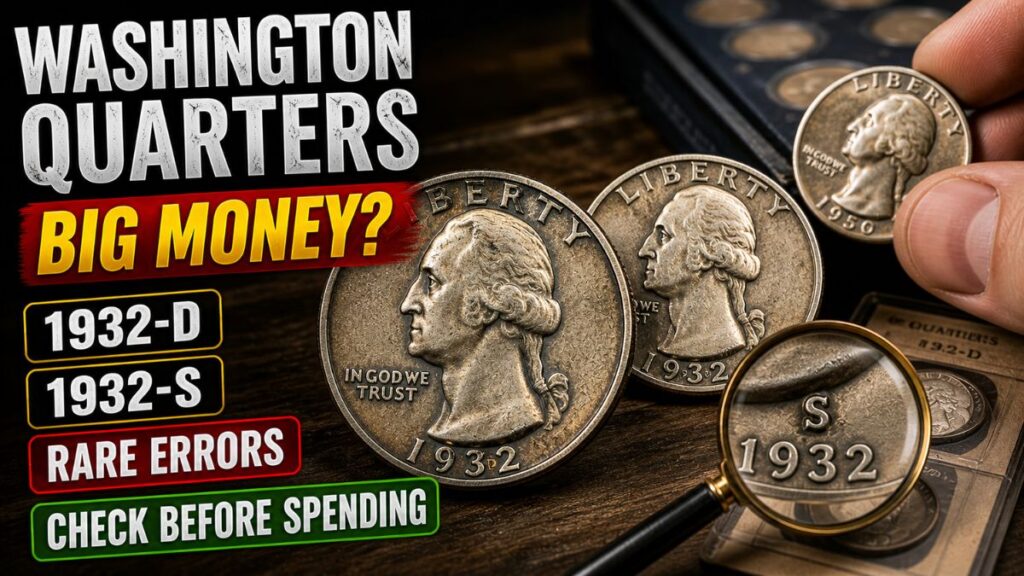
Finding a Washington quarter in your pocket, wallet, coin jar, or an old family collection may seem completely ordinary. After all, millions of quarters move through the United States every day. Most are worth exactly 25 cents, and many are used without anyone examining their dates or mintmarks.
However, some Washington quarters can be worth considerably more than their face value. Certain examples are desirable because of low production numbers, rare dates, unusual minting varieties, major errors, silver content, or exceptional condition. In the right circumstances, a small quarter can become an important collectible with a value reaching hundreds, thousands, or even much more.
The challenge is knowing what to look for. An old-looking quarter is not automatically rare, and a coin with an unusual mark is not necessarily valuable. Collectors must examine the date, mintmark, design details, condition, and authenticity before making any valuation decision.
Among the most important early Washington quarters are the 1932-D and 1932-S issues. The 1932-D had a reported mintage of only 436,800 coins, while the 1932-S had a mintage of approximately 408,000. These low production figures make both dates significant in the Washington quarter series.
A documented high-grade 1932-D example has reached $143,750 at auction, while a 1932-S example has a reported auction record of $52,800 in the PCGS auction database. These results belong to specific coins and should not be interpreted as the guaranteed value of every quarter from those years.
Modern quarters can also attract collector attention. The 2004-D Wisconsin quarter is famous for its Extra Leaf varieties, which involve unusual additional leaf details near the corn stalk on the reverse. Some high-grade examples have sold for thousands of dollars.
This guide explains the Washington quarters worth examining, why certain dates matter, how mintmarks influence value, what makes the Wisconsin Extra Leaf varieties interesting, and how to avoid mistakes when evaluating a potentially valuable coin.
Why Some Washington Quarters Are Worth More Than 25 Cents
The value of a Washington quarter depends on more than its age. Collectors consider several characteristics when deciding whether a coin deserves a premium.
The most important factors include rarity, demand, condition, mintmark, variety, composition, and authenticity. A coin that combines several desirable characteristics may be worth substantially more than an ordinary example.
For instance, a quarter with a low mintage may be scarce in high grades but relatively available in circulated condition. Another coin may have a common date but contain a rare doubled die or another recognized minting variety.
Condition is equally important. A heavily worn coin may have limited value, while a well-preserved example with sharp details and attractive surfaces may be highly desirable.
The market also matters. A coin is worth what informed buyers are willing to pay for a genuine example in a specific condition. An online asking price is not the same as a completed auction result.
This is why collectors should avoid relying on a single headline. A claim that a particular Washington quarter is worth thousands of dollars usually refers to a specific variety, grade, or authenticated specimen.
Understanding the Washington Quarter Series
The Washington quarter was introduced in 1932 to commemorate the 200th anniversary of George Washington’s birth. The design became an important part of American coinage and continued through multiple changes in composition, appearance, and production.
The early Washington quarters were made from a silver alloy. Later quarters were produced using copper-nickel clad compositions, while special issues and commemorative versions have used different materials.
The design has changed over time, but the Washington portrait remained a familiar feature on the obverse for decades. The reverse design also changed, particularly during the modern era when different national parks, historic locations, and other subjects appeared on circulating quarters.
Because the series spans many decades, collectors examine quarters from different periods for different reasons. Early silver issues may attract attention because of their age and composition. Modern quarters may be desirable because of errors, varieties, low production numbers, or collector demand.
The date alone is only the beginning of the examination. The mintmark and design characteristics must also be checked.
The Importance of the 1932-D Washington Quarter
The 1932-D Washington quarter is one of the most important early dates in the series. The Denver Mint reportedly produced only 436,800 examples, making this issue scarce compared with many other Washington quarters.
Low mintage is an important factor in coin collecting, but mintage figures do not tell the entire story. The number of surviving coins, the number available in different grades, and collector demand also influence rarity.
Many circulated examples may show significant wear from decades of use. The design details on Washington’s hair, cheek, and other raised areas may be softened. The reverse may also show wear around the eagle and surrounding lettering.
High-grade examples are particularly important because fewer coins survive with strong original details and attractive surfaces. Collectors seeking to complete a Washington quarter set may compete strongly for well-preserved 1932-D specimens.
A reported auction result of $143,750 for a high-grade 1932-D quarter demonstrates the potential of an exceptional example. However, this result should not be used to estimate every 1932-D quarter.
A circulated specimen, cleaned coin, damaged example, or coin with questionable authenticity could have a very different market value.
How to Identify a 1932-D Quarter
The first step is to locate the date on the obverse side of the coin. Confirm that the year is 1932.
Next, examine the mintmark. The letter D identifies the Denver Mint. The mintmark’s position and appearance should be checked carefully because damage or corrosion can make small details difficult to read.
A coin should not be identified only from a blurry photograph. Examine the date and mintmark together, and look at the overall design for signs of alteration.
Important details to inspect include:
- The complete 1932 date
- The D mintmark
- The shape of the lettering
- The surface around the mintmark
- Evidence of scratches or tooling
- Signs of cleaning or artificial treatment
- Overall wear and preservation
If the coin appears to be a genuine 1932-D quarter, handle it carefully and consider professional evaluation. A high-value coin should not be polished or cleaned before inspection.
The 1932-S Washington Quarter
The 1932-S Washington quarter is another important early issue. The San Francisco Mint reportedly produced approximately 408,000 examples, making it one of the key dates in the series.
Although the mintage is low, the value of a particular 1932-S quarter depends on its condition and authenticity. A circulated example may show considerable wear, while a high-grade specimen with strong details can be significantly more desirable.
The S mintmark identifies the San Francisco Mint. As with the 1932-D, collectors should verify the date and mintmark carefully.
The reported auction record of $52,800 for a 1932-S example demonstrates the demand for high-quality specimens. The result belongs to a specific coin and does not establish a fixed value for every 1932-S quarter.
Collectors should pay attention to the coin’s grade, surface quality, original appearance, and whether it has been professionally authenticated.
Comparing the 1932-D and 1932-S Quarters
Both the 1932-D and 1932-S Washington quarters are important early dates, but they should be evaluated individually.
The reported mintage of the 1932-D was 436,800, while the 1932-S had a reported mintage of approximately 408,000. These figures help explain why both issues are important to collectors.
However, the value difference between two coins depends on more than the mintage number. Grade, eye appeal, surface preservation, certification, and auction demand can strongly influence the result.
A circulated 1932-D may not be worth the same amount as a high-grade 1932-D. Similarly, an attractive 1932-S in a strong grade may command a premium compared with a heavily worn example.
The best approach is to identify the exact coin first and then compare it with similar authenticated examples.
Why High-Grade Quarters Can Reach Exceptional Prices
Condition plays a major role in the market for collectible Washington quarters. Coins that remain sharply detailed and free from serious damage are often more desirable than heavily worn examples.
Professional grading services assess coins using established standards. They consider circulation wear, marks, luster, strike quality, surface problems, and other characteristics.
A high-grade quarter may still contain small marks. A coin graded in the upper mint-state range is not necessarily perfect, but it has preserved a significant level of detail and surface quality.
The difference between grades can be important when a coin is already rare. A small improvement in condition may significantly reduce the number of comparable examples available to collectors.
However, owners should not assume that an uncirculated-looking coin automatically qualifies for a high grade. Cleaning, environmental damage, scratches, discoloration, and weak strikes can affect the evaluation.
Professional grading can provide a more reliable assessment than an informal opinion based on appearance alone.
The Role of Silver in Early Washington Quarters
Many early Washington quarters were made from silver. This composition gives them a different collecting background from later copper-nickel clad quarters.
Silver content can provide a base value connected to the precious metal market, but collectible value may be much higher for scarce dates, varieties, and well-preserved examples.
Collectors should not assume that every silver quarter is rare. Many silver Washington quarters were produced in large quantities and remain relatively available.
The date, mintmark, condition, and overall demand determine whether a silver quarter has only a modest premium or significant numismatic value.
Owners should also avoid damaging the surface in an attempt to reveal the metal. Scraping, polishing, or chemical testing can reduce collector appeal and may permanently harm the coin.
When a quarter appears to be an important early date, non-destructive examination is the safest choice.
Modern Washington Quarters Can Also Be Valuable
Valuable Washington quarters are not limited to the early 1930s. Modern issues can contain recognized varieties and errors that attract collectors.
One of the best-known examples is the 2004-D Wisconsin quarter with the Extra Leaf variety. This coin is part of the 50 State Quarters program and features a Wisconsin design on the reverse.
The Extra Leaf varieties involve unusual additional leaf details near the corn stalk. These characteristics are not simply ordinary wear. They are varieties that collectors study and identify based on specific design features.
The 2004-D mintmark indicates that the quarter was produced at the Denver Mint. The combination of date, mintmark, and reverse design is important when examining a possible example.
Not every 2004-D Wisconsin quarter contains an Extra Leaf variety. Most examples are ordinary coins. The specific placement, shape, and appearance of the additional leaf must be examined carefully.
Understanding the Wisconsin Extra Leaf Varieties
The Wisconsin quarter is famous for unusual leaf details near the corn stalk on the reverse. Collectors commonly discuss the Extra Leaf High and Extra Leaf Low varieties.
These varieties involve differences in the appearance and position of the additional leaf. Identifying them correctly requires close examination of the relevant area.
A beginner may notice a shape that appears to be an extra leaf, but shadows, scratches, die wear, and lighting can create confusion. The coin should be examined under consistent lighting and compared with confirmed examples.
The Extra Leaf varieties are collectible because they represent a recognized design difference associated with the minting process. They are not simply coins that became valuable because someone scratched an additional mark into the surface.
The value depends on the exact variety, grade, color and surface quality, authenticity, and collector demand. High-grade examples have attracted strong interest, and some have sold for thousands of dollars.
However, the presence of a suspected extra leaf does not automatically establish a specific price.
How to Inspect a 2004-D Wisconsin Quarter
Begin by confirming the year and mintmark. The coin should show the 2004 date and the D mintmark associated with the Denver Mint.
Turn the coin over and examine the Wisconsin design. Focus on the corn stalk and the area where the Extra Leaf varieties are found.
Use a magnifying glass or coin loupe if necessary. Avoid excessive magnification that may make ordinary scratches appear significant.
Look for a raised design feature that matches the recognized Extra Leaf characteristics. The shape should be evaluated in relation to the surrounding stalk and leaves.
A useful examination process includes:
- Confirming the 2004 date
- Confirming the D mintmark
- Inspecting the reverse design
- Locating the corn stalk
- Examining the additional leaf area
- Comparing the shape with established examples
- Checking for scratches or damage
- Avoiding cleaning or alteration
If the coin appears promising, have it evaluated by someone experienced with modern quarter varieties.
Why Not Every Extra-Looking Mark Is Valuable
Coins experience wear and damage throughout their lives. They may be dropped, scratched, rubbed against other coins, exposed to chemicals, or affected by environmental conditions.
A scratch near the corn stalk may look like an additional leaf, but damage does not create the same collectible value as a recognized minting variety.
The shape and structure of the feature are important. A genuine variety should show a consistent design characteristic rather than an irregular mark that cuts across the surface.
Machine damage, die deterioration, contact marks, and post-mint alterations can all cause confusion.
Collectors should avoid making a valuation decision based on a single photograph or a social media comparison. If the coin may be worth a significant amount, professional attribution is the safest approach.
Doubled Dies and Other Washington Quarter Varieties
Washington quarters can contain several types of varieties and minting errors. These may include doubled dies, repunched mintmarks on applicable issues, over-mintmark varieties, and other recognized production differences.
A doubled die occurs when the design is transferred to a die more than once in slightly different positions. The resulting coin may show a secondary design image on letters, numbers, or other features.
Machine doubling is different. It can produce a flattened or shelf-like appearance during striking and generally does not have the same collector premium as a major doubled die.
Collectors should learn to distinguish genuine varieties from ordinary minting effects. Not every doubling-like appearance is significant.
A recognized variety should be identified through specific characteristics rather than a general impression that the lettering looks unusual.
The date and mintmark remain important because some varieties occur only on particular issues.
What Makes a Mint Error Valuable?
Mint errors can attract attention when they are unusual, clearly identifiable, and supported by collector demand. However, not every minting error has substantial value.
The importance of an error depends on its type, rarity, visibility, condition, and whether it is recognized by specialists. A dramatic and rare error may command a strong premium, while a minor production imperfection may have limited interest.
Examples of minting abnormalities may include:
- Off-center strikes
- Broadstrikes
- Clipped planchets
- Die cracks
- Die clashes
- Doubled dies
- Missing design elements
- Struck-through errors
- Other recognized production mistakes
The market value of an error cannot be determined simply by how unusual it looks. Authentication and comparison with known examples are important.
A coin that has been damaged after leaving the mint should not be confused with a genuine mint error.
The Difference Between a Mint Error and Post-Mint Damage
A mint error occurs during the production of the coin. Post-mint damage happens after the coin has entered circulation or otherwise left the mint.
This distinction is crucial because post-mint damage is common. Coins may be scratched, bent, flattened, exposed to chemicals, or altered intentionally.
For example, a sharp mark on the reverse of a quarter may resemble an extra design element. However, if the mark cuts into the surface or has an irregular shape, it may be damage rather than a minting variety.
A genuine minting feature typically has characteristics connected to the manufacturing process. Specialists examine the shape, texture, location, and relationship of the feature to the rest of the design.
When a coin appears unusual, do not attempt to improve or modify the feature. Preserve the coin in its current condition and seek an informed evaluation.
How Mintmarks Affect Washington Quarter Value
Mintmarks identify the mint facility where a coin was produced. On Washington quarters, collectors commonly encounter mintmarks associated with Philadelphia, Denver, and San Francisco, depending on the issue and production period.
The presence or absence of a mintmark can be important. Certain dates are scarce specifically because of their mintmark and production quantity.
The 1932-D and 1932-S quarters are examples of early key dates where the mintmark helps distinguish the issue. The 2004-D Wisconsin quarter is another example in which the mintmark is part of the identification process.
Collectors should inspect the mintmark carefully but should not assume that every unusual mintmark is valuable. Damage, corrosion, and alteration can change its appearance.
A professional evaluation may be necessary if the mintmark appears manipulated or inconsistent with known examples.
Why Condition Matters for Modern Quarter Varieties
Modern quarters are often found in better condition than older coins because they have circulated for less time. Nevertheless, many modern coins have marks from production, transportation, storage, and everyday handling.
For varieties such as the Wisconsin Extra Leaf, condition can influence market value. A coin with sharp details, attractive surfaces, and minimal marks may be more desirable than a heavily circulated example.
The grade should be determined carefully. A coin that appears shiny may have been polished or chemically treated. Brightness does not automatically indicate a high grade.
Collectors should examine the surface under good lighting and avoid touching the coin unnecessarily. Original surfaces are important for both authentication and grading.
A professional grading service may be useful when a modern variety appears genuine and potentially valuable.
How to Estimate the Value of a Washington Quarter
Estimating the value of a Washington quarter requires several steps. The first is accurate identification.
Start with the date and mintmark. Then determine whether the coin belongs to a recognized variety or error category. Next, evaluate the condition and surface quality.
After identification, compare the coin with completed sales of similar examples. Ideally, the comparisons should involve the same variety, a similar grade, and a similar color or surface designation.
Important valuation factors include:
- Exact date
- Mintmark
- Variety or error
- Authenticity
- Grade
- Surface condition
- Original color
- Certification
- Provenance
- Market demand
Do not rely on a single online listing. A seller may ask for an amount that does not reflect actual buyer demand.
A completed auction result is more useful, but it must still be compared carefully with the coin being evaluated.
Why Auction Records Should Be Interpreted Carefully
Auction records provide useful evidence about what collectors have paid for specific coins. However, a record price is not a universal price for every example of the same date.
The reported $143,750 result for a high-grade 1932-D quarter and the reported $52,800 result for a 1932-S quarter apply to particular specimens. Their grades, surface quality, certification, and other characteristics influence the final prices.
Likewise, a high-grade Wisconsin Extra Leaf quarter that sold for thousands of dollars should not be used as the automatic value of every 2004-D Wisconsin quarter.
Auction prices may also change over time. Market conditions, the number of bidders, publicity, and the quality of the specimen can affect results.
The best method is to review several comparable sales and understand the differences between the coins.
Should You Get a Washington Quarter Professionally Graded?
Professional grading may be appropriate when a coin is rare, valuable, or difficult to authenticate. It is not necessary for every ordinary quarter.
For common coins, grading fees may exceed the coin’s potential market value. For a suspected 1932-D, 1932-S, or Wisconsin Extra Leaf variety, professional evaluation may be more useful.
Grading services examine authenticity, condition, and other characteristics. Some services also attribute recognized varieties and errors when the coin meets their requirements.
A professional holder can protect the coin and provide information about its grade. However, certification does not guarantee a specific selling price.
Before submitting a coin, consider the likely value, service fees, shipping, insurance, and turnaround time. An experienced dealer or numismatic specialist may help determine whether professional grading is appropriate.
Why You Should Never Clean a Potentially Valuable Quarter
Cleaning is one of the most damaging mistakes a collector can make. People sometimes believe that removing dirt or discoloration will improve a coin’s appearance, but cleaning can leave permanent scratches and unnatural surfaces.
Polishing may remove original metal and create an artificial shine. Chemical treatments can change the coin’s color or texture. These alterations may reduce collector interest and lead to a details designation during professional grading.
Silver and copper-based coins can both be damaged by improper cleaning. A potentially valuable quarter should be left in its original condition.
Avoid:
- Polishing
- Scrubbing
- Rubbing with a cloth
- Using chemical cleaners
- Scraping the design
- Applying oil
- Attempting to remove toning
- Testing the coin with destructive methods
If a quarter looks unusual, preserve it and have it examined professionally.
How to Handle and Store a Valuable Quarter
Handle coins by their edges whenever possible. Fingerprints contain oils and residues that may affect the surface over time.
Place the coin on a clean, soft surface during examination. Avoid dropping it onto hard tables or allowing it to slide across rough materials.
For storage, use a suitable coin holder made from inert materials. Avoid containers that contain chemicals or materials that may react with the metal.
Keep the coin away from moisture, extreme temperatures, and household cleaning products. Do not store a potentially valuable quarter loosely with other coins where it may become scratched.
If the coin is professionally encapsulated, avoid opening the holder unnecessarily. Proper storage helps preserve the condition that contributes to collector value.
Common Myths About Valuable Washington Quarters
Many online claims about valuable quarters are incomplete or misleading. One common myth is that every old quarter is worth hundreds or thousands of dollars.
Age alone does not establish rarity. Many old quarters were produced in large quantities and remain available to collectors.
Another myth is that every quarter with doubling is valuable. Machine doubling, die deterioration, and damage can create appearances that are not recognized major varieties.
Some people also believe that a coin must be shiny to be valuable. In reality, artificial shine may indicate cleaning or surface alteration.
Other common misconceptions include:
- Every 1932 quarter is rare
- Every 2004-D Wisconsin quarter has an Extra Leaf
- Any unusual mintmark guarantees a premium
- Online asking prices prove market value
- A coin’s face value determines its collector value
- A photograph can always establish authenticity
- Cleaning improves the value of an old coin
Accurate identification is more important than an exciting headline.
Where to Search for Washington Quarters
Washington quarters can be found in many everyday places, including coin jars, inherited collections, old envelopes, estate accumulations, and personal change.
Collectors may also examine rolls of quarters obtained from financial institutions. However, finding a major rarity is not guaranteed, and most coins will be common.
When searching, use a systematic method. Separate coins by date and mintmark, then examine the most relevant issues more closely.
Pay particular attention to early dates, unusual mintmarks, and recognized modern varieties. Keep potentially interesting coins separate from ordinary examples.
Do not rush through the process. Careful handling and accurate recordkeeping can prevent mistakes.
The purpose of searching should be education and discovery rather than an expectation that every group of quarters contains a valuable rarity.
How to Photograph a Potentially Valuable Quarter
Clear photographs can help with preliminary examination, although photographs cannot always establish authenticity.
Use even lighting and avoid strong reflections. Photograph both sides of the coin and include close-up images of important areas.
For an early key date, photograph the date, mintmark, and surrounding surface. For a Wisconsin quarter, include the full reverse and a close-up of the corn stalk and Extra Leaf area.
Avoid editing the image in a way that changes the appearance of the coin. Filters, excessive sharpening, and color adjustments can create misleading details.
Photographs should support a professional evaluation, not replace it. If a coin may be worth a substantial amount, physical examination is often necessary.
What to Do If You Find a 1932-D or 1932-S Quarter
If you discover a quarter that appears to be from 1932, handle it carefully and confirm the mintmark.
A D mintmark may indicate the 1932-D issue, while an S mintmark may indicate the 1932-S issue. Examine the date and mintmark without scraping or cleaning the surface.
Record where the coin was found if that information is available. If it came from an inherited collection, preserve any related documentation or storage materials.
Next, seek an evaluation from a qualified numismatic professional. A specialist can help determine whether the coin is genuine and assess its condition.
Do not accept an immediate offer without understanding the coin’s identity and potential market. If the coin is valuable, obtaining an independent opinion may be worthwhile.
What to Do If You Find a 2004-D Wisconsin Quarter
If you find a 2004-D Wisconsin quarter, inspect the reverse near the corn stalk. Look for the recognized Extra Leaf characteristics rather than assuming that every additional-looking mark is valuable.
Use a magnifying glass and good lighting. Compare the feature with established examples and check for signs of scratches or post-mint damage.
Do not attempt to make the feature clearer by scraping or polishing the coin. Alteration could destroy evidence and reduce its value.
If the coin appears to match an Extra Leaf variety, consider having it examined by a specialist. High-grade examples may attract stronger interest, but the exact value depends on authentication, grade, and market demand.
How to Avoid Being Misled by Coin Buyers
Most coin dealers operate professionally, but collectors should still approach high-value transactions carefully.
Be cautious when someone makes an immediate offer without examining the coin. A trustworthy buyer should be able to explain the identification and provide clear terms.
Before selling a rare-looking quarter, consider obtaining an independent opinion. Compare the proposed offer with documented sales of similar coins.
Ask about:
- The basis of the valuation
- Whether the coin will be authenticated
- Any fees or deductions
- Payment terms
- Return policies
- Insurance and shipping
- Whether the offer is final
Do not allow pressure to force a quick decision. A potentially valuable quarter deserves careful consideration.
Frequently Asked Questions About Valuable Washington Quarters
Which Washington Quarters Are Worth the Most Money?
Some of the most important examples include scarce early dates such as the 1932-D and 1932-S, along with recognized modern varieties such as the 2004-D Wisconsin Extra Leaf. Value depends on authenticity, grade, condition, and demand.
How Much Is a 1932-D Washington Quarter Worth?
The value depends on its condition and authenticity. A reported high-grade example reached $143,750 at auction, but circulated and damaged coins may be worth much less.
How Much Is a 1932-S Washington Quarter Worth?
A documented auction record of $52,800 has been reported for a 1932-S example. The value of another coin depends on its grade, surfaces, authenticity, and market conditions.
Why Are the 1932-D and 1932-S Important?
Both issues had low reported mintages. The 1932-D had approximately 436,800 coins produced, while the 1932-S had approximately 408,000.
Is Every 1932 Washington Quarter Valuable?
No. The mintmark and condition are important. The 1932-D and 1932-S are particularly significant, but identification and authentication are still necessary.
What Is the 2004-D Wisconsin Extra Leaf Quarter?
It is a recognized variety involving an additional leaf detail near the corn stalk on the reverse of certain 2004-D Wisconsin quarters.
Is Every 2004-D Wisconsin Quarter Rare?
No. Most 2004-D Wisconsin quarters are ordinary coins. Only specific recognized Extra Leaf varieties have the unusual design characteristics sought by collectors.
How Much Is a Wisconsin Extra Leaf Quarter Worth?
Some high-grade examples have sold for thousands of dollars. The value depends on the exact variety, condition, authenticity, and current collector demand.
Can Modern Washington Quarters Have Valuable Errors?
Yes. Modern quarters can contain recognized doubled dies, varieties, and other minting errors. However, not every unusual mark or imperfection is valuable.
How Do I Tell a Mint Error From Damage?
A mint error occurs during production, while damage happens after the coin leaves the mint. The shape, texture, location, and design characteristics should be examined carefully.
Should I Clean an Old Washington Quarter?
No. Cleaning can damage the original surface and reduce collector value. A potentially valuable coin should be left untouched.
Should I Have My Quarter Graded?
Professional grading may be worthwhile if the coin is rare, valuable, or difficult to authenticate. It may not be economical for common quarters.
Can a Photograph Prove That My Quarter Is Valuable?
A photograph can help with preliminary examination, but it cannot always establish authenticity or grade. A professional physical evaluation may be necessary.
Is an Auction Record a Guaranteed Price?
No. Auction records apply to specific coins sold under particular circumstances. Another example may sell for more or less depending on its condition and market demand.
What Should I Do Before Selling a Rare Quarter?
Confirm the date, mintmark, variety, authenticity, and condition. Consider an independent evaluation and compare the coin with documented sales of similar examples.
Final Thoughts on Washington Quarters Worth Big Money
Washington quarters remain popular among collectors because the series includes scarce early dates, silver issues, modern varieties, and unusual minting errors. While most quarters are worth only their face value, certain examples can command substantial premiums.
The 1932-D and 1932-S are two important dates to examine. Their reported low mintages of approximately 436,800 and 408,000 coins make them key issues in the early Washington quarter series. Documented auction results of $143,750 for a high-grade 1932-D and $52,800 for a 1932-S demonstrate the potential value of exceptional examples.
Modern collectors should also examine the 2004-D Wisconsin quarter for the Extra Leaf varieties. These unusual reverse details have attracted significant interest, particularly when found on high-grade examples.
Still, identification is essential. A common quarter should not be valued like a rare specimen simply because it has an old date, unusual mark, or apparent doubling. Condition, mintmark, recognized variety, authenticity, and market demand all influence the final value.
Before spending your next Washington quarter, take a moment to check the date and mintmark. If something looks unusual, do not clean, polish, scrape, or sell the coin in a hurry. Preserve its original condition and seek professional authentication when appropriate.
That ordinary-looking quarter in your pocket may be worth only 25 cents—or it may deserve a much closer look.