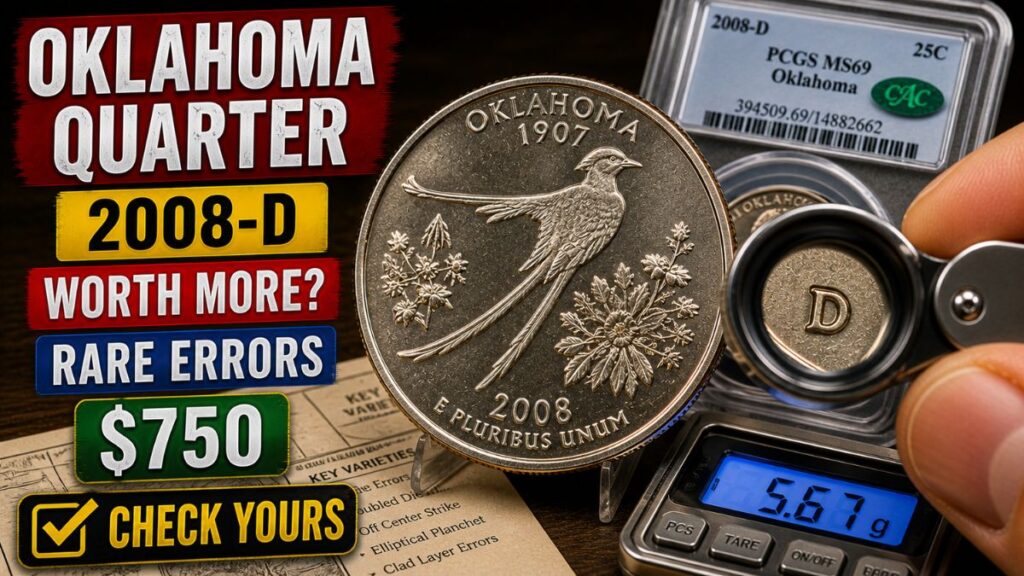
Finding a 2008 Oklahoma State Quarter in your pocket change may not seem exciting at first. After all, most examples are common coins worth approximately 25 cents in circulated condition. However, some Oklahoma quarters can attract additional collector interest when they possess exceptional grades, genuine mint errors, or other identifiable characteristics.
That does not mean every Oklahoma quarter is rare or valuable. The majority were produced in substantial quantities for everyday circulation. A coin’s date and state design alone are not enough to establish a premium value.
The real opportunity comes from learning how to identify the difference between an ordinary circulated quarter and a coin with a documented collectible feature.
The Oklahoma State Quarter was released in 2008 as the 46th issue in the United States 50 State Quarters Program. Its reverse design features the Scissortail Flycatcher flying above an Indian Blanket wildflower. The inscriptions include “OKLAHOMA” and “1907,” connecting the design to the state’s identity and history.
Collectors should begin by checking the date, mint mark, condition, and reverse design. The P mint mark identifies Philadelphia production, while D identifies Denver production. The 2008-P issue had a reported mintage of approximately 222 million, and the 2008-D issue had approximately 194.6 million.
These production numbers help explain why ordinary examples are not considered particularly scarce. Nevertheless, condition and unusual mint-made errors can change the collecting interest of an individual coin.
Documented auction records include $72 for a 2008-P Oklahoma quarter graded MS67 and $750 for a 2008-D example graded MS69. A 2008-D Oklahoma quarter struck on an elliptical planchet reportedly sold for $528.
These values apply to specific coins with particular characteristics. They should not be interpreted as guaranteed prices for every Oklahoma State Quarter.
This guide explains the coin’s history, design, mint marks, condition, documented values, possible errors, authentication process, storage methods, and common identification mistakes.
When Was the Oklahoma State Quarter Released?
The Oklahoma State Quarter was released in 2008 as part of the United States 50 State Quarters Program. It was the 46th coin issued in the series.
The program introduced circulating quarters representing each state. Every reverse design was intended to highlight a meaningful aspect of the state’s history, culture, geography, or identity.
Oklahoma’s design focuses on aviation and the state flower. The Scissortail Flycatcher appears in flight above the Indian Blanket wildflower. The design provides a recognizable feature that collectors can use to confirm that they are examining an Oklahoma issue.
Because the coin was made for circulation, large numbers entered the public through banks, businesses, vending machines, and everyday transactions. Many examples were also saved by collectors who wanted to complete the state quarter series.
The large production volume means that most Oklahoma quarters are not rare simply because they were released in 2008. Collectors must examine additional characteristics before deciding whether a coin deserves further attention.
Understanding the Oklahoma Quarter Reverse Design
The reverse of the Oklahoma State Quarter includes a Scissortail Flycatcher and an Indian Blanket wildflower. The bird is shown flying above the flower, creating a design that is different from many other state quarters.
The inscriptions “OKLAHOMA” and “1907” also appear on the reverse. The year 1907 is associated with Oklahoma’s admission to the Union.
Understanding the normal design is important because it allows collectors to identify unusual features. If a part of the bird, flower, lettering, or state outline appears distorted, the collector can compare it with a normal example.
However, a difference in appearance does not automatically indicate a mint error. Lighting, wear, scratches, die deterioration, and damage can change the way a design looks.
The first goal should be to understand what a normal Oklahoma quarter looks like. Only then can a collector begin assessing whether an unusual feature may have occurred during production.
Why Most 2008 Oklahoma Quarters Are Common
The 2008 Oklahoma State Quarter was produced in large quantities. The reported mintage was approximately 222 million for the Philadelphia issue and 194.6 million for the Denver issue.
These numbers indicate that ordinary examples were distributed widely. A coin produced in such quantities is generally not considered rare unless a specific variety, error, or condition rarity is involved.
Circulated quarters often show scratches, contact marks, surface wear, and discoloration. These characteristics are normal results of everyday use and usually do not create a significant premium.
A common circulated Oklahoma quarter will generally be worth around its face value of 25 cents. Its value may be slightly different in certain collecting situations, but large premiums should not be expected without a specific reason.
The important point is that scarcity is not determined by age alone. A 2008 quarter is older than a newly issued coin, but it is still relatively common in the collecting market.
Checking the Date on an Oklahoma State Quarter
The date is the first detail collectors should verify. The Oklahoma State Quarter was issued in 2008, so the year should appear clearly on the coin.
A date that is difficult to read may be the result of wear, dirt, corrosion, or damage. Do not assume that an unclear date represents a rare mint error.
Use a magnifying glass if necessary, but avoid rubbing the surface. Cleaning or polishing can damage the coin and reduce its collectible appeal.
Once the date is confirmed, examine the mint mark. The combination of date and mint mark helps determine which issue you have and allows you to compare it with documented varieties or auction records.
A useful first inspection includes:
- Confirming the 2008 date.
- Identifying the P or D mint mark.
- Checking both sides of the coin.
- Examining the reverse design.
- Looking for unusual striking characteristics.
- Evaluating the coin’s condition.
- Avoiding any cleaning or alteration.
Basic identification prevents collectors from comparing their coin with the wrong issue.
Understanding the P and D Mint Marks
The mint mark identifies the facility where a coin was produced. On the Oklahoma State Quarter, collectors commonly encounter P and D mint marks.
The P mint mark represents Philadelphia, while the D mint mark represents Denver.
A mint mark is useful when researching a coin, but it does not automatically make the quarter rare. Both the 2008-P and 2008-D Oklahoma quarters were produced in substantial quantities.
The reported mintage figures are approximately:
- 2008-P: 222 million.
- 2008-D: 194.6 million.
These figures help explain why normal examples are widely available. However, a specific mint-marked issue may still be important when connected to a documented doubled die, mint error, or exceptional grade.
Collectors should inspect the mint mark carefully. Damage or wear can distort its appearance, and a strange-looking letter is not automatically evidence of an error.
Why Condition Matters So Much
Condition is one of the most important factors affecting the value of a coin. Two Oklahoma quarters with the same date and mint mark may have very different market values if their preservation levels are different.
A circulated coin usually has wear on the highest parts of the design. It may also have scratches, contact marks, dull surfaces, and other signs of handling.
An uncirculated coin has not experienced normal circulation, but it can still contain marks from production, transportation, storage, or packaging.
Professional grading evaluates multiple characteristics, including:
- Surface preservation.
- Luster.
- Strike quality.
- Contact marks.
- Wear.
- Overall appearance.
A coin that looks bright or attractive to the naked eye is not automatically a high-grade example. Small imperfections may affect its official grade.
This distinction is important when examining documented auction records. A certified MS67 or MS69 coin is a specific condition example and should not be compared directly with a worn quarter found in pocket change.
What Does MS67 Mean?
MS stands for Mint State. The term is used for coins that show no evidence of normal circulation.
The number indicates the coin’s position on the grading scale. MS67 is a very high grade and generally requires strong preservation with limited imperfections.
A coin can be uncirculated but still receive a grade below MS67 because of contact marks, weak strike details, surface issues, or other characteristics.
Collectors should not assume that every coin removed from a roll will receive an exceptionally high grade. Even coins that have never circulated can have production marks or handling damage.
The $72 documented auction record for a 2008-P Oklahoma quarter graded MS67 applies to a specific certified example. It does not establish the value of every uncirculated 2008-P quarter.
What Does MS69 Mean?
MS69 is an exceptionally high Mint State grade. Coins at this level have outstanding preservation and very few imperfections within the grading standards.
The documented $750 auction record for a 2008-D Oklahoma quarter graded MS69 reflects the importance of exceptional condition.
An MS69 example is not representative of the average Oklahoma quarter found in circulation. Most circulated coins will have wear and contact marks that prevent them from reaching such a grade.
Even among uncirculated coins, MS69 examples may be uncommon. A small difference in surface preservation can affect the final grade and market interest.
Collectors should not assign an MS69 value to an ungraded coin based only on its appearance. An official grade requires professional evaluation.
Documented Value of a 2008-P Oklahoma Quarter
A 2008-P Oklahoma State Quarter graded MS67 has a reported documented auction record of $72.
This result shows that a common state quarter can sometimes bring more than face value when it is preserved in an exceptional condition.
The record applies to a specific coin. It does not mean that every 2008-P Oklahoma quarter is worth $72.
A circulated quarter with scratches and wear will not be comparable to an MS67 example. Even an uncirculated coin may be worth less if it has lower-grade surfaces or weaker eye appeal.
When comparing your coin with the documented result, examine:
- The mint mark.
- The coin’s preservation.
- The presence of wear.
- Contact marks on the surface.
- Luster and strike quality.
- Whether the coin has been professionally certified.
Historical auction records are useful for understanding the market, but they should not be treated as guaranteed selling prices.
Documented Value of a 2008-D MS69 Oklahoma Quarter
A 2008-D Oklahoma State Quarter graded MS69 has a reported auction record of $750.
This is a substantial premium over face value, but it applies to an exceptionally high-grade certified example.
The grade is critical. A normal circulated 2008-D Oklahoma quarter is not comparable to an MS69 coin. A coin may look clean and shiny but still contain marks that prevent it from receiving such a high grade.
The market value of a high-grade coin can also depend on collector demand, certification, availability, and the circumstances of the sale.
Collectors should use the $750 result as a reference for a particular certified condition example rather than as a general estimate for every 2008-D quarter.
Understanding the $528 Elliptical-Planchet Error
A reported 2008-D Oklahoma State Quarter struck on an elliptical planchet sold for $528.
An elliptical planchet error involves an unusual shape of the coin blank used during striking. The planchet is not normally round, and the resulting coin may display an elongated or distorted outline.
This type of error is different from a quarter that was bent or damaged after leaving the mint. Establishing whether the unusual shape originated during production is essential.
Collectors should not assume that every oval-shaped or misshapen quarter is a genuine elliptical-planchet error. Coins can be altered by pressure, machinery, heat, or other post-mint events.
A genuine error should be examined through its shape, edge, design, metal characteristics, and other physical evidence. Professional authentication is recommended when the coin appears significant.
The $528 sale applies to a specific error coin. It should not be used as a fixed value for every unusual-looking Oklahoma quarter.
What Is an Elliptical-Planchet Error?
A planchet is the prepared metal blank used to strike a coin. Before striking, it is normally shaped and prepared to meet the requirements of the denomination.
An elliptical-planchet error occurs when the blank has an abnormal elliptical shape rather than the expected round form. The striking process can transfer the design onto this unusual blank.
The final appearance may include a stretched outline, unusual edge proportions, or a design that does not fit the planchet in the normal way.
The exact characteristics can vary. A collector should evaluate the entire coin instead of focusing only on its shape.
Important questions include:
- Does the shape appear to be mint-made?
- Is the edge consistent with an unusual planchet?
- Does the design show evidence of being struck on the abnormal blank?
- Is the coin damaged or altered after production?
- Can the feature be confirmed by a professional?
An unusual shape may be interesting, but authentication is necessary before assigning a premium value.
Other Possible Oklahoma Quarter Mint Errors
Collectors may encounter claims involving missing clad layers, off-center strikes, broadstrikes, and other mint errors on state quarters.
These errors can be collectible when they are genuine and sufficiently significant. However, not every unusual mark represents a mint-made error.
A missing clad layer may affect the coin’s color and surface. An off-center strike may shift the design toward one side. A broadstrike may affect the shape and rim because of a striking issue.
The value depends on the specific error, its severity, authenticity, condition, and collector demand.
Collectors should avoid making assumptions based on color, shape, or a single photograph. Each potential error requires careful examination.
Examining a Possible Off-Center Strike
An off-center strike occurs when the planchet is not properly aligned during the striking process. As a result, the design may be shifted toward one side of the coin.
The degree of displacement is important. A slight shift may have limited collector interest, while a dramatic off-center strike can be more desirable.
The visibility of the date is also significant. If the date remains visible, identification is easier. If the date is missing, determining the exact issue may be more difficult.
Damage can create a similar appearance. A quarter may become bent, squeezed, or distorted after leaving the mint.
Collectors should inspect the rim, design, and overall shape together. Clear photographs of both sides and the edge can help a specialist assess the coin.
Investigating a Possible Missing Clad Layer
Modern quarters use layered metal construction. A missing clad layer occurs when an outer layer is absent from part of the coin.
Such an error can create an unusual color or surface appearance. However, a different color alone is not enough to prove that a clad layer is missing.
Environmental exposure, chemicals, abrasion, and damage can also change the color of a coin.
Collectors should not scrape the surface or attempt to remove material. Doing so can destroy evidence and reduce the coin’s value.
A professional may evaluate the coin’s weight, surface, edge, and physical structure to determine whether the appearance is consistent with a mint-made error.
The potential value of a missing-clad-layer error depends on its authenticity, size, appearance, and condition.
Doubled Dies and Machine Doubling
Doubled dies are another area of interest for collectors. A genuine doubled die results from a duplicated or misaligned design impression during die production.
The doubling may appear in letters, numbers, or other design elements. Its location and shape are important when comparing a coin with a recognized variety.
Machine doubling is different. It can occur when movement during striking creates a flat or shelf-like appearance. This effect may look like doubling but does not necessarily represent a valuable doubled-die variety.
Other causes of apparent doubling include:
- Die deterioration.
- Scratches.
- Surface damage.
- Wear.
- Poor lighting.
- Photography distortion.
A coin should not be identified as a genuine doubled die simply because a letter looks thick or doubled.
Collectors should compare the suspected feature with documented variety information and seek professional advice when necessary.
How to Inspect Your Oklahoma Quarter
A careful inspection can help determine whether an Oklahoma quarter deserves additional research.
Begin in a clean workspace with good lighting. Use a soft surface so the coin is not damaged if it falls.
Examine the obverse and reverse slowly. Confirm the date and mint mark before inspecting other details.
Check Washington’s portrait, lettering, and date for possible abnormalities. Then examine the reverse design, including the bird, flower, inscriptions, and state outline.
Look for signs of major production errors, such as:
- A clearly displaced design.
- An unusual planchet shape.
- Significant missing metal.
- A major off-center strike.
- A recognizable doubled-die characteristic.
- An abnormal edge.
Avoid using sharp tools, chemicals, or abrasive materials. Do not scrape a suspected error to make it more visible.
If something appears unusual, take clear photographs and compare the coin with normal examples.
Using a Magnifying Glass
A magnifying glass can be useful for examining lettering, dates, mint marks, and small design details.
It can help reveal whether a suspected feature is raised, flat, scratched, or connected to the surrounding surface.
However, magnification does not prove that a coin is rare. It may make ordinary damage appear more dramatic.
Use the magnifying glass alongside good lighting and comparison images. Examine the same feature from different angles rather than relying on one view.
A microscope or high-powered lens may be useful for specialists, but excessive magnification can also make minor surface imperfections appear important.
The goal is to identify a meaningful characteristic, not to find something unusual in every part of the coin.
Why Weight Can Help but Cannot Prove an Error
Weight can be useful as an initial screening tool. If a coin weighs differently from the expected standard, it may deserve further examination.
However, weight differences can result from wear, dirt, manufacturing tolerances, damage, or inaccurate equipment.
Weight alone cannot confirm an elliptical planchet, missing clad layer, or another mint error. The coin’s shape, surface, edge, and design must also be evaluated.
If you weigh the coin, use a reliable digital scale and record the result. Do not alter the coin during testing.
Professional evaluators may use weight as one part of a complete examination, but it is rarely sufficient by itself to establish authenticity.
Mint Errors Versus Post-Mint Damage
One of the most important skills in coin collecting is distinguishing mint-made errors from damage that happened later.
Coins circulate through machines, cash registers, vending systems, pockets, and coin-counting equipment. These environments can produce scratches, dents, bends, and other marks.
Post-mint damage may include:
- Scraped surfaces.
- Flattened rims.
- Bent planchets.
- Chemical discoloration.
- Heat damage.
- Filing.
- Pressure marks.
- Abrasion.
A genuine mint error must originate during production. Its physical characteristics should be consistent with a problem involving the planchet, die, striking process, or another mint operation.
If a quarter appears unusual, do not immediately assume it is valuable. Compare the feature with known examples and seek expert examination when appropriate.
Why You Should Never Clean an Unusual Quarter
Cleaning can permanently damage a coin. Although polishing may make the surface look brighter, it can create scratches, unnatural shine, or chemical damage.
Collectors should avoid:
- Metal polish.
- Vinegar or acidic solutions.
- Abrasive cloths.
- Brushes.
- Scraping tools.
- Chemical cleaners.
- Rubbing the surface.
Cleaning may also remove evidence that helps determine whether an error is genuine.
If you suspect that an Oklahoma quarter has a valuable characteristic, preserve it in its current condition. Handle it by the edges and place it in a suitable holder.
A coin’s original surface is often more important than its brightness.
When Should You Seek Professional Authentication?
Professional authentication is useful when a coin appears to have a major mint error, a documented variety, or exceptional condition.
A qualified service can evaluate whether the coin is genuine and whether the suspected feature is consistent with a recognized error.
Authentication is especially important when the potential value is substantial. Counterfeit, altered, or damaged coins can sometimes appear unusual in photographs.
Professional grading may also be appropriate for an exceptionally well-preserved coin. However, grading and authentication involve costs, so collectors should consider the potential value before submitting.
A common circulated quarter usually does not justify expensive grading. A coin with a credible major error or exceptional preservation may be a more reasonable candidate.
How to Store Your Oklahoma State Quarter
Proper storage helps protect the coin from scratches, moisture, chemicals, and unnecessary handling.
Use a holder designed for coin storage. Avoid containers that may contain harmful materials or deteriorate over time.
Do not store a potentially valuable coin loosely with other coins. Contact between metal surfaces can create scratches and abrasions.
Handle the coin by its edges. Fingerprints and oils can affect the surface, particularly on high-grade examples.
Keep the coin in a dry, stable environment. Avoid extreme humidity and unnecessary temperature changes.
If the coin is professionally certified, keep it inside its original holder unless an expert recommends another approach.
Good storage does not make a common coin rare, but it can help preserve a coin that already has collectible potential.
How to Compare Auction Records Correctly
Auction records should be used carefully. A documented sale applies to a specific coin, not every coin of the same date.
Before comparing your Oklahoma quarter with a reported value, examine the following details:
- Date.
- Mint mark.
- Grade.
- Certification.
- Error or variety.
- Surface condition.
- Strike quality.
- Sale circumstances.
A 2008-D MS69 quarter should not be compared with a circulated 2008-D coin. Likewise, an elliptical-planchet error should not be compared with an ordinary quarter simply because both carry the same date.
Auction results may change over time because of market demand and the availability of similar examples.
The difference between an asking price and a completed sale is also important. A seller can list a coin for a high amount without finding a buyer willing to pay that price.
Realized auction results are more useful than unsupported online claims, but they still must be interpreted in context.
Common Mistakes Made by New Collectors
Many beginners make similar mistakes when searching for valuable state quarters.
The first is assuming that every coin from 2008 is rare because it is older than modern currency. Age alone does not establish scarcity.
Another mistake is believing that every unusual color represents a mint error. Chemical exposure and damage can change a coin’s appearance.
Some collectors confuse machine doubling with genuine doubled dies. The two features are produced differently and must be carefully distinguished.
Other beginners compare their circulated coins with high-grade auction records. This can create unrealistic expectations because condition strongly influences value.
Cleaning is another common mistake. A coin that has been polished may lose collector appeal even if it originally had an attractive surface.
Finally, collectors may trust social media claims without checking the exact date, mint mark, grade, or error description.
Careful identification is more reliable than dramatic headlines.
Can a Circulated Oklahoma Quarter Be Valuable?
Yes, a circulated Oklahoma quarter can be valuable if it contains a genuine and desirable mint error or variety.
However, most circulated examples are worth approximately 25 cents. Wear and contact marks generally reduce the possibility of a premium for condition alone.
A major mint error may still attract collector interest even when the coin has circulated. The value depends on the error’s authenticity, rarity, visibility, and demand.
Collectors should not use the $72, $750, or $528 records as automatic values for circulated coins. Each record concerns a particular example with specific characteristics.
If your circulated quarter shows an unusual mint-made feature, preserve it and seek an informed evaluation.
Is Every 2008-D Oklahoma Quarter Worth $750?
No. A specific 2008-D Oklahoma quarter graded MS69 reached a reported auction record of $750.
The record applies to an exceptionally high-grade certified coin. Most circulated 2008-D quarters are common and worth close to face value.
Even uncirculated examples may not reach MS69. Surface marks, weak strikes, and other imperfections can affect the grade.
An official grading service would be needed to determine whether a coin meets the MS69 standard.
Is a 2008-P Oklahoma Quarter Worth $72?
A 2008-P Oklahoma quarter graded MS67 has a reported auction record of $72.
This value applies to a specific certified example. It should not be treated as a fixed price for every 2008-P Oklahoma quarter.
Most circulated coins will be worth around 25 cents. The condition, surface quality, and certification status must be considered when making comparisons.
What Is the Elliptical-Planchet Error Worth?
A reported 2008-D Oklahoma quarter struck on an elliptical planchet sold for $528.
The amount applies to a specific documented error coin. Another example may have a different value depending on authenticity, shape, condition, visibility, and market demand.
A coin with an unusual shape should be professionally examined before it is assigned a premium value.
Should I Grade an Ordinary Oklahoma Quarter?
Usually, an ordinary circulated Oklahoma quarter is not a practical candidate for professional grading because the grading costs may exceed its value.
Grading may be more appropriate for a coin with a credible major error, a recognized variety, or exceptional uncirculated condition.
Collectors should research submission fees and compare similar certified coins before making a decision.
How Can I Tell Whether My Coin Has a Mint Error?
Start by examining the date, mint mark, design, edge, and surface. Compare the unusual characteristic with documented examples.
Do not rely on color or a single photograph. Damage can resemble a mint error.
If the feature appears significant, professional authentication is the safest way to obtain a more reliable identification.
Can Cleaning Reduce the Value of an Oklahoma Quarter?
Yes. Cleaning can create scratches, chemical damage, and unnatural surfaces. It may reduce the coin’s collectible value and interfere with professional grading.
Leave an unusual coin in its original condition and store it safely.
Are Oklahoma State Quarters Made of Silver?
Ordinary 2008 Oklahoma State Quarters are modern circulating quarters and should not be assumed to contain the silver composition used in older U.S. quarters.
Their potential collectible value generally comes from condition, varieties, or mint errors rather than silver content.
What Should I Do If My Oklahoma Quarter Looks Unusual?
Do not clean, scrape, bend, or polish it. Photograph both sides and the edge, record the date and mint mark, and compare the feature with reliable examples.
If the coin appears to have a significant mint error or exceptional grade, consider professional authentication.
Final Thoughts on the 2008 Oklahoma State Quarter
The 2008 Oklahoma State Quarter is common in circulated condition, with most examples worth approximately 25 cents. Its large reported mintages of around 222 million for the Philadelphia issue and 194.6 million for the Denver issue explain why ordinary pieces are widely available.
Nevertheless, individual coins can attract additional interest because of exceptional preservation or genuine mint errors.
Reported documented values include $72 for a 2008-P MS67 example, $750 for a 2008-D MS69 coin, and $528 for a 2008-D quarter struck on an elliptical planchet. These amounts relate to specific coins and should not be applied to every Oklahoma quarter.
The most important identification steps are straightforward. Confirm the 2008 date, check the P or D mint mark, study the Scissortail Flycatcher and Indian Blanket design, inspect the obverse lettering, and look for genuine mint-made abnormalities.
Always distinguish damage from authentic errors, and never clean a coin that may have collectible value. If a quarter appears unusual, preserve it carefully and seek professional authentication.
A careful inspection may reveal nothing more than an ordinary 25-cent coin, but it can also help identify a coin deserving further research. The key is to rely on physical evidence, documented examples, and realistic valuation rather than exaggerated claims.
Finding a 2008 Oklahoma State Quarter in your pocket change may not seem exciting at first. After all, most examples are common coins worth approximately 25 cents in circulated condition. However, some Oklahoma quarters can attract additional collector interest when they possess exceptional grades, genuine mint errors, or other identifiable characteristics.
That does not mean every Oklahoma quarter is rare or valuable. The majority were produced in substantial quantities for everyday circulation. A coin’s date and state design alone are not enough to establish a premium value.
The real opportunity comes from learning how to identify the difference between an ordinary circulated quarter and a coin with a documented collectible feature.
The Oklahoma State Quarter was released in 2008 as the 46th issue in the United States 50 State Quarters Program. Its reverse design features the Scissortail Flycatcher flying above an Indian Blanket wildflower. The inscriptions include “OKLAHOMA” and “1907,” connecting the design to the state’s identity and history.
Collectors should begin by checking the date, mint mark, condition, and reverse design. The P mint mark identifies Philadelphia production, while D identifies Denver production. The 2008-P issue had a reported mintage of approximately 222 million, and the 2008-D issue had approximately 194.6 million.
These production numbers help explain why ordinary examples are not considered particularly scarce. Nevertheless, condition and unusual mint-made errors can change the collecting interest of an individual coin.
Documented auction records include $72 for a 2008-P Oklahoma quarter graded MS67 and $750 for a 2008-D example graded MS69. A 2008-D Oklahoma quarter struck on an elliptical planchet reportedly sold for $528.
These values apply to specific coins with particular characteristics. They should not be interpreted as guaranteed prices for every Oklahoma State Quarter.
This guide explains the coin’s history, design, mint marks, condition, documented values, possible errors, authentication process, storage methods, and common identification mistakes.
When Was the Oklahoma State Quarter Released?
The Oklahoma State Quarter was released in 2008 as part of the United States 50 State Quarters Program. It was the 46th coin issued in the series.
The program introduced circulating quarters representing each state. Every reverse design was intended to highlight a meaningful aspect of the state’s history, culture, geography, or identity.
Oklahoma’s design focuses on aviation and the state flower. The Scissortail Flycatcher appears in flight above the Indian Blanket wildflower. The design provides a recognizable feature that collectors can use to confirm that they are examining an Oklahoma issue.
Because the coin was made for circulation, large numbers entered the public through banks, businesses, vending machines, and everyday transactions. Many examples were also saved by collectors who wanted to complete the state quarter series.
The large production volume means that most Oklahoma quarters are not rare simply because they were released in 2008. Collectors must examine additional characteristics before deciding whether a coin deserves further attention.
Understanding the Oklahoma Quarter Reverse Design
The reverse of the Oklahoma State Quarter includes a Scissortail Flycatcher and an Indian Blanket wildflower. The bird is shown flying above the flower, creating a design that is different from many other state quarters.
The inscriptions “OKLAHOMA” and “1907” also appear on the reverse. The year 1907 is associated with Oklahoma’s admission to the Union.
Understanding the normal design is important because it allows collectors to identify unusual features. If a part of the bird, flower, lettering, or state outline appears distorted, the collector can compare it with a normal example.
However, a difference in appearance does not automatically indicate a mint error. Lighting, wear, scratches, die deterioration, and damage can change the way a design looks.
The first goal should be to understand what a normal Oklahoma quarter looks like. Only then can a collector begin assessing whether an unusual feature may have occurred during production.
Why Most 2008 Oklahoma Quarters Are Common
The 2008 Oklahoma State Quarter was produced in large quantities. The reported mintage was approximately 222 million for the Philadelphia issue and 194.6 million for the Denver issue.
These numbers indicate that ordinary examples were distributed widely. A coin produced in such quantities is generally not considered rare unless a specific variety, error, or condition rarity is involved.
Circulated quarters often show scratches, contact marks, surface wear, and discoloration. These characteristics are normal results of everyday use and usually do not create a significant premium.
A common circulated Oklahoma quarter will generally be worth around its face value of 25 cents. Its value may be slightly different in certain collecting situations, but large premiums should not be expected without a specific reason.
The important point is that scarcity is not determined by age alone. A 2008 quarter is older than a newly issued coin, but it is still relatively common in the collecting market.
Checking the Date on an Oklahoma State Quarter
The date is the first detail collectors should verify. The Oklahoma State Quarter was issued in 2008, so the year should appear clearly on the coin.
A date that is difficult to read may be the result of wear, dirt, corrosion, or damage. Do not assume that an unclear date represents a rare mint error.
Use a magnifying glass if necessary, but avoid rubbing the surface. Cleaning or polishing can damage the coin and reduce its collectible appeal.
Once the date is confirmed, examine the mint mark. The combination of date and mint mark helps determine which issue you have and allows you to compare it with documented varieties or auction records.
A useful first inspection includes:
- Confirming the 2008 date.
- Identifying the P or D mint mark.
- Checking both sides of the coin.
- Examining the reverse design.
- Looking for unusual striking characteristics.
- Evaluating the coin’s condition.
- Avoiding any cleaning or alteration.
Basic identification prevents collectors from comparing their coin with the wrong issue.
Understanding the P and D Mint Marks
The mint mark identifies the facility where a coin was produced. On the Oklahoma State Quarter, collectors commonly encounter P and D mint marks.
The P mint mark represents Philadelphia, while the D mint mark represents Denver.
A mint mark is useful when researching a coin, but it does not automatically make the quarter rare. Both the 2008-P and 2008-D Oklahoma quarters were produced in substantial quantities.
The reported mintage figures are approximately:
- 2008-P: 222 million.
- 2008-D: 194.6 million.
These figures help explain why normal examples are widely available. However, a specific mint-marked issue may still be important when connected to a documented doubled die, mint error, or exceptional grade.
Collectors should inspect the mint mark carefully. Damage or wear can distort its appearance, and a strange-looking letter is not automatically evidence of an error.
Why Condition Matters So Much
Condition is one of the most important factors affecting the value of a coin. Two Oklahoma quarters with the same date and mint mark may have very different market values if their preservation levels are different.
A circulated coin usually has wear on the highest parts of the design. It may also have scratches, contact marks, dull surfaces, and other signs of handling.
An uncirculated coin has not experienced normal circulation, but it can still contain marks from production, transportation, storage, or packaging.
Professional grading evaluates multiple characteristics, including:
- Surface preservation.
- Luster.
- Strike quality.
- Contact marks.
- Wear.
- Overall appearance.
A coin that looks bright or attractive to the naked eye is not automatically a high-grade example. Small imperfections may affect its official grade.
This distinction is important when examining documented auction records. A certified MS67 or MS69 coin is a specific condition example and should not be compared directly with a worn quarter found in pocket change.
What Does MS67 Mean?
MS stands for Mint State. The term is used for coins that show no evidence of normal circulation.
The number indicates the coin’s position on the grading scale. MS67 is a very high grade and generally requires strong preservation with limited imperfections.
A coin can be uncirculated but still receive a grade below MS67 because of contact marks, weak strike details, surface issues, or other characteristics.
Collectors should not assume that every coin removed from a roll will receive an exceptionally high grade. Even coins that have never circulated can have production marks or handling damage.
The $72 documented auction record for a 2008-P Oklahoma quarter graded MS67 applies to a specific certified example. It does not establish the value of every uncirculated 2008-P quarter.
What Does MS69 Mean?
MS69 is an exceptionally high Mint State grade. Coins at this level have outstanding preservation and very few imperfections within the grading standards.
The documented $750 auction record for a 2008-D Oklahoma quarter graded MS69 reflects the importance of exceptional condition.
An MS69 example is not representative of the average Oklahoma quarter found in circulation. Most circulated coins will have wear and contact marks that prevent them from reaching such a grade.
Even among uncirculated coins, MS69 examples may be uncommon. A small difference in surface preservation can affect the final grade and market interest.
Collectors should not assign an MS69 value to an ungraded coin based only on its appearance. An official grade requires professional evaluation.
Documented Value of a 2008-P Oklahoma Quarter
A 2008-P Oklahoma State Quarter graded MS67 has a reported documented auction record of $72.
This result shows that a common state quarter can sometimes bring more than face value when it is preserved in an exceptional condition.
The record applies to a specific coin. It does not mean that every 2008-P Oklahoma quarter is worth $72.
A circulated quarter with scratches and wear will not be comparable to an MS67 example. Even an uncirculated coin may be worth less if it has lower-grade surfaces or weaker eye appeal.
When comparing your coin with the documented result, examine:
- The mint mark.
- The coin’s preservation.
- The presence of wear.
- Contact marks on the surface.
- Luster and strike quality.
- Whether the coin has been professionally certified.
Historical auction records are useful for understanding the market, but they should not be treated as guaranteed selling prices.
Documented Value of a 2008-D MS69 Oklahoma Quarter
A 2008-D Oklahoma State Quarter graded MS69 has a reported auction record of $750.
This is a substantial premium over face value, but it applies to an exceptionally high-grade certified example.
The grade is critical. A normal circulated 2008-D Oklahoma quarter is not comparable to an MS69 coin. A coin may look clean and shiny but still contain marks that prevent it from receiving such a high grade.
The market value of a high-grade coin can also depend on collector demand, certification, availability, and the circumstances of the sale.
Collectors should use the $750 result as a reference for a particular certified condition example rather than as a general estimate for every 2008-D quarter.
Understanding the $528 Elliptical-Planchet Error
A reported 2008-D Oklahoma State Quarter struck on an elliptical planchet sold for $528.
An elliptical planchet error involves an unusual shape of the coin blank used during striking. The planchet is not normally round, and the resulting coin may display an elongated or distorted outline.
This type of error is different from a quarter that was bent or damaged after leaving the mint. Establishing whether the unusual shape originated during production is essential.
Collectors should not assume that every oval-shaped or misshapen quarter is a genuine elliptical-planchet error. Coins can be altered by pressure, machinery, heat, or other post-mint events.
A genuine error should be examined through its shape, edge, design, metal characteristics, and other physical evidence. Professional authentication is recommended when the coin appears significant.
The $528 sale applies to a specific error coin. It should not be used as a fixed value for every unusual-looking Oklahoma quarter.
What Is an Elliptical-Planchet Error?
A planchet is the prepared metal blank used to strike a coin. Before striking, it is normally shaped and prepared to meet the requirements of the denomination.
An elliptical-planchet error occurs when the blank has an abnormal elliptical shape rather than the expected round form. The striking process can transfer the design onto this unusual blank.
The final appearance may include a stretched outline, unusual edge proportions, or a design that does not fit the planchet in the normal way.
The exact characteristics can vary. A collector should evaluate the entire coin instead of focusing only on its shape.
Important questions include:
- Does the shape appear to be mint-made?
- Is the edge consistent with an unusual planchet?
- Does the design show evidence of being struck on the abnormal blank?
- Is the coin damaged or altered after production?
- Can the feature be confirmed by a professional?
An unusual shape may be interesting, but authentication is necessary before assigning a premium value.
Other Possible Oklahoma Quarter Mint Errors
Collectors may encounter claims involving missing clad layers, off-center strikes, broadstrikes, and other mint errors on state quarters.
These errors can be collectible when they are genuine and sufficiently significant. However, not every unusual mark represents a mint-made error.
A missing clad layer may affect the coin’s color and surface. An off-center strike may shift the design toward one side. A broadstrike may affect the shape and rim because of a striking issue.
The value depends on the specific error, its severity, authenticity, condition, and collector demand.
Collectors should avoid making assumptions based on color, shape, or a single photograph. Each potential error requires careful examination.
Examining a Possible Off-Center Strike
An off-center strike occurs when the planchet is not properly aligned during the striking process. As a result, the design may be shifted toward one side of the coin.
The degree of displacement is important. A slight shift may have limited collector interest, while a dramatic off-center strike can be more desirable.
The visibility of the date is also significant. If the date remains visible, identification is easier. If the date is missing, determining the exact issue may be more difficult.
Damage can create a similar appearance. A quarter may become bent, squeezed, or distorted after leaving the mint.
Collectors should inspect the rim, design, and overall shape together. Clear photographs of both sides and the edge can help a specialist assess the coin.
Investigating a Possible Missing Clad Layer
Modern quarters use layered metal construction. A missing clad layer occurs when an outer layer is absent from part of the coin.
Such an error can create an unusual color or surface appearance. However, a different color alone is not enough to prove that a clad layer is missing.
Environmental exposure, chemicals, abrasion, and damage can also change the color of a coin.
Collectors should not scrape the surface or attempt to remove material. Doing so can destroy evidence and reduce the coin’s value.
A professional may evaluate the coin’s weight, surface, edge, and physical structure to determine whether the appearance is consistent with a mint-made error.
The potential value of a missing-clad-layer error depends on its authenticity, size, appearance, and condition.
Doubled Dies and Machine Doubling
Doubled dies are another area of interest for collectors. A genuine doubled die results from a duplicated or misaligned design impression during die production.
The doubling may appear in letters, numbers, or other design elements. Its location and shape are important when comparing a coin with a recognized variety.
Machine doubling is different. It can occur when movement during striking creates a flat or shelf-like appearance. This effect may look like doubling but does not necessarily represent a valuable doubled-die variety.
Other causes of apparent doubling include:
- Die deterioration.
- Scratches.
- Surface damage.
- Wear.
- Poor lighting.
- Photography distortion.
A coin should not be identified as a genuine doubled die simply because a letter looks thick or doubled.
Collectors should compare the suspected feature with documented variety information and seek professional advice when necessary.
How to Inspect Your Oklahoma Quarter
A careful inspection can help determine whether an Oklahoma quarter deserves additional research.
Begin in a clean workspace with good lighting. Use a soft surface so the coin is not damaged if it falls.
Examine the obverse and reverse slowly. Confirm the date and mint mark before inspecting other details.
Check Washington’s portrait, lettering, and date for possible abnormalities. Then examine the reverse design, including the bird, flower, inscriptions, and state outline.
Look for signs of major production errors, such as:
- A clearly displaced design.
- An unusual planchet shape.
- Significant missing metal.
- A major off-center strike.
- A recognizable doubled-die characteristic.
- An abnormal edge.
Avoid using sharp tools, chemicals, or abrasive materials. Do not scrape a suspected error to make it more visible.
If something appears unusual, take clear photographs and compare the coin with normal examples.
Using a Magnifying Glass
A magnifying glass can be useful for examining lettering, dates, mint marks, and small design details.
It can help reveal whether a suspected feature is raised, flat, scratched, or connected to the surrounding surface.
However, magnification does not prove that a coin is rare. It may make ordinary damage appear more dramatic.
Use the magnifying glass alongside good lighting and comparison images. Examine the same feature from different angles rather than relying on one view.
A microscope or high-powered lens may be useful for specialists, but excessive magnification can also make minor surface imperfections appear important.
The goal is to identify a meaningful characteristic, not to find something unusual in every part of the coin.
Why Weight Can Help but Cannot Prove an Error
Weight can be useful as an initial screening tool. If a coin weighs differently from the expected standard, it may deserve further examination.
However, weight differences can result from wear, dirt, manufacturing tolerances, damage, or inaccurate equipment.
Weight alone cannot confirm an elliptical planchet, missing clad layer, or another mint error. The coin’s shape, surface, edge, and design must also be evaluated.
If you weigh the coin, use a reliable digital scale and record the result. Do not alter the coin during testing.
Professional evaluators may use weight as one part of a complete examination, but it is rarely sufficient by itself to establish authenticity.
Mint Errors Versus Post-Mint Damage
One of the most important skills in coin collecting is distinguishing mint-made errors from damage that happened later.
Coins circulate through machines, cash registers, vending systems, pockets, and coin-counting equipment. These environments can produce scratches, dents, bends, and other marks.
Post-mint damage may include:
- Scraped surfaces.
- Flattened rims.
- Bent planchets.
- Chemical discoloration.
- Heat damage.
- Filing.
- Pressure marks.
- Abrasion.
A genuine mint error must originate during production. Its physical characteristics should be consistent with a problem involving the planchet, die, striking process, or another mint operation.
If a quarter appears unusual, do not immediately assume it is valuable. Compare the feature with known examples and seek expert examination when appropriate.
Why You Should Never Clean an Unusual Quarter
Cleaning can permanently damage a coin. Although polishing may make the surface look brighter, it can create scratches, unnatural shine, or chemical damage.
Collectors should avoid:
- Metal polish.
- Vinegar or acidic solutions.
- Abrasive cloths.
- Brushes.
- Scraping tools.
- Chemical cleaners.
- Rubbing the surface.
Cleaning may also remove evidence that helps determine whether an error is genuine.
If you suspect that an Oklahoma quarter has a valuable characteristic, preserve it in its current condition. Handle it by the edges and place it in a suitable holder.
A coin’s original surface is often more important than its brightness.
When Should You Seek Professional Authentication?
Professional authentication is useful when a coin appears to have a major mint error, a documented variety, or exceptional condition.
A qualified service can evaluate whether the coin is genuine and whether the suspected feature is consistent with a recognized error.
Authentication is especially important when the potential value is substantial. Counterfeit, altered, or damaged coins can sometimes appear unusual in photographs.
Professional grading may also be appropriate for an exceptionally well-preserved coin. However, grading and authentication involve costs, so collectors should consider the potential value before submitting.
A common circulated quarter usually does not justify expensive grading. A coin with a credible major error or exceptional preservation may be a more reasonable candidate.
How to Store Your Oklahoma State Quarter
Proper storage helps protect the coin from scratches, moisture, chemicals, and unnecessary handling.
Use a holder designed for coin storage. Avoid containers that may contain harmful materials or deteriorate over time.
Do not store a potentially valuable coin loosely with other coins. Contact between metal surfaces can create scratches and abrasions.
Handle the coin by its edges. Fingerprints and oils can affect the surface, particularly on high-grade examples.
Keep the coin in a dry, stable environment. Avoid extreme humidity and unnecessary temperature changes.
If the coin is professionally certified, keep it inside its original holder unless an expert recommends another approach.
Good storage does not make a common coin rare, but it can help preserve a coin that already has collectible potential.
How to Compare Auction Records Correctly
Auction records should be used carefully. A documented sale applies to a specific coin, not every coin of the same date.
Before comparing your Oklahoma quarter with a reported value, examine the following details:
- Date.
- Mint mark.
- Grade.
- Certification.
- Error or variety.
- Surface condition.
- Strike quality.
- Sale circumstances.
A 2008-D MS69 quarter should not be compared with a circulated 2008-D coin. Likewise, an elliptical-planchet error should not be compared with an ordinary quarter simply because both carry the same date.
Auction results may change over time because of market demand and the availability of similar examples.
The difference between an asking price and a completed sale is also important. A seller can list a coin for a high amount without finding a buyer willing to pay that price.
Realized auction results are more useful than unsupported online claims, but they still must be interpreted in context.
Common Mistakes Made by New Collectors
Many beginners make similar mistakes when searching for valuable state quarters.
The first is assuming that every coin from 2008 is rare because it is older than modern currency. Age alone does not establish scarcity.
Another mistake is believing that every unusual color represents a mint error. Chemical exposure and damage can change a coin’s appearance.
Some collectors confuse machine doubling with genuine doubled dies. The two features are produced differently and must be carefully distinguished.
Other beginners compare their circulated coins with high-grade auction records. This can create unrealistic expectations because condition strongly influences value.
Cleaning is another common mistake. A coin that has been polished may lose collector appeal even if it originally had an attractive surface.
Finally, collectors may trust social media claims without checking the exact date, mint mark, grade, or error description.
Careful identification is more reliable than dramatic headlines.
Can a Circulated Oklahoma Quarter Be Valuable?
Yes, a circulated Oklahoma quarter can be valuable if it contains a genuine and desirable mint error or variety.
However, most circulated examples are worth approximately 25 cents. Wear and contact marks generally reduce the possibility of a premium for condition alone.
A major mint error may still attract collector interest even when the coin has circulated. The value depends on the error’s authenticity, rarity, visibility, and demand.
Collectors should not use the $72, $750, or $528 records as automatic values for circulated coins. Each record concerns a particular example with specific characteristics.
If your circulated quarter shows an unusual mint-made feature, preserve it and seek an informed evaluation.
Is Every 2008-D Oklahoma Quarter Worth $750?
No. A specific 2008-D Oklahoma quarter graded MS69 reached a reported auction record of $750.
The record applies to an exceptionally high-grade certified coin. Most circulated 2008-D quarters are common and worth close to face value.
Even uncirculated examples may not reach MS69. Surface marks, weak strikes, and other imperfections can affect the grade.
An official grading service would be needed to determine whether a coin meets the MS69 standard.
Is a 2008-P Oklahoma Quarter Worth $72?
A 2008-P Oklahoma quarter graded MS67 has a reported auction record of $72.
This value applies to a specific certified example. It should not be treated as a fixed price for every 2008-P Oklahoma quarter.
Most circulated coins will be worth around 25 cents. The condition, surface quality, and certification status must be considered when making comparisons.
What Is the Elliptical-Planchet Error Worth?
A reported 2008-D Oklahoma quarter struck on an elliptical planchet sold for $528.
The amount applies to a specific documented error coin. Another example may have a different value depending on authenticity, shape, condition, visibility, and market demand.
A coin with an unusual shape should be professionally examined before it is assigned a premium value.
Should I Grade an Ordinary Oklahoma Quarter?
Usually, an ordinary circulated Oklahoma quarter is not a practical candidate for professional grading because the grading costs may exceed its value.
Grading may be more appropriate for a coin with a credible major error, a recognized variety, or exceptional uncirculated condition.
Collectors should research submission fees and compare similar certified coins before making a decision.
How Can I Tell Whether My Coin Has a Mint Error?
Start by examining the date, mint mark, design, edge, and surface. Compare the unusual characteristic with documented examples.
Do not rely on color or a single photograph. Damage can resemble a mint error.
If the feature appears significant, professional authentication is the safest way to obtain a more reliable identification.
Can Cleaning Reduce the Value of an Oklahoma Quarter?
Yes. Cleaning can create scratches, chemical damage, and unnatural surfaces. It may reduce the coin’s collectible value and interfere with professional grading.
Leave an unusual coin in its original condition and store it safely.
Are Oklahoma State Quarters Made of Silver?
Ordinary 2008 Oklahoma State Quarters are modern circulating quarters and should not be assumed to contain the silver composition used in older U.S. quarters.
Their potential collectible value generally comes from condition, varieties, or mint errors rather than silver content.
What Should I Do If My Oklahoma Quarter Looks Unusual?
Do not clean, scrape, bend, or polish it. Photograph both sides and the edge, record the date and mint mark, and compare the feature with reliable examples.
If the coin appears to have a significant mint error or exceptional grade, consider professional authentication.
Final Thoughts on the 2008 Oklahoma State Quarter
The 2008 Oklahoma State Quarter is common in circulated condition, with most examples worth approximately 25 cents. Its large reported mintages of around 222 million for the Philadelphia issue and 194.6 million for the Denver issue explain why ordinary pieces are widely available.
Nevertheless, individual coins can attract additional interest because of exceptional preservation or genuine mint errors.
Reported documented values include $72 for a 2008-P MS67 example, $750 for a 2008-D MS69 coin, and $528 for a 2008-D quarter struck on an elliptical planchet. These amounts relate to specific coins and should not be applied to every Oklahoma quarter.
The most important identification steps are straightforward. Confirm the 2008 date, check the P or D mint mark, study the Scissortail Flycatcher and Indian Blanket design, inspect the obverse lettering, and look for genuine mint-made abnormalities.
Always distinguish damage from authentic errors, and never clean a coin that may have collectible value. If a quarter appears unusual, preserve it carefully and seek professional authentication.
A careful inspection may reveal nothing more than an ordinary 25-cent coin, but it can also help identify a coin deserving further research. The key is to rely on physical evidence, documented examples, and realistic valuation rather than exaggerated claims.