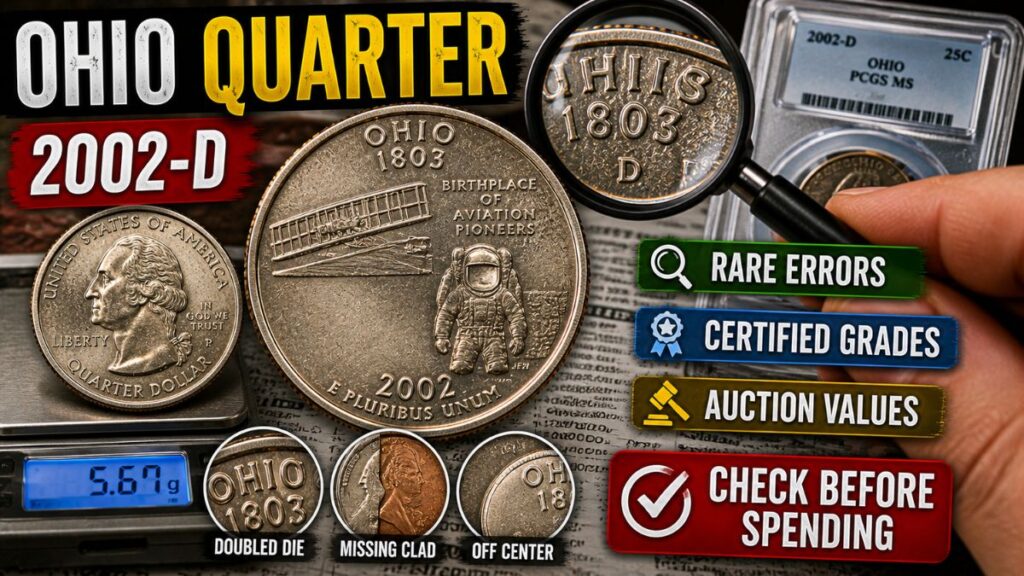
Finding an Ohio State Quarter in your pocket change might seem ordinary. After all, millions of these coins were produced, and most circulated examples are worth only their face value of 25 cents. However, certain Ohio quarters can attract collector interest when they display genuine mint errors, doubled-die characteristics, or exceptionally high certified grades.
That difference is important. A coin described as “rare” online is not automatically valuable, and an ordinary quarter should not be confused with a certified example that achieved a strong auction result. The condition, mint mark, variety, error type, authenticity, and buyer demand all influence the potential value of a coin.
The Ohio State Quarter was released in 2002 as part of the United States 50 State Quarters Program. Its reverse design celebrates Ohio’s contributions to aviation and space exploration. The design includes an early aircraft and an astronaut positioned above an outline of the state.
While the design is familiar to millions of collectors, some individual coins may deserve closer inspection. Certain 2002-D Ohio quarters have documented doubled-die obverse varieties. Other unusual examples may show major mint errors, such as a missing clad layer or an off-center strike.
Documented auction records also show that some Ohio quarters have sold for considerably more than 25 cents. A 2002-P Ohio quarter has reached a reported auction record of $495, while a certified 2002-D Ohio quarter graded MS69 reached $3,525.
These results apply to specific coins with particular grades and characteristics. They do not mean every 2002 Ohio quarter is worth hundreds or thousands of dollars.
Understanding the difference between an ordinary coin and a collectible rarity is the first step toward accurate identification. This guide explains the Ohio State Quarter’s design, mint marks, condition, doubled dies, major errors, documented values, authentication process, storage recommendations, and common questions collectors often ask.
Understanding the 2002 Ohio State Quarter
The Ohio State Quarter was issued in 2002 as the seventeenth release in the 50 State Quarters series. The program introduced circulating quarters featuring designs representing each U.S. state.
Ohio’s design was created to recognize the state’s historical connection to aviation and space exploration. The reverse includes an early aircraft and an astronaut, with both images positioned above the outline of Ohio.
The design is not simply decorative. It reflects Ohio’s association with important developments in flight and space history. This historical theme makes the coin interesting to collectors, even when the individual example has no unusual error or variety.
Most Ohio State Quarters were produced for normal circulation. They were intended to be used in everyday transactions, so many examples show scratches, contact marks, discoloration, and wear from handling.
Circulated coins generally do not bring large premiums unless they contain a significant and authenticated variety or error. A quarter that has been used frequently may still be collectible, but ordinary wear does not automatically make it rare.
Collectors should therefore begin with a realistic expectation. The majority of 2002 Ohio quarters are common coins. The purpose of an inspection is not to assume that every coin is valuable, but to determine whether a particular example has an identifiable characteristic that deserves further examination.
Why Most Ohio Quarters Are Worth Face Value
A coin’s age alone does not determine its value. The 2002 Ohio State Quarter is more than two decades old, but age does not automatically make it scarce.
Large numbers of state quarters were produced and distributed across the country. Many were saved by families, collectors, and people who believed the entire series might become valuable. As a result, Ohio quarters are still commonly found in collections, jars, coin rolls, and pocket change.
A normal circulated Ohio quarter usually has a value close to 25 cents. Its condition may be worn, and it may show small scratches or marks from contact with other coins. These characteristics are common and generally do not qualify as valuable mint errors.
A coin becomes more interesting when it has a documented variety, a significant production error, or an unusually high grade. Even then, the value depends on how many comparable examples exist and how strongly collectors compete for them.
The distinction between rarity and popularity is essential. A coin can be popular without being rare. Likewise, a coin can have an unusual appearance without being a genuine mint error.
Before spending money on professional grading or authentication, collectors should first determine whether the coin has a potentially meaningful characteristic.
Checking the Date and Mint Mark
The first step in identifying an Ohio State Quarter is to confirm the year. The Ohio design was issued in 2002, so the date should be visible on the obverse, the side featuring George Washington.
After confirming the year, inspect the mint mark. A 2002 Ohio quarter may have a P mint mark for Philadelphia or a D mint mark for Denver. The mint mark helps identify where the coin was produced and can be important when researching specific varieties or auction records.
The mint mark is not proof of rarity by itself. A quarter with a P or D mint mark is not automatically valuable. However, identifying the mint facility allows collectors to compare the coin with known varieties associated with that production source.
When examining the mint mark, use good lighting and avoid assuming that a damaged or distorted letter is an error. Circulation damage, scratches, corrosion, and contact marks can change the appearance of lettering.
A useful initial checklist includes:
- Confirm that the date is 2002.
- Identify whether the mint mark is P or D.
- Examine both sides of the coin.
- Inspect the lettering and Washington’s portrait.
- Check the edge for unusual characteristics.
- Look for signs of major striking errors.
- Avoid cleaning or altering the coin.
Accurate identification begins with basic information. Without the date, mint mark, and clear photographs, it is difficult to compare an example with documented varieties.
Examining the Obverse Design
The obverse of the Ohio State Quarter features George Washington, along with the inscriptions traditionally found on U.S. quarters.
Collectors searching for doubled-die characteristics should carefully inspect the lettering and design elements on this side. Potential areas of interest may include the date, inscriptions, and details around Washington’s portrait.
However, not every apparent doubling is a doubled die. Coins can show machine doubling, die deterioration, damage, or distortions caused after the coin left the mint.
True doubled-die varieties originate during the die-making process. The design on the die contains a duplicated or misaligned impression, which can then appear on coins struck from that die. The appearance and location of the doubling are important when determining whether a coin matches a recognized variety.
A magnifying glass can help with an initial inspection, but magnification alone cannot prove authenticity. Collectors should compare the suspected doubling with reliable variety references or seek an opinion from a qualified specialist.
A blurry photograph or a heavily worn coin may make the details difficult to interpret. Strong lighting, clear focus, and images taken from different angles can improve the inspection process.
Genuine Doubled Dies Versus Machine Doubling
One of the most common mistakes in coin collecting is confusing machine doubling with a genuine doubled die.
Machine doubling can occur when the die or coin shifts slightly during the striking process. This may create a flat, shelf-like appearance along part of a letter or number. The result can look unusual, especially under magnification.
A genuine doubled die is created earlier, during the production of the die itself. It may show separated design elements, secondary images, or distinctive spread in specific letters and numbers.
The difference can be subtle. Some examples are easy to recognize, while others require comparison with documented photographs and variety descriptions.
Collectors should avoid declaring a coin valuable solely because a letter appears thicker or wider. A genuine variety must match known characteristics, not merely resemble doubling at a glance.
When evaluating a possible doubled die, consider the following:
- Is the doubling raised as part of the design?
- Does it appear in a recognized location?
- Is the shape consistent with known doubled-die characteristics?
- Does the appearance result from damage or machine doubling?
- Can the feature be confirmed through comparison or professional examination?
A suspected doubled die may be worth further investigation, but it should not be assigned a premium value until the variety is properly identified.
Documented 2002-D Ohio Doubled-Dies
Some 2002-D Ohio State Quarters have documented doubled-die obverse varieties. This makes the Denver issue particularly interesting to collectors who specialize in state quarter varieties.
The existence of documented varieties does not mean that every 2002-D Ohio quarter contains doubling. A recognized variety is usually associated with specific design details and diagnostic features.
Collectors should compare the coin against the exact variety description. The date, lettering, portrait details, and location of the doubling may all matter.
A coin that looks similar but lacks the required characteristics should not automatically be identified as the same variety. This is especially important because photographs taken under harsh lighting can exaggerate minor irregularities.
If a suspected doubled die appears promising, preserve the coin in its current condition and obtain clear photographs. Avoid rubbing the surface to make the doubling more visible. Rubbing can create scratches and reduce the coin’s collectible appeal.
Professional examination may be appropriate when the suspected variety appears strong or when the potential value justifies the expense. Authentication and grading costs should be considered before submitting an ordinary coin.
Understanding Major Mint Errors
Mint errors occur when something goes wrong during the coin manufacturing process. These errors can affect the planchet, striking process, die alignment, metal layers, or other stages of production.
Some errors are minor and have limited collector interest. Others are dramatic and scarce, making them more desirable.
Examples of major mint errors that collectors may examine on Ohio State Quarters include:
- Missing clad layer.
- Major off-center strike.
- Incorrect planchet.
- Striking-related distortions.
- Significant design or metal abnormalities.
The word “major” is important. A small scratch, dent, discoloration, or damaged edge is usually not a mint error. Genuine errors generally result from the production process and can often be identified through physical evidence.
A valuable error should be evaluated based on its type, size, authenticity, condition, and scarcity. A dramatic and confirmed error may attract more interest than a minor production irregularity.
Collectors should also understand that unusual-looking coins are not always errors. Damage can occur when coins are dropped, squeezed, scraped, heated, chemically treated, or exposed to harsh environments.
Missing Clad Layer Errors
Modern U.S. quarters are made using a layered metal construction. A missing clad layer error occurs when one of the outer metal layers is absent from part of the coin.
This type of error can change the coin’s color, surface appearance, and weight. However, color alone is not enough to prove that a coin has a missing clad layer.
Environmental exposure, chemical reactions, abrasion, and post-mint damage can also produce unusual colors. A coin that appears darker, lighter, reddish, or copper-colored should be examined carefully before being described as an error.
A genuine missing clad layer may show characteristics associated with the production process, including an altered surface and potentially different weight. The details depend on the specific error and how the coin was struck.
Collectors should not scrape the surface or attempt to remove metal layers for testing. Such actions can permanently damage the coin and destroy evidence needed for authentication.
If a quarter appears to have a missing clad layer, compare it with normal examples and consider professional evaluation. A qualified service can determine whether the appearance is consistent with a recognized mint error.
Off-Center Strike Errors
An off-center strike occurs when the planchet is not properly positioned during striking. The design may appear shifted toward one side, leaving part of the coin blank or missing some of the intended design.
The degree of displacement matters. A coin that is only slightly off center may have a limited premium, while a dramatic off-center strike with a visible date can be more desirable.
The date is particularly important because it helps identify the coin. An off-center error that removes the date may be harder to identify and may have a different level of collector interest.
Not every coin with an uneven appearance is an off-center strike. Damage to the edge can make a normal coin appear irregular. A coin may also be bent, squeezed, or altered after leaving the mint.
A genuine off-center strike usually shows evidence that the abnormality occurred during production. The surfaces, rim, and design displacement should be evaluated together.
Collectors should photograph both sides and the edge. The percentage of off-center displacement, visibility of the date, and overall condition can all affect the assessment.
Distinguishing Mint Errors From Damage
Damage is one of the biggest sources of confusion in modern coin collecting. Because quarters circulate through machines, pockets, cash registers, and coin-counting equipment, they can develop many unusual marks.
Common forms of damage include:
- Scratches.
- Dents.
- Flattened rims.
- Chemical discoloration.
- Heat damage.
- Edge filing.
- Surface scraping.
- Bending.
- Contact marks.
These characteristics may look dramatic but usually do not represent valuable mint errors.
A mint error must be connected to the manufacturing process. For example, an off-center strike should show a displaced design caused during striking, not a coin that was pushed or bent after circulation.
Likewise, a missing clad layer should not be confused with a surface that has been scraped or chemically altered.
Collectors should be cautious about social media claims that describe every unusual coin as rare. Online photographs may not show the entire coin, and some sellers use exaggerated descriptions to attract attention.
The safest approach is to identify the physical characteristic first, compare it with known examples, and obtain professional confirmation when necessary.
The Importance of Coin Condition
Condition plays a major role in the value of collectible coins. Two Ohio State Quarters with the same date and mint mark may have very different values if one is heavily circulated and the other is exceptionally well preserved.
Circulated coins commonly show wear on Washington’s portrait, lettering, rims, and other raised details. They may also contain contact marks from being stored with other coins.
Uncirculated coins have not been used in normal circulation, but they can still have marks from production, transportation, packaging, and storage. A coin’s grade depends on multiple factors, including surface preservation, luster, strike quality, and visible imperfections.
High-grade coins are evaluated using professional grading standards. A coin that looks attractive to an untrained observer may receive a lower grade because of small marks or other issues.
This is why auction records for high-grade examples should not be used to estimate the value of every Ohio quarter. A certified MS69 coin is a specific condition rarity, not a typical circulated coin.
What Does MS69 Mean?
The term MS refers to Mint State. It is used for coins that show no evidence of normal circulation. The number following MS indicates the grade within the grading scale.
MS69 is an exceptionally high grade. A coin at this level must display outstanding preservation, although it may still have very minor imperfections consistent with the grading standard.
A coin does not become MS69 simply because it looks shiny or was stored in a collection. Professional graders examine the surface, strike, luster, and overall appearance.
The difference between high grades can be important in the marketplace. A coin graded MS69 may be worth much more than a similar coin graded several points lower, particularly when the population of coins at that grade is limited.
However, grade alone does not guarantee a high value. Demand, availability, certification company, market conditions, and the coin’s specific issue all influence the final price.
Collectors should never assume that an ungraded quarter is automatically equivalent to a certified MS69 example.
Documented Value of a 2002-P Ohio Quarter
A 2002-P Ohio State Quarter has reached a documented auction record of $495 in high grade.
This figure demonstrates that a regular-design Ohio quarter can attract more than face value when it is preserved at an exceptional level and meets collector demand.
The record should be interpreted carefully. It applies to a specific certified coin that achieved that result in a particular auction. It does not establish a guaranteed price for every 2002-P Ohio quarter.
Most 2002-P examples found in circulation will show wear and will not approach this result. Even uncirculated coins may vary significantly in quality.
Collectors should consider the following before comparing their coin with the $495 record:
- Is the coin from Philadelphia?
- Is it genuinely uncirculated?
- Does it have strong luster?
- Are there visible contact marks?
- Has it been professionally graded?
- Does it have a recognized variety or error?
- Is the market currently interested in that grade?
A documented auction record is useful evidence, but it should be treated as a reference point rather than a promise of future value.
Documented Value of a 2002-D MS69 Ohio Quarter
A 2002-D Ohio State Quarter graded MS69 has reached a documented auction record of $3,525.
This result is significantly higher than the face value of the coin, but it is associated with a specific certified example in an exceptionally high grade.
The grade is a central part of the record. Most Ohio quarters are not preserved at this level, especially those that have circulated through everyday commerce.
A collector may own an attractive 2002-D Ohio quarter, but appearance alone cannot confirm that it would receive MS69. Small marks, weak strike details, surface imperfections, and other factors can affect the final grade.
The $3,525 result should therefore be understood as an example of the premium that an exceptional certified coin can achieve. It should not be used as a general valuation for all 2002-D Ohio quarters.
The value of a coin can also change over time. Auction results depend on the specific event, competing bidders, market conditions, and the individual coin’s presentation.
Why Auction Records Do Not Guarantee Current Value
Auction records provide useful historical information, but they do not guarantee that another coin will sell for the same amount.
A documented sale reflects one specific coin, one specific grade, and one specific market situation. Another example may be worth less because of lower grade, weaker eye appeal, different certification, or a lack of buyer interest.
There is also a difference between a realized auction price and an asking price. A seller may advertise a coin for a very high amount, but the listing does not prove that a buyer will pay that price.
Collectors should focus on completed sales involving coins that closely match the example they own. The date, mint mark, variety, grade, and error characteristics should be compared carefully.
A coin with an impressive headline may still have little value if the claimed characteristic is not genuine or if the example is significantly different from the documented sale.
Responsible collecting requires separating verified results from speculation.
How to Inspect an Ohio State Quarter at Home
A basic home inspection can help identify whether an Ohio quarter deserves further research. The process does not require expensive equipment, but it does require patience and careful handling.
Begin by choosing a clean, well-lit workspace. Use a soft surface to prevent the coin from being scratched if it slips from your fingers.
Examine the obverse and reverse under direct but controlled lighting. Rotate the coin slowly to observe the surfaces from different angles.
Check the date and mint mark first. Then inspect the lettering, portrait, rim, and major design elements.
Look for unusual features such as:
- Clearly displaced design elements.
- Significant missing metal.
- A dramatic off-center strike.
- Unusual planchet appearance.
- Distinctive doubling in recognized locations.
- Abnormal edge characteristics.
Do not use sharp tools to test the coin. Do not scrape, polish, or rub suspicious areas. These actions can damage the surface and interfere with professional evaluation.
Take clear photographs of the entire obverse and reverse, followed by close-up images of the suspected feature. Include the edge if the error may involve the planchet or rim.
Using Weight as an Initial Screening Tool
Weight can sometimes help collectors investigate an unusual coin, but it should not be treated as conclusive proof of an error.
A scale with sufficient precision may reveal that a coin differs from the expected standard. However, differences can result from wear, dirt, damage, manufacturing tolerances, or measurement problems.
Weight alone cannot establish whether a quarter has a missing clad layer, an incorrect planchet, or another production error. The physical characteristics must be evaluated together.
If you weigh a coin, use a reliable digital scale and check its accuracy. Make sure the coin is clean of loose dirt but do not wash or chemically treat it.
Record the result without altering the coin. A professional evaluator may use weight as one part of a broader examination.
Collectors should avoid making a final identification based only on a number displayed by an inexpensive scale.
Why Cleaning Can Reduce Collectible Value
Cleaning a coin may make it appear brighter, but it can damage the original surface and reduce collector interest.
Common harmful methods include:
- Polishing with a cloth.
- Using metal cleaner.
- Applying chemicals.
- Scrubbing with a brush.
- Scraping stains.
- Rubbing with an abrasive material.
Even if the coin looks improved to the owner, cleaning can leave hairlines, scratches, unnatural brightness, or chemical damage. Professional graders may classify the coin as cleaned rather than assigning it a standard numeric grade.
This is particularly important when dealing with a possible error or high-grade example. The original surface may provide evidence of authenticity and condition.
If an Ohio quarter looks unusual, leave it as it is. Place it in a suitable holder and seek advice before attempting any treatment.
The safest rule is simple: never clean a coin that might be valuable.
When Professional Authentication Is Necessary
Professional authentication becomes important when a coin appears to contain a major error, a recognized doubled die, or an unusually high-grade condition.
A specialist can examine the coin’s design, surfaces, weight, strike characteristics, and other evidence. Professional grading services may also encapsulate the coin and assign a grade if it meets their standards.
Authentication is especially important when a potential error could have significant financial value. Counterfeit coins, altered coins, damaged coins, and incorrectly identified varieties can appear convincing in photographs.
Collectors should understand that grading and authentication are not always the same process. Authentication focuses on whether the coin is genuine and whether the claimed characteristic is legitimate. Grading evaluates condition according to established standards.
Before submitting a coin, research the service fees, turnaround time, submission requirements, and potential value. Sending a common circulated quarter for grading may cost more than the coin is worth.
Professional evaluation should be based on a reasonable possibility of collectible value, not only on an online claim.
How to Store an Ohio State Quarter
Proper storage helps protect a coin from scratches, moisture, chemicals, and unnecessary handling.
A coin should be stored in a holder made from a material suitable for long-term numismatic storage. Avoid containers that may contain harmful chemicals or soft plastics that can deteriorate over time.
Do not place valuable coins loosely in jars with other coins. Contact between metal surfaces can create scratches and abrasions.
Handle the coin by its edges whenever possible. Fingerprints and oils can affect the surface, especially on coins with high-grade preservation.
Keep the storage area stable and avoid extreme humidity or temperature changes. A clean, dry environment is generally preferable.
If the coin is already certified, keep it inside its original holder unless there is a specific reason to have it examined again. Avoid opening a professional holder unnecessarily.
Good storage does not turn an ordinary coin into a rarity, but it can help preserve the condition of a coin that already has collectible potential.
Common Mistakes Made by New Collectors
New collectors often encounter the same identification mistakes. Avoiding these errors can save time, money, and disappointment.
One common mistake is believing that every old or unusual-looking coin is rare. A coin may be more than twenty years old and still be common.
Another mistake is assuming that a high online asking price represents the actual market value. A seller’s listing is not proof of a completed sale.
Some collectors also confuse damage with mint errors. A scratch, stain, or bent edge may look unusual but does not necessarily originate at the mint.
Another problem is relying on a single photograph or short social media video. Images can exaggerate features and may not show the entire coin.
Collectors should also avoid cleaning coins before inspection. Cleaning can reduce value and remove evidence needed for authentication.
Finally, do not spend substantial money on grading without first determining whether the coin has a credible reason to be submitted.
How to Compare Your Coin With a Documented Example
When comparing an Ohio quarter with a documented auction result, match as many details as possible.
Start with the date and mint mark. A 2002-P coin should not be compared directly with a 2002-D coin if the record concerns a different mint issue.
Next, compare the grade. A circulated quarter is not comparable to an MS69 example. Even two uncirculated coins may differ substantially in quality.
If the record involves a doubled die or mint error, confirm that the suspected characteristic matches the documented variety. A general resemblance is not enough.
Review the following information:
- Date.
- Mint mark.
- Variety or error type.
- Certification status.
- Numerical grade.
- Surface quality.
- Strike quality.
- Auction date.
- Realized sale price.
The closer the match, the more useful the comparison becomes. Even then, market conditions can change, and no historical result guarantees a future sale price.
Does Every 2002 Ohio Quarter Have a Mint Mark?
Not every quarter necessarily displays a mint mark in the same way, depending on the production source and issue. For the 2002 Ohio State Quarter, collectors commonly encounter P and D mint marks.
The mint mark is located on the obverse near the lower-right area of Washington’s portrait. It should be inspected carefully because dirt, wear, and damage can make the letter difficult to read.
A missing or unclear mint mark should not automatically be considered an error. The appearance may be affected by wear, damage, or the condition of the coin.
If the mint mark appears unusual, take clear photographs and compare the coin with normal examples. A suspected mint-mark error should be professionally evaluated before assigning a premium value.
Can a Circulated Ohio Quarter Be Valuable?
A circulated Ohio quarter can be valuable if it contains a genuine and desirable error or variety. However, most circulated examples remain close to face value.
Condition is important because circulation removes detail and creates surface marks. A major error may still be collectible even when the coin is worn, but the value depends on the error’s rarity and appearance.
A circulated coin should not be valued using the record for a high-grade certified example. The $495 and $3,525 auction records concern specific coins and should not be applied to ordinary pocket-change examples.
If a circulated quarter displays a major off-center strike, missing clad layer, or recognizable doubled die, further investigation may be justified.
Is a 2002-D Ohio Quarter Worth $3,525?
A specific 2002-D Ohio quarter graded MS69 reached a documented auction record of $3,525. This does not mean that every 2002-D Ohio quarter is worth thousands of dollars.
The record applies to an exceptionally high-grade certified example. Most quarters found in circulation have lower grades and lack the preservation necessary to reach such a result.
To determine whether your coin could be comparable, examine its condition, surface quality, mint mark, and certification status. A professional grading service would be needed to establish an official grade.
Do not assume that a shiny coin is MS69. A coin can appear attractive but still contain marks that prevent an extremely high grade.
Is a 2002-P Ohio Quarter Worth $495?
A documented auction record of $495 exists for a 2002-P Ohio quarter. This result reflects a specific coin and its condition, not the value of every Philadelphia-minted Ohio quarter.
Most 2002-P quarters are common, especially those that have circulated. An uncirculated example may have some collector interest, but the exact value depends on grade and demand.
When comparing your coin, check whether it is certified and whether its grade is similar to the example associated with the auction record.
The record should be treated as historical evidence of what one particular coin achieved, not as a guaranteed selling price.
Should You Send Every Ohio Quarter for Grading?
Sending every Ohio quarter for professional grading is generally not practical. Grading involves fees, shipping, insurance, and time, so the potential collectible value should be considered first.
A common circulated quarter may be worth only face value. In that situation, grading costs could exceed the coin’s market value.
Professional grading may make more sense when a coin appears to have:
- A major mint error.
- A recognized doubled die.
- Exceptional uncirculated preservation.
- A documented variety.
- Strong evidence of rarity.
Before submitting, research comparable certified coins and determine whether the possible value justifies the expense.
If the coin has only minor scratches or an uncertain appearance, a preliminary consultation may be more useful than immediate submission.
How to Photograph a Suspected Error
Clear photographs can help specialists and experienced collectors evaluate an unusual Ohio quarter.
Use natural light or a soft light source that reveals the surface without creating harsh reflections. Place the coin on a neutral background and keep the camera steady.
Take full images of both sides. Then photograph close-ups of the date, mint mark, lettering, portrait, rim, and suspected error.
If the issue concerns an off-center strike or missing metal, include the entire edge and surrounding surface. Avoid cropping away important evidence.
Do not use filters that change the coin’s color or sharpen details artificially. Edited images can make an ordinary feature appear more dramatic than it really is.
Photographs cannot replace professional authentication, but they can help communicate the characteristics of the coin.
Why Online Coin Claims Require Caution
The internet contains useful collecting information, but it also contains exaggerated claims and misleading headlines.
A post stating that an Ohio quarter is worth thousands of dollars may refer to a rare certified example rather than an ordinary coin. Some content may also confuse asking prices with actual auction results.
Collectors should look for clear information about the coin’s date, mint mark, grade, variety, error, and sale history.
Be especially careful when a claim:
- Gives a high value without identifying the coin’s grade.
- Uses words such as “guaranteed” or “everyone should check.”
- Treats damage as a mint error.
- Shows only one angle of the coin.
- Does not distinguish between asking prices and completed sales.
- Promises a fixed value for every example.
Reliable identification requires evidence. Exciting headlines can encourage inspection, but they should not replace careful research.
A Practical Ohio Quarter Identification Checklist
Before deciding whether an Ohio State Quarter may be collectible, follow a consistent process.
First, confirm that the coin is dated 2002 and features the Ohio reverse design. Next, identify the mint mark as P or D.
Inspect the coin under good lighting. Examine Washington’s portrait, inscriptions, date, and other design elements for possible doubled-die characteristics.
Turn the coin over and inspect the aircraft, astronaut, state outline, lettering, and rim. Look for unusual missing metal or significant design displacement.
Examine the edge for abnormalities, but remember that damage can also affect the edge.
If you find a possible error, do not clean or modify the coin. Photograph it and compare the feature with documented examples.
Finally, consider professional authentication if the characteristic appears substantial and credible.
This process helps separate ordinary wear from features that may deserve further attention.
Frequently Asked Questions About Ohio State Quarters
What Year Was the Ohio State Quarter Released?
The Ohio State Quarter was released in 2002 as part of the United States 50 State Quarters Program.
What Does the Ohio Quarter Design Represent?
The reverse design includes an early aircraft and an astronaut above the outline of Ohio. It honors the state’s contributions to aviation and space exploration.
Are Most Ohio State Quarters Rare?
No. Most Ohio State Quarters are common, especially circulated examples. Most are worth approximately their face value of 25 cents unless they have a recognized variety, genuine mint error, or exceptional grade.
What Mint Marks Should I Look For?
Collectors commonly encounter P and D mint marks on 2002 Ohio State Quarters. The mint mark helps identify the production facility and may be important when researching varieties.
Can a 2002-D Ohio Quarter Have a Doubled Die?
Yes. Some 2002-D Ohio quarters have documented doubled-die obverse varieties. The suspected doubling must match recognized diagnostic characteristics before it can be identified as a genuine variety.
What Is the Documented Value of a 2002-P Ohio Quarter?
A 2002-P Ohio quarter has reached a documented auction record of $495. This result applies to a specific coin and should not be considered a guaranteed value for every 2002-P example.
What Is the Documented Value of a 2002-D Ohio Quarter Graded MS69?
A certified 2002-D Ohio quarter graded MS69 reached a documented auction record of $3,525. The result applies to an exceptionally high-grade coin, not ordinary circulated quarters.
Can a Missing Clad Layer Increase Value?
A genuine missing clad layer can make a coin collectible, but the value depends on the authenticity, size, appearance, condition, and collector demand. Color alone does not prove a missing clad layer.
How Can I Tell a Mint Error From Damage?
Mint errors originate during production, while damage occurs after the coin leaves the mint. Comparing the feature with documented examples and consulting a qualified specialist can help distinguish the two.
Should I Clean My Ohio Quarter Before Selling It?
No. Cleaning can scratch or chemically damage the coin and may reduce its collectible value. Keep a potentially valuable coin in its original condition.
Is a Shiny Ohio Quarter Automatically Valuable?
No. Shine alone does not establish rarity or a high grade. A coin must be evaluated for surface quality, strike, wear, variety, and authenticity.
Should I Get My Ohio Quarter Professionally Graded?
Professional grading may be appropriate for a coin with a credible major error, documented variety, or exceptional condition. For ordinary circulated coins, grading expenses may exceed the potential value.
Can Auction Prices Change Over Time?
Yes. Auction prices depend on market demand, the coin’s specific characteristics, certification, grade, and the circumstances of the sale. A previous result does not guarantee a future price.
What Should I Do If I Find an Unusual Ohio Quarter?
Do not clean, scrape, polish, or alter it. Photograph both sides and the edge, record the date and mint mark, compare the feature with documented examples, and seek professional authentication if necessary.
Final Thoughts on the Ohio State Quarter
The 2002 Ohio State Quarter is a common coin in circulated condition, but some examples deserve closer examination. Genuine doubled-die varieties, major mint errors, and exceptionally high-grade coins can attract significant collector interest.
The most important identification steps are simple: confirm the date, check the P or D mint mark, inspect both sides, examine the lettering and portrait, and look for genuine production abnormalities.
Documented auction records show that a 2002-P Ohio quarter has reached $495, while a certified 2002-D example graded MS69 reached $3,525. These results demonstrate the potential of specific collectible coins, but they should never be treated as guaranteed values for ordinary Ohio quarters.
A coin’s condition, variety, error type, authenticity, and certification all matter. Damage and normal wear should not be confused with mint errors, and online asking prices should not be mistaken for completed auction sales.
If your Ohio quarter looks unusual, protect it in its current condition and avoid cleaning. Careful inspection and professional authentication are the best ways to determine whether your coin is simply worth 25 cents or has characteristics that make it more valuable to collectors.