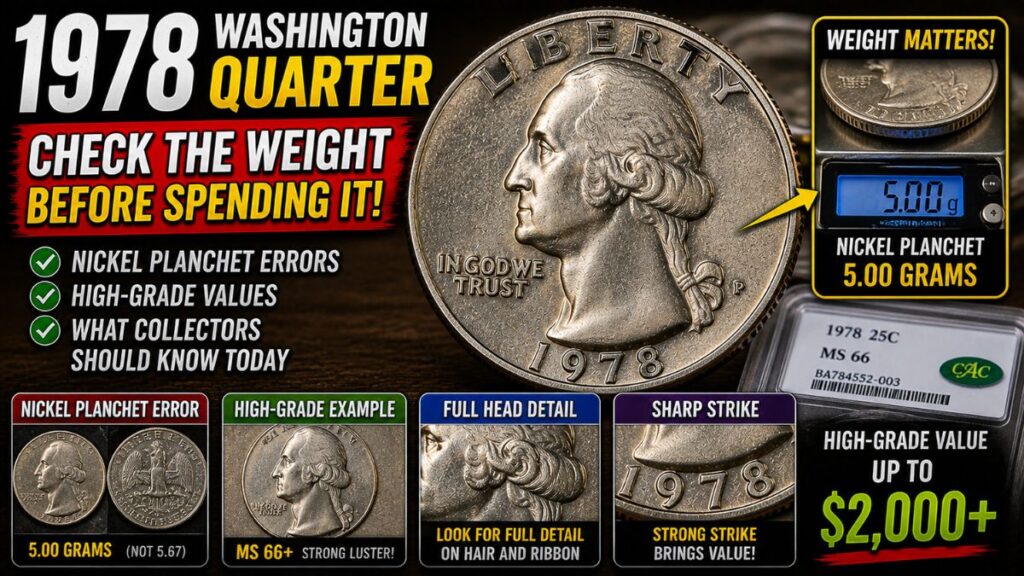
Finding a 1978 Washington Quarter in your pocket, coin jar, old collection, or change drawer usually does not seem like a major event. Millions of these quarters were produced, and most examples remain relatively common. Yet that does not mean every 1978 quarter should be spent without a second thought.
The most important reason to pause is simple: unusual minting errors can transform an otherwise ordinary-looking quarter into a much more interesting collectible.
One documented 1978 Washington Quarter was accidentally struck on a nickel planchet rather than the planchet normally intended for a quarter. That unusual coin weighed approximately 4.98 grams and was authenticated in an MS65 grade. It later sold for $528 at Stack’s Bowers in June 2024.
That example demonstrates why checking the weight can be a useful first step when examining a 1978 quarter.
However, there is an important distinction that every collector should understand. A weight reading by itself does not prove that a coin is a genuine mint error. A coin can be damaged, altered, worn, contaminated, or otherwise unusual for reasons unrelated to the original minting process.
That is why the weight should be treated as a clue rather than a final answer.
A normal 1978 Washington Quarter is expected to weigh about 5.67 grams. A documented quarter struck on a nickel planchet weighed about 4.98 grams. That difference is significant enough to make a precise scale useful when screening an unusual coin.
But weight is only the beginning.
The edge, diameter, overall design, surfaces, lettering, rims, and other physical characteristics should also be examined. If a coin appears significantly different from a normal example, professional authentication becomes especially important before assigning a major value to it.
There is another reason the 1978 Washington Quarter can attract collector attention. Even without a dramatic planchet error, exceptionally well-preserved examples can be worth substantially more than ordinary circulated coins.
The reported auction record for a regular 1978 Philadelphia issue is $2,875 for an MS67+ example, while the 1978-D record is $1,527.50 for an MS67+ example.
Those figures do not mean that every 1978 quarter is worth hundreds or thousands of dollars. They represent specific coins in specific grades and circumstances.
Understanding that difference is essential.
If you have a 1978 Washington Quarter, the smartest approach is not to assume that you have a rare coin. Instead, inspect it carefully. Start with the weight, then look at the rest of the coin for evidence that could explain why it differs from a normal example.
The 1978 Washington Quarter Is Usually a Common Coin
The first thing to understand about the 1978 Washington Quarter is that most examples are not rare.
The regular Philadelphia issue had a mintage of more than 521 million coins. With that many pieces produced, the existence of a 1978 quarter by itself is not enough to make the coin valuable.
This is an important point because age alone does not determine rarity.
A coin from 1978 may be more than four decades old, but millions of examples can still survive. Collectors therefore look beyond the date. They examine condition, mint origin, errors, varieties, and other characteristics that can separate an ordinary example from a collectible one.
That is exactly why the title of this article focuses on checking the weight.
A normal coin can be common, while a coin produced incorrectly during the minting process can be much more unusual.
The difference may not always be obvious to the naked eye.
Someone unfamiliar with error coins might look at two quarters and see almost identical designs. A specialist, however, may notice that one coin has a different weight, an unusual edge, a different diameter, or another characteristic consistent with an incorrect planchet.
This is where careful examination becomes useful.
Instead of asking only, “Is this old quarter valuable?” a better question is, “Does this quarter have characteristics that are different from a normal 1978 Washington Quarter?”
That shift in thinking can prevent both mistakes and unrealistic expectations.
What a Normal 1978 Washington Quarter Should Weigh
Weight is one of the easiest measurements for a collector to check.
A regular 1978 Washington Quarter weighs approximately 5.67 grams.
That figure provides a baseline for comparison.
If you place an ordinary 1978 quarter on a precise digital scale and see a measurement close to its expected weight, that generally supports the idea that you are dealing with a normal quarter. It does not, by itself, establish rarity or value.
On the other hand, if the coin produces a noticeably different reading, it deserves additional examination.
The documented nickel-planchet example is particularly interesting because it weighed about 4.98 grams.
That is substantially lighter than the approximately 5.67-gram weight expected for a normal quarter.
The difference is roughly 0.69 gram.
For a small coin, that is a meaningful difference.
Still, collectors should resist the temptation to treat a specific number as an automatic value trigger. Finding a quarter that weighs 4.98 grams does not automatically mean that it is the same type of error as the authenticated example.
A scale can tell you that the coin has an unusual weight.
It cannot independently tell you why.
That distinction is extremely important.
Weight can change for many reasons. Wear can remove small amounts of metal. Damage can affect a coin. Environmental exposure can alter surfaces. Manufacturing problems can also produce unusual characteristics. In addition, inaccurate household scales may give unreliable measurements.
For that reason, a precise scale designed for small objects is much more useful than relying on an ordinary kitchen scale.
Why the Nickel Planchet Error Is So Interesting
The most important unusual feature in the supplied 1978 quarter example is that it was struck on a nickel planchet.
Coins are produced using prepared metal blanks or planchets of specific dimensions and compositions. Different denominations require different planchets because the finished coins are supposed to have particular weights, sizes, and physical characteristics.
If the wrong planchet enters the production process and receives the design of another denomination, the resulting coin can become a collectible mint error.
That is what makes the documented 1978 Washington Quarter so interesting.
Instead of being struck on the planchet intended for a quarter, it was struck on a nickel planchet.
The result was a Washington Quarter design on an incorrect planchet.
Because the planchet was different, the finished coin also had a different weight.
The authenticated example weighed 4.98 grams and was graded MS65. It sold for $528 at Stack’s Bowers in June 2024.
This is a concrete example of how a minting error can create collector interest even when the date itself is common.
It also demonstrates why error collecting requires more than simply searching for old dates.
The coin does not become interesting merely because it is from 1978. Its significance comes from the unusual manufacturing circumstance associated with the specific piece.
That is a major distinction when evaluating coins.
What Does “Struck on a Nickel Planchet” Mean?
The phrase “struck on a nickel planchet” can sound complicated, but the basic idea is straightforward.
A planchet is a prepared blank of metal that is ready to receive a coin design.
Normally, a Washington Quarter should be struck using the appropriate planchet for that denomination. If a planchet intended for another denomination enters the wrong production process and receives the quarter design, the resulting piece can be classified as a wrong-planchet error when the evidence supports that conclusion.
The important point is that the unusual planchet was involved during the original minting process.
That separates a genuine mint error from a coin that was altered later.
For example, if someone intentionally changes a coin’s size, weight, edge, or surface after it leaves the mint, that does not make the coin a genuine wrong-planchet error.
This is why authentication matters.
A professional examination can consider the total physical evidence rather than relying on one measurement.
For collectors, this is one of the most valuable lessons from the 1978 nickel-planchet quarter.
A surprising weight should encourage investigation, not immediate celebration.
Why 4.98 Grams Is an Important Clue
The 4.98-gram measurement associated with the authenticated nickel-planchet example is particularly useful as a reference point.
A regular 1978 Washington Quarter is approximately 5.67 grams.
The documented error example is approximately 4.98 grams.
That creates a noticeable difference.
If you find a 1978 quarter that is significantly lighter than the normal specification, you have a legitimate reason to investigate further.
But it is important not to reverse the logic.
You should not say:
“My quarter weighs 4.98 grams, therefore it must be worth $528.”
Instead, the correct reasoning is:
“My quarter has an unusual weight, so I should examine it more carefully to determine whether the difference is consistent with a genuine minting error.”
That is a much more reliable approach.
The auction result belongs to a specific authenticated coin. It is not a guaranteed price for every coin with a similar weight.
Even two coins with similar measurements can have very different values depending on authenticity, condition, appearance, and other characteristics.
How to Weigh Your 1978 Washington Quarter Correctly
If you want to examine a 1978 Washington Quarter, start with a clean, accurate digital scale capable of measuring small differences.
A scale with a resolution suitable for individual coins is preferable because a basic household scale may not detect small changes accurately.
Before weighing the coin, make sure the scale is properly calibrated according to its instructions.
Place the quarter carefully on the weighing surface.
Record the result.
Do not press down on the coin, and do not allow another object to touch it during measurement.
If the reading is approximately 5.67 grams, that is consistent with the expected weight of a normal quarter.
If the reading is around 4.98 grams or otherwise noticeably different, the coin deserves closer inspection.
However, do not immediately clean the coin to make the measurement more accurate.
Cleaning can permanently damage collectible surfaces and can reduce the desirability of a coin.
The safest approach is to handle the coin carefully by its edges and inspect it without altering its surfaces.
If the weight is unusual and other characteristics also appear consistent with a wrong-planchet error, professional authentication is the next logical step.
Why Weight Alone Cannot Prove a Mint Error
This is perhaps the most important warning in the entire discussion.
Weight is a screening tool.
It is not a certificate of authenticity.
A coin that weighs less than expected can have several explanations.
It might have experienced significant wear.
It could have suffered damage.
It could have been chemically or physically altered.
The scale could also be inaccurate.
Even if the weight is close to that of a known error example, the rest of the coin must support the conclusion.
This is especially important when a coin is associated with a potentially valuable error.
The higher the claimed value, the more important authentication becomes.
Collectors should therefore avoid online claims that rely entirely on weight.
A video, photograph, social media post, or informal appraisal may help you identify a possibility, but it cannot replace a professional examination when substantial money is involved.
Check the Edge After Checking the Weight
The edge is another important area to examine.
When a coin has an unusual planchet, its edge can provide useful information about its physical characteristics.
Look at the quarter from the side under good lighting.
Do not scrape or scratch it.
Observe whether the edge appears consistent with a normal Washington Quarter or whether there are unusual characteristics that require further investigation.
The edge can also help you notice damage.
A coin may appear thinner or different because its edge has been altered after leaving the mint. That kind of alteration is very different from a genuine wrong-planchet error.
This is another reason why the entire coin must be considered.
Weight, edge characteristics, diameter, design details, and surface condition should tell a consistent story.
One unusual measurement is not enough.
Check the Diameter as Well
Diameter provides another useful comparison.
If a coin was struck on a planchet intended for another denomination, its physical dimensions may differ from those expected for a normal quarter.
That makes diameter worth checking when the weight is unusual.
Use a precise measuring tool rather than estimating by eye.
However, just as with weight, diameter should not be interpreted in isolation.
A coin can be damaged or altered.
A small difference in measurement can also result from inaccurate tools or improper positioning.
The goal is not to find one number that proves the coin is rare.
The goal is to build a collection of physical observations.
When multiple characteristics point toward the same minting explanation, the case becomes more interesting.
Look Carefully at the Overall Design
After checking the weight, edge, and diameter, examine the design.
A 1978 Washington Quarter should display the expected Washington portrait on the obverse and the appropriate reverse design for the period.
Look closely at the rims, lettering, date, and overall appearance.
If the coin was struck on a planchet of a different size or composition, the relationship between the design and the planchet can sometimes provide useful clues.
For example, collectors can consider how the design sits relative to the edge and whether the rims appear normal.
Again, the goal is comparison.
Do not search for a random imperfection and assume it is a mint error.
Coins circulate through machines, pockets, drawers, jars, and collections for decades. They can pick up scratches, dents, discoloration, flattening, and other forms of damage.
The more carefully you distinguish manufacturing characteristics from post-mint damage, the more reliable your evaluation becomes.
Mint Errors and Damage Are Not the Same Thing
One of the biggest challenges for beginning error collectors is distinguishing genuine mint errors from damage.
A coin can look strange without having been produced incorrectly.
For example, a coin may be bent, scratched, scraped, squeezed, polished, or otherwise altered after leaving the mint.
Those changes can affect its appearance and potentially its weight.
A genuine wrong-planchet error, by contrast, results from a mistake in the minting process.
This difference is fundamental.
Collectors should therefore ask whether the unusual feature could realistically have occurred during production.
If the answer is uncertain, authentication can help.
This is particularly important when a coin is being advertised or described as a major error.
A dramatic claim deserves strong evidence.
The Difference Between an Unusual Coin and a Valuable Coin
Another common mistake is assuming that unusual automatically means valuable.
A coin can be unusual but have little market demand.
Conversely, a coin can be valuable because it combines rarity, authenticity, condition, and collector demand.
The documented 1978 nickel-planchet quarter is valuable as a specific authenticated error example.
That does not establish a fixed value for every unusual 1978 quarter.
The same principle applies to high-grade coins.
A normal 1978 quarter can be common in circulated condition while an exceptionally preserved example can be much more collectible.
This difference is one of the most important concepts in coin collecting.
Why Condition Matters So Much
Coin condition can have a major effect on collectibility.
A quarter that has spent years circulating may show scratches, contact marks, wear, discoloration, and other signs of use.
Another quarter from the same year can survive with much stronger surfaces and sharper details.
The difference between those coins can be significant to collectors.
Professional grading systems use standardized grades to describe condition.
The documented nickel-planchet example was graded MS65.
The reported auction records for regular 1978 quarters also involve very high grades.
That tells us something important: the highest prices cited for 1978 quarters are associated with particular coins, not ordinary circulated examples.
An ordinary 1978 quarter should not be valued using an auction record for an exceptional MS67+ coin.
Condition has to be considered separately.
What Does MS65 Mean?
MS stands for Mint State.
A coin graded MS65 is considered to have Mint State condition within the relevant grading scale.
For a collector, the important takeaway is that MS65 is not the same as an ordinary circulated quarter.
A coin can have the same date and mint origin but a completely different market position depending on its condition.
The 1978 nickel-planchet quarter that sold for $528 was an MS65 example.
That grade is part of the description of that particular auction result.
If you find a 1978 quarter with an unusual weight but significant circulation wear, you cannot simply apply the $528 result to it.
Authentication and grading are essential parts of the valuation process.
The $528 Auction Result: What It Actually Tells Us
The authenticated 1978 Washington Quarter struck on a nickel planchet sold for $528 at Stack’s Bowers in June 2024.
That result is interesting because it demonstrates that a 1978 quarter can command a meaningful premium when it has a documented and authenticated minting error.
But the auction result should be interpreted carefully.
It does not mean that every 1978 quarter struck on an unusual-looking planchet is worth exactly $528.
Auction prices are tied to individual coins.
The specific example had an identified wrong-planchet characteristic, an MS65 grade, and authentication supporting its status as a genuine error.
Those details matter.
The result is therefore best understood as an example of what the market paid for that particular authenticated coin at that particular auction.
It should not be treated as a guaranteed price guide for an unidentified coin found in circulation.
The $2,875 Record for a Regular 1978 Philadelphia Quarter
The error coin is not the only reason a 1978 quarter can attract attention.
The reported auction record for the regular Philadelphia issue is $2,875 for an MS67+ example.
At first, that may seem surprising.
How can a common coin command thousands of dollars?
The answer is condition.
A coin can be common in general but difficult to find in exceptional condition.
When millions of coins were produced, many entered circulation. Over time, they accumulated marks and wear.
Finding a coin that survives in extraordinary condition can therefore be much harder than finding the date itself.
This is why collectors should not confuse mintage with condition rarity.
More than 521 million regular Philadelphia examples were struck, but that does not mean millions of them survived in top condition.
The $2,875 record belongs to a specific high-grade example.
It is not the normal value of a circulated 1978 quarter.
The $1,527.50 Record for the 1978-D Quarter
The 1978-D Washington Quarter also has a reported high auction result.
The stated record is $1,527.50 for an MS67+ example.
Again, this is a specific high-grade coin.
The result illustrates the same basic principle: condition can dramatically change collector interest.
If you find a circulated 1978-D quarter, you should not assume it is worth $1,527.50.
The relevant question is whether your coin shares the characteristics of the exceptional example.
That means looking at condition, mintmark, authenticity, and other identifying details.
Auction records are useful for understanding the potential of exceptional coins, but they should never be used as automatic valuations for ordinary examples.
Why You Should Not Assume Every 1978 Quarter Is Valuable
The internet has made it easy for coin values to become exaggerated.
A headline may say that a certain quarter is “worth thousands,” but the actual auction result may involve a highly unusual error or an exceptionally high grade.
That distinction can disappear in short social media posts.
For the 1978 Washington Quarter, this distinction is especially important.
Most examples are common.
The valuable cases discussed here involve specific circumstances:
A genuine quarter struck on a nickel planchet.
An exceptionally high-grade regular Philadelphia example.
An exceptionally high-grade 1978-D example.
These are not the same thing as an ordinary circulated quarter.
Understanding the difference can help collectors avoid both disappointment and unnecessary spending on questionable claims.
How to Handle a Potentially Valuable 1978 Quarter
If your 1978 quarter shows an unusual weight or another potentially significant characteristic, handle it carefully.
Hold the coin by its edges.
Avoid touching the surfaces unnecessarily.
Do not clean it.
Do not polish it.
Do not scrape it.
Do not attempt to change its weight.
Do not attempt to modify the edge.
Any alteration can damage the coin and make professional evaluation more difficult.
Instead, preserve the coin exactly as you found it.
Write down the weight and other observations separately.
If possible, compare the coin with a normal 1978 quarter without damaging either coin.
This gives you a useful reference.
If the unusual characteristics remain convincing, professional authentication is the appropriate next step.
Why Cleaning Can Be a Serious Mistake
People sometimes believe that a valuable coin should be cleaned so that its details become easier to see.
That approach can be harmful.
Cleaning can leave scratches, unnatural surfaces, residue, or other evidence of alteration.
Collectors generally want original surfaces rather than a coin that has been aggressively polished.
For a potentially valuable error coin, preserving the coin in its existing condition is particularly important.
If your 1978 quarter has an unusual weight, do not clean it before seeking professional advice.
The best examination is usually performed on the coin in the condition in which it was found.
How to Compare Your Coin Without Damaging It
A useful first comparison is between your unusual 1978 quarter and an ordinary 1978 quarter.
Place both coins side by side.
Compare their overall appearance.
Look at their edges.
Measure their diameter carefully if you have an appropriate tool.
Weigh them using the same calibrated scale.
Observe how the design sits on the planchet.
The objective is to identify differences.
If your coin is approximately 5.67 grams and looks consistent with a normal example, there may be no obvious reason to suspect a wrong-planchet error.
If it is significantly lighter, particularly near the 4.98-gram reference associated with the authenticated nickel-planchet example, additional investigation may be justified.
But remember: similarity in weight does not equal identical origin.
Authentication still matters.
What Collectors Should Look for on the Date
The date is the starting point.
Confirm that the coin is actually a 1978 Washington Quarter.
The date should be clearly visible.
If the coin is heavily worn, make sure you are not confusing the date with another year.
Once the year is confirmed, move beyond the date.
The date tells you what coin you have.
It does not, by itself, tell you whether the coin is rare.
That is why the weight check is useful.
You are moving from simple identification toward error detection.
Check Whether the Coin Has a Mintmark
The mintmark is another important identifying feature.
The 1978 issues can be distinguished by their mint origins, and the supplied information specifically references both the regular Philadelphia issue and the 1978-D issue.
For valuation purposes, the exact issue matters.
The reported record for the regular Philadelphia coin is $2,875 for an MS67+ example.
The reported record for the 1978-D is $1,527.50 for an MS67+ example.
Those different records show why collectors should identify the exact issue rather than simply calling every 1978 quarter the same coin.
When inspecting your quarter, record the date and mintmark before comparing values.
Why a Precise Scale Is Worth Having
A small digital scale can be one of the most useful tools for someone interested in error coins.
It does not need to replace professional authentication.
Instead, it helps identify coins that deserve a closer look.
The advantage is speed.
You can quickly screen a group of 1978 quarters and identify pieces whose weights differ noticeably from the expected figure.
That can help you focus your attention.
However, the scale should be treated as an initial screening instrument.
Do not use it to make a final declaration that a coin is rare.
The best approach is:
Weigh the coin.
Record the result.
Inspect the edge.
Check the diameter.
Examine the design.
Compare it with a normal example.
Then seek professional authentication if the evidence remains compelling.
What If Your 1978 Quarter Weighs Exactly 4.98 Grams?
If you discover a 1978 Washington Quarter weighing approximately 4.98 grams, that is certainly a reason to investigate further.
The weight is close to the documented authenticated nickel-planchet example described earlier.
But do not assume that your coin is automatically the same error.
The coin should be examined for additional evidence.
Check the edge.
Check the diameter.
Look at the overall design.
Inspect the surfaces for signs of damage or alteration.
Make sure the scale is accurate.
Then consider professional authentication.
The key point is that 4.98 grams is a clue.
It is not a guarantee.
This distinction protects collectors from one of the most common errors in modern coin research: assigning an auction value to a coin before proving that it belongs to the same category as the auction example.
What If Your Coin Weighs Less Than 5.67 Grams?
A measurement below approximately 5.67 grams does not automatically mean that the coin is valuable.
The amount of difference matters, but the reason for the difference matters even more.
A small deviation may have an ordinary explanation.
A larger deviation may justify closer inspection.
A reading around 4.98 grams is especially interesting because it resembles the documented wrong-planchet example.
Still, the coin must be authenticated.
Think of weight as a filter.
It helps you decide which coins deserve more attention.
It does not complete the identification process.
What If Your Quarter Weighs More Than Expected?
The same principle applies in the opposite direction.
A heavier-than-expected coin should not automatically be labeled a mint error.
There can be many explanations for unusual measurements.
The important thing is to determine whether the difference is consistent with a known minting error or whether another explanation is more likely.
Do not force an unusual coin into a rare category simply because you want it to be valuable.
Collectors who develop disciplined habits are more likely to make accurate evaluations.
Why Professional Authentication Matters
Professional authentication becomes especially important when a coin appears to be a major mint error.
The reason is simple.
A professional can evaluate the coin as a complete object rather than relying on a single measurement.
That evaluation can help distinguish a genuine minting error from damage or alteration.
This is especially important when a potentially valuable coin is involved.
The 1978 nickel-planchet quarter that sold for $528 was not valuable merely because someone placed it on a scale and saw 4.98 grams.
Its status as an authenticated error and its MS65 condition were important parts of the result.
That is why collectors should treat authentication as part of the valuation process.
How Auction Records Should Be Used
Auction records are useful because they provide real examples of what specific coins have sold for.
But they should be interpreted carefully.
An auction record is not the same as a guaranteed market value.
The price depends on the individual coin, its grade, its authentication, its appearance, the buyer interest at the time, and the circumstances of the sale.
For the 1978 Washington Quarter, three reported figures are particularly useful as examples:
The authenticated nickel-planchet example sold for $528 in June 2024.
The regular Philadelphia issue has a reported auction record of $2,875 for MS67+.
The 1978-D has a reported auction record of $1,527.50 for MS67+.
Each figure describes a particular coin.
None should be applied automatically to every 1978 quarter.
Why High-Grade Coins Can Be Surprisingly Valuable
The high-grade records for 1978 quarters illustrate an important concept in collecting: condition rarity.
A coin can have a large original mintage but still be difficult to find in exceptional condition.
Circulation creates wear.
Coins rub against other coins, move through machines, sit in containers, and experience contact with other objects.
Small marks can accumulate.
That means a coin preserved with unusually strong surfaces can become much more desirable than an ordinary circulated example.
The difference can become particularly important at the highest grading levels.
That is why the MS67+ records mentioned for 1978 quarters should be understood as high-grade achievements rather than ordinary valuations.
How to Think About the Value of Your 1978 Quarter
Instead of asking, “How much is a 1978 quarter worth?” ask several more specific questions.
What exact 1978 issue is it?
What is its mintmark?
What does it weigh?
Is the weight normal?
Does the edge look normal?
Is the diameter consistent?
Does the coin show evidence of a genuine minting error?
What is its condition?
Has it been professionally authenticated?
These questions provide a much stronger foundation for determining whether your coin deserves special attention.
A circulated quarter with no unusual features is fundamentally different from an authenticated wrong-planchet error.
Likewise, a heavily worn coin is different from an MS67+ example.
The date alone cannot answer these questions.
Common Mistakes When Searching for Rare 1978 Quarters
One of the most common mistakes is assuming that every unusual-looking coin is a mint error.
Another is using a kitchen scale and trusting the number completely.
A third is comparing a circulated coin with the auction price of a top-grade example.
Another mistake is cleaning the coin before having it examined.
Some collectors also rely entirely on online photographs.
Photographs can be useful for learning, but they do not always reveal weight, edge characteristics, thickness, or subtle surface details.
A final mistake is believing a headline without checking the exact circumstances behind the claimed price.
Good collecting requires patience.
The Difference Between a Record Price and an Asking Price
There is also an important distinction between an auction result and an advertised price.
A seller can list a coin for any amount.
That does not mean someone will actually pay that amount.
An auction result reflects a completed transaction under the circumstances of that sale.
For that reason, documented auction results can be more informative than unsupported asking prices.
Even then, collectors should remember that one auction result does not guarantee the same result for another coin.
The $528 nickel-planchet quarter is an example of this principle.
It tells us what that authenticated example achieved at auction.
It does not establish a universal value for all 1978 quarters with unusual weights.
Why the 1978 Quarter Is a Good Coin to Check Carefully
The 1978 Washington Quarter provides a useful lesson in how coin searching works.
At first glance, it is simply a common date.
The Philadelphia issue had a mintage exceeding 521 million.
Yet specific coins can become much more interesting because of errors or exceptional condition.
The nickel-planchet example shows how a wrong planchet can create a collectible error.
The MS67+ auction records show how condition can create another path to premium value.
These two possibilities demonstrate why collectors should not stop at the date.
The most useful habit is to examine the individual coin.
A Simple Inspection Routine for Your 1978 Quarter
If you find a 1978 Washington Quarter, use a consistent process.
First, confirm the date.
Second, identify the mintmark.
Third, inspect the coin visually.
Fourth, weigh it on a precise scale.
Fifth, compare the measurement with the approximately 5.67-gram expectation for a normal quarter.
Sixth, if the coin is significantly lighter, compare it with the approximately 4.98-gram measurement associated with the authenticated nickel-planchet example.
Seventh, inspect the edge.
Eighth, check the diameter.
Ninth, look for signs of damage or alteration.
Finally, if the evidence suggests a genuine error, seek professional authentication.
This routine is simple, but it can prevent many incorrect conclusions.
Why You Should Preserve the Coin If Something Looks Wrong
Suppose you find a 1978 quarter that weighs noticeably less than expected.
The best response is not to experiment with it.
Do not scrape the surface.
Do not file the edge.
Do not drill it.
Do not attempt to remove metal.
Do not polish it.
Any such action can permanently change the coin.
Instead, preserve it in its current condition.
If it turns out to be an important error, keeping the coin original is valuable.
If it turns out to be damage, you have still avoided making the situation worse.
Either way, careful handling is the correct approach.
Could a Normal 1978 Quarter Still Be Collectible?
Yes, but the circumstances matter.
The reported $2,875 record for a regular Philadelphia example and $1,527.50 record for a 1978-D example demonstrate that exceptional condition can matter greatly.
These results are associated with MS67+ coins.
That is very different from an ordinary circulated quarter.
Therefore, if your coin has no unusual error but appears remarkably well preserved, condition may still justify further examination.
Look carefully at the surfaces and overall preservation.
If the coin appears unusually sharp and clean without signs of circulation, professional grading may become relevant.
Again, the goal is not to assume value.
The goal is to identify whether the coin belongs to a more collectible category.
Why Circulated and High-Grade Coins Should Not Be Compared Directly
Imagine two 1978 quarters.
One has been carried in pockets for years and shows obvious wear.
The other remains in exceptionally strong condition and eventually receives an MS67+ grade.
They share the same date.
They may even share the same basic design and mint origin.
But collectors can view them very differently.
The high-grade coin represents a much more difficult condition achievement.
That is why an auction record involving MS67+ should never be used as a simple price tag for a circulated quarter.
Condition is not a minor detail.
It can be central to the coin’s collectible status.
Why the Nickel-Planchet Error and High Grade Are Different Value Factors
The two major 1978 examples discussed here demonstrate separate concepts.
The nickel-planchet coin is interesting because of its minting error.
The high-grade regular coins are interesting because of their exceptional condition.
These are different reasons for collector demand.
A coin does not need to have an error to be collectible.
Likewise, an error coin does not automatically become extremely valuable simply because it is an error.
The market considers the specific characteristics of the individual coin.
That is why accurate identification comes before valuation.
What Should You Tell a Professional?
If you decide to have your coin examined, provide as much useful information as possible.
Tell the professional that it is a 1978 Washington Quarter.
Provide the weight you measured.
Mention whether the coin has a mintmark.
Explain any unusual edge or diameter observations.
Do not clean the coin before submission.
If you have a photograph, it may be useful as supplementary information, but the physical coin remains essential for a proper examination.
Most importantly, avoid telling the examiner what you think the coin “must” be.
Present the observations and allow the evidence to be evaluated.
Why Evidence Is More Important Than Excitement
Finding a coin that appears unusual can be exciting.
That excitement is part of what makes coin collecting enjoyable.
But valuable collecting decisions should be based on evidence.
The fact that an authenticated 1978 nickel-planchet quarter sold for $528 does not mean your 1978 quarter is worth the same amount.
The fact that a regular 1978 quarter reached $2,875 in MS67+ does not mean a circulated example has a similar value.
The evidence must connect your individual coin to the documented category.
That means matching the characteristics, not simply matching the date.
Frequently Asked Questions About the 1978 Washington Quarter
Is a 1978 Washington Quarter rare?
Most 1978 Washington Quarters are common. The regular Philadelphia issue had a mintage of more than 521 million. Specific error coins and exceptionally high-grade examples can be much more collectible.
How much should a normal 1978 Washington Quarter weigh?
A normal 1978 Washington Quarter weighs approximately 5.67 grams. A precise scale can help you determine whether your coin appears significantly different from the expected weight.
What is unusual about the 4.98-gram 1978 quarter?
A documented 1978 Washington Quarter was struck on a nickel planchet and weighed approximately 4.98 grams. The authenticated MS65 example sold for $528 at Stack’s Bowers in June 2024.
Does a 4.98-gram weight automatically prove that my quarter is a mint error?
No. Weight is an important clue, but it does not prove an error by itself. The coin should also be examined for its edge, diameter, design characteristics, surfaces, and signs of damage or alteration.
What should I do if my 1978 quarter weighs around 4.98 grams?
Handle the coin carefully and do not clean or alter it. Verify the measurement using a precise scale, inspect the edge and diameter, and consider professional authentication if the unusual characteristics remain convincing.
Is every 1978 quarter worth hundreds of dollars?
No. Most 1978 quarters are common. The $528 figure applies to a specific authenticated nickel-planchet example, not every 1978 quarter.
Can a normal 1978 quarter be worth thousands?
An exceptionally high-grade example can be much more collectible than an ordinary circulated coin. The reported auction record for the regular Philadelphia issue is $2,875 for an MS67+ example.
What is the reported record for a 1978-D Washington Quarter?
The reported auction record for the 1978-D issue is $1,527.50 for an MS67+ example. This represents a specific high-grade coin and should not be treated as the value of every 1978-D quarter.
Why is the edge important?
The edge can provide additional evidence when determining whether a coin has an unusual planchet or has been altered. It should be examined alongside weight, diameter, and the rest of the coin.
Should I clean my 1978 quarter before checking it?
No. Cleaning or polishing can damage the coin’s surfaces. If you suspect that the coin could be valuable, preserve it in its existing condition.
Can damage make a quarter weigh differently?
Damage or alteration can affect a coin’s physical characteristics, which is one reason weight alone cannot prove a mint error. A professional examination can help distinguish mint-produced errors from later damage.
Is the date enough to determine whether a 1978 quarter is valuable?
No. The date is only the starting point. Mint origin, condition, errors, planchet characteristics, authentication, and other details can all matter.
Should I compare my coin with a normal 1978 quarter?
Yes. A side-by-side comparison can help you notice differences in weight, appearance, edge characteristics, and overall dimensions. A normal example can provide a useful reference point.
Can a digital scale identify a wrong-planchet error?
A scale can help identify an unusual coin, but it cannot independently authenticate a wrong-planchet error. The weight should be treated as a screening clue rather than final proof.
Why are MS67+ coins so much more interesting?
MS67+ represents exceptionally high condition within the grading system. High-grade coins can be difficult to find because most pieces experience wear and contact marks during circulation and handling.
What is the safest way to handle a potentially valuable quarter?
Hold it by the edges, avoid unnecessary contact with the surfaces, and do not clean, scratch, scrape, polish, or otherwise alter it. Preserve the coin as found until it can be properly evaluated.
Should I trust an online claim that my 1978 quarter is worth thousands?
Be cautious. Compare the claim with documented information and determine whether your coin actually matches the characteristics of the specific high-value example. A headline price does not automatically apply to every coin of the same date.
What is the most important first step when checking a 1978 quarter?
For the specific situation discussed here, checking the weight is a useful first step. A normal quarter is approximately 5.67 grams, while the documented nickel-planchet example weighed about 4.98 grams. Any unusual result should then be investigated further.
Final Thoughts on the 1978 Washington Quarter
The 1978 Washington Quarter is a perfect reminder that coin collecting is often about looking beyond the obvious.
Most 1978 quarters are common, and the regular Philadelphia issue had a mintage of more than 521 million. Simply finding a quarter dated 1978 does not make it rare.
But the individual coin can tell a different story.
One authenticated 1978 Washington Quarter was struck on a nickel planchet and weighed approximately 4.98 grams. That MS65 example sold for $528 at Stack’s Bowers in June 2024.
That is why the weight deserves attention.
A normal 1978 quarter weighs approximately 5.67 grams, so a substantially different measurement can be an important clue. Still, the scale should never be treated as the final authority. A weight difference can have several explanations, and genuine mint errors need to be distinguished from damage or later alterations.
If your quarter looks unusual, continue the inspection.
Check the edge.
Check the diameter.
Study the design.
Look for evidence that supports a genuine minting error.
At the same time, remember that condition can create another form of collector interest. The reported auction record of $2,875 for a regular Philadelphia 1978 quarter in MS67+ condition and $1,527.50 for a 1978-D MS67+ example demonstrate how exceptional preservation can make a normally common issue much more desirable.
The biggest lesson is simple: do not judge the coin by its date alone.
A 1978 Washington Quarter may be an ordinary piece of pocket change, or it may deserve a much closer examination because of its weight, condition, mint origin, or an unusual minting characteristic.
If you have one in your collection, grab a precise scale and start there.
If it weighs around the normal 5.67 grams, continue checking its condition and other characteristics.
If it is significantly lighter, especially near the 4.98-gram measurement associated with the authenticated nickel-planchet example, do not immediately assume you have found a valuable error. Preserve the coin carefully and investigate further.
The goal is not to turn every 1978 quarter into a rare coin.
The goal is to recognize the few that genuinely deserve a second look.
And that is exactly why checking the weight before spending your 1978 Washington Quarter can be a smart first step.