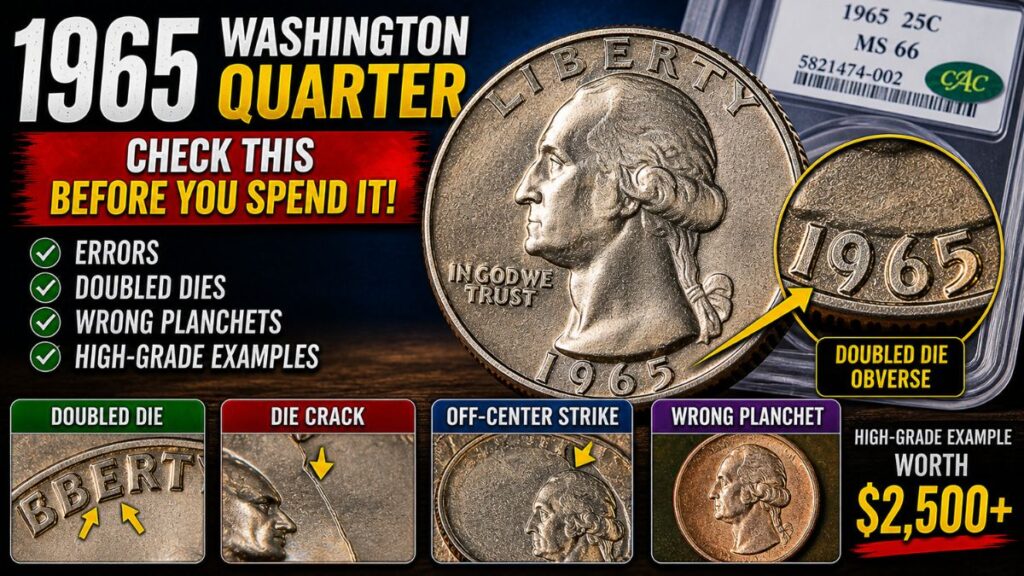
Finding a 1965 Washington Quarter may not seem unusual at first. More than 1.8 billion regular examples were struck, so the date itself does not automatically make the coin rare. But before spending one, there is a good reason to take a closer look.
The 1965 Washington Quarter belongs to an important transition period in United States coinage. It was the first year of the copper-nickel clad quarter, replacing the earlier silver composition used on regular Washington quarters. That change makes the year historically interesting, but the real collecting excitement comes from coins that differ from the normal 1965 issue.
Some 1965 quarters show possible doubled-die characteristics. Others can have major striking errors. A particularly dramatic example is a 1965 Washington Quarter struck on a five-cent planchet, an unusual minting mistake that created a coin dramatically different from the normal quarter.
Condition can also change the story. While most circulated 1965 quarters are common, an exceptionally preserved example can be much more desirable to collectors. A documented auction result of $12,650 for a regular 1965 Washington Quarter illustrates just how different an extraordinary high-grade coin can be from an ordinary circulated example.
That does not mean every 1965 quarter is valuable.
It means that identification matters.
If you have a 1965 Washington Quarter, the date should be the beginning of your examination rather than the end. Look at the design, check for possible doubling, consider the coin’s weight, inspect the surfaces, and watch for characteristics that could indicate a genuine minting error.
Most importantly, do not confuse damage with a mint error.
A scratch, dent, altered surface, or post-mint deformation can make an ordinary quarter look unusual without adding collectible value. Genuine errors are created during the manufacturing process, and determining whether an unusual feature happened at the Mint is often much more difficult than it first appears.
The 1965 Washington Quarter is therefore an excellent example of an important principle in coin collecting: a common date can still contain uncommon coins.
Why the 1965 Washington Quarter Deserves a Closer Look
The year 1965 is especially important in the history of the Washington Quarter because it marked the beginning of a major composition change.
The United States was experiencing a shortage of circulating coins, and the rising price of silver created pressure to reduce the use of silver in everyday coinage.
The quarter changed from the traditional silver composition to a copper-nickel clad construction.
A normal 1965 Washington Quarter consists of a copper-nickel outer layer bonded to a copper core.
This is very different from the earlier silver Washington quarters.
That distinction is important when examining a 1965 coin because the year helps identify the beginning of a new era in the denomination.
The coin may be common, but it represents a significant change in American coin production.
And when a major change in coinage occurs, collectors naturally pay attention to unusual pieces from the transition period.
The regular 1965 quarter is not rare simply because it was the first year of the clad quarter.
Its enormous production makes that clear.
The interesting question is whether a particular 1965 quarter has something beyond the standard design.
More Than 1.8 Billion Regular Examples Were Struck
One reason collectors should avoid assuming that every 1965 quarter is rare is the enormous production total.
More than 1.8 billion regular 1965 Washington Quarters were struck.
That is a huge number.
With such a large production run, many examples survived. Some entered circulation and became heavily worn, while others were saved in collections or remained in better condition.
This means that finding a 1965 quarter is not, by itself, a major rarity discovery.
The date is important historically, but the individual coin must be examined for characteristics that distinguish it from the enormous population of ordinary examples.
This is where varieties, errors, and condition become important.
A collector should think of the 1965 date as an invitation to inspect the coin rather than proof that the coin is valuable.
The Composition Change Makes 1965 Historically Significant
Before 1965, regular Washington Quarters were struck in a silver composition.
Beginning with 1965, regular quarters were produced using a copper-nickel clad composition.
The new structure consisted of a copper-nickel outer layer surrounding a copper core.
This change was one of the most significant developments in modern United States coinage.
For collectors, the 1965 quarter therefore has an important place in the history of the series.
It represents the beginning of a new composition era.
However, historical importance and rarity are not the same thing.
A coin can be historically significant while remaining common.
The regular 1965 quarter demonstrates exactly that.
Its historical importance makes it interesting to collectors, but its large production means that ordinary circulated examples are not automatically scarce.
What Makes a 1965 Quarter Potentially Valuable?
There are several characteristics that can make an individual 1965 Washington Quarter more collectible.
The first is a recognized variety.
The second is a genuine mint error.
The third is exceptional condition.
The fourth is a combination of these factors.
For example, a regular 1965 quarter in heavily circulated condition may have little premium beyond its basic collectible interest.
A sharply preserved example can be much more desirable.
A genuine doubled-die variety can attract additional interest.
A major error, such as a quarter struck on the wrong planchet, can be dramatically more unusual.
This is why the phrase “1965 quarter value” does not have one simple answer.
There is no single price that applies to every coin with the date.
The exact characteristics of the individual coin determine its place in the collecting market.
The 1965 Doubled Die Obverse FS-101
One of the varieties associated with the 1965 Washington Quarter is the Doubled Die Obverse FS-101.
This variety is important because genuine doubled-die characteristics can appear in prominent areas of the obverse design.
The supplied information identifies possible doubling on the date, LIBERTY, and IN GOD WE TRUST.
Those are exactly the kinds of areas collectors should examine when searching for a potential doubled-die example.
But caution is essential.
Not every appearance of doubling represents a genuine doubled die.
Coins can develop mechanical or post-mint features that look similar to inexperienced eyes.
That means a collector should not assume that any blurry or doubled-looking lettering is automatically the FS-101 variety.
The specific characteristics need to match the recognized variety.
What Is a Doubled Die?
A doubled die is a die variety created during the die-making process.
The die used to strike coins contains the design that is transferred onto the planchets.
If a die receives an improperly aligned impression during its preparation, certain design elements can appear doubled on coins struck from that die.
The resulting doubling is part of the die itself.
That is different from damage that occurs after a coin has been struck.
This distinction is fundamental.
A genuine doubled-die characteristic is reproduced on coins struck from the same die.
A random scratch or post-mint distortion will not behave in the same way.
For collectors, understanding this difference can prevent many false identifications.
Where to Look for the 1965 Doubled Die
If you suspect that a 1965 Washington Quarter may have doubled-die characteristics, examine the obverse carefully.
Start with the date.
Look at the individual digits and their shapes.
Then examine LIBERTY.
Finally, inspect IN GOD WE TRUST.
Use consistent lighting.
A magnifying glass can help reveal details that are difficult to see with the naked eye.
However, magnification should not be used to exaggerate ordinary surface marks.
The objective is to determine whether the apparent doubling has the characteristics associated with the recognized variety.
If the doubling appears weak, irregular, or more like surface damage, additional caution is necessary.
Why Machine Doubling Can Be Confusing
One of the biggest challenges for new collectors is distinguishing true doubled-die characteristics from other forms of apparent doubling.
Mechanical or machine doubling can occur during the striking process and may produce a flattened or shelf-like appearance.
To an inexperienced observer, that can look like doubled lettering.
But it is not necessarily the same thing as a recognized doubled-die variety.
This is why collectors should not make a high-value claim based solely on a photograph showing what appears to be doubled text.
The exact shape, location, and appearance of the doubling matter.
When a coin may be a valuable variety, professional attribution can be worthwhile.
The Reported $489 Auction Result for FS-101
The supplied information identifies a documented auction result of $489 for a 1965 Doubled Die Obverse FS-101 graded AU58.
That result is useful because it shows that a recognized 1965 doubled-die variety can command a premium over a normal circulated quarter.
But the context is critical.
The result applies to a specific coin with a specific variety and grade.
It does not mean that every 1965 quarter with apparent doubling is worth hundreds of dollars.
It also does not mean that every FS-101 example will sell for exactly $489.
Market prices can vary based on grade, eye appeal, certification, demand, and the circumstances of the sale.
The safest interpretation is that a genuine, properly attributed FS-101 can be substantially more collectible than an ordinary 1965 quarter.
Understanding the AU58 Grade
The AU designation means About Uncirculated.
A coin graded AU58 generally shows only limited evidence of circulation, while retaining much of its original detail and appearance.
That is very different from a heavily circulated quarter with extensive wear.
The 1965 FS-101 auction result of $489 involved an AU58 example.
Therefore, someone finding a worn 1965 quarter should not assume that it has the same market value even if it appears to show some doubling.
The variety and condition must both be considered.
This is another reason why auction records should never be treated as universal price tags.
The Dramatic Five-Cent Planchet Error
Perhaps the most striking error associated with the 1965 Washington Quarter is an example struck on a five-cent planchet.
This is an extraordinary type of minting error because the wrong blank was used for the quarter.
Instead of being struck on the planchet intended for a quarter, the design was struck on a planchet intended for a five-cent coin.
That creates a coin that does not match the normal physical characteristics of a 1965 Washington Quarter.
Such an error is dramatically different from ordinary wear or minor damage.
It is a manufacturing error that occurred during the coin-production process.
Because genuine wrong-planchet errors are uncommon and can be highly collectible, authentication becomes especially important.
What Is a Wrong-Planchet Error?
Before a coin is struck, the Mint prepares blank pieces of metal called planchets.
Different denominations require different planchets.
They can vary in composition, size, thickness, and weight.
A quarter normally requires a planchet appropriate for a quarter.
A five-cent planchet is intended for a nickel.
If a quarter design is accidentally struck on a five-cent planchet, the result is a wrong-planchet error.
The final coin can therefore have a mismatch between its design and physical characteristics.
This is fundamentally different from a coin that was damaged after leaving the Mint.
Why the Five-Cent Planchet Error Is So Interesting
A 1965 Washington Quarter struck on a five-cent planchet is interesting because it combines several clues.
The design says “quarter.”
The physical blank belongs to another denomination.
That mismatch provides an important diagnostic feature.
Collectors can examine the coin’s weight, diameter, thickness, and overall appearance as part of the investigation.
However, these measurements alone cannot establish authenticity.
A damaged or altered coin can sometimes produce unusual dimensions or weight.
Professional examination is particularly important for major wrong-planchet claims.
The Reported $5,175 Sale
The supplied information identifies a documented auction result of $5,175 for a 1965 Washington Quarter struck on a five-cent planchet.
That is a dramatic result compared with the ordinary value of a circulated 1965 quarter.
It illustrates why major mint errors can attract significant collector interest.
But again, the result belongs to a specific authenticated error coin.
It should not be interpreted as meaning that every unusual-looking 1965 quarter is worth thousands of dollars.
A genuine wrong-planchet error must be established.
The physical characteristics need to make sense.
The coin’s history and surfaces need to be considered.
And professional authentication is especially important when the claimed value is substantial.
Why Weight Matters When Examining a 1965 Quarter
Weight is one of the most useful preliminary tools when checking a potentially unusual coin.
A normal 1965 clad quarter has a standard expected weight.
If a coin believed to be a quarter has a substantially different weight, that can be a reason to investigate further.
This is especially relevant when considering a wrong-planchet error.
However, weight is only a clue.
A coin can lose material through damage.
Scales can have different levels of accuracy.
Environmental contamination can also affect a measurement.
Therefore, a surprising weight does not automatically prove an error.
The correct approach is to use weight as one part of a larger identification process.
Why You Should Measure More Than Weight
If a 1965 quarter appears unusual, consider more than the scale reading.
Look at the diameter.
Look at the thickness.
Examine the edge.
Study the surface.
Compare the overall appearance with a normal quarter.
A wrong-planchet error may produce multiple characteristics that make sense together.
For example, a planchet intended for another denomination can have different physical proportions from a quarter planchet.
A combination of consistent physical evidence is much more useful than one isolated measurement.
What the Edge Can Tell You
The edge of a coin can provide important clues.
A normal clad quarter has a particular edge appearance associated with its composition and construction.
If a suspected error has an unusual edge, that may deserve further examination.
But edge differences can also result from damage.
A coin can be squeezed, struck, filed, or otherwise altered after leaving the Mint.
Therefore, an unusual edge should be documented and evaluated rather than automatically labeled an error.
For a suspected wrong-planchet coin, the edge can be particularly informative when considered alongside weight and diameter.
Why Genuine Errors Are Different From Damage
A genuine mint error occurred during manufacturing.
Damage occurs afterward.
This distinction is essential.
Suppose a quarter has been flattened or squeezed by machinery.
It may have an unusual shape.
That does not necessarily mean it was struck incorrectly at the Mint.
Likewise, a coin that has been shaved, bent, scratched, or chemically altered is not automatically a valuable mint error.
Collectors should ask a simple question:
Does the unusual characteristic make sense as something that could have happened during the minting process?
If not, post-mint damage becomes a more likely explanation.
How a Coin Can Look Strange Without Being Rare
Coins encounter many hazards after leaving the Mint.
They can be dropped.
They can be exposed to chemicals.
They can be scratched.
They can be crushed.
They can be struck by machines.
They can be cleaned.
They can even be deliberately altered.
These events can create dramatic-looking features.
A damaged quarter can sometimes look much more unusual than a genuine error.
That does not make it more valuable.
In fact, damage generally reduces collector appeal.
This is why collectors should be skeptical of dramatic claims based only on appearance.
The Importance of Condition for a Normal 1965 Quarter
The 1965 Washington Quarter does not need to contain an error to become collectible.
Condition alone can make a major difference.
Most quarters were made to circulate.
They were handled by millions of people, placed into cash registers, carried in pockets, and used in ordinary transactions.
Everyday use creates contact marks and wear.
As a result, many surviving quarters have noticeable circulation damage.
A coin that escaped circulation and remained in exceptionally strong condition can be much more difficult to find.
That scarcity among top-grade examples can create significant collector demand.
The $12,650 Auction Record for a Regular 1965 Quarter
The supplied information identifies a PCGS auction record of $12,650 for a regular 1965 Washington Quarter.
At first glance, that number may seem surprising.
If more than 1.8 billion regular examples were struck, how could an ordinary example reach such a price?
The answer is condition.
The reported result represents an exceptionally high-grade collectible example.
It does not mean that a normal circulated 1965 quarter is worth thousands of dollars.
This distinction is essential.
A coin can be common overall while being rare in an extremely high grade.
The population of surviving coins at the very top of the grading scale can be dramatically smaller than the total number produced.
That is how a common date can still produce an impressive auction result.
Why High-Grade Coins Can Be So Scarce
Imagine a coin that was produced more than a billion times.
It might seem impossible for that date to be rare.
But now imagine that collectors want examples with virtually flawless surfaces and exceptional strike quality.
Most coins would have entered circulation.
Many would have received scratches or contact marks before anyone recognized their potential importance.
Others may have been stored poorly.
Some may have been cleaned.
Over decades, the number of coins that remain in truly exceptional condition can become surprisingly small.
This creates a type of rarity known as condition rarity.
The date is common.
The top condition is not.
The reported $12,650 auction record illustrates this concept clearly.
Why an Ordinary Circulated Quarter Is Different
A typical circulated 1965 Washington Quarter should not be compared directly with a top-grade certified example.
Circulation leaves marks.
The high points of the design become worn.
Luster fades.
Small scratches and contact marks accumulate.
The edge can also become damaged.
A high-grade coin avoids many of these problems.
Therefore, the difference between a circulated quarter and a top-grade example can be enormous from a collector’s perspective.
This is why you should inspect your coin’s condition before becoming excited about an auction record.
How to Judge the General Condition at Home
You do not need to assign an exact professional grade to understand whether a coin is heavily circulated or potentially high grade.
Start by looking at the major design elements.
Are the details sharp?
Does the surface show many scratches?
Are there obvious contact marks?
Does the coin appear worn?
Does it retain original-looking luster?
Has it been cleaned?
A coin that has obvious wear and numerous marks is unlikely to compete with the highest-grade examples.
A coin that looks unusually sharp and well preserved may deserve closer attention.
Professional grading is required for an official grade, but basic condition screening can help collectors decide which coins deserve further investigation.
Why Surface Quality Matters
Surface quality can be just as important as the sharpness of the design.
A coin may have strong details but numerous scratches.
Another coin may have excellent surfaces but weaker strike detail.
Collectors evaluating high-grade coins consider these characteristics together.
Cleaning can also complicate the picture.
A polished coin may appear bright while having an altered surface.
That does not make it comparable with a naturally preserved Mint State example.
For this reason, never polish a 1965 quarter in an attempt to improve its appearance.
You could permanently damage a coin that might otherwise have been collectible.
Why You Should Never Clean a Suspected Rare Quarter
This is one of the most important rules in coin collecting.
Do not use metal polish.
Do not use toothpaste.
Do not scrub the surface.
Do not scrape dirt from the design.
Do not use household chemicals.
Do not attempt to make the coin shiny.
Cleaning can leave microscopic scratches and unnatural surfaces.
Professional collectors generally want to see the original condition of the coin.
If a 1965 quarter appears potentially valuable, preservation is far more important than appearance enhancement.
Handle it by the edges and store it safely until it can be evaluated.
How to Inspect a 1965 Quarter Step by Step
A systematic examination can help prevent mistakes.
Begin by confirming the date.
Make sure the coin actually says 1965.
Next, examine the obverse.
Look closely at the date.
Inspect LIBERTY.
Check IN GOD WE TRUST.
If possible, use magnification to look for consistent doubling.
Then turn the coin over and inspect the reverse.
Look at the design, lettering, and overall strike.
Next, examine the edge.
After that, measure the weight if you have an accurate scale.
If the coin seems unusually light or otherwise inconsistent with a normal quarter, measure its dimensions as well.
Finally, consider its condition.
This process does not prove that a coin is rare, but it can identify reasons to investigate further.
How to Look for the FS-101 Doubled Die
When examining a possible 1965 Doubled Die Obverse FS-101, focus on the areas associated with the variety.
The date is an obvious starting point.
Look carefully at the digits.
Then inspect LIBERTY.
Finally, examine IN GOD WE TRUST.
True doubled-die characteristics should appear as part of the design rather than as random scratches across the surface.
The shape and position of the doubling matter.
If the feature appears to be a flat shelf-like edge, mechanical doubling may be a possibility.
If it looks like damage cutting across the lettering, it may have happened after the coin was struck.
When the characteristics are difficult to interpret, professional attribution is the safest route.
Why a Photograph Is Not Always Enough
Coin photographs can be extremely useful, but they have limitations.
Lighting can create shadows.
Reflections can exaggerate surface marks.
Camera focus can blur small details.
Digital sharpening can make ordinary edges appear doubled.
A photograph can therefore create a misleading impression.
If you believe your coin has the FS-101 variety or a major striking error, a clear physical examination is preferable.
High-value claims should not be based on one blurry photograph.
How to Photograph Possible Doubling
If you want to document your coin before professional examination, take clear photographs.
Use even lighting.
Keep the camera directly above the coin.
Avoid extreme angles.
Photograph the entire obverse.
Then take close-ups of the date, LIBERTY, and IN GOD WE TRUST.
Do not use filters.
Do not digitally alter the image.
The purpose is to show the coin accurately.
Good documentation can make comparisons easier and may help a professional determine whether additional examination is justified.
What a Genuine Wrong-Planchet Quarter Should Make You Question
If a 1965 quarter appears unusually small, thin, light, or otherwise different from a normal quarter, several questions should be asked.
Could the coin have been struck on a different planchet?
Could the coin have been damaged after leaving the Mint?
Is the weight consistent with the suspected planchet?
Does the diameter make sense?
Does the edge support the proposed explanation?
Does the coin’s design appear complete?
Are the surfaces original?
These questions help separate a potentially important mint error from ordinary damage.
Why the Five-Cent Planchet Theory Must Be Proven
It is tempting to look at a lightweight 1965 quarter and immediately conclude that it was struck on a five-cent planchet.
That would be premature.
Weight alone is not proof.
The entire coin must support the explanation.
A genuine wrong-planchet error should have physical characteristics consistent with the proposed planchet.
Professional authentication can examine these characteristics in detail.
This is especially important because a confirmed wrong-planchet error can have substantial collector value.
The greater the potential value, the greater the importance of accurate authentication.
Why Professional Authentication Matters
When a coin could potentially be worth hundreds or thousands of dollars, professional authentication becomes especially important.
An experienced grading and authentication service can examine the coin’s authenticity, variety, condition, and error characteristics.
This helps distinguish a genuine mint product from an altered or damaged coin.
For a suspected FS-101 doubled die, professional attribution can confirm whether the coin matches the recognized variety.
For a suspected wrong-planchet error, professional examination can determine whether the physical characteristics are consistent with the claimed error.
For an exceptionally high-grade regular 1965 quarter, professional grading can establish its condition.
In all three cases, authentication provides information that a casual inspection cannot reliably provide.
Why Auction Records Must Be Put Into Context
Auction records are useful because they show what collectors have actually paid for specific coins.
But they should never be treated as guaranteed prices.
The $489 FS-101 result involved a specific AU58 coin.
The $5,175 wrong-planchet result involved a specific major mint error.
The $12,650 regular-issue result involved an exceptionally high-grade example.
These are three very different situations.
A circulated ordinary quarter should not be compared with a certified error coin or a top-grade condition rarity.
Understanding that difference is one of the most important parts of responsible coin collecting.
Why the Highest Price Is Usually the Wrong Starting Point
A common mistake is to search for the most expensive example of a date and assume that your coin might be worth the same.
That approach can create unrealistic expectations.
Instead, start with identification.
Determine the coin’s exact variety.
Determine whether it is an error.
Determine its condition.
Determine whether it has been certified.
Then look at comparable sales.
A high auction record can be useful after identification, but it should not be used to identify the coin in the first place.
The process should always move from identification to valuation, not the other way around.
What Makes a Mint Error Different From a Variety?
A variety is generally a recurring difference in the design or die characteristics.
A doubled die is a classic example of a die variety.
A mint error is an unintended mistake that occurs during production.
A wrong-planchet error is an example of a striking error involving an incorrect blank.
Both varieties and errors can be collectible.
But they are identified differently.
Understanding the distinction helps collectors communicate accurately and avoid calling every unusual coin an “error.”
Why the 1965 Quarter Is a Good Coin for Beginners to Study
The 1965 Washington Quarter offers several useful collecting lessons in one coin.
It introduces the copper-nickel clad composition.
It has a huge production total.
It has recognized varieties.
It can appear with major minting errors.
It can also become scarce in exceptionally high grades.
That combination makes the date educational for anyone learning about modern United States coinage.
Instead of simply asking whether a 1965 quarter is rare, a collector can learn to ask better questions.
What variety is it?
What minting process produced the unusual feature?
What condition is it in?
Is the characteristic genuine?
Does it match a recognized variety?
Those questions build much stronger collecting skills.
What If Your 1965 Quarter Looks Completely Normal?
If your 1965 quarter looks normal, that is not necessarily a bad thing.
The majority of examples are expected to be ordinary.
A normal circulated 1965 quarter is still a piece of American coinage history.
It represents the transition to clad coinage and the beginning of a new era for the Washington Quarter.
Not every coin needs to be worth thousands to be interesting.
However, if you are searching specifically for valuable examples, focus your attention on unusual characteristics, condition, and recognized varieties.
What If the Coin Is Heavily Worn?
A heavily worn coin can still be examined for major errors.
Some mint errors remain visible even after years of circulation.
For example, a major wrong-planchet characteristic may still be apparent through physical measurements.
However, condition will affect the coin’s market appeal.
A heavily worn coin generally cannot be compared directly with a top-grade example.
The key is to separate the questions of rarity and condition.
A rare error can remain rare even when worn.
A common coin remains common even when worn.
What If the Quarter Has No Obvious Error?
Do not assume that nothing is interesting about it.
Examine the condition.
A very well-preserved regular issue can be collectible.
The reported $12,650 auction record demonstrates that a regular 1965 quarter can achieve a substantial result under exceptional circumstances.
But the coin would need to be in extraordinary condition to make that comparison meaningful.
For most circulated examples, the high-grade auction record is not relevant.
The lesson is simply that common dates can sometimes become condition rarities.
Why High-Grade 1965 Quarters Require Careful Preservation
If you find a 1965 quarter that appears unusually sharp and well preserved, handle it carefully.
Do not stack it with other coins.
Do not carry it loose in a pocket.
Do not wipe it with a cloth.
Do not attempt to remove spots.
Even minor surface damage can affect the appearance of an otherwise exceptional coin.
Store it in an appropriate holder and consider professional grading if its condition genuinely appears exceptional.
The goal is to preserve the coin’s current state while you investigate it.
What New Collectors Should Avoid
New collectors often make the same mistakes.
They assume an old coin must be rare.
They confuse damage with errors.
They mistake machine doubling for a doubled die.
They rely on a single online photograph.
They clean coins.
They compare their circulated coin with the highest auction result.
They assume a strange weight proves a wrong-planchet error.
Avoiding these mistakes can save both money and disappointment.
The best collectors are not necessarily those who find the most dramatic coins.
They are often the ones who identify their coins most carefully.
How to Store a Potentially Valuable 1965 Quarter
Once you suspect that a quarter may be unusual, protect it.
Use a suitable coin holder made from materials intended for long-term numismatic storage.
Keep the coin away from moisture and extreme environmental conditions.
Avoid contact with other coins.
Handle it by the edges.
Do not repeatedly remove and replace it from a tight holder.
Good storage will not increase rarity, but it can help prevent additional damage.
This is especially important if the coin is already in unusually high condition.
Why You Should Record Your Observations
Before sending a coin for professional evaluation, write down what you noticed.
Record the date.
Record the apparent mint information.
Record the weight.
Record any unusual doubling.
Record whether the edge looks different.
Record any evidence of cleaning or damage.
Take clear photographs.
This information can make the examination process more organized.
It also prevents you from forgetting what first attracted your attention to the coin.
How to Think About a 1965 Quarter Found in Change
If you find a 1965 quarter in ordinary change, there is no reason to assume that it is automatically valuable.
But there is also no reason to spend it without looking.
The date makes it easy to identify.
Take a moment to examine the coin.
Check the overall condition.
Look for obvious unusual characteristics.
If nothing stands out, it may simply be a common 1965 quarter.
If something does look unusual, investigate further before making a decision.
That simple habit can make searching pocket change more interesting without creating unrealistic expectations.
The Difference Between a Coin’s Age and Its Rarity
A 1965 quarter is now many decades old.
That may sound impressive, but age alone does not determine rarity.
Billions of coins can be produced in one year.
Many can survive for decades.
The passage of time does not automatically eliminate them from existence.
Rarity comes from scarcity.
A coin can be old and common.
A coin can be modern and rare.
A coin can also be common in circulated condition but scarce at the highest grade.
The 1965 Washington Quarter demonstrates all of these ideas.
Why the Composition Change Does Not Make Every 1965 Quarter Valuable
Because 1965 marked the beginning of the copper-nickel clad quarter era, some people assume that all 1965 quarters must be rare.
That is not accurate.
The composition change makes the year historically important.
It does not make every individual coin scarce.
More than 1.8 billion regular examples were struck.
That production number alone explains why ordinary examples are widely available.
The collectible opportunities come from specific varieties, errors, and exceptional condition.
How to Decide Whether Further Investigation Is Worthwhile
You do not need to submit every 1965 quarter for professional grading.
Instead, look for specific reasons.
The coin may show credible doubled-die characteristics.
The weight may be significantly different from normal.
The physical dimensions may suggest a different planchet.
The coin may be unusually well preserved.
The surfaces may appear original and exceptionally clean.
If one or more of these characteristics is present, further investigation may make sense.
If the coin is heavily worn and completely ordinary, professional grading may not be necessary.
The goal is to use resources intelligently.
Why Authentication Is Especially Important for Major Errors
Major errors can be valuable because they are unusual.
That value also creates an incentive for altered coins to be misrepresented.
A damaged quarter may be marketed as an error.
A modified coin may be presented as a wrong-planchet example.
A coin with mechanical doubling may be described as a doubled die.
Professional authentication helps protect collectors from these problems.
When a coin could potentially be worth several thousand dollars, paying for proper evaluation can be far more sensible than relying on an online claim.
Frequently Asked Questions About the 1965 Washington Quarter
Is the 1965 Washington Quarter rare?
The regular 1965 Washington Quarter is common because more than 1.8 billion regular examples were struck. Certain varieties, major mint errors, and exceptional high-grade examples can be much more collectible.
Why is the 1965 quarter historically important?
It marks the beginning of the copper-nickel clad composition for regular Washington Quarters, replacing the earlier silver composition.
What is the normal composition of a 1965 Washington Quarter?
The regular 1965 quarter has a copper-nickel outer layer over a copper core.
What is the 1965 Doubled Die Obverse FS-101?
It is a recognized doubled-die variety associated with the 1965 Washington Quarter. The supplied information notes visible doubling in areas including the date, LIBERTY, and IN GOD WE TRUST.
How much did a 1965 FS-101 quarter sell for?
The supplied information identifies a documented $489 auction result for an AU58 example. That price applies to the specific certified coin and should not be treated as the value of every 1965 quarter showing apparent doubling.
What should I look for when checking a possible doubled die?
Examine the date, LIBERTY, and IN GOD WE TRUST carefully. Compare the apparent doubling with recognized examples and be careful not to confuse machine doubling or damage with a genuine doubled die.
What is a five-cent planchet error?
It is a minting error in which a coin intended to be a quarter is struck on a planchet intended for a five-cent coin.
How much did a 1965 quarter struck on a five-cent planchet sell for?
The supplied information identifies a documented auction result of $5,175 for such an error. The result applies to the authenticated error coin and does not mean every unusual 1965 quarter is worth thousands.
Can weight help identify a wrong-planchet error?
Yes. Weight can be an important preliminary clue, but it cannot prove an error by itself. Diameter, thickness, edge characteristics, surfaces, and professional authentication may also be necessary.
Can a normal 1965 quarter be valuable?
An exceptionally high-grade regular 1965 quarter can be highly collectible. The supplied information identifies a $12,650 auction record for a regular issue, but that result represents an exceptional high-grade example rather than an ordinary circulated quarter.
Does every 1965 quarter have a high value?
No. Most 1965 quarters are common. Value depends on variety, error status, condition, authenticity, and collector demand.
Should I clean my 1965 Washington Quarter?
No. Cleaning, polishing, or using chemicals can damage the coin’s original surface and reduce its collector appeal.
Does a shiny 1965 quarter mean it is rare?
No. Shine can result from original surfaces, lighting, polishing, or cleaning. A coin’s rarity must be established through its actual variety, error characteristics, and condition.
How can I tell if doubling is genuine?
Look for consistent characteristics in the recognized areas and compare them with established examples. If the feature is difficult to interpret, professional attribution is the safest option.
Is machine doubling the same as a doubled die?
No. Machine doubling is a different phenomenon and should not automatically be identified as a doubled-die variety.
Should I weigh my 1965 quarter?
If you suspect a major error, an accurate weight measurement can be useful as an initial screening tool. However, weight alone cannot establish authenticity or rarity.
What should I do if my 1965 quarter looks unusual?
Do not clean or alter it. Record the date, measure its weight if possible, photograph both sides, examine the edge, and consider professional authentication if the characteristics suggest a major variety or error.
Is an old 1965 quarter automatically worth more than face value?
No. Age alone does not establish a premium. The regular 1965 issue was produced in enormous numbers, so specific characteristics must be present to create substantial collector interest.
Why can a common coin have a high auction record?
A common date can still be rare in an exceptional grade. The highest-grade surviving examples may be scarce even when millions or billions of lower-grade examples exist.
What is the safest way to handle a potentially rare quarter?
Hold it by the edges, avoid rubbing the surfaces, keep it away from other loose coins, and store it in a suitable holder until it can be properly examined.
Final Thoughts on the 1965 Washington Quarter
The 1965 Washington Quarter is a perfect reminder that coin collecting is often about the details.
More than 1.8 billion regular examples were struck, so the date alone does not make the coin rare. Nevertheless, the year remains historically important because it introduced the copper-nickel clad composition for regular Washington Quarters.
The real collecting interest begins when an individual coin differs from the ordinary issue.
A recognized doubled-die variety such as the 1965 Doubled Die Obverse FS-101 can attract a premium when properly identified. The supplied auction record of $489 for an AU58 example demonstrates the potential collector interest in an authenticated variety.
Major mint errors can be even more dramatic. A 1965 Washington Quarter struck on a five-cent planchet represents a completely different category of rarity, and the supplied $5,175 auction result shows why genuine wrong-planchet errors can command substantial attention.
Then there is condition.
The reported $12,650 auction record for a regular 1965 Washington Quarter demonstrates that even a normal issue can become highly collectible when preserved at an exceptional level. That result should not be confused with the value of an ordinary circulated coin.
The key is to identify the exact coin before thinking about price.
If you find a 1965 Washington Quarter, check the date first. Then examine the obverse for possible doubling, especially around the date, LIBERTY, and IN GOD WE TRUST. Look at the reverse and edge. Consider the coin’s weight if something seems unusual. Pay attention to the overall condition and watch for evidence of cleaning or damage.
Most importantly, do not assume that every unusual-looking feature is a mint error.
A genuine variety or error needs to be supported by characteristics consistent with the minting process. When a coin appears potentially valuable, professional authentication can provide the confidence needed to separate a genuine rarity from an ordinary coin with post-mint damage.
So before spending that 1965 Washington Quarter, take a moment to look closely.
It may be completely ordinary.
But if the doubling, weight, physical characteristics, or preservation looks unusual, that small piece of American coinage may deserve much more attention than its 25-cent face value suggests.