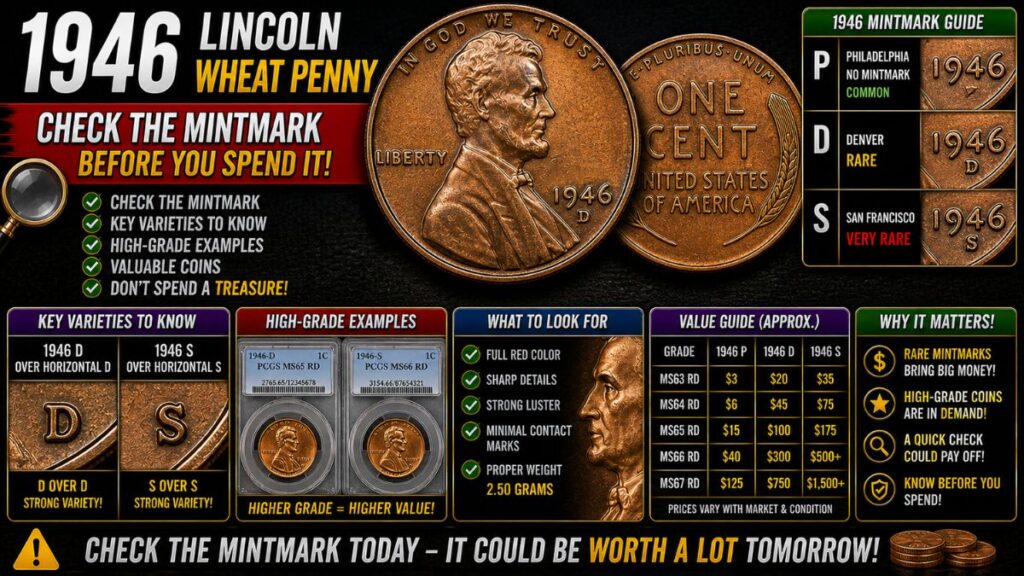
Stop before you spend that 1946 Lincoln Wheat Penny. At first glance, it may look like an ordinary old one-cent coin, but the small mintmark beneath the date can tell you something important about where it was made and which version you have.
The 1946 Lincoln Wheat Penny is generally a common coin, especially in circulated condition. Millions were produced, and many examples have survived. That means simply finding a penny dated 1946 does not automatically make it rare or extremely valuable.
But there is a reason collectors still pay close attention to this date.
The 1946 Lincoln Wheat Penny was produced at three United States Mints: Philadelphia, Denver, and San Francisco. Philadelphia examples have no mintmark, while Denver coins carry a small “D” and San Francisco coins carry an “S.” That tiny letter can immediately separate one version from another.
Condition can make an even bigger difference.
A worn 1946 wheat penny may be relatively ordinary from a collector’s perspective, while an exceptionally preserved example can become much more interesting. The 1946-S is especially notable in superb condition, with a PCGS-recorded auction sale of $16,800 for an MS67+ Red example.
That number can easily grab attention, but it needs to be understood correctly.
A $16,800 auction result for a specific authenticated, exceptionally high-grade coin does not mean every 1946-S penny is worth thousands of dollars. Most 1946 Lincoln Wheat Pennies do not come close to that level.
The real lesson is simple: check the mintmark, examine the condition, and investigate unusual details before deciding what your coin might be worth.
For collectors, the 1946 Lincoln Wheat Penny is particularly interesting because it combines an accessible common date with different mintmarked issues, recognized varieties, and the possibility of finding an exceptionally preserved example.
Why the 1946 Lincoln Wheat Penny Deserves a Closer Look
The Lincoln Wheat Penny is one of the most recognizable coins in American numismatic history.
The obverse features Abraham Lincoln, while the reverse displays two wheat ears surrounding the denomination and other inscriptions. The wheat reverse gives the series its familiar name and makes these coins instantly recognizable to collectors and casual finders alike.
The 1946 issue belongs to the post-war period of American coinage. It was produced shortly after World War II, when the United States was transitioning back toward peacetime production.
That historical setting adds interest to the coin, but history alone does not determine its monetary value.
The important point for someone holding a 1946 penny is that there are several things worth checking before treating it as an ordinary one-cent coin.
The first is the mintmark.
The second is condition.
The third is whether the coin displays a recognized variety or another legitimate characteristic that separates it from a standard example.
These three areas can make the difference between an ordinary collectible and a much more desirable specimen.
A collector examining a 1946 penny should therefore resist the temptation to judge the coin based only on its age.
It is not enough to say, “This penny is nearly eighty years old, so it must be valuable.”
Instead, ask more specific questions.
Where was it struck?
How well has it survived?
Does it have original surfaces?
Is the color attractive?
Are the details sharp?
Does it show a recognized variety?
And if someone claims it is exceptionally valuable, is there evidence supporting that claim?
Those questions create a much more realistic way to evaluate a 1946 Lincoln Wheat Penny.
The Three Mintmarks of the 1946 Lincoln Wheat Penny
The easiest place to begin is the mintmark.
In 1946, Lincoln Wheat Pennies were produced at Philadelphia, Denver, and San Francisco.
The three versions can be distinguished by their mintmarks.
A Philadelphia 1946 cent has no mintmark.
A Denver 1946 cent carries a “D.”
A San Francisco 1946 cent carries an “S.”
The mintmark appears beneath the date on the obverse of the coin.
This tiny area deserves special attention because it immediately tells you which mint produced the coin.
For someone unfamiliar with Lincoln Wheat Pennies, the difference may seem insignificant. A tiny letter may not look important at first.
For collectors, however, identifying the mint is one of the fundamental steps in identifying a coin.
It allows the coin to be placed into the correct date-and-mint category.
That matters because different mint issues can have different production histories, surviving populations, varieties, and collector demand.
So if you have a 1946 Lincoln Wheat Penny, do not stop after confirming the date.
Look directly underneath it.
If there is no letter, you have the Philadelphia issue.
If there is a D, you have a Denver issue.
If there is an S, you have a San Francisco issue.
That tiny detail is the starting point for everything that follows.
The 1946 Philadelphia Lincoln Wheat Penny
The Philadelphia version of the 1946 Lincoln Wheat Penny has no mintmark.
This can confuse new collectors because they may assume that every genuine United States coin should have a letter indicating its mint.
That is not the case.
For this issue, the absence of a mintmark is exactly what identifies the Philadelphia production.
When examining the coin, look beneath the 1946 date.
If there is no D or S, it is the Philadelphia issue.
The lack of a mintmark should not automatically be interpreted as an error.
It is a normal characteristic of the Philadelphia 1946 cent.
This is an important point because collectors frequently encounter claims that a missing mintmark must mean something unusual happened to the coin.
In this case, no mintmark is exactly what you should expect from a Philadelphia example.
The condition of the coin then becomes one of the major factors to consider.
A heavily circulated Philadelphia 1946 cent is generally much less remarkable than a beautifully preserved specimen with strong original characteristics.
Collectors should therefore identify the mint first and then move on to condition and variety research.
The 1946-D Lincoln Wheat Penny
The Denver version can be identified by the small “D” beneath the date.
This letter indicates that the coin was produced at the Denver Mint.
The D is small, so beginners sometimes overlook it, especially when the coin is worn.
Circulation can soften the edges of the mintmark and make it harder to see.
Dirt, discoloration, and scratches can also distract from the small letter.
A magnifying glass can make identification much easier.
Once the D is confirmed, the coin can be classified as a 1946-D Lincoln Wheat Penny.
That identification is useful because it separates the coin from the Philadelphia and San Francisco versions.
However, the presence of a D does not automatically make the coin rare.
A mintmark is an identification feature, not a guarantee of high value.
Collectors should still examine the coin’s condition and look for any legitimate variety or error.
A worn 1946-D cent and a superbly preserved 1946-D cent can have very different collector appeal.
That is why identifying the mintmark is only the first step.
The 1946-S Lincoln Wheat Penny
The San Francisco issue carries an “S” beneath the date.
This version is particularly interesting to collectors because recognized 1946-S varieties exist, including an S-over-D overmintmark variety and an inverted mintmark variety.
The existence of these varieties makes the mintmark especially important.
A collector should not simply glance at the S and move on.
Instead, examine it carefully if the coin appears promising.
The shape, orientation, and details of the mintmark can potentially provide clues about whether the coin belongs to a recognized variety.
However, careful identification is essential.
Not every unusual-looking S is a valuable variety.
Wear, damage, lighting, scratches, and surface changes can make a normal mintmark appear strange.
A genuine variety should be supported by recognized characteristics rather than simply looking unusual.
The 1946-S also has another important attraction: exceptional high-grade examples can be considerably more valuable than ordinary circulated coins.
That is where condition becomes especially important.
The $16,800 1946-S Lincoln Wheat Penny Sale
One of the most striking facts associated with the 1946-S Lincoln Wheat Penny is the PCGS-recorded $16,800 auction sale for an MS67+ Red example.
That figure can immediately make someone wonder whether the 1946 penny sitting in a collection or coin jar might also be worth thousands of dollars.
But this is exactly where careful interpretation matters.
The $16,800 result applies to a very specific coin.
It was an authenticated example in an exceptionally high grade, designated MS67+ Red.
That is dramatically different from an ordinary circulated 1946-S cent.
The auction result demonstrates what can happen when the right combination of date, mintmark, condition, color, authentication, and collector demand comes together.
It does not establish a value of $16,800 for every 1946-S penny.
This distinction is critical.
A circulated 1946-S cent can look similar in basic design while being vastly different in condition from an MS67+ Red specimen.
One coin may have years of circulation wear, while the other has survived in extraordinary condition.
Therefore, the high auction result should be viewed as an example of the potential importance of exceptional condition rather than as a standard price for the date.
What Does MS67+ Mean?
MS stands for Mint State.
A Mint State coin is an uncirculated coin that has not experienced normal circulation wear.
The numerical grade provides additional information about its condition.
An MS67 grade represents a very high level of preservation.
An MS67+ designation indicates an example that is considered to have characteristics above the standard level for that grade but not quite enough, under the grading system, to reach the next full grade.
For a common-date coin, an extremely high grade can make an enormous difference in collector interest.
That is especially true when very few examples survive at such a high level of preservation.
An MS67+ Red 1946-S Lincoln Wheat Penny is therefore not simply “a 1946 penny.”
It is a highly specific collectible.
The coin has to meet strict standards for its condition and color designation.
This is why comparing an ordinary pocket-change example with an MS67+ Red specimen would be misleading.
The two coins may share the same date and mintmark, but they occupy completely different categories in the collector market.
What Does “Red” Mean on a Lincoln Wheat Penny?
The term “Red” refers to the color designation used for copper coins that retain a substantial amount of their original red coloration.
Copper changes appearance over time.
A newly struck copper-alloy coin can have a reddish appearance, but exposure to the environment can cause the surface to develop darker tones.
Lincoln cents can therefore display different color appearances depending on their age, storage, handling, and surface history.
Collectors commonly encounter brown and red-brown examples as well as coins retaining significant original red color.
For high-grade Lincoln Wheat Pennies, color can be an important part of the coin’s description.
That helps explain why an MS67+ Red 1946-S cent represents a very specific type of coin.
It is not simply a high-grade example.
Its color designation is also part of the description.
This is another reason that the $16,800 auction result should not be generalized to every 1946-S cent.
The exact combination of grade and color matters.
Why Condition Matters So Much on the 1946 Lincoln Wheat Penny
Condition can completely change the collector appeal of a 1946 Lincoln Wheat Penny.
A circulated coin may have been handled thousands of times.
The high points of Lincoln’s portrait can become worn.
The hair detail can soften.
The cheek and jawline can lose sharpness.
The wheat ears on the reverse can become less defined.
The lettering can also show wear.
An uncirculated coin, by contrast, can retain much more of the original detail.
However, uncirculated does not mean perfect.
An uncirculated coin can still have contact marks, surface imperfections, discoloration, or other characteristics that influence its grade.
The highest-grade coins are difficult to find because preserving a coin in exceptional condition for decades is challenging.
Coins can be scratched during production.
They can contact other coins during handling.
They can be stored improperly.
They can develop spots or color changes.
All of these factors can affect the final grade and appearance.
That is why collectors examining a 1946 penny should pay attention to the entire surface rather than focusing exclusively on the date or mintmark.
How to Tell if a 1946 Wheat Penny Is Circulated
A circulated 1946 Lincoln Wheat Penny will generally show evidence of use.
The easiest areas to examine are the raised parts of Lincoln’s portrait and the wheat reverse.
Look closely at Lincoln’s hair, cheek, jawline, and other high points.
If these areas appear flattened or smooth compared with the surrounding design, the coin may have experienced circulation wear.
On the reverse, inspect the wheat ears and lettering.
Circulation gradually removes the sharpness from raised design elements.
The coin may also have scratches, nicks, stains, or other marks from its time in commerce.
A circulated coin can still be attractive and collectible.
It simply belongs to a different condition category from a Mint State specimen.
Understanding that distinction helps prevent unrealistic comparisons.
A worn 1946-S penny should not be compared directly with the $16,800 MS67+ Red example simply because both carry the same date and S mintmark.
What Makes an Uncirculated 1946 Wheat Penny Different?
An uncirculated 1946 Lincoln Wheat Penny generally shows no normal circulation wear.
The raised portions of the design can retain much more detail.
The coin may also display original mint luster.
However, the presence of luster alone does not prove that a coin is uncirculated.
A coin can be shiny because it has been cleaned or polished.
That is why collectors look at multiple characteristics rather than relying on brightness.
An uncirculated coin may also have contact marks from other coins.
Those marks can affect its grade.
Two uncirculated 1946-S pennies can therefore look noticeably different from each other.
One may have numerous marks and weaker eye appeal, while another may have cleaner surfaces and stronger overall preservation.
This variation is one reason grading matters so much when discussing potentially valuable examples.
What Is an S-Over-D Overmintmark Variety?
One of the recognized 1946-S varieties mentioned by collectors is an S-over-D overmintmark variety.
An overmintmark occurs when one mintmark is impressed over another mintmark.
In this case, the S is associated with a D underneath it.
This type of variety is especially interesting because it provides evidence of a difference in the production process.
The feature is not simply a scratch or random surface mark.
The important task for collectors is confirming whether the coin actually displays the recognized characteristics of the variety.
An ordinary S can look unusual when worn.
Damage around the mintmark can also create extra lines.
Therefore, simply seeing what appears to be another letter does not prove that the coin is an S-over-D variety.
Collectors should compare the mintmark with trusted examples and examine the shape carefully.
If the feature matches a documented variety, the coin may deserve additional attention.
What Is the Inverted Mintmark Variety?
Another recognized 1946-S variety involves an inverted mintmark.
As the name suggests, the orientation of the mintmark is an important part of the variety.
Because the mintmark is extremely small, identifying such a feature requires careful observation.
Magnification can be useful, particularly when the coin is well preserved.
However, a collector should avoid declaring a coin an inverted-mintmark variety based solely on an unclear photograph or an unusual-looking letter.
Lighting and surface wear can change the apparent orientation of small details.
The correct approach is to compare the coin with established examples of the recognized variety.
The surrounding design should also be examined.
A legitimate variety should have a characteristic appearance that can be consistently identified.
This is an excellent example of why a tiny detail can become important in coin collecting.
Why Not Every Unusual Mintmark Is a Variety
Small coins are full of visual details that can be misleading.
A scratch through a mintmark can look like an extra letter.
A dent can create a line that appears to be part of the original design.
Wear can make one side of a letter look thicker.
Lighting can produce shadows that resemble doubling.
Photography can exaggerate small surface differences.
Because of these possibilities, collectors should be cautious about claims of rare varieties.
A recognized variety is more than an unusual appearance.
It has specific characteristics associated with the coin’s production.
This is particularly important when a seller claims that an ordinary 1946 penny is a rare variety.
Before paying a premium, identify exactly what feature is being claimed and compare it with reliable examples.
How to Examine the Mintmark With a Magnifying Glass
A magnifying glass can be one of the most useful tools for examining a 1946 Lincoln Wheat Penny.
Place the coin under good lighting.
Hold the magnifier steadily above the mintmark.
Look at the edges of the letter.
Then examine the interior of the letter and the surrounding surface.
Do not focus only on the most obvious line.
Look at how the entire feature relates to the rest of the coin.
If you suspect an S-over-D variety, look for evidence consistent with overlapping mintmark impressions.
If you suspect an inverted mintmark, pay attention to the orientation of the S.
Take clear photographs from multiple angles if necessary.
Avoid pressing tools against the coin or attempting to scrape away dirt.
Physical manipulation can damage the surface and potentially destroy evidence that might otherwise help with identification.
Why the 1946 Penny’s Weight Matters
The 1946 Lincoln Wheat Penny weighs 3.11 grams under its standard specifications.
That number can be useful when examining a coin.
Weight can help collectors determine whether a coin appears consistent with the standard issue.
However, a scale reading should not be treated as proof of rarity by itself.
Small differences can result from wear, measurement limitations, dirt, or other factors.
A coin that weighs slightly differently does not automatically represent an unusual composition or mint error.
The weight should be considered alongside the coin’s physical appearance, dimensions, and other characteristics.
For a normal 1946 Lincoln Wheat Penny, the expected weight provides a useful reference point.
If a coin shows a substantial difference, additional examination may be justified.
But weight alone cannot establish that a coin is rare or valuable.
The Copper Composition of the 1946 Lincoln Wheat Penny
The 1946 Lincoln Wheat Penny is primarily made of copper.
Its standard composition is associated with the copper-alloy Lincoln cents of the period.
This copper content helps explain why the coins can change color as they age.
A freshly struck copper-alloy cent can display a reddish appearance.
Over time, exposure to air and the environment can cause the surface to become darker.
Storage conditions can also influence appearance.
This is why two 1946 pennies can have very different colors even when they were produced at the same mint.
One may appear brown, another red-brown, and another may retain more of its original red color.
Color should therefore be viewed as part of the coin’s overall condition rather than as proof of rarity by itself.
Why Copper Coins Change Color
Copper is reactive with its environment.
Over many years, the surface can undergo changes that alter its appearance.
A coin stored in a dry, stable environment may preserve its surfaces differently from one exposed to moisture or chemicals.
Handling can also affect the surface.
Fingerprints and oils can leave residues.
Improper storage may contribute to spots or discoloration.
These changes are one reason collectors care about original surfaces.
A naturally aged coin may show attractive color changes without having been damaged.
By contrast, a coin that has been chemically treated or polished may have an altered appearance.
The goal when evaluating a 1946 Wheat Penny is to determine whether the surface appears original and well preserved.
Why You Should Never Polish a Potentially Valuable Penny
A common mistake is cleaning an old coin in an attempt to make it look newer.
That can be particularly harmful when dealing with a potentially valuable Lincoln Wheat Penny.
Polishing can leave fine scratches across the surface.
Chemical cleaning can change the color.
Abrasive materials can remove original surface characteristics.
Once the original surface has been altered, it may be impossible to restore the coin to its previous condition.
This matters because collectors often value original preservation.
If you believe your 1946 penny might be unusual, leave it in its current condition while researching it.
Do not use household cleaners, metal polish, abrasive cloths, or other substances.
A coin that looks dirty may still be more desirable in its original state than after an aggressive cleaning attempt.
Why the $16,800 Price Does Not Apply to Every 1946 Penny
The $16,800 auction result is one of the most important details to understand correctly.
It is an example of what an exceptional 1946-S Lincoln Wheat Penny can achieve under particular circumstances.
It is not a standard value for the date.
The coin involved was an MS67+ Red example and had been authenticated.
That means the coin had an extraordinary combination of condition and collector appeal.
A typical 1946 penny found in circulation is completely different.
Even a 1946-S cent that has the same basic design can be dramatically less valuable if it has circulation wear.
This is one of the most common misunderstandings in online coin collecting.
Someone sees an auction result for a rare or exceptional example and assumes that every coin with the same date must have a similar value.
That is not how the market works.
The exact grade, color, variety, authentication, and condition matter.
Why an Exceptional Coin Can Be Worth So Much More
Imagine two 1946-S pennies.
The first has been heavily circulated. Lincoln’s portrait shows wear, the wheat ears are softened, and the surfaces contain numerous marks.
The second has survived in extraordinary condition with sharp details, strong preservation, and a high professional grade.
Although both coins share the same date and mintmark, collectors do not necessarily treat them as equivalent.
The second coin belongs to a much more specialized category.
High-grade collectors may compete for examples that are difficult to find in exceptional condition.
This can create a substantial difference in market value.
The principle applies throughout coin collecting.
A common date can still produce valuable individual specimens when those specimens are unusually well preserved.
That is why examining condition is so important.
How to Check the Obverse of a 1946 Lincoln Penny
Start with the front of the coin.
Confirm that the date reads 1946.
Then look beneath the date.
This is where you should identify the mintmark.
No mintmark means Philadelphia.
A D indicates Denver.
An S indicates San Francisco.
Next, examine Lincoln’s portrait.
Look at the hair, cheek, jawline, and other raised areas.
Determine whether the coin shows circulation wear.
Then inspect the surface.
Look for scratches, spots, discoloration, cleaning, and contact marks.
If the coin appears unusually well preserved, take a closer look at its luster and color.
Finally, inspect the mintmark under magnification if you have a 1946-S and suspect a recognized variety.
This systematic approach is more reliable than simply searching for one dramatic feature.
How to Check the Reverse
Turn the coin over and inspect the wheat reverse.
The two wheat ears should be clearly visible.
Examine the lettering and denomination.
Look for wear on the wheat stalks and other raised areas.
An uncirculated coin may show much sharper details than a circulated example.
The reverse can also reveal scratches, spots, corrosion, or other surface problems.
Remember that the grade applies to the entire coin.
A beautiful obverse does not automatically make the coin high grade if the reverse has significant damage.
Likewise, a coin with a strong reverse can still have weaknesses on the obverse.
Always examine both sides before reaching a conclusion.
How to Determine Whether Your 1946 Penny Is Worth Further Research
Not every 1946 Lincoln Wheat Penny needs professional evaluation.
Most ordinary circulated examples are common.
But certain characteristics can make further research worthwhile.
The first is exceptional condition.
If your coin looks unusually sharp and appears to have little or no circulation wear, examine it carefully.
The second is the mintmark.
A 1946-S deserves attention to the mintmark area because recognized varieties include the S-over-D overmintmark and inverted mintmark variety.
The third is unusual appearance.
If you see something that appears to be a genuine mint error or die variety, document it before making any changes to the coin.
The fourth is originality.
A coin that appears naturally preserved may be more interesting than one that has been cleaned or polished.
If several of these characteristics appear together, professional evaluation may be worth considering.
When Professional Grading Makes Sense
Professional grading can be useful when a coin appears to have significant collector potential.
For example, an exceptionally well-preserved 1946-S penny may benefit from professional evaluation.
Grading can provide an independent assessment of condition and can place the coin into a standardized grading category.
Authentication can also provide confidence when a suspected variety is involved.
However, grading costs money.
For an ordinary circulated 1946 penny, professional grading may not make financial sense.
The decision should be based on the characteristics of the individual coin.
If the coin is worn, common, and unremarkable, careful identification may be sufficient.
If it appears to be an exceptionally high-grade example or a recognized variety, professional examination may be more useful.
What to Do If You Think You Found the $16,800 Type of Coin
If you believe your 1946-S penny could be an exceptionally high-grade example, do not rush to sell it.
First, handle it carefully.
Do not clean it.
Do not polish it.
Do not attempt to improve the appearance.
Document the coin with clear photographs.
Confirm the date and S mintmark.
Examine the surfaces under good lighting.
Look for signs of circulation.
Then consider professional grading or authentication if the coin genuinely appears to have exceptional preservation.
The key word is “appears.”
A coin can look beautiful without qualifying for an extremely high grade.
Professional grading involves standards that are more detailed than simply asking whether the coin looks shiny.
The goal is to determine the actual condition and authenticity before assigning a major value expectation.
How to Photograph Your 1946 Lincoln Wheat Penny
Good photographs can help you document the coin’s condition and possible varieties.
Place the penny on a clean surface.
Use even lighting.
Avoid strong reflections.
Take one clear photograph of the obverse and another of the reverse.
Then take a close-up of the date and mintmark.
If you suspect an S-over-D variety or inverted mintmark, photograph the mintmark from several angles.
Do not use filters that alter the coin’s color.
Accurate photographs are more useful than heavily edited images.
If you later seek an expert opinion, clear photographs can make the initial discussion easier.
However, photographs cannot always replace physical examination.
Important details such as surface texture, luster, and very small mintmark characteristics may be difficult to evaluate accurately from an image alone.
Common Mistakes Made by New 1946 Penny Collectors
One of the biggest mistakes is assuming that an old coin must be rare.
The 1946 Lincoln Wheat Penny is old, but most examples are common.
Another mistake is assuming that every S mintmark makes a coin valuable.
The S identifies San Francisco production, but condition and variety still matter.
A third mistake is seeing an unusual line and immediately calling it doubling.
Surface damage and machine doubling can be mistaken for genuine doubled dies.
Another common mistake is cleaning the coin.
Collectors should generally avoid altering the surface of a potentially valuable coin.
Finally, some people see the $16,800 auction result and assume their 1946-S penny has the same value.
The auction result belongs to a specific authenticated MS67+ Red specimen.
It should not be used as the expected value of an ordinary 1946-S penny.
How to Avoid Misleading Coin Value Claims
Online coin discussions can contain dramatic claims about supposedly rare pennies.
A common pattern is to take the highest known auction result and apply it to every coin with the same date.
That approach is misleading.
A responsible evaluation should identify the exact coin.
Start with the date and mintmark.
Then determine the condition.
Then investigate the variety.
Finally, compare the coin with similar authenticated examples.
If a value claim depends on an exceptionally high grade, make sure the coin actually has that grade.
If a value claim depends on a specific variety, make sure the coin has the recognized characteristics of that variety.
This method helps separate genuinely interesting coins from ordinary examples that simply resemble them.
Why Authentication Matters for Rare Varieties
Authentication becomes particularly important when a coin is being described as a rare variety.
A valuable variety needs to be correctly identified.
The difference between an ordinary mintmark and a recognized overmintmark can be extremely small.
The same is true of an inverted mintmark.
A photograph can sometimes provide useful clues, but it may not be enough to establish authenticity.
Professional evaluation can help determine whether the feature is genuine.
This is especially important when a substantial amount of money is involved.
Collectors should not pay a major premium simply because someone claims that a coin has a rare variety.
The characteristic should be clearly identified and supported.
Why the Mintmark Is the Best Starting Point
The mintmark is one of the easiest details for a collector to check.
It does not require advanced equipment.
Simply look beneath the date.
That one tiny area can immediately tell you whether the coin was produced in Philadelphia, Denver, or San Francisco.
For a 1946 penny, the possibilities are straightforward.
No mintmark means Philadelphia.
D means Denver.
S means San Francisco.
Once the mintmark has been identified, you can focus on the characteristics specific to that issue.
For a 1946-S, this includes investigating recognized varieties.
For any 1946 penny, condition remains important.
This simple habit can prevent you from overlooking a potentially interesting coin.
Why the 1946-S Is Especially Interesting in High Grade
The 1946-S is worth particular attention when it appears to be in exceptional condition.
The documented $16,800 auction sale for an MS67+ Red example demonstrates how dramatically a superb specimen can stand apart from ordinary coins.
The significance is not simply the date.
It is the combination of the 1946 date, San Francisco mintmark, exceptional preservation, professional authentication and grading, and Red color designation.
Each characteristic contributes to the coin’s identity.
This is why collectors should avoid thinking about a coin’s value as a simple date-based number.
The same date can represent multiple levels of collector interest depending on the exact characteristics.
The 1946-S provides a particularly clear example of that principle.
What Makes the 1946 Lincoln Wheat Penny Collectible
The 1946 Lincoln Wheat Penny has several features that make it appealing to collectors.
Its Lincoln portrait is instantly recognizable.
Its wheat reverse belongs to a historically important series.
Its 1946 date places it in the post-war period.
Its three mint sources create different mintmarked versions.
Its San Francisco issue has recognized varieties worth investigating.
And its exceptional high-grade examples demonstrate how condition can transform the desirability of an otherwise common date.
For beginners, it is an approachable coin.
For experienced collectors, it offers opportunities to examine condition, varieties, color, grading, and authentication.
That combination gives the coin continuing interest.
A Simple Checklist for Your 1946 Lincoln Wheat Penny
Before deciding what your 1946 penny might be worth, check these details carefully.
Confirm that the date is 1946.
Look beneath the date for the mintmark.
No mintmark indicates Philadelphia.
A D indicates Denver.
An S indicates San Francisco.
Check the coin for circulation wear.
Examine Lincoln’s portrait for sharpness and detail.
Inspect the wheat reverse.
Look for original-looking surfaces and natural color.
Check for scratches, corrosion, cleaning, or other damage.
If the coin is a 1946-S, examine the mintmark carefully for recognized varieties.
Do not assume that every unusual mark is a variety or mint error.
If the coin appears exceptionally well preserved, consider whether professional grading could help establish its condition.
And most importantly, do not use the $16,800 auction result as a general value for every 1946 penny.
The exact coin matters.
Frequently Asked Questions About the 1946 Lincoln Wheat Penny
Is a 1946 Lincoln Wheat Penny rare?
Most 1946 Lincoln Wheat Pennies are common, especially in circulated condition. Certain varieties and exceptionally well-preserved examples can attract greater collector interest.
How do I identify a 1946 Philadelphia penny?
A Philadelphia 1946 Lincoln Wheat Penny has no mintmark beneath the date.
What does the D mean on a 1946 penny?
The D indicates that the 1946 Lincoln Wheat Penny was produced at the Denver Mint.
What does the S mean on a 1946 penny?
The S indicates that the coin was produced at the San Francisco Mint.
Where is the mintmark located on a 1946 Lincoln Wheat Penny?
The mintmark is located beneath the date on the obverse side of the coin.
How much does a 1946 Lincoln Wheat Penny weigh?
The standard weight is 3.11 grams.
What is a 1946 Lincoln Wheat Penny made of?
The 1946 Lincoln Wheat Penny is primarily made of copper and belongs to the copper-alloy Lincoln cent issues of the period.
Is the 1946-S Lincoln Wheat Penny valuable?
Most circulated 1946-S pennies are common. Exceptional examples and recognized varieties can be significantly more collectible.
What is the highest price mentioned for a 1946-S penny?
A PCGS-recorded auction sale reached $16,800 for an MS67+ Red 1946-S Lincoln Wheat Penny.
Is every 1946-S penny worth $16,800?
No. That auction result applies to a specific authenticated, exceptionally high-grade MS67+ Red example. It does not represent the value of every 1946-S penny.
What is an S-over-D 1946-S penny?
It is a recognized overmintmark variety in which an S is associated with a D underneath it. The exact characteristics should be compared with recognized examples before making an attribution.
What is the inverted mintmark variety?
The inverted mintmark variety is a recognized 1946-S variety involving the orientation of the S mintmark. Careful examination and comparison with established examples are important for identification.
Can I identify a rare 1946-S variety with a magnifying glass?
A magnifying glass can help you inspect the mintmark, but magnification alone does not prove that a coin is a recognized variety. Comparison with reliable examples is necessary.
Does an unusual-looking S mean my coin is rare?
Not necessarily. Wear, scratches, damage, lighting, and other factors can make a normal mintmark appear unusual.
Should I clean my 1946 Lincoln Wheat Penny?
It is generally best not to clean a potentially collectible coin. Polishing or chemical cleaning can damage the original surface and reduce collector appeal.
Can a circulated 1946 penny be valuable?
A circulated 1946 penny can have collector value, but most ordinary examples are common. Specific varieties or unusual characteristics may increase interest.
Why is condition important for the 1946 Lincoln Wheat Penny?
Condition separates ordinary worn examples from coins that may have survived in unusually high grades. Exceptional preservation can make a common date considerably more collectible.
What does MS67+ mean?
MS means Mint State, referring to an uncirculated coin. MS67+ represents an exceptionally high level of preservation within the grading system.
What does Red mean on a Lincoln Wheat Penny?
Red refers to the color designation used for copper coins that retain a substantial amount of their original red coloration.
Should I get my 1946 penny professionally graded?
Professional grading may be worth considering if the coin appears exceptionally well preserved or has a potentially significant recognized variety. An ordinary circulated coin may not justify the cost.
Can the weight prove that my 1946 penny is rare?
No. Weight is useful for identification and investigation, but it cannot by itself establish rarity or value.
What should I check first on a 1946 Lincoln Wheat Penny?
Check the mintmark first. Then examine the condition and look for recognized varieties or unusual characteristics.
Final Thoughts on the 1946 Lincoln Wheat Penny
The 1946 Lincoln Wheat Penny is a perfect reminder that sometimes the smallest detail deserves the closest inspection.
The date itself does not automatically make the coin rare. Most 1946 Lincoln Wheat Pennies are common, particularly when they have circulated heavily.
But the mintmark tells an important part of the story.
A missing mintmark indicates Philadelphia. A D identifies Denver. An S identifies San Francisco.
That small letter becomes especially interesting on the 1946-S, where recognized varieties include an S-over-D overmintmark and an inverted mintmark variety.
Condition is another major factor.
The PCGS-recorded $16,800 auction sale of an MS67+ Red 1946-S demonstrates how valuable an exceptional specimen can become. But that result belongs to one specific authenticated, high-grade coin. It should never be interpreted as the normal value of every 1946 penny.
If you have a 1946 Lincoln Wheat Penny, start with the basics.
Check the mintmark.
Examine the condition.
Inspect the date and mintmark under magnification.
Look for recognized varieties rather than random scratches or damage.
Avoid cleaning the coin.
And if it appears unusually well preserved or displays a potentially significant variety, consider having it professionally examined.
The most important lesson is simple: do not spend or sell your 1946 Lincoln Wheat Penny based only on the date. That tiny mintmark beneath Lincoln’s portrait could be the first clue that you have something worth investigating more closely.