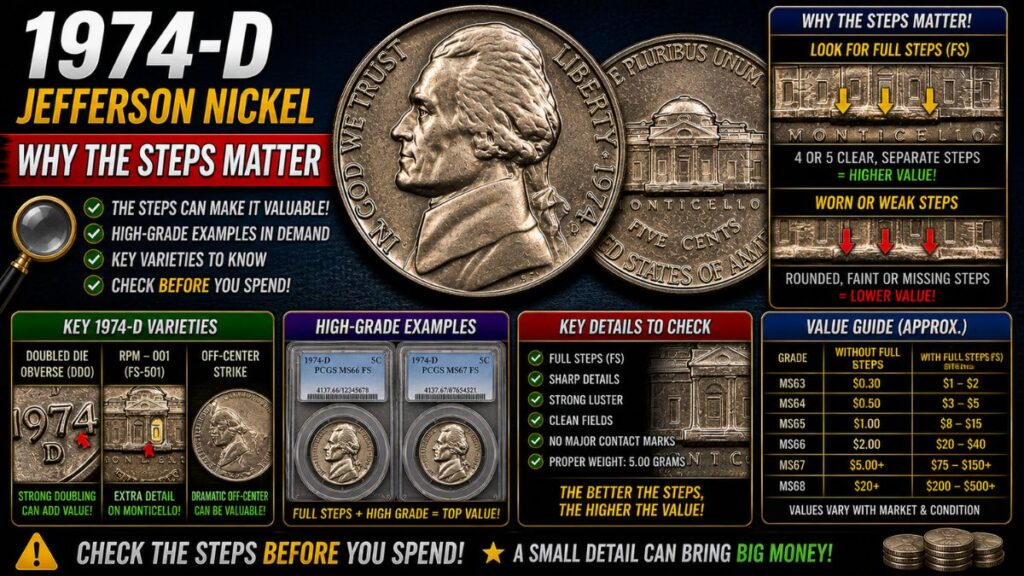
Before you spend or dismiss a 1974-D Jefferson nickel, take a closer look at the reverse. Most examples from this year are common, but a sharply struck coin with clearly defined Full Steps can attract considerably more attention from collectors.
That distinction is important because the date and mintmark alone do not tell the entire story. Two 1974-D Jefferson nickels can look similar at first glance, yet their collector appeal can be very different if one has weakly defined steps and the other shows strong, uninterrupted detail on the steps of Monticello.
The 1974-D Jefferson nickel is therefore an excellent example of why condition and strike quality matter in coin collecting. A typical circulated piece may be an ordinary coin with little premium beyond its basic collectible interest. A sharply struck, high-grade example, however, can become much more interesting, particularly when the reverse displays the Full Steps designation collectors look for.
The key is knowing what to examine. You do not need to assume that every 1974-D nickel is rare, and you should not assume that every coin with visible steps is automatically valuable. Instead, the smart approach is to identify the date and mintmark, examine the overall condition, study the reverse carefully, and determine whether the steps are genuinely strong and complete.
That small detail can change the way a collector views an otherwise ordinary-looking Jefferson nickel.
Understanding the 1974-D Jefferson Nickel
The 1974-D Jefferson nickel is identified by two basic features: the 1974 date on the obverse and the small “D” mintmark indicating production at the Denver Mint.
For collectors, this makes identification relatively straightforward. Once you find a 1974 Jefferson nickel with a D mintmark, you have the coin described in this article.
But identification is only the first step.
Coin collecting often becomes more interesting when collectors move beyond the date and mintmark and begin examining condition, strike, surface quality, and specific design details. This is especially true with Jefferson nickels because the reverse contains an area that can be particularly important when evaluating sharply struck examples.
That area is the staircase beneath Monticello.
On an ordinary circulated nickel, those steps may appear worn, incomplete, or difficult to distinguish. Even some uncirculated coins can have less-than-perfect definition because of how the coin was struck.
A high-grade coin with strong step definition is different.
When the steps are sharply separated and show the level of detail collectors associate with Full Steps, the coin can receive additional attention. This is one reason collectors are encouraged to inspect the reverse rather than simply looking at the date and deciding that a 1974-D nickel is common and therefore uninteresting.
The most valuable information can sometimes be found in a very small area of the design.
What Does the “D” Mintmark Tell You?
The D mintmark is one of the first things to check when examining a 1974 Jefferson nickel.
A 1974-D nickel has a “D” mintmark that identifies Denver as the mint associated with the coin’s production. That single letter separates the coin from Jefferson nickels of the same year carrying a different mintmark or no mintmark.
For someone searching through an old collection, inherited coins, jars, rolls, or loose change, checking the mintmark is a simple first step.
However, the presence of the D does not by itself make a 1974-D nickel rare.
This is an important point because coin collecting often involves separating ordinary examples from coins with unusual characteristics. A mintmark can help identify a coin, but it does not automatically establish a high value.
With the 1974-D Jefferson nickel, the more important question becomes what kind of example you have.
Is it heavily circulated?
Is it relatively sharp?
Does it retain strong original-looking surfaces?
Are the design details clearly defined?
Most importantly for this topic, what do the steps beneath Monticello look like?
These questions provide a much more useful starting point for determining whether a 1974-D nickel deserves closer attention.
Why the Steps on Monticello Matter
The phrase “Full Steps” refers to the appearance and definition of the steps on the reverse of a Jefferson nickel.
Monticello, the building shown on the reverse, includes a staircase beneath the structure. On a sharply struck coin, those steps can be distinctly visible.
On many coins, however, the steps are not completely defined.
They can become weak because of wear, but even an uncirculated coin can have incomplete detail because of strike quality. This is where the distinction between condition and strike becomes especially important.
A coin may have no obvious wear yet still fail to show complete step definition.
Another coin may have exceptionally sharp detail across the reverse and show the uninterrupted appearance collectors seek.
That is why simply saying that a nickel is “uncirculated” is not enough when discussing Full Steps.
Collectors examining a potentially premium 1974-D Jefferson nickel need to look closely at the actual steps.
The tiny lines across the staircase should be examined under good lighting and, when necessary, magnification. The goal is not merely to see that there are steps. The goal is to determine how clearly and completely those steps are represented.
This is a much more demanding examination than simply identifying the coin.
What Are Full Steps?
Full Steps is a designation associated with strong, uninterrupted definition of the steps on the reverse of Jefferson nickels.
The exact standards used for a Full Steps designation depend on the grading service and its criteria, so collectors should not assume that every visible staircase qualifies.
This distinction is critical.
A casual glance might reveal several horizontal lines and make a coin appear to have excellent steps. Under closer inspection, however, the lines may be interrupted by contact marks, strike weakness, or other imperfections.
A genuine high-quality Full Steps candidate needs to withstand careful examination.
The reason collectors care about Full Steps is simple: sharply defined steps demonstrate an unusually strong level of detail in an area that is frequently weak on Jefferson nickels.
For a 1974-D example, that can make an otherwise common coin substantially more interesting.
The designation is therefore not simply another way of saying “nice-looking coin.” It is connected to a specific area of the reverse and the quality of its strike and preservation.
If you are searching through 1974-D nickels, the steps should be one of the first places you inspect after confirming the date and mintmark.
Strike Quality Is a Major Part of the Story
One of the most important ideas to understand when looking for Full Steps is the difference between strike quality and overall condition.
A coin can be in excellent condition but have weak design details.
This happens because the quality of the original strike affects how completely the design is transferred to the coin.
If the dies and planchet do not produce complete detail in a particular area, the resulting coin can remain weakly defined even if it experiences very little circulation afterward.
That means a collector should not look at a 1974-D nickel and think:
“This coin is uncirculated, so the steps must be strong.”
That conclusion would be unreliable.
Instead, inspect the steps directly.
Likewise, a coin with clearly visible steps should not automatically be assumed to be a top-grade example. Surface preservation, marks, luster, and other factors still matter.
The most interesting combination is a coin that has both strong strike characteristics and excellent preservation.
That is where the potential appeal of a high-grade Full Steps 1974-D Jefferson nickel comes into focus.
Circulated 1974-D Nickels
Most people who encounter a 1974-D Jefferson nickel will find an example that has experienced some circulation.
Circulation gradually affects the appearance of a coin. High points of the design can become smoother, surface marks can accumulate, and fine details can become less distinct.
The staircase on Monticello is particularly useful for demonstrating this effect.
A circulated nickel may show the basic outline of the building and staircase while lacking the sharp, separated step lines associated with an exceptionally struck example.
That does not make the coin worthless or uninteresting. It simply places it in a different category from a highly preserved collector-grade specimen.
Collectors should therefore avoid judging a coin’s potential entirely from its age.
A coin from 1974 is old enough to attract curiosity, but age alone does not make it rare.
What matters is the combination of date, mintmark, condition, strike, and any recognized characteristics that distinguish the particular coin.
For the 1974-D Jefferson nickel, the steps provide an especially useful place to begin that examination.
Uncirculated Does Not Automatically Mean Full Steps
This is one of the easiest mistakes for new collectors to make.
An uncirculated Jefferson nickel can retain attractive luster and sharp-looking design elements while still lacking the step definition necessary for a Full Steps designation.
The reason is that circulation and strike are two different issues.
Circulation can wear down existing detail.
Strike quality determines how much detail was impressed into the coin in the first place.
Therefore, a coin that has never circulated may still have weak steps.
Conversely, a coin with impressive step detail may be especially attractive because that level of definition was successfully preserved.
When evaluating a 1974-D nickel, think about these characteristics separately.
First, ask whether the coin shows evidence of circulation.
Next, examine whether the coin’s surfaces are well preserved.
Then inspect the strike.
Finally, look carefully at the staircase.
This method prevents one characteristic from being mistaken for another.
How to Inspect a 1974-D Nickel at Home
You do not need an elaborate setup to perform an initial examination.
Start with the date.
Confirm that the coin actually reads 1974.
Next, check for the D mintmark.
Once the identity is established, turn the coin over and examine the reverse.
Look directly below Monticello.
The staircase is the area that deserves your closest attention.
Good lighting can make a major difference. A bright light positioned so that it illuminates the reverse without producing excessive glare can help reveal small details.
A magnifying glass or coin loupe can also be useful.
Do not immediately decide that a coin has Full Steps simply because you can see several horizontal lines.
Instead, examine whether the step detail appears complete and uninterrupted.
Look for areas where the lines disappear or become difficult to distinguish.
Also examine the surrounding surfaces. A contact mark across the steps can affect how the staircase appears and can matter when the coin is evaluated professionally.
This kind of inspection takes only a few moments, but it can prevent you from overlooking an unusually sharp example.
Why Magnification Can Help
The staircase on a Jefferson nickel is small.
What appears clear to the naked eye may look very different under magnification.
A loupe can help you determine whether the apparent step lines are actually distinct or whether shadows and reflections are creating the impression of stronger detail.
Magnification can also reveal small marks that are difficult to see without assistance.
That matters because high-grade coins are judged on many small details.
When examining a potential Full Steps candidate, do not focus exclusively on the staircase. Look at the entire coin.
Check the fields.
Look around the lettering.
Examine Jefferson’s portrait.
Inspect the rims.
Then return to the reverse and study Monticello and the steps.
A coin that looks spectacular in one small area but has significant problems elsewhere may not be the exceptional example you initially thought it was.
The best approach is to treat the steps as a major clue rather than the only factor.
The Difference Between Strong Steps and Weak Steps
The easiest way to understand the Full Steps concept is to compare different levels of definition.
A weakly struck coin may show the staircase as a somewhat blended area. Individual steps can be difficult to separate.
A moderately defined coin may show several recognizable horizontal lines, but some portions may remain weak or interrupted.
A sharply struck example can show a much cleaner staircase, with distinct separation between the individual steps.
This difference can be subtle.
That is why photographs alone can sometimes be misleading. Lighting angle, image quality, focus, and contrast can make step definition appear stronger or weaker than it really is.
If a 1974-D nickel appears unusually sharp in a photograph, it is worth examining the actual coin carefully before reaching a conclusion.
For valuable coins, professional examination provides a more dependable determination.
Why High-Grade Coins Get More Attention
Condition is one of the central factors in coin collecting.
A coin that has survived with exceptional surfaces and sharp detail is naturally more difficult to find than a heavily circulated example.
This becomes especially relevant for coins that are generally common.
When a date and mintmark combination is readily available, ordinary examples may not attract significant collector attention.
Exceptional examples can be different.
Collectors may compete for coins that combine a high grade with excellent visual quality and a desirable designation such as Full Steps.
This creates an important distinction between rarity in general and rarity in a particular condition.
A 1974-D Jefferson nickel can be common as a date-and-mintmark combination while still being much more difficult to find at an exceptionally high grade with strong Full Steps.
That is why collectors should not stop their examination after determining that the coin is a common issue.
The question becomes whether the individual coin is an exceptional example.
A Common Coin Can Still Have an Uncommon Example
This concept is useful far beyond Jefferson nickels.
Coin collectors often search through ordinary dates because extraordinary individual specimens can be hidden among them.
The majority may be completely ordinary.
But occasionally, a coin survives with unusually strong characteristics.
For the 1974-D Jefferson nickel, those characteristics can include outstanding preservation and sharp Full Steps.
That does not mean every coin from the date should be treated as rare.
Instead, it means collectors should understand the difference between the general availability of a coin and the availability of a particular high-quality version.
This is exactly why the title’s advice to “check the steps” is so important.
The date alone may not tell you whether you have something worth further investigation.
The reverse might.
Surface Quality Still Matters
Strong steps are important, but they are not the only consideration.
A high-grade coin must also have surfaces that support its grade.
Small contact marks can affect a coin’s appearance.
Larger marks can be even more important.
Collectors should inspect the open areas around the design for scratches, hits, abrasions, or other distractions.
Luster should also be considered when evaluating an uncirculated coin.
A coin with attractive original-looking surfaces and strong design detail can present very differently from one that has been heavily marked or improperly handled.
This is why it is dangerous to evaluate a coin from a single feature.
The staircase might look excellent, but the rest of the coin must also be examined.
When collectors talk about a high-grade Full Steps example, they are describing a combination of qualities rather than simply a staircase that happens to be visible.
Avoid Cleaning a Potentially Valuable Nickel
If you discover a 1974-D Jefferson nickel with unusually strong details, resist the temptation to clean it.
Cleaning can alter the original surface and potentially reduce collector appeal.
This is especially important when a coin appears to have exceptional condition.
Collectors sometimes believe that removing dirt or discoloration will make a coin more attractive. In reality, improper cleaning can leave scratches, unnatural surfaces, or other evidence of alteration.
The safest approach for a potentially important coin is simple handling and proper storage rather than aggressive cleaning.
Hold the coin by its edges when possible.
Avoid rubbing the surface.
If you think you have found an exceptional Full Steps example, preserve its condition while deciding what to do next.
The goal should be to protect the characteristics that make the coin interesting, not accidentally damage them.
Handling a 1974-D Jefferson Nickel Correctly
Even an ordinary coin can benefit from careful handling, but it becomes particularly important when examining a potentially high-grade specimen.
Fingerprints can leave oils on the surface.
Scratches can occur if coins are dragged across hard surfaces.
Improper storage can also expose coins to unnecessary environmental damage.
When examining a coin, handle it carefully and avoid touching the main surfaces more than necessary.
If you need to compare the steps under magnification, place the coin on a clean, safe surface rather than sliding it across a table.
These small habits matter because a high-grade coin can lose some of its appeal through careless handling.
The irony is that the better the coin looks, the more carefully it should be treated.
How Collectors Think About Full Steps
Full Steps are appealing because they provide a visible way to recognize strike quality.
Collectors can look at the reverse and immediately see whether the staircase is sharply defined.
This makes the designation particularly useful when comparing otherwise similar coins.
Imagine two 1974-D Jefferson nickels that appear uncirculated.
One has soft, incomplete steps.
The other has crisp, clearly separated steps and strong overall surfaces.
Even before considering professional grading, the second coin presents a very different collecting proposition.
The Full Steps characteristic gives collectors another way to distinguish an exceptional specimen from an ordinary one.
This is one reason experienced collectors often spend extra time examining the reverse.
A quick glance at the obverse can tell you the date.
A careful look at the reverse may tell you much more about the coin’s potential collector interest.
Why the Reverse Deserves Your Attention
Many casual coin searches focus almost entirely on the front of the coin.
Collectors check the date, look for a mintmark, and move on.
With Jefferson nickels, that can mean missing one of the most interesting details.
The reverse contains Monticello and its staircase.
That staircase can reveal information about strike quality that is not obvious from the obverse.
For a 1974-D nickel, the reverse should therefore be treated as an essential part of the inspection rather than an afterthought.
Turn the coin over.
Study the building.
Look beneath it.
Examine the individual steps.
Then inspect the surrounding surfaces.
That simple habit can make your coin searches much more effective.
What Makes a 1974-D Nickel Worth a Closer Look?
A 1974-D Jefferson nickel becomes especially interesting when several favorable characteristics come together.
The first requirement is identification: it should actually be a 1974-D coin.
The next consideration is preservation.
A heavily circulated coin generally will not have the same appearance as an untouched or nearly untouched example.
Then comes strike quality.
Strong detail across the design is desirable.
Finally, there are the steps.
A sharply struck coin with clearly defined Full Steps can stand apart from ordinary examples.
This does not mean that every coin with attractive steps will automatically command a large premium.
The market value of any individual coin depends on its specific condition, grading, designation, demand, and other factors.
But these are the characteristics that explain why collectors may look much more closely at a particular 1974-D nickel.
Don’t Confuse Age With Rarity
A common mistake among beginning collectors is assuming that an older coin must automatically be valuable.
The 1974-D Jefferson nickel demonstrates why that assumption is unreliable.
A coin can be several decades old and still be common.
What matters is not simply how long ago it was produced, but how many examples exist and how unusual the specific example is.
For the 1974-D nickel, ordinary examples can be common while exceptional high-grade Full Steps examples receive substantially more attention.
This is an important distinction.
If you find a 1974-D nickel, you should not assume you have discovered a rare coin simply because it is from 1974.
Instead, use the date as the starting point.
Then investigate the coin’s condition and strike.
That approach is both more accurate and more useful.
The Importance of Professional Grading
If a 1974-D Jefferson nickel appears to be an exceptional candidate, professional grading may become worth considering.
A professional grading service can authenticate and evaluate the coin according to established standards.
For a coin that might qualify for a high grade and Full Steps designation, professional certification can provide an objective assessment that is difficult to establish from a casual home inspection.
However, not every 1974-D nickel needs professional grading.
If the coin is heavily circulated and clearly ordinary, the cost and effort associated with professional grading may not make sense.
The decision becomes more relevant when the coin appears unusually well preserved and sharply struck.
In other words, first inspect the coin yourself.
Then decide whether its characteristics justify taking the next step.
What a High-Grade Full Steps Example Looks Like
A high-grade Full Steps 1974-D Jefferson nickel should immediately stand out as a well-preserved coin.
The surfaces should show little evidence of circulation.
The design should retain strong detail.
The reverse should be particularly impressive around Monticello.
Most importantly, the staircase should show the kind of sharp, uninterrupted definition associated with the Full Steps designation.
The visual effect can be surprisingly dramatic.
A regular circulated nickel may have a duller appearance and softened details.
A sharply struck, high-grade example can look much more precise.
The difference is not necessarily obvious from across a room, but under good lighting and magnification, it can become clear.
That is exactly why careful examination matters.
Why Full Steps Can Affect Collector Demand
Collectors often seek qualities that are difficult to find.
When a particular characteristic appears on only a small portion of otherwise common coins, it can attract specialized interest.
Full Steps are one such characteristic in Jefferson nickel collecting.
A collector interested in high-grade Jefferson nickels may not simply want a 1974-D example.
They may want a particularly sharp example with strong step definition.
This creates a narrower collecting category.
Instead of competing only for the date and mintmark, collectors are looking for a combination of grade and design detail.
As a result, the difference between an ordinary coin and an exceptional one can become significant.
That is the fundamental reason a common date can still produce an exciting find.
What to Look for Under Good Lighting
Lighting can dramatically influence how a coin’s surfaces and steps appear.
When examining the reverse, avoid relying on a single angle.
Move the coin gently or change the direction of the light so that the staircase can be viewed clearly.
The objective is to determine whether the step lines remain distinct rather than simply appearing because of a particular reflection.
Strong lighting can also expose contact marks that might otherwise remain hidden.
This is useful because an attractive first impression can sometimes disappear once the coin is viewed from another angle.
A careful collector therefore examines the coin under consistent, controlled conditions.
Take your time.
There is no reason to rush through a coin that might be an unusually sharp example.
The Role of Magnification in Step Hunting
A basic loupe can be useful for anyone seriously searching Jefferson nickels.
The staircase is small enough that subtle interruptions may be difficult to see with the naked eye.
Magnification allows you to inspect individual lines more carefully.
You can look for areas where the steps blend together or where marks interrupt the design.
You can also examine the overall surface for evidence of contact.
However, magnification should not make you overconfident.
Seeing more detail does not automatically mean you can assign a professional grade or Full Steps designation.
It simply gives you better information.
For a serious candidate, professional evaluation remains the better way to establish an official grade or designation.
Common Mistakes When Searching for 1974-D Nickels
One of the most common mistakes is stopping at the mintmark.
Finding the D may seem exciting, but the mintmark only identifies the coin.
Another mistake is assuming that an uncirculated appearance guarantees Full Steps.
As discussed earlier, strike quality and circulation are separate issues.
A third mistake is counting visible horizontal lines and immediately declaring the coin Full Steps.
The entire staircase needs to be examined carefully.
Another error is cleaning the coin.
Potentially valuable coins should not be polished or scrubbed simply because they appear dirty.
Finally, collectors sometimes focus so intensely on one feature that they ignore the rest of the coin.
A strong staircase is important, but so are the overall grade and surface quality.
The best approach is to consider the coin as a complete object.
How to Compare Two 1974-D Nickels
If you have several 1974-D Jefferson nickels, comparing them side by side can be extremely helpful.
Place them under the same lighting.
Look at the obverse first.
Then turn each coin over and compare Monticello.
Pay particular attention to the staircase.
You may quickly notice that one coin has softer detail while another has sharper lines.
Next, compare the surfaces.
Look for signs of circulation, contact marks, scratches, and overall preservation.
This side-by-side method is often more useful than examining one coin in isolation.
Once you train your eyes to recognize strong step definition, you may begin spotting differences much faster.
That is one of the enjoyable aspects of coin collecting: careful observation becomes a skill.
Why a Sharp Strike Is So Exciting
A sharply struck coin can reveal design details that are missing or weak on many other examples.
For collectors, that creates a sense of discovery.
The date may be ordinary.
The mintmark may be ordinary.
But the individual coin can still be extraordinary because of the quality with which its design was struck and preserved.
This is what makes searching through common coins worthwhile.
You are not necessarily looking for an old coin.
You are looking for an unusual example of an otherwise familiar coin.
The 1974-D Jefferson nickel provides a particularly good illustration of this idea because the steps on Monticello offer such a visible indicator of strike quality.
Does Every 1974-D Nickel Have Full Steps?
No.
The presence of the Monticello staircase does not mean every coin will show complete, sharply defined steps.
Different coins can display different levels of detail.
Some may have weak areas.
Others may show strong definition.
Only examples meeting the relevant standards can receive a Full Steps designation from a grading service.
Therefore, collectors should not assume that Full Steps is a standard feature of the date.
It is a characteristic that makes certain individual coins stand out.
That is why it is worth checking rather than assuming.
How Condition Changes the Collector Appeal
Condition can dramatically change the way collectors view a coin.
A circulated 1974-D Jefferson nickel may be an ordinary example.
A high-grade uncirculated coin can be more desirable.
A high-grade coin with strong Full Steps can be even more specialized.
This creates a hierarchy of collector interest without meaning that every high-grade coin is automatically rare or valuable.
The important point is that condition helps separate individual examples.
When a coin is common in ordinary grades, exceptional preservation can become a defining feature.
For this reason, the best 1974-D nickels are not necessarily the oldest-looking or most worn coins.
They are often the ones that have retained remarkable detail and surface quality.
Why You Should Not Assume a Price From a Photo
Collectors frequently encounter photographs of impressive coins and then try to estimate the value of their own example by comparison.
That can be misleading.
Two coins that appear similar in a photograph may differ significantly in grade, strike quality, surface preservation, certification, or designation.
Even small differences can matter when dealing with high-grade coins.
For a 1974-D Jefferson nickel, the distinction between strong-looking steps and a formally recognized Full Steps example is especially important.
Therefore, a photograph can be useful for learning, but it should not be treated as proof of a coin’s value.
The actual coin needs to be examined carefully.
What to Do If You Think You Found a Full Steps Example
If your 1974-D Jefferson nickel looks unusually sharp, slow down.
Do not clean it.
Do not polish it.
Do not rub the surfaces.
Instead, examine it carefully under good lighting.
Confirm the date.
Confirm the D mintmark.
Inspect the obverse for overall preservation.
Turn the coin over.
Study Monticello.
Then focus on the steps.
If the staircase appears unusually sharp and complete, examine the rest of the coin just as carefully.
If the coin remains impressive after this examination, professional evaluation may be worth considering.
The most important thing is preservation.
Finding an interesting coin is only the beginning. Protecting it properly ensures that you do not accidentally reduce its condition while investigating it.
Why Coin Collecting Rewards Patience
The 1974-D Jefferson nickel is a good reminder that successful coin hunting is not always about finding something obviously rare.
Sometimes the interesting detail is extremely small.
A date can be common.
A mintmark can be common.
The coin can look ordinary at first.
Then a closer look at the reverse reveals exceptionally strong steps.
That moment is part of what makes collecting enjoyable.
Patience allows collectors to notice details that casual searches miss.
Instead of quickly sorting coins into “valuable” and “worthless” piles, experienced collectors learn to inspect specific characteristics.
For Jefferson nickels, the staircase beneath Monticello is one of those characteristics worth learning.
Building Your Eye for Full Steps
Like many skills, recognizing strong step definition improves with practice.
Start by examining multiple Jefferson nickels.
Compare circulated and uncirculated examples.
Look at coins with clearly different levels of strike quality.
Pay attention to the staircase and learn how weak, moderate, and strong detail appears.
Over time, your eyes will become more familiar with the differences.
You may eventually notice a sharply struck coin almost immediately.
However, even experienced collectors should remain cautious about assigning official designations.
Learning to identify a promising candidate is different from guaranteeing that it will receive a particular grade.
The first skill is useful for searching.
The second requires formal evaluation.
Why the 1974-D Jefferson Nickel Is Worth Checking
The appeal of the 1974-D Jefferson nickel is not that every example is rare.
Quite the opposite.
Most are common.
That is what makes the search interesting.
Because the ordinary examples are not especially difficult to encounter, collectors can focus on finding the exceptional ones.
The key characteristic in this case is the Full Steps detail.
A sharply struck, high-grade example can be significantly more interesting to collectors than a typical circulated specimen.
That means the 1974-D nickel should not be dismissed simply because it is a common date and mintmark combination.
Instead, turn it over.
Check Monticello.
Check the steps.
Then evaluate the entire coin.
Frequently Asked Questions About the 1974-D Jefferson Nickel
Is the 1974-D Jefferson nickel rare?
Most 1974-D Jefferson nickels are common. The greater collector interest comes from individual examples that are exceptionally well preserved and sharply struck, particularly those with strong Full Steps.
What does the D mean on a 1974 Jefferson nickel?
The D mintmark identifies the Denver Mint. It is one of the basic characteristics used to identify a 1974-D Jefferson nickel.
What are Full Steps on a Jefferson nickel?
Full Steps refers to strong, uninterrupted definition of the staircase beneath Monticello on the reverse. It is a characteristic collectors look for when evaluating sharply struck Jefferson nickels.
Does an uncirculated 1974-D nickel automatically have Full Steps?
No. A coin can be uncirculated while still having weak or incomplete step definition. Circulation and strike quality are separate factors.
Where should I look for the steps?
Turn the nickel over and examine the staircase directly beneath Monticello. Good lighting and magnification can help reveal the individual step lines.
Can a circulated 1974-D nickel have strong steps?
A circulated coin may retain some visible step detail, but wear can reduce sharpness. Full Steps interest is generally associated with coins showing exceptionally strong and complete detail.
Should I clean my 1974-D Jefferson nickel?
No. If the coin appears potentially valuable or unusually well preserved, avoid cleaning, polishing, or rubbing it. Improper cleaning can damage the coin’s surfaces.
What makes a 1974-D nickel especially interesting to collectors?
A combination of strong overall preservation, high grade, sharp strike, and clearly defined Full Steps can make an individual 1974-D Jefferson nickel much more interesting than an ordinary example.
Can I determine Full Steps just by looking at a photograph?
A photograph can provide a useful first impression, but lighting and image quality can make step definition difficult to judge accurately. A promising coin should be examined directly and, when appropriate, professionally evaluated.
Should every 1974-D nickel be professionally graded?
Not necessarily. Professional grading is generally more relevant when a coin appears unusually well preserved, sharply struck, and potentially eligible for a desirable designation such as Full Steps.
Is the mintmark the only thing I should check?
No. The mintmark identifies the coin, but collectors should also examine condition, surface quality, strike strength, and especially the steps beneath Monticello.
Why can two 1974-D nickels look different?
Individual coins can differ because of circulation, surface preservation, and strike quality. Some may have weak design details, while others can be exceptionally sharp.
Final Thoughts on the 1974-D Jefferson Nickel
The 1974-D Jefferson nickel is a perfect example of why coin collecting is about more than simply finding an old date.
Most examples are common, and that should be understood from the beginning. But common does not mean every individual coin is identical.
A sharply struck, high-grade example with strong Full Steps can stand apart from ordinary pieces and attract much greater collector attention.
That is why the reverse deserves a careful inspection.
Check the date.
Confirm the D mintmark.
Examine the overall condition.
Then turn the coin over and study Monticello.
Most importantly, check the steps.
Look closely for sharp, uninterrupted definition rather than simply assuming that visible lines qualify as Full Steps.
If the coin appears unusually well preserved and sharply struck, handle it carefully and avoid cleaning it. The next step may be professional examination if its condition and characteristics justify it.
The biggest lesson is simple: do not judge a 1974-D Jefferson nickel from the date and mintmark alone. The real difference may be hiding in a tiny detail on the reverse.
For collectors searching through older Jefferson nickels, that tiny detail is worth checking.