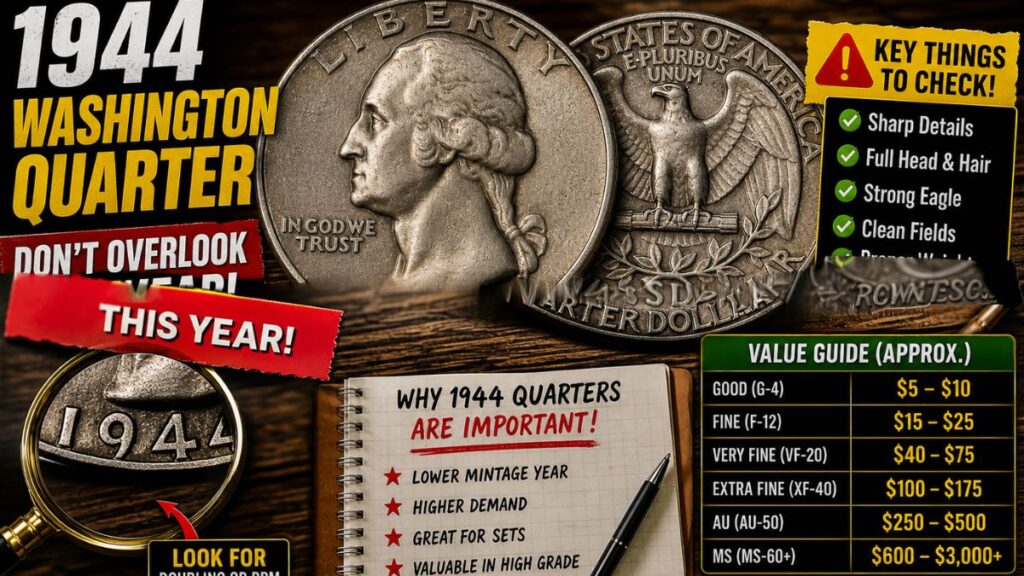
The 1944 Washington quarter may look like an ordinary old coin, but its silver content, condition, mint mark, and possible varieties can make it much more interesting to collectors than its face value suggests. Struck during the final years of World War II, the 1944 Washington quarter belongs to the classic era of U.S. 90% silver coinage. While many examples trade primarily because of their silver content, sharply preserved specimens and certain recognized doubled-die or other unusual varieties can command substantially more attention.
That does not mean every 1944 quarter is rare or highly valuable. Most circulated examples show considerable wear and are valued according to their silver content and collectible demand. The real opportunity comes from identifying coins that stand apart from ordinary pieces.
For someone who discovers a 1944 Washington quarter in an old collection, inherited coin group, box of miscellaneous change, or family keepsake, the first question should not simply be, “How much is this quarter worth?” A better question is, “What exactly do I have?”
The answer depends on several factors, including where the coin was minted, how much wear it has, whether its surfaces remain original and attractive, and whether it displays a genuine collectible variety or error.
Understanding those details can help separate a common worn silver quarter from a potentially much more desirable example.
Why the 1944 Washington Quarter Gets Attention
The 1944 Washington quarter is interesting for two major reasons: its silver composition and its place in the history of the Washington quarter series.
Unlike modern U.S. quarters made primarily from copper and nickel, the 1944 quarter was struck from a traditional silver alloy containing 90% silver and 10% copper. The silver gives the coin intrinsic metal value in addition to its collectible value.
That distinction matters.
Even a heavily circulated 1944 quarter is not simply an ordinary 25-cent piece in the modern sense. Its composition makes it part of the classic U.S. silver coinage group that collectors and precious-metal buyers have followed for decades.
But silver content is only the beginning.
A coin’s condition can dramatically influence collector interest. A worn 1944 quarter with scratches, discoloration, and heavy contact marks is a very different collectible from a sharply struck example with strong detail, original-looking surfaces, and attractive luster.
Then there are varieties.
Collectors examine older coins carefully because production at a large mint involves enormous numbers of dies, repeated striking operations, and countless opportunities for unusual die characteristics or minting anomalies to occur. Doubled-die varieties are among the features that can attract particular attention.
The important point is that not every coin that appears doubled is automatically a valuable doubled die. Genuine die doubling has specific characteristics, while mechanical or machine doubling can create a similar-looking appearance without carrying the same collectible significance.
That is why identification matters.
What Makes the 1944 Quarter a Silver Coin?
The 1944 Washington quarter was made from a composition of 90% silver and 10% copper.
Its standard weight is approximately 6.25 grams.
The copper was incorporated into the alloy primarily to give the silver coin greater durability. Pure silver is relatively soft, so combining it with copper produced a harder material suitable for everyday circulating coinage.
This composition was standard for U.S. dimes, quarters, and half dollars of the era.
The silver content is one of the simplest reasons a 1944 quarter can be worth more than 25 cents.
The actual market value of the silver contained in the coin changes with the price of silver. Therefore, the metal value of a 1944 quarter is not a permanently fixed number. It rises and falls with the precious-metals market.
However, a collector should not automatically assume that silver melt value represents the entire value of the coin.
A collectible coin can be worth more than its metal content.
That premium may come from condition, scarcity, demand, an identifiable variety, an error, or a combination of these factors.
The Basic Design of the 1944 Washington Quarter
The 1944 Washington quarter follows the classic design introduced for the Washington quarter series in 1932.
The obverse features a portrait of George Washington facing left.
The reverse features an eagle with outstretched wings, surrounded by the inscriptions associated with the quarter’s denomination and national identity.
Because the basic design remained familiar throughout this period, collectors often pay close attention to small details rather than expecting major visual differences between years.
The date is one of the first things to inspect.
A genuine 1944 quarter should clearly display the year 1944 on the obverse. The digits should have the appropriate shape and spacing for the issue.
The mint mark is another important feature.
For Washington quarters of this period, the mint mark appears on the reverse, below the eagle.
A 1944 quarter without a mint mark was struck at the Philadelphia Mint.
A “D” indicates Denver.
An “S” indicates San Francisco.
The mint of origin can affect availability and collector demand, so identifying the mint mark is an essential first step when examining one.
How Many 1944 Washington Quarters Were Made?
The 1944 Washington quarter was produced at three U.S. Mint facilities.
Philadelphia struck quarters without a mint mark.
Denver produced quarters bearing the “D” mint mark.
San Francisco produced quarters bearing the “S” mint mark.
The reported production figures for the 1944 quarter issues were approximately 104,956,000 from Philadelphia, 9,769,000 from Denver, and 12,560,000 from San Francisco.
These numbers provide important context.
The Philadelphia issue had a very large production total, so the existence of a 1944 Philadelphia quarter by itself does not make a coin rare.
The Denver and San Francisco issues had much lower production totals, but mintage alone does not determine today’s value. Survival rates, condition, collector demand, and the availability of examples in different grades also matter.
A coin with a lower original mintage is not automatically more valuable than one with a higher mintage.
Collectors ultimately care about how difficult a particular coin is to obtain in the condition they want.
That distinction becomes especially important with older silver coins.
Why Condition Can Change the Value So Much
Condition is one of the most important factors in determining whether a 1944 Washington quarter is simply a silver coin or a significant collectible.
A coin that circulated heavily for decades may have lost much of its original detail. Washington’s hair, facial features, lettering, and other design elements can become worn and flattened.
The reverse can show similar signs of circulation.
By contrast, a coin that spent most of its life protected from circulation may retain sharp details and much of its original mint luster.
Collectors generally describe these differences using grading terminology.
A circulated coin can range from lightly worn to heavily worn. An uncirculated coin shows no normal circulation wear, although it can still have marks from the minting process, storage, handling, or contact with other coins.
As the grade increases, the standard for quality becomes more demanding.
A coin cannot become valuable simply because it is old.
Age helps establish historical interest, but preservation is critical when discussing collectible value.
For that reason, two 1944 quarters that look similar to a casual observer may have very different market values.
What Collectors Look for on a High-Grade 1944 Quarter
When examining a potentially high-grade 1944 Washington quarter, collectors look at more than whether the coin “looks shiny.”
They examine the amount of original detail, the presence of wear, the quality of the surfaces, the sharpness of the strike, and the overall visual appeal.
Original luster can be particularly important.
Freshly struck coins have a characteristic surface appearance produced by the interaction between the metal and the dies during striking. Over time, circulation, cleaning, environmental exposure, and handling can alter that appearance.
A coin may still look bright after being cleaned, but cleaning can actually reduce its desirability to collectors.
Hairlines from polishing or abrasive cleaning can be obvious under magnification.
For that reason, an attractive original-looking coin can be more desirable than an artificially bright coin.
Collectors also examine contact marks.
Silver quarters frequently came into contact with other coins during production, transportation, storage, and circulation. Small marks can be expected even on uncirculated examples.
The location and severity of those marks can influence the grade.
Large scratches, deep gouges, stains, or damage in highly visible areas can significantly reduce desirability.
Why Strike Quality Matters
Strike quality is another consideration that can separate ordinary examples from exceptional ones.
A coin is struck when a planchet is placed between dies and enormous pressure forces the design into the metal.
Ideally, the details transfer sharply.
In practice, some coins receive stronger strikes than others.
Collectors examining a 1944 Washington quarter may pay attention to the definition of the design, especially in areas where weakness can be noticeable.
A high-grade coin with strong detail and attractive surfaces can be much more desirable than an otherwise similar coin with a weak strike.
This is one reason professional grading can become important when a coin appears unusually well preserved.
The Importance of the Mint Mark
Finding the mint mark is one of the easiest ways to begin identifying a 1944 Washington quarter.
Turn the coin over and look beneath the eagle on the reverse.
If there is no mint mark, the coin was struck at Philadelphia.
If there is a “D,” it came from Denver.
If there is an “S,” it came from San Francisco.
The mint mark does not automatically determine value, but it provides an important piece of identification.
Collectors often compare different mint issues within the same year.
A collector building a complete Washington quarter set by date and mint may need all three 1944 issues.
That creates demand for examples from Philadelphia, Denver, and San Francisco, particularly in desirable grades.
What Is a Doubled Die?
The phrase “doubled die” can create excitement among coin collectors because genuine doubled-die varieties can be collectible and, depending on the issue and degree of doubling, potentially valuable.
A doubled die is created during the die-making process.
A coin die is not simply a normal piece of metal that randomly becomes doubled while striking an individual coin. The doubling originates in the die itself.
During the creation of the working die, the design can be impressed or transferred more than once with a misalignment between impressions. If that doubled design remains on the die, every coin struck from that particular die can potentially display the same doubling characteristics.
That is fundamentally different from a coin that experiences a problem during the striking process.
The distinction is important because collectors use the term “doubled die” very specifically.
Not Every Coin That Looks Doubled Is a Doubled Die
One of the biggest mistakes beginners make is assuming that any blurry, shadow-like, or doubled-looking lettering represents a valuable doubled die.
It does not.
Coins can display other forms of doubling that are created during striking rather than during die preparation.
Mechanical doubling, for example, can produce a secondary appearance along parts of the design. Depending on the situation, it can look impressive to an inexperienced collector.
But mechanical doubling is generally not treated the same way as a genuine doubled-die variety.
A genuine doubled die typically shows specific characteristics that repeat consistently in the same locations across coins struck from that die.
That is why comparison with recognized variety information and careful examination is so important.
Where to Look for Possible Doubling
If a 1944 Washington quarter appears unusual, begin by examining the date and lettering.
Look closely at the digits in the date.
Then inspect major lettering on the obverse and reverse.
Use magnification, but do not assume that every extra line or shadow represents doubling.
A genuine variety should show a meaningful and identifiable relationship between the primary design and the secondary impression.
The appearance may include separation between parts of letters or digits, depending on the particular variety.
The key is consistency and structure.
Random scratches do not count.
Damage does not count.
Surface stains do not count.
A reflection caused by the coin’s luster does not count.
And ordinary machine doubling should not automatically be described as a doubled die.
Why Magnification Helps
A basic magnifying glass can make a major difference when inspecting an old quarter.
The naked eye is often insufficient for examining small design details.
A loupe or magnifier allows collectors to inspect the date, lettering, mint mark, and other areas closely.
Good lighting is equally important.
Move the coin beneath the light rather than relying on a single fixed viewing angle. Different lighting angles can reveal scratches, die characteristics, doubling, and surface problems.
However, magnification should be used to inspect the coin, not to convince yourself that something valuable is present.
It is easy to see patterns in tiny areas of metal that are actually caused by normal wear or damage.
A careful approach is better than an enthusiastic one.
The Difference Between a Valuable Variety and a Normal Coin
A 1944 quarter can become more interesting when it possesses a recognized variety, but recognition is essential.
The coin should match documented characteristics associated with the specific variety.
A vague statement such as “the date looks doubled” is not enough.
Collectors want evidence.
They may compare the shape, position, and separation of the suspected doubling with known examples.
They may also examine whether the feature is raised, incuse, part of the original design, or simply a surface disturbance.
This is why valuable coin varieties are often easier to identify when the collector has experience with the series.
The more familiar someone becomes with normal Washington quarter details, the easier it becomes to notice something genuinely unusual.
Why Exceptional Condition Can Be More Important Than Age
Many people assume that a coin becomes increasingly valuable simply because it gets older.
That is not how the collectible coin market works.
A 1944 quarter is old, but millions of quarters from that era were produced and many have survived.
What matters is how many examples remain available in a particular condition.
An ordinary circulated 1944 quarter may be relatively easy to find.
A sharply preserved example with attractive surfaces can be much harder to locate.
That difference creates what collectors sometimes call condition rarity.
In other words, the important question is not merely how many coins were originally struck.
It is also how many survived with the specific qualities collectors want.
What Circulation Does to a 1944 Quarter
A quarter used in everyday commerce could pass through thousands of transactions.
Every exchange created another opportunity for the coin to become scratched, worn, dented, or otherwise damaged.
The highest areas of the design usually experience wear first.
On the obverse, the details of Washington’s portrait can become less defined.
On the reverse, the eagle and surrounding design can lose sharpness.
The rims may also show evidence of repeated contact.
A heavily circulated coin may still be historically interesting and valuable for its silver content, but it generally will not have the same collector appeal as an exceptionally preserved example.
Why Cleaning Can Hurt a Silver Quarter
A common reaction when someone discovers an old silver coin is to clean it.
That can be a mistake.
Silver can develop toning and surface changes over time. Collectors often prefer original surfaces, particularly when the coin has attractive natural coloration and has not been harshly treated.
Cleaning can leave scratches or unnatural brightness.
Even methods that seem gentle can alter the surface.
A coin should generally be examined in its existing condition before anyone considers attempting to improve its appearance.
If a 1944 quarter appears valuable, cleaning it can potentially reduce its collectible desirability rather than increase it.
The safest approach is simple: avoid unnecessary cleaning.
Natural Toning on a 1944 Quarter
Toning is another feature that can influence appearance.
Silver reacts with its environment over time, and older coins can develop different shades on their surfaces.
Some collectors appreciate natural toning because it can provide evidence of long-term storage and originality.
Other collectors prefer bright, untoned examples.
The important point is that attractive natural toning should not automatically be treated as damage.
However, artificial coloring or unusual surface treatment can be a different matter.
When evaluating a potentially valuable coin, originality remains an important consideration.
How to Check Your 1944 Quarter Step by Step
Start with the date.
Confirm that the coin is actually dated 1944.
Next, inspect the reverse for the mint mark.
Determine whether the coin is from Philadelphia, Denver, or San Francisco.
Then examine the overall condition.
Look at the portrait, lettering, rims, eagle, and major design details.
Ask whether the coin shows obvious circulation wear.
Then inspect the surfaces under good lighting.
Look for scratches, cleaning marks, corrosion, stains, dents, and other damage.
After that, examine the date and lettering for possible doubling or other unusual characteristics.
Do not stop at the first unusual-looking feature.
Compare what you see with known characteristics of genuine varieties.
Finally, consider professional evaluation if the coin appears to be unusually well preserved or potentially represents a significant variety.
Why Professional Grading Can Matter
Professional grading can be useful when a coin may have significant collectible value.
A grading service can authenticate the coin, evaluate its condition, and encapsulate it in a protective holder.
This becomes particularly relevant when small differences in condition can produce large differences in market value.
For a common, heavily circulated silver quarter, professional grading may not always be economically practical.
But if a 1944 quarter appears exceptionally preserved, displays an unusual variety, or could potentially fall into a valuable high-grade category, professional evaluation may make more sense.
The decision should be based on the coin’s potential value and the cost of authentication and grading.
What Does a 1944 Quarter Usually Depend On for Value?
There is no single universal value for every 1944 Washington quarter.
The most important factors include:
The mint mark.
The condition.
The amount of original detail.
The quality of the surfaces.
The presence or absence of damage.
The strength of the strike.
The presence of attractive original luster.
Whether the coin has a recognized variety.
Whether it has a genuine minting error.
Collector demand.
The current value of silver.
These factors interact.
A worn coin may be valued largely for its silver content.
A better-preserved coin may receive a collector premium.
An exceptionally high-grade coin may be worth substantially more than an ordinary circulated example.
A recognized variety can create another layer of collector interest.
This is why it is dangerous to rely on a single price number without first identifying the exact coin.
Why Online Price Claims Can Be Misleading
Search results and social media posts sometimes feature dramatic claims about old coins.
A headline may suggest that a particular quarter is worth thousands or even far more.
Such claims should be approached carefully.
The existence of a rare variety does not mean every coin from that year is rare.
Likewise, an auction result for an exceptional example does not establish the value of every ordinary specimen.
A coin’s grade, variety, authenticity, and overall quality must be considered.
The most useful comparison is with actual examples that closely match the coin being examined.
A circulated 1944 quarter should not be compared with an exceptionally graded example simply because both carry the same date.
Silver Value Versus Collector Value
It helps to separate two different sources of value.
The first is bullion value.
Because the 1944 quarter contains 90% silver, its metal has intrinsic value. That value changes with silver prices.
The second is numismatic value.
Numismatic value comes from collector interest in the coin as a historical object.
A coin may have both.
For example, an ordinary worn 1944 quarter may be worth more than face value because of its silver content, while an exceptional example may command an additional premium because collectors value its condition.
A rare variety can add another premium.
Understanding this distinction prevents confusion when comparing prices.
Why a 1944 Quarter Is Historically Interesting
The year 1944 falls within World War II.
The United States was producing enormous quantities of coinage while the country was deeply involved in the war effort.
A quarter dated 1944 therefore represents more than a piece of silver.
It is a physical object from a specific period in American history.
The Washington quarter series itself was relatively young at the time. The design had been introduced in 1932, and the 1944 issue belongs to the early decades of the series.
For collectors, that combination of historical context, silver composition, and classic design gives the coin enduring appeal.
How Collectors Build Washington Quarter Sets
Collectors often assemble Washington quarter collections by date and mint.
In such a collection, the 1944 Philadelphia, Denver, and San Francisco issues can each have a place.
Some collectors concentrate on obtaining one example of every date.
Others seek every mint combination.
More advanced collectors may focus on high-grade examples.
Still others specialize in varieties and errors.
This broad collector base helps explain why condition and unusual characteristics matter.
The same coin can appeal to different types of collectors for different reasons.
Why High-Grade Silver Coins Are Especially Interesting
Most old coins spent at least some time in circulation.
That means finding an example with unusually strong preservation can be exciting.
A high-grade 1944 quarter can show details that are much sharper than those found on typical circulated pieces.
Its surfaces may also retain more original character.
For advanced collectors, small differences between grades can become increasingly important.
At lower grades, obvious wear separates one coin from another.
At higher grades, tiny contact marks, surface quality, strike strength, luster, and eye appeal can become much more significant.
That is why exceptional-condition coins should be handled carefully.
What to Look for Around the Rims
The rim can provide useful clues about condition.
A heavily circulated coin may have flattened or worn rim details.
The edge can also show signs of contact or damage.
Inspect the rim from several angles.
A coin that appears excellent from the front can sometimes reveal significant damage around the edge.
However, minor marks should not automatically make a coin undesirable.
Coins were manufactured and transported in large quantities, so small imperfections can occur even on high-quality examples.
The overall condition matters more than one tiny mark considered in isolation.
Examine the Coin Without Damaging It
Handling is another important part of evaluating an old coin.
Hold the coin by its edges whenever possible.
Avoid touching the main surfaces unnecessarily.
Finger oils can leave residues.
Do not scrape suspected doubling with a sharp object.
Do not polish the surface to make it brighter.
Do not use abrasive materials to remove dirt.
And do not attempt aggressive chemical treatments.
The goal is to discover what the coin is, not to change it before it can be evaluated.
What If Your 1944 Quarter Looks Extremely Clean?
An unusually bright 1944 quarter deserves closer examination.
Brightness alone does not prove high grade.
Some old coins have been cleaned, polished, or otherwise treated.
A genuinely uncirculated coin should be examined for natural mint luster, surface quality, and signs of circulation.
Look for fine hairline scratches that might indicate cleaning.
Pay attention to whether the brightness appears natural or unusually uniform.
A professional opinion can be helpful when a coin appears significantly better than typical examples.
What If You See Doubling on the Date?
Do not immediately assume you have found a rare coin.
First, inspect the feature carefully.
Is there clear separation between portions of the digits?
Does the feature have a consistent appearance?
Does it resemble a genuine doubled-die characteristic rather than a flattened or displaced area?
Is the same type of feature known for the particular 1944 issue?
These questions are more important than simply seeing two apparent outlines.
The word “doubled” can be misleading because many different conditions can produce a secondary-looking image.
Why Variety Identification Requires Patience
Coin collecting rewards careful observation.
A suspected variety can look exciting at first, but proper identification often requires comparison.
Collectors may examine photographs, measurements, die markers, and the precise location of unusual characteristics.
A genuine variety may have multiple identifying features.
One small line alone may not be enough.
This is especially important when an online post claims that a certain date automatically contains a rare doubled die.
The safest approach is to identify the exact variety before assigning significant value.
What Other Minting Problems Can Increase Interest?
Although the title specifically highlights doubled-die varieties, other genuine minting errors can also attract collector interest.
Examples can include unusual striking problems, wrong planchets, off-center strikes, clipped planchets, or other recognized mint errors.
However, these should not be confused with post-mint damage.
A coin dropped on a hard surface can develop an unusual shape.
A coin exposed to chemicals can change color.
A coin struck by another object can acquire an apparent secondary design.
Those conditions may be interesting, but they are not automatically valuable mint errors.
Authentic mint errors are generally evaluated based on how and when the unusual feature occurred.
The Importance of Authentication
Authentication becomes increasingly important as potential value increases.
Older coins can be altered.
Dates can sometimes be modified.
Mint marks can be manipulated.
Surfaces can be cleaned or treated.
Variety claims can also be misunderstood.
If a 1944 quarter appears to be worth substantially more than its silver value, authentication can protect the collector from making a decision based on an incorrect identification.
This is especially important for coins with potentially rare varieties or exceptional grades.
How to Store a 1944 Silver Quarter
Proper storage can help preserve the coin’s condition.
A suitable coin holder should protect the quarter from unnecessary contact, moisture, and environmental contamination.
Avoid storing silver coins loosely where they can rub against one another.
Do not put valuable coins in ordinary containers where they can become scratched.
If the coin is already in a protective holder, avoid repeatedly removing it.
The objective is simple: preserve the condition you have.
For collectible coins, future value can depend heavily on maintaining the original surface.
Why You Should Not Judge Value by Appearance Alone
A coin can look old and valuable without actually being rare.
Another coin can look ordinary and turn out to be much more interesting under magnification.
That is why identification should follow a process.
Start with the date.
Then the mint mark.
Then condition.
Then varieties.
Then errors or unusual characteristics.
Then authentication and market comparison.
This approach reduces the chance of becoming distracted by dramatic but unsupported claims.
Could a Common-Looking 1944 Quarter Still Be Worth More?
Yes.
Even an ordinary circulated 1944 quarter has value beyond its face value because it contains silver.
But “worth more” does not automatically mean “worth hundreds or thousands.”
The actual premium depends on the specific coin.
A heavily worn example with no unusual characteristics may primarily attract silver-related demand.
A better-preserved coin may have additional collector value.
An exceptional coin or recognized variety may attract significantly stronger interest.
The difference is determined by evidence, not by the date alone.
What Makes an Exceptional Example Stand Out?
An exceptional 1944 Washington quarter should have a combination of desirable characteristics.
It may have minimal or no circulation wear.
Its surfaces may be clean and original-looking.
Its design details may be sharply struck.
Its luster may remain attractive.
It may have limited contact marks.
The rims may be strong.
And it may possess a recognized variety or error.
The more of these characteristics a coin has, the more interesting it may become to serious collectors.
However, the coin still needs to be evaluated as a whole.
One excellent feature does not automatically make a coin rare.
Why Eye Appeal Matters
Coin collecting is not entirely mechanical.
Two coins with similar technical grades can sometimes attract different levels of interest because one simply looks better.
Eye appeal includes overall brightness, toning, surface appearance, strike quality, and the balance of marks across the coin.
A pleasing coin can stand out in a collection.
For a 1944 quarter, original surfaces and attractive preservation can make a significant difference.
This is another reason not to clean a coin simply because it appears dark or toned.
What looks imperfect to a beginner may actually be desirable to a collector.
Should You Keep a 1944 Quarter?
If you find a 1944 Washington quarter, there is little reason to treat it like an ordinary modern quarter.
Its 90% silver composition already makes it historically and materially interesting.
If the coin is in good condition, it deserves closer inspection.
If it has a visible mint mark, record it.
If the coin appears unusually sharp, examine it carefully.
If the date or lettering appears doubled, investigate rather than assuming.
And if the coin appears exceptional, consider having it professionally evaluated.
Even when a coin does not turn out to be rare, it can still be a fascinating piece of American numismatic history.
Common Mistakes to Avoid
The first mistake is assuming that every 1944 quarter is rare.
It is not.
The second mistake is using a single online price as the value of every coin with the same date.
The third is confusing silver value with collector value.
The fourth is treating every doubled-looking feature as a doubled die.
The fifth is cleaning the coin before it has been evaluated.
The sixth is ignoring the mint mark.
The seventh is judging condition without looking closely at the surfaces and design details.
The eighth is assuming that age alone determines rarity.
Avoiding these mistakes can make the evaluation process much more accurate.
Frequently Asked Questions About the 1944 Washington Quarter
Is a 1944 Washington quarter made of silver?
Yes. The 1944 Washington quarter was struck in a 90% silver and 10% copper alloy. Its silver composition gives it intrinsic metal value in addition to any collectible value.
How much does a 1944 Washington quarter weigh?
A standard 1944 Washington quarter weighs approximately 6.25 grams. Its silver alloy consists of 90% silver and 10% copper.
Where is the mint mark on a 1944 Washington quarter?
The mint mark is located on the reverse, below the eagle. A missing mint mark indicates Philadelphia, while “D” represents Denver and “S” represents San Francisco.
Is every 1944 quarter valuable?
Every genuine 1944 quarter has value beyond its face value because of its silver content, but not every example is rare or highly valuable to collectors. Condition, mint mark, varieties, errors, and demand all influence the value.
What makes a 1944 quarter more valuable?
Exceptional condition, strong preservation, desirable eye appeal, a recognized variety, or a genuine minting error can increase collector interest. The specific combination of characteristics matters.
Are 1944 Washington quarters rare?
The answer depends on the specific issue and condition. Large numbers were produced, so the date itself does not automatically make a quarter rare. Exceptional examples can be much harder to find than worn examples.
What is a doubled die?
A doubled die is a variety created during the production of the coin die. Because the die contains a doubled design element, coins struck from that die can display the same doubling characteristic.
Does every doubled-looking 1944 quarter have a valuable doubled die?
No. Some apparent doubling can result from mechanical or strike-related effects, damage, wear, or other causes. A suspected doubled die should be carefully identified before assigning a premium value.
Where should I look for doubling?
Start with the date and major lettering. Examine the suspected area under magnification and good lighting. Look for consistent, structured separation rather than random scratches or surface damage.
Should I clean my 1944 silver quarter?
It is generally best not to clean an old collectible coin. Cleaning can leave scratches or alter the original surface and may reduce collector desirability.
Does a shiny 1944 quarter automatically mean it is valuable?
No. A shiny appearance can result from original mint luster, later cleaning, polishing, or other surface treatment. Brightness alone does not establish rarity or grade.
Does the mint mark determine the entire value?
No. The mint mark is an important identification feature, but condition, variety, surface quality, strike, and collector demand also influence value.
Why can an uncirculated 1944 quarter be worth more?
An uncirculated coin has avoided normal circulation wear. High-quality examples can be much harder to find than heavily circulated coins, making exceptional preservation more desirable to collectors.
What should I do if my 1944 quarter looks unusually valuable?
Handle it carefully, avoid cleaning it, inspect the date and mint mark, examine the surfaces and possible varieties, and consider professional authentication or grading if the coin appears exceptional.
How can I tell whether my quarter has a real error?
A genuine mint error should be consistent with a problem that occurred during production. Post-mint damage can look unusual but is not necessarily a collectible mint error. Professional evaluation can help distinguish the two.
Is silver value the same as collectible value?
No. Silver value is based primarily on the precious metal contained in the coin, while collectible value depends on factors such as rarity, condition, varieties, errors, and collector demand. A coin can have both types of value.
What is the best first step when examining a 1944 quarter?
Confirm the date and mint mark first. Then evaluate condition and surfaces. After that, investigate any unusual doubling or other characteristics. This simple sequence can help determine whether the coin deserves closer attention.
The Bottom Line on the 1944 Washington Quarter
The 1944 Washington quarter is a classic U.S. silver coin that deserves more attention than its original 25-cent denomination might suggest.
Its 90% silver composition gives every genuine example intrinsic metal value. But that is only one part of the story.
The mint mark can help identify the specific issue. Condition can separate an ordinary circulated coin from a much more desirable example. Original surfaces, strong strike quality, attractive luster, and exceptional preservation can all increase collector interest.
Then there are varieties.
A genuine doubled-die variety can be particularly interesting, but identifying one requires care. Not every apparent doubling is a true doubled die, and not every unusual mark represents a valuable mint error.
That is why the smartest approach is to slow down and inspect the coin carefully.
Check the date.
Check the mint mark.
Look at the condition.
Study the surfaces.
Inspect the lettering and digits under magnification.
Do not clean the coin.
And never assume that a dramatic online claim applies to every example of the same date.
The most exciting possibility is not simply finding a 1944 quarter. It is discovering that the particular quarter in your hands has something unusual that separates it from the millions of ordinary coins that once circulated.
A well-preserved 1944 Washington quarter, especially one with a recognized variety or genuine minting characteristic, can be far more interesting to collectors than its face value suggests.
So if you have a 1944 Washington quarter, take a closer look before putting it away. That small silver coin may be ordinary, or it may have qualities that make it considerably more desirable.