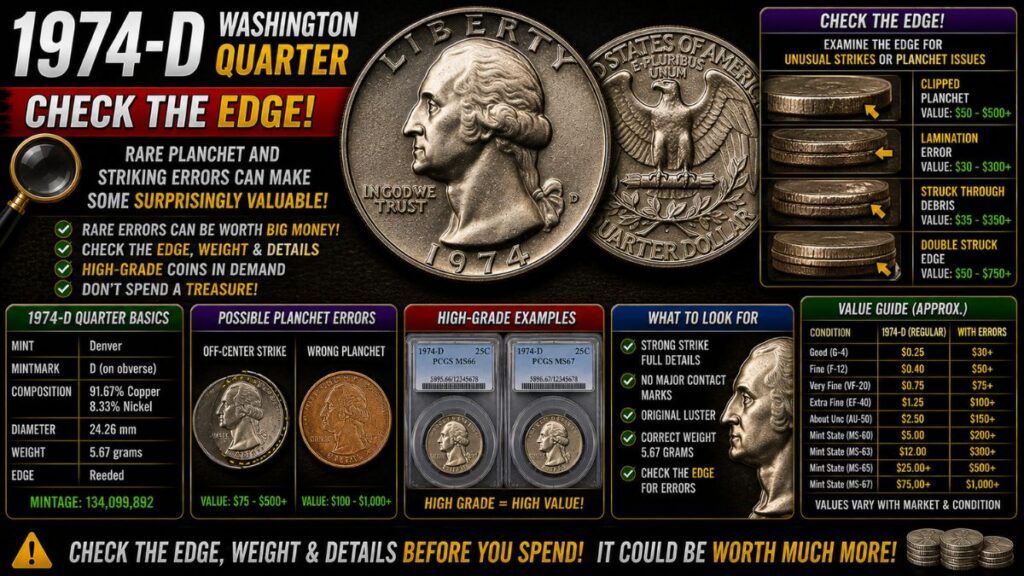
The 1974-D Washington quarter is one of those coins that can look completely ordinary at first glance. Millions were produced, and most examples found in circulation are worth little more than their face value. Yet collectors know that an ordinary-looking quarter can sometimes hide an unusual error, and the edge is one of the best places to begin looking.
A quick inspection of the edge can reveal clues that are difficult to notice when viewing the coin from the front or back. On a normal copper-nickel clad quarter, the edge has a characteristic appearance that comes from the coin’s layered construction. If that edge looks different, shows an unusual color, appears unusually thin or thick, or seems inconsistent with a standard quarter, the coin deserves closer examination.
That does not mean every 1974-D quarter with a strange-looking edge is rare or valuable. Many apparent errors are simply the result of damage, environmental exposure, wear, discoloration, or lighting. The important task is separating a genuine minting error from an ordinary coin that has been altered after leaving the U.S. Mint.
For collectors, this distinction can make all the difference. A normal 1974-D quarter is generally not a scarce coin simply because of its age. A genuine error, however, can attract significant interest because it represents something unusual that happened during the manufacturing process.
The 1974-D Washington quarter therefore offers an excellent lesson in coin collecting: never judge a coin only by its date and mint mark. Examine the entire piece, and pay particular attention to the edge.
Why the 1974-D Quarter Gets Attention From Error Collectors
The Washington quarter has been produced in enormous quantities, making common examples readily available. The 1974-D quarter carries a D mint mark indicating production at the Denver Mint.
For most collectors, the date and mint mark are only the beginning of the examination. When a coin is common, rarity usually comes from something beyond the basic date and mint location.
That is where errors become important.
A minting error occurs when something goes wrong during the production process. Coins are manufactured through a series of highly controlled steps involving blanks, planchets, dies, striking pressure, metal composition, and mechanical handling. A mistake or malfunction at one of those stages can produce a coin that differs significantly from the normal issue.
Some errors are dramatic and immediately recognizable. Others are subtle and require careful examination.
The 1974-D quarter can be particularly interesting when its edge raises questions about the planchet or the striking process. An unusual edge may provide an early clue that the coin should be investigated more carefully.
Collectors should remember, however, that rarity is not automatically created by an unusual appearance. The unusual feature must be understood and, ideally, supported by evidence that it occurred during mint production rather than afterward.
The First Thing to Understand: What a Normal 1974-D Quarter Should Look Like
Before identifying an error, it is important to know what a normal coin looks like.
A standard 1974-D Washington quarter was produced as a copper-nickel clad coin. Its construction is different from that of a solid silver quarter from an earlier era.
The outer surfaces contain a copper-nickel alloy, while the center contains a copper core. This layered construction gives the coin its familiar appearance.
When you look directly at the obverse or reverse, the coin may appear mostly silver-colored. The edge can reveal the construction more clearly.
A normal clad quarter typically shows a narrow copper-colored line around the edge between the outer layers. Depending on wear, lighting, toning, photographs, and the condition of the coin, this line can vary in appearance.
That is why collectors should not assume that every reddish or darker line on the edge represents an error.
The key is consistency.
Look around the entire circumference rather than examining only one small section. Compare the edge on multiple normal quarters if possible. A genuine manufacturing difference may have characteristics that are difficult to reproduce through ordinary circulation damage.
Understanding the normal appearance gives you a reference point for evaluating an unusual 1974-D quarter.
Why the Edge Is So Important
The edge is often overlooked because collectors naturally focus on the date, mint mark, portrait, lettering, and major design elements.
But the edge can provide information that the faces of the coin cannot.
For a clad quarter, the edge can reveal the relationship between the outer metal layers and the central core. If the construction is unusual, the difference may become easier to see from the side.
This is especially useful when investigating possible planchet errors.
A coin that looks perfectly normal from the front might reveal something unusual when viewed edge-on. The thickness, color, layering, and shape of the edge can all provide clues.
An edge examination can also help distinguish a possible error from a damaged coin.
For example, a quarter that has been squeezed, filed, scraped, or exposed to unusual conditions may develop an abnormal edge. That does not necessarily make it a mint error.
A collector therefore needs to ask a simple question:
Does the unusual feature appear to be part of the coin’s original manufacturing process?
That question should guide the entire investigation.
What Is a Planchet?
The term planchet is important when discussing rare coin errors.
A planchet is essentially the prepared metal piece that is ready to be struck into a coin. Before the coin receives its design, the metal must be processed into the appropriate shape, size, thickness, and composition.
If something goes wrong with the planchet before or during striking, the resulting coin may display characteristics that differ from a normal example.
Planchet errors can be especially interesting because they involve the basic material from which the coin was made.
Examples can include a coin struck on the wrong type of planchet, an improperly prepared planchet, or other abnormalities involving the metal blank.
These errors are different from simple damage that occurs after the coin leaves the Mint.
That distinction is critical.
If someone alters the edge of a normal quarter after production, the coin may look unusual, but it is not a Mint-made planchet error. Genuine errors originate during the manufacturing process.
What Is a Striking Error?
A striking error happens during the stage when the prepared planchet is struck by coin dies.
The dies carry the design of the coin. When the planchet is positioned between them, enormous pressure forces the design onto the metal.
If the planchet, dies, collar, or striking mechanism does not function correctly, the coin can receive an unusual impression.
Possible striking-related abnormalities can include off-center strikes, broadstrikes, clipped planchets, multiple strikes, and other unusual configurations.
The exact appearance depends on what happened during production.
Some striking errors are immediately obvious. Others are much more subtle.
A collector examining a 1974-D quarter should therefore inspect both sides and the edge. A possible error should make sense as a result of the minting process rather than simply looking unusual.
The Edge Can Help Reveal a Possible Wrong-Planchet Error
One of the most interesting possibilities for an unusual 1974-D quarter is a wrong-planchet error.
This occurs when a coin is struck on a planchet intended for a different denomination or coin type.
Because different coins can use different sizes, weights, thicknesses, and compositions, a wrong-planchet coin can have characteristics that differ noticeably from a normal quarter.
The edge can be particularly useful in such a situation.
A collector may notice that the edge does not resemble the normal edge of a standard clad quarter. The coin may also have an unusual weight or thickness.
However, visual inspection alone is not enough.
If a 1974-D quarter appears suspicious, weighing it with an accurate scale can provide useful information. Measurements of diameter and thickness can also help.
These observations should be considered together.
An unusual edge combined with an unusual weight and dimensions is much more interesting than an edge that simply looks different under one type of lighting.
Why Weight Matters When Examining a Suspected Error
Weight is one of the most useful tools available to a collector.
A normal coin has a specific expected weight based on its composition and dimensions. If a suspected error is significantly different, that difference can be an important clue.
Suppose a 1974-D quarter appears unusual on the edge. The next logical step is to weigh it.
If the weight is consistent with an ordinary quarter, the unusual appearance may have another explanation.
If the weight is substantially different, further investigation may be justified.
Weight alone, however, does not prove an error.
A coin can lose metal through damage, corrosion, filing, or other post-mint activity. Conversely, dirt or foreign material can affect a measurement.
That is why professional evaluation considers several characteristics together.
For collectors who regularly search coins for errors, a reliable digital scale capable of measuring small differences can be a useful part of the hobby.
The Difference Between a Mint Error and Damage
This is one of the most important concepts for anyone searching for valuable quarters.
Coins experience a lot of abuse after leaving the Mint.
They are dropped, rubbed against other coins, carried in pockets, stored in containers, exposed to moisture, handled repeatedly, and sometimes intentionally altered.
As a result, a damaged coin can look surprisingly strange.
Edge damage is especially common.
A quarter may develop dents, scratches, flattening, gouges, or irregular areas after entering circulation. These features can make the edge appear abnormal even though the coin was perfectly normal when it was manufactured.
Collectors should therefore be cautious when a suspected error appears only on a damaged area.
A genuine mint error generally has characteristics that are consistent with the manufacturing process.
Post-mint damage tends to show evidence of external force or wear.
Learning this distinction prevents collectors from overestimating the value of ordinary damaged coins.
What a Clad Edge Can Tell You
The layered construction of a clad quarter makes the edge particularly informative.
When a coin is viewed from the side, the relationship between its outer layers and central core becomes visible.
On a normal clad quarter, the copper core can produce the familiar copper-colored appearance along portions of the edge.
If the layers appear separated, damaged, or unusually exposed, the coin deserves examination.
But there is an important warning: a damaged clad layer is not automatically a valuable mint error.
Cladding can be affected by circulation and mechanical damage. The outer layer can become worn, scraped, or otherwise disturbed.
Collectors should examine whether the feature appears to have been created during manufacturing or afterward.
The difference can be subtle, which is why serious error collectors often use professional opinions when a potentially valuable coin is involved.
Could a 1974-D Quarter Be Worth More Than Face Value?
Yes, but the reason matters.
Most ordinary 1974-D quarters are not valuable simply because they are from 1974 or because they carry the Denver mint mark.
A common circulated quarter is generally a common coin.
The potential for a significant premium comes from characteristics such as an authentic mint error, an unusual variety, exceptional preservation, or another collectible attribute.
The phrase “rare error” should therefore not be applied to every unusual 1974-D quarter.
A genuine, documented error can be collectible because relatively few examples may exist. The more dramatic, unusual, and clearly attributable the error, the more attention it may receive.
Value is ultimately determined by the specific coin and the marketplace.
Two coins with the same date and mint mark can have dramatically different values if one is a normal circulated example and the other is a genuine major mint error.
Why Condition Still Matters
Error status does not make condition irrelevant.
Collectors still examine the overall preservation of the coin.
A heavily circulated coin may have scratches, marks, dull surfaces, and wear that make its features difficult to evaluate. A well-preserved example can be much easier to study and may also be more desirable to collectors.
For an error coin, condition can influence both desirability and value.
Imagine two coins with the same unusual minting error. If one has severe damage and the other remains sharply preserved, collectors may value the better-preserved example more highly.
This is another reason not to clean a suspected error coin.
Cleaning can damage the original surface and potentially reduce collector interest.
Why Cleaning a Suspected 1974-D Error Is a Bad Idea
When collectors discover a strange-looking coin, one of the first impulses can be to clean it.
That is usually a mistake.
Scrubbing, polishing, chemical cleaning, scraping, or other treatments can permanently alter the surface.
If the coin really is an important error, cleaning can reduce its desirability and make the original characteristics more difficult to evaluate.
Instead, handle the coin carefully by its edges and keep it in a protective holder.
If dirt is present, avoid aggressive attempts to remove it.
A potentially valuable coin is better preserved in its original condition than subjected to an experiment that could permanently damage it.
How to Inspect the Edge of a 1974-D Quarter
A careful inspection does not require expensive equipment.
Start in a well-lit area.
Hold the quarter by its edges and rotate it slowly.
Look at the entire circumference rather than concentrating on one location.
Pay attention to:
The overall thickness.
The color of the edge.
The appearance of the copper core.
Any unusual separation or layering.
Unusual flattening.
Areas that look thicker or thinner.
Unexpected shapes.
Evidence of clipping.
Signs of scraping or filing.
Any feature that appears inconsistent with a normal quarter.
A magnifying glass can help, although excessive magnification is not necessary for the initial inspection.
The most important thing is good lighting and a careful comparison with an ordinary quarter.
Compare It With Another 1974-D Quarter
Comparison is one of the easiest ways to improve an examination.
If you have another normal 1974-D quarter, place the coins side by side.
Compare their diameter, thickness, edge appearance, surface characteristics, and overall construction.
You can also compare the suspected coin with ordinary quarters from nearby years.
This can help determine whether what you are seeing is actually unusual.
Sometimes a coin appears strange simply because the collector is unfamiliar with normal variation caused by wear or lighting.
A side-by-side comparison can quickly eliminate some false alarms.
Look at Both Faces of the Coin
The edge should not be examined in isolation.
Turn the quarter over and inspect the obverse and reverse carefully.
Look for signs that the coin was struck abnormally.
An off-center strike, for example, may leave part of the design missing near the edge.
A broadstrike may affect the overall shape and appearance of the coin.
A clipped planchet can create an unusual curved or missing section.
Other errors can produce doubling, weakness, distortion, or unusual design placement.
The goal is to build a complete picture.
If the edge looks strange but both faces appear completely normal, the coin may still deserve attention, but the evidence needs to be interpreted carefully.
If several characteristics point toward the same manufacturing problem, the case becomes more interesting.
Off-Center Strikes and the 1974-D Quarter
An off-center strike occurs when a planchet is not properly centered between the dies when struck.
The resulting coin can show a design that is noticeably shifted toward one side.
Depending on the severity, part of the design may be missing.
Off-center strikes can be visually appealing to collectors because the error is usually easy to understand.
The important factor is that the abnormality must be the result of the striking process.
A coin that has been bent, damaged, or altered after leaving the Mint is not an off-center strike simply because its design looks unusual.
Collectors should examine the shape, rim, design position, and overall characteristics together.
Broadstrikes and Their Importance
A broadstrike is another type of striking error.
It can occur when a coin is struck without the normal restraining action of the collar.
The result may be a coin that is broader or differently shaped than a normal example.
The edge and rim can provide important clues.
A genuine broadstrike generally has characteristics that are consistent with the coin being struck outside the normal collaring process.
Post-mint flattening can sometimes create a superficially similar appearance.
Again, the distinction between mint-made error and later damage is critical.
Clipped Planchets and Unusual Edges
A clipped planchet can create one of the most recognizable abnormalities on a coin.
The blank may have been improperly cut from the metal strip, leaving a curved or otherwise missing portion.
If such a planchet is struck, the finished coin can retain evidence of the original problem.
The edge may be particularly informative because the missing or abnormal section can affect how the coin’s rim and design appear.
However, not every irregular edge represents a clipped planchet.
Coins can be damaged after production in ways that create similar shapes.
Collectors should therefore look for characteristics consistent with a genuine clipping process.
Why a Strange Color Does Not Automatically Mean a Rare Error
Color can be misleading.
A quarter’s edge may appear coppery, dark, gray, reddish, yellowish, or otherwise unusual depending on lighting and surface condition.
Environmental exposure can also alter a coin’s appearance.
A coin stored in an unfavorable environment may develop discoloration that has nothing to do with a minting error.
Similarly, photographs can exaggerate color differences.
For that reason, collectors should never declare a coin rare simply because the edge has an unusual color.
Color can be a clue, but it needs to be considered alongside weight, dimensions, construction, and visible evidence of a minting abnormality.
Why Lighting Can Fool Collectors
Modern phone cameras make coin photography easy, but lighting can dramatically change how metal appears.
A copper-colored edge can look brighter under warm light and darker under cool light.
Shadows can make a normal seam appear deeper.
Reflections can create the appearance of lines or irregularities that disappear when the coin is rotated.
Before concluding that a 1974-D quarter has a strange edge, examine it under more than one lighting condition.
Natural, neutral lighting can be particularly useful.
Rotate the coin slowly instead of relying on a single photograph.
If the suspected feature disappears when the lighting changes, it may be an optical effect rather than a genuine structural abnormality.
What Makes a Genuine Error Valuable?
There is no single formula.
Collectors generally consider several factors.
Rarity is important. A dramatic error that is seldom encountered can attract substantial interest.
Visibility also matters. Errors that are obvious and easy to understand can be especially appealing.
The type of error matters as well. Some error categories are much more desirable than others.
Condition can influence the price.
Authentication can also matter significantly.
A collector may be reluctant to pay a substantial premium for an unusual coin if there is uncertainty about whether the feature is genuine.
A professionally authenticated error can provide greater confidence.
Ultimately, the market determines what a specific example is worth.
Why Online Claims About Huge Values Should Be Treated Carefully
Coin collecting has a large online audience, and unusual quarters often attract attention.
Unfortunately, headlines can sometimes make ordinary coins sound rare.
A claim that a particular 1974-D quarter is worth thousands or more should never be accepted without examining exactly why that particular coin supposedly has that value.
The date alone does not establish rarity.
The mint mark alone does not establish rarity.
A strange edge alone does not establish rarity.
The coin needs to be evaluated for a specific, legitimate collectible characteristic.
Collectors should be particularly careful with articles or social media posts that use a very high auction price without explaining the exact error, condition, authentication, or circumstances surrounding the sale.
One exceptional coin does not mean every similar-looking coin has the same value.
How to Tell Whether the Edge Has Been Damaged
Post-mint damage can take many forms.
A quarter may be run through machinery, squeezed between objects, struck against another hard surface, scraped, or intentionally altered.
Signs of damage can include sharp scratches, unnatural grooves, flattened areas, tool marks, or irregular deformation.
The location of the damage can also provide clues.
If only one small portion of the edge looks unusual and that area shows obvious physical impact, damage becomes a strong possibility.
A genuine manufacturing problem may affect the coin in a way that makes sense from the moment it was struck.
Learning to recognize these differences is one of the most valuable skills an error collector can develop.
Use a Scale Before Making a Big Claim
If you think your 1974-D quarter is unusual, weigh it.
A small precision scale can provide useful information.
Record the weight carefully and compare it with a normal example of the same denomination.
If the weight is substantially different, investigate further.
If it matches normal specifications, that does not completely eliminate the possibility of an error, but it can make certain theories less likely.
For example, a suspected wrong-planchet coin may have a weight that is inconsistent with a standard quarter.
Measurements should always be interpreted together rather than individually.
Measure Diameter and Thickness
Weight is only one part of the examination.
Diameter and thickness can also help.
A coin struck on an incorrect planchet may have unusual dimensions.
Likewise, certain striking errors can affect the shape or apparent dimensions of the coin.
A basic measuring tool can provide additional information.
However, collectors should avoid damaging the coin while measuring it. Handle it carefully and do not squeeze or manipulate the edge.
When a coin appears genuinely unusual, preserving its condition should be more important than conducting repeated physical tests.
Do Not Scratch the Edge to Test the Metal
One of the worst ways to investigate a suspected error is to intentionally scratch the coin.
Collectors sometimes hear suggestions about cutting, filing, scratching, or applying chemicals to determine the composition.
Do not do this to a potentially valuable coin.
Such actions can permanently damage the specimen.
If metal composition is genuinely important, professional testing is a better approach.
A serious error collector should preserve the coin rather than sacrifice its condition for an informal experiment.
Why Authentication Can Matter
When a coin appears to have a major error, authentication can become important.
Professional experts can examine the coin’s physical characteristics and determine whether the abnormality is consistent with a recognized minting error.
This is especially valuable when the potential value is substantial.
Authentication can also help protect collectors from altered or damaged coins.
The world of error coins includes many pieces that look unusual but are not genuine Mint errors.
An experienced professional can often distinguish between a manufacturing abnormality and post-mint alteration more effectively than a casual examination.
What to Photograph If You Find Something Unusual
Good photographs can make examination easier.
Take a clear image of the obverse.
Take another of the reverse.
Photograph the entire edge.
Then take close-ups of the specific area that looks unusual.
Use even lighting and avoid reflections.
A scale or ruler can sometimes help provide context, although it should not touch or damage the coin.
If the coin appears to have a significant error, preserve it carefully rather than repeatedly handling it.
Clear photographs can also help when discussing the coin with experienced collectors or professionals.
Why the Denver Mint Mark Matters
The D mint mark identifies the Denver Mint as the production facility.
On Washington quarters of this era, the mint mark can help distinguish Denver issues from Philadelphia or other production locations.
However, the D mint mark by itself does not make a 1974 quarter rare.
This is an important point because collectors sometimes assume that a specific mint mark automatically increases value.
For a common issue, the mint mark is simply part of the coin’s identification.
Its significance becomes greater when combined with a legitimate error or other collectible characteristic.
The Date 1974 Does Not Automatically Mean Silver
Another common misunderstanding involves older-looking quarters.
A 1974-D Washington quarter is not automatically a silver quarter merely because it is decades old.
The composition of U.S. quarters changed long before 1974.
The standard quarter of this period used the clad construction discussed earlier.
Therefore, a collector who finds a silver-colored 1974-D quarter should not automatically assume it is silver.
The edge can help reveal the construction, but weight and professional testing can provide stronger evidence when composition is in question.
This is another reason why examining the edge is useful.
Why the Edge Should Be Checked Before Spending the Coin
A quarter may pass through many people’s hands without anyone ever looking at its edge.
That makes edge examination a simple habit for collectors.
Before spending an unusual 1974-D quarter, rotate it and look around the circumference.
If everything appears normal, the coin is probably an ordinary example.
If something seems different, stop and investigate.
The process takes only a few seconds.
For a common coin, that is an easy habit to develop.
And while most coins will not turn out to be rare, the occasional unusual specimen is exactly what makes error hunting exciting.
Common Mistakes New Collectors Make
One of the biggest mistakes is assuming that age equals rarity.
A coin from the 1970s may look old, but millions of coins from that period still exist.
Another mistake is assuming that every unusual feature is an error.
Damage is extremely common.
A third mistake is focusing only on the date and mint mark.
The entire coin should be examined.
Another mistake is trusting an internet value claim without identifying the exact error.
Finally, collectors sometimes clean coins after finding them.
That can permanently reduce their appeal.
A better approach is simple: inspect, compare, measure when appropriate, preserve, and seek expert confirmation if the evidence is convincing.
A Practical Inspection Checklist for a 1974-D Quarter
If you find a 1974-D quarter that looks unusual, work through the following checklist.
First, confirm the date.
Next, confirm the D mint mark.
Then inspect the obverse and reverse for obvious striking abnormalities.
After that, rotate the coin and inspect the entire edge.
Look for unusual thickness, color, layering, clipping, or deformation.
Compare the coin with a normal quarter.
Weigh it if you have an accurate scale.
Measure its diameter and thickness if necessary.
Look for evidence of post-mint damage.
Do not clean, scratch, file, or otherwise alter the coin.
If the evidence continues to suggest a genuine error, consider professional examination.
This systematic approach is much more reliable than judging the coin from one unusual feature.
What If the Edge Looks Copper Colored?
A copper-colored edge is not necessarily a problem.
Because clad quarters contain a copper core, the edge can show copper coloration.
The important question is whether the appearance matches the normal construction of the coin.
Compare it with another clad quarter.
If the edge looks essentially the same, there may be nothing unusual.
If the copper appearance is dramatically different and is accompanied by unusual weight, thickness, or other characteristics, further investigation may be justified.
The edge should therefore be treated as evidence, not as an automatic diagnosis.
What If the Quarter Looks Too Thin?
A coin that appears thinner than normal deserves closer attention, but appearance can be deceptive.
Perspective and lighting can affect how thickness is perceived.
Actual measurement is much more useful.
If a coin is genuinely thinner, the reason must be determined.
It could involve a planchet issue, damage, or another manufacturing characteristic.
A suspected wrong-planchet error may also produce differences in size and weight.
Again, one measurement should not be treated as proof by itself.
What If the Quarter Looks Too Thick?
The same principle applies to a coin that appears unusually thick.
Measure it and compare it with a normal quarter.
Check whether the edge is damaged or distorted.
Look at the rim and both faces.
A striking or planchet abnormality may produce unusual dimensions, but post-mint damage can also alter the shape.
A genuine error should make sense in terms of the manufacturing process.
Why Expert Opinions Can Save Collectors Money
Suppose a collector believes a 1974-D quarter could be a major error.
Selling it immediately based on a guess can be risky.
On the other hand, spending a large amount of money on a professional service without first doing a basic inspection may also be unnecessary.
The best approach is to gather evidence first.
Inspect the coin.
Compare it with normal examples.
Check weight and dimensions when appropriate.
Photograph the unusual characteristics.
If the evidence is strong, professional evaluation becomes much more worthwhile.
An expert opinion can help determine whether the coin has genuine collector value or is simply damaged.
The Importance of Provenance and Documentation
When a coin is believed to be an important error, documentation can add confidence.
Keep photographs of the coin before sending it anywhere.
Record its measurements.
Note exactly what attracted your attention.
If it is professionally examined, preserve the resulting documentation.
This information can be useful later if the coin is sold, submitted for grading, or compared with other examples.
Documentation does not magically increase the value of a coin, but it can help establish confidence in its identity and characteristics.
Why Some Errors Are More Exciting Than Others
Error collectors often enjoy coins that clearly demonstrate what happened during production.
A dramatic off-center strike, unusual planchet, major clipping, or other unmistakable error can tell a story.
The coin becomes more than an ordinary piece of money.
It becomes an example of a production mistake that escaped normal quality control.
That story is part of the appeal.
A subtle error can still be collectible, but major visible errors often attract more attention because they are easier to recognize and understand.
The 1974-D Quarter Is a Good Coin for Learning Error Hunting
Even if your particular quarter turns out to be ordinary, the search itself can be educational.
The 1974-D issue provides an opportunity to learn how clad coins are constructed, how planchets work, how striking errors occur, and how post-mint damage differs from genuine errors.
The edge is an especially useful teaching tool.
Once collectors become comfortable identifying normal clad construction, unusual examples become easier to recognize.
That knowledge can then be applied to other denominations and dates.
In that sense, even a face-value quarter can teach valuable collecting skills.
Don’t Assume Every Valuable Quarter Has a Dramatic Appearance
Some collectors expect a valuable error to look spectacular.
That is not always the case.
Certain collectible errors can be subtle.
A small but genuine manufacturing abnormality can sometimes be more important than a dramatic-looking feature caused by damage.
This is why identification should come before valuation.
First determine what the coin actually is.
Only then should you begin thinking about how much it might be worth.
Why Identification Comes Before Price
The biggest mistake in coin valuation is asking “How much is this worth?” before asking “What exactly is this?”
For a 1974-D quarter, the first question should be whether it is a normal example or an error.
If it is an error, what type?
Is the feature related to the planchet?
Is it related to striking?
Is it a mint-made characteristic or post-mint damage?
What is the condition?
Has it been authenticated?
Only after those questions are answered does a meaningful valuation become possible.
Without identification, a price estimate is little more than speculation.
Frequently Asked Questions
Is every 1974-D Washington quarter valuable?
No. Most 1974-D Washington quarters are ordinary coins and are not rare simply because of their date or Denver mint mark. The potential for a significant premium comes from a genuine error, unusual collectible characteristic, exceptional condition, or another factor that makes the individual coin desirable.
Why should I check the edge of a 1974-D quarter?
The edge can reveal details about the coin’s construction that are difficult to see from the front and back. Because the quarter is a clad coin, the edge can provide clues about its metal layers, thickness, and possible planchet abnormalities.
Does a copper-colored edge mean my quarter is rare?
Not necessarily. A normal clad quarter can show copper coloration on its edge because of its copper core. Compare the coin with a normal quarter before assuming the color represents an error.
What is a planchet error?
A planchet error involves an abnormality in the metal blank used to make the coin. A coin struck on the wrong type of planchet is one example of a potentially important planchet error.
What is a striking error?
A striking error occurs during the process in which the prepared planchet is struck by the dies. Off-center strikes and broadstrikes are examples of abnormalities that can result from problems during this stage.
Can a 1974-D quarter be valuable because it weighs differently?
A significant difference in weight can be an important clue, especially when investigating a possible wrong-planchet error. However, weight alone does not prove that a coin is a genuine Mint error. Damage and other factors must also be considered.
Should I clean a 1974-D quarter that looks unusual?
No. Cleaning, polishing, scratching, or using chemicals can damage the coin and reduce its collector appeal. If the quarter appears potentially valuable, preserving it in its original condition is generally the safer approach.
How can I tell if an unusual edge is damage?
Look for scratches, gouges, flattening, tool marks, or other evidence of external force. Compare the edge with a normal quarter and inspect both faces. If the feature appears to have occurred after production, it is likely damage rather than a Mint error.
Does the D mint mark make the 1974 quarter rare?
No. The D simply identifies the Denver Mint. A 1974-D quarter needs an additional collectible characteristic, such as a legitimate error or exceptional condition, to become significantly more interesting from a rarity perspective.
Should I weigh my suspected 1974-D error?
Yes, if you have an accurate scale and can do so without damaging the coin. Weight can provide useful evidence when investigating possible planchet abnormalities. It should be considered together with appearance, dimensions, and other characteristics.
Can a damaged coin look like a mint error?
Yes. Circulation and post-mint damage can create many unusual shapes, colors, scratches, and edge abnormalities. This is why identifying the cause of the unusual feature is more important than simply noticing that something looks different.
What should I do if I think my 1974-D quarter has a major error?
Handle it carefully, avoid cleaning or altering it, document the unusual characteristics, and compare it with normal examples. If the evidence remains convincing, professional examination or authentication can help determine whether the feature is a genuine minting error.
Is a strange-looking edge enough to prove a rare 1974-D quarter?
No. The edge is an excellent place to begin an investigation, but it is not proof by itself. Weight, dimensions, construction, the appearance of both faces, and evidence of the manufacturing process should all be considered.
Why the 1974-D Quarter Deserves a Closer Look
The most important lesson is simple: an ordinary-looking 1974-D Washington quarter can be worth only its face value, but an authentic minting error can make an individual example much more interesting to collectors.
That is why the edge deserves attention.
A quick rotation of the coin can reveal its clad construction and sometimes provide clues that are not obvious from the obverse or reverse. Unusual thickness, strange layering, unexpected dimensions, or other abnormalities can justify a closer examination.
But collectors should also keep expectations realistic. Most 1974-D quarters are ordinary. A strange appearance does not automatically mean rarity, and a high-value claim should never be accepted without identifying the exact characteristic that makes the coin unusual.
The best approach is careful and methodical. Examine the date and mint mark, inspect both sides, check the edge, compare the coin with a normal quarter, and use accurate measurements when necessary. Most importantly, distinguish genuine Mint errors from damage that happened after production.
If your 1974-D quarter really does show an unusual planchet or striking characteristic, preserving the coin is the first priority. Do not clean it, scratch it, file it, or otherwise attempt to modify it.
So the next time a 1974-D Washington quarter lands in your hands, don’t immediately toss it into the spend pile. Turn it sideways. Check the edge carefully. Most will be ordinary, but that simple inspection could be the first step toward discovering something genuinely unusual.