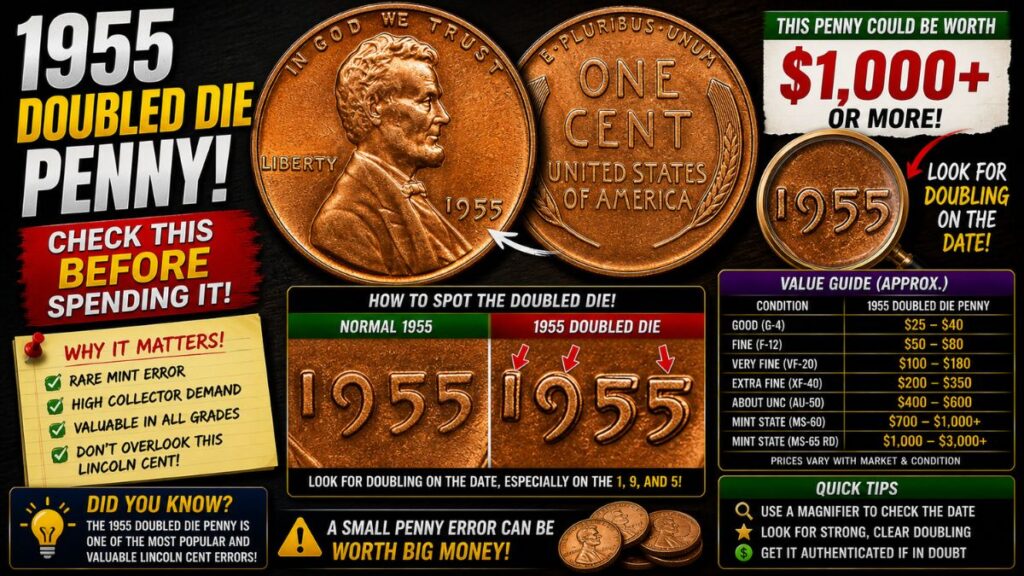
A 1955 Lincoln cent can look like an ordinary old penny, but one particular variety has become one of the most recognized doubled-die coins in American numismatics. Before spending a 1955 penny or dismissing it as an old coin with some unusual-looking lettering, it is worth taking a careful look at the date and inscriptions.
The genuine 1955 Doubled Die Obverse, identified as FS-101, is known for dramatic doubling on the obverse. The doubling is especially noticeable on the date and lettering, making the variety much easier to recognize than many subtle doubled dies.
That visibility is one reason the coin has attracted so much attention from collectors.
But there is an equally important warning: not every 1955 penny showing something that resembles doubling is the famous variety.
This distinction matters enormously.
A genuine FS-101 must be properly identified before anyone relies on a high-value claim. Similar-looking effects can occur for other reasons, and an ordinary 1955 Lincoln cent should not automatically be treated as the famous doubled die.
If you happen to have a 1955 penny, the best approach is simple: check it carefully, understand what genuine doubling should look like, avoid altering the coin, and verify the variety before making any assumptions about its value.
What Makes the 1955 Doubled Die Penny So Interesting?
The 1955 Doubled Die Obverse is famous because the doubling is dramatic enough to be visible on important parts of the coin without requiring an expert eye or specialized equipment.
The key feature is the obverse doubling.
The obverse is the front side of the Lincoln cent, showing Abraham Lincoln’s portrait.
On a genuine example, the doubling is especially apparent in the date and lettering.
Instead of the lettering appearing as a single clean impression, the genuine doubled die displays distinct duplicated elements caused by the doubled-die variety.
This is fundamentally different from a coin that simply looks blurry, damaged, or distorted.
That difference is critical when examining a possible 1955 doubled die.
The famous variety is not valuable merely because someone sees two edges on a letter.
It is valuable because the coin represents a specific recognized doubled-die variety with identifiable characteristics.
Therefore, identification must come before valuation.
What Is the 1955 Doubled Die Obverse?
The 1955 Doubled Die Obverse is a specific variety of the 1955 Lincoln cent.
The term “obverse” refers to the front of the coin.
The term “doubled die” describes a situation in which the working die itself contains a doubled design.
That distinction is important because collectors differentiate true doubled dies from other forms of doubling that can occur during the minting process.
The genuine 1955 variety is especially notable because the doubling is strong and visible.
The date is one of the first areas a collector should examine.
The lettering is another important area.
Rather than relying on a general impression that the coin “looks doubled,” the collector should look for the characteristic appearance associated with the recognized variety.
The more carefully the coin is examined, the easier it becomes to separate a genuine doubled die from an ordinary cent with unrelated visual effects.
What Does FS-101 Mean?
FS-101 is an identification designation associated with the famous 1955 Doubled Die Obverse.
For someone examining a possible example, this designation is important because it provides a specific reference point.
Instead of simply saying, “This penny looks doubled,” collectors can identify the particular recognized variety they believe they have found.
This is one reason the term FS-101 appears frequently in discussions of the 1955 doubled die.
However, the presence of the 1955 date alone does not make a coin FS-101.
The variety must be verified.
This is the most important message for anyone hoping to determine whether their penny has significant collector value.
A 1955 Lincoln cent and a genuine 1955 Doubled Die Obverse are not automatically the same thing.
The Date Is One of the Most Important Areas to Check
If you have a 1955 Lincoln cent and want to investigate whether it could be the famous doubled die, start with the date.
The genuine variety is known for dramatic doubling in the date.
Look closely at the individual numerals.
The doubling should appear as part of the design rather than as random damage around the numbers.
This is an important distinction.
A scratch near the date does not create a doubled die.
A flattened numeral caused by wear does not create a doubled die.
A blurry photograph does not prove doubling.
The collector is looking for actual duplicated design elements that correspond to the recognized variety.
A good magnifying glass or suitable magnification can make the examination easier, although magnification should be used to inspect the details rather than to manufacture an interpretation.
Look Beyond the Date
Although the date is an obvious place to start, it should not be the only area examined.
The genuine 1955 doubled die is also known for dramatic doubling in the lettering on the obverse.
This provides additional evidence when trying to determine whether a coin matches the recognized variety.
A collector should examine the lettering carefully rather than focusing on one numeral.
Look at the relationship between the apparent doubled elements.
Does the doubling appear consistent?
Does it affect multiple parts of the obverse?
Does the appearance resemble the established characteristics of the 1955 Doubled Die Obverse?
These questions are much more useful than simply asking whether the coin looks unusual.
A genuine variety should have identifiable characteristics.
Why the Lettering Matters
The dramatic doubling on the lettering is one of the reasons the 1955 variety is so recognizable.
When examining a possible example, pay attention to the obverse inscriptions rather than looking only at Lincoln’s portrait.
The lettering can show the characteristic separation associated with the doubled die.
This is important because a genuine doubled die represents a specific relationship between the duplicated design elements.
Random damage does not reproduce that relationship.
A damaged letter may appear to have an extra edge.
A worn letter may appear distorted.
A coin photographed at an angle may produce strange shadows.
But genuine die doubling should be part of the design itself.
That is why collectors examine the coin carefully from multiple angles and under appropriate lighting.
Genuine Doubling Versus Damage
One of the biggest mistakes a new collector can make is assuming that every unusual line or extra edge is a doubled die.
Coins experience a lot of handling.
They can be scratched, rubbed, struck against other coins, stored improperly, or exposed to other forms of damage.
A damaged coin can produce visual effects that look surprising under magnification.
This is particularly true around raised lettering and numbers.
The correct question is not:
“Do I see something that looks like another number?”
The better question is:
“Does the coin display the recognized characteristics of the 1955 Doubled Die Obverse?”
That change in thinking can prevent many incorrect identifications.
Why Verification Is So Important
The 1955 doubled die is famous enough that claims about its value can spread quickly.
Someone may see a photograph online, compare it with their own penny, and immediately assume they have found a valuable example.
That can lead to unrealistic expectations.
The problem is that photographs can exaggerate small features.
Lighting can create shadows.
Camera angles can make edges appear duplicated.
Damage can become more obvious under extreme magnification.
For this reason, the variety should be verified before trusting any high-value claim.
The identity of the coin comes first.
The grade comes second.
The market value comes after that.
Reversing this order can lead to confusion.
Do Not Assume Every 1955 Penny Is Valuable
The year 1955 alone is not enough.
This point deserves emphasis because it is easy to overlook.
A 1955 Lincoln cent can be an interesting old coin without being the famous doubled die.
The key question is whether it matches the recognized variety.
If it does not, the coin should not be represented as the 1955 Doubled Die Obverse.
This is particularly important when reading claims about very high prices.
High-value figures associated with famous coin varieties can attract attention, but those figures generally apply to specific examples that meet specific criteria.
A normal 1955 cent should not automatically be assigned the value of a verified doubled-die example.
Why the 1955 Date Can Create Confusion
The 1955 date itself is visually distinctive enough that collectors may naturally focus on it.
If a coin has an unusual-looking “5,” “9,” or other numeral, it can be tempting to assume the unusual appearance is the famous doubling.
But a genuine doubled die is not identified by one strange-looking numeral in isolation.
The entire relevant design needs to be considered.
The date is important, but the surrounding characteristics matter as well.
This is why careful identification is more reliable than visual excitement.
If the coin appears to show doubling, inspect the other relevant areas of the obverse.
Consistency is important.
What a Collector Should Look For
A careful inspection of a possible 1955 Doubled Die Obverse should focus on several basic questions.
First, is the coin actually dated 1955?
Second, does the obverse show dramatic doubling in the date?
Third, does the lettering also show the characteristic doubling?
Fourth, does the apparent doubling look like part of the die-created design rather than post-mint damage?
Fifth, does the overall appearance correspond to the recognized FS-101 variety?
If the answer to these questions is uncertain, the coin should not immediately be described as genuine.
Instead, further verification is appropriate.
That is especially true if someone is considering the coin to be worth a substantial amount.
Why a Magnifying Glass Can Help
The doubling on a genuine 1955 doubled die is dramatic, but magnification can still help you study the details.
A simple magnifying glass can make the relationship between the letters and numerals easier to see.
However, magnification should not be treated as a substitute for knowledge.
A larger image can make almost any small surface irregularity look significant.
That is why it is important to understand what you are actually looking for.
Use magnification to examine the coin.
Do not use it to convince yourself that every unusual mark is a doubled die.
Lighting Can Change What You See
Lighting is another important part of coin examination.
A coin can look very different under direct light, indirect light, or light coming from the side.
Surface scratches may become more obvious.
Edges may cast shadows.
Raised details may appear doubled simply because of lighting.
This is why a possible doubled die should be examined from more than one angle.
If an apparent second outline disappears when the coin is rotated, it may be a reflection or shadow rather than an actual doubled design element.
The objective is to determine whether the doubling is physically part of the design.
Do Not Clean a Possible 1955 Doubled Die
If you believe you have found a possible 1955 Doubled Die, do not clean it.
This is especially important if the coin may have significant collector value.
Cleaning can change the surface of the coin.
Polishing, rubbing, abrasive materials, or chemical treatments can leave marks or otherwise alter the original appearance.
A collector interested in a valuable variety generally wants the coin preserved rather than modified.
If the coin is dirty, resist the urge to make it shine.
Its current condition is part of the coin’s history, and unnecessary cleaning can hurt its desirability.
Handle the Coin Carefully
If you believe a 1955 cent may be a genuine doubled die, minimize unnecessary handling.
Hold the coin by its edges when possible.
Avoid rubbing the obverse or reverse with your fingers.
Do not repeatedly slide it across a table.
Do not place it loosely in a container with other coins where it can pick up additional marks.
Careful handling is especially sensible when the potential value depends on the coin’s condition.
A genuine variety with strong preservation can be more desirable than a similar example that has been damaged after discovery.
What If the Coin Really Looks Like FS-101?
If the coin appears to match the characteristics of FS-101, the next step is verification.
Do not immediately sell it based on a visual comparison alone.
Do not assume a price from an online headline applies automatically.
Instead, have the variety confirmed by a knowledgeable and reputable source or professional grading service when appropriate.
This is particularly important because the 1955 doubled die is a recognized variety with specific identifying characteristics.
Verification establishes whether the coin is actually the variety being claimed.
Once authenticity and variety are established, other factors such as condition become relevant.
Why Grade Matters After Variety Identification
Even after a coin has been correctly identified as the 1955 Doubled Die Obverse, condition still matters.
Collectors do not necessarily value every genuine example identically.
A coin’s preservation can influence its desirability.
A heavily worn example and a well-preserved example can have very different collector appeal.
This means that identifying the variety is only one stage of the process.
The next stage is evaluating the coin’s condition.
That is another reason high-value claims should be treated carefully.
The phrase “1955 doubled die” identifies a variety.
It does not automatically tell you the exact market value of a particular coin.
Why High-Value Claims Need Context
Claims about rare pennies can be extremely attention-grabbing.
A headline may suggest that a 1955 doubled die is worth a large amount of money.
But collectors should always ask what specific coin the figure refers to.
Was it a verified FS-101?
What was its grade?
Was it professionally certified?
Was the price an auction result?
Was it an asking price?
These distinctions matter.
A high asking price does not necessarily mean someone paid that amount.
An auction result reflects a specific transaction involving a specific coin.
A valuation estimate may differ from the actual amount a buyer is willing to pay.
Therefore, high-value claims should never be separated from the coin’s exact identity and condition.
The Difference Between Variety and Condition
It helps to think of coin value as a process.
First, identify the coin.
Then identify the variety.
Then assess its condition.
Then consider the market.
For a 1955 Lincoln cent, this means you should not begin by searching for the highest price you can find.
Start by determining whether the coin is actually the recognized doubled die.
If it is, then consider its condition.
Only after those questions have been answered should you think seriously about market value.
This approach is much more reliable than starting with a price.
Why the 1955 Doubled Die Is Easy to Talk About but Harder to Verify
The variety is famous because its doubling is dramatic.
That makes it easier for beginners to notice than subtle doubled dies.
But visibility does not eliminate the need for verification.
A coin can look unusual for many reasons.
The challenge is determining whether the unusual appearance matches the recognized variety.
This is where experience becomes valuable.
Collectors learn to distinguish actual die characteristics from post-mint damage and other visual effects.
They also learn not to rely on one feature in isolation.
How to Examine the Date Carefully
Place the coin under good lighting.
Look directly at the date.
Then tilt the coin slightly.
Examine the shapes and edges of the numerals.
You are looking for genuine duplication rather than random scratches or shadows.
If the date appears doubled, move on to the lettering.
Do not stop after finding one unusual feature.
The goal is to see whether the entire appearance is consistent with the recognized doubled-die characteristics.
If it is not, the coin should not automatically be classified as FS-101.
Examine the Lettering Carefully
The obverse lettering provides another important area for inspection.
On the genuine variety, the doubling is dramatic.
Look closely at the relevant letters and compare the apparent duplicated elements.
The key is consistency.
If one letter has a random scratch but the rest of the design looks normal, that is not enough.
If multiple relevant design elements show the characteristic appearance, the coin becomes more interesting.
Again, the final identification should be verified before a high-value claim is accepted.
Why Photographs Can Be Misleading
Modern smartphone cameras can capture extremely detailed images of coins.
That can be useful.
But photographs can also create confusion.
A reflection can look like an extra letter.
A shadow can appear to be doubling.
Digital sharpening can exaggerate edges.
A camera angle can make a normal design element appear displaced.
This is why a photograph is useful for examination but should not automatically be treated as proof.
When possible, inspect the actual coin directly under suitable lighting.
If the potential value is substantial, professional verification is even more important.
What Beginners Often Get Wrong
A beginner may make several predictable mistakes when searching for a 1955 doubled die.
The first is assuming every 1955 cent is rare.
The second is assuming any visible doubling is the famous variety.
The third is relying on a single photograph.
The fourth is cleaning the coin.
The fifth is trusting an unverified price claim.
The sixth is overlooking condition.
Avoiding these mistakes makes the search much more productive.
The purpose of checking your coin is not to create excitement without evidence.
It is to identify genuine characteristics carefully.
Why Authentication Matters
Authentication is especially important when a coin could potentially be worth substantially more than an ordinary cent.
The 1955 doubled die is a famous variety, so incorrect identifications can have serious consequences.
If a coin is sold as a genuine FS-101 when it is not, the buyer may be misled.
Likewise, an owner may mistakenly sell an interesting coin for far less than it deserves if they fail to recognize the variety.
Proper verification protects both sides.
It provides confidence about what the coin actually is.
What Professional Grading Can Add
Professional grading can provide a standardized assessment of a coin’s condition and can also be important when documenting a recognized variety.
For a potentially valuable 1955 doubled die, certification may provide additional confidence to collectors and buyers.
However, not every old penny needs to be professionally graded.
The decision should be based on the coin’s apparent characteristics and potential significance.
If the coin clearly does not match the doubled-die variety, there may be little reason to pursue expensive evaluation.
If the coin appears to be a strong candidate for FS-101, professional verification becomes much more relevant.
What You Should Not Do With a Possible Valuable Penny
Do not polish it.
Do not scratch it to “test” the surface.
Do not rub the date.
Do not scrape dirt away with a sharp object.
Do not use household chemicals.
Do not assume a high price based on a social-media post.
Do not sell it immediately based solely on an unverified identification.
Instead, preserve the coin and establish what you actually have.
That simple approach can prevent avoidable mistakes.
Why Preservation Matters
Once a potentially important coin has been found, preservation becomes part of the process.
A coin can remain valuable because of its variety, but its condition can also influence collector interest.
Unnecessary handling can introduce scratches.
Improper storage can create additional problems.
Cleaning can permanently change the surface.
The safest approach is to minimize interference until the coin has been properly evaluated.
Does the 1955 Doubled Die Have Obverse Doubling?
Yes. The famous variety is the 1955 Doubled Die Obverse, and its dramatic doubling is visible on the front of the coin.
The date and lettering are particularly important areas to inspect.
This is one of the defining characteristics that separates the recognized variety from an ordinary 1955 Lincoln cent.
Why the Date and Lettering Are So Important
The date and lettering provide some of the clearest visual evidence of the variety.
If you are checking a 1955 penny, these areas should receive careful attention.
The goal is to identify genuine duplicated design elements rather than random marks.
Because the doubling is dramatic on the recognized variety, the relevant details should stand out when the coin is examined properly.
Could Damage Make a Penny Look Doubled?
Yes.
Damage and surface irregularities can create misleading shapes around letters and numbers.
This is why it is not enough to find one extra-looking line.
A true doubled die is part of the die-created design.
Damage happens after the coin is struck and can create a very different appearance.
Understanding that distinction is fundamental to correctly identifying a 1955 doubled die.
What Should You Do If You Find a 1955 Penny Today?
Start by checking the date.
If it is 1955, inspect the obverse carefully.
Look at the date.
Then inspect the lettering.
If you see dramatic doubling that appears consistent with the recognized variety, protect the coin and pursue verification.
Do not clean it.
Do not assume its value.
Do not rely solely on an online photograph.
The most important next step is confirming whether the coin is genuinely the FS-101 variety.
Why the Phrase “Check Before Spending It” Matters
Old coins can easily be spent without a second thought.
A person may receive a 1955 penny and think of it as nothing more than one cent.
But a quick inspection can sometimes reveal characteristics worth investigating.
The point is not that every old penny is valuable.
The point is that certain recognized varieties can be dramatically more desirable than ordinary examples.
The 1955 Doubled Die Obverse is one of the clearest examples of why paying attention can matter.
A few seconds of inspection can tell you whether the coin deserves further consideration.
What Makes FS-101 Different From a Random Doubled-Looking Penny?
FS-101 is a recognized variety with specific characteristics.
A random doubled-looking penny may simply have damage, mechanical doubling, wear, or another unrelated surface effect.
The distinction comes from identification.
A collector should compare the actual characteristics of the coin with those expected for the recognized variety.
This is why verification is so important before accepting a high-value claim.
Why Mechanical or Other Doubling Can Cause Confusion
Not every apparent doubling is the result of a doubled die.
Other minting-related effects can create secondary outlines or flattened-looking design elements.
These effects may look impressive under magnification but are not necessarily the same thing as a recognized doubled-die variety.
For someone searching a 1955 cent, this is another reason to avoid assigning a variety based on appearance alone.
The goal is to determine exactly what produced the visible feature.
How Condition and Authenticity Work Together
Imagine two 1955 pennies.
One is a verified FS-101 with significant wear.
The other is also a verified FS-101 but is exceptionally well preserved.
They are both the same recognized variety.
Yet their collector appeal may be different because condition differs.
This illustrates why identification and grading are separate steps.
First establish authenticity and variety.
Then evaluate condition.
Only after both are understood can a realistic value discussion begin.
Why You Should Be Careful With Online Price Claims
The internet contains many claims about valuable pennies.
Some may be based on genuine auction results.
Others may represent asking prices, speculative estimates, or misunderstandings.
A headline can make a coin sound more valuable than it actually is.
That is why the safest approach is to ask what exact coin produced the quoted price.
A verified FS-101 in one condition should not automatically be compared with an ordinary 1955 cent in another.
The coin must be identified first.
How to Think Like a Coin Collector
The best way to examine a 1955 penny is to remain curious but skeptical.
Curious enough to inspect it carefully.
Skeptical enough not to believe every high-value claim.
This balance is important.
If you dismiss every unusual coin, you can miss something interesting.
If you assume every unusual mark is valuable, you can become convinced by false identifications.
A careful collector asks questions and looks for evidence.
A Simple Checklist for a 1955 Penny
When you encounter a 1955 Lincoln cent, remember these basic steps.
Check the date.
Inspect the obverse.
Examine the date for dramatic doubling.
Examine the lettering for corresponding doubling.
Consider whether the appearance looks like a die-created feature rather than damage.
Do not clean the coin.
Protect it from unnecessary handling.
If the characteristics appear consistent with the recognized variety, seek proper verification.
Only after verification should you consider high-value claims.
Frequently Asked Questions About the 1955 Doubled Die Penny
What is the 1955 Doubled Die Penny?
It is a 1955 Lincoln cent with a recognized doubled-die obverse variety. The genuine variety has dramatic doubling that is particularly noticeable on the date and lettering.
What is FS-101?
FS-101 is the identification designation associated with the recognized 1955 Doubled Die Obverse variety.
Where should I look for doubling?
Start with the date and then inspect the obverse lettering. The genuine variety is known for dramatic doubling in these areas.
Does every 1955 penny have the doubled die?
No. A 1955 date alone does not establish the famous variety. The coin must display the appropriate characteristics and be properly verified.
Can scratches make a 1955 penny look doubled?
Yes. Damage and other surface effects can create misleading extra lines or edges. That is why the actual variety must be identified rather than assumed.
Should I clean a 1955 penny that looks valuable?
No. Cleaning or polishing can alter the coin’s surfaces and potentially reduce its desirability. A possible valuable variety should be preserved in its existing condition.
Is every doubled-looking 1955 penny valuable?
No. Not every apparent doubling represents the recognized 1955 Doubled Die Obverse. The specific characteristics need to be verified.
Does the date matter?
Yes. The 1955 date is essential when identifying the famous variety, but the date alone is not enough. The coin also needs to match the recognized doubled-die characteristics.
Why is verification so important?
Because high-value claims depend on the exact identity of the coin. A genuine FS-101 should not be confused with an ordinary 1955 cent or a coin showing unrelated damage or doubling.
Can a photograph prove that my penny is FS-101?
A photograph can help with examination, but it should not automatically be treated as definitive proof. Lighting, reflections, camera angles, and image processing can create misleading appearances.
Does condition affect a genuine 1955 doubled die?
Yes. Once the variety is established, the coin’s condition becomes an important part of evaluating its desirability and potential market value.
Should I get a possible 1955 doubled die professionally evaluated?
If the coin appears to match the recognized variety and could have significant collector value, professional verification can be a sensible next step.
What is the biggest mistake to avoid?
The biggest mistake is trusting a high-value claim before verifying that the coin is actually the genuine FS-101 variety.
Final Thoughts on the 1955 Doubled Die Penny
The 1955 Doubled Die Obverse is one of the most recognizable doubled-die varieties associated with the Lincoln cent. Its dramatic doubling on the date and lettering makes it particularly interesting to collectors and gives anyone who finds a 1955 penny a good reason to look twice.
But the most important lesson is not simply that the coin can be valuable.
It is that identification matters.
A 1955 date does not automatically mean you have the famous doubled die. A strange-looking line does not automatically prove genuine doubling. A photograph does not automatically establish authenticity. And a high price mentioned online does not automatically apply to the coin in your hand.
The genuine FS-101 has recognizable characteristics, especially the dramatic doubling on the obverse date and lettering. Those characteristics should be carefully examined and, when necessary, professionally verified.
If you find a 1955 penny, take a moment before spending it.
Check the date.
Study the doubling.
Examine the lettering.
Look for evidence that the unusual features are actually part of the coin’s design.
Most importantly, protect the coin and verify the variety before trusting any high-value claim.
That combination of careful observation and proper verification is the best way to approach a possible 1955 doubled die. A few minutes of careful checking could tell you whether you are holding an ordinary old Lincoln cent or a coin that deserves much closer attention.