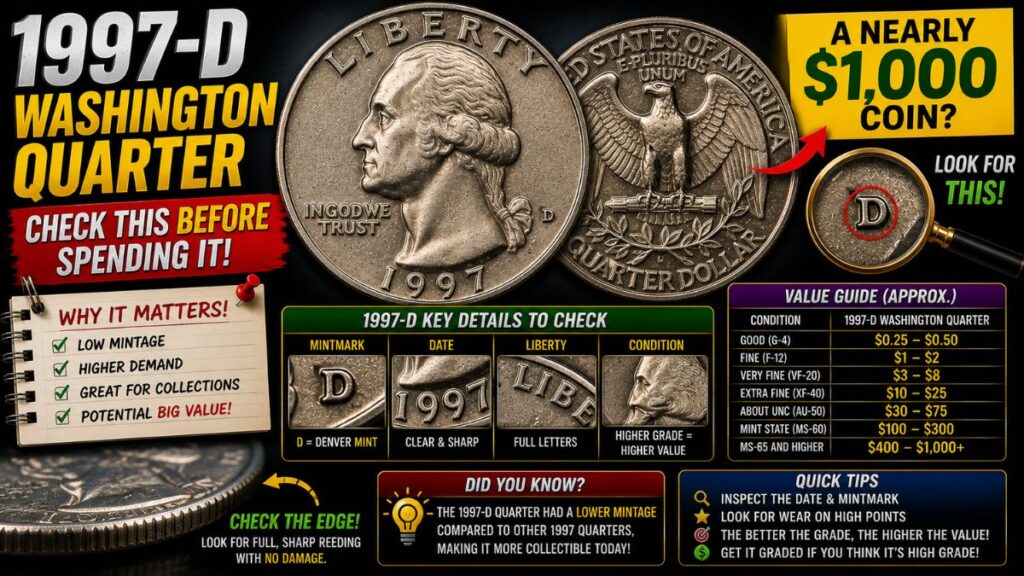
Finding a 1997-D Washington quarter in your pocket, coin jar, cash register change, or an old collection may not seem exciting at first. After all, the 1997-D quarter is generally a common coin, and millions of Washington quarters from this era were produced for everyday circulation.
But there is an important reason collectors may still want to take a closer look before spending one.
While most 1997-D Washington quarters are worth little more than their ordinary face value when circulated, exceptionally preserved examples can be considerably more interesting. In particular, highly graded Mint State examples have demonstrated that condition can make an enormous difference. Exceptionally preserved MS68 examples have reached nearly $1,000 at auction.
That does not mean every 1997-D quarter is a hidden $1,000 treasure. It also does not mean that a normal circulated coin should automatically be valued at hundreds of dollars. The important lesson is much simpler: condition matters.
A quarter that spent years moving through pockets, vending machines, cash registers, and coin-counting machines is very different from one that survived with remarkable original surfaces and almost no visible imperfections.
That is why the 1997-D Washington quarter deserves a second look.
If you have one, the first thing to determine is not whether it is old. It is whether it has survived in unusually good condition.
This guide explains what makes the 1997-D Washington quarter worth checking, why MS68 examples can command much more attention than ordinary pieces, what collectors look for, why surface preservation matters so much, and what you should consider before deciding whether to spend, save, or have a particularly attractive example professionally evaluated.
Why the 1997-D Washington Quarter Is Worth Checking
The 1997-D Washington quarter is not rare simply because of its date.
That distinction is important.
Many people naturally associate valuable coins with very old dates. A coin from the 1800s can seem more exciting than one from the 1990s. However, age alone does not determine a coin’s value.
Modern coins can become collectible when they are found in unusually high condition, have a recognized variety or error, or possess another characteristic that separates them from the ordinary examples that collectors encounter every day.
The 1997-D quarter is particularly interesting from a condition perspective because ordinary circulation can quickly damage the appearance of a coin.
A quarter does not need to be visibly damaged beyond recognition to lose significant grade potential. Small marks, contact scratches, dull surfaces, abrasions, and signs of handling can all affect how a professional grader evaluates its condition.
This is where the difference between an ordinary circulated quarter and an exceptional Mint State example becomes important.
A circulated 1997-D quarter may show obvious evidence of use. Its surfaces may have numerous contact marks, its high points may have lost their original appearance, and its overall presentation may be far from what collectors expect from a top-condition coin.
An exceptional MS68 example is a completely different situation.
At that level, preservation is the story.
The coin must have survived with remarkably clean surfaces and an overall appearance that places it far above the typical examples encountered in circulation.
That is why the same date and mint mark can produce dramatically different collector interest depending on condition.
What Does the “D” Mean on a 1997 Quarter?
The “D” on a 1997-D Washington quarter identifies the Denver Mint.
For collectors examining a 1997 quarter, the mint mark is one of the first details worth checking.
The date tells you the year the coin was struck, while the mint mark helps identify the facility associated with its production.
A 1997-D quarter therefore refers specifically to a Washington quarter dated 1997 bearing the Denver “D” mint mark.
This distinction matters because collectors often organize coins by date and mint. Two quarters may look nearly identical at first glance, yet their dates and mint marks can make them different collecting pieces.
However, simply finding the “D” does not make a 1997 quarter rare.
That is one of the most important points to remember.
The interesting part of the 1997-D quarter is not that the letter “D” automatically transforms an ordinary quarter into a valuable coin. Instead, the focus is on finding an exceptionally preserved example.
In other words, don’t stop after identifying the mint mark.
The next step is to examine the coin’s condition carefully.
Most 1997-D Quarters Are Common
The phrase “check this before spending it” can easily create unrealistic expectations if it is misunderstood.
Most 1997-D Washington quarters are common.
If you find a typical circulated 1997-D quarter, there is no reason to assume that it is worth hundreds of dollars simply because it carries the correct date and mint mark.
Coins from common dates can exist in enormous numbers.
Many were placed into circulation and used as ordinary money. Over time, those coins naturally picked up marks and signs of handling.
This is why collectors make a strong distinction between a common date in ordinary condition and a common date in extraordinary condition.
A common coin can remain common even when collectors find it interesting.
At the same time, an exceptionally preserved example can attract serious attention because coins at the highest grades are much harder to locate.
That is the key idea behind the 1997-D quarter story.
The coin does not need to be rare in every grade for an exceptional example to be valuable.
Instead, the rarity can come from the combination of date, mint mark, and condition.
This is something that new collectors often overlook.
They may search only for old dates or obvious errors while ignoring the surfaces of relatively modern coins. Yet a coin that looks ordinary at first glance can become much more interesting when it is unusually well preserved.
Why Condition Can Change the Value So Dramatically
Condition is one of the most important factors in coin collecting.
Imagine two 1997-D quarters.
Both have the same date.
Both have the same mint mark.
Both were struck as Washington quarters.
Yet one has spent years in circulation, while the other was protected soon after leaving the Mint and survived with exceptionally clean surfaces.
To a casual observer, both may simply be quarters.
To a collector, they can represent very different opportunities.
A circulated coin has been exposed to countless chances for damage. It may have rubbed against other coins, fallen onto hard surfaces, passed through machines, been carried in pockets, or been stored improperly.
Every interaction can leave a mark.
An uncirculated coin has not experienced the same type of wear from normal circulation. But even among uncirculated coins, condition varies greatly.
One Mint State coin can have numerous small contact marks.
Another can have remarkably clean surfaces.
That difference is reflected in grading.
As the grade rises, the requirements for preservation become increasingly demanding.
This is why an MS68 1997-D quarter can be far more interesting than an ordinary circulated example.
The market is not simply paying for the metal or the denomination.
Collectors are responding to the coin’s condition, scarcity at that level, eye appeal, and documented market performance.
Understanding What MS68 Means
The term MS68 refers to a very high Mint State grade.
“MS” stands for Mint State, a grading designation used for coins that show no evidence of circulation wear in the conventional sense.
The number that follows indicates the grade within the grading scale.
An MS68 coin is therefore an exceptionally high-grade Mint State example.
For a modern quarter, that distinction can be particularly important because many coins from the same date may be readily available in lower grades.
The challenge is finding one that survived with the quality necessary to reach a grade as high as MS68.
A coin does not become MS68 simply because it looks shiny.
Shine is not enough.
A coin can have bright surfaces while still showing numerous small imperfections. Lighting can also make minor marks appear less noticeable from certain angles.
Professional grading considers the overall condition of the coin, including its surfaces, strike, preservation, and other characteristics relevant to the grading process.
This is why someone inspecting a possible high-grade coin should avoid relying on a quick glance.
A careful examination under appropriate lighting can reveal details that are almost invisible at first.
The difference between “looks nice” and “might actually be an exceptionally high-grade coin” is significant.
What to Look for on a 1997-D Quarter
If you have a 1997-D Washington quarter, start with a basic inspection.
Do not immediately assume that you have discovered a valuable coin.
Instead, approach the coin as a collector would.
First, confirm the date.
Look for the 1997 date and verify that the mint mark is “D.”
Next, examine the overall appearance.
Does the coin show obvious circulation wear?
Are there scratches?
Are there numerous small contact marks?
Does the surface appear heavily disturbed?
Does the coin look dull from handling or storage?
Or does it appear unusually clean and well preserved?
The answers to these questions can help determine whether further investigation makes sense.
A coin that has obvious wear and many marks is unlikely to be the type of exceptional MS68 example that attracts major attention.
On the other hand, a 1997-D quarter that appears remarkably fresh, clean, and untouched may deserve closer examination.
The goal is not to prove its value by looking at it for a few seconds.
The goal is to identify whether it has enough quality to justify taking the next step.
Surface Marks Matter More Than Many People Realize
One of the biggest obstacles facing a coin that might otherwise qualify for a high grade is surface damage.
Quarters are large enough that they can pick up contact marks relatively easily.
When coins come into contact with one another, small marks can appear.
These marks may be tiny.
They may not be obvious under normal room lighting.
But on a high-grade coin, small imperfections can matter significantly.
This is why a collector should inspect both sides of the coin.
Do not examine only the portrait side.
The reverse also needs attention.
Look across the surfaces rather than focusing only on the design itself.
Tilting the coin slightly under a good light can help reveal marks that disappear when viewed straight on.
However, be careful not to mistake normal reflection for damage.
The objective is to learn how clean the surfaces really are.
An exceptionally high-grade coin should present a level of preservation that clearly separates it from the average examples found in circulation.
Do Not Clean Your 1997-D Quarter
If your 1997-D quarter looks dirty, the temptation to clean it can be strong.
That is generally a mistake when the goal is collectible value.
Cleaning can alter a coin’s original surface and may leave scratches, unnatural brightness, or other evidence of treatment.
A coin that looks dull or dirty should not automatically be scrubbed, polished, wiped, or treated with household chemicals.
Collectors generally want to see the coin in its original state.
This is especially important when dealing with a coin that might have unusual condition potential.
A potentially valuable coin should be handled carefully rather than aggressively.
If you believe your 1997-D quarter could be an exceptional example, preservation should take priority over making it look shiny.
A naturally preserved coin is much more interesting to a collector than a coin that has been altered in an attempt to improve its appearance.
Why an MS68 Example Can Be So Different
The term “MS68” may sound like only a number on a grading scale, but for a collector it represents something much more meaningful.
It indicates exceptional preservation.
That is especially important for a coin like the 1997-D Washington quarter because the ordinary examples are common.
When a date is common, collectors often have access to many examples.
Therefore, a coin needs some distinguishing feature to stand out.
For the 1997-D quarter, one of those distinguishing characteristics can be extraordinary condition.
An MS68 example is not merely another 1997-D quarter.
It is a particularly well-preserved representative of that issue.
This is where the nearly $1,000 auction result becomes relevant.
An exceptionally preserved MS68 example has reached nearly $1,000 at auction, demonstrating that the right combination of date, mint mark, grade, and collector demand can produce a value dramatically higher than face value.
But that result should be interpreted correctly.
It does not establish a universal price for every MS68 coin.
It also does not mean that every 1997-D quarter that appears shiny is worth $1,000.
Auction results are evidence of what a particular example achieved under particular circumstances.
They are not automatic price tags for every coin with the same date.
The Difference Between a Good-Looking Coin and a High-Grade Coin
This is one of the most important lessons for anyone searching pocket change.
A coin can look good without being a top-grade coin.
It may have attractive surfaces, strong detail, and a bright appearance.
But professional grading is much more demanding.
A collector examining a coin for potential high-grade status must consider the entire piece.
That includes surface preservation, marks, overall appearance, and other factors used in professional grading.
This is why casual inspection can sometimes lead to disappointment.
Someone may find a 1997-D quarter that looks almost new and immediately imagine a four-figure discovery.
That conclusion is premature.
The coin could have more marks than expected.
It could have subtle damage.
It could have storage-related problems.
It could have been cleaned.
Or it could simply fall short of the extremely high standard required for MS68.
The right approach is curiosity without exaggeration.
Look carefully.
Compare it with ordinary examples.
If it appears unusually well preserved, consider professional evaluation.
But do not assume a high value before the coin has been properly assessed.
Why Pocket Change Can Still Be Interesting
The idea of finding valuable coins in everyday change continues to attract collectors because it combines history, observation, and chance.
You do not necessarily need to begin with an expensive collection.
Sometimes the first step is simply paying attention.
A 1997-D quarter may pass through hundreds of hands without anyone noticing anything special about it.
Most people see a quarter and spend it.
A collector sees the date and mint mark.
Then comes the more important question:
How well did this particular coin survive?
That question changes the way you look at ordinary money.
Instead of searching only for ancient coins, you start noticing condition.
You begin looking at surfaces.
You learn to recognize signs of circulation.
You become more familiar with the difference between an average coin and an unusually preserved one.
That knowledge is useful far beyond the 1997-D quarter.
It is a fundamental part of collecting modern coins.
Where You Might Find a 1997-D Quarter
A 1997-D Washington quarter can appear in ordinary places where circulated U.S. coins are found.
That can include pocket change, coin jars, old accumulations of coins, and other everyday sources.
The important point is that finding one is not itself the major discovery.
The condition is what deserves attention.
If the quarter has been heavily circulated, it is generally not comparable to an exceptionally preserved MS68 example.
If the coin looks unusually fresh and clean, however, it may be worth setting aside for closer examination.
This does not mean every bright quarter is valuable.
Some coins remain bright for reasons unrelated to exceptional preservation.
Therefore, the correct method is to examine the actual condition rather than relying on appearance alone.
What Makes an Exceptionally Preserved Coin Stand Out
A truly impressive 1997-D quarter should immediately look different from the typical worn example.
Its surfaces should appear well preserved.
The coin should not show the obvious signs of heavy circulation.
Small marks still matter, because high-grade collecting is about details that ordinary spending rarely considers.
A collector may spend much more time examining the fields and design elements than the average person would ever imagine.
That is because a high-grade coin can be separated from another example by very subtle differences.
This is also why photographs can sometimes be misleading.
A coin may look perfect in one photograph while revealing marks from another angle.
Lighting conditions can hide or exaggerate surface characteristics.
Consequently, serious evaluation should not rely on one quick image or one glance.
Why Auction Results Matter
Auction results are useful because they provide evidence of actual market behavior.
The nearly $1,000 result associated with an exceptionally preserved MS68 1997-D Washington quarter demonstrates that collectors can place substantial value on top-condition examples.
This is important because someone might reasonably ask:
“If the 1997-D quarter is common, why would anyone pay hundreds of dollars for one?”
The answer is that common does not necessarily mean equally common in every condition.
There may be many ordinary examples while far fewer coins survive at the very highest grades.
That difference can create a specialized market.
Collectors who want the best-known examples of an issue may compete for coins that have the quality necessary to reach very high grades.
When multiple interested buyers compete for a particularly attractive coin, an auction result can rise accordingly.
Still, one auction result should never be treated as a guaranteed future price.
The market can change.
Individual coins can differ.
And a coin’s exact grade and appearance matter.
Is Every 1997-D Quarter Worth Nearly $1,000?
No.
This is perhaps the most important answer in the entire discussion.
Most 1997-D Washington quarters are common.
The nearly $1,000 figure applies to exceptionally preserved MS68 examples that have achieved strong auction results.
It should not be applied to an ordinary circulated 1997-D quarter.
If your coin has visible circulation wear, scratches, numerous contact marks, or other obvious signs of handling, it should not be assumed to have the same value as a top-grade example.
Think of the auction result as a reminder to inspect the coin, not as a promise of wealth.
The real opportunity is identifying whether your particular quarter is unusual.
That distinction protects collectors from unrealistic expectations while still allowing them to recognize genuinely interesting coins.
How to Handle a Potentially Valuable 1997-D Quarter
If you find a 1997-D quarter that looks exceptionally well preserved, handle it carefully.
Avoid unnecessary contact with the surfaces.
Natural skin oils can affect coins, and rough handling can introduce new marks.
If you need to move the coin, hold it by its edges whenever possible.
Do not rub the surfaces to test whether they are shiny.
Do not polish the coin.
Do not attempt household cleaning methods.
The less you interfere with an exceptional-looking coin, the better.
If you believe the coin has genuine high-grade potential, professional evaluation may be worth considering.
The purpose of professional grading is not merely to put a number on the coin.
A reputable grading process can help establish condition and provide a standardized assessment that collectors can understand.
Why Professional Grading Can Matter
When a coin appears to be unusually valuable, professional grading can provide an important layer of confidence.
A raw coin is simply an ungraded coin.
Its owner may believe it is MS68.
Another person may believe it is MS67.
Someone else may see enough marks to place it lower.
Without professional evaluation, these opinions remain subjective.
A professionally graded coin has been assessed according to established grading standards.
For a coin whose potential value depends heavily on exceptional condition, this distinction can be significant.
However, grading is not automatically necessary for every 1997-D quarter.
If a coin is obviously circulated and ordinary, paying for professional grading may not make economic sense.
The decision becomes more relevant when a coin appears to have genuine high-grade potential.
What to Do If Your Coin Looks Almost Perfect
Suppose you find a 1997-D quarter that looks almost untouched.
What should you do?
First, resist the temptation to immediately assign a value.
Second, inspect both sides carefully.
Third, check the surfaces under good lighting.
Fourth, compare the coin with ordinary examples so that you can better appreciate the differences.
Fifth, make sure you are not mistaking brightness for quality.
Finally, if the coin continues to look exceptional, consider obtaining a professional opinion.
The key is patience.
A coin does not become more valuable because its owner becomes excited about it.
Its condition and characteristics determine its desirability.
Careful examination gives you a much better foundation for deciding what to do next.
Common Mistakes to Avoid
There are several mistakes people can make when searching for a potentially valuable 1997-D quarter.
The first is assuming that the date alone makes the coin rare.
It does not.
The second is assuming that the “D” mint mark automatically makes the quarter valuable.
It does not.
The third is treating every shiny example as a high-grade coin.
That is also unreliable.
The fourth is cleaning the coin.
This can damage or alter the surface.
The fifth is assuming that one auction result guarantees the same price for another coin.
It does not.
The sixth is ignoring small marks.
On a high-grade coin, surface preservation is critical.
Finally, some people become so focused on potential value that they forget to examine the actual coin in front of them.
The best approach is objective.
Look at the evidence.
Ask whether the coin is genuinely exceptional.
Then decide whether further evaluation is justified.
Why Modern Coins Can Be Valuable
The 1997-D quarter also illustrates a broader truth about coin collecting.
Modern does not automatically mean worthless.
Collectors can become interested in modern coins for many reasons, including condition.
Coins that are only a few decades old can still have examples that survived far better than others.
As time passes, circulation naturally removes some coins from pristine condition.
Others are lost, damaged, altered, or simply handled too much.
That means exceptional survivors can become more interesting to collectors.
The important thing is to understand why the coin is desirable.
In the case of the 1997-D quarter discussed here, the focus is on exceptional preservation and the demonstrated auction interest in a very high-grade MS68 example.
The Importance of Eye Appeal
Condition is not the only thing collectors notice.
Eye appeal can also influence how a coin is received.
Two coins with the same numerical grade may not look exactly alike.
One may have an especially attractive appearance, while another may be less impressive to the eye.
When collectors compete at auction, presentation can matter.
A coin that immediately looks impressive may attract greater attention than one that technically shares a grade but lacks the same visual appeal.
For someone searching a 1997-D quarter, this means you should not focus exclusively on a single feature.
Look at the coin as a whole.
Does it look fresh?
Are the surfaces clean?
Does the design remain attractive?
Does anything immediately stand out as damage or alteration?
The more consistently positive the answers are, the more interesting the coin becomes.
Why You Should Check Both Sides
It is easy to focus on the side of a coin that people recognize most quickly.
With a Washington quarter, that often means concentrating on Washington’s portrait.
But the reverse deserves equal attention.
A high-grade coin needs to be evaluated as a complete piece.
A clean-looking obverse cannot compensate for significant problems elsewhere.
Turn the quarter over carefully and inspect the reverse from several angles.
Look for contact marks, scratches, discoloration, and signs of handling.
Then return to the obverse and inspect it again.
Taking your time can reveal details you missed initially.
What “Before Spending It” Really Means
The phrase “check this before spending it” should not be interpreted as “every 1997-D quarter is valuable.”
Instead, it means that you should avoid automatically spending a coin before checking whether it has characteristics that might make it collectible.
That is a sensible habit for anyone interested in coins.
A quick date-and-mint-mark check costs almost nothing.
A careful look at condition takes only a little more time.
If the coin turns out to be ordinary, you have lost very little.
If it turns out to be an unusually preserved example, however, that brief inspection could be important.
The real value of the habit is that it trains you to recognize unusual coins rather than automatically treating every coin as interchangeable.
How to Think About the Nearly $1,000 Figure
The nearly $1,000 auction figure is attention-grabbing, but it needs context.
It is not a prediction.
It is not a standard value for all 1997-D quarters.
It is not a guarantee that an ungraded coin will reach the same amount.
Instead, it is an example of how high-grade condition can transform collector interest.
The figure tells us that an exceptionally preserved MS68 1997-D quarter can be dramatically more desirable than an ordinary example.
That is the part worth remembering.
If you discover a 1997-D quarter, do not immediately ask, “Is this a $1,000 coin?”
Ask a better question:
“Is this unusually well preserved compared with normal examples?”
That question leads to a much more realistic evaluation.
How Collectors Can Compare Their Coin With Ordinary Examples
One useful way to develop your eye is comparison.
Look at your 1997-D quarter alongside several ordinary circulated quarters.
Notice the differences.
A circulated coin may have obvious wear, duller surfaces, and numerous marks.
An exceptionally preserved example should stand out because of its overall freshness and lack of significant surface disturbance.
Comparison is useful because people often have difficulty judging condition in isolation.
If you have only one coin in front of you, you may not know whether its appearance is normal.
Seeing multiple examples can help you understand what separates average preservation from exceptional preservation.
Over time, this kind of comparison can make you a better coin observer.
Should You Save Every 1997-D Quarter?
Probably not.
If every ordinary 1997-D quarter were saved simply because of the date, collections would quickly become filled with common examples.
The more useful strategy is selective.
Look for unusually well-preserved pieces.
If a coin has obvious circulation wear, it is generally not comparable to the high-grade examples that generate the strongest interest.
If a coin appears unusually clean and fresh, set it aside temporarily for further inspection.
This approach prevents unnecessary accumulation while allowing you to keep potentially interesting examples.
Why Coin Collecting Rewards Patience
The 1997-D quarter is a good example of why patience matters.
The first glance may tell you the date.
The second glance may tell you the mint mark.
But the third and fourth examinations can reveal the details that actually matter.
Collectors learn to slow down.
Instead of immediately deciding that a coin is worthless or valuable, they investigate.
They look at surfaces.
They consider condition.
They compare examples.
They avoid damaging the coin.
And when necessary, they seek professional evaluation.
That process is more reliable than making a decision based on excitement.
Could a Circulated 1997-D Quarter Still Be Interesting?
Yes, it can still be interesting from a collecting perspective, even if it does not have the exceptional condition associated with the nearly $1,000 auction result.
Coin collecting is not exclusively about expensive pieces.
Some people collect dates, mint marks, complete series, or coins found in circulation.
A circulated 1997-D quarter can be part of a collection even when its monetary value is modest.
However, when discussing the possibility of a substantially higher value, condition becomes especially important.
The nearly $1,000 example is significant precisely because it represents exceptional preservation rather than an ordinary circulated coin.
What If You Think You Found an MS68?
If you believe you have discovered a possible MS68 1997-D quarter, slow down.
Do not clean it.
Do not polish it.
Do not put it loose in a pocket with other coins.
Do not repeatedly touch the surfaces.
Instead, protect it from unnecessary handling and consider professional evaluation if the coin genuinely appears exceptional.
Remember that “looks perfect to me” is not the same as an MS68 grade.
High-grade coins are judged against demanding standards.
A professional evaluation is the appropriate way to establish a recognized grade.
Why a High Grade Is Difficult to Achieve
The higher a coin’s grade becomes, the harder it is for a small imperfection to be ignored.
A coin may leave the Mint in excellent condition, but its journey afterward can change everything.
It may strike another coin.
It may fall.
It may be stored improperly.
It may be transported with other coins.
It may be handled repeatedly.
Every stage creates opportunities for marks.
This is why the existence of an exceptionally preserved example can be noteworthy even when the date itself is common.
The challenge is preservation.
A coin that survives with very few significant imperfections can stand apart from the majority.
What Makes the 1997-D Quarter a Good Coin to Check?
The answer is simple: it combines a common modern date with the possibility of unusually strong value at the highest condition levels.
That makes it an interesting coin for casual searching.
You do not need to assume that every example is valuable.
You simply need to know what to look for.
Confirm the date.
Confirm the mint mark.
Then inspect condition.
If the coin is ordinary, move on.
If it is exceptionally preserved, investigate further.
That approach is practical, realistic, and consistent with how collectors think about high-grade modern coins.
Frequently Asked Questions About the 1997-D Washington Quarter
Is the 1997-D Washington quarter rare?
Most 1997-D Washington quarters are common. The potential collector interest comes primarily from exceptionally preserved examples rather than from the date alone.
Why can a 1997-D quarter be worth much more than face value?
An exceptionally preserved example can attract collector interest because high-grade coins are much harder to find than ordinary circulated examples. MS68 examples have reached nearly $1,000 at auction.
Does every 1997-D quarter have a high value?
No. Most are common. A circulated 1997-D quarter should not automatically be valued anywhere near the price achieved by an exceptional MS68 example.
What does the “D” mean on the quarter?
The “D” identifies the Denver Mint. It is the mint mark associated with the 1997-D designation.
What does MS68 mean?
MS68 is a very high Mint State grade indicating an exceptionally well-preserved coin. It is significantly different from an ordinary circulated quarter.
Should I clean my 1997-D quarter?
No. If you think the coin could have collector value, avoid cleaning, polishing, or otherwise altering its surfaces. Preservation is more important than making the coin look brighter.
What should I look for first?
Start by confirming the 1997 date and the “D” mint mark. Then focus on condition. Look for unusually clean surfaces and minimal evidence of circulation or contact damage.
Can a shiny 1997-D quarter automatically be MS68?
No. Brightness alone does not establish a high grade. A coin must be evaluated for its overall condition and surface preservation.
Why are surface marks important?
Small contact marks and scratches can affect the grade of a coin, especially at very high grades. An MS68 example must meet a demanding standard of preservation.
Should I get my coin professionally graded?
If your 1997-D quarter appears genuinely exceptional and you believe it could qualify for a very high grade, professional evaluation may be worth considering. Ordinary circulated examples generally do not require the same level of attention.
Does the nearly $1,000 auction result mean my coin is worth nearly $1,000?
Not necessarily. Auction results apply to particular coins under particular circumstances. Your coin’s condition, grade, appearance, and other characteristics must be evaluated individually.
Is a circulated 1997-D quarter worthless?
Not necessarily, but it should not be confused with an exceptionally preserved high-grade example. Its collector interest and value can be very different from that of an MS68 coin.
What is the most important thing to remember?
The most important point is that condition matters. Most 1997-D quarters are common, but exceptionally preserved examples can be much more desirable.
Final Thoughts on the 1997-D Washington Quarter
The 1997-D Washington quarter is a perfect reminder that valuable coins are not always the oldest coins you can find.
Most examples of this date are common, and there is no reason to believe that an ordinary circulated quarter is automatically worth a large premium.
But exceptional preservation can change the story.
A 1997-D quarter that survived in remarkable condition can become much more interesting to collectors, particularly when it reaches an extremely high Mint State grade. The fact that exceptionally preserved MS68 examples have reached nearly $1,000 at auction shows just how dramatically condition can influence collector demand.
That is why it makes sense to check before spending one.
Look at the date.
Look for the “D” mint mark.
Then examine the surfaces carefully.
Pay attention to contact marks, scratches, circulation wear, and the overall appearance of the coin. Do not clean or polish an example that appears unusually well preserved.
Most importantly, keep your expectations realistic.
The goal is not to turn every 1997-D quarter into a valuable discovery. The goal is to recognize the rare possibility that an ordinary-looking modern coin may have survived in extraordinary condition.
So the next time a 1997-D Washington quarter lands in your change, take a second look before spending it. Most likely, it will be an ordinary quarter. But if it is exceptionally well preserved, that small piece of change may deserve much more attention than its face value suggests.