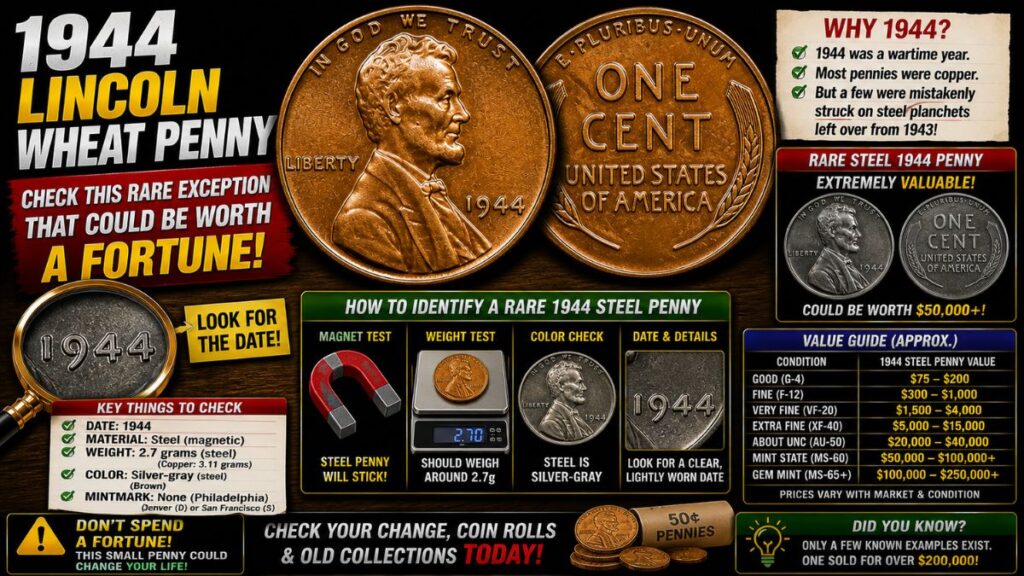
The 1944 Lincoln Wheat Penny is one of those coins that can easily be overlooked in an old jar, a forgotten collection, or a box of inherited coins. Millions of these pennies were produced, and most examples are worth only a small amount above or around their face value, depending on their condition and the collector market. However, a few unusual exceptions have attracted considerable attention from coin collectors because of rare minting errors and distinctive varieties. Among the most fascinating are genuine 1944 pennies struck on steel planchets and certain unusual mintmark varieties that require careful examination.
The difference between an ordinary 1944 wheat penny and a rare error coin can be substantial. A common copper example in circulated condition may have modest collector value, while an authenticated steel-planchet error can be worth thousands or potentially much more, depending on its authenticity, condition, and auction demand. This dramatic difference explains why collectors pay close attention to unusual 1944 Lincoln cents.
Before assuming that an old penny is valuable, however, it is important to understand what makes these coins special, how genuine minting errors occur, and why authentication matters so much. A coin that looks unusual is not necessarily rare, and a penny that appears silver-colored is not automatically a valuable steel error.
Understanding these distinctions can help collectors avoid costly mistakes and recognize when a coin deserves professional evaluation.
What Makes the 1944 Lincoln Wheat Penny Special?
The Lincoln Wheat Penny is one of the most recognizable coins in American numismatic history. Its design features Abraham Lincoln on the front and two wheat stalks on the reverse, a design that remained in use for decades before the reverse was changed in 1959.
The 1944 issue belongs to the Wheat Penny series, which was introduced in 1909 to commemorate the 100th anniversary of Lincoln’s birth. Because Lincoln pennies have been collected for generations, many people still encounter these coins in household collections, inherited coin albums, and old containers of spare change.
The year 1944 is particularly interesting because it falls during World War II. Copper was an important industrial material during the war, and the United States Mint changed the composition of its one-cent coin in 1943 to conserve copper for wartime needs. Those 1943 cents were primarily struck on zinc-coated steel planchets.
In 1944, the Mint returned to producing Lincoln cents on copper-based planchets. The change created a fascinating contrast between the two years. The 1943 steel penny became famous for its unusual appearance, while the 1944 copper penny represented the return to the traditional material.
However, a small number of exceptional 1944 cents are believed to have been struck on leftover steel planchets from the previous year. These unusual coins are among the most desirable error varieties associated with the Lincoln Wheat Penny series.
Their rarity comes from the unexpected combination of a 1944 date and a planchet associated with the 1943 steel-cent production.
Collectors must remember that the ordinary 1944 Lincoln Wheat Penny is not rare simply because it was produced during wartime. The exceptional value belongs to specific authenticated varieties and errors, not to every penny carrying the date 1944.
Why Most 1944 Wheat Pennies Are Common
A major reason the 1944 Lincoln cent attracts attention is the contrast between its enormous production and the extreme rarity of certain errors.
The United States Mint produced large quantities of Lincoln cents in 1944 to meet the demand for everyday transactions. Pennies were an essential part of ordinary commerce, and the coin was not intended to be a limited collector issue.
As a result, many 1944 wheat pennies have survived. Collectors can find circulated examples with worn surfaces, softened lettering, and reduced design detail. Some coins are in better condition, with stronger details and more original luster.
The ordinary copper composition is also an important identifying feature. Most genuine 1944 Lincoln cents have a reddish-brown, brown, or mixed copper appearance, depending on their age, handling, and storage conditions.
A typical circulated 1944 penny is usually not a major rarity. Its value depends on factors such as condition, mintmark, surface quality, and collector demand.
Coins in exceptional uncirculated condition may command higher prices than worn examples. A coin that retains much of its original red color can be particularly attractive to collectors, although its value depends on the quality of the surfaces and the availability of comparable examples.
This is why collectors should avoid assuming that every 1944 penny is worth a fortune. The date alone does not establish exceptional value.
The real opportunity lies in identifying a genuine variety or error that distinguishes a coin from the large number of ordinary examples.
The Rare 1944 Steel Wheat Penny Explained
The 1944 steel wheat penny is one of the most remarkable exceptions in the Lincoln cent series.
In 1943, the United States Mint produced cents using steel planchets coated with zinc. These coins were visibly different from the traditional copper cents. Their silvery appearance helped make them memorable, and many survived because collectors recognized their unusual composition.
When the Mint returned to copper-based cents in 1944, leftover steel planchets could theoretically have remained in production facilities or entered the striking process accidentally.
If a 1944-dated Lincoln cent was struck on one of these steel planchets, the result would be an unusual transitional error. The date would indicate 1944, but the coin’s underlying metal would be consistent with the steel cents associated with 1943.
Such a coin is not simply a normal penny that has changed color with age. Its composition and physical characteristics would be fundamentally different from those of a standard copper-based 1944 cent.
Authentic 1944 steel cents are extremely rare. Their desirability comes from the unusual circumstances required for their production and the difficulty of finding a genuine example.
The distinction between a genuine steel-planchet error and a plated copper penny is essential. A coin that has been coated with another metal after leaving the Mint does not become a genuine steel-planchet error.
Collectors should therefore treat unusual silver-colored pennies as candidates for investigation rather than immediately assigning them a high value.
How a 1944 Steel Penny Could Have Been Produced
To understand the rarity of the 1944 steel penny, it helps to examine the basic coin-production process.
A planchet is a prepared metal blank that will be struck to create a coin. Before striking, the planchet must have the appropriate composition, dimensions, and physical characteristics for the denomination being produced.
During the striking process, dies impress the coin’s design onto the planchet under substantial pressure. The resulting coin receives its date, lettering, portrait, and reverse design.
In 1943, the Mint used zinc-coated steel planchets for Lincoln cents. In 1944, it returned to copper-based planchets.
The exceptional 1944 steel cent is associated with the possibility that an unused steel planchet from the previous year’s production remained available and was accidentally struck with dies bearing the 1944 date.
This would create a coin with an unexpected combination of date and metal composition.
Such errors are possible in principle because coin production involves large quantities of blanks, dies, machinery, and material handling. However, the precise circumstances behind any individual coin must be evaluated through its physical evidence and documented history.
A genuine example must show characteristics consistent with an authentic mint-produced coin. Its composition, weight, dimensions, design details, and overall manufacturing characteristics all contribute to the examination.
The rarity of this error is not a reason to accept every claimed example. In fact, its reputation makes authentication particularly important.
How to Identify a Possible 1944 Steel Penny
If you find a 1944 Lincoln Wheat Penny that appears silver-colored, begin with careful observation rather than assumptions.
The first step is to confirm the date. Use adequate lighting and, if necessary, a magnifying glass to examine the final two digits. A worn 1943 penny may be mistaken for a 1944 penny, especially when the date is damaged or difficult to read.
Next, examine the coin’s color. A standard copper-based 1944 cent generally appears copper-colored, brown, reddish-brown, or a mixture of these shades. A genuine steel-planchet candidate may have a gray or silvery appearance.
Color alone, however, is not enough to establish authenticity.
A copper penny may have been plated with nickel, silver-colored material, or another substance. Environmental exposure and chemical treatments can also alter a coin’s surface. Such changes can make an ordinary penny appear unusual without changing its underlying composition.
A magnet provides another useful preliminary test. Steel is attracted to a magnet, while the copper-based composition of an ordinary 1944 Lincoln cent is not.
If a clearly dated 1944 cent is strongly attracted to a magnet, it deserves further investigation. Nevertheless, a magnet test does not prove that the coin is genuine. Other metals, alterations, and counterfeit techniques can complicate identification.
The next step is to have the coin examined by a qualified coin dealer or professional authentication service. Composition testing and a detailed physical examination can help determine whether the coin is consistent with a genuine steel-planchet error.
Do not scratch, file, polish, or chemically treat the penny to test its metal. These actions can damage the coin and reduce its potential collector value.
The Importance of Weight and Dimensions
Weight is one of the most useful physical characteristics for distinguishing a possible steel-planchet error from an ordinary copper-based Lincoln cent.
A standard copper-based 1944 Lincoln cent generally weighs about 3.11 grams. A traditional 1943 zinc-coated steel cent weighs approximately 2.7 grams.
A suspected 1944 steel cent that has a weight consistent with a steel planchet may therefore deserve closer examination.
However, small differences can result from wear, corrosion, surface damage, or measurement limitations. A household scale may also be insufficiently precise to provide a reliable reading.
For this reason, weight should be considered alongside the coin’s dimensions, composition, date, and manufacturing characteristics.
Diameter alone may not settle the question because a coin struck from a different metal can still have dimensions similar to those of the intended denomination.
Professional examiners may use specialized equipment to determine composition without unnecessarily damaging the coin. Depending on the circumstances, they may also examine the edge, surface structure, die characteristics, and other physical details.
A convincing identification requires multiple pieces of consistent evidence. No single test should be treated as conclusive.
What About Rare 1944 Overmintmark Varieties?
The topic of unusual 1944 Lincoln cents also raises questions about mintmarks and possible overmintmark varieties.
A mintmark identifies the Mint facility associated with a coin’s production. On Lincoln Wheat Pennies, the most familiar mintmarks are D for Denver and S for San Francisco. Philadelphia cents from this period generally did not carry a mintmark.
Mintmarks are important to collectors because coins produced at different facilities may have different production totals, survival rates, and levels of collector demand.
An overmintmark occurs when one mintmark is impressed over another, creating evidence of an earlier mintmark beneath or around the final one. Such varieties can be interesting because they preserve evidence of an alteration or reuse involving the coin-production process.
However, not every unusual mark near a mintmark is an overmintmark. Damage, die deterioration, corrosion, contact with other coins, and post-mint alterations can create shapes that resemble a second letter.
It is also important to distinguish an established collectible variety from an unverified claim. The existence of rare overmintmark varieties in coinage history does not mean that every alleged 1944 overmintmark is recognized, rare, or valuable.
A collector evaluating a purported 1944 overmintmark should identify the exact claimed variety and compare the coin with reliable examples of that specific variety.
The date, mintmark location, letter shape, die characteristics, and any recognized diagnostic details should agree with the variety being claimed.
When the evidence is uncertain, professional attribution is preferable to relying on photographs or informal descriptions.
How to Examine the Mintmark on a 1944 Penny
Start by locating the mintmark, if one is present. On a Lincoln Wheat Penny, the mintmark is found on the obverse beneath the date area, near the portrait.
Use a magnifying glass or a coin loupe to examine the letter carefully. Look for the shape of the letter, the clarity of its edges, and whether the surrounding metal shows unusual features.
An alleged overmintmark should display evidence consistent with a known mintmark combination rather than merely an irregular shape.
For example, a damaged letter may have a line extending beyond its normal outline. That line could be caused by a die defect, a scratch, or a strike against another object. It does not automatically indicate that one mintmark was impressed over another.
Collectors should also be cautious about coins that have been altered to create the appearance of a rare variety. A person can modify a coin’s surface, but such changes do not reproduce the original manufacturing evidence reliably.
Photographs can help with preliminary identification, especially when taken from several angles under good lighting. Nevertheless, a photograph may not show the depth, metal flow, or surface characteristics needed for a confident attribution.
If a possible overmintmark appears promising, preserve the coin in its current condition and seek an expert opinion.
How Much Is a 1944 Lincoln Wheat Penny Worth?
The value of a 1944 Lincoln Wheat Penny depends on its type, condition, mintmark, authenticity, and current collector demand.
Most ordinary circulated examples have modest value. Their prices may be only a little above face value, although individual coins can command more depending on grade and the market.
Better-preserved examples may be worth more because collectors often seek coins with strong details and attractive surfaces. Uncirculated coins can vary substantially in value according to their grade, color designation, and overall quality.
The most important distinction is between a common copper-based cent and a genuinely rare error.
A confirmed 1944 steel-planchet cent belongs to an entirely different category from an ordinary penny. Authentic examples have achieved prices reaching into the hundreds of thousands of dollars at major auctions, with some exceptional examples reported at even higher levels.
Those results should not be interpreted as a guaranteed price for every coin described as a 1944 steel penny. The final value depends on authentication, grade, provenance, auction conditions, and the willingness of collectors to compete for that particular example.
Claims about rare overmintmark varieties also require caution. The value of a specific variety depends on whether it is recognized, how rare it is, its condition, and the evidence supporting its attribution.
A collector should never estimate value solely from an online headline, an asking price, or a photograph of a similar-looking coin.
Realized auction prices for authenticated examples are generally more informative than unsupported claims about what a seller hopes to receive.
Why Condition Can Make Such a Big Difference
Condition is a major factor in coin collecting because a penny’s surfaces preserve evidence of its history.
A circulated coin may show wear on Lincoln’s hair, the lettering, and the wheat stalks. Its color may have changed, and small marks may have accumulated through decades of use.
An uncirculated coin has not experienced ordinary circulation wear, although it may still have contact marks, scratches, discoloration, or other imperfections from production and storage.
Professional grading evaluates several aspects of a coin’s physical condition. These can include wear, surface preservation, strike quality, luster, and overall eye appeal.
For copper cents, color is especially important to many collectors. A coin may be described as red, red-brown, or brown according to the amount of original red coloration remaining.
A well-preserved red example can be more desirable than a heavily toned or worn coin of the same date and mintmark. However, artificial color enhancement or cleaning can negatively affect collectibility.
Condition matters for ordinary 1944 cents, but it does not turn a common coin into a major rarity by itself. A high-grade normal cent and a genuine steel-planchet error are different collecting categories.
A rare error can be valuable even when it has some wear, while an ordinary penny may remain relatively inexpensive despite excellent preservation.
The most accurate evaluation considers rarity and condition together rather than relying on either factor alone.
Why Authentication Matters More Than Appearance
Rare coins attract counterfeits, altered examples, and mistaken identifications. The 1944 steel penny is particularly vulnerable to confusion because its unusual composition is the central reason for its value.
A common copper cent can be plated to make it appear silver. Such a coin may look convincing in a photograph, particularly when lighting hides the surface texture.
A different possibility is a coin whose date has been altered. A genuine steel cent from another year may be modified to resemble a 1944 issue, creating a coin that looks rare but is not an authentic example of the claimed variety.
Collectors may also encounter coins damaged by corrosion or chemical treatment. These can have unusual colors that are mistakenly interpreted as evidence of a different metal.
Authentication involves more than deciding whether a coin looks unusual. An examiner must determine whether its physical characteristics are consistent with the claimed date, composition, minting process, and variety.
Professional grading and authentication services can evaluate coins and, when appropriate, encapsulate them in protective holders with identification information.
This process can improve confidence for buyers and sellers, although the decision to submit a coin should take its potential value and the associated costs into account.
For an ordinary circulated 1944 penny, professional authentication may not be economically worthwhile. For a credible steel-planchet candidate, however, expert examination can be an important step.
Never assume that a coin is genuine simply because it comes in a holder or is accompanied by an informal certificate. The reputation of the service and the reliability of its identification both matter.
How to Avoid Common Identification Mistakes
One of the most frequent mistakes is assuming that a silver-colored 1944 penny must be made of steel.
Color can change because of plating, chemical reactions, corrosion, or environmental exposure. The underlying composition must be established independently.
Another common mistake is relying entirely on a magnet. Although magnetism can help distinguish steel from copper, the test does not establish the coin’s date, originality, or authenticity.
Misreading the date is another potential problem. Worn digits, scratches, and damage can make a coin appear to belong to a different year.
Collectors should inspect the entire date rather than concentrating on one digit. If the date is unclear, the coin should not be assigned a rare designation until it can be identified reliably.
A further mistake involves assuming that every mintmark anomaly represents an overmintmark. Marks created by circulation, die deterioration, or damage after the coin left the Mint can resemble unusual varieties.
Finally, some collectors overestimate value by comparing their coin with an exceptional auction result without confirming that both coins are the same variety and grade.
A high auction price for a genuine steel-planchet error does not establish the value of a plated copper cent. Likewise, a rare variety in exceptional condition may be worth substantially more than a similar coin with significant damage.
Careful identification prevents disappointment and helps collectors make informed decisions.
What to Do If You Find a Possible Rare 1944 Penny
If you discover a 1944 penny that appears to be an unusual error, begin by protecting it.
Handle the coin by its edges whenever possible. Avoid rubbing the surfaces with your fingers, since oils and small particles can affect the coin’s appearance.
Do not clean it. Even gentle polishing can leave fine scratches, remove original surface characteristics, and reduce collector value.
Place the coin in a suitable protective holder that will not scratch the surface or expose it to unnecessary moisture. Avoid improvised holders containing materials that may react with metal.
Next, record the basic observations. Note the date, mintmark, approximate weight, color, and whether the coin responds to a magnet. These details can help an expert understand why you suspect the coin is unusual.
Photograph both sides under neutral lighting. Close-up images of the date, mintmark, and edge may be useful for preliminary review.
The next step is to seek an assessment from a reputable coin dealer or an experienced numismatic professional. If the evidence suggests a genuine rare error, consider professional authentication before attempting to sell the coin.
Do not make an expensive grading submission based solely on a seller’s claim, an online comment, or a dramatic video. Preliminary evaluation can help determine whether the potential value justifies further expense.
If the coin is confirmed as a genuine 1944 steel cent, retain its authentication documentation and any reliable information about its ownership history.
A documented coin is easier for prospective buyers to evaluate than one accompanied only by an unsupported claim.
Understanding the Role of Auction Prices
Auction results are useful for understanding the market for rare Lincoln cents, but they require careful interpretation.
A confirmed rare error may attract strong competition because collectors understand that only a small number of examples are known. If two or more bidders are determined to acquire the same coin, the final price can rise substantially.
The condition of the individual coin also influences the result. An example with attractive surfaces, a clear date, and strong visual appeal may receive more attention than a damaged specimen.
Authentication and provenance can influence buyer confidence. A coin with a credible history and recognized certification may be easier to evaluate than an example whose authenticity remains uncertain.
However, auction prices can fluctuate over time. A result achieved in one sale does not guarantee that the same coin, or another example of the same variety, will bring an identical amount later.
Collectors should also distinguish between a realized sale price and an advertised asking price. A seller can list an ordinary penny for an extraordinary amount without finding a buyer willing to pay it.
When researching a potential rarity, compare genuinely similar coins. The date, composition, variety, grade, and certification status should be as close as possible.
This approach produces a more realistic estimate than relying on the largest price associated with a broadly similar coin.
Are 1944 Wheat Pennies With Mintmarks More Valuable?
A 1944 Lincoln Wheat Penny may carry a D or S mintmark, indicating production at Denver or San Francisco. Philadelphia cents from this period generally have no mintmark.
These differences are useful when identifying and cataloging coins, but a mintmark does not automatically make a penny rare.
The value of a particular mint issue depends on factors such as the number produced, the number surviving in collectible condition, collector demand, and the availability of higher-grade examples.
Some mintmarks may be more desirable for a particular grade or collecting goal, while ordinary circulated examples from different facilities may all remain relatively inexpensive.
The situation changes when a coin has a recognized error or variety. A genuine minting anomaly may attract a specialized group of collectors who are willing to pay more for a properly attributed example.
It is important to keep the two concepts separate. A normal D-mint or S-mint cent is not equivalent to a rare steel-planchet error merely because it has a mintmark.
Collectors should first identify the coin accurately and then determine whether it matches a recognized variety.
If an alleged overmintmark is involved, the precise attribution matters more than the general presence of an unusual-looking letter.
The Difference Between a Mint Error and Post-Mint Damage
A genuine mint error occurs during the production of a coin. It may involve an incorrect planchet, a striking problem, or another manufacturing irregularity.
Post-mint damage happens after the coin leaves the Mint. Coins can be scratched, bent, plated, chemically altered, or struck against other objects during circulation and handling.
This distinction is essential because genuine mint errors can attract collector interest, while damage usually does not create a premium.
A wrong-planchet error is especially significant because the coin has been struck on a blank with a composition or denomination inconsistent with the intended issue.
A 1944 cent struck on a genuine steel planchet would be an example of this general type of error.
By contrast, a normal copper cent that has been coated with a silver-colored substance remains a copper cent with an altered surface.
Similarly, a scratch near the mintmark does not establish an overmintmark. The mark must be consistent with the recognized characteristics of the claimed variety.
Examining the edge, surfaces, design details, and metal composition can help distinguish manufacturing evidence from later alteration.
Because some forms of damage can be difficult to interpret, questionable examples should be examined by someone familiar with coin production and error attribution.
Can You Find a Rare 1944 Penny in Everyday Change?
Finding a genuinely rare 1944 steel penny in everyday change would be an extraordinary event. These coins are exceptionally scarce, and most 1944 cents encountered today are ordinary copper-based examples.
Nevertheless, looking through old coins can be an enjoyable way to learn about numismatics. Collectors may find wheat pennies in inherited collections, old coin folders, jars, or groups of coins saved by previous generations.
The most practical approach is to identify coins systematically instead of assuming that every old date signals a major rarity.
Begin by separating coins by date and mintmark. Examine unusual colors, obvious errors, and coins in especially good condition.
If a coin appears to have a composition inconsistent with its date, investigate it carefully. A magnet and an accurate scale can provide preliminary information, but neither replaces professional authentication.
Be cautious about viral videos and online posts claiming that a particular penny is worth a fortune simply because it has a certain date. Such claims often omit important details about composition, condition, and certification.
It is possible to discover an interesting coin unexpectedly, but extraordinary values should never be treated as the normal outcome of searching pocket change.
For most collectors, the enjoyment comes from learning to recognize historical issues, understanding minting errors, and building a collection with accurate identifications.
Why the 1944 Steel Cent Continues to Attract Collectors
The 1944 steel cent remains fascinating because it combines a familiar design with an unexpected material.
Collectors already recognize the Lincoln Wheat Penny as a historic American coin. The possibility of a 1944-dated cent struck on a steel planchet introduces a production anomaly that is easy to understand but exceptionally difficult to find.
The coin also connects directly to the wartime changes in American coinage. The use of steel planchets in 1943 and the return to copper-based cents in 1944 provide the historical background that makes the error meaningful.
Its appeal is not limited to price. Collectors value unusual coins because they reveal how complicated large-scale minting can be and how small production mistakes can become important numismatic discoveries.
A genuine error offers a physical record of an unusual event in the manufacturing process. That combination of rarity, history, and verifiable evidence gives the coin its lasting significance.
At the same time, the coin’s fame can create confusion. A large number of ordinary pennies may be described online as rare, and altered examples can be presented as genuine errors.
For serious collectors, reliable identification is therefore part of the appeal. Discovering an unusual coin is only the beginning; understanding what it actually is makes the discovery meaningful.
Frequently Asked Questions About the 1944 Lincoln Wheat Penny
Is every 1944 Lincoln Wheat Penny valuable?
No. Most 1944 Lincoln Wheat Pennies are common copper-based cents. Their value depends on condition, mintmark, and collector demand. The exceptional values associated with this date generally concern specific authenticated errors or recognized varieties.
What is the rare exception associated with the 1944 penny?
The best-known exception is the genuine 1944 steel-planchet Lincoln cent. It combines a 1944 date with a steel planchet associated with the previous year’s steel-cent production. Authentic examples are extremely rare.
How can I tell whether my 1944 penny is made of steel?
A silvery appearance and a strong response to a magnet can provide preliminary clues. However, plating and other alterations can make a copper cent look similar. Professional composition testing and authentication are needed to establish whether the coin is genuine.
How much can a genuine 1944 steel penny be worth?
Authenticated examples have achieved prices reaching hundreds of thousands of dollars at major auctions, with exceptional examples reported at even higher levels. The value of an individual coin depends on authenticity, grade, provenance, and market demand. No particular price is guaranteed.
Does a silver-colored 1944 penny automatically have a high value?
No. A silver-colored appearance does not prove that the coin is made of steel. It may have been plated, chemically altered, or damaged. The metal composition must be established before assigning a rare-error designation.
Is a 1944 penny with a D or S mintmark rare?
Not automatically. D and S identify Denver and San Francisco production, respectively. The mintmark can affect a coin’s collectible desirability, but a normal example is not necessarily rare. Any premium depends on the specific issue, condition, and market.
What is an overmintmark on a Lincoln Wheat Penny?
An overmintmark is a variety in which evidence of one mintmark appears beneath or alongside another. A claimed example must be compared with the diagnostic characteristics of a recognized variety. Damage or irregular marks alone do not prove an overmintmark.
Can a 1944 copper penny become a steel penny if it is plated?
No. Plating changes the surface appearance but does not change the coin’s underlying planchet into steel. A genuine steel-planchet error must have been struck on a steel blank rather than created through a later surface treatment.
Should I use a magnet to test my 1944 penny?
A magnet is useful as an initial screening tool because steel is magnetic while the normal copper-based composition of a 1944 cent is not. However, the test cannot establish authenticity by itself. Other physical evidence must also be considered.
Should I clean my 1944 penny before selling it?
No. Cleaning can scratch the surface, remove original characteristics, and reduce collector appeal. Preserve the coin in its existing condition and seek professional advice if you believe it may be rare.
Are online price claims for 1944 pennies reliable?
Not always. Some prices refer to authenticated rare errors, while others are merely asking prices or unsupported estimates. Compare documented sales of coins with the same variety, composition, and grade rather than relying on a headline.
Is professional grading worthwhile for every 1944 penny?
No. A common circulated coin may not justify the cost. A credible candidate for a rare steel-planchet error or another recognized variety may warrant professional authentication because the potential value and risk of misidentification are much greater.
What should I do if I believe I have found a 1944 steel penny?
Protect the coin, avoid cleaning it, record its weight and other observable characteristics, and seek an evaluation from a reputable numismatic professional. If it appears genuine, consider independent authentication before selling it.
Conclusion: Check the Details Before Assuming Your Penny Is Rare
The 1944 Lincoln Wheat Penny demonstrates why careful identification matters in coin collecting. Although millions of ordinary copper-based examples were produced, a small number of exceptional errors have made this date particularly interesting to collectors.
The genuine 1944 steel-planchet cent is the most famous exception. Its unusual composition, historical connection to wartime coin production, and extreme scarcity help explain why authenticated examples can command extraordinary prices. Alleged overmintmark varieties also deserve careful investigation, but their value depends on whether the specific variety is recognized and correctly attributed.
If you have a 1944 penny, start with the basics: verify the date, examine the mintmark, assess the color, and consider the weight and magnetic response. Treat these observations as preliminary clues rather than proof of rarity.
Most importantly, avoid cleaning the coin or making expensive decisions before its identity has been established. Professional authentication is particularly valuable when a coin appears to be a genuine wrong-planchet error.
A common 1944 wheat penny can still be an enjoyable piece of American history, while a genuine rare error may represent a significant discovery. The key is knowing the difference.