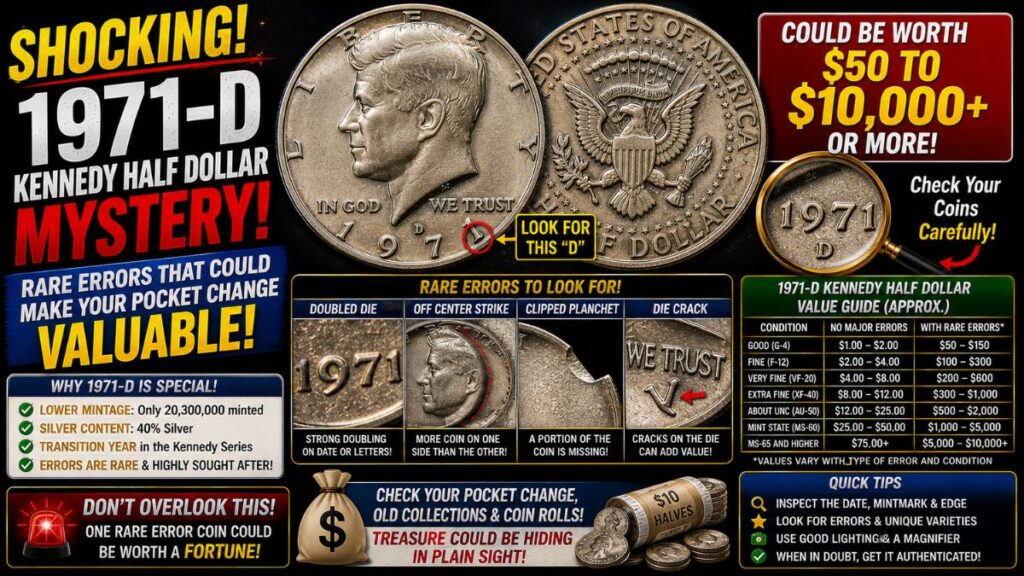
The 1971-D Kennedy Half Dollar may look like an ordinary coin from the early 1970s, but certain unusual examples can attract serious attention from collectors. While most coins from this year are common copper-nickel clad half dollars, unusual minting errors, distinctive doubled die varieties, and genuine planchet defects can make particular examples more interesting and potentially more valuable. The challenge is knowing which features represent authentic mint errors and which are simply the result of wear, damage, or ordinary manufacturing variations.
The year 1971 is especially important in the history of the Kennedy Half Dollar. It marked the first year that the regular circulating half dollar was produced without the 40% silver composition used for the 1965–1970 issues. The United States Mint returned to a copper-nickel clad composition for circulation strikes, creating a clear dividing line between earlier silver-bearing Kennedy half dollars and the newer clad coins.
The Denver Mint produced 1971-D Kennedy Half Dollars for everyday commerce, and many examples remain available to collectors today. Most are not rare. However, collectors sometimes investigate unusual doubling, missing outer cladding, off-center strikes, and other manufacturing anomalies that may distinguish an individual coin from an ordinary example.
The key is to separate genuine collectible errors from exaggerated claims. A coin does not become rare merely because its lettering looks unusual or its edge appears different. Authentication, condition, the precise type of error, and actual collector demand all influence its value.
If you have a 1971-D Kennedy Half Dollar in an old collection, a jar of coins, or a box of inherited change, understanding these details can help you determine whether it deserves closer examination.
Why the 1971-D Kennedy Half Dollar Is Important
The Kennedy Half Dollar was introduced in 1964 to honor President John F. Kennedy following his assassination in November 1963. Its familiar portrait and historic significance quickly made it one of the most recognizable American coins.
The original 1964 Kennedy Half Dollar contained 90% silver. Rising silver prices and the changing economics of coin production led to a reduction in silver content beginning in 1965.
From 1965 through 1970, regular Kennedy Half Dollars were made with a copper-nickel outer layer and a silver-bearing inner core, producing an overall composition of 40% silver. These coins differed from the original 1964 issue but retained precious-metal content.
In 1971, the regular circulating Kennedy Half Dollar transitioned to a copper-nickel clad composition without silver. The coin retained its traditional diameter, weight, and familiar design, but its metal composition changed.
That transition explains why 1971 is an important date for collectors studying the Kennedy Half Dollar series. It represents the first year of regular circulation strikes in the modern clad composition.
However, the historical significance of the date should not be confused with rarity. The Denver Mint produced large numbers of 1971-D half dollars, and ordinary examples are generally obtainable.
What makes a particular coin worth investigating is not simply its date or mintmark. It is whether the coin has a verifiable feature that distinguishes it from normal production.
Understanding the 1971-D Mintmark
The letter D on a 1971-D Kennedy Half Dollar identifies the Denver Mint as the production facility.
The mintmark is located on the obverse, near the date and beneath the portrait area. Its position and appearance can help collectors identify the coin and distinguish it from examples produced at other facilities.
A mintmark does not automatically make a coin rare. The Denver Mint produced substantial quantities of Kennedy Half Dollars, and many 1971-D examples entered circulation.
The importance of the D mintmark is that it identifies the coin’s production origin. When investigating a possible variety or error, collectors should make sure they are examining the correct issue.
Some claims about rare Kennedy Half Dollars involve specific mintmarks, dates, or varieties. A collector should not assume that an error attributed to another year or mint applies equally to the 1971-D issue.
The exact coin must be examined, and any claimed variety should be supported by reliable identifying characteristics.
Collectors should also be careful when looking at damaged mintmarks. A worn or distorted letter may result from contact with another object, corrosion, or damage after the coin left the Mint.
A genuine minting variety must be distinguished from a feature created by circulation or later alteration.
Why Most 1971-D Kennedy Half Dollars Are Common
The 1971-D Kennedy Half Dollar was produced for circulation rather than as a limited-edition collectible. Large-scale production means that many examples have survived in collections, bank-wrapped rolls, and circulated coin holdings.
The coin’s copper-nickel clad composition also makes it different from the silver-bearing Kennedy Half Dollars produced in earlier years.
For most ordinary 1971-D examples, collector value depends primarily on condition and demand. A circulated coin with scratches, worn surfaces, and contact marks is generally less desirable than an attractive uncirculated example.
Coins that retain strong luster and have relatively few marks may appeal to collectors assembling high-grade sets. However, an ordinary coin in excellent condition is still different from a genuine mint error.
This distinction matters because online headlines sometimes describe the 1971-D Kennedy Half Dollar as a hidden treasure without explaining which specific coin features are actually collectible.
A normal coin does not become valuable simply because it is old, has a Denver mintmark, or belongs to the first year of clad production.
The most useful approach is to begin with the assumption that a coin is ordinary until a specific, verifiable feature suggests otherwise.
That does not mean ignoring unusual coins. It means evaluating them carefully instead of assigning a premium based on appearance alone.
The 1971 Kennedy Half Dollar’s Copper-Nickel Clad Composition
One of the most important features of a 1971-D Kennedy Half Dollar is its layered metal construction.
The coin uses an outer layer of copper-nickel bonded to a copper core. This construction is known as clad coinage.
The copper-nickel outer layers provide the familiar silver-colored appearance, while the copper core gives the coin a distinctive reddish-brown edge when viewed from the side.
A standard 1971-D Kennedy Half Dollar weighs approximately 11.34 grams and measures about 30.6 millimeters in diameter. These specifications can help collectors evaluate a suspected error, although weight and dimensions alone cannot establish authenticity.
The coin’s edge is particularly useful when examining its composition. Unlike a solid silver coin, a normal clad half dollar typically displays a visible copper-colored stripe between the outer layers.
Collectors sometimes interpret an unusual edge as evidence of a rare missing-clad error. However, scratches, corrosion, plating, and damage can all affect the edge’s appearance.
A genuine missing-clad or incomplete-cladding error must be consistent with a manufacturing defect rather than damage occurring after the coin was struck.
Understanding the normal clad construction provides a foundation for recognizing unusual examples.
What Is a Doubled Die Error?
A doubled die is a variety created during the manufacture of a coin die.
Coin dies carry the design that is transferred to planchets during striking. If the design is impressed onto a die more than once in a misaligned way during die preparation, the resulting die may carry duplicated design elements.
Coins struck by that die can display genuine doubling in parts of the lettering, numbers, portrait details, or other design features.
This is different from ordinary machine doubling, which can occur during the striking process and often produces a flattened or shelf-like appearance rather than a clearly separated second image.
The distinction is important because genuine doubled die varieties can be collectible, while machine doubling generally does not command the same premium.
For a 1971-D Kennedy Half Dollar, claims of a rare doubled die reverse should be approached carefully. The existence of doubled die varieties in coinage generally does not prove that a particular dramatic-looking 1971-D reverse variety is established or exceptionally rare.
Collectors should identify the exact claimed variety and compare the coin with recognized diagnostic features.
A doubled appearance in the letters, eagle, or other reverse details is not sufficient on its own. The shape, direction, separation, and location of the doubling must be examined.
When the attribution remains uncertain, a knowledgeable specialist can help determine whether the coin displays a genuine die variety or a more ordinary production effect.
How to Examine the Reverse of a 1971-D Kennedy Half Dollar
The reverse of the Kennedy Half Dollar features the presidential seal, including an eagle with outstretched wings, a shield, and surrounding inscriptions.
Because the design contains many small details, it can be useful when examining a suspected doubled die.
Begin by checking the lettering around the rim. Look for signs of a clearly duplicated design rather than a vague shadow or an irregular edge.
Next, examine the eagle’s feathers, shield, and other raised details. Genuine die doubling should appear as a consistent feature of the struck design, not simply as a random scratch or dent.
Use a magnifying glass or a coin loupe with good lighting. Tilting the coin slightly can help reveal raised or recessed features that are difficult to see from a straight-on angle.
It is important not to confuse a doubled die with a coin that has been struck more than once because of a striking malfunction. These errors are produced differently and may have different visual characteristics.
A genuine doubled die variety generally shows repeated design features that can be traced to the die itself. A double-struck coin may show broader displacement or overlapping impressions resulting from multiple strikes.
The exact nature of the error determines how the coin should be described and evaluated.
Photographs can help with an initial assessment, but very small differences may require direct examination. If a coin appears promising, preserve it and seek an expert opinion before making assumptions about its value.
Is a 1971-D Doubled Die Reverse Worth a Fortune?
A genuine doubled die can attract collector interest, but its value depends on the specific variety.
The strength and location of the doubling matter. A dramatic, well-defined variety that is recognized by collectors may be more desirable than a subtle feature that is difficult to distinguish from ordinary production effects.
Rarity also plays a major role. A variety found frequently in collections is generally less scarce than one documented in very limited numbers.
Condition is another consideration. Collectors often pay more for examples with strong details, attractive surfaces, and minimal damage.
However, there is an important qualification: claims about rare 1971-D doubled die reverse Kennedy Half Dollars should not be treated as established facts without a precise attribution.
A coin may appear doubled because of machine doubling, die deterioration, contact marks, or post-mint damage. These conditions can create dramatic-looking features without establishing a rare doubled die variety.
Before placing a high value on a suspected example, identify the specific variety and confirm that its diagnostic features match reliable references or expert assessments.
An asking price on an online marketplace is not proof that a coin is worth that amount. A documented sale of a comparable, authenticated coin provides more useful evidence.
Understanding Missing Clad Errors
The phrase missing clad refers to an error involving the outer layer of a clad coin.
On a normal 1971-D Kennedy Half Dollar, copper-nickel layers cover the copper core. If a layer is absent or incompletely bonded during production, the coin may display an unusual surface or exposed copper-colored metal.
A genuine missing-clad error can be interesting because it reveals something about the manufacturing process.
However, not every exposed copper area represents a mint error.
A coin may lose part of its outer layer through corrosion, harsh chemicals, abrasive cleaning, or damage. A scratch can expose the copper core without indicating that the coin left the Mint with a missing layer.
Similarly, plating and other surface treatments may change a coin’s appearance, making it difficult to determine whether the underlying metal structure is original.
A convincing missing-clad candidate should show physical characteristics consistent with a production defect. The affected area, surrounding surfaces, and overall structure need to be examined.
The location and extent of the missing material also matter. A small patch of exposed copper caused by a scratch is not equivalent to a documented manufacturing error.
Because these distinctions can be difficult to assess visually, professional evaluation may be necessary before a coin is assigned a rare-error designation.
How to Identify a Possible Missing-Clad Error
Start by examining the coin’s obverse and reverse under good lighting.
Look for areas where the outer copper-nickel layer appears absent, incomplete, or different from the surrounding surface. Compare those areas with the normal edge and appearance of the coin.
If the coin has an exposed copper-colored area, check whether the transition between the normal surface and the exposed metal looks consistent with a manufacturing defect or more like a scratch, gouge, or chemical alteration.
Do not attempt to remove more material to investigate the defect. Scraping, sanding, or applying chemicals can destroy useful evidence and reduce the coin’s value.
Weigh the coin using an accurate scale if possible. A missing portion of the outer layer may affect the coin’s weight, but the amount of material involved and the precision of the scale must be considered.
A normal 1971-D half dollar weighs approximately 11.34 grams. A reading that differs from the expected weight may justify further investigation, but it is not proof of a missing-clad error.
A coin can also lose weight through corrosion or physical damage. Conversely, a small cladding defect may not create a weight difference large enough to be measured reliably with an ordinary scale.
For a serious candidate, a professional can examine the metal layers and determine whether the physical evidence supports a genuine minting error.
Why the Edge Matters When Examining a 1971-D Half Dollar
The edge of a Kennedy Half Dollar can reveal useful information about its construction.
A standard copper-nickel clad half dollar typically shows a copper-colored core between its outer layers. This stripe is normal and should not be mistaken for an error.
When examining a suspected missing-clad coin, compare the edge with both faces of the coin. Look for areas where the outer layer may be absent or where the metal appears unusually exposed.
However, the edge is also vulnerable to damage. A coin may be dropped, scraped against a hard surface, or altered deliberately.
An irregular edge, missing portion of the outer layer, or unusual color pattern does not automatically establish a mint error.
The strongest evidence comes from a combination of observations: the appearance of the affected area, the relationship between the layers, the coin’s weight, and other manufacturing characteristics.
Collectors should also distinguish a missing-clad error from an ordinary planchet defect or a coin that has been damaged after production. These are different conditions, even if their appearance can overlap.
When uncertainty remains, avoid making irreversible changes to the coin. Preserving the original surfaces gives an examiner a better opportunity to evaluate its history.
Other Minting Errors to Look For
Although doubled dies and cladding defects attract attention, other types of mint errors can occur in modern coinage.
One example is an off-center strike. This happens when a planchet is not positioned correctly between the dies, leaving part of the coin’s design missing and sometimes exposing a blank area.
The amount of displacement can affect desirability. A clearly off-center coin with a visible date may be more useful to collectors than one whose date is completely missing, although preferences vary.
Another possibility is a clipped planchet, which results when the metal blank is cut incorrectly before striking. The finished coin may have a curved or straight-edged area missing from its outline.
A broadstrike can occur when a coin is struck without the normal collar properly constraining its expansion. The resulting coin may be wider than expected and have an altered edge.
Struck-through errors can occur when foreign material interferes with the dies or planchet during striking, leaving an unusual impression on the finished coin.
These examples illustrate the variety of errors that can arise in coin production. However, they should not be assumed to be common or particularly valuable on the 1971-D Kennedy Half Dollar without evidence.
The precise error, its visual appeal, condition, and rarity all influence collector interest.
Ordinary damage can imitate some of these features, so correct identification remains essential.
How Machine Doubling Differs From a Genuine Doubled Die
Machine doubling is one of the most common reasons collectors mistake an ordinary coin for a rare doubled die variety.
During striking, a die and planchet interact under high pressure. Movement or other mechanical factors can produce a secondary appearance on parts of the design.
This type of doubling often looks flat, shelf-like, or smeared. It may reduce the apparent thickness of the original design rather than creating two distinct, rounded design images.
A genuine doubled die, by contrast, results from duplicated design elements on the die itself. The resulting coin may show clear separation between the original and secondary details.
The exact appearance varies with the type and strength of the doubling, so simple visual rules are not always enough.
Collectors should also remember that worn dies, die deterioration, and contact damage can produce irregular outlines that resemble doubling.
When examining the reverse of a 1971-D Kennedy Half Dollar, focus on whether the feature repeats in a consistent way and whether it matches a recognized variety.
If a claimed doubled die cannot be identified precisely, it is safer to describe it as a possible doubling feature until further evaluation is completed.
This careful approach prevents ordinary machine doubling from being mistaken for a rare and valuable die variety.
How Condition Affects the Value of a 1971-D Kennedy Half Dollar
Condition is an important factor in the value of nearly every collectible coin.
A circulated 1971-D Kennedy Half Dollar may have scratches, contact marks, dull surfaces, or wear from decades of handling. Such coins generally have less appeal to collectors seeking high-grade examples.
An uncirculated coin has avoided ordinary circulation wear, but it may still have marks from contact with other coins or imperfections from the minting process.
Collectors often distinguish between coins according to their level of preservation, strike quality, surface condition, and eye appeal.
A coin with clean surfaces and strong details may be more desirable than one with extensive marks or unattractive discoloration.
For modern clad coins, the presence of original mint luster can also influence collector interest. However, cleaning or polishing a coin can damage its surfaces and reduce its desirability.
Condition should not be confused with rarity. A common 1971-D half dollar in excellent condition may be collectible, but it is not automatically a major rarity.
Likewise, a genuine mint error may have substantial interest even if its condition is not perfect.
A sensible evaluation considers the type of coin, the exact error if present, its condition, and the market for comparable examples.
How Much Is a 1971-D Kennedy Half Dollar Worth?
The value of a 1971-D Kennedy Half Dollar depends on whether it is a normal circulation strike, a high-grade collectible, or a genuine mint error.
For an ordinary circulated example, the starting point is its face value of 50 cents. Many circulated coins are worth little more than face value unless their condition or another collectible feature creates additional demand.
Uncirculated examples may command a premium, particularly when they are well preserved or suitable for a high-grade collection. The size of that premium varies with condition, grading, and market demand.
A genuine mint error can have a different value profile. A dramatic off-center strike, a verified cladding error, or another unusual manufacturing defect may attract collectors interested in error coins.
A recognized doubled die variety can also command a premium when the variety is established and its characteristics are clearly visible.
However, no universal price applies to all 1971-D error coins. An ordinary coin with machine doubling is not equivalent to a certified doubled die variety, and a damaged coin with exposed copper is not necessarily a missing-clad error.
Online asking prices should be treated cautiously. Sellers may list coins at high prices without completing a sale, and sensational claims often omit essential information.
The most useful comparisons are completed transactions involving coins of the same date, mintmark, error type, and similar condition.
If a coin appears to have a significant error, authentication can help establish what it is before a realistic value estimate is made.
Why Authentication Is Essential for Rare Kennedy Half Dollars
Authentication is particularly important when a coin is claimed to contain a rare mint error.
A genuine mint error occurs during production. Post-mint damage happens after the coin leaves the Mint. Although these conditions can sometimes look similar, they have different implications for collectibility.
For example, a genuine missing-clad error results from a problem involving the coin’s construction or production. A copper-colored patch caused by scraping or chemical damage is a different matter.
Likewise, genuine doubled die varieties result from a characteristic of the die, while machine doubling and ordinary damage can create similar-looking features.
Professional authentication involves evaluating the coin’s physical evidence, manufacturing characteristics, and claimed variety.
A reputable coin dealer or professional grading service may be able to determine whether the coin is consistent with the claimed error and whether additional grading is worthwhile.
For ordinary circulated coins, formal grading may cost more than the coin’s likely value. For a potentially important error, however, authentication can provide valuable assurance.
Collectors should not rely solely on an online comment, a seller’s description, or a photograph. A confident claim requires evidence.
Preserving the coin in its original condition is important throughout the process.
How to Examine Your 1971-D Kennedy Half Dollar at Home
A basic inspection can help determine whether a 1971-D Kennedy Half Dollar deserves further attention.
First, confirm the date and mintmark. Make sure the coin is actually a 1971-D rather than another Kennedy Half Dollar with a similar appearance.
Second, examine both sides under good lighting. Look for unusually strong doubling, off-center design elements, missing portions of the outer layer, or other features that differ from normal production.
Third, inspect the edge. A standard clad coin normally shows a copper-colored core between the outer layers. An unusual edge should be examined carefully, but normal copper exposure must not be mistaken for a defect.
Fourth, check the weight with an accurate scale if one is available. The expected weight is approximately 11.34 grams. A substantial discrepancy can be a reason for additional investigation, but it is not conclusive evidence of an error.
Fifth, use magnification to inspect the details. A coin loupe can help distinguish a clear doubled feature from a scratch or a flat, shelf-like appearance.
Finally, compare the coin with well-documented examples of the exact variety being claimed. Avoid assuming that a generic photograph of a doubled coin or missing-clad error establishes the identity of your example.
Do not polish, scratch, or chemically treat the coin during the inspection.
If several features suggest a genuine mint error, seek an experienced opinion before selling it or paying for formal grading.
Common Mistakes When Searching for Valuable 1971-D Half Dollars
One common mistake is assuming that every 1971-D Kennedy Half Dollar is rare because it marks the first year of regular clad circulation strikes.
The date is historically significant, but large production numbers mean that ordinary examples are not scarce simply because they were made in 1971.
Another mistake is interpreting every form of doubling as a valuable doubled die. Machine doubling, die deterioration, and contact marks can create secondary outlines that look unusual under magnification.
Collectors may also mistake the normal copper stripe on a clad coin’s edge for a missing-clad error. The construction of the coin must be understood before judging whether a defect exists.
A further mistake is assuming that exposed copper always indicates a manufacturing problem. Scratches, corrosion, and chemical treatment can expose or discolor the underlying metal.
Some people also rely on asking prices rather than documented sales. A high listing does not establish market value.
Finally, collectors sometimes clean coins in an attempt to make the design easier to see. This can leave scratches, remove original surfaces, and reduce collector appeal.
The best way to avoid these problems is to identify the coin carefully, document its unusual features, and seek expert guidance when necessary.
Does the 1971-D Kennedy Half Dollar Contain Silver?
A regular 1971-D Kennedy Half Dollar intended for circulation is made from copper-nickel clad material rather than the 40% silver composition used for regular circulation issues from 1965 through 1970.
This distinction is important because some collectors mistakenly assume that every Kennedy Half Dollar from the early 1970s contains silver.
The 1971-D circulation strike has a copper core and copper-nickel outer layers. Its familiar silver-colored surface comes from the outer cladding rather than from a silver alloy.
Special collector issues and other coins from different years may have different compositions, so the date and issue type should always be confirmed.
A normal 1971-D half dollar should not be assigned silver bullion value simply because its surface looks silver-colored.
If the coin appears to have an unusual composition, the possibility of damage, alteration, or a genuine production error should be evaluated before reaching a conclusion.
Collectors interested in precious-metal content should distinguish between silver-bearing Kennedy Half Dollars and ordinary clad examples.
The change in composition is part of what makes the 1971 issue historically interesting, but it does not mean that normal examples contain valuable amounts of silver.
Can a Rare 1971-D Kennedy Half Dollar Be Found in Pocket Change?
It is possible to encounter Kennedy Half Dollars in coin collections, old containers of change, inherited holdings, and other everyday sources.
However, finding a genuinely rare 1971-D mint error is a different matter from finding an ordinary half dollar. Most examples are normal clad coins, and claims of exceptional rarity require specific evidence.
A practical search begins with identification. Separate coins by date and mintmark, then examine examples that display unusual features.
Pay particular attention to clear manufacturing irregularities rather than minor scratches or discoloration.
If you notice possible doubling, compare the feature with recognized doubled die diagnostics. If the cladding appears incomplete, inspect the affected area and edge without damaging the coin.
Do not assume that an unusual appearance guarantees a high price. The market value of an error depends on its type, authenticity, rarity, condition, and demand.
For most people, searching half dollars is best viewed as a hobby rather than a guaranteed way to earn money.
The educational value can be significant. Examining real coins helps collectors understand the transition to clad coinage, the striking process, and the differences between mint errors and ordinary damage.
An unexpected discovery can be exciting, but careful verification is what turns an unusual-looking coin into a meaningful collectible.
How to Protect a Potentially Valuable 1971-D Half Dollar
If you suspect that your coin has a genuine mint error, preserve its condition while investigating.
Handle the coin by its edges whenever possible. Avoid rubbing the obverse or reverse, since fingerprints, oils, and small particles can affect the surfaces.
Do not clean or polish the coin. Even gentle cleaning can leave marks that affect its appearance and collector desirability.
Store it in a suitable coin holder that will not scratch the surfaces or expose the metal to harmful materials. Keep the coin away from unnecessary moisture and harsh chemicals.
Photograph both sides and the edge under neutral lighting. Close-up images of the date, mintmark, and suspected error can help with preliminary evaluation.
Record the coin’s weight if you have an accurate scale. Note any unusual features, but describe them objectively rather than assuming they prove a rare error.
If the coin appears promising, consult a reputable coin dealer or professional grading service. Ask whether the feature is consistent with a recognized mint error and whether formal authentication is likely to be worthwhile.
If a rare error is confirmed, retain any documentation that identifies the coin and explains its characteristics.
Careful preservation protects both the coin and the evidence needed to evaluate it.
What Makes a Coin Error Desirable to Collectors?
Not all errors are equally desirable. Collectors consider several factors when deciding whether an unusual coin deserves a premium.
The first is authenticity. A feature must be consistent with a genuine production error rather than damage or alteration.
The second is rarity. An error that is rarely encountered may attract more interest than a common variation.
The third is visual appeal. A clearly visible error may be more attractive than a subtle one that is difficult to identify.
The fourth is condition. Strong surfaces and clear details can improve a coin’s desirability, although the severity and nature of the error also matter.
The fifth is collector demand. A particular error may be popular because it is easy to understand, visually striking, or associated with an important coin series.
These factors help explain why two coins with superficially similar abnormalities can have very different values.
A genuine 1971-D doubled die variety, if correctly attributed, must be evaluated according to the particular variety involved. A coin with machine doubling should not receive the same classification simply because its lettering looks unusual.
Similarly, a verified cladding error is different from a coin whose surface has been damaged.
Accurate attribution is essential to determining whether an error is collectible and what the market might reasonably pay.
Frequently Asked Questions About the 1971-D Kennedy Half Dollar
Is the 1971-D Kennedy Half Dollar rare?
Most 1971-D Kennedy Half Dollars are common copper-nickel clad coins. A particular example may be more desirable because of its condition or a genuine, documented mint error, but the date and mintmark alone do not make it rare.
Why is 1971 important for Kennedy Half Dollars?
The year 1971 marked the first year of regular circulating Kennedy Half Dollars made without the 40% silver composition used from 1965 through 1970. Regular 1971-D circulation strikes use copper-nickel clad construction.
Does every 1971-D half dollar contain silver?
No. Regular 1971-D circulation strikes are copper-nickel clad coins with a copper core. Their silver-colored appearance comes from the outer layers, not from silver content.
What is a doubled die reverse error?
A doubled die reverse is produced when duplicated design elements are present on the reverse die. Coins struck by that die can display repeated design details. The exact variety must be identified before its rarity or value can be assessed.
How can I tell a genuine doubled die from machine doubling?
Machine doubling often looks flat or shelf-like, while genuine doubled die varieties may show clearer separation between design elements. The distinction can be subtle, so compare the coin with recognized diagnostics or consult a knowledgeable specialist.
Is a missing-clad 1971-D half dollar valuable?
A genuine missing-clad error may attract collector interest, but value depends on the nature and extent of the defect, authenticity, condition, and market demand. Exposed copper caused by scratches or corrosion is not automatically a mint error.
How much is an ordinary 1971-D Kennedy Half Dollar worth?
An ordinary circulated example is generally worth its face value of 50 cents, although condition and collector demand can affect the price. Attractive uncirculated coins or authenticated errors may command premiums.
What should a 1971-D Kennedy Half Dollar weigh?
A standard example weighs approximately 11.34 grams. Weight can help identify a possible anomaly, but small discrepancies may result from measurement limitations, wear, or damage. It should not be used as the only test.
Can I use a magnet to identify a rare 1971-D half dollar?
A magnet is not a reliable way to identify doubled die or missing-clad errors. These conditions require examination of the design, surfaces, metal layers, and manufacturing characteristics.
Should I clean my 1971-D Kennedy Half Dollar before selling it?
No. Cleaning can scratch the coin or damage its original surfaces. If you suspect an error, preserve the coin as it is and seek an expert opinion.
Are high online asking prices proof that a coin is valuable?
No. An asking price shows what a seller hopes to receive, not necessarily what buyers will pay. Completed sales of comparable, authenticated coins provide a better basis for estimating value.
Is professional grading worthwhile for a suspected error coin?
It can be worthwhile if the coin has credible evidence of a significant error. For an ordinary circulated half dollar, grading costs may exceed its likely value. A preliminary assessment can help determine whether formal authentication is justified.
Conclusion: Look Beyond the Date and Check the Details
The 1971-D Kennedy Half Dollar is an important coin in the transition from silver-bearing Kennedy halves to modern copper-nickel clad circulation coinage. Although most examples are common, unusual manufacturing errors can make individual coins more interesting to collectors.
The most important possibilities to understand are genuine doubled die varieties, missing-clad errors, and other verifiable striking or planchet defects. Each must be distinguished from ordinary machine doubling, surface damage, corrosion, and later alterations.
If you have a 1971-D half dollar, begin by confirming the date and mintmark. Examine the reverse lettering, the eagle’s details, the coin’s edge, and any areas that appear unusual. Use magnification and accurate measurements as preliminary tools, not as definitive proof.
Remember that a rare-looking coin is not necessarily a rare coin. The specific error, authentication, condition, and collector demand determine whether an example deserves a premium.
Avoid cleaning or altering a suspected error, and seek professional advice when the evidence appears promising.
The real mystery of the 1971-D Kennedy Half Dollar is not that every coin hides a fortune. It is that an ordinary-looking coin can sometimes reveal an unusual piece of minting history when examined carefully.