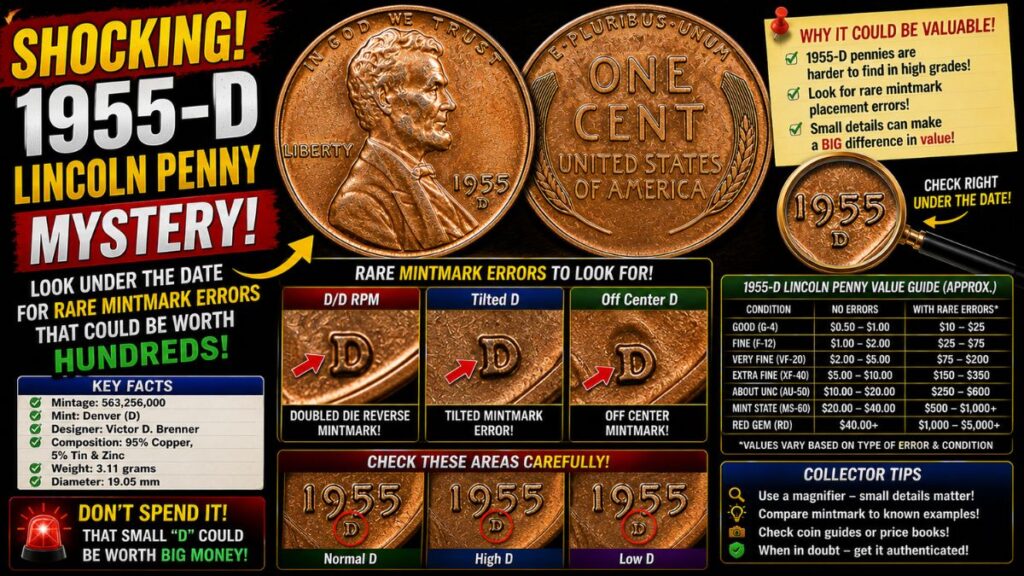
The 1955-D Lincoln Wheat Penny may look like an ordinary old coin, but a closer inspection could reveal details that make it more interesting to collectors. While most pennies dated 1955 and bearing the Denver mintmark are common, unusual mintmark varieties, including genuine repunched mintmarks, can attract attention from collectors who specialize in Lincoln cents. The key is knowing what to look for and understanding the difference between an authentic minting variety and ordinary damage.
If you have a 1955-D Lincoln penny in a coin jar, an inherited collection, or an old album, take a moment to examine the area around the date. The small letter D identifies the Denver Mint, and its shape and appearance can provide useful clues when investigating a possible mintmark variety.
However, not every unusual-looking mintmark is rare, and not every 1955-D penny is worth hundreds of dollars. A coin’s value depends on its exact variety, condition, authenticity, and collector demand. Some online claims exaggerate the potential value of ordinary coins, making careful identification more important than ever.
The 1955-D Lincoln Wheat Penny belongs to a popular American coin series that has been collected for generations. Its familiar portrait of Abraham Lincoln and wheat-stalk reverse make it easy to recognize, but identifying a collectible variety requires more than simply reading the date.
In this guide, you will learn how to examine a 1955-D penny, what a repunched mintmark is, how to distinguish genuine varieties from damage, what affects a coin’s value, and when professional authentication may be worthwhile.
Why the 1955-D Lincoln Penny Deserves a Closer Look
The Lincoln Wheat Penny was introduced in 1909 to commemorate the 100th anniversary of Abraham Lincoln’s birth. Designed by Victor David Brenner, it became one of the most recognizable coins in American history.
The obverse features Lincoln’s portrait, while the reverse displays two wheat stalks surrounding the words ONE CENT and UNITED STATES OF AMERICA. The wheat reverse remained in use until 1958, making the 1955 issue one of the final years of the original design.
The 1955-D Lincoln cent was produced at the Denver Mint. The D mintmark distinguishes it from cents produced at Philadelphia, which generally did not carry a mintmark during this period.
Although the coin has historical appeal, most 1955-D pennies are not rare. Large quantities were produced for everyday commerce, and many examples survive in circulated and uncirculated condition.
What makes the coin interesting to variety collectors is the possibility of finding unusual characteristics that distinguish one example from another. These may include recognized die varieties, repunched mintmarks, or other genuine minting anomalies.
A repunched mintmark occurs when a mintmark is impressed into a working die more than once in slightly different positions. Depending on the characteristics of the variety, the resulting coin may show traces of an earlier impression.
The presence of an unusual-looking D is not enough to establish that a coin is rare. Collectors must examine the shape, position, and diagnostic features of the mintmark before deciding whether it matches a recognized variety.
What Does the D Mintmark Mean on a 1955 Penny?
The D mintmark identifies the Denver Mint as the facility responsible for producing the coin.
During the period when the 1955-D Lincoln cent was made, the United States Mint operated facilities that produced coins for circulation in different quantities. The mintmark helps collectors distinguish coins from these facilities.
On a Lincoln Wheat Penny, the mintmark appears on the obverse, beneath the date and near the area below Lincoln’s portrait.
When examining a 1955-D penny, start by confirming that the date is readable and that the mintmark is actually a D. Dirt, corrosion, scratches, and worn metal can sometimes make small details difficult to interpret.
The mintmark itself should be examined under magnification. Look for unusual outlines, apparent doubling, or shapes that suggest a second impression.
However, a D mintmark does not automatically make a coin rare. Denver produced large numbers of Lincoln cents, and an ordinary 1955-D example is generally a common collectible coin.
The value comes from a specific, verifiable feature rather than the mintmark alone.
If a seller describes a 1955-D penny as a rare repunched mintmark variety, ask which variety is being claimed and what evidence supports the identification. A precise attribution is much more useful than a general statement that the mintmark looks unusual.
What Is a Repunched Mintmark?
A repunched mintmark, often abbreviated RPM, is a coin variety associated with a mintmark that was punched into a working die more than once in slightly different positions.
Historically, mintmarks were added to working dies separately from the main design. If an initial impression was misplaced or insufficiently clear, a mint worker could make another impression.
When the second impression did not align perfectly with the first, traces of the original position could remain.
Coins struck from that die could display a mintmark with apparent doubling, an extra curve, a small projection, or another distinctive feature.
The exact appearance depends on the location and direction of the impressions, as well as the condition of the die.
For collectors, the important point is that a genuine repunched mintmark is a feature of the die, not damage added to an individual coin after it was struck.
A coin struck from a die with a repunched mintmark may display the same characteristic as other coins produced from that die. This repeatability helps specialists identify and document varieties.
However, the term RPM should not be applied to every mintmark that appears doubled. Scratches, contact marks, die deterioration, and other production effects can produce similar-looking shapes.
A claimed repunched mintmark should therefore be compared with established examples before it is assigned a collectible variety designation.
Where to Look Under the Date on a 1955-D Penny
The area beneath the date is the natural starting point when inspecting a 1955-D Lincoln cent.
First, locate the four digits of the date and confirm that the coin reads 1955. Then look immediately below the date for the D mintmark.
Use a magnifying glass or coin loupe to examine the letter’s outline.
A normal mintmark should have a recognizable shape. On a worn coin, some edges may be softened by circulation, while dirt or corrosion can obscure the details.
When searching for a possible repunched mintmark, look for evidence of an additional impression. Depending on the specific variety, this might appear as a secondary curve, a small extra projection, or a partial outline next to the main letter.
Do not assume that any extra line represents a second mintmark. The line may be a scratch, a contact mark, or a feature created by deterioration of the die.
It is also important to examine the surrounding field, the relatively flat area of the coin around the raised design. Damage in this area can distort the apparent outline of the mintmark.
Photographs taken from different angles can help reveal details, but lighting can also create shadows that make an ordinary D look doubled.
For the most reliable comparison, examine a clear image of the exact claimed variety or consult a knowledgeable coin specialist.
How to Recognize a Possible 1955-D Repunched Mintmark
A possible repunched mintmark should be evaluated using several characteristics rather than a single visual clue.
Begin with the letter’s shape. Determine whether the D has an unusual outline that cannot be explained easily by normal wear or damage.
Next, examine the direction of any apparent doubling. If an earlier impression is present, the secondary detail may appear consistently on one side of the main letter.
Look for raised metal features that appear integrated into the mintmark rather than random cuts or scratches across the surface.
Also examine the surrounding area. A scratch may continue beyond the letter and cross the coin’s field, while a genuine die-related feature should be consistent with the way the die formed the design.
These are preliminary observations, not definitive rules. Different varieties can have different appearances, and not every genuine repunched mintmark will display a dramatic second letter.
A coin may also show machine doubling, which can produce a flattened secondary outline. That effect is different from a true repunched mintmark variety.
The next step is comparison. If a specific 1955-D RPM is being claimed, the coin should match the variety’s known diagnostic details.
Without a recognized attribution, the safest description is that the coin has a possible mintmark anomaly rather than a confirmed rare RPM.
Is Every 1955-D Penny With a Doubled D Valuable?
No. A doubled-looking D does not automatically make a 1955-D Lincoln penny valuable.
Several different conditions can produce an unusual mintmark appearance. Some are genuine die varieties, while others are ordinary production effects or damage.
For example, a coin may show machine doubling caused by movement during the striking process. This can make a letter appear to have a second edge, but it is not the same as a repunched mintmark.
A coin may also have a scratch or gouge near the D. Under magnification, the damaged metal can resemble an additional curve or outline.
Die deterioration may soften the letter’s edges or create irregular shapes around the design. Corrosion can produce similar visual confusion.
Even when a genuine RPM is present, its market value depends on the particular variety and the level of collector demand.
Some varieties are more widely recognized than others. A subtle, common variety may carry little additional value, while a clearly documented and scarce variety may attract greater interest.
The important question is not simply whether the D looks doubled. It is whether the coin matches a recognized variety that collectors actively seek.
Accurate identification is the first step toward determining whether a premium is justified.
The Difference Between a Repunched Mintmark and Machine Doubling
One of the most important skills for Lincoln cent collectors is learning to distinguish a genuine repunched mintmark from machine doubling.
A repunched mintmark originates during the preparation of the working die. More than one mintmark impression is present on the die, and the resulting coin reproduces that feature.
Machine doubling occurs during the striking process. It often creates a flat, shelf-like secondary edge on part of the design.
The visual distinction can be subtle, particularly on a small mintmark.
With machine doubling, the secondary area may appear flattened or cut away rather than showing a clearly defined second impression. The effect can vary according to the circumstances of the strike.
A genuine repunched mintmark may display traces of the earlier letter in a position that is consistent with an additional punch impression.
However, no single visual rule applies perfectly to every coin. Wear, lighting, die condition, and the exact variety can affect what is visible.
Collectors should avoid classifying a coin based solely on a magnified photograph of one small feature.
If a coin appears to show doubling, compare it with known examples and consider asking an experienced specialist to examine it.
Understanding the difference can prevent an ordinary coin from being mistaken for a rare variety.
Why the 1955-D Lincoln Penny Is Not the Same as the Famous 1955 Doubled Die
The year 1955 is especially famous in Lincoln cent collecting because of the well-known 1955 doubled die obverse.
That variety displays prominent doubling in parts of the obverse lettering and date. It has become one of the best-known American coin varieties because the doubling is visible without extreme magnification on many examples.
However, the famous 1955 doubled die obverse should not be confused with an ordinary 1955-D Lincoln penny.
The celebrated variety is associated with Philadelphia production and is generally identified by the absence of a D mintmark. Its doubled lettering is a different feature from a repunched mintmark on a Denver coin.
This distinction is important because online discussions sometimes mix together several different kinds of 1955 Lincoln cent varieties.
A 1955-D penny with a possible repunched mintmark should be evaluated on its own characteristics. The reputation and value of the famous 1955 doubled die obverse cannot automatically be applied to a Denver-minted coin.
Collectors should verify both the date and mintmark before comparing a coin with a famous variety.
The exact attribution matters because two coins from the same year can have very different characteristics, rarity levels, and market values.
How Much Is a 1955-D Lincoln Penny Worth?
The value of a 1955-D Lincoln Wheat Penny depends on its condition, originality, and whether it has a recognized collectible variety.
Most circulated examples are common. They may be worth only a modest amount to collectors, depending on their condition and the current market.
Uncirculated examples can be more desirable, especially when they retain strong mint luster and have relatively few marks.
The value of a possible repunched mintmark depends on whether the variety is genuine, recognized, and sought after by collectors. There is no single price that applies to every coin described as a 1955-D RPM.
Some rare coin varieties can sell for hundreds of dollars or more, but that does not mean every unusual 1955-D mintmark will reach that level.
The precise variety, grade, surface quality, and available supply all matter. Authentication and certification can also affect buyer confidence.
A coin that has merely been advertised as rare may not have any special market value if its unusual appearance results from damage or ordinary machine doubling.
When researching a coin, compare it with documented sales of the same variety and a similar grade. Be cautious about using online asking prices as evidence of actual value.
A realistic estimate begins with an accurate identification, not a headline promising extraordinary auction results.
How Condition Affects the Value of a 1955-D Penny
Condition is one of the major factors in determining the value of a Lincoln Wheat Penny.
A circulated 1955-D cent may show wear on Lincoln’s hair, cheek, and other raised features. The wheat stalks and lettering on the reverse may also have softened through handling.
An uncirculated coin has avoided normal circulation wear, but it can still have contact marks, scratches, discoloration, or other imperfections.
Collectors often evaluate coins according to their preservation, strike quality, luster, and eye appeal.
For copper cents, color is another important consideration. Coins may retain red coloration, show a mixture of red and brown, or become predominantly brown as their surfaces change over time.
Original red examples in high grades can attract interest, but the amount of red color alone does not determine value. Surface quality and authenticity are important as well.
Cleaning can reduce a coin’s desirability. Polishing or abrasive treatment may leave fine scratches and remove original surface characteristics.
If a 1955-D penny has a genuine repunched mintmark, condition may influence its market value, but the variety itself must first be established.
An ordinary coin in excellent condition and a scarce mintmark variety are not the same thing. A proper assessment considers both the coin’s grade and the significance of its variety.
What Makes a Repunched Mintmark Rare?
A repunched mintmark is not automatically rare simply because the mintmark was impressed more than once.
Rarity depends on how many coins were produced from the relevant die, how many examples have survived, and how well the variety is documented.
A variety may be relatively common if the die produced a large number of coins or if many examples have been preserved.
Another variety may be more difficult to find because it was produced briefly, has distinctive characteristics, or has received relatively little attention from collectors.
The visibility of the feature can also influence demand. A clearly recognizable RPM may be easier for collectors to identify than a subtle variety that requires substantial magnification.
Collectors who specialize in Lincoln cents sometimes pursue individual die varieties as part of a detailed collection. This specialized demand can influence prices even when the coins themselves are not exceptionally old.
However, a variety’s popularity can change over time. A coin that receives attention in an online video may attract temporary interest without becoming genuinely scarce.
For this reason, rarity claims should be supported by established variety information and comparable market evidence.
The strongest case for a premium is a coin whose variety can be identified precisely and whose characteristics are consistent with recognized examples.
How to Inspect Your 1955-D Penny at Home
A careful home inspection can help determine whether a coin deserves further research.
Start by cleaning neither the coin nor the mintmark. Instead, use a soft, well-lit area and examine the coin as it is.
Confirm the date and mintmark. The date should read 1955, and the letter beneath it should be D.
Use a magnifying glass or coin loupe to study the mintmark. Look for a secondary outline, extra curve, or other feature that may suggest a repunched mintmark.
Next, examine the surrounding field. Check whether the apparent extra line is part of the mintmark or whether it continues across the surface like a scratch.
Inspect the rest of the coin for signs of damage. A coin with heavy corrosion or significant surface alteration may be more difficult to evaluate.
Take clear photographs of the obverse, reverse, date, and mintmark. Try more than one lighting angle, since a single photograph can create misleading shadows.
Finally, compare the coin with known examples of the exact variety being considered.
If the feature remains convincing, ask a reputable coin dealer or specialist to review it.
This approach is more reliable than assuming that an unusual-looking D must be rare.
Common Mistakes When Searching for Rare 1955-D Pennies
One common mistake is confusing the famous 1955 doubled die obverse with a repunched mintmark on a 1955-D cent. These are different varieties and should not be evaluated as though they were the same coin.
Another mistake is treating machine doubling as proof of a rare RPM. A flat secondary outline may be a normal striking-related effect rather than a true repunched mintmark.
Collectors also sometimes mistake scratches and dents for additional letter details. Damage near the mintmark can change its apparent shape, especially when viewed under strong magnification.
A further mistake is assuming that every genuine RPM must be worth hundreds of dollars. Variety values differ according to scarcity, condition, recognition, and collector demand.
Online asking prices can create unrealistic expectations. A seller may request a high price for a coin without finding a buyer willing to pay it.
Finally, cleaning a coin in an attempt to reveal the mintmark can do more harm than good. Abrasive cleaning may remove surface details and reduce its desirability.
The best defense against these mistakes is careful identification and a willingness to verify unusual features before assigning value.
Should You Have a 1955-D Penny Professionally Graded?
Professional grading and authentication may be useful when a coin appears to have a significant variety or is in exceptionally good condition.
A grading service can assess the coin’s condition and may be able to identify or attribute a recognized variety, depending on its services and policies.
However, professional grading is not necessary for every 1955-D penny.
For an ordinary circulated coin with no unusual features, the cost of submission may exceed the likely financial benefit.
A possible rare repunched mintmark deserves a different approach. Before paying for formal grading, consider obtaining a preliminary opinion from an experienced dealer or variety specialist.
The first goal is to establish whether the coin actually matches a recognized RPM.
If the feature turns out to be machine doubling or damage, an expensive submission may not be worthwhile.
If the variety is confirmed and the coin appears to have meaningful collector value, professional certification may help buyers evaluate it with greater confidence.
The decision should be based on the coin’s specific characteristics and likely market value rather than the excitement surrounding a potential discovery.
How Auction Prices Should Be Interpreted
Auction prices can help collectors understand the market for unusual Lincoln cents, but they must be interpreted carefully.
A completed sale of an authenticated example provides evidence of what a buyer was willing to pay under particular circumstances.
The final price can depend on the coin’s grade, variety, surface quality, provenance, and the number of interested bidders.
A highly sought-after variety may attract competition, while a less recognized or poorly preserved example may receive less attention.
The price of a rare 1955 Lincoln cent variety should not automatically be applied to a 1955-D penny with a different feature.
For example, a famous doubled die obverse and a possible repunched mintmark are different collecting categories. Their values can differ substantially.
It is also important to distinguish a realized auction price from an advertised price. An online listing may show an ambitious asking price without proving that a transaction occurred.
When estimating the value of a 1955-D RPM, look for sales of the same attributed variety in comparable condition.
If no reliable comparable sales are available, it is better to acknowledge the uncertainty than to invent a precise value.
How to Preserve a Potentially Valuable 1955-D Lincoln Penny
If you believe your coin may have a genuine repunched mintmark, preserving its condition is important.
Handle the penny by its edges whenever possible. Avoid touching the main surfaces unnecessarily.
Do not polish, scrape, or chemically clean the coin. Such treatment can damage the surfaces and remove evidence that helps specialists identify the variety.
Store the penny in a suitable coin holder that will not scratch the metal or expose it to harmful materials.
Keep it in a dry environment and avoid unnecessary handling while researching its identity.
Photograph the coin under neutral lighting, including clear images of the date and mintmark. If you have an accurate scale, recording the weight may also be useful, although weight alone cannot confirm an RPM.
Make a note of the feature that caught your attention. Describe what you observe rather than assuming the coin is rare.
If a specialist confirms a recognized variety, retain any relevant documentation and consider whether professional grading is appropriate.
Proper preservation helps protect the coin’s appearance and supports a more reliable evaluation.
Frequently Asked Questions About the 1955-D Lincoln Penny
Is the 1955-D Lincoln penny rare?
Most 1955-D Lincoln Wheat Pennies are common. A specific coin may be more desirable if it has a recognized repunched mintmark variety, another genuine mint error, or exceptional preservation.
Where should I look for a repunched mintmark?
Examine the D mintmark beneath the date on the obverse. Use magnification to look for evidence of an earlier impression, but compare the feature with recognized examples before identifying it as a genuine RPM.
Can a 1955-D penny with a doubled D be worth hundreds of dollars?
Some collectible varieties can command substantial premiums, but not every doubled-looking mintmark is rare or valuable. The exact variety, authenticity, condition, and collector demand determine the coin’s market value.
Is the 1955-D penny the famous 1955 doubled die penny?
No. The famous 1955 doubled die obverse is associated with Philadelphia production and is generally identified by the absence of a D mintmark. A 1955-D penny with a possible repunched mintmark is a different type of variety.
How can I tell a repunched mintmark from a scratch?
A scratch may cut across the coin’s surface or continue beyond the letter, while a genuine die-related feature should be consistent with the way the design was formed. Magnification and comparison with recognized examples can help, but expert examination may be necessary.
Does machine doubling make a 1955-D penny rare?
Not usually. Machine doubling is a striking-related effect that can create a flat or shelf-like outline. It is different from a genuine repunched mintmark variety and generally does not carry the same collector premium.
Should I clean my 1955-D penny before examining it?
No. Cleaning may scratch the coin or alter its original surface. Examine it as it is and preserve any unusual details for evaluation.
Are online listings reliable for estimating a penny’s value?
Not always. Asking prices do not prove that a coin has sold for that amount. Completed sales of comparable, accurately attributed coins provide a better basis for estimating value.
Is professional grading necessary for every 1955-D penny?
No. Ordinary circulated examples generally do not need formal grading. A coin that appears to match a scarce variety or has exceptional condition may justify a professional assessment.
What should I do if I think I found a rare 1955-D repunched mintmark?
Preserve the coin, photograph the date and mintmark, compare its characteristics with recognized examples, and seek an opinion from a reputable coin dealer or variety specialist before making a financial decision.
Conclusion: Look Closely, Verify the Variety, and Know What You Have
The 1955-D Lincoln Wheat Penny is a familiar coin, but a close examination can reveal details worth investigating. Genuine repunched mintmarks and other documented varieties can attract collector interest, especially when their characteristics are clear and their identities are well established.
The most important area to inspect is the D mintmark beneath the date. Look for signs of a possible earlier impression, but remember that machine doubling, scratches, corrosion, and ordinary wear can produce misleading shapes.
Most 1955-D pennies remain common, and an unusual appearance does not guarantee a high value. The exact variety, condition, authentication, and demand all influence what a collector might pay.
If your penny appears unusual, avoid cleaning it and compare it with reliable examples of the claimed variety. Seek expert guidance if the evidence suggests a genuine RPM.
Have you found a 1955-D Lincoln penny with an unusual mintmark? Take a closer look, record what you observe, and share your discovery with other collectors. The most rewarding finds begin with careful examination and end with accurate identification.