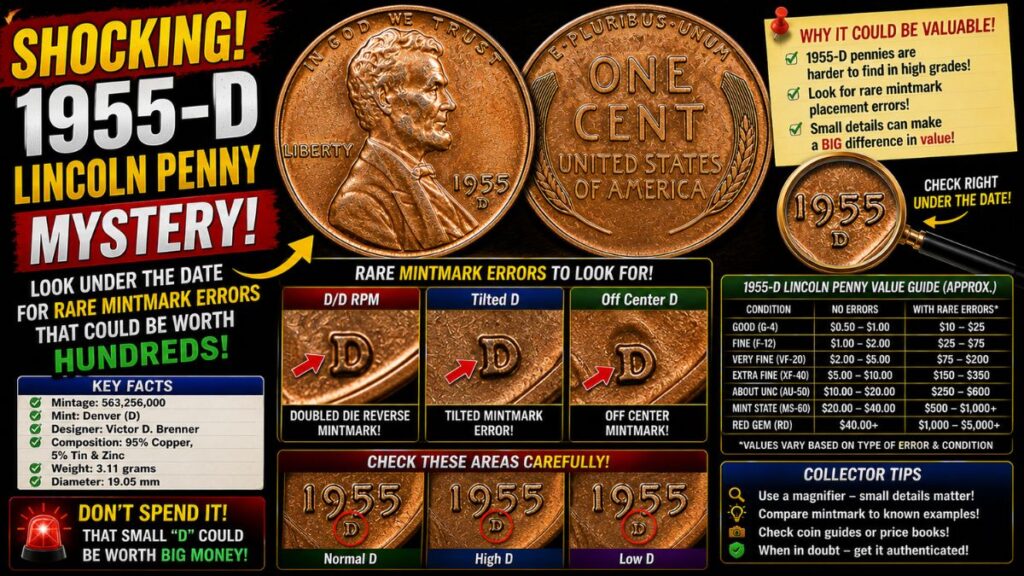
The 1958-D Lincoln Wheat Penny may look like an ordinary old copper coin, but it represents an important moment in American coinage. It belongs to the final year of the Lincoln Wheat cent design, a series that had been part of everyday American life since 1909. For collectors, that historical connection makes the 1958-D penny an interesting coin to examine, especially when it survives in excellent condition or displays a genuine minting variety.
The date and mintmark are the first details to check. The number 1958 identifies the year, while the small letter D beneath the date indicates that the coin was struck at the Denver Mint. The 1958-D is one of the final Lincoln cents to carry the familiar wheat-ear reverse, which was replaced by the Lincoln Memorial design in 1959.
However, being a final-year Wheat penny does not automatically make every 1958-D cent rare. Millions were produced, and circulated examples are generally obtainable by collectors. The coins that deserve particular attention are those with unusually strong preservation, authentic minting errors, or recognized varieties that can be distinguished from ordinary wear and damage.
That distinction matters because claims about valuable pennies can easily become exaggerated. A coin that looks unusual under a magnifying glass is not necessarily a rare variety, and a penny that has survived for nearly seven decades is not automatically worth a large amount.
If you have a 1958-D Wheat penny in a jar, old collection, coin folder, or inherited group of coins, a careful inspection can help you understand what you own. You do not need expensive equipment to begin. Good lighting, a magnifier, and a basic understanding of the coin’s design can help you identify the details that matter most.
What Makes the 1958-D Lincoln Wheat Penny Special?
The 1958-D Lincoln Wheat penny is part of the Lincoln cent series introduced in 1909. Its obverse features Abraham Lincoln’s portrait, while the reverse displays two wheat ears framing the words ONE CENT and UNITED STATES OF AMERICA.
The wheat design became one of the most recognizable images in American coin collecting. It remained on the cent through 1958, making that year the end of the Wheat reverse era.
In 1959, the reverse changed to show the Lincoln Memorial. This transition gives 1958-dated Wheat cents a clear historical place in the series. Collectors building a complete date-and-mintmark collection often include a 1958-D because it represents the final year of the design.
The Denver Mint produced the 1958-D cent in large quantities. As a result, the date is not considered rare simply because it is the last year of the Wheat reverse. Ordinary circulated examples remain accessible to collectors, and many survive in collections today.
The more interesting question is whether a particular coin has something that separates it from the many ordinary examples. It could be unusually sharp detail, original surfaces, an authentic die variety, or a genuine minting error.
These characteristics affect collectibility in different ways. A high-grade coin may be desirable because it has little wear and strong visual appeal. A recognized die variety may attract specialists who study the small differences created by individual dies. A dramatic minting error may appeal to collectors who focus on unusual production mistakes.
Understanding these categories helps you avoid treating every unusual-looking 1958-D penny as a potential rarity.
Why 1958 Was the Final Year of the Wheat Reverse
The Lincoln cent first appeared in 1909 to mark the centennial of Abraham Lincoln’s birth. Its introduction was a major change in American coin design because Lincoln became the first historical president depicted on a regular-issue United States circulating coin.
The original reverse featured two wheat stalks, a design that remained in use for nearly half a century. The wheat ears represented an agricultural theme and gave the coin its familiar nickname: the Wheat penny.
In 1959, the reverse was redesigned to show the Lincoln Memorial in Washington, D.C. The new design marked the 150th anniversary of Lincoln’s birth and replaced the wheat ears with an architectural image.
That makes the 1958-D an important date for collectors who follow the transition between the two reverse designs. It is among the last coins bearing the Wheat reverse, and its Denver mintmark identifies its place of production.
Still, the historical significance of a final-year issue should not be confused with scarcity. A coin can mark the end of a design and remain relatively common because so many examples were struck and preserved.
For this reason, collectors generally look beyond the date alone. They consider the coin’s grade, surface quality, color, authenticity, and any identifiable variety or error.
How to Identify a Genuine 1958-D Wheat Penny
Before investigating possible varieties or unusual features, confirm that the coin is actually a 1958-D Lincoln cent.
Start with the date on the obverse, the side showing Lincoln’s portrait. The date should read 1958. The digits may appear worn on heavily circulated examples, so examine them under good light if any number is unclear.
Next, look for the mintmark. On a 1958-D cent, the small letter D appears beneath the date. It indicates that the coin was struck at the Denver Mint.
The reverse should display the two wheat ears, the denomination ONE CENT, and the inscription UNITED STATES OF AMERICA. The wheat design is an important clue because a 1958 cent with the Lincoln Memorial reverse would not match the normal design of a genuine 1958 issue.
The coin’s overall appearance can also provide useful clues. A genuine circulated copper cent usually shows signs of normal contact with other coins, gradual surface wear, or changes in color caused by age and storage. However, appearance alone cannot establish authenticity.
If the date or mintmark looks suspicious, compare the coin with a reliable reference image or ask an experienced coin dealer to examine it. Altered dates, added mintmarks, and damaged surfaces can sometimes mislead inexperienced collectors.
Do not attempt to improve a coin’s appearance by scraping away material or polishing the area around the date. Such actions can destroy important evidence and reduce collector appeal.
Understanding the Denver Mintmark
The D mintmark is a small but important feature of the 1958-D penny. It identifies Denver as the production facility and helps distinguish the coin from cents struck at other mints.
Because the mintmark is small, it can be difficult to inspect on a worn coin. Dirt, corrosion, scratches, and contact marks may obscure its shape. Magnification can help reveal the letter’s outline and its position relative to the date.
Collectors sometimes focus on mintmarks because dies can show small differences from one another. In some cases, a mintmark may appear to have been punched into a die more than once, creating what is known as a repunched mintmark variety.
That does not mean every unusual D is a valuable repunched mintmark. A genuine variety must be supported by identifiable characteristics, and those characteristics need to be distinguished from damage, die wear, and other production effects.
The mintmark should therefore be examined as part of the whole coin rather than as an isolated feature. Check its shape, surrounding metal, location, and appearance under different lighting angles.
If the D looks doubled or distorted, document the feature before drawing conclusions. A clear photograph taken straight on, along with close-up images under angled lighting, can be useful when comparing the coin with established variety references.
What Is a Repunched Mintmark?
A repunched mintmark, often abbreviated RPM, is a variety associated with a mintmark that was punched into a working die more than once, with the impressions not perfectly aligned.
In the period when mintmarks were applied to individual working dies by hand, a mint worker could make an initial impression and then punch the same letter again to strengthen or correct its placement. If the impressions did not align precisely, traces of the earlier position could remain visible.
On a coin struck from such a die, the mintmark may show an extra curve, a secondary edge, or a small portion of another impression.
The important point is that a genuine repunched mintmark is a feature of the die. It is repeated on coins struck by that die, although wear, strike strength, and condition can affect how clearly it appears.
An RPM is not the same as a scratch or a damaged letter. Scratches often cut into the surface, while post-mint damage may displace metal in irregular ways. A die variety generally has more consistent, identifiable characteristics.
The mintmark may also appear doubled because of lighting, reflections, or the way the coin was photographed. A magnifier alone cannot confirm a variety if the evidence is ambiguous.
Collectors should be cautious about claims that a 1958-D penny with any apparent doubling is automatically worth hundreds of dollars. The value of a variety depends on whether it is recognized, how clearly it can be identified, its condition, and what buyers are willing to pay.
A responsible examination begins with identifying the feature and comparing it with documented examples, not assuming a high value from an unusual appearance.
Are 1958-D Wheat Pennies With Repunched Mintmarks Rare?
Some Lincoln cent dates have documented repunched mintmark varieties, and specialists continue to study die characteristics across the series. However, a claim that a particular 1958-D mintmark is rare needs specific evidence.
It is not enough for the D to look thick, crooked, or doubled. Those appearances can have several explanations, including die deterioration, a weak strike, damage after the coin left the mint, or simple optical effects.
A recognized variety should have diagnostic features that can be compared with reliable reference material. The location and direction of any secondary impression matter. The shape of the letter and the relationship between the apparent impressions also matter.
If your coin seems to show a second D outline, take close-up photographs and compare the feature with confirmed examples. If you cannot find a convincing match, avoid labeling it a rare RPM until a knowledgeable specialist has evaluated it.
It is also important to separate a possible variety from its financial value. Even when a variety is genuine, it may not command a substantial premium if it is common, difficult to see, or of limited demand.
For the 1958-D, condition and authenticity remain central to the evaluation. A coin with a clearly identified variety may interest specialists, but an unsupported claim of rarity does not establish market value.
How to Examine the Mintmark Without Damaging the Coin
A careful inspection can reveal much more than hurried handling, and it does not require aggressive cleaning or special tools.
Place the penny on a clean, soft surface. Use a magnifier with enough power to see the edges of the D clearly. A desk lamp or another steady light source can help, especially if the light comes from different angles.
First, examine the mintmark under direct light. Look at the outline of the letter and its position beneath the date. Then change the angle of the light. A feature that appears doubled from one angle may disappear when the light moves, suggesting that reflection rather than a true secondary impression is responsible.
Next, inspect the metal immediately around the D. A genuine die characteristic should fit naturally into the coin’s struck design. A scratch or impact mark may interrupt nearby details or show an irregular groove.
Do not use a needle, blade, abrasive material, or other pointed tool to uncover the mintmark. Scraping can create false outlines and permanently damage the coin.
Avoid rubbing the area with a cloth. Even a soft material can leave fine marks on a coin’s surface, especially if particles of dust or grit are present.
If the mintmark is covered by dirt or residue, it is usually better to leave the coin alone until its condition can be assessed. Cleaning may make the letter easier to see temporarily but can reduce the coin’s desirability and complicate authentication.
The goal is to observe what is already present, not to change the coin in order to make a feature more visible.
The Difference Between a True Variety and Machine Doubling
One of the most common sources of confusion in coin collecting is the difference between a true die variety and machine doubling.
A true die variety results from a characteristic built into the die used to strike the coin. A repunched mintmark is one example. Other die varieties may involve doubled design elements or changes in the die’s surface.
Machine doubling, sometimes called strike doubling, occurs during the striking process. It can leave a flattened or shelf-like secondary outline beside a letter or number. The effect may look like a second impression, especially when viewed through a magnifier.
The distinction matters because machine doubling is not generally treated as the same kind of collectible doubled-die variety. Its appearance can be dramatic, but it usually does not create the same kind of premium associated with a recognized die variety.
A useful clue is the shape of the apparent doubling. Machine doubling often looks flat or cut back, as though part of the original design has been pushed sideways. A genuine doubled-die feature typically reflects a different relationship between the design elements and the die.
However, these visual clues are not enough to authenticate every coin. Some features are subtle, and damage can imitate more than one type of doubling.
If you suspect that the mintmark or date is doubled, compare the coin with specialist references and avoid assigning a variety name without supporting evidence.
Could a 1958-D Penny Be Worth Hundreds of Dollars?
The short answer is that exceptional coins can sometimes attract strong collector interest, but a normal 1958-D Wheat penny is not automatically worth hundreds of dollars.
The value depends on several factors. The most important include the coin’s grade, the quality of its surfaces, its color and originality, the presence of a recognized variety, and demand among collectors.
A heavily circulated example with obvious wear will usually be evaluated differently from a coin that retains sharp details and nearly untouched surfaces. A genuinely rare, well-documented variety may also have a different market position from an ordinary example.
Online headlines can create unrealistic expectations by emphasizing the highest reported prices without explaining the coin’s grade, certification, variety attribution, or sale conditions. A result for one exceptional coin cannot be applied to every coin with the same date.
As a result, there is no single price that accurately describes all 1958-D cents. Even two coins that look similar at first glance can differ in important ways.
When researching value, compare coins with the same date, mintmark, grade, and variety status. Recent completed sales are generally more informative than asking prices, because an advertised price does not prove that a buyer has paid that amount.
If a coin appears unusually well preserved or shows a potentially significant variety, consider obtaining an expert opinion before making a financial decision.
Why Condition Matters So Much
Condition is one of the most important factors in the value of a collectible coin. In numismatics, condition is commonly described using grades that reflect wear, surface preservation, and the amount of original detail remaining.
A circulated 1958-D penny may show wear on Lincoln’s cheek, hair, and the highest parts of the wheat ears. The date and mintmark may remain readable even when other details have become soft.
An uncirculated coin has not experienced the normal wear associated with circulation. However, uncirculated does not necessarily mean flawless. A coin may have contact marks from other coins, scratches from mishandling, weakly struck details, or other imperfections.
Small differences become especially important among high-grade examples. Two coins may both appear uncirculated, yet one may have fewer marks, better luster, and stronger visual appeal.
Professional grading services use standardized criteria to evaluate coins, but grading can be complex. Lighting, magnification, and experience all affect how a coin is assessed.
For collectors, the practical lesson is straightforward: do not judge a penny only by whether it looks shiny. Original luster, wear patterns, surface marks, and the sharpness of the design all contribute to its condition.
A coin that has been polished may look brighter than an original example but can be less desirable to collectors. A naturally toned coin with original surfaces may be more attractive than one that has been aggressively cleaned.
What to Look for on Lincoln’s Portrait
The obverse of the 1958-D Wheat penny provides several useful areas for evaluating condition.
Start with Lincoln’s cheek, jaw, and the high points of his hair. These areas often show wear first on circulated coins. A smooth or flattened appearance can indicate circulation, while sharper details may suggest better preservation.
Look at the lettering and date as well. The digits should have recognizable shapes, and the surrounding fields should be examined for scratches, dents, or unusual marks.
The surface around Lincoln’s portrait can reveal contact marks from other coins. These marks do not necessarily mean the coin is damaged beyond collector interest, but their size, number, and location can affect its grade.
Pay attention to luster, too. Original mint luster can appear as a moving sheen when the coin is tilted under a light. A dull, lifeless surface may be the result of circulation, environmental exposure, or cleaning, although appearance alone cannot establish the cause.
Do not rub the portrait to test its texture. The coin’s surface should be observed under changing light rather than physically manipulated.
A strong obverse does not guarantee a high overall grade, since the reverse and the rest of the coin must also be evaluated. Nevertheless, Lincoln’s portrait is a useful starting point for understanding wear and preservation.
What to Look for on the Wheat Reverse
The reverse is particularly important because it identifies the coin as part of the Wheat cent series.
Examine both wheat ears and the central lettering. On a well-preserved coin, the grains, stalks, and surrounding details should remain relatively sharp. Circulation gradually softens the raised parts of the design.
The words ONE CENT and UNITED STATES OF AMERICA should also be clear. Heavy wear can flatten the lettering and reduce the definition of the surrounding areas.
Check the open fields for scratches, corrosion, stains, and contact marks. These features may be more visible on a coin with relatively little wear, but they can occur on coins of any grade.
The wheat reverse can also help reveal whether the coin has been cleaned or exposed to harsh conditions. Uneven color, unnatural brightness, or a surface that appears stripped of normal texture may warrant closer inspection.
Do not assume that every dark spot or color change is a minting error. Many coins acquire marks and discoloration through decades of handling, storage, and exposure to the environment.
A detailed reverse inspection helps establish the coin’s overall condition and may reveal issues that are not obvious when looking only at the date and mintmark.
Copper Color: Red, Red-Brown, and Brown
Copper cents change appearance over time, and color is an important consideration when evaluating an uncirculated Lincoln cent.
Collectors commonly use three broad color designations for copper coins: Red, Red-Brown, and Brown. These terms describe the amount of original red color remaining on the coin’s surface.
A Red coin retains nearly all of its original red appearance. Red-Brown examples show a mixture of red and brown, while Brown coins display predominantly brown surfaces.
Color alone does not determine grade. A coin can retain considerable red color while having noticeable contact marks, or it can be brown and still have excellent detail and original surfaces.
The way a coin was stored can influence its color. Exposure to air, moisture, chemicals, and certain storage materials can change the surface over time.
Artificially brightening a coin is not a reliable way to improve its value. Cleaning products and polishing methods can alter the surface and may leave the coin less attractive to experienced collectors.
If you have a bright 1958-D penny, look closely for signs of cleaning rather than assuming that brightness indicates exceptional quality. Natural color and original surface texture are generally more meaningful than shine by itself.
Color is best considered alongside grade, luster, marks, and authenticity. It can influence collector interest, particularly for high-grade copper cents, but it should never be evaluated in isolation.
Genuine Mint Errors That Could Attract Attention
Mint errors occur when something unusual happens during the production of a coin. They are different from ordinary die varieties, although both categories can be collectible.
A die variety is a repeatable characteristic of a particular die. A mint error generally results from an abnormal event during the manufacturing process, such as a planchet problem, a striking issue, or a feeding malfunction.
Examples of mint errors across modern coinage include off-center strikes, broadstrikes, clipped planchets, and certain types of doubled or multiple strikes. These are general categories, not proof that a particular 1958-D penny exists in every form.
The significance of an error depends on its authenticity, visibility, severity, and demand among collectors. A dramatic and clearly identifiable error may attract more interest than a minor production irregularity.
It is also important to distinguish mint errors from damage that occurred after the coin was made. A penny that has been squeezed, bent, scratched, drilled, or struck by a tool may appear unusual without having a collectible mint error.
Look for evidence that the feature was created during minting. The shape of the coin, the flow of metal, the design’s relationship to the edge, and the character of the affected surfaces can all help specialists assess a suspected error.
If your 1958-D penny has an unusual shape or strike, preserve it and seek an informed opinion before attempting any treatment.
Off-Center Strikes and Other Striking Problems
An off-center strike occurs when the planchet and dies are not properly aligned during striking, leaving part of the design missing and an area of blank planchet visible.
The appearance can vary considerably. A slight misalignment may leave most of the design intact, while a more dramatic error can shift the design far enough that part of the coin’s intended image is absent.
Off-center strikes are often evaluated by how far the design is displaced and whether the date remains visible. The exact degree of displacement and the coin’s overall condition can influence collector interest.
A coin with a visibly incomplete design should still be examined carefully. Post-mint damage can bend or distort a cent, and such damage may imitate some features of an unusual strike.
Other striking problems may involve irregularly formed edges or evidence of multiple impacts, but identifying them correctly requires an understanding of how coins are produced.
Do not assume that a misshapen 1958-D penny is valuable simply because it looks different. The feature must be consistent with a genuine minting error, and its importance depends on the specifics of the coin.
For a potentially significant error, clear photographs of both sides and the edge can help an experienced specialist make an initial assessment.
Why Ordinary Damage Is Often Mistaken for a Mint Error
A coin that has spent decades in circulation can accumulate many unusual marks. It may have been dropped, struck against other coins, stored in a container, or exposed to harsh environmental conditions.
These experiences can create scratches, dents, flattened letters, displaced metal, and irregular edges. Under magnification, some of these marks can look surprisingly similar to minting abnormalities.
Damage around the D mintmark is particularly easy to misinterpret because the letter is small. A scratch crossing the letter can make it appear doubled or distorted. A dent beside the mintmark can create a shadow that resembles an additional outline.
Environmental damage can also change the surface around a feature. Corrosion and deposits may obscure parts of a letter or make the surrounding metal appear uneven.
A genuine mint characteristic generally fits the coin’s manufacturing history. Post-mint damage, by contrast, often interrupts the design or changes the surface in ways that are inconsistent with the original strike.
Even so, visual rules are not perfect. A coin can have both a genuine variety and later damage, and some error types are difficult to identify without specialist knowledge.
The safest approach is to record the feature, compare it with reliable examples, and avoid making claims about rarity until the evidence is clear.
How to Research the Value of Your 1958-D Penny
A useful value estimate begins with identifying exactly what kind of coin you have.
First, confirm the date and mintmark. Next, evaluate the coin’s condition, including wear, surface marks, luster, and color. Then determine whether the coin has a recognized variety or a genuine mint error.
Once those details are established, compare it with coins that match as closely as possible. A circulated 1958-D penny should not be compared directly with an exceptionally preserved example, and a coin with an authenticated error should not be valued using prices for ordinary cents.
Completed auction results can help establish what buyers have actually paid. However, sales should be considered in context because grades, certification, eye appeal, and the strength of demand can differ.
Be careful with online listings that advertise extraordinary prices without showing a verified sale. An asking price is simply the amount a seller hopes to receive. It does not prove that the coin is worth that amount.
Also be cautious about claims based on a single auction result. Exceptional coins sometimes attract unusual attention, and one result may not reflect the broader market.
If the penny appears valuable, obtain more than one informed opinion when practical. A reputable coin dealer or professional grading service may help determine whether further authentication is worthwhile.
When Professional Authentication Makes Sense
Not every old penny needs professional grading. For many ordinary circulated 1958-D cents, the cost of authentication and grading may be greater than the coin’s market value.
Professional evaluation becomes more relevant when the coin appears to be in exceptional condition, has a potentially significant variety, or displays a dramatic mint error.
Authentication can help establish whether the coin is genuine and whether its unusual feature is consistent with a recognized variety or error. Grading can also provide a standardized description of its condition.
However, professional grading is not a guarantee that a coin will sell for a particular amount. Market value still depends on demand, comparable sales, and the coin’s specific characteristics.
Before submitting a penny, consider its likely value and the cost of the service. If the coin is ordinary and heavily circulated, a basic examination may be sufficient.
If a mintmark variety seems promising, seek an opinion from someone familiar with Lincoln cent varieties. If the coin appears to have an unusual strike, look for an expert who understands mint errors.
The goal is to obtain useful information without spending more than the coin’s likely collector value justifies.
How to Store a 1958-D Wheat Penny Properly
Proper storage helps protect a coin’s condition and makes it easier to inspect in the future.
Avoid carrying a potentially collectible penny loose in a pocket or keeping it in a container where it can rub against other coins. Repeated contact can produce scratches and small marks.
Coin holders made from materials intended for long-term storage can help limit handling. Choose a holder that fits the coin without forcing it into place, and avoid materials that may react with copper.
Keep the coin in a dry environment with relatively stable conditions. Moisture and certain chemicals can contribute to corrosion or changes in color.
Handle the coin by its edges whenever possible. Skin oils and residue can leave marks on a copper surface, especially if the coin is uncirculated or has delicate original luster.
Do not attempt to clean a coin to make it more attractive. Polishing, rubbing, chemical treatments, and abrasive cleaning can permanently change its surface.
If you suspect a mint error, preserve the coin in its current condition until it has been evaluated. The original surfaces may provide clues that are important for determining what happened during production.
Good storage cannot make an ordinary coin rare, but it can help preserve whatever collector appeal the coin already has.
Common Myths About the 1958-D Wheat Penny
Several common misconceptions can make it difficult to judge the importance of a 1958-D penny.
One myth is that every coin from the final year of a design is rare. The 1958-D is historically significant as a final-year Wheat cent, but its large production means that ordinary examples are not automatically scarce.
Another misconception is that a visible mintmark anomaly guarantees a high value. A strange-looking D may be caused by damage, lighting, or machine doubling rather than a recognized repunched mintmark variety.
Some collectors also assume that any bright copper penny must be in excellent condition. Brightness can result from cleaning or other surface changes, so it is important to assess originality and detail rather than shine alone.
A further myth is that old coins become valuable simply because they have survived for a long time. Age can add historical interest, but value is influenced by scarcity, condition, authenticity, and demand.
Finally, not every unusual mark is a mint error. Damage after production is common, and it can sometimes look convincing when examined without specialist knowledge.
Avoiding these myths helps collectors make better decisions. The most useful approach is to establish what the coin actually is before estimating what it might be worth.
Is the 1958-D Wheat Penny a Good Coin for Beginners?
Yes. The 1958-D is a useful coin for someone learning how to collect Lincoln cents because its design is familiar, its date and mintmark are easy to understand, and examples can often be found without a major financial commitment.
A beginner can use it to practice identifying the obverse and reverse, recognizing circulation wear, and comparing coins in different conditions.
It also provides an introduction to the difference between a date, a mintmark, a die variety, and a mint error. These distinctions are important throughout coin collecting and become especially useful when examining coins that are advertised as rare.
The 1958-D can also serve as a starting point for building a collection of Wheat cents by date and mintmark. Collectors may enjoy assembling examples from different years and comparing how wear, color, and strike quality vary.
Beginners should resist the temptation to buy an expensive coin based solely on a claim that it has a rare feature. It is better to learn the basics of grading and authentication before spending significant money.
A simple magnifier, careful observation, and reliable reference material are enough to begin. Over time, comparing many coins can make it easier to recognize normal differences and identify features that deserve further study.
A Practical Checklist for Your 1958-D Penny
Before deciding whether your coin deserves a closer professional look, work through a few simple checks.
Confirm that the date reads 1958 and that the D mintmark is present beneath it. Examine the wheat reverse to make sure the design matches the expected issue.
Look at Lincoln’s portrait and the wheat ears for signs of wear. Check the surfaces for scratches, corrosion, dents, and signs of cleaning.
Inspect the D under magnification and change the angle of the light. If it appears doubled or distorted, determine whether the effect might be caused by damage, reflection, or machine doubling.
Consider whether the coin has exceptional preservation. Strong details and original-looking surfaces can make an example more appealing than a heavily circulated one, although a formal grade requires broader assessment.
If you suspect a genuine variety or mint error, take clear photographs and compare the coin with documented examples. Do not assign a rare variety name based on appearance alone.
Finally, research comparable completed sales and consider professional advice if the coin seems unusual or valuable.
This checklist will not guarantee that you find a rare penny, but it can help you make a more informed decision about what to do next.
Frequently Asked Questions About the 1958-D Wheat Penny
Why is the 1958-D Wheat penny important?
It is a final-year issue of the Lincoln Wheat cent design. The wheat reverse was replaced by the Lincoln Memorial design in 1959, giving 1958-dated cents a clear place in the history of the series.
Does every 1958-D penny have a high value?
No. The Denver Mint produced large numbers of 1958-D cents, so ordinary circulated examples are generally common. Condition, recognized varieties, genuine mint errors, and collector demand influence value.
Where is the D mintmark located?
The D mintmark is on the obverse, beneath the date 1958. It identifies the Denver Mint as the production facility.
What is a repunched mintmark?
A repunched mintmark is a die variety created when a mintmark was punched into a working die more than once with imperfect alignment. The resulting coin may show traces of more than one impression.
Is a doubled-looking D proof of a rare variety?
No. A doubled-looking mintmark can result from a recognized die variety, machine doubling, damage, or lighting effects. The feature must be examined and compared with reliable references before it can be identified.
Can a 1958-D penny be worth hundreds of dollars?
An exceptional coin or a properly identified variety may attract significant collector interest, but an ordinary 1958-D penny is not automatically worth hundreds of dollars. Any estimate should be based on its condition, authentication, and comparable sales.
How can I tell if my penny is uncirculated?
An uncirculated coin generally lacks the wear caused by normal circulation, but it may still have contact marks or other imperfections. Original luster, design detail, and surface condition all matter when assessing its grade.
Should I clean my 1958-D Wheat penny?
No. Cleaning, polishing, or using chemicals can damage the coin’s surface and reduce its appeal to collectors. It is usually best to leave the coin as it is.
Are mint errors and die varieties the same thing?
No. A die variety is a repeatable characteristic of a particular die, while a mint error generally results from an unusual event during production. Both can be collectible, but they must be identified correctly.
Should I pay for professional grading?
Professional grading may be worthwhile for a coin that appears exceptionally well preserved or has a potentially significant variety or mint error. For an ordinary circulated cent, the cost may outweigh the likely benefit.
What is the best way to store a 1958-D penny?
Keep it in a suitable coin holder, handle it by the edges, and store it in a dry environment with stable conditions. Avoid rubbing, polishing, or exposing it to harsh chemicals.
Is the 1958-D Wheat penny a good choice for a beginner?
Yes. It offers a practical way to learn about Lincoln cent designs, mintmarks, condition, and the difference between varieties and errors without assuming that every coin is rare.
Final Thoughts on the 1958-D Wheat Penny
The 1958-D Lincoln Wheat penny is worth examining because it represents the final year of the Wheat reverse and remains a familiar part of American coin collecting. Its historical significance makes it appealing to collectors, but the date alone does not make every example rare.
The most important details are the coin’s condition, the originality of its surfaces, and whether it has a genuine, identifiable variety or mint error. A repunched-looking D deserves careful investigation, but it should not be labeled rare without supporting evidence.
If you have a 1958-D penny, begin by confirming the date and mintmark, examining both sides, and checking for wear or damage. Use magnification and good lighting, avoid cleaning the coin, and compare any unusual features with reliable examples.
If the coin appears exceptional, consider getting an informed opinion before selling it or paying for professional grading. Researching comparable completed sales can also help you avoid unrealistic price expectations.
The best discovery may not be a penny worth a fortune. It may be learning to recognize the difference between an ordinary old coin and one with genuine collector significance. By examining your 1958-D carefully and relying on evidence rather than hype, you can make a more confident decision about its place in your collection.