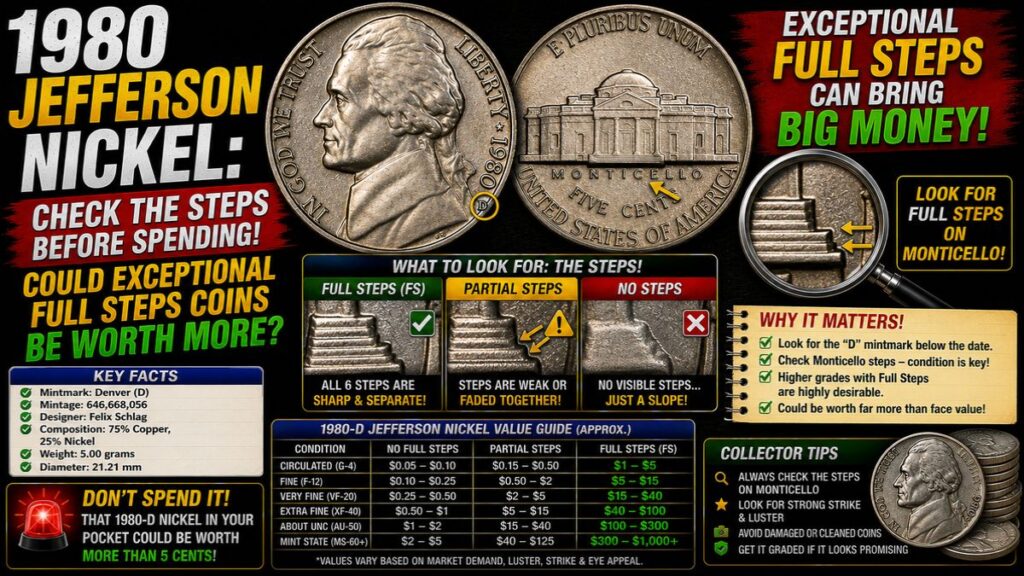
A 1980 Jefferson nickel may look like an ordinary five-cent coin, but its condition could make it more interesting to collectors. Most nickels from this year are common, and circulated examples generally have little additional value. However, coins with exceptional preservation and sharply defined Full Steps details on Monticello may attract collector premiums.
The key is knowing what to look for before assuming that an ordinary nickel is rare. The Jefferson nickel series has a familiar design featuring Thomas Jefferson on the front and Monticello, his Virginia home, on the reverse. Although millions of nickels have circulated with this design, the quality of individual coins can vary considerably.
One of the most important details to examine is the staircase beneath Monticello. On many coins, the steps appear weak, blended together, or interrupted by small marks. On a sharply struck example, the individual horizontal lines are clearly separated and easier to distinguish.
Collectors often refer to this characteristic as Full Steps. It can make a difference when evaluating an exceptionally well-preserved Jefferson nickel, particularly when the coin also has attractive surfaces, strong luster, and few distracting marks.
However, visible steps do not automatically make a 1980 nickel rare or valuable. The coin must be evaluated according to its overall condition, strike quality, recognized grading criteria, and market demand.
If you have a 1980 Jefferson nickel in your pocket, a change jar, or an old collection, checking the reverse is a simple way to learn more about it. You might discover an ordinary coin, or you might find an example that deserves closer examination.
What Makes the 1980 Jefferson Nickel Worth Examining?
The 1980 Jefferson nickel belongs to a long-running American coin series introduced in 1938. The design replaced the Buffalo nickel and has remained recognizable for generations.
The obverse features a portrait of Thomas Jefferson, while the reverse shows Monticello. The building’s architectural details provide collectors with useful clues about the sharpness of the strike and the preservation of the coin.
The year 1980 does not, by itself, make a Jefferson nickel scarce. Many examples were produced for circulation, and surviving coins can be found in a wide range of conditions.
Some have spent decades moving through cash registers, vending machines, and pockets. Others were saved in coin folders or stored away shortly after production. These different histories can lead to significant differences in surface quality.
An ordinary circulated nickel may show flattened details, scratches, and contact marks. An uncirculated example may retain its original mint luster, although it can still have marks from contact with other coins.
The most desirable examples often combine strong preservation with a sharp strike. For collectors who specialize in Jefferson nickels, the clarity of Monticello’s steps can be especially important.
That is why examining the reverse can be worthwhile. The steps provide a specific feature to inspect, but they should always be considered alongside the rest of the coin.
How to Identify a 1980 Jefferson Nickel
Before checking for Full Steps, confirm that you have the correct coin.
Look at the obverse and locate the date. It should read 1980. Thomas Jefferson’s portrait should occupy the central portion of the design, with the usual inscriptions surrounding it.
Turn the coin over and examine Monticello. The building should appear above the denomination FIVE CENTS, with UNITED STATES OF AMERICA and E PLURIBUS UNUM also present on the reverse.
Next, check the mintmark. A 1980 nickel may have a D mintmark for Denver or a P mintmark for Philadelphia. The mintmark is located on the obverse, near the area below the date and to the right of Jefferson’s portrait.
Identifying the mint is useful because collectors often organize Jefferson nickels by date and mintmark. It also helps when comparing your coin with examples that have similar characteristics.
Do not assume that the mintmark alone determines value. Both date and mintmark are only part of the identification process, and ordinary examples from this year are generally common.
Once you have confirmed the date and mintmark, inspect the coin’s condition. Look for wear, scratches, corrosion, stains, and signs of cleaning.
Finally, turn your attention to the reverse staircase. If the coin appears sharply struck and well preserved, a closer examination may be worthwhile.
What Does Full Steps Mean on a Jefferson Nickel?
Full Steps is a collector designation associated with the staircase at the base of Monticello on the reverse of a Jefferson nickel.
The steps are formed by narrow horizontal lines that represent the building’s staircase. Because these lines are small and close together, they can be difficult to reproduce clearly when a coin is struck.
On many nickels, some of the lines appear weak or merge into one another. The staircase may look like a single band instead of a series of distinct steps.
A sharply struck coin can show the individual lines more clearly. The steps appear separated, and their outlines remain visible across the relevant portion of the staircase.
This feature matters because it provides evidence of the strike’s quality. It can also help distinguish a particularly desirable example from other coins of the same date and mint.
However, Full Steps is not simply a casual description for any nickel with visible stair lines. Grading services apply specific standards when deciding whether a coin qualifies for the designation. Those standards may include requirements for the number of steps visible and the continuity of the lines.
A coin can have several visible steps without meeting the formal criteria. For that reason, collectors should be cautious about assigning the designation based only on a quick glance.
The Full Steps designation can add collector interest, but the coin’s overall condition and market demand remain important.
Why Monticello’s Steps Matter to Collectors
Monticello is the central feature of the Jefferson nickel’s reverse, and its staircase provides a useful way to judge strike sharpness.
During coin production, a blank piece of metal is placed between dies that carry the design. Under pressure, the metal flows into the recessed portions of the dies, creating the raised details of the finished coin.
Fine lines can be difficult to transfer completely. If the dies are worn or the strike does not reproduce the design sharply, the steps may appear incomplete.
This explains why two nickels from the same year and mint can look different. One may have clear, separated stair lines, while another has weak or blended details.
The difference can be particularly noticeable when comparing coins that otherwise appear similar. A nickel with strong steps, original luster, and clean surfaces may be more attractive to specialists than one with less complete details.
Collectors also inspect the steps for interruptions. A small contact mark or scratch crossing the staircase can break one or more lines, potentially affecting whether the coin meets a Full Steps standard.
Lighting is important during inspection. Reflections and shadows can make lines appear more distinct or less distinct than they really are. Viewing the coin from different angles can help reveal the actual detail.
The staircase is therefore a valuable area to inspect, but it should never be the only factor used to estimate a coin’s value.
Can a 1980 Jefferson Nickel Be Worth More Than Five Cents?
Yes, some 1980 Jefferson nickels may have collector value beyond their face value. The important question is what makes a particular example desirable.
Most circulated coins from this year are common. If a nickel has ordinary wear and no recognized collectible feature, its market value may be close to five cents.
Uncirculated examples can be more interesting, especially when they retain original luster and have relatively few marks. However, being uncirculated does not automatically make a coin valuable.
A coin with sharp Full Steps details may attract additional attention. The premium depends on how difficult the combination of date, mintmark, grade, and strike quality is to find.
The coin’s surfaces also matter. A sharply struck nickel with distracting scratches or stains may be less desirable than another coin with similarly strong details and better eye appeal.
A recognized mint error or die variety could create another reason for collectors to take interest, but any such feature must be authenticated before its significance can be established.
The best way to assess value is to identify the coin’s characteristics and compare it with similar examples that have actually sold. An asking price on a marketplace is not proof of what a buyer will pay.
Could a 1980 Full Steps Nickel Be Worth Thousands?
Exceptional coins sometimes attract high prices, but it is misleading to suggest that any 1980 nickel with visible steps could be worth thousands of dollars.
The highest prices in coin collecting tend to involve specific combinations of scarcity, condition, strike quality, and demand. A top-grade coin with a recognized designation may compete in a different market from an ordinary example.
For a 1980 Jefferson nickel, the Full Steps feature can improve desirability, but the size of any premium depends on the actual coin and the availability of comparable examples.
A common circulated nickel should not be compared with a professionally graded coin in exceptional condition. Nor should the highest reported sale for a rare or unusually preserved coin be treated as a normal price for the entire date.
Online headlines sometimes highlight a striking auction result without explaining the grade, mintmark, certification, or details that made the coin special. Such stories can create unrealistic expectations.
If you think your nickel is unusually valuable, first establish its condition and determine whether it meets recognized Full Steps criteria. Then research completed sales of comparable coins.
If the coin appears to be an exceptional candidate, professional grading may help clarify its quality. Until those details are known, a claim of a four-figure value would be premature.
Why Most 1980 Jefferson Nickels Are Common
A coin’s age is only one part of its collectibility. The number originally produced and the number that remain available in different conditions are equally important.
The 1980 Jefferson nickel was made for everyday circulation. Large numbers of ordinary examples survived, so the date is not generally considered rare simply because it is several decades old.
Many circulated nickels still show clear dates and recognizable designs. Others have been stored in drawers, jars, coin albums, and collections.
This broad availability means that collectors can often obtain ordinary examples without paying a substantial premium. The situation can be different for coins with exceptionally high grades or specific desirable characteristics.
A date can be common in circulated condition but less available in a particular grade with sharply defined details. That distinction is important when evaluating Full Steps coins.
However, a coin that looks unusually sharp is not necessarily rare. Other examples may have similar characteristics, and the market determines how much collectors are willing to pay.
Instead of assuming that every 1980 nickel is valuable, consider the actual evidence: its condition, strike, mintmark, originality, and any authenticated variety or error.
How to Check the Steps on Your 1980 Nickel
You can begin examining the staircase with a magnifier and a steady light source. The goal is to observe the coin’s existing details without altering its surface.
Place the nickel on a clean, soft surface. Hold the magnifier over the reverse and focus on the horizontal lines at the bottom of Monticello.
First, look at the staircase without magnification. Determine whether the lines appear clearly separated or whether they blend together into a single band.
Next, examine the steps more closely. Look for individual horizontal lines and check whether they remain visible across the relevant area. Pay attention to interruptions, flattened sections, and contact marks.
Move the light source slightly. Angled lighting can make the raised and recessed details easier to distinguish. If a line seems to appear only from one particular angle, check whether it might be a reflection or shadow.
Inspect the rest of Monticello as well. The columns, dome, and surrounding lettering should be considered alongside the staircase. A sharp overall strike can support the impression that the coin is a high-quality example.
Finally, turn the coin over and examine the obverse. A coin with strong reverse detail can still have marks or other characteristics that affect its overall grade.
If the steps appear complete, compare the coin with professionally graded examples and the applicable designation standards. A magnifier is useful, but it cannot guarantee that a grading service will award Full Steps.
What Can Prevent a Nickel From Qualifying for Full Steps?
Several factors can make a Jefferson nickel fail to qualify for a Full Steps designation.
The first is a weak strike. If the dies do not transfer the staircase details clearly, the steps may appear faint, blended, or incomplete.
The second is die condition. Worn or deteriorated dies may fail to reproduce fine lines as sharply as fresh dies. A coin struck from such a die can have soft details even if it never circulated.
The third is damage. A small scratch or contact mark crossing the staircase can interrupt one or more lines. On a coin being considered for a special designation, even a small interruption may matter.
The fourth is the condition of the coin after production. Circulation wear can flatten raised details and reduce the clarity of the steps.
Finally, grading standards may require a particular degree of continuity and separation. A staircase that looks reasonably sharp to a casual observer may not meet the specific requirements used by a professional service.
These factors show why Full Steps is more than a simple count of visible lines. The quality, completeness, and condition of the steps must be assessed carefully.
Full Steps Versus Overall Coin Grade
A coin’s numerical grade and its Full Steps designation describe different characteristics.
The grade evaluates the coin’s overall condition, including wear, surface marks, luster, and other aspects of preservation. For an uncirculated coin, contact marks and surface quality can influence the assigned grade.
Full Steps focuses on the clarity and completeness of the staircase on Monticello. It is a designation related to a particular design feature rather than a complete description of the coin.
A nickel can be uncirculated but have weak steps because the original strike was incomplete. It may retain mint luster and show little wear while still failing to qualify for Full Steps.
Another nickel may have sharply defined steps but also have marks or surface imperfections that lower its overall grade.
This is why experienced collectors consider both characteristics. They examine the overall condition and then assess whether the coin has the special feature they are seeking.
A high grade does not guarantee Full Steps, and Full Steps does not guarantee a top grade.
The combination of condition and strike quality is often more meaningful than either characteristic alone.
How to Recognize Original Mint Luster
Mint luster is the characteristic sheen that can appear on a coin’s surface when it leaves the mint. On an uncirculated nickel, this sheen may move across the surface as the coin is tilted under a light.
Original luster can help distinguish a well-preserved coin from one that has experienced extensive handling. However, it must be evaluated carefully because cleaning and polishing can change the surface.
A polished nickel may look unusually bright but show fine scratches or an unnatural reflective appearance. Such a coin may be less desirable than an original example with a softer sheen.
Look at the coin from several angles rather than judging it under a single light source. Observe whether the surface has a consistent appearance and whether the details remain sharp.
Luster should not be confused with color. A nickel may appear bright, gray, or slightly toned depending on its storage history and surface condition.
The presence of luster also does not prove that a coin has never been touched or marked. Uncirculated coins can have contact marks from other coins and handling during production or storage.
When evaluating a possible Full Steps example, consider luster together with the staircase detail, surface quality, and overall eye appeal.
Why Surface Marks Matter on High-Grade Nickels
Small marks can have a surprisingly large effect when collectors compare coins in high grades.
During production, nickels may come into contact with other coins or equipment. These interactions can leave tiny nicks, scratches, or abrasions. Additional marks can occur during storage and handling.
On an ordinary circulated coin, such marks may be difficult to distinguish from general wear. On a high-grade example, they can become more noticeable because the coin retains so much original detail.
The location of a mark also matters. A mark in an open area may be less distracting than one that crosses Jefferson’s face or Monticello’s staircase.
For a coin being considered for Full Steps, interruptions in the step lines deserve particular attention. A scratch crossing the staircase can affect its appearance and may prevent the coin from qualifying for the designation.
Surface marks do not automatically make a coin worthless. They are part of the condition assessment and should be considered in proportion to their size, number, and location.
The most desirable examples tend to combine clear details with attractive surfaces and minimal distracting imperfections.
Could a 1980 Nickel Have a Mint Error?
A 1980 Jefferson nickel could potentially display a minting error, but unusual appearance alone does not establish that an error occurred.
Mint errors are abnormalities created during coin production. Across American coinage, recognized error categories include off-center strikes, broadstrikes, clipped planchets, and certain multiple-strike errors.
These errors differ from die varieties, which are repeated characteristics associated with a particular die. Both can attract collectors, but they require different kinds of identification.
A coin with an irregular edge, doubled-looking lettering, or a strange mark should be examined carefully. The feature could be a genuine minting abnormality, but it could also be damage caused after the coin left the mint.
For example, a nickel may be bent, squeezed, scratched, or struck by a tool. Such damage can create unusual shapes that look dramatic without having any special minting significance.
Experts examine the shape of the coin, the flow of metal, the relationship between the design and the edge, and other evidence to determine whether a feature is consistent with a production error.
If your nickel appears unusual, avoid cleaning or manipulating it. Take clear photographs of both sides and the edge, and seek a knowledgeable opinion if the feature seems significant.
Machine Doubling and Doubled-Die Varieties
Another feature that can attract attention is apparent doubling on the date, lettering, or design.
A doubled-die variety occurs when a die receives misaligned impressions during the die-making process. The resulting doubled design is part of the die and can appear repeatedly on coins struck from it.
Machine doubling happens during the striking process and often creates a flattened, shelf-like outline beside the original design. It is not generally treated in the same way as a recognized doubled-die variety.
The two effects can look similar to inexperienced observers, particularly under poor lighting or low magnification.
If you notice doubling on a 1980 nickel, examine the shape of the secondary outline. Compare the feature with documented examples and avoid assuming that a visible second edge is proof of a rare variety.
A genuine variety must be identified through specific characteristics. A coin’s market value then depends on its recognition, grade, availability, and demand.
Do not pay a premium for an alleged variety until its identity has been supported by reliable evidence.
Mintmarks and the 1980 Jefferson Nickel
Mintmarks help identify where a coin was produced. They are useful when building a date-and-mintmark collection and when comparing examples from different facilities.
A 1980 Jefferson nickel may carry a P mintmark for Philadelphia or a D mintmark for Denver. The letter appears on the obverse in the area below the date and to the right of Jefferson’s portrait.
The mintmark is a helpful identification detail, but it does not automatically establish rarity. A common date can remain common even when examples from different mints have different characteristics.
Collectors should also avoid confusing normal mintmark conventions with errors. The absence of a letter or a slightly unusual appearance is not enough to prove that a coin is rare.
If a mintmark looks doubled, distorted, or unusually positioned, examine it closely and compare it with confirmed examples from the same date and mint.
Lighting, surface damage, and ordinary variations in appearance can make a mintmark seem unusual. A reliable attribution requires more than a visual impression.
For most 1980 nickels, the date, mintmark, and condition provide the foundation for a realistic evaluation.
How to Research the Value of a 1980 Jefferson Nickel
A realistic value estimate begins with identifying the coin’s characteristics rather than searching for the highest advertised price.
Confirm the date and mintmark, then assess whether the coin is circulated or uncirculated. Examine its luster, surface marks, and strike quality.
Next, inspect the Monticello steps. If they appear unusually sharp, compare them with examples that have received a recognized Full Steps designation. Be careful not to assume that visible lines automatically qualify.
If the coin has a possible mint error or die variety, establish whether the feature is genuine and recognized before including it in a value estimate.
Once the coin has been identified, look for completed sales involving similar examples. The best comparisons match the date, mintmark, grade, and any special designation.
A sale involving a certified high-grade Full Steps coin may not be a useful comparison for a circulated nickel. Likewise, a price advertised by a seller may not reflect what buyers are actually willing to pay.
Consider the date of the sale and the specific characteristics of the coin. Market demand can change, and exceptional auction results do not necessarily represent typical prices.
If the nickel appears unusually valuable, an independent assessment may help confirm whether the coin deserves further attention.
When Professional Grading May Be Worth the Cost
Professional grading can provide a standardized assessment of a coin’s condition and, where applicable, identify special designations.
However, grading is not necessary for every 1980 Jefferson nickel. If the coin is heavily circulated and has no unusual features, the cost may exceed its likely collector value.
Grading becomes more relevant when the coin appears to have exceptional preservation, sharp Full Steps detail, or a potentially significant variety or mint error.
Before submitting it, consider all associated costs, including grading, shipping, and insurance. There is also a possibility that the coin will receive a lower grade than expected or fail to qualify for the special designation you hoped for.
A professional service can help establish condition, but it does not guarantee a particular market price. Actual value still depends on comparable sales and collector demand.
If the coin has a possible mint error, authentication may be especially useful because it can help distinguish a genuine production abnormality from post-mint damage.
For an initial opinion, an experienced coin dealer familiar with Jefferson nickels may be able to explain whether the coin merits further evaluation.
Why You Should Never Clean a Potentially Valuable Nickel
Cleaning can permanently change a coin’s surface and reduce its appeal to collectors.
Polishing may create fine scratches that become visible under magnification. Abrasive materials can remove or alter the original texture, while chemical treatments may change the coin’s appearance.
A coin that looks brighter after cleaning is not necessarily in better condition. Collectors often prefer original surfaces, especially when evaluating high-grade examples.
Cleaning is particularly risky if you suspect the nickel has Full Steps detail. Rubbing the staircase can create scratches that interrupt the lines and make the coin more difficult to evaluate.
If the coin has dirt or discoloration, do not try to remove it with household products. Leave the coin as it is until you have determined whether professional advice is appropriate.
Handle it by the edges and avoid touching the main surfaces. Fingerprints and skin oils can leave marks that become more noticeable over time.
Preserving the original condition is generally the best approach when investigating a potentially collectible nickel.
How to Store Your 1980 Jefferson Nickel
Good storage can help protect the coin’s existing condition.
Avoid carrying a potentially valuable nickel loose in a pocket or keeping it in a container where it can rub against other coins. Contact can cause scratches and small dents.
Use a coin holder made from materials intended for coin storage. The holder should fit appropriately without forcing the coin into place or putting pressure on its edges.
Keep the coin in a dry environment with relatively stable conditions. Moisture and unsuitable storage materials can contribute to staining or other surface changes.
Handle the nickel by its edges whenever possible. If you need to inspect it, place it on a soft surface and avoid sliding it across a table.
If you suspect a mint error or believe the coin may qualify for Full Steps, preserve it in its current state until it has been evaluated.
Storage will not make a common coin rare, but it can help prevent avoidable damage and preserve the characteristics that make an example desirable.
Common Myths About the 1980 Jefferson Nickel
One common misconception is that every old nickel is valuable. Although a 1980 coin is several decades old, many examples remain available, and age alone does not establish rarity.
Another myth is that every nickel with visible steps qualifies for Full Steps. The designation depends on specific standards for the clarity and completeness of the staircase, not merely on whether a few lines can be seen.
Some collectors assume that uncirculated coins must be flawless. In reality, uncirculated nickels can have contact marks, scratches, or weakly struck details.
Another mistake is confusing a weak strike with circulation wear. A coin may never have circulated yet still have incomplete steps because of the way it was struck.
Finally, an unusual mark is not necessarily a mint error. Damage caused after production can create shapes and lines that look like manufacturing abnormalities.
The best defense against these misconceptions is careful examination and comparison with reliable examples. Identify the coin’s actual characteristics before assigning a rarity label or estimating an unusually high price.
Is the 1980 Jefferson Nickel Worth Keeping?
A 1980 Jefferson nickel can be worth keeping for several reasons, even if it does not have a significant financial premium.
Collectors who build date-and-mintmark sets may need examples from both Philadelphia and Denver. Others enjoy studying the design, comparing grades, or learning to recognize a sharp strike.
A common circulated coin can be a useful reference for understanding how wear affects Jefferson’s portrait and Monticello’s steps. An uncirculated coin can provide a better opportunity to study original luster and surface quality.
If your nickel appears ordinary, there is no reason to assume that you have missed a hidden fortune. If it has unusually sharp details and clean surfaces, a closer examination may be worthwhile.
You can organize common examples in a coin folder and keep any potentially exceptional coins in separate holders.
The decision to keep a coin should be based on your collecting goals as well as its potential market value. A coin does not have to be worth hundreds of dollars to be interesting.
A Practical Checklist Before Spending Your 1980 Nickel
Before using your 1980 nickel in a transaction, take a moment to inspect it.
Confirm that the date is 1980 and identify the mintmark. Check both sides for unusual features, scratches, corrosion, and signs of cleaning.
Turn the coin over and examine the staircase beneath Monticello. Look for clear, separated horizontal lines, and use magnification if necessary.
Inspect the rest of the reverse and the obverse. Strong steps are more meaningful when the coin also has attractive surfaces and little wear.
If the coin appears exceptionally sharp, compare it with professionally graded Full Steps examples. Remember that visual inspection alone cannot guarantee a special designation.
If you notice doubling, an unusual mintmark, or an irregular strike, investigate the feature before assuming it is a valuable error. Compare it with documented examples or seek expert advice.
Finally, research completed sales for coins with comparable characteristics. Do not rely on a headline or an inflated asking price to determine value.
This simple process can help you decide whether the nickel is an ordinary five-cent coin or one that deserves more careful evaluation.
Frequently Asked Questions About the 1980 Jefferson Nickel
Is the 1980 Jefferson nickel rare?
Most 1980 Jefferson nickels are common. Examples with exceptional preservation, recognized Full Steps details, or genuine mint errors may be more desirable.
What does Full Steps mean?
Full Steps refers to sharply defined and clearly separated staircase details beneath Monticello on the reverse. Qualification depends on the standards used by the grading service.
Can a 1980 nickel be worth thousands of dollars?
Exceptional coins can sometimes command high prices, but ordinary 1980 nickels are not generally worth thousands. Any substantial valuation requires evidence of exceptional quality, rarity, or a recognized collectible feature.
Where should I look for the steps?
Look at the bottom of Monticello on the reverse, beneath the building’s columns. The horizontal staircase lines should be clearly separated for a coin to be considered a strong Full Steps candidate.
Does every uncirculated 1980 nickel qualify for Full Steps?
No. An uncirculated coin can have weak or incomplete staircase details because of strike quality or die condition.
Does Full Steps guarantee a premium?
No. Full Steps can increase collector interest, but the premium depends on the coin’s grade, availability, surface quality, and demand.
What mintmarks can appear on a 1980 Jefferson nickel?
A 1980 nickel may carry a P mintmark for Philadelphia or a D mintmark for Denver. The mintmark helps identify the production facility but does not automatically make the coin rare.
Should I clean my 1980 nickel before checking it?
No. Cleaning or polishing can damage the surface and reduce collector appeal. Inspect the coin as it is.
How can I tell if my nickel has a mint error?
Look for features that appear consistent with a production abnormality rather than damage acquired after minting. If the feature may be significant, seek an informed opinion.
Should I pay for professional grading?
Grading may be worthwhile if the coin appears exceptionally preserved or has potentially significant Full Steps detail or a genuine mint error. For ordinary circulated examples, the cost may outweigh the benefit.
What is the best way to store a potentially valuable nickel?
Keep it in a suitable coin holder, handle it by the edges, and store it in a dry environment. Avoid rubbing or polishing the coin.
What should I check first before spending my 1980 nickel?
Confirm the date and mintmark, examine both sides, and inspect Monticello’s steps. If the coin appears unusually sharp or has a possible error, research it before spending it.
Final Thoughts on the 1980 Jefferson Nickel
The 1980 Jefferson nickel is a useful reminder that small details can matter in coin collecting. Most examples are common, but exceptional condition and sharply defined Monticello steps can make certain coins more appealing to specialists.
Full Steps is worth understanding because it highlights a specific aspect of strike quality. However, a few visible lines do not automatically qualify a coin for the designation, and even a genuine Full Steps nickel is not guaranteed to command an extraordinary price.
If you find a 1980 nickel, begin by checking its date and mintmark. Examine the staircase under good lighting, then evaluate the coin’s overall condition, luster, and surface marks.
Avoid cleaning the coin, and do not assume that an unusual mark proves a mint error. If the nickel appears exceptional, compare it with reliable examples and consider professional evaluation.
Most importantly, use realistic market evidence. Completed sales of comparable coins provide a better guide than sensational headlines or unverified asking prices.
Before spending your 1980 Jefferson nickel, take a moment to check the steps. The coin may be ordinary, but a careful inspection is the best way to determine whether it deserves a closer look.