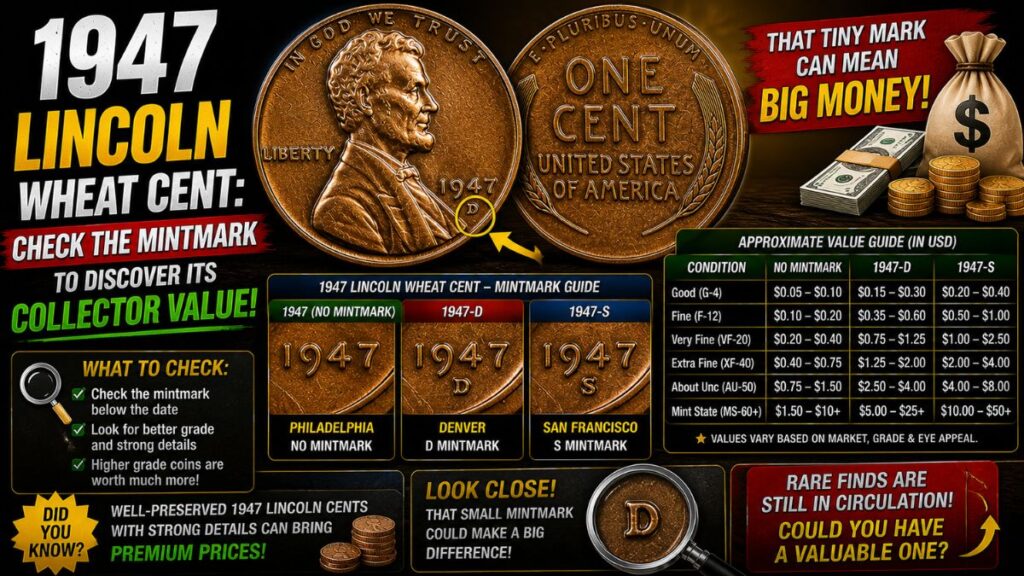
The 1947 Lincoln Wheat Cent is a classic American penny that may look ordinary at first glance, but its date, mintmark, condition, and possible die varieties can make it worth a closer inspection. Millions of cents were produced during this period, so most examples are common. However, well-preserved coins and genuine, identifiable doubled-die varieties can attract additional interest from collectors.
Before spending a 1947 wheat penny or placing it in a jar with other old coins, take a moment to examine it. The small mintmark, the sharpness of Lincoln’s portrait, the condition of the wheat stalks, and the coin’s original surface can all help you understand what you have.
The important thing is to separate genuine collector features from ordinary wear and damage. A penny does not become rare simply because it is old, and a doubled-looking date does not automatically indicate a valuable variety. Accurate identification and realistic comparisons are essential.
Whether you found a 1947 Lincoln Wheat Cent in pocket change, inherited a coin collection, or are searching through rolls of old pennies, this guide explains how to inspect the mintmark, assess condition, recognize possible varieties, and estimate the coin’s potential value without relying on exaggerated claims.
What Makes the 1947 Lincoln Wheat Cent Interesting?
The Lincoln Wheat Cent belongs to one of the best-known series in American coin collecting. Introduced in 1909, it features Abraham Lincoln on the obverse, or front, and two wheat stalks on the reverse, or back.
The wheat design remained in use through 1958, making the 1947 issue part of the final dozen years of the classic Wheat Cent series.
By 1947, the United States had moved beyond the exceptional coinage circumstances associated with World War II. The cent had returned to its traditional bronze composition after the temporary use of zinc-coated steel cents in 1943. The 1947 penny is therefore a copper-based coin rather than one of the familiar silver-colored 1943 steel cents.
The 1947 issue is interesting because collectors can study differences among coins produced at different mints, compare their condition, and search for recognized die varieties. It is also an accessible date for people beginning a Lincoln Wheat Cent collection.
However, accessibility does not mean that every example is valuable. Ordinary circulated 1947 cents are generally common. Their value may be modest unless they possess a desirable characteristic, exceptional preservation, or a recognized variety.
For collectors, the appeal lies in learning how to distinguish a typical coin from an example that deserves closer attention.
Where to Find the Mintmark on a 1947 Wheat Penny
The mintmark is one of the first details to inspect on a 1947 Lincoln Wheat Cent.
Turn the coin to the obverse, the side showing Lincoln’s portrait. Look below the date, near the area just beneath the year. If the coin was struck at Denver or San Francisco, you should find a small letter identifying the mint.
The common mintmark possibilities for 1947 are:
- No mintmark: Philadelphia.
- D: Denver.
- S: San Francisco.
Philadelphia cents from this period generally carried no mintmark. Therefore, a 1947 penny without a letter in the expected location is not automatically missing a feature or damaged.
A small D identifies a Denver-minted coin, while an S identifies one from San Francisco. These letters are part of the coin’s identification, but neither letter automatically makes a coin rare.
Use bright, even lighting and a magnifying glass if the mintmark is difficult to read. On a circulated penny, dirt, scratches, or wear may make the letter less distinct.
Do not confuse a tiny surface mark with a genuine mintmark. Examine its shape and position, and compare it with clear photographs of correctly identified 1947 cents.
The mintmark is an important starting point because it helps you identify the exact issue before researching its production history and market value.
Understanding the Three Mintmark Possibilities
The three mintmark possibilities help distinguish the main 1947 Lincoln Wheat Cent issues.
A Philadelphia cent has no mintmark. A Denver cent carries a D, and a San Francisco cent carries an S.
All three are legitimate 1947 issues, but collectors may evaluate them differently depending on their collecting goals, condition, and market availability.
A collector assembling a date-and-mintmark set may want one example from each production facility. Someone focusing on high-grade coins may be more concerned with sharp detail, original surfaces, and the availability of well-preserved examples.
The mintmark should never be evaluated in isolation. A coin with an S is not automatically worth more than a Philadelphia cent, and a D does not guarantee a premium.
The condition of each coin also matters. A worn example with a clear mintmark may have less collector appeal than a sharply detailed coin from the same year.
When researching prices, compare coins with the same date and mintmark whenever possible. Then consider the grade, surface quality, and any recognized variety.
This approach produces a more accurate comparison than relying on a general statement that one mintmark is always more valuable than another.
How Many 1947 Lincoln Wheat Cents Were Produced?
The 1947 Lincoln Wheat Cent was produced in large quantities across the participating mint facilities.
Approximate production figures commonly reported for the three issues are:
| Issue | Approximate mintage |
|---|---|
| 1947 Philadelphia, no mintmark | 190,555,000 |
| 1947-D Denver | 194,750,000 |
| 1947-S San Francisco | 99,000,000 |
These figures help explain why ordinary 1947 cents are generally not considered rare dates. Each issue was produced in substantial numbers, although the San Francisco issue had a lower mintage than the Philadelphia and Denver coins.
Mintage is only one part of a coin’s story. It tells you how many were originally produced, not how many survive today in a particular grade.
Some coins were heavily circulated and became worn. Others were lost, damaged, or discarded. Some were saved in collections and may still survive in attractive condition.
As a result, the availability of coins in exceptional grades can differ from the availability of ordinary circulated examples.
A large mintage does not mean that every coin is uninteresting. A well-preserved specimen or a recognized variety may still attract collector attention.
The best use of mintage figures is to understand the general supply of an issue rather than to calculate an individual coin’s value directly.
What Is the 1947 Lincoln Wheat Cent Made Of?
The 1947 Lincoln Wheat Cent is a bronze cent composed primarily of copper, with small amounts of tin and zinc.
The standard composition for this period is approximately 95% copper and 5% tin and zinc combined. The coin typically weighs about 3.11 grams and has a diameter of approximately 19.05 millimeters.
This composition gives the 1947 penny its familiar copper-based appearance, although its color may vary considerably depending on age, storage, handling, and environmental exposure.
A newly struck cent generally has a reddish appearance. Over time, exposure to air and handling can change the surface color, producing red-brown or brown toning.
These changes are normal and do not automatically indicate that a coin is damaged or rare.
The composition also distinguishes the 1947 issue from the 1943 Lincoln cent, which was generally made from zinc-coated steel because copper was needed for wartime production. A 1947 penny is not supposed to be a steel cent.
If a 1947 coin appears silver-colored, do not immediately assume it is an extraordinary error. The appearance may result from plating, chemical exposure, environmental damage, or another alteration after minting.
A genuine wrong-planchet error would require careful examination and authentication. Color alone is not enough to establish such a claim.
Why the Color of a 1947 Penny Matters
Collectors often describe copper cents according to their remaining original red color.
Three broad color descriptions are commonly used for uncirculated copper coins:
- Red (RD): The coin retains nearly all or most of its original red mint color, according to the grading standard being applied.
- Red-Brown (RB): The coin shows a mixture of original red color and brown toning.
- Brown (BN): The surface is predominantly brown.
These descriptions are particularly relevant to uncirculated copper cents. They should not be treated as a simple price ranking that works independently of grade and surface quality.
A coin with attractive red color may be desirable, but it still needs to be evaluated for marks, strike quality, and overall preservation.
Likewise, a brown 1947 cent is not automatically damaged. Natural toning is a normal part of copper’s interaction with its environment.
Artificially changing a coin’s color can reduce collector appeal. Cleaning, chemical treatment, or polishing may leave surface damage that is difficult to reverse.
When examining a 1947 penny, focus on whether the surface appears natural and whether the coin’s condition supports the color designation.
Color is one part of the assessment, not a substitute for evaluating the entire coin.
How to Assess the Condition of a 1947 Lincoln Wheat Cent
Condition is one of the strongest influences on a coin’s collector value.
A circulated 1947 penny may have flattened high points on Lincoln’s portrait, worn lettering, scratches, and reduced detail on the wheat stalks. Such a coin can still be suitable for a basic date collection, but its value is generally limited.
An uncirculated example has not experienced ordinary circulation wear. It may retain original mint luster and sharper design details, although contact marks and other imperfections can still be present.
To inspect the condition, examine both sides of the coin.
On the obverse, look at Lincoln’s cheek, jaw, hair, and the lettering. These areas can reveal wear, scratches, and marks from contact with other coins.
On the reverse, inspect the wheat stalks, the lines within the stalks, and the lettering. Look for clear detail and signs of flattening.
Also examine the open fields around the design. Large scratches, dents, discoloration, or evidence of cleaning can affect the coin’s desirability.
Do not rely on brightness alone. A polished penny may appear shiny but have an altered surface, while a naturally toned coin may still be attractive to collectors.
If the coin appears unusually well preserved, compare it with examples of known grades. This can help you determine whether professional grading might be worth considering.
What Is the Difference Between Circulated and Uncirculated?
A circulated coin has been used in everyday transactions. Contact with other coins and surfaces gradually wears down raised design elements.
On a circulated 1947 Lincoln Wheat Cent, Lincoln’s portrait may appear smooth in places, the wheat stalks may lose definition, and the original mint luster may be largely absent.
An uncirculated coin has not experienced ordinary circulation wear. Its raised details may remain sharp, and portions of the original mint luster may still be visible.
However, uncirculated does not mean perfect. Coins can acquire marks during production, counting, transportation, or storage. Some may also have weakly struck details even though they never circulated.
This distinction is important when evaluating a potential collector premium. A coin that looks attractive at first glance may still have small marks that affect its grade.
A useful inspection includes the high points, the fields, the lettering, and the overall surface.
If you are unsure whether a penny is circulated, compare its details and luster with clearly graded examples. Avoid making a grading decision from color alone.
For most 1947 cents, the difference between a common circulated coin and an exceptionally preserved specimen can matter more than the date itself.
Can a 1947 Wheat Penny Be Worth More Than Face Value?
Yes, some 1947 Lincoln Wheat Cents can be worth more than one cent, but the reason matters.
Ordinary circulated examples are common and usually have modest value. Their age and wheat reverse make them collectible, but those characteristics alone do not guarantee a substantial premium.
Coins in better condition may attract more interest, particularly when they retain strong detail and attractive original surfaces. High-grade red examples can be more desirable than worn brown coins.
A genuine, recognized doubled-die variety or another documented minting error may also have a premium. However, such coins need to be identified accurately rather than judged by a vague visual resemblance.
The market value depends on several factors:
- Date and mintmark.
- Grade and surface preservation.
- Color designation for uncirculated copper coins.
- Whether a genuine, recognized variety is present.
- Current collector demand and comparable sales.
A coin’s value cannot be determined reliably from its date alone. Two 1947 cents may have very different market values if one is worn and the other is exceptionally preserved.
When researching a potential premium, look for completed sales of closely comparable coins. Asking prices can be much higher than the amounts buyers actually pay.
What Is a Doubled-Die Variety?
A doubled-die variety is created during the preparation of a coin die, when the design receives misaligned impressions. The resulting die can transfer doubled design details to coins struck from it.
The doubling may appear in lettering, numbers, or other parts of the design. Its appearance depends on the particular die and the type of doubling involved.
A genuine doubled-die variety is different from ordinary damage or machine doubling. It is a repeatable feature associated with the die rather than a random scratch or impact on an individual coin.
This distinction is essential because many coins have marks that look unusual under magnification but do not represent recognized varieties.
On a 1947 Lincoln Wheat Cent, apparent doubling should be examined carefully before any claim of rarity or value is made. Look at the date, inscriptions, and other design details under good lighting.
Compare the feature with documented examples of the specific variety you suspect. A general resemblance is not enough; the location and shape of the doubling need to match.
If the coin appears to show significant doubling, seek an informed opinion before spending money on grading or selling it.
A confirmed variety can be interesting, but the market premium depends on the exact attribution, grade, and collector demand.
How to Distinguish Genuine Doubled Dies From Machine Doubling
Machine doubling is a common source of confusion for people searching for valuable pennies.
A genuine doubled die originates during die production. The design on the die contains a doubled impression, so the feature can appear consistently on coins struck by that die.
Machine doubling, by contrast, occurs during the striking process. It often creates a flattened or shelf-like secondary image rather than the distinct, separated design features associated with a genuine doubled die.
Under magnification, machine doubling may make letters or numbers appear to have an extra edge. However, that appearance does not automatically indicate a collectible variety.
Lighting can also create misleading effects. Shadows, reflections, worn surfaces, and small scratches can make ordinary details appear doubled.
To investigate a suspected doubled die, inspect the feature from different angles and compare it with reliable images of the exact variety. Pay attention to the shape and position of the secondary image.
Do not assume that every doubled-looking date is valuable. Accurate attribution requires a specific, recognizable characteristic.
If you cannot confidently distinguish the feature, an experienced coin dealer or variety specialist may be able to help.
Are There Valuable 1947 Lincoln Wheat Cent Errors?
A genuine minting error can make a 1947 cent more interesting to collectors, but not every unusual mark is an error.
Errors can occur when something goes wrong during the production process. Depending on the circumstances, a coin may be struck off-center, show certain die-related abnormalities, or exhibit another recognizable manufacturing defect.
The value of an error coin depends on the type of error, its visibility, its condition, and collector demand.
A dramatic, clearly identifiable error may be more desirable than a minor and common production imperfection. However, even genuine errors do not all command high prices.
Post-mint damage is an important alternative explanation. A penny may be scratched, squeezed, bent, plated, or exposed to chemicals after leaving the mint. Such changes can create unusual appearances without making the coin a valuable mint error.
If you find a 1947 cent that looks different, examine the affected area carefully and compare it with normal examples. Look for a plausible production explanation rather than assuming the coin is rare.
For an unusual specimen that may have substantial value, consider professional authentication.
The most important principle is that an error must be identified and supported by evidence before its market significance can be assessed.
What Does an Off-Center Strike Look Like?
An off-center strike occurs when a coin blank is not properly positioned between the dies during striking.
The resulting coin may show part of the design missing, with the remaining design shifted toward one side. Depending on the degree of misalignment, some of the original blank may remain visible.
This type of error differs from a coin that has simply been cut, bent, or damaged after production.
When evaluating a possible off-center 1947 cent, examine the shape of the coin, the rim, and the remaining design. The pattern should be consistent with a striking error.
A damaged penny may also have an irregular edge, but the surrounding metal and design often show signs of cutting, grinding, impact, or another post-mint process.
Not all off-center strikes have the same value. The amount of displacement, the presence of the date, the condition, and collector demand can all influence desirability.
A coin with a clear, dramatic error may attract more interest than one with only a minor irregularity.
If the feature appears genuine, document it with clear photographs and seek an informed assessment before assigning a price.
Why a Silver-Colored 1947 Penny Is Not Automatically Rare
A 1947 Lincoln Wheat Cent is supposed to be copper-based. If one looks silver, gray, or unusually pale, the color deserves investigation rather than an immediate assumption of rarity.
Several factors can change the appearance of copper. Chemical exposure, environmental conditions, plating, and other post-mint alterations can affect its surface color.
A coin can also appear different under certain lighting conditions. A photograph may exaggerate the effect, making a normal surface look unusually metallic.
The 1947 date does not belong to the regular 1943 steel-cent issue. Therefore, a silver-colored 1947 cent should not be described as a rare steel penny simply because it resembles one visually.
A genuine wrong-planchet error would require evidence that the coin was struck on a planchet intended for another denomination or composition. Establishing such an error can require careful measurements and professional examination.
Do not scratch the coin or use chemicals to test the metal. Those actions can damage the surface and complicate authentication.
If the coin seems genuinely unusual, record its weight and dimensions using suitable equipment, compare it with a normal 1947 cent, and seek expert advice.
Color alone is not proof of a valuable error.
How Much Is a 1947 Lincoln Wheat Cent Worth?
There is no single value that applies to every 1947 Lincoln Wheat Cent.
Ordinary circulated examples are common and generally have modest collector value. Their price may be only slightly above face value, depending on the selling situation and the coin’s condition.
Uncirculated examples can be more desirable, particularly when they have sharp detail, attractive surfaces, and strong original red color.
Coins with recognized varieties or genuine minting errors may attract additional premiums, but the amount depends on the specific feature and the market for that coin.
The following table provides a general guide to collector interest rather than a fixed price list.
| Coin characteristic | General collector significance |
|---|---|
| Ordinary circulated 1947 cent | Usually common, with modest value |
| Heavily worn or damaged example | Often limited collector appeal |
| Uncirculated example | May attract a premium depending on grade |
| Uncirculated red example | Potentially desirable if the color is original and the surfaces are attractive |
| Genuine, recognized doubled-die variety | May attract additional interest depending on attribution and condition |
| Confirmed minting error | Value depends on the specific error and its desirability |
| Coin with an unusual color but no verified error | Requires investigation; color alone does not establish a premium |
These categories are broad. They should not be used as substitutes for an actual valuation.
To estimate your coin’s value, identify the mintmark, assess its condition, and compare it with recent completed sales of the same issue. If it has a suspected variety or error, make sure the comparison involves the same recognized feature.
A common mistake is to compare an ordinary circulated penny with an exceptionally graded auction coin. The resulting estimate can be misleading.
The most reliable valuation is based on the specific coin rather than a headline about the most expensive penny from a particular year.
Does the 1947-S Penny Have More Value Than the 1947-D?
Not automatically.
The S mintmark identifies a San Francisco coin, while D identifies a Denver coin. Philadelphia cents from this period generally have no mintmark.
The three issues had different mintages, but a difference in production numbers does not by itself establish a large price difference for ordinary circulated examples.
A coin’s grade, surface quality, and specific characteristics can be more important than its mintmark alone.
For example, an exceptionally preserved 1947-S may attract strong interest from collectors seeking a high-grade example. A Denver cent with similar preservation may also be desirable, depending on the market and the exact grade.
The appropriate way to compare the issues is to look at recent sales for the same date, mintmark, and condition.
Avoid assuming that the lowest-mintage issue must always be the most valuable. Survival rates, collector demand, and the number of coins available in particular grades also matter.
The mintmark is a useful identification feature, but it is only one piece of the valuation process.
How to Examine the Wheat Stalks on the Reverse
The reverse of the 1947 Lincoln Wheat Cent features two wheat stalks surrounding the central inscriptions.
These stalks provide useful clues about the coin’s condition. On a well-preserved example, the lines within the stalks and the smaller design details should remain relatively clear.
On a heavily circulated coin, the raised details may become flattened, making the stalks look smoother or less distinct.
Examine both sides of the reverse rather than focusing only on one stalk. Look at the lettering between them and the surrounding fields for scratches, dents, and discoloration.
The condition of the reverse contributes to the overall grade, but it does not establish the coin’s value on its own. The obverse, mintmark, surface quality, and any special variety must also be considered.
A coin may show sharp wheat details while having significant marks on Lincoln’s portrait. Conversely, a penny with moderate wear may still be attractive for a basic date collection.
Use a magnifying glass to inspect the details, but avoid treating every tiny line or irregularity as evidence of a rare variety.
The purpose of the inspection is to understand preservation and identify anything that warrants further research.
Why Original Surfaces Matter
The surface of a copper cent can reveal a great deal about its history and condition.
A coin that retains natural mint luster and has not been cleaned may be more desirable than one that has been polished to look brighter. Cleaning can leave fine scratches and alter the surface in ways that reduce collector appeal.
Copper is particularly sensitive to environmental changes. Exposure to air, moisture, chemicals, and other materials can affect its color and surface condition.
Brown toning is not automatically a defect. It can be a natural result of aging and storage. Likewise, red color does not guarantee that a coin is valuable.
Collectors evaluate color alongside grade, surface preservation, strike quality, and other characteristics.
When inspecting a 1947 Wheat Cent, look for unusual brightness, fine hairline scratches, uneven surface texture, or signs of chemical treatment. These may indicate that the coin’s appearance has been altered.
Do not attempt to improve a penny’s color by rubbing or polishing it. If it has collector potential, preserving the existing surface is usually the safer choice.
A coin’s original condition is part of what makes it collectible. Altering that condition can make accurate evaluation more difficult.
How to Store a 1947 Wheat Cent Safely
If you find a 1947 cent that looks promising, proper storage can help prevent additional damage.
Use a holder designed for coin storage and made from materials suitable for long-term preservation. Avoid containers that trap moisture or may react with copper.
Store the coin in a cool, dry environment with relatively stable conditions. Excessive humidity can contribute to surface problems, particularly if the coin is already exposed to contaminants.
Handle it by the edges whenever possible. Repeatedly touching the main surfaces can leave oils and residue.
Do not keep the coin loose with other pennies where it can rub against them. Contact can create scratches and small marks.
If you are examining several coins, organize them by date and mintmark. This makes it easier to compare the different 1947 issues and avoid mixing them up.
For a coin that appears to have a recognized variety or unusual error, take clear photographs of both sides and the relevant detail. These images can help when seeking advice or researching comparable examples.
Storage will not make a common penny rare, but it can help preserve the features that determine its condition and desirability.
Should You Have a 1947 Wheat Penny Professionally Graded?
Professional grading may be useful if a coin appears to be in exceptional condition or has a possible variety or error that could justify a premium.
A grading service examines the coin’s preservation, wear, surface characteristics, and other relevant features. Depending on the service and coin, certification may also help document a recognized variety or error attribution.
However, grading costs money. Submission fees, shipping, insurance, and related expenses can exceed the value of an ordinary circulated 1947 cent.
Before submitting a coin, estimate its potential value and compare it with recent sales of similar certified examples.
If your penny has noticeable wear, scratches, corrosion, or other damage, professional grading may not be financially worthwhile.
If it appears exceptionally sharp, retains attractive original color, or has a possible recognized variety, further evaluation may make sense.
You can begin by asking an experienced coin dealer or numismatist for an opinion. Clear photographs of both sides, along with the date and mintmark, may help with an initial assessment.
Professional grading should be a practical decision based on the coin’s characteristics and likely market value, not a way to turn an ordinary penny into a rare collectible.
How to Research the Value of Your 1947 Penny
Once you have identified the date and mintmark, the next step is to research the specific coin.
Begin by determining whether it is a Philadelphia, Denver, or San Francisco issue. Then assess its condition and color.
If you suspect a doubled-die variety or minting error, identify the exact feature rather than relying on a general description such as “double date” or “rare penny.”
Compare your coin with recognized examples and recent completed sales. The closest comparisons are those that match the date, mintmark, grade, color designation, and variety.
Completed sales are generally more informative than active listings because they show that a transaction took place. Even then, one sale should not be treated as a guaranteed value for another coin.
Pay attention to whether a reported price refers to a certified specimen or an uncertified one. A professionally graded coin with a documented designation may not be directly comparable to an ungraded penny.
If you cannot find reliable comparisons, treat the value as uncertain rather than using an unrelated high price.
For a possible error coin, authentication may be particularly important. A feature that looks convincing in a photograph may turn out to be damage or machine doubling when examined closely.
Careful research is more useful than guessing based on the year alone.
Common Mistakes to Avoid When Collecting 1947 Wheat Cents
One common mistake is assuming that every wheat penny is rare. The Wheat Cent design is historic and popular, but many dates were produced in large quantities.
Another mistake is treating the mintmark as a guarantee of value. The D and S letters identify the mint, but neither automatically makes a 1947 cent valuable.
Some people also confuse machine doubling with a genuine doubled-die variety. This can lead to unrealistic expectations when a coin’s design appears doubled under magnification.
A silver-colored or unusually dark penny can also attract attention, but color changes may result from environmental exposure, plating, or chemical alteration. An unusual appearance is not enough to establish a minting error.
Cleaning is another avoidable mistake. Polishing can leave scratches and alter the original surface, potentially reducing the coin’s appeal.
Finally, be careful when interpreting auction prices. A high price paid for a certified, exceptional specimen does not establish the value of an ordinary circulated penny.
The best approach is to identify the coin correctly, inspect it carefully, and rely on comparable evidence before making a valuation.
Frequently Asked Questions About the 1947 Lincoln Wheat Cent
Where is the mintmark on a 1947 Lincoln Wheat Cent?
The mintmark appears on the obverse, below the date area. A D indicates Denver, an S indicates San Francisco, and Philadelphia cents from this period generally have no mintmark.
Is a 1947 wheat penny rare?
Most 1947 Lincoln Wheat Cents are common because they were produced in large quantities. Exceptional condition, a recognized variety, or a genuine minting error can make an individual coin more desirable.
Is a 1947-S penny worth more than a 1947-D?
Not automatically. The mintmark and production figures are useful for identification, but condition, surface quality, collector demand, and the specific issue determine value.
What is a 1947 Lincoln Wheat Cent made of?
It is a bronze cent made primarily of copper, with small amounts of tin and zinc. Its standard weight is approximately 3.11 grams.
Can a 1947 wheat penny be worth hundreds of dollars?
An ordinary circulated example should not be assumed to have a high value. Exceptional certified coins or recognized varieties may command premiums, but any large valuation should be supported by comparable sales for the specific coin.
How can I identify a doubled-die 1947 penny?
Examine the date and lettering under magnification, then compare the apparent doubling with documented examples of the exact variety. Machine doubling and post-mint damage can resemble a doubled die, so visual suspicion alone is not enough.
Is every doubled-looking date a valuable error?
No. Some apparent doubling results from the striking process, damage, wear, or lighting. A genuine variety needs to be identified accurately before its collector significance can be assessed.
Why does my 1947 penny look silver?
The surface may have been altered by plating, chemical exposure, environmental conditions, or other factors. A silver-colored appearance does not prove that the coin is a rare steel cent or a genuine wrong-planchet error.
Does a red 1947 wheat penny have more value?
Original red color can contribute to the desirability of an uncirculated copper cent, but color alone does not determine value. Grade, surface quality, strike, and collector demand also matter.
Should I clean my 1947 Lincoln Wheat Cent?
No. Cleaning or polishing can leave scratches and alter the surface. Preserve the coin in its existing condition, especially if it may have collector value.
Is professional grading worth it for a 1947 penny?
It may be worthwhile if the coin is exceptionally well preserved or appears to have a recognized variety or genuine error. For ordinary circulated examples, grading costs often exceed the likely premium.
What is the best way to estimate my 1947 penny’s value?
Identify the mintmark, evaluate the condition and color, and compare the coin with recent completed sales of similar examples. If you suspect a variety or error, obtain an informed opinion before relying on a price estimate.
Final Thoughts: Check the Mintmark Before You Spend Your 1947 Wheat Penny
The 1947 Lincoln Wheat Cent is a classic copper penny that deserves a closer look, especially if you enjoy searching through old coins. Its mintmark helps identify where it was produced, while its condition, color, and possible varieties help determine its collector appeal.
Most examples remain common, so the date alone does not make a coin valuable. The best candidates for a premium are those with exceptional preservation, attractive original surfaces, a recognized doubled-die variety, or a genuine minting error that can be verified.
Start with the small area below the date. Look for a D, an S, or no mintmark, then examine both sides under good lighting. Pay attention to Lincoln’s portrait, the wheat stalks, and any unusual marks that may deserve further investigation.
Avoid cleaning the coin, and do not rely on sensational claims or asking prices to estimate its worth. Instead, compare your penny with similar examples and consider professional advice if it appears exceptional.
A careful inspection may reveal a desirable addition to your collection, or it may simply help you understand a familiar piece of American coinage. Either way, checking the mintmark is the right first step before deciding whether to keep, research, or spend your 1947 Lincoln Wheat Cent.