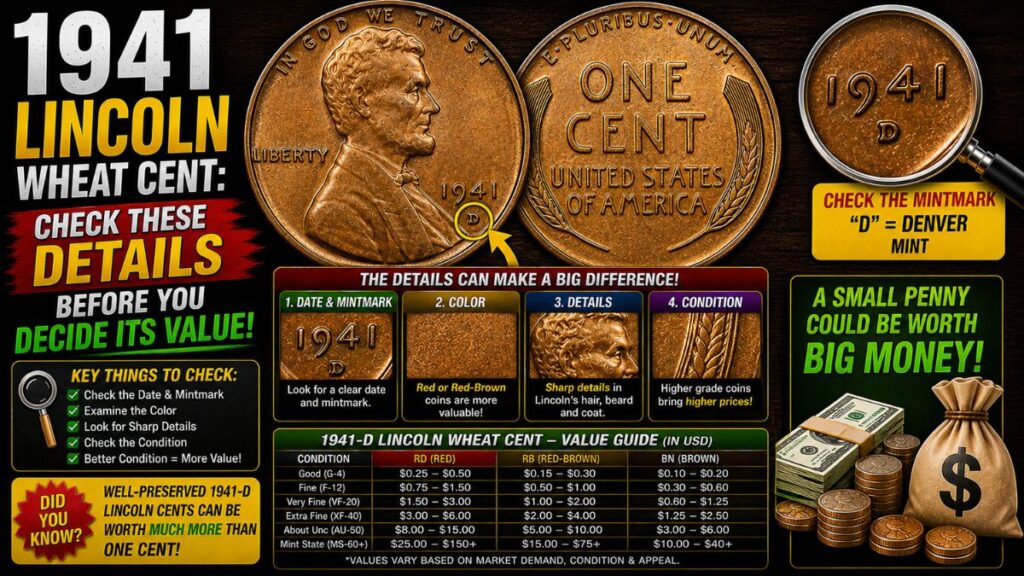
The 1941 Lincoln Wheat Cent is a familiar coin in American numismatics, but its age and historical design can make it more interesting than an ordinary penny. First issued decades ago, this coin features Abraham Lincoln on the front and two wheat stalks on the reverse. Millions were produced in 1941, so many examples remain available today. However, not every surviving coin has the same appearance, condition, or potential collector value.
If you have discovered a 1941 Lincoln Wheat Cent in an old coin collection, inherited a jar of pennies, or found one among everyday change, a closer inspection can help you understand what you own. The mintmark, surface preservation, original copper color, and possible minting varieties are among the most important details to examine.
A common circulated example is generally not a rare coin simply because it is more than 80 years old. Nevertheless, a well-preserved specimen, a coin with attractive original surfaces, or a genuinely verified variety may attract more interest from collectors.
Understanding these differences is essential before estimating a coin’s value. Two pennies with the same date can look similar at first glance but differ significantly in condition and desirability.
What Is the 1941 Lincoln Wheat Cent?
The 1941 Lincoln Wheat Cent is a United States one-cent coin featuring Abraham Lincoln on the obverse, or front, and two wheat stalks on the reverse, or back. It belongs to the Lincoln cent series introduced in 1909 to commemorate the 100th anniversary of Lincoln’s birth.
The wheat reverse remained in use until 1958, when the design was replaced by the Lincoln Memorial reverse in 1959. Because the 1941 issue falls within the original Wheat Cent era, it is part of a widely collected historical series.
The coin has a face value of one cent. Its collector value, however, depends on factors such as its condition, mint of origin, color, and any confirmed distinguishing characteristics.
Most 1941 Lincoln Wheat Cents encountered by collectors are ordinary examples rather than major rarities. Their appeal comes from their historical significance, recognizable design, and usefulness in building a complete date-and-mintmark collection.
Collectors often organize Wheat Cents by year and mintmark. This makes identifying the exact variety an important first step when examining an individual coin.
Why the 1941 Wheat Cent Still Attracts Collectors
The 1941 issue belongs to a period when Lincoln cents were an everyday part of American commerce. These coins passed through shops, households, banks, and pockets before many eventually entered collections.
Their long circulation history makes surviving examples particularly interesting to examine. Some coins show heavy wear, while others retain substantial detail. A smaller number have survived in exceptional condition.
Collectors may be interested in the 1941 cent for several reasons. Some are completing a Lincoln Wheat Cent album, while others focus on coins from particular mints or on specimens with unusually strong preservation.
The coin is also useful for learning about grading. Because circulated examples are relatively accessible, beginners can compare differences in wear, color, and remaining design detail without needing to start with an expensive rarity.
Its age should not be confused with scarcity. A coin can be old and historically important without being difficult to obtain. For the 1941 cent, condition and specific identifying characteristics generally matter more than age alone.
The Three Main 1941 Lincoln Wheat Cent Issues
The first important detail is the mint of origin. The 1941 Lincoln Wheat Cent was produced at three United States Mint facilities, and the coins are identified by their date and mintmark, or by the absence of a mintmark.
The three principal issues are the 1941 Philadelphia cent, the 1941-D Denver cent, and the 1941-S San Francisco cent.
Each belongs to the same general design series, but collectors distinguish them when assembling date-and-mintmark sets.
The 1941 Philadelphia Lincoln Wheat Cent
The Philadelphia issue carries the date 1941 without a mintmark. On the coin, the area beneath the date is the place to check when identifying the mintmark status.
An absence of a mintmark is normal for this issue. It does not mean the coin is incomplete, damaged, or missing a stamped letter.
Philadelphia produced large quantities of Lincoln cents, and the 1941 issue is generally considered common in circulated grades. Finding one does not automatically indicate a rare discovery.
Condition can still make a difference. A well-preserved Philadelphia cent with strong detail and attractive original surfaces may be more desirable than a heavily worn example.
Collectors should also distinguish an ordinary Philadelphia coin from a possible minting error or variety. A missing mintmark on a genuine 1941 Philadelphia cent is not, by itself, an error.
The 1941-D Lincoln Wheat Cent
The 1941-D cent was produced at the Denver Mint. Its identifying letter is a small D located below the date on the obverse.
When examining a possible 1941-D coin, use good lighting and magnification to check whether the letter is actually present. Dirt, wear, scratches, and surface discoloration can make a small mintmark difficult to see.
The D mintmark is part of the coin’s original design and is not a separate addition. A genuine mintmark should appear consistent with the surrounding coin surface.
The 1941-D cent is another widely collected issue. Its collector appeal depends on its actual grade, surface quality, and any independently established variety or error.
A coin with a clear mintmark is not necessarily valuable simply because it came from Denver. Collectors evaluate the complete coin rather than relying on a single identifying letter.
The 1941-S Lincoln Wheat Cent
The 1941-S cent was struck at the San Francisco Mint and carries an S mintmark below the date.
As with the Denver issue, the mintmark helps distinguish the coin from other cents produced in the same year. It is a normal feature of the San Francisco issue rather than evidence of an error.
Some collectors prefer to obtain one coin from each mint that produced cents in a particular year. For them, the 1941-S is an important part of completing a 1941 date-and-mintmark set.
The S mintmark alone does not establish that a coin is rare or unusually valuable. Its grade, surface preservation, color, and any verified special characteristics still need to be considered.
If the mintmark appears distorted, unusually positioned, or inconsistent with the surrounding design, investigate carefully before reaching a conclusion. Wear and damage can create misleading impressions.
Understanding the Coin’s Design
The design of the 1941 Lincoln Wheat Cent is one of its most recognizable features. Both sides provide useful information when identifying and evaluating the coin.
On the obverse, Abraham Lincoln’s portrait faces right. The word LIBERTY appears to the left of the portrait, while the date 1941 appears on the right. The inscription IN GOD WE TRUST runs along the upper portion of the design.
The mintmark, when present, appears beneath the date.
On the reverse, two wheat stalks frame the central inscriptions. The words ONE CENT appear prominently in the middle, with UNITED STATES OF AMERICA below. The motto E PLURIBUS UNUM appears near the upper edge.
These details are useful for determining whether the coin is a standard Wheat Cent and for assessing how much design information remains visible.
A heavily circulated coin may show flattened hair details, worn wheat lines, and softened lettering. An uncirculated example may preserve sharper design elements, although the degree of sharpness can vary because of striking characteristics.
The design also helps collectors identify damage. Scratches, gouges, and unusual marks that cross the portrait or wheat stalks may be post-mint damage rather than original features.
What Is the 1941 Lincoln Wheat Cent Made Of?
The standard 1941 Lincoln Wheat Cent was made primarily of copper. Its composition is approximately 95% copper, with the remaining 5% consisting of zinc and tin.
The coin has a nominal weight of approximately 3.11 grams and a diameter of about 19.05 millimeters.
These specifications can be useful when investigating a coin that appears unusual. However, small differences in measurements may result from wear, damage, measurement accuracy, or the limitations of the equipment used.
Composition also affects the coin’s appearance. Copper can develop a wide range of colors as it ages and reacts with its environment.
A 1941 cent may appear bright red, reddish-brown, brown, or somewhere between these shades. These differences are important to collectors, particularly when the coin is in uncirculated condition.
The copper content does not mean that an ordinary 1941 cent is automatically worth a substantial amount for its metal. For most collectible examples, numismatic factors are more relevant than the raw value of the copper.
Why Original Copper Color Matters
Color is one of the most noticeable features of a copper coin, and it can influence collector desirability.
A freshly struck copper cent begins with a bright reddish appearance. Over time, exposure to air, moisture, handling, and other environmental conditions can change the surface color.
Collectors commonly describe copper Lincoln cents using three color categories: Red, Red-Brown, and Brown.
A Red coin retains nearly all of its original red coloration. A Red-Brown coin displays a mixture of red and brown areas. A Brown coin has predominantly brown coloration.
These terms describe the coin’s appearance, not three different metal compositions.
Color can be especially important for uncirculated cents because original red coloration is more difficult to preserve over many decades. A sharply struck coin with substantial original red color may attract more attention than an otherwise similar specimen that has turned mostly brown.
However, color must be evaluated carefully. Artificially brightened copper is not equivalent to naturally preserved original red copper.
A coin that looks unusually orange, pink, or shiny may have been cleaned or chemically treated. Brightness alone does not establish authenticity, originality, or a high grade.
How to Recognize Natural Copper Color
When examining a 1941 Lincoln Wheat Cent, begin by looking at the color under neutral, consistent lighting.
Natural copper coloration may be uneven. One part of the coin can remain reddish while another has developed brown tones. Such variation does not automatically mean the coin is damaged or altered.
Examine both sides, including the protected areas around lettering and design elements. The surface should be assessed as a whole rather than judged by a single bright spot.
Be cautious if the coin has an unnaturally uniform shine, unusual color patches, or evidence of abrasive cleaning. Polishing can create a reflective surface while removing the original texture that collectors value.
Cleaning can also leave fine parallel scratches that become visible under magnification. Chemical treatments may alter the color without restoring the coin’s original surfaces.
If you are unsure whether the color is natural, avoid attempting to improve it yourself. Preserving the coin in its existing condition is usually safer than experimenting with cleaning products.
How to Grade a 1941 Lincoln Wheat Cent
Grading describes a coin’s state of preservation. For the 1941 Lincoln Wheat Cent, the difference between a worn circulated example and a well-preserved uncirculated specimen can significantly affect collector interest.
Professional grading uses established standards and examines several features, including wear, remaining detail, surface marks, luster, and overall eye appeal.
You do not need professional equipment to begin a basic inspection. A magnifying glass, neutral lighting, and careful observation can help you understand the coin’s condition.
However, assigning an exact numerical grade requires experience. A coin that appears attractive to a beginner may have hidden scratches, cleaning, or other defects that affect its grade.
Heavily Circulated 1941 Wheat Cents
A heavily circulated cent has experienced substantial use. Lincoln’s hair may be flattened, facial details may be weak, and the lettering may show considerable wear.
On the reverse, the wheat stalks can lose much of their fine detail. The central lettering may remain readable even when the outer design is noticeably worn.
Such coins are common in collections and are useful for studying the history of everyday money.
A heavily worn coin is not necessarily damaged. Normal circulation gradually removes high points and softens design details.
The important distinction is between ordinary wear and damage caused by scratches, corrosion, harsh cleaning, or physical alteration.
For most common 1941 issues, heavy circulation generally limits collector value. Nevertheless, the exact coin should still be evaluated before a final assessment is made.
Moderately Circulated Examples
A moderately circulated 1941 cent typically retains more of Lincoln’s portrait and the reverse wheat design than a heavily worn specimen.
Some hair detail may remain visible, while the highest points of the portrait show flattening. The wheat stalks may still display recognizable lines, even if the finer details are reduced.
These coins can be suitable for collectors who want an affordable example of each 1941 mint issue.
Surface condition remains important. A moderately worn coin with clean, original-looking surfaces may be more appealing than a similar example covered in scratches, corrosion, or discoloration.
The presence of wear should be considered together with the coin’s overall appearance. A single grading label cannot capture every feature that affects desirability.
About Uncirculated 1941 Wheat Cents
An About Uncirculated, or AU, coin shows only limited wear on its highest design points.
A 1941 cent in this category may retain much of its original luster, although the portrait or other raised details can show slight friction from handling.
The distinction between AU and uncirculated condition can be difficult for beginners. A coin may look nearly new but still have small areas of wear that prevent it from receiving an uncirculated grade.
The amount and location of wear matter, as does the remaining surface luster.
An AU specimen with attractive color and minimal marks may be desirable to collectors, but its market value depends on the specific mint issue and current demand.
Uncirculated 1941 Lincoln Wheat Cents
An uncirculated coin has not experienced the ordinary wear associated with circulation. It may still have contact marks from production, storage, or contact with other coins.
Uncirculated does not mean flawless. Coins can leave the mint with striking weaknesses or acquire marks while being transported and stored.
The sharpness of Lincoln’s portrait, the clarity of the wheat stalks, and the quality of the original surfaces all help determine the coin’s grade.
Luster is another important feature. Original mint luster creates a characteristic sheen that moves across the surface when the coin is tilted under light.
A coin with strong luster, attractive natural color, and few distracting marks may be more desirable than another example of the same date with weaker surfaces.
At the highest grades, small differences in preservation can have a disproportionate effect on collector demand.
Why High-Grade Coins Can Be Different
A common date can still be challenging to obtain in exceptional condition.
Large numbers of 1941 cents were produced, but many spent years in circulation. Others were stored in ways that exposed them to moisture, friction, or environmental damage.
As a result, a large surviving population does not mean that every grade is equally easy to find.
Collectors pursuing high-grade examples often compare strike quality, luster, contact marks, and color. A coin may be technically uncirculated yet less desirable than another because of numerous marks or unattractive surfaces.
The finest examples can command stronger prices than ordinary circulated coins. However, a high asking price is not proof that a coin is rare or worth that amount.
A credible valuation should consider the actual grade, the exact mint issue, and completed sales of comparable coins.
What Is the 1941 Lincoln Wheat Cent Worth?
The value of a 1941 Lincoln Wheat Cent depends primarily on its condition, mintmark, color, and whether it has a verified variety or minting error.
Most circulated examples are common and generally have modest collector value. Their value may be only a small amount above face value, depending on the buyer and the coin’s condition.
Uncirculated examples may be worth more, particularly when they retain attractive original surfaces. High-grade specimens with desirable color can be more collectible than ordinary brown examples.
The Philadelphia, Denver, and San Francisco issues should be evaluated separately when estimating a coin’s market value. However, the presence of a D or S mintmark does not automatically make an otherwise ordinary cent rare.
A genuine error or recognized variety may increase interest, but such a feature needs to be established rather than assumed from a photograph or an unusual-looking mark.
The most reliable approach is to compare the coin with recently sold examples of the same date, mintmark, grade, and color designation. Asking prices alone are less informative because they show what sellers hope to receive, not necessarily what buyers have paid.
Why Online Price Estimates Can Be Misleading
Online listings sometimes display extremely high prices for ordinary coins. These listings can create unrealistic expectations, particularly for people who have recently discovered an old penny.
A seller can ask almost any amount for a coin, but that does not mean the market will support the price.
Another problem is comparing coins that look similar but have different grades. A circulated cent cannot be valued accurately by using the price of a certified, high-grade uncirculated specimen.
Color also matters. A coin with original red surfaces may fall into a different collector category from a brown coin of the same date and numerical grade.
Errors and varieties create additional confusion. A coin advertised as rare may simply have damage, discoloration, or a normal design feature.
Before assigning a value, check the identifying details and compare genuinely similar coins. If the coin appears exceptional, a professional assessment may be worthwhile.
Does the 1941 Cent Have Any Rare Varieties?
Collectors sometimes search for unusual features on 1941 Lincoln Wheat Cents, hoping to find a variety worth more than a standard example.
A genuine variety is a recognizable difference associated with the minting process, such as a documented die characteristic. A minting error is a separate category involving an unintended production result.
These terms should not be used interchangeably. A coin can show unusual characteristics without qualifying as a recognized variety or a valuable minting error.
For a variety to be meaningful, it should be supported by reliable numismatic identification. The specific feature must match the documented characteristics of the variety rather than merely resemble them.
Small differences in lettering, numbers, or the mintmark can be difficult to interpret. Lighting, magnification, wear, and damage may all change how these details appear.
It is better to investigate a suspected variety carefully than to assume that every unusual mark represents a valuable discovery.
How to Inspect the Date and Mintmark
Begin by examining the date 1941 on the obverse. Confirm that the numbers are readable and that the coin has the expected Wheat Cent design.
Next, look immediately below the date for the mintmark.
A coin without a mintmark is consistent with the Philadelphia issue. A D indicates Denver, while an S indicates San Francisco.
Use moderate magnification if necessary. Avoid pressing a tool against the surface or scraping away material in an attempt to reveal a letter.
If the mintmark looks unusual, compare its shape and placement with verified examples of the same issue. Do not conclude that it is doubled, repunched, or otherwise special solely because its edges appear irregular.
Photographs taken straight on under even lighting can help reveal the date and mintmark clearly. Additional close-up images may be useful when investigating a suspected variety.
Understanding Doubled Dies and Other Errors
A doubled die is created when a coin die receives a doubled image during its preparation. Coins struck from that die can show distinctive doubling in parts of the design.
This is different from mechanical doubling, which can occur during the striking process and often produces a flatter, shelf-like appearance.
The two can look similar in photographs, particularly when the image is enlarged or poorly lit. Correct identification requires examining the shape, direction, and structure of the apparent doubling.
Other minting errors may involve features such as an off-center strike or an unusual planchet. Their significance depends on the type and severity of the error, its authenticity, and collector demand.
Damage occurring after a coin leaves the mint should not be mistaken for a minting error. Scratches, dents, gouges, and alterations may create irregular features that resemble production anomalies.
If you suspect that a 1941 cent has a genuine error, preserve it and seek an informed evaluation before buying expensive authentication services or assuming it has a premium value.
How to Distinguish a Minting Error From Damage
The location and structure of an unusual feature can provide useful clues.
A genuine minting error usually has characteristics consistent with the way the coin was struck or manufactured. Post-mint damage often appears as an impact, scratch, cut, deformation, or alteration affecting the finished coin.
For example, a groove across Lincoln’s portrait may simply be a scratch. A raised line can be caused by several different processes and cannot be identified confidently from its appearance alone.
Color changes are also not proof of an error. Copper naturally changes color, and exposure to chemicals can create unusual surface effects.
Look at the surrounding metal and consider whether the feature appears integrated into the original design or interrupts the surface in a way consistent with later damage.
Avoid filing, polishing, scraping, or applying chemicals to test a suspected error. These actions can destroy evidence and reduce the coin’s collector appeal.
Can Cleaning Increase the Value of a 1941 Wheat Cent?
Cleaning a collectible copper coin is generally a poor way to improve its value.
A coin may look brighter after polishing, but the process can remove or alter its original surface. Fine scratches may become visible under magnification, and the unnatural shine can reduce collector interest.
Chemical cleaners may also change the copper’s color and surface characteristics. Even if the coin looks more attractive to an inexperienced observer, collectors often prefer original, undisturbed surfaces.
Dirt and discoloration should not automatically be treated as problems that require removal. Some color changes are natural results of aging and storage.
If a coin is valuable enough to justify special handling, consult a qualified numismatic professional before attempting any treatment.
For an ordinary 1941 cent, the safest course is usually to leave the coin as it is and focus on accurate identification and preservation.
How to Store a 1941 Lincoln Wheat Cent
Proper storage helps protect the coin’s existing condition.
Copper can react with moisture, pollutants, and certain materials. A coin kept in a damp environment may develop corrosion or other surface changes.
Store the cent in a suitable coin holder designed for long-term preservation. Choose materials intended for coins rather than ordinary paper envelopes, adhesive-backed holders, or containers that may contain harmful chemicals.
Keep the coin in a cool, dry environment with reasonably stable conditions. Avoid storing it near household chemicals or in places exposed to repeated moisture and temperature changes.
Handle the coin by its edges whenever possible. Skin oils can leave fingerprints, and unnecessary handling increases the risk of scratches or accidental damage.
If the coin is already in a protective holder, do not remove it simply to inspect it more closely unless there is a good reason to do so.
Is Professional Grading Worth It?
Professional grading can help establish a coin’s authenticity, condition, and marketability. However, grading is not automatically worthwhile for every 1941 Lincoln Wheat Cent.
Because ordinary circulated examples are common, the cost of professional grading may exceed the coin’s likely market value.
Grading may be more reasonable when a coin appears to be in exceptional condition, has a potentially significant variety, or displays a credible minting error.
The decision should be based on the coin’s likely value relative to the total cost of authentication, grading, shipping, insurance, and related services.
A professional grade can also make comparisons easier because it provides a standardized description of condition. Nevertheless, certification does not guarantee a particular sale price.
Before submitting a coin, compare it with certified examples and consider whether the potential financial or collecting benefit justifies the expense.
What to Look for When Buying a 1941 Wheat Cent
Collectors purchasing a 1941 cent should begin with the exact date and mintmark. The next step is to assess condition, color, and the quality of the surfaces.
Clear photographs are useful, but they should show both sides and provide enough detail to inspect the date, mintmark, portrait, and wheat stalks.
Be cautious of descriptions that rely on vague phrases such as extremely rare, one of a kind, or priceless without providing convincing evidence.
If a seller claims that the coin contains a valuable variety, ask what recognized feature supports that identification. The claim should be verifiable rather than based on an unusual appearance alone.
For high-grade or potentially valuable coins, certification may provide additional confidence. However, the certification and grade should still be checked carefully against the coin being offered.
A sensible purchase is based on identifiable characteristics and realistic market comparisons, not on promises of extraordinary future value.
What Makes One 1941 Cent More Desirable Than Another?
Several factors can combine to influence collector demand.
First, the coin’s grade determines how much wear and damage it has experienced. Better-preserved specimens generally attract more interest than heavily worn examples of the same issue.
Second, original color matters, particularly among uncirculated copper cents. A coin that retains substantial natural red coloration may be more desirable than one that is predominantly brown.
Third, the mintmark identifies the issue and allows the coin to be compared with other examples from the same mint.
Fourth, strike quality and surface condition affect appearance. A sharply detailed coin with attractive luster may be preferred over one with weak details or numerous distracting marks.
Finally, verified varieties and genuine minting errors can add interest. Their importance depends on how clearly the feature is established and whether collectors actively seek it.
No single characteristic guarantees a high value. A realistic evaluation considers all of these factors together.
Common Misconceptions About the 1941 Lincoln Wheat Cent
One widespread misconception is that every old penny must be valuable. In reality, many historic coins survive in large quantities, and age alone does not establish rarity.
Another misconception is that a mintmark automatically makes a coin special. The D and S mintmarks identify the Denver and San Francisco issues, but they are normal parts of those coins.
Some people also assume that a bright, shiny cent must be in excellent condition. A coin may have been polished or chemically treated, and an unnatural shine can reduce its desirability.
A further mistake is treating every doubled-looking letter or number as a valuable doubled die. Mechanical doubling, wear, damage, and photographic effects can all create misleading appearances.
Finally, a high online asking price should not be confused with a confirmed market value. Actual completed sales of comparable coins provide a more useful indication of demand.
Avoiding these misunderstandings can save collectors money and help them evaluate their coins more confidently.
A Practical Checklist for Examining Your 1941 Cent
If you have a 1941 Lincoln Wheat Cent in front of you, work through a few simple checks.
First, confirm the date and the Wheat Cent design. Make sure the coin is consistent with the standard issue rather than a different Lincoln cent that has been altered.
Second, identify the mintmark, if present. Look beneath the date for a D or S. If there is no mintmark, the coin is consistent with the Philadelphia issue.
Third, assess wear. Examine Lincoln’s hair, cheek, jaw, and the wheat stalks to determine how much design detail remains.
Fourth, evaluate the surface. Look for scratches, corrosion, cleaning marks, dents, and other damage.
Fifth, assess the color. Determine whether the coin appears naturally red, Red-Brown, or Brown, while remembering that color alone cannot establish a grade.
Sixth, investigate any suspected variety or error using reliable identification criteria. Do not rely solely on an unusual mark or an online claim.
Finally, compare the coin with similar examples in the same condition before assigning a market value.
This process will not replace professional grading, but it provides a useful starting point for understanding the coin.
Frequently Asked Questions About the 1941 Lincoln Wheat Cent
Is the 1941 Lincoln Wheat Cent rare?
The standard 1941 Lincoln Wheat Cent is generally common, particularly in circulated condition. Exceptional preservation or a verified variety or minting error may make an individual coin more desirable.
How can I identify the mint of a 1941 Wheat Cent?
Check the area beneath the date on the obverse. A D indicates Denver, an S indicates San Francisco, and no mintmark is normal for the Philadelphia issue.
What is the metal composition of a 1941 Lincoln cent?
The standard coin is approximately 95% copper, with the remaining 5% consisting of zinc and tin.
Does a 1941 cent have to be red to be valuable?
No. Brown and Red-Brown examples can have collector value too. Original red coloration may increase desirability for certain uncirculated specimens, but grade, surface quality, and market demand also matter.
Can a circulated 1941 Wheat Cent be worth more than one cent?
Yes. Collectors may pay more than face value for an example suitable for a collection. However, ordinary circulated specimens generally have modest value.
Is the 1941-D cent automatically more valuable than the Philadelphia issue?
No. The D mintmark identifies the Denver issue, but it does not automatically make the coin rare or valuable. Condition, color, and other verified characteristics must also be considered.
Is the 1941-S cent rare?
The standard 1941-S cent is a regular issue, not automatically a rarity. Its value depends on preservation, color, and any established special characteristics.
Can I clean my 1941 Lincoln Wheat Cent?
Cleaning is generally discouraged because it can scratch the surface, alter the natural color, and reduce collector appeal. Leaving the coin untreated is usually the safer choice.
How do I know whether my coin has a doubled die?
Examine the relevant design details under magnification and compare them with documented characteristics of a recognized doubled-die variety. Apparent doubling may instead be mechanical doubling, damage, or an effect of lighting.
Should I have my 1941 cent professionally graded?
Professional grading may be worthwhile for an exceptional specimen or a coin with a potentially significant variety or error. For an ordinary circulated example, grading costs may outweigh the likely financial benefit.
Can an unusual-looking 1941 cent be valuable?
Possibly, but an unusual appearance is not sufficient proof. The feature may result from normal wear, damage, discoloration, or cleaning. Proper identification is necessary before assigning any premium value.
What is the best way to estimate its value?
Identify the mintmark, assess the grade and color, check for damage or recognized varieties, and compare recently completed sales of similar coins. This approach is more reliable than using the highest advertised online price.
Conclusion
The 1941 Lincoln Wheat Cent is an important part of the Lincoln cent series and an accessible coin for collectors interested in American numismatic history. Although standard circulated examples are generally common, differences in preservation, original copper color, mintmark, and verified varieties can influence desirability.
The first step is to identify whether the coin came from Philadelphia, Denver, or San Francisco. Next, examine the date, design details, wear, luster, and surface condition. If you notice a possible minting error or unusual variety, verify the feature before assuming that it adds value.
Most importantly, do not judge the coin by its age, shine, or an impressive online asking price alone. A careful inspection and comparison with genuinely similar coins will provide a more realistic understanding of its collector appeal.
Whether your 1941 Wheat Cent is a modest circulated example or a particularly well-preserved specimen, understanding its characteristics is the best way to appreciate what makes it worth keeping.