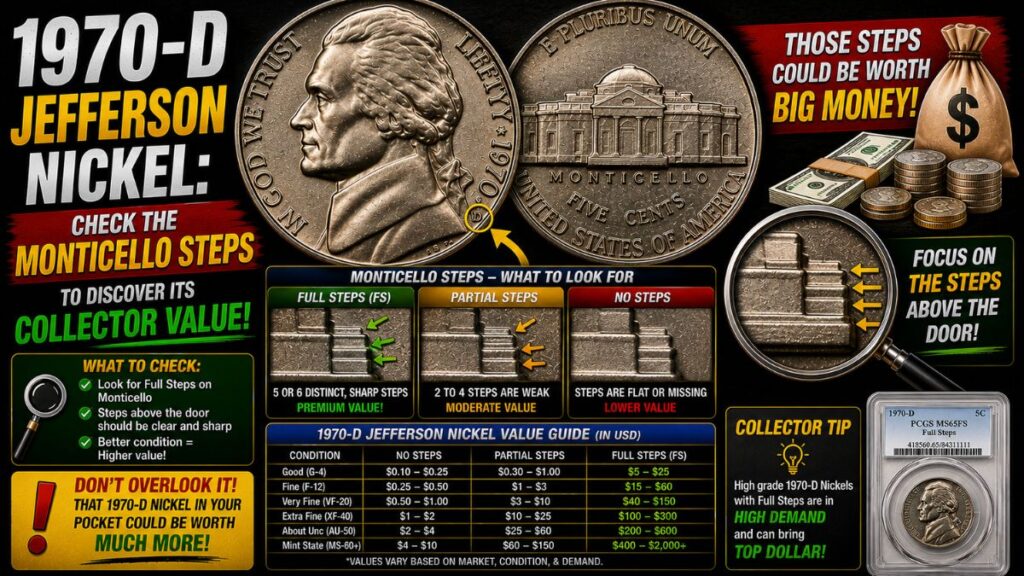
A Jefferson nickel from 1970 might look like an ordinary five-cent coin, but one small detail can make it more interesting to collectors: the steps leading to Monticello on the reverse. If you have a 1970-D Jefferson nickel in a coin jar, an old collection, or a drawer full of spare change, those steps are worth examining before you spend it.
Most 1970-D Jefferson nickels are common and worth their face value when circulated. The Denver Mint produced large quantities, and many examples remain available today. However, coins can differ considerably in strike quality, surface preservation, and overall appearance.
Some nickels have clear, sharply separated steps beneath Monticello, Thomas Jefferson’s historic home. Others show weak details, with the steps appearing merged, incomplete, or difficult to distinguish. Collectors often pay particular attention to these differences when assessing the quality of a Jefferson nickel.
Exceptional condition can also influence collector interest. A coin with original mint luster, minimal contact marks, and well-defined architectural details may be more desirable than a heavily circulated example. Genuine mint errors and verified varieties can create additional interest, although they must be identified carefully.
The important thing to remember is that not every 1970-D nickel with visible steps is rare. The date and mint mark identify the coin, but its condition, strike quality, and any authenticated special characteristics help determine whether it deserves a premium.
Learning how to examine the Monticello steps can help you distinguish an ordinary nickel from an example worth researching more closely.
Understanding the 1970-D Jefferson Nickel
The 1970-D Jefferson nickel belongs to the Jefferson nickel series introduced in 1938. The coin features Thomas Jefferson on the obverse, or front, and a depiction of Monticello on the reverse.
Monticello was Jefferson’s home in Virginia and is one of the most recognizable architectural features on American coinage. The building’s columns, windows, roofline, and staircase provide several details that collectors can use to evaluate the coin’s strike and preservation.
The letter D identifies the Denver Mint as the facility responsible for striking the coin. On a 1970-D Jefferson nickel, the mint mark appears on the obverse near the date.
The standard 1970-D nickel was produced for circulation. It was not intended to be a rare collectible, and its ordinary examples remain relatively common.
The coin’s composition also matters when identifying it. A standard 1970 Jefferson nickel is made of a copper-nickel alloy, generally containing 75% copper and 25% nickel. It does not have the silver composition associated with certain older United States coins.
Although the design has been familiar to Americans for generations, collectors continue to study differences in strike quality and preservation. A coin’s age alone does not determine its value; the details that remain visible after decades of handling can be much more important.
How Much Is a 1970-D Jefferson Nickel Worth?
The value of a 1970-D Jefferson nickel depends on its condition, strike quality, and whether it has a verified variety or genuine mint error.
Most circulated examples are worth five cents. They may be useful for filling a date-and-mintmark collection, but ordinary wear and common availability usually limit their market value.
Uncirculated examples may be worth more, especially when they retain attractive mint luster and have few distracting marks. Coins in exceptionally high grades can be more desirable because collectors often seek the best-preserved examples available.
The Monticello steps can be an important part of this evaluation. Sharply defined steps may indicate a strong strike and can make a coin more appealing to collectors who specialize in Jefferson nickels.
However, visible steps alone do not guarantee a high price. The coin must still be evaluated for overall grade, surface quality, and collector demand.
Genuine mint errors may also attract premiums. A substantial off-center strike or another authenticated manufacturing error can make a coin more distinctive than a normal example. But an unusual-looking mark is not automatically a mint error.
There is no single value that applies to every 1970-D Jefferson nickel. A worn coin, a high-grade example with exceptional step detail, and a verified error coin are different collecting items.
For a realistic estimate, compare your nickel with recent completed sales of coins with similar grades, strike characteristics, and verified varieties.
What Makes the Monticello Steps Important?
The Monticello staircase is one of the most closely examined features on the reverse of a Jefferson nickel.
On the standard design, a series of horizontal lines represents the steps leading toward the building’s entrance. These lines may look small, but they provide useful information about how sharply the coin was struck.
During coin production, metal is forced into the recessed details of the dies. If the strike is strong enough, the design can appear clearly. If the strike is weak or the dies have certain limitations, small architectural features may not be fully reproduced.
This means that two nickels with the same date and mint mark can show noticeably different step detail.
On one coin, the steps may appear as distinct horizontal lines with visible separation. On another, the lines may merge together or disappear into a flat-looking area beneath the building.
Collectors pay attention to this distinction because strong architectural detail can help set an exceptional coin apart from an ordinary example.
Nevertheless, the steps should not be evaluated in isolation. A coin with sharply defined steps may still have scratches, contact marks, or other defects that affect its grade.
Likewise, a coin with less-than-perfect step detail can still be collectible and attractive. The steps are one important part of the overall assessment, not the only factor that determines value.
What Does Full Steps Mean on a Jefferson Nickel?
The term Full Steps, commonly abbreviated FS, is used for Jefferson nickels whose Monticello staircase shows a high degree of separation and completeness under the applicable grading standards.
The designation reflects the sharpness of the step details on the reverse. It is not simply a statement that the coin has visible lines beneath Monticello.
Depending on the grading service and the applicable criteria, the required number of complete steps and the degree of separation may differ. Collectors should therefore understand which standard applies when comparing certified coins.
A nickel can be uncirculated without qualifying for a Full Steps designation. Uncirculated means that the coin has not experienced ordinary circulation wear; it does not guarantee that every design element was struck sharply.
Similarly, a coin can have attractive step detail without meeting the formal requirements for a Full Steps designation.
For collectors, this distinction can matter because sharply struck examples may be more desirable than ordinary coins of the same date and mint.
However, the Full Steps designation does not automatically make a 1970-D nickel rare or valuable. The coin’s grade, surface preservation, availability, and market demand remain important.
If your nickel appears to have complete steps, examine the lines carefully and compare them with certified examples. A preliminary visual inspection can identify a potentially interesting coin, but a formal designation requires the applicable grading standards.
How to Inspect the Monticello Steps at Home
You can begin examining a 1970-D Jefferson nickel with a few simple tools. A clean surface, good lighting, and a magnifier are enough for an initial inspection.
Start by placing the coin on a soft, clean surface. Handle it by the edges to avoid transferring oils or moisture from your fingers onto the coin.
Use natural, indirect daylight or a neutral white light. Strong shadows can hide details, while direct reflections can make lines appear more distinct than they really are.
Look at the staircase beneath Monticello. Try to identify the individual horizontal lines rather than treating the entire area as one pattern.
Check whether the lines remain separated across their length. Look for areas where two steps merge, where a line appears incomplete, or where the detail becomes weak.
Then tilt the coin slightly under the light. Changing the angle can help reveal the shape of the raised design and make surface marks easier to distinguish from actual features.
Use a magnifier if necessary, but avoid relying on extreme magnification. Excessive magnification can make ordinary contact marks appear more important than they are.
After examining the steps, look at the rest of Monticello. Check the columns, windows, roofline, and lettering. Strong detail throughout the building can contribute to the coin’s overall appeal.
Finally, turn the coin over and inspect Jefferson’s portrait, the date, the mint mark, and the open fields for wear or damage.
Do not clean or polish the coin to make the steps easier to see. Cleaning can damage the surface and reduce collector appeal.
Why Some 1970-D Nickels Have Weak Steps
Weak Monticello steps do not automatically indicate that a coin is damaged or unusual. Differences in step definition can result from several aspects of the striking process.
One factor is strike strength. If the coin does not receive enough effective pressure to reproduce all the fine details, some architectural features may appear weak.
The condition of the dies can also affect the final appearance. A coin struck from dies that do not reproduce the smallest details sharply may show less definition in certain areas.
Metal flow during striking influences how well the design fills the die recesses. The interaction between the blank, the dies, and the striking process can affect the clarity of the staircase.
Circulation wear is another consideration. A coin that has spent years moving through commerce may lose fine details as its raised surfaces are gradually worn down.
Damage can also obscure the steps. Scratches, dents, corrosion, or harsh cleaning may interfere with the original design.
These possibilities should be distinguished rather than treated as interchangeable explanations. A weakly struck coin and a worn coin may look similar in some areas, but the causes are different.
When assessing a 1970-D nickel, inspect the entire coin. If the Monticello steps are weak while other details remain strong, strike characteristics may be relevant. If the coin shows broad wear across its highest points, circulation may be a more likely explanation.
A weak staircase does not make the nickel rare. In most cases, exceptional sharpness is more useful for identifying potentially desirable examples than weak detail is for proving rarity.
How to Recognize a Strongly Struck 1970-D Nickel
A strongly struck Jefferson nickel typically shows clear design details rather than flattened or indistinct features.
On the reverse, examine the staircase beneath Monticello first. The individual lines should be visible and separated, with as much completeness as the coin’s strike allows.
Then inspect the building’s columns and other architectural features. A strong impression may produce well-defined edges and clear details around the entrance and roofline.
The lettering should also be readable and well formed. Look at MONTICELLO, the denomination, and the surrounding inscriptions without assuming that every small variation represents an error.
On the obverse, inspect Jefferson’s hair, facial features, and the open fields. These areas can reveal wear and contact marks that influence the coin’s grade.
A strong strike is not the same as a high grade. A coin can be sharply struck but still have scratches or marks that lower its overall grade.
Conversely, a coin may be well preserved but show weaker details because of the way it was struck.
This distinction is important when evaluating a 1970-D nickel. Collectors often value a combination of strong strike, excellent surfaces, and minimal wear.
If your coin appears unusually sharp, compare it with other examples of the same date and mint. Similar lighting and magnification make the comparison more useful.
The Difference Between Full Steps and Uncirculated Condition
Full Steps and uncirculated condition describe different aspects of a coin.
Uncirculated condition refers to the absence of ordinary circulation wear. Such a coin may still show contact marks from production, transport, or storage.
Full Steps refers specifically to the definition and separation of the staircase on the reverse. It is a strike-related designation under established grading criteria.
A 1970-D Jefferson nickel can therefore be uncirculated without having Full Steps. Its surfaces may be well preserved even though the staircase is weakly defined.
Likewise, a coin with good step detail can still have distracting marks that affect its overall grade.
Collectors should avoid treating these terms as interchangeable. A high-grade coin with a Full Steps designation combines strong preservation with the required step definition, making it a more specialized collecting target.
The distinction also matters when researching prices. A certified Full Steps coin should not be compared directly with a coin of the same numerical grade that lacks the designation if the market treats the two categories differently.
If a seller advertises a 1970-D nickel as Full Steps, check whether the designation is supported by a recognized grading service or whether it is simply the seller’s visual description.
A clear understanding of the terminology can help you make better comparisons and avoid paying a premium for an unverified claim.
Why Condition Matters When Evaluating a 1970-D Nickel
Condition is one of the most important factors in determining a Jefferson nickel’s collector appeal.
A circulated nickel may have flattened design details, scratches, small dents, and reduced luster. These changes are normal for a coin that has been used in everyday transactions.
An uncirculated coin may retain much of its original luster, but it can still have contact marks from other coins. The number, size, and location of these marks influence the coin’s overall appearance.
On the obverse, Jefferson’s cheek and the surrounding open fields can reveal marks that affect grade. The portrait’s hair and facial features may also show wear.
On the reverse, the staircase, columns, lettering, and open fields around Monticello deserve careful attention.
A coin with sharply defined steps but severe surface damage may be less desirable than a cleaner coin with slightly weaker details. Collectors evaluate the coin as a whole.
Original luster also matters. A coin that has been polished may look shiny but have lost desirable surface characteristics.
For ordinary circulated 1970-D nickels, differences in condition may not create a meaningful premium. Exceptional examples are a different matter, particularly when they combine strong step definition with excellent surfaces.
The best approach is to evaluate the coin honestly rather than assuming that a few sharp lines make it valuable.
Circulated, About Uncirculated, and Uncirculated Examples
Understanding basic grading categories helps you evaluate your 1970-D Jefferson nickel more accurately.
A circulated coin shows evidence of normal use. Its highest design points may be worn, its luster may be reduced, and the surface may contain numerous contact marks.
Such a coin is generally worth its face value unless it has another feature that makes it collectible.
An about-uncirculated coin has experienced very limited circulation. It may retain much of its original luster, but slight wear can be visible on the highest points.
An uncirculated nickel has not experienced ordinary circulation wear. However, it may still have marks from handling during production or storage.
Within the uncirculated category, coins can vary considerably. Some have noticeable contact marks or uneven surfaces, while others have strong luster and very few distractions.
High-grade examples are usually those with excellent overall preservation. If they also have sharply defined Monticello steps, they may be more appealing to collectors who focus on strike quality.
These categories do not provide an automatic price. A coin’s date, mint mark, strike, surface condition, and market demand all remain relevant.
If your nickel is worn and ordinary, professional grading is unlikely to be necessary. If it appears exceptionally preserved, comparing it with certified examples may help you decide whether further evaluation is worthwhile.
Identifying the 1970-D Mint Mark
The mint mark helps identify where a coin was struck. On the 1970-D Jefferson nickel, the D appears on the obverse near the date.
Check the date and mint mark together. The date should read 1970, and the letter D should be visible beneath it.
Use good lighting and a magnifier if necessary. Do not scrape the area or try to reshape the letter, because that can damage the coin and complicate identification.
A 1970 nickel without a mint mark is not automatically an error. Philadelphia-produced coins from this period generally did not carry a mint mark, while Denver coins carry the D.
This is an important distinction because missing-mint-mark claims can be misleading. A coin should not be described as a rare missing-mint-mark error merely because no letter is present.
If the mint mark looks unusual, examine the surrounding surface carefully. Wear, damage, corrosion, and lighting can change how the letter appears.
The mint mark is useful for identifying the coin and comparing it with other examples. However, the D itself does not make a 1970 nickel rare.
Collector value depends on the complete coin, including its grade, strike quality, surfaces, and any verified special characteristics.
Can a 1970-D Jefferson Nickel Be Valuable?
Most 1970-D Jefferson nickels are common, so a normal circulated example is generally worth five cents.
However, some coins may attract premiums because they are exceptionally well preserved, have strong step definition, or possess a verified variety or genuine mint error.
A high-grade uncirculated nickel can be more desirable than a worn example because collectors often seek the best-preserved coins for their collections.
A Full Steps designation may add interest when it is supported by the relevant grading standards. The coin’s overall grade and surface quality still matter.
A genuine mint error may also create additional value, depending on the type and severity of the error and the demand among collectors.
There is no reliable basis for claiming that every 1970-D nickel with clear steps is worth hundreds or thousands of dollars. Such claims require evidence.
When estimating value, distinguish between advertised prices and completed sales. An online listing may show an ambitious asking price, but that does not prove that a buyer has paid it.
The most useful comparisons are recent sales of coins with the same date and mint mark, similar grades, comparable step designations, and matching error characteristics.
If no close comparisons exist, acknowledge the uncertainty rather than relying on the highest price you can find.
What Are Genuine Mint Errors?
A mint error occurs when a problem during coin production changes the coin’s shape, design, composition, or striking characteristics.
Errors can range from subtle abnormalities to dramatic changes that are easy to recognize. Some attract significant collector interest, while others have little financial premium.
A genuine error must be distinguished from damage that occurred after the coin left the Mint.
For example, a coin that has been squeezed, scratched, bent, or struck by a tool may look unusual, but these features do not necessarily indicate a manufacturing error.
Likewise, a weak design detail is not automatically an error. It may result from a normal variation in strike strength or from wear.
If your 1970-D nickel has an unusual feature, examine it carefully and compare it with reliable examples. Do not assign a rare-error label until the feature has been identified.
Professional authentication may be useful when the potential error is significant enough to justify the cost.
Even genuine mint errors vary in value. The size, visibility, rarity, condition, and collector demand all influence the price.
The key is to establish exactly what makes the coin different rather than assuming that every unusual-looking nickel is valuable.
Off-Center Strikes
An off-center strike occurs when the coin blank is not correctly positioned between the dies during striking.
The result is a coin with part of the design displaced toward one side, often leaving a blank area where the design did not reach the metal.
The amount of displacement can influence collector interest. A minor shift may be less noticeable, while a more substantial off-center strike may be more distinctive.
The date and mint mark can be especially useful for identification. If the date remains visible, it may be easier to establish which coin issue is involved.
However, an unusual outline does not automatically prove that a nickel was struck off-center. Damage after production can distort a coin’s shape.
Look for a displaced design that is consistent with the minting process. Check the rim, the blank area, and the overall shape without bending or altering the coin.
If you suspect an off-center strike, compare it with authenticated examples or seek a specialist’s opinion.
The value depends on the severity and appearance of the error, the coin’s condition, and collector demand. Not every off-center coin commands a large premium.
Broadstrikes and Other Shape Errors
A broadstrike can occur when a coin is struck without the normal collar that constrains its shape during production.
This can result in a coin that is wider or flatter than a standard example. Its rim and overall dimensions may look different from those of an ordinary Jefferson nickel.
However, a coin that has been flattened or squeezed after production can also have an unusual shape. Such damage should not be confused with a genuine broadstrike.
Compare the coin’s dimensions, thickness, edge, and design with a normal example. Avoid forcing it into measuring tools or performing tests that could scratch the surface.
Other manufacturing errors can affect the shape or structure of a coin, but the exact cause must be established before the coin is assigned a specific error designation.
If the feature appears significant, professional evaluation may help determine whether it occurred during production.
The market value of a shape error depends on the strength of the feature, the coin’s condition, and how much interest collectors have in that type of error.
A strange shape can be a reason to investigate, but it is not proof of rarity or high value.
Doubled Dies and Other Forms of Doubling
Doubled dies are varieties created during the preparation of a coin die. If impressions are misaligned during die preparation, a doubled image may be transferred to coins struck by that die.
Collectors look for consistent doubling in design elements such as letters, numbers, and other details.
This differs from machine doubling, which can occur during the striking process. Machine doubling often appears as a flattened or shelf-like secondary outline and is generally not valued in the same way as a recognized doubled-die variety.
Scratches, reflections, worn lettering, and other forms of damage can also create misleading shapes.
If you notice apparent doubling on a 1970-D Jefferson nickel, examine the feature under consistent lighting. Look for a distinct, repeatable separation in the design rather than a vague shadow.
Do not assume that an unusual-looking letter or date is a rare variety. The exact characteristic must be identified and compared with reliable examples.
A verified variety can increase collector interest, but the value depends on its recognition, availability, condition, and market demand.
Until the feature has been confirmed, describe what you see without assigning an unsupported variety name.
How to Avoid Mistaking Damage for a Mint Error
One of the most important skills in coin collecting is learning to distinguish genuine mint errors from post-mint damage.
Coins experience many forms of wear and damage after production. They can be scratched, dented, bent, exposed to chemicals, or struck by other objects.
These changes may create unusual shapes or marks that resemble manufacturing errors.
For example, a flattened letter may look doubled under magnification, while a damaged rim can resemble a shape error. Corrosion may obscure the Monticello steps and make the coin appear to have a weak strike.
A genuine mint error should have physical characteristics consistent with how coins are manufactured. Its appearance should make sense as a result of the production process rather than an impact or alteration that occurred later.
Compare the coin with normal examples and authenticated errors. Pay attention to the rim, edge, metal flow, and design rather than focusing only on the unusual area.
Avoid scraping, polishing, or applying chemicals to investigate the feature. These actions can destroy evidence and lower the coin’s collector appeal.
If you are uncertain and the coin may have meaningful value, consult a knowledgeable coin dealer or error specialist.
A careful identification is more useful than a dramatic claim that cannot be supported.
How to Estimate the Value of Your 1970-D Nickel
A practical value estimate begins with the coin’s identity and condition.
First, confirm the date and mint mark. Make sure the coin is a 1970-D Jefferson nickel rather than a different issue.
Second, inspect the Monticello steps. Determine whether the lines are weak, partly separated, or sharply defined. Remember that a visual inspection does not guarantee a formal Full Steps designation.
Third, assess the overall condition. Look for wear, contact marks, scratches, original luster, and surface damage.
Fourth, check the rest of the design. Inspect the columns, roofline, lettering, Jefferson’s portrait, and the open fields for signs of wear or damage.
Fifth, investigate any suspected variety or mint error. Compare the feature with reliable examples before deciding that it is genuine.
Sixth, research completed sales of similar coins. Focus on the same date and mint mark, comparable grades, and matching step designations or error types.
Finally, consider whether professional grading would be financially sensible. A common circulated nickel is unlikely to justify certification, while an exceptionally well-preserved coin or significant error may deserve further evaluation.
This process provides a more realistic estimate than relying on an online headline or an unusually high asking price.
Why Completed Sales Are More Useful Than Online Asking Prices
The price requested by a seller does not necessarily reflect what a coin is worth in the market.
An online listing may advertise a 1970-D Jefferson nickel for a high amount, but the coin may remain unsold. Without a completed transaction, the asking price provides limited evidence of actual demand.
Completed sales can offer a better guide, particularly when the coins being compared are genuinely similar.
When researching your nickel, compare the numerical grade, Full Steps designation if applicable, surface quality, and any recognized variety or error.
A circulated coin should not be compared with an exceptional certified specimen. Similarly, a normal nickel should not be valued using the sale price of a genuine major mint error.
Pay attention to when the sale occurred, because collector demand and market conditions can change.
Auction totals may also include buyer premiums or other costs, so the final amount paid may differ from the seller’s proceeds.
If there are few comparable sales, treat the estimate as uncertain. It is better to acknowledge limited evidence than to choose an inflated number.
For most circulated 1970-D nickels, research will likely support a value close to face value. For a high-grade example with strong step detail, comparable sales can help establish whether a premium is realistic.
Should You Get Your 1970-D Nickel Professionally Graded?
Professional grading can be useful when a coin appears exceptionally well preserved or has a potentially significant mint error.
A grading service evaluates the coin under established standards and may assign a numerical grade, authenticate it, and determine whether it qualifies for a relevant designation such as Full Steps.
Certification can make a coin easier to compare with other graded examples. It can also provide greater confidence to potential buyers when a coin has meaningful collector value.
However, grading is not worthwhile for every nickel.
If your 1970-D coin is worn, common, and has no unusual characteristics, the cost of grading, shipping, and insurance may exceed its value.
Before submitting it, research similar certified coins and estimate a realistic market price. Consider whether the potential premium could justify the total expense.
If you suspect a significant mint error, an initial opinion from a knowledgeable dealer or specialist may help you decide whether formal certification is appropriate.
Do not submit a coin merely because the steps appear sharp. Overall condition, surface originality, and collector demand still matter.
For most ordinary examples, careful identification and basic preservation are sufficient.
How to Protect Your Jefferson Nickel
Proper storage helps preserve the coin’s condition and prevents avoidable damage.
Handle the nickel by its edges whenever possible. Fingerprints and moisture can affect the surface, while dropping the coin may cause dents or scratches.
Avoid cleaning or polishing it. Abrasive rubbing can create fine scratches, and chemical products may change the surface or damage the original finish.
Store the coin in a suitable holder designed for numismatic use. A proper holder helps reduce unnecessary handling and contact with other coins.
Keep it away from excessive humidity, harsh chemicals, and environments that may encourage corrosion or discoloration.
Do not store loose coins together in a way that allows them to rub against each other. Repeated contact can create marks that affect the coin’s appearance and grade.
If your nickel appears to have exceptional step detail, preserving the original surface is especially important. Any attempt to improve its appearance can reduce its desirability.
If you suspect a mint error or a valuable variety, leave the coin unaltered until it has been evaluated.
The safest approach is to protect the coin in its current condition and seek professional advice only when the possible value justifies further investigation.
Common Mistakes When Searching for Valuable 1970-D Nickels
Several common mistakes can lead collectors to overestimate a nickel’s value.
The first is assuming that age automatically makes a coin rare. The 1970-D Jefferson nickel was produced for circulation, and many examples survive.
The second is treating visible steps as proof of Full Steps. The formal designation has specific requirements, and the presence of some horizontal lines is not enough.
The third is confusing an uncirculated coin with a sharply struck coin. These are different characteristics. A coin can be well preserved but have weak step definition.
The fourth is mistaking damage for a mint error. An unusual mark or distorted shape must be evaluated carefully before it is described as a production error.
Another mistake is relying on the highest price found in an online listing. Asking prices do not prove that a coin has sold for that amount.
Finally, some collectors clean their coins in an attempt to make the details more visible. Cleaning can damage the surface and reduce collector appeal.
The best way to avoid these problems is to identify the coin correctly, inspect it under consistent lighting, and compare it with reliable examples.
A realistic assessment is more useful than an exaggerated claim, especially when deciding whether to spend money on grading or authentication.
A Practical Checklist Before Spending Your 1970-D Jefferson Nickel
Before spending a 1970-D Jefferson nickel, take a moment to inspect it.
- Confirm that the date reads 1970.
- Check for the D mint mark near the date.
- Examine the Monticello staircase under good lighting.
- Look for distinct horizontal lines and clear separation between the steps.
- Inspect the columns, roofline, and lettering for strong detail.
- Check Jefferson’s portrait and the open fields for wear, scratches, and contact marks.
- Determine whether the coin appears circulated or uncirculated.
- Investigate any unusual feature before calling it a mint error.
- Compare the coin with recent completed sales of similar examples.
- Consider professional grading only if the possible premium justifies the cost.
If the nickel is worn and ordinary, it is probably worth its face value.
If it has exceptional preservation, unusually sharp step detail, or a verifiable mint error, it may deserve further research.
This checklist helps you make a sensible decision without assuming that every old nickel is a valuable rarity.
Frequently Asked Questions About the 1970-D Jefferson Nickel
How much is a 1970-D Jefferson nickel worth?
Most circulated 1970-D Jefferson nickels are worth five cents. Uncirculated examples with excellent preservation and sharply defined Monticello steps may attract premiums. Genuine mint errors or verified varieties can also be worth more, depending on their characteristics and collector demand.
Is the 1970-D Jefferson nickel rare?
The standard 1970-D Jefferson nickel is common. It was produced for circulation, and many examples remain available. Exceptional high-grade coins or authenticated errors may be more desirable than ordinary examples.
What should I check on the Monticello steps?
Look for clear horizontal lines beneath the building and examine whether the steps remain separated across their length. Strong definition can indicate a sharp strike, but the coin’s overall condition and applicable grading standards also matter.
What does Full Steps mean?
Full Steps is a designation used for Jefferson nickels whose Monticello staircase meets specific standards for completeness and separation. Requirements can vary by grading service, so visible steps alone do not guarantee the designation.
Does Full Steps automatically make a 1970-D nickel valuable?
No. The designation can increase collector interest, but value also depends on the coin’s numerical grade, surface quality, availability, and market demand.
Where is the mint mark on a 1970-D nickel?
The D mint mark appears on the obverse, near the date. It identifies the Denver Mint as the production facility.
Is a 1970-D Jefferson nickel made of silver?
No. A standard 1970-D Jefferson nickel is made of a copper-nickel alloy, generally containing 75% copper and 25% nickel.
Can a 1970-D nickel be worth hundreds of dollars?
Exceptional certified examples or significant authenticated errors may command substantial premiums in some circumstances, but an ordinary circulated nickel generally does not. Any high valuation should be supported by comparable completed sales.
Can weak Monticello steps make a nickel rare?
Weak steps alone do not establish rarity. They may reflect strike characteristics, circulation wear, or surface damage. Collectors generally pay closer attention to exceptional step definition when evaluating high-quality examples.
How can I tell whether my nickel is uncirculated?
Look for the absence of ordinary circulation wear and the presence of original mint luster. Contact marks may still exist on an uncirculated coin. A professional grade may be needed if the distinction has a meaningful effect on value.
How do I know whether my 1970-D nickel has a mint error?
Look for a feature consistent with the manufacturing process, such as a genuine off-center strike or another identifiable production error. Compare it with reliable examples and seek expert authentication if the potential value justifies the cost.
Should I clean my 1970-D Jefferson nickel?
No. Cleaning or polishing can scratch the coin and reduce its collector appeal. Leave it in its current condition until you have determined whether further evaluation is worthwhile.
Is professional grading worth it for a 1970-D nickel?
It may be worthwhile for an exceptionally preserved coin, a potential Full Steps specimen, or a significant suspected mint error. For an ordinary circulated nickel, grading costs are likely to exceed its value.
Where can I sell a valuable 1970-D Jefferson nickel?
If your coin appears exceptional or has an authenticated error, consider a reputable coin dealer, a Jefferson nickel specialist, or an established numismatic auction. Compare completed sales of similar coins and account for selling costs before setting a price.
What is the first thing I should inspect?
Start with the date and mint mark, then examine the Monticello steps. After that, evaluate the coin’s overall condition, strike quality, and any unusual characteristics.
Conclusion: Check the Monticello Steps Before You Spend It
The 1970-D Jefferson nickel is a common coin, but its Monticello steps provide a useful way to evaluate its strike quality and potential collector appeal.
Most circulated examples are worth five cents. Coins with exceptional preservation, strong original luster, sharply separated steps, or authenticated mint errors may attract additional interest, but these features must be assessed carefully.
Remember that Full Steps is a specific designation, not simply a description of any visible staircase. Overall grade, surface quality, originality, and collector demand remain important when estimating value.
Avoid cleaning the coin, relying on exaggerated online claims, or assuming that an unusual mark proves a mint error. Instead, examine the nickel under good lighting, compare it with similar examples, and use completed sales to develop a realistic estimate.
If your 1970-D nickel is ordinary and worn, it is probably best treated as a five-cent coin. If its Monticello steps are exceptionally sharp or it displays a verifiable special characteristic, it may deserve a closer look.
A careful inspection can help you recognize a genuinely collectible example without mistaking a common nickel for a rare treasure.