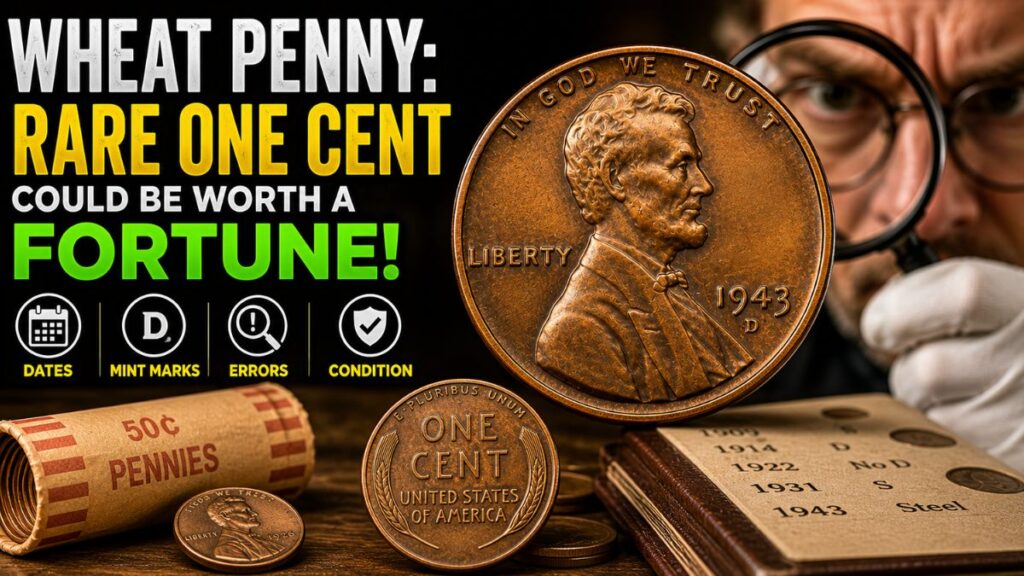
A Wheat Penny may look like an ordinary old one-cent coin, but some examples can be surprisingly valuable. That is what makes searching through old collections, inherited coin jars, family albums, and forgotten boxes so interesting. A small copper-colored coin can sometimes contain a feature that separates it from millions of ordinary examples.
The important word is sometimes.
Not every Wheat Penny is rare, and most old Wheat Cents are not worth anything close to the dramatic figures often seen in viral social-media posts. A coin’s real value depends on exactly what it is, how rare that specific issue or variety is, its condition, authenticity, and what collectors are willing to pay for it.
That distinction matters because headlines about extremely valuable pennies can create unrealistic expectations. A Wheat Penny is not automatically valuable simply because it is old. The date, mint mark, variety, error, composition, and preservation all need to be examined.
The Wheat Penny series is particularly interesting because it covers several decades of American coinage and includes numerous key dates, scarce issues, famous doubled dies, unusual compositions, and minting errors. Some varieties are widely recognized by collectors, while others require specialized knowledge to identify.
For someone discovering an old Wheat Penny, the first step should not be asking, “Is this worth a fortune?”
The better question is, “What exactly is this coin?”
Once the coin has been correctly identified, its potential significance becomes much easier to understand.
What Is a Wheat Penny?
The term Wheat Penny generally refers to the Lincoln cent produced from 1909 through 1958 with two wheat ears appearing on the reverse.
The coin was introduced in 1909 to commemorate the centennial of Abraham Lincoln’s birth. The design featured Lincoln on the obverse, while the reverse displayed two wheat ears surrounding the inscriptions associated with the denomination and the United States.
That reverse design remained in use until 1959, when it was replaced by a new Lincoln cent reverse commemorating the Lincoln Memorial.
Because of the wheat-ear design, collectors commonly call the earlier Lincoln cents “Wheat Pennies” or “Wheat Cents.”
The series is historically important because it spans major changes in American history, including two world wars, the Great Depression, changing manufacturing practices, and significant developments in United States coin production.
During those decades, millions upon millions of Lincoln cents were produced. As a result, simply finding a Wheat Penny does not mean you have discovered a rare coin.
However, within this large series are individual dates and varieties that collectors consider especially important.
That is where the search becomes interesting.
Why Some Wheat Pennies Are Worth Much More Than Others
There is no single factor that determines the value of a Wheat Penny.
Instead, several characteristics work together.
The first is rarity. A coin that exists in very small numbers can attract significant collector interest, particularly if demand remains strong.
The second is the date and mint mark. Certain combinations are much scarcer than others.
The third is variety or minting error. A major doubled die, unusual planchet, off-center strike, or other legitimate mint error can dramatically change the identity of a coin.
The fourth is condition. Two otherwise identical coins can have very different values if one is heavily worn while the other retains exceptional original detail.
The fifth is authenticity.
This is particularly important with famous Wheat Penny varieties. Valuable coins attract counterfeiters, and altered coins can sometimes be made to resemble desirable examples.
Finally, market demand matters. A coin’s value is not determined by age alone. Collectors must actually want the particular coin, and transactions involving authenticated examples help establish what the market has paid.
This means there is no universal price for “a Wheat Penny.”
There are thousands of different possibilities within the series.
Start With the Date
The date is usually the first thing to examine.
Turn the coin so the obverse is clearly visible and inspect the year carefully. On an old Wheat Penny, even a single digit can make a major difference in identification.
Do not rely on memory.
Look at the actual coin.
Worn surfaces can make digits difficult to read, and dirt or discoloration can obscure important details. Use good lighting and, if necessary, a magnifying glass rather than aggressively rubbing the surface.
Once the date is clear, the next question is whether there is a mint mark.
That tiny letter can be extremely important.
Different United States Mint facilities produced Lincoln cents during different periods. A coin without a mint mark can have a different production history from one carrying a mint mark, and particular date-and-mint combinations can have very different levels of scarcity.
The date and mint mark should therefore be considered together.
For example, two Wheat Pennies from the same year can look almost identical while having very different collector significance because they came from different mints.
That is why identifying only the year is not enough.
Why the Mint Mark Matters
Mint marks are small letters placed on coins to indicate the mint facility responsible for production.
On Wheat Pennies, collectors may encounter different mint marks depending on the year.
The location of the mint mark can also vary by period, so identification should be based on the specific coin rather than a general assumption about where the letter should appear.
A missing mint mark is not automatically an error.
This is one of the most common misunderstandings among beginning collectors.
Many Wheat Pennies were intentionally produced without a mint mark, and these coins can be perfectly normal.
Likewise, a tiny letter does not automatically make a coin valuable.
The combination of date, mint mark, variety, condition, and other characteristics determines whether a particular coin deserves closer attention.
If you are searching a group of Wheat Pennies, recording the date and mint mark of every potentially interesting coin is a simple way to organize your collection.
Famous Key Dates in the Wheat Cent Series
Some Wheat Cents are especially well known among collectors because of their scarcity and historical importance.
One of the most famous is the 1909-S VDB.
The 1909-S VDB has become one of the best-known Lincoln cent varieties because it combines an early date, the San Francisco mint mark, and the initials VDB associated with designer Victor David Brenner.
The initials appeared on the reverse and became controversial soon after the coin’s introduction. They were subsequently removed from the design.
Because the combination is distinctive and collectible, genuine examples receive considerable attention.
Another famous issue is the 1914-D Lincoln cent.
Its Denver mint origin and relatively limited surviving population have made it an important date for Lincoln cent collectors.
The 1922 No D is another famous variety.
This issue is associated with Denver and is notable because the expected D mint mark is absent from certain examples due to a known minting circumstance. However, identifying a genuine example requires care because worn or damaged coins can sometimes create misleading appearances.
The 1931-S Lincoln cent is another recognized key date in the Wheat Cent series.
Its relatively low mintage compared with many other Lincoln cents has made it particularly interesting to collectors.
These examples demonstrate an important principle:
A Wheat Penny becomes interesting not simply because it is old, but because its specific history and surviving population make it desirable.
The 1909-S VDB and Why Collectors Recognize It
The 1909-S VDB deserves special attention because it represents one of the most recognizable early Lincoln cent issues.
The coin carries the 1909 date and the S mint mark associated with San Francisco. The VDB initials appear on the reverse.
Those initials refer to Victor David Brenner, the designer of the Lincoln cent.
The initials became controversial because of their prominent placement. They were removed from subsequent Lincoln cents, making the 1909-S VDB particularly recognizable.
However, a collector should not assume that every coin with “VDB” is rare.
The date and mint mark matter.
A 1909 Lincoln cent with VDB is not automatically equivalent to a genuine 1909-S VDB.
This is an excellent example of why precise identification is essential.
When examining a possible 1909-S VDB, inspect the date, mint mark, reverse details, and VDB initials together. Because this is a famous and valuable collectible, authentication becomes particularly important if the coin appears genuine and well preserved.
The 1914-D Lincoln Cent
The 1914-D is another major date that can attract strong collector interest.
The D indicates Denver.
Because Lincoln cents from this period exist in many common date-and-mint combinations, a 1914-D can be easily overlooked by someone unfamiliar with the series.
Condition becomes particularly important when evaluating a coin of this type.
A heavily circulated example may have substantial wear, while a coin with strong original detail and better preservation can occupy a very different position in the collector market.
This illustrates a broader rule that applies across the Wheat Cent series:
The date establishes identity, but condition helps determine desirability.
A collector should therefore resist the temptation to assign a value immediately after spotting a key date.
The next step is examination.
The 1922 No D and the Importance of Genuine Varieties
The 1922 No D is one of the best-known Lincoln cent varieties and demonstrates how complicated coin identification can become.
The coin is associated with Denver production, yet certain recognized examples do not show the expected D mint mark.
That sounds simple.
In practice, it is not.
A weak or worn mint mark can disappear visually because of circulation. Damage, abrasion, polishing, or other changes can also affect the appearance of a coin.
That means a coin that appears to have “no D” should not automatically be treated as a rare variety.
Collectors need to examine the entire coin and compare the relevant characteristics with established examples.
This is another reason professional authentication can be valuable when a potentially major rarity is involved.
The 1931-S Wheat Cent
The 1931-S Lincoln cent is another issue frequently discussed when collectors study key dates.
The S identifies San Francisco.
Compared with many other Lincoln cents, the 1931-S has become an important date for collectors because of its relatively low production compared with more common issues.
Again, the existence of a 1931-S does not mean every example is worth an extraordinary amount.
Condition, authenticity, surface quality, and market demand all matter.
A worn coin and a sharply preserved coin should not be treated as interchangeable.
The lesson is simple: identifying a scarce date is the beginning of the valuation process, not the end.
Doubled Dies Can Change a Wheat Penny’s Identity
Mint varieties are another major area of interest.
One of the most famous examples is the 1955 Doubled Die Obverse Lincoln cent.
A true doubled die is created during the die-making process and can produce noticeable doubling on parts of the design.
The 1955 variety is especially famous because doubling can be visible in important areas such as the date and lettering.
This should not be confused with ordinary damage or post-mint doubling.
A coin can become scratched, hit, distorted, or mechanically damaged after leaving the mint. Those effects do not automatically create a collectible doubled-die variety.
True doubled dies are characteristics of the die itself.
This distinction is extremely important when searching through Wheat Pennies.
A magnifying glass can help identify possible doubling, but it should be used as a screening tool rather than a substitute for expert examination.
How to Look for Doubling Correctly
When examining a Wheat Penny for possible doubling, start with the date and lettering.
Look for clear separation or secondary images rather than simply noticing that the edges appear uneven.
The shape, direction, and location of the apparent doubling matter.
Lighting can also dramatically change what you see.
Tilting the coin slightly under a bright light can reveal details that are difficult to notice under flat lighting.
However, avoid touching the surfaces unnecessarily.
Finger oils, dirt, and scratches can reduce the quality of the coin.
Most importantly, do not clean the coin simply because it looks dirty.
Cleaning can permanently damage the original surface and may reduce collector desirability.
Why Coin Cleaning Can Be a Serious Mistake
Someone who discovers an old Wheat Penny may naturally want to make it look brighter.
That can be a costly mistake.
Collectors generally value original surfaces. Scrubbing, polishing, chemical treatment, scraping, or abrasive cleaning can leave permanent marks.
Even if the coin becomes visually brighter, the alteration can make it less desirable.
This is especially important if the coin turns out to be rare.
The safest approach is simple:
Leave the coin alone.
Do not polish it.
Do not scrape the surface.
Do not use household chemicals.
Do not attempt to remove discoloration aggressively.
If the coin appears potentially valuable, preserve it exactly as you found it and seek an appropriate evaluation.
Composition Can Matter
Another important characteristic in rare Lincoln cents is metal composition.
Most collectors associate Wheat Pennies with copper-colored bronze cents, but wartime production created an important exception.
In 1943, the United States Mint produced Lincoln cents primarily using zinc-coated steel rather than the traditional bronze composition.
The change was connected to wartime demand for copper.
This makes the 1943 cent particularly interesting when discussing unusual compositions.
A very small number of 1943 Lincoln cents were accidentally struck on bronze planchets instead of the intended steel planchets.
Genuine 1943 Bronze Cents are among the most famous Lincoln cent rarities.
Some authenticated examples have reached extraordinary auction prices, including sales above the million-dollar level.
But this does not mean every 1943 Wheat Penny is valuable.
Most 1943 cents are steel.
A collector should therefore be extremely cautious before assuming a 1943 coin is a rare bronze example.
How to Screen a 1943 Cent
One basic screening method involves weight.
A typical bronze Lincoln cent from this era weighs approximately 3.11 grams, while a 1943 steel cent is lighter at approximately 2.70 grams.
This difference can be useful as an initial clue.
However, weight alone does not prove authenticity.
Coins can be damaged, altered, coated, or otherwise manipulated.
Color is also not enough.
A coin that looks copper-colored is not automatically a genuine bronze 1943 cent.
Likewise, a magnetic reaction can provide a clue because ordinary 1943 steel cents contain steel, but magnetic testing is still only part of an identification process.
If a 1943 cent appears to have the characteristics of a bronze example, professional authentication becomes extremely important.
A coin with a potentially extraordinary value should never be altered during testing.
Why $5 Million Claims Require Caution
Rare-coin headlines can be extremely dramatic.
You may see claims that a Wheat Penny is worth millions, that someone discovered a $5 million coin, or that every old penny could become a fortune.
These statements can be misleading when they are presented without context.
A normal Wheat Penny is not automatically worth millions.
Even among genuinely rare coins, values differ significantly.
Auction records relate to specific coins with specific characteristics, grades, histories, and authentication.
An advertised asking price is not the same thing as a completed sale.
A social-media claim is not the same thing as a documented transaction.
Therefore, collectors should treat extraordinary valuations carefully.
The right question is not “What is the biggest price I have seen online?”
The right question is “What evidence establishes the value of this exact coin?”
Condition Can Make a Major Difference
Condition is one of the most important parts of coin valuation.
A Wheat Penny that circulated for decades may show wear across Lincoln’s portrait, lettering, wheat ears, and other design elements.
Another example from the same date may have survived with much sharper details.
Collectors generally distinguish different levels of preservation when evaluating coins.
For a beginner, the easiest approach is to recognize that heavily worn coins and exceptionally preserved coins should not be treated as equal.
Surface quality matters as well.
Scratches, corrosion, cleaning, stains, discoloration, and other damage can influence collector interest.
A coin may have a desirable date but still be worth less than a similar coin with stronger preservation.
Conversely, an exceptionally preserved example of an important issue can attract considerable attention.
Why Original Color Matters
Copper-based coins naturally change appearance over time.
A Wheat Penny can develop different shades depending on its environment and history.
Collectors may describe coins according to their color characteristics, but color should never be considered separately from the rest of the coin.
Artificially changing the surface can cause problems.
A bright, freshly polished appearance is not necessarily desirable.
Original surfaces are generally preferred over surfaces that have been chemically treated or aggressively cleaned.
If you find an old Wheat Penny with unusual color, do not immediately assume the color makes it rare.
Instead, investigate the date, mint mark, variety, composition, condition, and authenticity.
What Counts as a Mint Error?
Mint errors occur when something goes wrong during the production process.
Examples can include off-center strikes, certain planchet errors, wrong planchet strikes, clipped planchets, and other recognized production mistakes.
However, not every unusual-looking coin is a mint error.
A scratch is not automatically a mint error.
A dent is not automatically a mint error.
A coin damaged by machinery after leaving the mint is not necessarily a collectible error.
The distinction between a genuine mint error and post-mint damage is extremely important.
Collectors who discover an unusual Wheat Penny should document what they see rather than immediately assigning a dramatic label.
Off-Center Wheat Pennies
An off-center strike occurs when the planchet is not correctly positioned during striking.
This can produce a visibly shifted design and an area of blank metal.
The degree of displacement can vary.
Some minor examples may have limited collector interest, while more dramatic and clearly identifiable errors can be more desirable.
Again, condition and authenticity matter.
An off-center appearance should be examined carefully to determine whether it occurred during minting or resulted from damage later.
The most useful approach is to observe the coin rather than manipulate it.
Do not bend the coin or attempt to reproduce an error.
The Difference Between a Variety and an Error
Collectors sometimes use the words “error” and “variety” interchangeably, but they describe different concepts.
A variety generally involves a recurring characteristic associated with a die or production process.
A doubled die is a well-known example.
An error generally refers to an unintended mistake involving the coin’s production, such as an unusual strike or planchet problem.
The distinction can become technical, but the practical lesson is straightforward:
Not every unusual mark has collectible significance.
Understanding exactly what happened to the coin is more important than giving it an exciting label.
Why Authentication Matters for Rare Wheat Pennies
If a Wheat Penny appears to be extremely rare, authentication should be taken seriously.
Famous rarities are attractive targets for alteration and counterfeiting.
A valuable-looking date may be modified to resemble a scarcer mint-mark combination.
A mint mark can potentially be altered.
Surfaces can be manipulated.
Coins can be artificially colored.
And counterfeit examples can be produced to imitate desirable pieces.
That is why a potentially valuable coin should not be judged solely by a photograph, a social-media comment, or an online price listing.
Professional examination can help determine whether the coin is genuine and whether its variety or error is legitimate.
For a potentially high-value Wheat Penny, authentication can be one of the most important steps in the entire process.
How to Inspect a Wheat Penny at Home
You do not need expensive equipment to begin examining an old Wheat Penny.
Start with good natural or neutral lighting.
Handle the coin carefully by its edges.
Look at the date.
Then check the mint mark.
Examine the portrait and lettering.
Turn the coin over and inspect the wheat-ear reverse.
Look for unusual doubling, missing design elements, off-center striking, or other characteristics.
If the coin appears unusual, use a magnifying glass.
A precise digital scale can also be useful for screening coins where composition is relevant.
But remember that basic tools help with identification; they do not automatically authenticate a rare coin.
The goal of home inspection is to determine whether the coin deserves further professional attention.
What You Should Record During Your Search
If you have a large collection of Wheat Pennies, organization can make the process much easier.
Write down the year.
Record the mint mark.
Note any unusual characteristics.
Record obvious damage or cleaning.
Keep potentially important coins separate from ordinary examples.
For coins that appear especially interesting, take clear photographs of both sides without altering the coin.
You can also record weight when composition is relevant.
This information creates a useful identification record.
It also reduces the risk of confusing one coin with another when you have a large group.
Where People Often Find Wheat Pennies
Wheat Pennies can turn up in old collections, inherited coin groups, antique containers, family albums, and other places where older United States coins have been preserved.
Some were saved because of nostalgia.
Others remained in circulation or were placed into jars without anyone realizing they had become collectible.
The important point is that age alone does not determine value.
A box containing hundreds of old pennies might contain mostly common coins.
It could also contain a more unusual date or variety.
That possibility is what makes sorting old Wheat Cents appealing to collectors.
The search itself becomes a process of identification.
Why Old Does Not Automatically Mean Rare
A coin can be more than a century old and still exist in substantial numbers.
Rarity depends on factors such as original production, survival, condition, attrition, and collector demand.
A common date can remain common even after many decades.
Meanwhile, a specific variety may be difficult to find despite belonging to the same series.
This is why “old penny” and “rare penny” should never be treated as synonyms.
The date is the starting point.
The complete identification is the real objective.
Understanding Auction Prices
Auction prices can provide useful evidence when studying rare Wheat Pennies.
But they must be interpreted carefully.
A major auction result usually relates to one specific coin.
That coin may have a particular grade, exceptional preservation, documented authenticity, or a rare variety.
Another coin that appears similar may not have the same characteristics.
Therefore, it is dangerous to take a headline auction result and apply it to every coin with the same date.
For example, an extraordinary result for a famous rare cent does not mean every Wheat Penny is suddenly worth the same amount.
The exact coin matters.
Auction records are evidence of what buyers paid for particular examples, not guarantees of what another coin will sell for.
Why Asking Prices Can Be Misleading
Online marketplaces often contain coins listed at extremely high prices.
A listing price does not prove that the coin has actually sold for that amount.
Anyone can ask for a certain price.
The more meaningful evidence comes from completed transactions involving genuine, comparable examples.
Even then, prices can vary because of condition, authentication, timing, buyer interest, and other factors.
This is especially important when researching viral claims about million-dollar pennies.
A collector should separate asking prices, estimated values, auction results, and confirmed sales.
They are not interchangeable.
The Role of Collector Demand
Rarity alone does not create an enormous market.
Collectors also need to care about the coin.
Lincoln Cents have an established collector community, which contributes to demand for important dates and varieties.
Historical importance can increase interest.
Famous errors can attract attention.
Exceptional condition can make a coin more desirable.
And certain key dates have remained popular across generations of collectors.
This combination of rarity, history, condition, and demand explains why some small copper-colored coins can command significant premiums.
What to Do If You Think You Found a Rare Wheat Penny
The first rule is simple:
Do not clean it.
The second rule is:
Do not alter it.
Do not scrape the surface to see whether a mint mark is underneath.
Do not polish the coin.
Do not drill it, bend it, scratch it, or apply chemicals.
If the coin appears to be a potentially important rarity, preserve it in its current condition.
Document the date and mint mark.
Examine both sides carefully.
Compare its characteristics with established descriptions of the relevant variety.
Then consider professional authentication.
The more valuable the suspected rarity, the more important professional confirmation becomes.
How Beginners Can Avoid Common Mistakes
One of the biggest mistakes is assuming every Wheat Penny is valuable.
Another is focusing on a single feature.
For example, someone may see an unusual color and assume the coin is made from a rare metal.
Someone else may see a missing mint mark and immediately call it an error.
Another person may find doubling caused by damage and mistake it for a valuable doubled die.
These mistakes are understandable because coin collecting contains many technical details.
The best defense is careful identification.
Do not rush.
A potentially valuable coin will not become less valuable because you spent time examining it carefully.
Why Magnification Helps
Many important coin details are extremely small.
Mint marks can be tiny.
Doubled design elements may require close examination.
Surface damage can also be easier to recognize under magnification.
A basic magnifying glass can therefore be useful.
However, magnification should reveal information rather than encourage physical manipulation.
If a detail cannot be identified confidently, stop before attempting anything aggressive.
A professional can examine the coin using more advanced equipment without risking unnecessary damage.
Safe Handling of Old Wheat Pennies
Hold valuable-looking coins by the edges.
Avoid touching the main surfaces repeatedly.
Keep coins separated when necessary so they do not rub against one another.
Avoid loose storage where coins can become scratched.
If you suspect a major rarity, prioritize preservation over cleaning or presentation.
The goal is to protect the evidence already present on the coin.
Every scratch or chemical treatment can permanently change that evidence.
Why the Internet Can Create Confusion
Online videos and posts have made rare-coin collecting more visible than ever.
That visibility can encourage people to check old coins, which can be positive.
However, viral content often removes important context.
A headline may mention a huge auction price without explaining the exact coin involved.
A photograph may show an extraordinary rarity while implying that similar-looking coins have the same value.
A listing may display a huge price without showing evidence of an actual sale.
For beginners, this can make the market seem much simpler than it really is.
The solution is to slow down and focus on identification.
A real rarity should have specific characteristics that can be examined.
The Most Important Checklist for a Wheat Penny
When you find a Wheat Penny, work through a simple checklist.
First, identify the year.
Second, identify the mint mark, if present.
Third, inspect the design for recognized varieties.
Fourth, look for genuine minting errors.
Fifth, consider the coin’s composition when the issue makes that relevant.
Sixth, examine the condition.
Seventh, check whether the coin shows signs of cleaning or alteration.
Eighth, consider authentication if the coin appears to be a significant rarity.
This approach is much more reliable than judging a coin by appearance alone.
Why the Exact Date Can Be Everything
Two Wheat Pennies can have nearly identical designs and still occupy completely different places in the collector market.
The difference may be one year.
It may be one mint mark.
It may be a specific die variety.
It may be a rare composition.
That is why experienced collectors pay such close attention to dates.
A tiny number printed on a coin can tell an enormous story about when and where it was made.
The date is therefore not just a number.
It is part of the coin’s identity.
Why Minting History Makes Wheat Cents Fascinating
The Wheat Cent series captures changing American manufacturing practices.
The coins were produced during periods of economic growth, depression, war, and technological change.
Different mint facilities produced coins in different quantities.
Different dies were used.
Production mistakes occurred.
Design characteristics changed.
Metal requirements changed during wartime.
All of these factors contributed to the wide range of collectible varieties found within the series.
That historical depth is one reason Wheat Pennies remain popular even when a particular coin is not especially valuable.
The Difference Between Collectible and Extremely Valuable
A coin does not have to be worth thousands or millions of dollars to be interesting.
A common Wheat Penny can still be historically fascinating.
A scarce date can be desirable without being a million-dollar rarity.
A genuine error can be collectible without producing a spectacular auction result.
This distinction is important because the hobby is about more than finding a fortune.
It is also about understanding history, manufacturing, design, preservation, and collecting.
The possibility of finding a major rarity simply adds excitement.
Could an Ordinary Wheat Penny Be Worth a Fortune?
It is possible for a Wheat Cent to be worth dramatically more than its face value, but that does not mean an ordinary Wheat Penny is automatically a fortune.
The phrase “right coin” is critical.
A genuinely rare date, recognized major variety, unusual composition, or important mint error can change the situation.
Condition can further influence the result.
Authentication can establish whether the suspected rarity is genuine.
Without those characteristics, most Wheat Pennies do not belong in the same category as famous six- or seven-figure examples.
So if you have a Wheat Penny, do not spend it before checking it.
But do not assume it is worth a fortune either.
Identify first.
Evaluate second.
What Makes a Wheat Penny Worth Investigating?
A Wheat Penny deserves closer attention when it combines one or more potentially important characteristics.
An early key date can be significant.
A scarce mint-mark combination can matter.
A recognized doubled die can be important.
An unusual composition can be extremely significant in the right circumstances.
A major mint error can attract collector interest.
Exceptional condition can also elevate a coin’s importance.
The strongest candidates are those where multiple characteristics align.
For example, a scarce date combined with strong preservation and authentic originality can be much more interesting than a heavily damaged example.
Why Authentication Is More Important With Famous Coins
The more famous a variety becomes, the more likely it is to attract attempts at imitation or alteration.
This is particularly relevant for famous Lincoln cent rarities.
A beginner may see a promising date and become excited.
That excitement is understandable.
But excitement should be followed by verification.
If the potential value is substantial, professional authentication can help establish whether the coin is genuine and whether it matches the recognized variety.
This protects the collector from making decisions based on a mistaken identification.
What Not to Do With a Potentially Valuable Penny
Do not clean it.
Do not polish it.
Do not scrape it.
Do not chemically treat it.
Do not attempt to add or remove a mint mark.
Do not bend it.
Do not punch a hole in it.
Do not rely on a viral valuation.
Do not assume an online listing proves market value.
Do not sell a potentially major rarity before understanding exactly what you have.
The safest strategy is preservation and careful identification.
A Practical Wheat Penny Search Strategy
If you have a large group of Wheat Pennies, you do not need to inspect every microscopic detail immediately.
Start by sorting coins by year.
Then separate coins with notable mint marks.
Look for well-known key dates and varieties.
Set aside coins that appear unusually well preserved.
Create a separate group for coins showing possible errors or unusual compositions.
Then examine the candidates more carefully.
This makes the process manageable.
Instead of trying to determine the value of hundreds of coins at once, you narrow the collection down to pieces that deserve additional research.
Why Patience Matters
Rare-coin identification is not a race.
A single small feature can change the identity of a coin.
A worn mint mark can be difficult to interpret.
A suspected doubled die can require careful comparison.
A possible unusual composition may require more than a visual inspection.
Taking your time reduces mistakes.
It also protects the coin.
The worst outcome is not failing to recognize a rarity immediately.
The worst outcome is damaging the coin while trying to prove that it is rare.
What a Genuine Rarity Can Teach You
A rare Wheat Penny can provide insight into American coin production.
It may show how wartime material shortages affected manufacturing.
It may demonstrate how dies were produced and used.
It may reveal how minting errors happened.
It may preserve an unusual combination of date and mint.
And it can demonstrate how condition changes the collector market.
That is why rare coins are more than objects with prices attached to them.
They are physical records of history and manufacturing.
Why Wheat Pennies Remain Popular Today
The Wheat Penny has a combination that few coins can match.
It is old enough to feel historic.
It is common enough that ordinary people can still encounter examples.
Its design is instantly recognizable.
Its series contains famous rarities.
And the possibility of finding something unusual makes searching exciting.
A person can start with a handful of old pennies and quickly become interested in dates, mint marks, varieties, grading, errors, and authentication.
That accessibility is one of the reasons the series continues to attract collectors.
Frequently Asked Questions About Wheat Pennies
Are all Wheat Pennies valuable?
No. Most Wheat Pennies are not worth extraordinary amounts. Value depends on the specific date, mint mark, variety, error, condition, authenticity, and collector demand.
How old is a Wheat Penny?
The Lincoln Wheat Cent design was used from 1909 through 1958. The wheat-ear reverse was replaced in 1959.
What should I check first on a Wheat Penny?
Start with the date and mint mark. Then inspect the coin for recognized varieties, errors, unusual composition, and condition.
Can a Wheat Penny really be worth millions?
Some exceptionally rare and authenticated Lincoln cents have reached six- and seven-figure auction prices. However, this applies to specific extraordinary coins and does not mean ordinary Wheat Pennies are worth millions.
Is every 1943 copper-colored penny valuable?
No. A 1943 cent should be examined carefully because most 1943 cents were made from zinc-coated steel. A genuine bronze example is extremely rare, but color alone cannot establish that a coin is bronze.
How can I tell whether a 1943 cent might be bronze?
Weight can provide an initial clue. Bronze cents from the period are approximately 3.11 grams, while typical 1943 steel cents are approximately 2.70 grams. However, weight alone cannot authenticate a rare coin.
What is the 1909-S VDB?
It is a famous early Lincoln cent carrying the 1909 date, the S mint mark, and the VDB initials associated with designer Victor David Brenner. Genuine examples are important collectibles.
What is the 1955 Doubled Die?
The 1955 Doubled Die is a famous Lincoln cent variety with prominent doubling on parts of the obverse design, particularly noticeable in the date and lettering.
Is a missing mint mark automatically valuable?
No. Some Wheat Pennies were intentionally produced without mint marks. A missing letter should not automatically be considered an error.
Can cleaning reduce the value of a Wheat Penny?
Yes. Cleaning, polishing, chemicals, or abrasive treatment can damage the original surface and reduce collector desirability.
Should I use a magnet on a Wheat Penny?
A magnet can sometimes provide a useful screening clue for a 1943 cent because typical 1943 steel cents are magnetic. However, magnetic behavior alone cannot authenticate a rare coin.
Are online prices reliable?
Not necessarily. An asking price is different from a completed sale. Reliable evaluation should focus on the exact coin, its authenticity, condition, variety, and documented market evidence.
Should I get a rare-looking Wheat Penny professionally authenticated?
If a coin appears to be a significant rarity, professional authentication is strongly worth considering. This is especially important for famous key dates, major varieties, unusual compositions, and potentially high-value errors.
What is the biggest mistake a beginner can make?
One of the biggest mistakes is assuming that an old coin is automatically valuable. Another is cleaning or altering a coin before it has been properly examined.
Can a Wheat Penny still be found in an old collection?
Yes. Old Wheat Pennies can remain in collections, inherited coin groups, jars, albums, and other stored accumulations. Finding one does not guarantee rarity, but it can be worth checking carefully.
Why are mint marks so important?
Mint marks can identify where a coin was produced. Certain date-and-mint combinations are much scarcer than others, so the mint mark can significantly affect identification and collector interest.
What should I do if I think I found a major rarity?
Handle it carefully, avoid cleaning or altering it, document both sides, record the date and mint mark, and seek professional authentication if the characteristics suggest a significant rarity.
The Final Takeaway for Wheat Penny Collectors
The excitement surrounding Wheat Pennies comes from a simple possibility: a coin that looks ordinary may contain an extraordinary combination of date, mint mark, variety, error, composition, or condition.
But identifying that combination is what matters.
A Wheat Penny is not valuable simply because it is old.
A worn common date is different from a scarce key date. A normal 1943 steel cent is different from a genuine bronze example. Ordinary doubling caused by damage is different from a recognized doubled-die variety. A high asking price is different from a documented auction result.
These distinctions protect collectors from unrealistic claims while making genuine discoveries even more meaningful.
If you have a collection of Wheat Pennies, begin with the basics. Check every date. Look carefully for mint marks. Pay attention to famous varieties and legitimate mint errors. Consider composition when the date makes it relevant. Examine condition without attempting to improve the coin yourself.
And above all, never clean a potentially valuable Wheat Penny.
The most important lesson is that the value of a rare coin comes from its exact identity, not from the headline attached to it.
Some genuine Wheat Cents have reached remarkable prices, including six- and seven-figure auction results. Those coins are exceptional because they possess characteristics that make them rare and desirable.
So the next time you find an old Wheat Penny, don’t immediately throw it into a spending pile.
Turn it over.
Read the date.
Check the mint mark.
Study the details.
Look for legitimate varieties or unusual minting characteristics.
You may discover nothing more than an interesting piece of American history—and that is still worth appreciating.
But if the coin shows the right combination of rarity and authenticity, you may have found something that deserves much closer attention.
That is the real appeal of Wheat Penny collecting: the possibility of discovering history hiding in plain sight, one tiny cent at a time.