The 1942-P Jefferson Nickel is not an ordinary five-cent coin.
It belongs to one of the most interesting chapters in United States coin history, when World War II forced the U.S. Mint to change the metal used in everyday nickels.
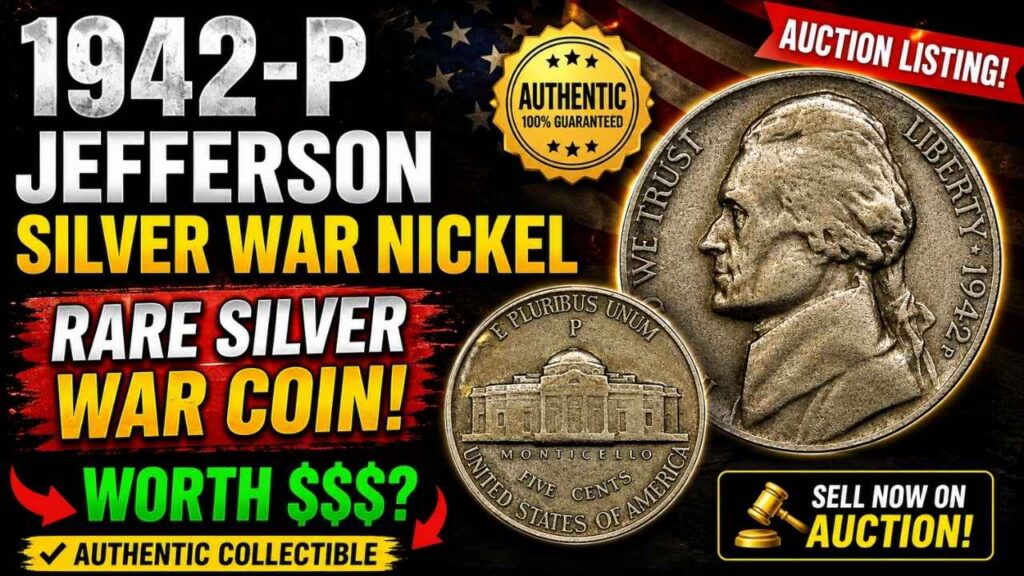
If you have an old Jefferson Nickel dated 1942 with a large P above Monticello on the reverse, you may be holding one of America’s famous wartime silver nickels.
These coins were made with approximately 35% silver, along with copper and manganese. The change was necessary because nickel was an important strategic material during the war.
Today, the 1942-P Jefferson Silver War Nickel is collected for several different reasons.
Some examples are worth only a few dollars.
Others in excellent condition can bring significantly more.
Coins with strong Full Steps detail, exceptional grades, recognized varieties, or major mint errors can become especially desirable.
This is why collectors often search old coin jars, inherited collections, estate finds, and rolls of Jefferson Nickels for the 1942-P.
The most important thing to remember is that the words “1942-P Silver Nickel” do not automatically mean that every example is worth hundreds or thousands of dollars.
The coin is already a genuine silver-containing U.S. issue, but its collector value depends heavily on condition, strike quality, preservation, variety, and whether it has an unusual mint error.
Why the 1942-P Nickel Is Different
Before World War II, the Jefferson Nickel was normally made from an alloy containing copper and nickel.
Nickel became strategically important during the war because it was needed for military production and other equipment.
The U.S. Mint therefore developed a replacement alloy.
Beginning with wartime nickels, the traditional composition was changed to approximately 56% copper, 35% silver, and 9% manganese.
The result was a five-cent coin containing real silver.
This wartime composition continued through 1945.
The 1942-P is especially recognizable because Philadelphia placed a large P mint mark on the reverse of the wartime nickel.
That was a major change.
Collectors could now quickly distinguish the new wartime composition from earlier and later Jefferson Nickels.
What Does the P Mean?
The large P on the reverse represents the Philadelphia Mint.
Look above Monticello on the reverse of the coin.
You should find a prominent letter P.
This is one of the easiest ways to identify a 1942-P wartime nickel.
If your coin is dated 1942 and has the large P in that location, it belongs to the wartime silver-nickel series.
Do not confuse this with a tiny accidental mark or damage.
The wartime mint mark is intentionally large and clearly positioned above Monticello.
Basic Facts About the 1942-P Silver Nickel
The 1942-P Jefferson Silver War Nickel has several characteristics that make identification relatively straightforward.
The basic specifications are:
- Date: 1942
- Mint: Philadelphia
- Mint mark: Large P
- Denomination: Five cents
- Designer: Felix Schlag
- Diameter: approximately 21.2 millimeters
- Weight: approximately 5 grams
- Edge: Plain
- Composition: approximately 35% silver, 56% copper, and 9% manganese
- Wartime issue: Yes
- Regular mintage: roughly 57.9 million pieces
Although nearly 58 million were produced, many examples survived.
Therefore, the 1942-P should not automatically be described as an extremely rare coin.
Its silver content and historical importance make it collectible, but true rarity usually comes from exceptional condition, Full Steps, varieties, or major errors.
How to Identify a Genuine 1942-P
Start with the date.
The obverse should clearly show 1942.
Then turn the coin over.
Look above Monticello.
You should see the large P.
Next, examine the overall appearance.
A genuine wartime nickel may have a somewhat different color from a regular pre-war Jefferson Nickel.
The coin should also have a plain edge rather than the reeded edge found on many other U.S. denominations.
Finally, check the weight.
A normal wartime Jefferson Nickel weighs approximately 5 grams.
These characteristics together provide a strong starting point for identification.
Why the Silver Content Matters
The 1942-P is not valuable simply because someone calls it a “silver nickel.”
It actually contains silver.
That gives the coin a base metal value in addition to its collectible value.
However, the amount of silver is much smaller than in a silver U.S. quarter or half dollar.
A wartime nickel contains about 35% silver rather than being made almost entirely from silver.
Therefore, its market price is influenced by both silver value and numismatic demand.
When silver prices move, the underlying metal value of wartime nickels can change.
But collectible examples can trade for much more than their metal value.
The 1942 Transition Is Particularly Interesting
The year 1942 was unusual because the U.S. Mint produced more than one type of Jefferson Nickel.
Earlier 1942 nickels can be found with the traditional pre-war composition.
Later wartime issues used the new silver alloy.
That makes 1942 a fascinating transition year.
Collectors who specialize in Jefferson Nickels often want to understand exactly which 1942 variety they have.
The 1942-P with the large P is the famous wartime silver type.
That large mint mark is an important identification feature.
Is Every 1942 Nickel Silver?
No.
This is one of the biggest mistakes made by new collectors.
Not every 1942 Jefferson Nickel has the wartime silver composition.
The date alone is not enough.
The large mint mark above Monticello is a key clue.
A 1942-P wartime nickel is part of the silver-alloy series.
A 1942 nickel without the large wartime mint mark can belong to a different composition category.
So if you find a 1942 nickel, turn it over before making any assumptions.
How Much Is a 1942-P Worth?
The value depends on condition.
A circulated 1942-P wartime nickel can often trade for several dollars rather than merely five cents.
The exact amount changes with silver prices, condition, collector demand, and the marketplace.
An ordinary circulated example is not normally a $500 coin.
An uncirculated coin can be worth more.
A high-grade example with excellent surfaces can command a stronger premium.
A Full Steps example can be substantially more desirable.
And a rare mint error can move into a completely different price category.
Typical Circulated Examples
Circulated coins have experienced normal use.
You may see wear on Jefferson’s portrait.
The hair details can become softer.
The lettering may show wear.
The reverse details around Monticello may also lose sharpness.
These coins can still be attractive and collectible.
For many collectors, a circulated 1942-P is an affordable way to own a genuine World War II-era silver coin.
The fact that it contains silver also gives it an interesting connection to the wartime economy.
Extremely Fine and About Uncirculated
As the condition improves, the coin becomes more attractive to collectors.
An Extremely Fine example retains considerably more detail than a heavily circulated coin.
An About Uncirculated coin may show only limited evidence of circulation.
The original luster can remain partially visible.
These coins generally command more than heavily worn pieces.
However, grading is not determined simply by whether the coin “looks nice.”
Surface marks, wear patterns, strike quality, and original luster all matter.
Uncirculated 1942-P Nickels
An uncirculated example has never experienced normal circulation wear.
It may retain much of its original mint luster.
But uncirculated does not mean flawless.
A coin can have contact marks from being stored together with other coins.
It can also have strike weakness.
For Jefferson Nickels, the reverse steps of Monticello are particularly important.
This leads to one of the most desirable features in the series: Full Steps.
What Are Full Steps?
Look at Monticello on the reverse.
The building has a series of horizontal steps.
When those steps are sharply defined and uninterrupted, the coin may qualify for a Full Steps designation.
This can have a significant effect on collector interest.
Many Jefferson Nickels do not have completely visible steps because of strike weakness or contact marks.
A 1942-P with strong, uninterrupted steps can therefore be much more interesting than an otherwise similar coin with weak detail.
Why Full Steps Matter So Much
Collectors who pursue high-grade Jefferson Nickels often build sets based on Full Steps examples.
A coin can have a high numerical grade but lack the desired step detail.
Another coin with a similar grade may have strong Full Steps and therefore attract greater attention.
This creates a separate layer of value.
If your 1942-P looks exceptionally sharp on the reverse, don’t ignore the Monticello steps.
Use magnification and strong lighting to examine them carefully.
Can Full Steps Make a 1942-P Worth Hundreds?
They can contribute to a much higher value, particularly in high certified grades.
Current auction records show that high-grade 1942-P Full Steps examples can sell for hundreds of dollars, while exceptional coins with unusually strong grades and surfaces can bring considerably more.
One recent public sale of a 1942-P Type Two Full Steps coin in MS67 was around $432, while higher-quality examples have achieved four-figure results.
This illustrates an important point.
A $500-level value is possible for a special 1942-P, but it is not the normal price of every wartime nickel.
What Makes a 1942-P a $500 Coin?
A 1942-P can approach or exceed the $500 level when several desirable factors come together.
The coin may have:
- A very high certified grade
- Strong Full Steps
- Excellent original surfaces
- Attractive luster
- A scarce recognized variety
- A significant mint error
- Exceptional eye appeal
The combination is important.
A common circulated coin will not become a $500 coin merely because it contains silver.
The rare characteristics have to be present and verifiable.
Major Mint Errors Can Change Everything
Mint errors are another category worth watching.
A wartime nickel with a dramatic production error can attract collectors who specialize in error coins.
Possible error categories can include:
- Off-center strikes
- Clipped planchets
- Broadstrikes
- Partial collars
- Wrong-planchet strikes
- Double denominations
- Other major striking abnormalities
The severity and authenticity of the error matter.
A minor irregularity may have little value.
A dramatic and authenticated error can be worth hundreds or thousands of dollars.
Off-Center 1942-P Nickel
An off-center strike occurs when the planchet is not correctly positioned during striking.
This can leave part of the design missing from one side.
The amount of displacement is important.
A coin that is only slightly off center may have a relatively modest premium.
A dramatic off-center example can be much more desirable.
The date and mint mark are also important because collectors generally want to identify the coin clearly.
If you find an apparently off-center 1942-P, photograph the entire coin rather than focusing only on the unusual edge.
Clipped Planchet Errors
A clipped planchet error occurs before the coin is struck.
The metal blank is improperly cut, leaving part of the planchet missing.
The resulting coin can have a distinctive curved shape.
However, damage can imitate a clipped planchet.
A coin that was cut, squeezed, or damaged after leaving the Mint is not equivalent to a genuine mint error.
The physical characteristics of the missing area need to be examined.
Wrong-Planchet Errors
Wrong-planchet errors can be extremely interesting.
The Mint accidentally strikes a coin on a blank intended for a different denomination or composition.
The result can have unusual physical characteristics.
Weight becomes especially important.
Diameter, thickness, edge appearance, and metal composition also need to make sense.
If your 1942-P appears dramatically different from a normal wartime nickel, don’t alter it.
Professional authentication is the safest approach.
Double-Denomination Errors
One of the most dramatic error categories involves a coin being struck more than once or interacting with another denomination during production.
Such pieces can show overlapping design characteristics.
These are not common.
If you believe your nickel has a double-denomination error, don’t attempt to explain the entire phenomenon from a photograph alone.
Professional examination is recommended because major errors can carry substantial value.
How to Tell Damage From a Mint Error
This is one of the most important skills for collectors.
A strange-looking coin is not necessarily an error.
For example, scratches can happen after circulation.
Dents can occur when a coin is dropped.
Edges can be damaged by machines.
Coins can be polished.
Chemicals can change their color.
Heat can alter the surface.
Grinding can remove metal.
None of these automatically creates a valuable mint error.
A genuine mint error must originate during production.
Don’t Clean Your 1942-P Nickel
Never polish a potentially valuable wartime nickel.
Don’t use silver cleaner.
Don’t use household chemicals.
Don’t scrub it with a toothbrush.
Don’t scrape dark areas.
Don’t try to make the coin look newer.
Original surfaces are important.
A coin with natural toning and original luster can be more desirable than an artificially bright coin.
Once a coin has been cleaned, the alteration generally cannot be reversed.
How to Check the Weight
A precision digital scale can help with an initial examination.
Place the coin gently on the scale.
A normal wartime Jefferson Nickel should be approximately 5 grams.
If the reading is substantially different, investigate further.
But don’t treat weight as the only authentication test.
A damaged coin can lose weight.
A scale can be inaccurate.
Residue can also affect the reading.
For an alleged rare error, professional testing is far more reliable.
The Edge of a 1942-P
Unlike a clad quarter, the 1942-P Jefferson Nickel has a plain edge.
There are no reeds around the edge.
This is another useful identification feature.
Hold the coin under good lighting and inspect the entire circumference.
Look for unusual cuts, seams, plating, or damage.
A plain edge is normal.
An unusual edge by itself does not necessarily mean the coin is rare.
The complete set of characteristics must be considered.
Authenticity Matters
Silver wartime nickels are common enough that counterfeit examples are not usually the biggest concern for ordinary pieces.
However, once a coin is claimed to be an expensive variety or major error, authentication becomes much more important.
Altered coins can be made to appear unusual.
Surfaces can be manipulated.
Dates and mint marks can sometimes be altered.
Damage can be presented as an error.
If someone tells you your 1942-P is worth thousands, ask why.
The explanation should be based on identifiable characteristics, not simply excitement.
How to Examine the Obverse
Start with Jefferson’s portrait.
Look at the date.
Check the lettering.
Study the fields surrounding the design.
Look for scratches, unusual doubling, die cracks, or other characteristics.
Use magnification if necessary.
Do not confuse random scratches with die varieties.
If a feature appears raised and integrated into the design, it deserves more attention than a random depression across the surface.
How to Examine the Reverse
The reverse is especially important.
First locate the large P.
Then examine Monticello.
Look at the steps.
Check the building’s columns and architectural details.
Inspect the lettering.
Look for strong strike quality.
The Full Steps area deserves particular attention if the coin appears uncirculated.
A sharp reverse can significantly increase collector interest.
The Importance of Eye Appeal
Two coins with similar technical grades can still attract different buyers.
One might have bright original luster and clean surfaces.
Another may have unattractive discoloration or distracting marks.
Collectors often call the overall visual attractiveness “eye appeal.”
For a high-grade 1942-P, eye appeal can contribute to desirability.
That is one reason photographs should show the coin under natural-looking lighting.
How to Photograph Your 1942-P
If you’re considering selling or getting an opinion, take several photographs.
Take a straight-on photograph of the obverse.
Take a straight-on photograph of the reverse.
Take a close-up of the P mint mark.
Photograph the date.
Take a detailed picture of Monticello and the steps.
Photograph the edge.
Use a stable camera position.
Avoid filters.
Avoid excessive color correction.
A potential buyer should be able to see the coin as it actually looks.
Should You Get It Graded?
Not every 1942-P needs professional grading.
A heavily worn example may not justify the expense.
But grading can make more sense when the coin is:
- Exceptionally well preserved
- Potentially Full Steps
- A recognized variety
- A suspected major mint error
- Particularly attractive
- Potentially worth hundreds of dollars
The cost of grading, shipping, insurance, and related services should always be considered before submission.
What Does Certification Add?
Certification provides an independent assessment of authenticity and condition.
For a valuable coin, this can make selling easier.
Buyers are often more comfortable purchasing an expensive coin when its identity and grade have been professionally evaluated.
A certified coin also provides a standardized description that can make auction listings clearer.
However, certification does not guarantee a particular selling price.
The market still determines what a buyer is willing to pay.
Current Value Perspective
A practical value approach is more useful than a sensational headline.
A normal circulated 1942-P can generally be worth several dollars.
A better-preserved example can bring more.
A regular uncirculated coin can reach the tens of dollars depending on grade.
Strong Full Steps examples can command considerably higher premiums.
Exceptional certified pieces can enter the hundreds or more.
Major authenticated errors can reach much higher levels.
Recent market records show that ordinary certified examples can sell for modest amounts, while strong Full Steps and unusual error coins can produce dramatically different results.
Silver Value vs. Collector Value
The coin has two important sources of interest.
The first is its silver content.
The second is its numismatic value.
A worn wartime nickel still contains silver.
But a high-grade coin can be worth significantly more because collectors value its preservation.
A rare error can be worth far more again.
This distinction is important when selling.
Don’t sell a potentially high-grade or unusual coin strictly for its metal value before determining whether collectors would pay a premium.
Why Some 1942-P Nickels Sell for $10 and Others for $500+
The answer is condition and rarity.
A circulated coin may show extensive wear.
A high-grade coin may retain original luster.
A Full Steps coin may have exceptional reverse detail.
A rare error may have a dramatic production abnormality.
A certified coin can provide additional confidence.
These differences can create enormous gaps in price.
The date is the same.
The denomination is the same.
But the individual coin can be completely different from a collector’s perspective.
How to Sell a 1942-P Jefferson Nickel
If you think you have a valuable example, don’t immediately accept the first offer.
First identify the coin.
Then assess the condition.
If appropriate, have it professionally authenticated and graded.
After that, compare selling options.
You can consider:
- A local coin dealer
- A professional coin show
- A specialized auction
- An established online marketplace
- A private collector transaction
Each method has different advantages.
Selling to a Coin Dealer
A dealer can provide a relatively quick transaction.
The dealer will normally offer less than the expected retail selling price because the dealer has expenses and needs room for resale.
That is normal.
If the coin is potentially valuable, getting more than one opinion can help.
A dealer who specializes in Jefferson Nickels may also recognize Full Steps and varieties better than a general secondhand buyer.
Selling Through an Auction
Auction can be attractive for rare coins.
A certified high-grade Full Steps nickel or dramatic mint error may attract collectors who specifically want that piece.
Competitive bidding can sometimes produce strong results.
However, auction fees and commissions must be considered.
The final hammer price is not necessarily the amount that reaches the seller.
Read the auction terms carefully before consigning your coin.
Online Auction Listing
If you’re preparing an online listing, accuracy is extremely important.
A good title should identify the coin without making unsupported promises.
For example, a listing can describe the coin as a “1942-P Jefferson Silver War Nickel” and then provide its condition, certification, and visible characteristics.
If you suspect a rare error, explain exactly what you see.
Don’t guarantee a value.
Don’t claim a coin is worth $5,000 simply because another unusual coin sold for that amount.
What Buyers Want to See
Serious collectors want clear information.
They may ask:
What is the grade?
Is the coin certified?
Are the surfaces original?
Does it have Full Steps?
Is the P mint mark genuine?
Does it have any major errors?
Has it been cleaned?
Are there scratches or environmental problems?
Clear answers increase buyer confidence.
How Much Will You Actually Receive?
The advertised sale price and your final payout can be different.
Selling expenses may include:
- Auction commissions
- Marketplace fees
- Payment processing
- Shipping
- Insurance
- Authentication
- Grading
- Packaging
Before selling, calculate the complete cost.
A $500 sale does not necessarily mean $500 goes directly into your pocket.
How to Store the Coin
Until you decide what to do, store the nickel safely.
Use a suitable non-damaging coin holder.
Keep it away from moisture.
Avoid loose storage with other coins.
Don’t repeatedly touch the surfaces.
Hold the coin by its edges whenever possible.
If it has already been professionally certified, leave it inside the holder unless there is a compelling reason to remove it.
Common 1942-P Collecting Mistakes
One common mistake is assuming that every 1942 nickel is silver.
Another is ignoring the large P.
Another is assuming every silver wartime nickel is rare.
Another is overlooking Full Steps.
Some collectors also confuse damage with mint errors.
Cleaning is another major mistake.
Finally, many sellers confuse an online asking price with an actual market result.
Avoid these mistakes and your evaluation will be much more realistic.
A Simple 1942-P Search Strategy
If you’re searching through old nickels, use a consistent method.
Pick up the coin.
Check the date.
Turn it over.
Look for the large P above Monticello.
Check the overall condition.
Examine the steps.
Look for unusual errors.
If the coin appears exceptional, weigh it.
Photograph it.
Then decide whether professional evaluation is justified.
This method is much more effective than randomly searching for “rare” marks.
What Makes a 1942-P Truly Collectible?
The wartime silver composition already gives the coin historical importance.
But the strongest collector interest usually comes from additional characteristics.
A high grade can make it more desirable.
Full Steps can make it more competitive.
A recognized variety can increase interest.
A dramatic mint error can make the coin exceptional.
Original surfaces and strong eye appeal can further improve desirability.
The combination of these features is what can transform an ordinary wartime nickel into a major collectible.
Contact and Selling Information
If you’re in the United States and you have a 1942-P Jefferson Silver War Nickel and want to explore your selling or evaluation options, check the link in the comments.
Click the link to learn how you can submit or send your coin for evaluation, explore the selling process, or contact me for more information.
Before sending any potentially valuable coin, verify the evaluation process and understand all applicable grading, shipping, insurance, and selling fees.
Never mail a valuable coin to an unknown buyer without confirming the recipient and transaction details.
Final Checklist for Your 1942-P Nickel
Before you decide that your coin is rare, check these points:
Confirm the date is 1942.
Look for the large P above Monticello.
Confirm that the coin has the wartime composition characteristics.
Check that the weight is close to 5 grams.
Inspect the plain edge.
Examine the condition.
Look carefully at the Monticello steps.
Check for recognized varieties.
Look for genuine mint errors.
Watch for signs of cleaning or damage.
Take clear photographs.
Consider professional grading if the coin appears exceptional.
Compare realistic completed sales rather than high asking prices.
Then choose the selling method that makes the most sense.
Final Thoughts
The 1942-P Jefferson Silver War Nickel is an important piece of American wartime history.
It tells the story of how World War II affected even the smallest denominations of U.S. money.
The large P above Monticello makes the wartime issue easy to recognize, while the 35% silver composition gives the coin an additional connection to America’s emergency wartime economy.
Most 1942-P examples are collectible but not extremely rare.
The biggest opportunities come from condition, Full Steps, recognized varieties, and major authenticated mint errors.
An ordinary circulated example may be worth only a few dollars.
A high-grade coin can be worth considerably more.
A strong Full Steps example can attract serious collector attention.
And a rare, authenticated error can move into a completely different price range.
So if you find a 1942-P Jefferson Nickel in an old collection, don’t throw it into a spending pile.
Turn it over.
Look for the P.
Study Monticello.
Check the steps.
Examine the surfaces.
And if the coin looks unusually sharp or unusual, take the time to investigate it properly.
The most important lesson is simple: the date identifies the coin, but the condition and characteristics determine how much collectors may be willing to pay.
A $500 result is possible for a special 1942-P, but it should never be treated as a guaranteed value for every wartime silver nickel.
The safest path is careful identification, original preservation, professional authentication when justified, and comparison with real market transactions before you sell.