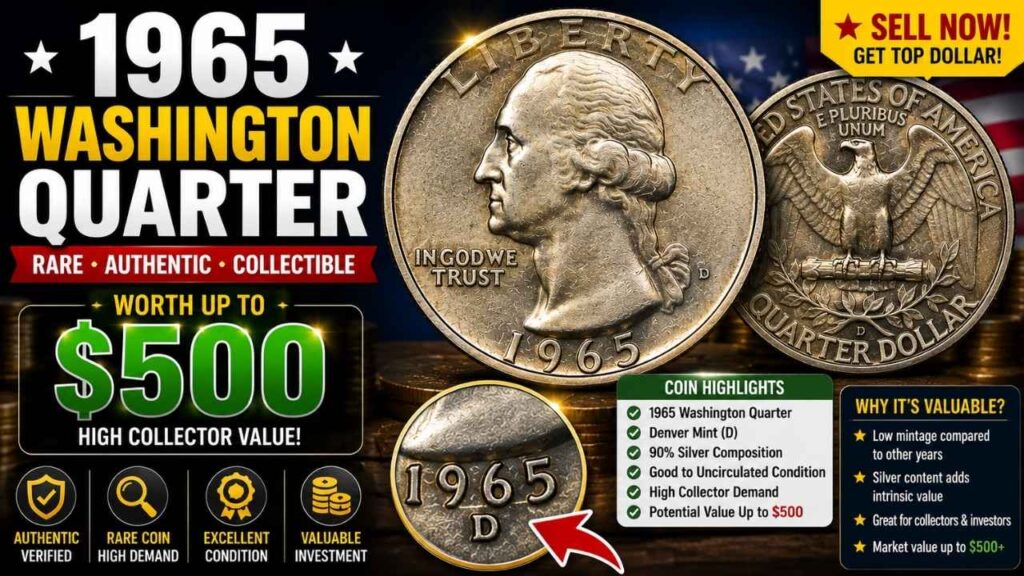
A 1965 Washington Quarter may look like an ordinary 25-cent coin, but this particular year has a fascinating place in United States coin history. It was the year when regular Washington quarters moved from the traditional silver era into the modern copper-nickel clad era.
That change makes the 1965 quarter especially interesting to collectors.
Most 1965 quarters are common and will not make you hundreds of dollars. However, a small number of unusual examples can be considerably more valuable. Coins with major mint errors, recognized doubled-die characteristics, exceptional condition, special finishes, or the extremely rare possibility of being struck on an old silver planchet can attract serious collector attention.
This is why some people search their old change for a 1965 quarter that could potentially be worth $500 or much more.
The important point is that the date alone does not make the coin rare.
You need to identify the exact type of 1965 quarter, inspect its condition, check its weight and edge, and determine whether anything unusual happened during production.
If you have one, don’t clean it or alter it before you know what you have.
Why the 1965 Washington Quarter Is Special
The story of the 1965 Washington Quarter begins with the changing economics of American coinage.
For many years, U.S. quarters were made from an alloy containing 90% silver and 10% copper. By the early 1960s, rising silver prices and heavy demand for coins created a serious problem.
Silver coins were increasingly being saved instead of circulated.
The government needed a practical way to continue producing enormous numbers of quarters without using the same quantity of silver.
The answer was clad coinage.
A clad quarter uses layers of different metals bonded together. The new regular quarter had copper-nickel outer layers surrounding a copper core.
The 1965 Washington Quarter became one of the first regular quarters of this new composition era.
That makes the date historically important even when the individual coin is not rare.
Basic Facts About the 1965 Quarter
The regular 1965 Washington Quarter has a face value of 25 cents.
Its basic characteristics include:
- Date: 1965
- Denomination: Quarter Dollar
- Country: United States
- Designer: John Flanagan
- Diameter: approximately 24.3 millimeters
- Normal clad weight: approximately 5.67 grams
- Edge: Reeded
- Regular composition: copper-nickel clad over a copper center
- Regular reported production: approximately 1.82 billion pieces
- Regular circulating issue: no mint mark
The large production number is important.
It means an ordinary 1965 quarter should not automatically be described as rare.
The collectible value comes from condition, variety, error status, or other unusual characteristics.
Why There Is No Mint Mark
One of the biggest misunderstandings about the 1965 Washington Quarter involves the missing mint mark.
Many collectors see a 1965 quarter without a P, D, or S and assume something went wrong at the Mint.
That is not correct.
The United States suspended mint marks on circulating coins during this period.
Therefore, a regular 1965 quarter without a mint mark is normal.
The absence of a mint mark should never be used by itself as proof that the coin is an error.
This is particularly important because many online coin listings incorrectly describe ordinary no-mint-mark 1965 quarters as rare.
The better question is not “Where is the mint mark?”
The better question is “What makes this particular 1965 quarter different from millions of others?”
The Normal 1965 Quarter
If your quarter has the standard copper-nickel clad construction, normal weight, ordinary wear, and no recognized variety or major error, it is most likely a common 1965 Washington Quarter.
A circulated example may be worth little more than its face value.
That doesn’t make it worthless from a collecting perspective.
The coin represents an important moment in U.S. monetary history.
Collectors interested in Washington quarters, silver-to-clad transitions, or mid-century American coinage may still enjoy owning one.
But historical interest and high monetary value are two different things.
The Most Important Test: Clad or Silver?
This is where the 1965 quarter becomes much more exciting.
1964 was the final regular year for the traditional 90% silver Washington quarter.
Regular 1965 quarters were supposed to use the new clad composition.
During a major change in coin production, however, old planchets could potentially remain in the manufacturing environment.
A very small number of 1965-dated quarters were struck on genuine silver planchets.
If authentic, such a coin is a major transitional error.
That is dramatically more valuable than a normal 1965 clad quarter.
How to Check the Edge
Turn your 1965 quarter sideways and carefully examine the reeded edge.
A normal clad quarter generally reveals a copper-colored center line between the outer layers.
The color can appear reddish or orange.
A genuine silver-planchet quarter does not have the same copper core appearance.
Instead, its edge should have the characteristics expected of a solid silver-alloy planchet.
This is one of the easiest first checks you can perform at home.
But don’t stop there.
An edge examination is only a screening step.
A coin should not be declared a rare silver error simply because the edge looks different in a photograph.
Check the Weight
A standard 1965 clad Washington Quarter weighs approximately 5.67 grams.
A traditional 90% silver quarter planchet weighs around 6.25 grams.
That difference makes a precision digital scale extremely useful.
If your 1965 quarter is close to 5.67 grams, it is behaving like a normal clad quarter.
If it is substantially closer to the silver-quarter weight, the coin deserves additional investigation.
A weight reading by itself does not prove an error.
The scale may be inaccurate.
The coin may have unusual wear or damage.
Different tolerances can also affect measurements.
For an expensive claim, professional authentication is the correct next step.
Don’t Damage the Coin During Testing
This warning is extremely important.
Never cut the coin.
Never drill it.
Never file the edge.
Never scrape the surface.
Never attempt to separate its layers.
Never put chemicals on it.
A valuable coin can be ruined in seconds by an unnecessary experiment.
If you think you have a silver-planchet 1965 quarter, preserve it exactly as it is.
The best evidence is an untouched coin.
Why the Silver 1965 Quarter Can Be Worth Thousands
A genuine silver-planchet 1965 quarter is rare because the normal 1965 production was supposed to use clad planchets.
The coin therefore combines two unusual characteristics:
It carries a 1965 date associated with the new clad era, while its physical composition belongs to the previous silver era.
That makes it a classic transitional error.
Documented examples have brought several thousand dollars at auction, with particularly desirable specimens reaching substantially higher amounts. One recently listed 1965 quarter struck on a 90% silver planchet was being actively bid at more than $4,000 before buyer’s premium in a 2026 auction.
That demonstrates why the silver possibility deserves serious attention.
But it also demonstrates why authentication is critical.
You should never assume that a silver-looking 1965 quarter is automatically worth thousands.
Can a 1965 Quarter Really Be Worth $500?
Yes, but only certain examples.
A normal circulated quarter should not be valued at $500 simply because it says 1965.
A $500-level valuation becomes more realistic when the coin has something exceptional.
Possible reasons include:
- A recognized doubled-die variety
- A major mint error
- An exceptionally high Mint State grade
- A desirable Special Mint Set example
- A genuine transitional silver-planchet error
- Another authenticated variety or unusual production characteristic
The exact price depends on rarity, condition, certification, eye appeal, collector demand, and the marketplace where the coin is sold.
Therefore, “1965 quarter worth $500” should be treated as a search possibility, not a guaranteed price.
Condition Can Change the Value Dramatically
Two 1965 quarters can look almost identical to an inexperienced collector but have very different values.
One might have spent decades circulating through stores, vending machines, and cash registers.
The other might have been stored carefully since the 1960s.
The circulated coin can have flattened details, scratches, discoloration, and numerous contact marks.
The better-preserved coin may retain strong original luster and sharp design details.
At the highest grades, small marks can make a major difference.
This is why professional grading can be important for coins that appear exceptionally well preserved.
Understanding Mint State Coins
A Mint State coin has not experienced normal circulation wear.
That doesn’t mean it is perfect.
A Mint State quarter can still have marks from contact with other coins during manufacturing, transportation, or storage.
The difference between a moderately high-grade coin and an elite example can therefore be surprisingly important.
Collectors examine:
- Surface preservation
- Luster
- Strike quality
- Contact marks
- Scratches
- Originality
- Eye appeal
If your 1965 quarter looks almost untouched, it may deserve closer examination before you spend it.
The 1965 Special Mint Set Quarter
There is another category collectors should know about.
In 1965, special collector coins were produced as part of Special Mint Sets.
These pieces were not ordinary circulation strikes.
They can display a distinctive finish and stronger presentation than typical coins pulled from circulation.
They also have no mint mark.
That means the absence of a mint mark still does not prove that a coin is an error.
A 1965 quarter with a special collector finish needs to be evaluated separately from a normal circulation strike.
Why SMS Coins Can Be Confusing
A collector may find a 1965 quarter with unusually smooth surfaces and think it has been polished.
Another coin might have attractive frosted details and reflective fields.
A third might simply be a well-preserved circulation strike.
These can sometimes be difficult to distinguish from photographs.
That is why collectors who specialize in the 1965 issue pay attention to surface texture, strike, finish, and overall appearance.
If the coin appears unusual but you aren’t sure why, don’t alter it.
Keep the coin original until it can be properly identified.
1965 Doubled-Die Varieties
The 1965 quarter is also known for recognized doubled-die varieties.
One notable variety is the 1965 Doubled Die Obverse FS-101.
It is known for significant doubling involving areas such as the lettering and date.
Another recognized variety, FS-102, shows less dramatic doubling and is distinguished from FS-101.
These varieties are different from ordinary machine doubling.
That distinction is extremely important.
A genuine doubled die is created during die production and becomes part of the die itself.
Every coin struck from that die can therefore reproduce the same variety characteristics.
How to Look for Genuine Doubling
Use a good magnifying glass or a macro-capable camera.
Examine:
- LIBERTY
- IN GOD WE TRUST
- The date
- Washington’s portrait area
- Other raised design elements
Look for clear, structured separation rather than a random flat edge.
If you think the coin has a recognized doubled-die variety, compare the exact characteristics with reliable specialist references or have the coin examined by a professional.
Do not automatically call every extra line a doubled die.
Machine Doubling vs. Doubled Die
Machine doubling is a common source of confusion.
It can create an appearance that resembles a second image.
However, the resulting shape is often flatter and more shelf-like.
True doubled-die characteristics are created differently and can have a much stronger collector premium.
This is one reason photographs found on social media can sometimes be misleading.
A coin can look “doubled” without actually being a valuable doubled-die variety.
Other Errors to Watch For
The 1965 Washington Quarter can also be collected in genuine mint-error categories.
Examples include:
- Off-center strikes
- Clipped planchets
- Broadstrikes
- Partial-collar errors
- Missing clad layers
- Wrong-planchet errors
- Other unusual striking abnormalities
Not every unusual-looking coin is valuable.
The error needs to be consistent with something that could have happened during the minting process.
A professional examination becomes increasingly important as the claimed value increases.
Off-Center Strikes
An off-center strike happens when the planchet is not positioned correctly when the dies strike.
Part of the design may therefore be missing from one side.
A dramatic off-center strike can be visually obvious.
The degree of displacement matters.
A small shift may produce only a modest premium.
A large and clearly documented error can be considerably more interesting.
The date is also important because collectors generally want to identify exactly what coin they are buying.
Clipped Planchet Errors
A clipped planchet occurs when the blank is improperly cut before being struck.
The resulting coin can have an unusual curved missing section.
The shape and characteristics of the affected area can help distinguish a genuine mint error from damage.
If the missing area looks freshly cut, crushed, or otherwise unnatural, be cautious.
Never assume that a damaged edge is automatically a clipped planchet.
Missing Clad Layer
Because the 1965 quarter uses a layered construction, collectors may encounter coins with unusual coloration or apparent layer problems.
A genuine missing-clad-layer error can produce a noticeably different appearance.
However, environmental exposure, chemicals, abrasion, or deliberate alteration can produce similar visual effects.
That is why an unusual color should not be treated as proof of a mint error.
Composition and manufacturing characteristics need to agree with the claim.
Wrong-Planchet Errors
A wrong-planchet error occurs when a coin is struck on a blank intended for a different coin.
These errors can create unusual weight and physical characteristics.
The 1965 date makes this category particularly interesting because the coin was produced during a major composition change.
However, wrong-planchet claims should be approached carefully.
A genuine error needs to make physical sense.
The weight, diameter, thickness, edge, metal composition, and striking characteristics all matter.
Damage Is Not an Error
This may be the most important lesson for new collectors.
A coin can become strange-looking after it leaves the Mint.
For example:
- Scratches are usually damage.
- Dents are usually damage.
- Grinding is damage.
- Filing is damage.
- Heat discoloration is damage.
- Chemical discoloration is damage.
- Polishing is alteration.
- Flattened areas can result from abuse.
- Edge cuts can be post-mint damage.
A genuine mint error must originate from the manufacturing process.
That distinction can mean the difference between a face-value coin and a collectible error.
Never Clean a 1965 Quarter
If you discover an old quarter, your first instinct may be to make it shiny.
Don’t.
Cleaning can leave microscopic scratches and unnatural surfaces.
Polishing can permanently change the appearance.
Chemical treatments can damage the original surface.
Collectors generally prefer coins that retain their original characteristics.
If you think the quarter may be rare, the safest approach is to leave it completely alone.
How to Inspect Your Coin Step by Step
If you have a 1965 Washington Quarter, follow this simple process.
Start by confirming the date.
Next, check the overall design.
Then look at the edge.
After that, weigh the coin on an accurate digital scale.
Record the weight rather than guessing.
Look closely at the lettering and date for possible doubled-die characteristics.
Check for obvious mint errors.
Examine the surfaces under good lighting.
Finally, compare your findings with known examples or obtain a professional opinion.
This method is much safer than relying on a headline claiming that every 1965 quarter is valuable.
A Simple Home Checklist
Before selling your coin, ask yourself:
Is the date definitely 1965?
Does it have the normal reeded edge?
Does the edge show the expected copper center?
Is the weight close to 5.67 grams?
Does the coin appear circulated or uncirculated?
Are there unusual marks that might actually be damage?
Does the lettering show genuine-looking doubling?
Does the coin have an obvious striking error?
Could it be an SMS piece?
Does anything suggest an unusual planchet?
Have you photographed both sides and the edge?
If several answers point toward an unusual coin, don’t spend it.
How to Photograph the Quarter
Good photographs can make evaluation much easier.
Take a clear picture of the entire front.
Take another picture of the entire back.
Then photograph the date.
Take a close photograph of the edge.
If you suspect doubling, take detailed close-ups of the affected letters.
Use natural-looking lighting and avoid heavy filters.
Don’t digitally alter the color or shape.
The goal is to show the coin as it actually appears.
When Professional Grading Makes Sense
Professional grading isn’t necessary for every old quarter.
If your coin is heavily worn and appears completely ordinary, grading may cost more than the coin is worth.
But if the quarter appears to be:
- A rare variety
- A major mint error
- A suspected silver-planchet error
- An exceptionally high-grade coin
- A particularly attractive SMS example
then professional evaluation may be worthwhile.
Authentication is especially important when you believe the coin could be worth hundreds or thousands of dollars.
Why Authentication Matters
Imagine finding a 1965 quarter that weighs about 6.25 grams.
That would be exciting.
But weight alone doesn’t prove that the coin is a genuine silver transitional error.
The coin could have been altered.
The scale could be inaccurate.
The planchet could have another explanation.
A professional authentication process can examine the coin’s physical characteristics and determine whether the unusual composition is genuine.
For high-value coins, this extra verification can make a major difference when it comes time to sell.
How to Sell a Valuable 1965 Quarter
Don’t immediately accept the first offer.
First, determine what you actually have.
If the coin appears ordinary, a local coin dealer may be the easiest selling option.
If the coin is a rare error or exceptional high-grade specimen, an auction may provide access to collectors who specifically want that type of coin.
Online selling is another possibility, but valuable coins require careful descriptions, strong photographs, secure payment, and appropriate shipping.
The best selling method depends on the coin.
Selling to a Coin Dealer
A dealer can provide a relatively quick transaction.
The dealer, however, needs to make a purchase price that leaves room for operating costs and potential resale.
Therefore, a dealer’s offer may be lower than the final retail price a collector eventually pays.
That doesn’t automatically mean the dealer is offering too little.
It’s simply a different part of the market.
If the coin appears valuable, obtaining more than one professional opinion can help you understand the market better.
Selling at Auction
Auction selling can work particularly well for rare certified errors and exceptional coins.
If several collectors want the same coin, competition can push the final price higher.
But remember that the hammer price and your final payout may not be the same.
Auction fees, commissions, and other costs can affect what the seller receives.
Always understand the seller agreement before consigning a valuable coin.
Online Marketplace Selling
Online platforms can expose your coin to collectors around the world.
However, avoid exaggerated claims.
Don’t write “guaranteed $10,000 coin” unless you have strong evidence.
Don’t describe every no-mint-mark 1965 quarter as rare.
Don’t use an unrealistic asking price as proof of value.
An asking price is simply what someone hopes to receive.
An actual completed sale is much more useful when judging market value.
Asking Price vs. Actual Sale Price
This is a major issue in online coin research.
You may find a 1965 quarter listed online for $5,000.
That does not mean the coin is worth $5,000.
It only means somebody has placed a $5,000 asking price on it.
The important evidence is what comparable coins actually sell for.
Even then, two coins can sell for different amounts because of grade, certification, eye appeal, auction competition, timing, and buyer demand.
So don’t value your coin simply by finding the highest listing on the internet.
How Much Money Could You Actually Receive?
Suppose a rare coin sells for a particular amount.
The seller may not receive that entire figure.
Depending on the selling method, there can be:
- Auction commissions
- Marketplace fees
- Payment processing costs
- Shipping expenses
- Insurance
- Grading fees
- Authentication fees
A dealer offer also works differently because the dealer needs room to resell the coin.
Always distinguish between the advertised value, sale price, and money that actually reaches your pocket.
What Collectors Should Look For
If you are searching through old U.S. coins, the 1965 quarter deserves a place on your checklist.
Pay particular attention to:
- Unusually heavy pieces
- Edges without the expected copper core
- Strong recognized doubled-die characteristics
- Dramatic striking errors
- Exceptional uncirculated condition
- Special Mint Set characteristics
- Unusual planchet characteristics
- Professionally certified examples
Don’t overlook an ordinary coin simply because it isn’t worth hundreds.
The historical story itself makes the date interesting.
Common Mistakes New Collectors Make
The first mistake is assuming that every old coin is rare.
The second is believing that a missing mint mark automatically indicates an error.
The third is assuming every 1965 quarter is silver.
The fourth is confusing machine doubling with a doubled die.
The fifth is treating damage as a mint error.
The sixth is cleaning the coin.
The seventh is trusting an online asking price as if it were an actual sale.
The eighth is spending money on grading before establishing whether the coin has realistic collector value.
Avoiding these mistakes will make your search much more productive.
The Historical Importance of the 1965 Quarter
Even if your coin is worth only face value, the 1965 Washington Quarter still tells an important story.
It belongs to the period when American coinage was moving away from traditional silver circulation coins.
The transition changed the appearance and composition of everyday U.S. money.
Millions of Americans used these new quarters without thinking about the historical change taking place.
Today, collectors can look at the same coin and see evidence of that transition.
That is part of what makes the 1965 issue so interesting.
Why the Date Continues to Attract Collectors
The 1965 Washington Quarter combines several collecting themes in one date.
It has historical importance.
It represents a major composition change.
It has recognized die varieties.
It has Special Mint Set examples.
It has unusual mint errors.
And it has a famous transitional silver-planchet possibility.
That combination makes the date much more interesting than its large production number might suggest.
1965 Quarter Value Guide
A practical way to think about the 1965 quarter is to divide examples into categories.
A heavily circulated ordinary clad quarter is generally a face-value or modest-premium coin.
A nicer uncirculated example can command more depending on its grade and appearance.
A very high-grade certified circulation strike can become considerably more valuable.
A desirable SMS example can have its own collector premium.
A recognized doubled-die variety can be worth substantially more than an ordinary coin.
A major authenticated mint error can also command strong prices.
A genuine 1965 quarter struck on a 90% silver planchet belongs to an entirely different level of rarity and can sell for thousands of dollars.
Therefore, the $500 figure is possible, but it is not the standard value for a normal 1965 quarter.
What to Do If You Think You Found the Rare One
Don’t rush.
Don’t clean it.
Don’t sell it immediately to the first person who offers money.
Don’t post exaggerated claims online.
Instead, document the coin.
Take photographs.
Measure its weight carefully.
Inspect the edge.
Record anything unusual.
Then seek an experienced coin professional or reputable grading and authentication service.
If the coin is genuinely rare, proper documentation can help protect its value.
Contact and Selling Information
If you’re in the United States and you have this coin and want to explore your selling or evaluation options, check the link in the comments.
Click the link to learn how you can submit or send your coin for evaluation, explore the selling process, or contact me for more information.
Before sending any valuable coin, make sure you understand the evaluation process, shipping requirements, insurance, fees, and payment terms.
Never send a potentially valuable coin to an unknown buyer without verifying who you are dealing with.
Final Checklist Before You Sell
Before making a final decision, check everything one more time.
Confirm the 1965 date.
Remember that no mint mark is normal.
Check whether the coin is clad.
Weigh it accurately.
Inspect the edge.
Look for recognized doubling.
Check for genuine mint errors.
Evaluate the condition.
Look for Special Mint Set characteristics.
Avoid cleaning.
Photograph both sides.
Get professional authentication if the evidence suggests significant value.
Compare realistic selling options.
And remember that an online asking price is not the same as a confirmed market price.
Final Thoughts on the 1965 Washington Quarter
The 1965 Washington Quarter is a fascinating example of how an ordinary-looking coin can carry an extraordinary story.
Most examples are common clad quarters and should not be expected to bring $500.
But the year is worth examining because it sits directly at a major transition in American coin production.
A genuine silver-planchet transitional error can be extremely valuable.
Recognized doubled-die varieties can command premiums.
Major mint errors can attract collectors.
Exceptional grades and Special Mint Set examples can also be worth considerably more than ordinary circulated pieces.
So if you have a 1965 Washington Quarter, take a second look before spending it.
Check the date.
Check the edge.
Check the weight.
Check the surfaces.
Check for varieties and errors.
And most importantly, don’t damage the coin while trying to discover its value.
The real treasure is not simply finding a 1965 quarter.
The real opportunity is discovering that your particular example has something unusual that millions of ordinary quarters do not.
A $500 valuation can be realistic for the right coin, but the coin must earn that value through rarity, condition, variety, error status, or another verifiable collectible characteristic.
That is why careful identification should always come before selling.