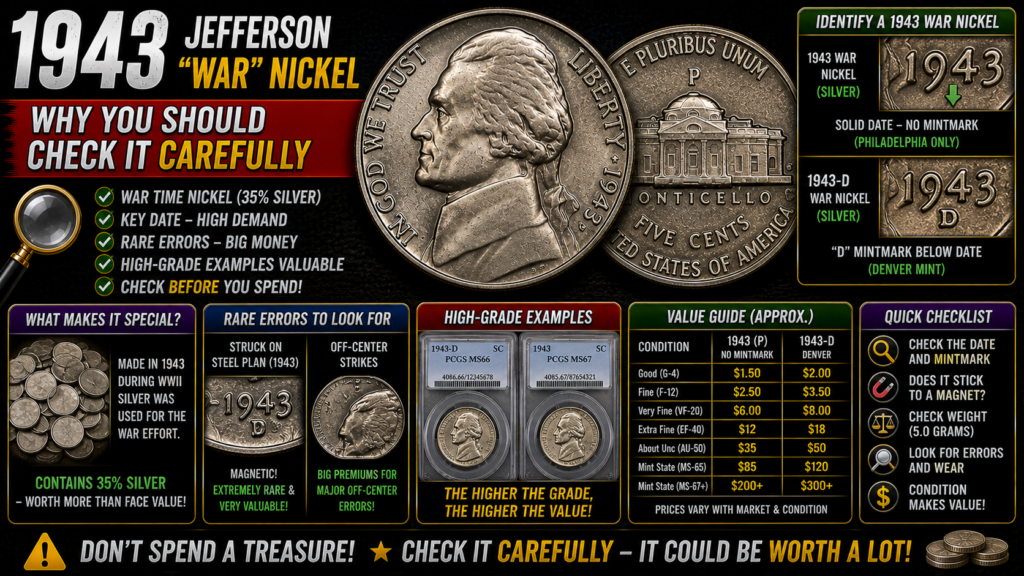
If you come across a 1943 Jefferson nickel, do not dismiss it as an ordinary five-cent coin. This date belongs to the special wartime period when the United States changed the composition of the Jefferson nickel to conserve important industrial metals. Instead of the traditional nickel-based composition, wartime nickels were made with 35% silver.
That single detail makes the 1943 Jefferson nickel different from an ordinary nickel.
But there is another reason collectors pay attention to these coins. Not every 1943 Jefferson nickel is equally desirable. Rare varieties, unusual characteristics, and exceptionally preserved high-grade examples can attract substantially more collector interest than typical circulated pieces.
This means that finding a 1943 nickel is only the beginning.
The next step is to identify exactly what you have.
Look at the date. Examine the mintmark. Check the coin’s condition. Pay attention to the reverse and the overall quality of the strike. If the coin is especially sharp and well preserved, it deserves a much closer examination.
The 1943 Jefferson “war” nickel is an excellent reminder that a small five-cent coin can carry an important piece of American history and a composition that is fundamentally different from the nickels people normally encounter.
If you have one in an old collection, coin jar, inherited group, or box of miscellaneous change, the silver content alone makes it worth identifying correctly.
And if the coin also has a rare variety or exceptional condition, its collector appeal can be considerably greater.
Why the 1943 Jefferson Nickel Is Called a War Nickel
The term “war nickel” comes from the circumstances surrounding its production.
During World War II, the United States needed large quantities of strategic materials for military and industrial purposes. Nickel was an important material, and conserving it became a priority.
As a result, the composition of the five-cent coin was temporarily changed.
The wartime Jefferson nickel was produced using a special alloy containing 35% silver. Copper and manganese made up the remainder of the composition.
This was a significant departure from the standard composition associated with Jefferson nickels.
The change was temporary, which is one reason wartime nickels occupy such an interesting place in American coin collecting.
The coins were still five-cent pieces in denomination, but their metallic composition was different.
That difference is exactly what collectors should remember when they encounter a 1943 Jefferson nickel.
It is not simply another Jefferson nickel from the 1940s.
It is part of a special wartime series made under unusual circumstances.
The Silver Content Makes These Nickels Different
The most important fact to remember is simple: wartime Jefferson nickels contain 35% silver.
That gives them a special place among U.S. coins.
A typical nickel is not something most people associate with precious-metal content. The wartime Jefferson nickel is an exception.
Its 35% silver composition was introduced as part of the wartime effort to conserve nickel.
This does not mean that every 1943 Jefferson nickel is automatically a high-value coin.
The silver content gives the coin an intrinsic material component that ordinary nickels do not have, but collector value depends on additional factors.
Condition matters.
Mintmark matters.
Variety matters.
Strike quality matters.
Rarity matters.
A common circulated wartime nickel and a rare, exceptionally preserved example can have very different levels of collector interest.
That distinction is essential for anyone searching through old coins.
How to Identify a 1943 Jefferson War Nickel
The first step is the easiest.
Check the date on the obverse.
If the coin shows 1943, you have identified the year.
Next, examine the area around the mintmark.
Wartime Jefferson nickels are particularly interesting because their mintmarks were placed prominently above Monticello on the reverse.
This is different from the placement collectors may be accustomed to seeing on many other Jefferson nickels.
The large mintmark is an important visual clue when identifying a wartime example.
A 1943 Jefferson nickel can carry a P, D, or S mintmark, representing Philadelphia, Denver, or San Francisco.
The Philadelphia issue is particularly notable because the P mintmark appears on the wartime nickel.
That was an important change in U.S. coinage practice at the time.
For a collector, the mintmark is therefore one of the first details to check after confirming the 1943 date.
Why the Mintmark Matters
A 1943 Jefferson nickel is not necessarily identical to every other 1943 Jefferson nickel.
The mintmark tells you where the coin was produced, and different mint issues can have different levels of collector interest.
For that reason, do not stop after finding the date.
Turn the coin over.
Look above Monticello.
Check carefully for the mintmark.
You may see a P, D, or S.
This simple inspection can immediately tell you more about the specific coin in your hand.
It also helps collectors organize and compare their wartime nickel collections.
When examining older coins, small details can make a significant difference.
The mintmark is one of those details.
The Special Appearance of a Wartime Nickel
The wartime composition can give these Jefferson nickels a distinctive appearance, although the exact look of an individual coin can vary with age, handling, storage, and surface condition.
A circulated example may show substantial wear and a softer appearance.
A well-preserved example can retain much more detail.
The coin’s color can also vary depending on its condition and environment, so appearance alone should not be used as the only method of identifying a wartime nickel.
The date and mintmark remain essential.
Collectors should also remember that tarnish or discoloration does not necessarily mean that a coin is damaged or altered.
Older silver-containing coins can naturally change appearance over time.
That is one reason cleaning is generally something to avoid, especially when dealing with a potentially valuable collector coin.
Why the 1943 Date Is Historically Important
The 1943 Jefferson nickel belongs to one of the most unusual periods in the history of American coinage.
The United States was in the middle of World War II.
Materials that had previously been used routinely in coin production were being reconsidered because of their importance to the war effort.
The change to the Jefferson nickel was a direct reflection of those circumstances.
This makes the 1943 nickel more than just a five-cent piece.
It is a physical reminder of a period when even everyday money was affected by the enormous demands of wartime production.
For collectors, that historical connection adds another layer of interest.
The coin can be appreciated for its silver content, its design, its rarity characteristics, and its place in American history.
What Makes Some 1943 Nickels More Valuable?
The phrase “1943 Jefferson nickel” describes a broad group of coins.
Within that group, individual examples can differ considerably.
A heavily circulated coin with ordinary characteristics may have modest collector interest.
A coin in outstanding condition can be much more desirable.
A recognized rare variety can also attract attention.
When rarity and exceptional preservation occur together, collector interest can increase further.
This is why it is not accurate to assign one universal value to every 1943 Jefferson nickel.
The coin must be evaluated as an individual specimen.
Its mintmark, condition, variety, surface quality, strike, and other characteristics all contribute to its collector appeal.
That is the real reason careful examination matters.
Rare Varieties Are Worth Checking
The 1943 Jefferson nickel series includes recognized varieties that collectors may specifically search for.
This is one of the most interesting aspects of wartime nickel collecting.
A coin can belong to a common date and still have an unusual variety.
Variety collecting involves examining small differences or unusual features that distinguish one die pairing or production characteristic from another.
These details may not be obvious to someone who has never studied Jefferson nickels.
That is why collectors often use magnification when examining potential varieties.
The important point is not to assume that every unusual-looking mark is a rare variety.
A genuine variety should be distinguished from damage, scratches, stains, or ordinary die characteristics.
Careful comparison and reliable identification are important.
The Importance of Condition
Condition is one of the most important factors when evaluating a 1943 Jefferson nickel.
A coin that has spent years circulating will normally show evidence of handling.
The high points of the design can become worn.
The surfaces can develop contact marks.
Fine details can become less distinct.
An uncirculated coin can preserve much more of its original appearance.
For collectors, exceptionally high-grade examples are much more difficult to find than ordinary circulated pieces.
This is particularly relevant when discussing rare or desirable varieties.
A rare variety in average condition and the same variety in exceptional condition can have very different levels of collector interest.
Therefore, do not evaluate a 1943 nickel only by asking whether it is silver.
That is the starting point, not the entire story.
What Does High Grade Mean?
A high-grade coin is one that has been preserved in unusually strong condition relative to other examples of the same issue.
For an uncirculated coin, collectors examine the surfaces, luster, strike, marks, and overall preservation.
The difference between a typical uncirculated coin and an exceptional high-grade coin can be surprisingly subtle.
Small contact marks may matter.
Weak design details may matter.
Surface quality may matter.
The quality of the strike can also become especially important.
That is why high-grade collecting requires careful examination.
A coin may look nearly perfect to someone who is unfamiliar with grading but reveal several small imperfections under magnification.
The reverse and obverse should both be considered.
Why Strike Quality Matters
Strike quality refers to how clearly the design details were impressed onto the coin during production.
A coin can be well preserved but still have areas of weak detail because of the original strike.
This is an important distinction.
Condition tells you about what happened to the coin after it was made.
Strike quality tells you something about how well the design was transferred during production.
Collectors interested in exceptional 1943 Jefferson nickels should therefore look for both.
A well-preserved coin with sharp details can be particularly attractive.
A coin with weak detail may not have the same appeal even if it shows little evidence of circulation.
This is another reason why simply calling a coin “uncirculated” does not tell the complete story.
Examining the Obverse
Start your inspection on the front of the coin.
Look at Jefferson’s portrait.
Check the date.
Examine the lettering.
Look at the fields around the design.
You are searching for signs of wear, marks, scratches, and other surface disturbances.
The date should be clearly visible.
A worn coin may show softness around the highest parts of the design.
An uncirculated example should retain much stronger detail.
Do not immediately decide on a grade from one feature.
Instead, examine the entire obverse.
A high-grade coin should present consistently strong surfaces and detail rather than having one impressive area surrounded by obvious problems.
Examining the Reverse
The reverse is especially important on a wartime Jefferson nickel.
Begin by locating Monticello.
Then examine the large mintmark above it.
Confirm whether the coin carries a P, D, or S.
Next, inspect the building and surrounding design details.
Look for sharpness and preservation.
The reverse can also help you identify potential varieties, although distinguishing a true variety from ordinary damage may require specialized knowledge.
This is where magnification becomes useful.
The reverse should not be treated as secondary to the obverse.
For wartime Jefferson nickels, it contains some of the most important identification information.
Why the Large Mintmark Is So Useful
The wartime Jefferson nickel’s large mintmark above Monticello is one of its most recognizable features.
It makes identifying the mint relatively straightforward once you know where to look.
For someone searching a group of old Jefferson nickels, this can make sorting much easier.
First separate the wartime dates.
Then check the mintmarks.
After that, focus on condition and potential varieties.
This method is more efficient than trying to evaluate every coin in exactly the same way.
The mintmark provides the first useful classification.
The coin’s condition and characteristics determine whether it deserves deeper attention.
Philadelphia, Denver, and San Francisco Issues
The 1943 wartime Jefferson nickel was produced at Philadelphia, Denver, and San Francisco.
The mintmarks allow collectors to distinguish these issues.
Philadelphia is represented by P.
Denver is represented by D.
San Francisco is represented by S.
Because wartime nickels use the distinctive mintmark placement above Monticello, checking this location is especially important.
Collectors building date-and-mintmark sets will want to identify these differences carefully.
However, mintmark alone does not establish rarity or value.
It is one part of the coin’s identity.
The individual condition and any unusual variety must also be considered.
The Silver Content Does Not Mean Every Coin Is Extremely Valuable
This is one of the most important points for new collectors.
Finding silver in a coin is exciting, but the presence of silver does not automatically make every example a rare or exceptionally valuable collectible.
The wartime nickel contains 35% silver.
That makes it fundamentally different from a regular nickel.
But collector value and metal value are separate concepts.
A coin can have silver content while still being a relatively common collectible.
Another example can be valuable because of its exceptional condition or rare variety.
Therefore, do not assume that the 35% silver composition alone determines the market value of a 1943 Jefferson nickel.
Instead, use the silver content as the first important clue.
Then investigate the rest of the coin.
Why You Should Not Clean a 1943 War Nickel
If you discover an old 1943 Jefferson nickel, cleaning it is one of the worst things you can do if you are hoping to preserve collector value.
Silver-containing coins can develop natural changes in appearance over time.
Some collectors appreciate original surfaces and natural toning.
Aggressive cleaning can create scratches or unnatural-looking surfaces.
Polishing can also remove the original appearance that collectors want to preserve.
A coin that appears dull should not automatically be treated as dirty.
It may simply have developed its current appearance naturally over many decades.
If the coin looks potentially rare or exceptionally well preserved, leave it alone.
Preservation is more important than trying to make an old coin look shiny.
How to Handle a Potentially Valuable 1943 Nickel
When examining a promising coin, handle it carefully.
Hold it by the edges whenever possible.
Avoid touching the main surfaces unnecessarily.
Do not rub fingerprints away with a cloth.
Do not scrape away dirt.
Do not use household cleaners.
These precautions are especially important when a coin appears to have exceptional condition.
A small mistake can permanently alter a coin’s surfaces.
The safest approach is to identify first and clean never.
If professional evaluation becomes appropriate, preserving the coin in its original state gives the evaluator a better specimen to examine.
Why Magnification Can Help
Some of the most interesting characteristics on old coins are extremely small.
Magnification can help you examine lettering, mintmarks, surfaces, and potential varieties.
A basic loupe can reveal details that are difficult to see with the naked eye.
However, magnification should be used carefully.
It can make ordinary imperfections look dramatic.
A scratch can appear like a major variety.
A stain can look like an unusual marking.
A die characteristic can be mistaken for damage.
Therefore, magnification is a tool for closer inspection, not a guarantee of identification.
When something looks unusual, compare it with reliable references or seek professional evaluation rather than assuming that every strange mark is valuable.
How to Separate Damage From a Variety
This is an important skill for collectors.
Coins experience decades of handling.
They can be scratched, hit, stained, bent, cleaned, or otherwise damaged.
Some marks may look unusual but have nothing to do with the original production of the coin.
A true variety is part of the coin’s manufacturing history.
Damage happened afterward.
Distinguishing between the two requires careful observation.
If a feature appears raised or integrated into the original design, it may deserve further investigation.
If it looks like a scratch, gouge, or surface disturbance, it may simply be damage.
However, appearance alone is not always enough.
This is another situation where specialized knowledge can prevent mistakes.
Why Rare Varieties Matter to Collectors
Varieties add another level of collecting beyond simply assembling dates and mintmarks.
A collector can search for subtle differences among coins that otherwise appear identical.
This can make the hobby more challenging and rewarding.
For 1943 Jefferson nickels, recognized varieties can make particular examples more desirable.
The important word is recognized.
Not every unusual feature is a recognized variety.
Collectors should avoid assigning a premium simply because a coin looks different.
Instead, the feature should be properly identified.
This protects collectors from both overestimating ordinary coins and overlooking genuine varieties.
Exceptional Condition Can Change the Conversation
A common coin in ordinary condition may receive limited attention.
The same coin in exceptional condition can be a very different collectible.
This happens because high-grade preservation becomes increasingly difficult as grades rise.
Coins can acquire marks through handling, storage, and circulation.
Finding a piece that escaped those problems can be challenging.
For the 1943 Jefferson nickel, the situation is even more interesting because the wartime composition already makes the coin historically distinctive.
When exceptional preservation is combined with a recognized variety, collector interest can become much stronger.
That does not mean every high-grade coin has extraordinary value.
It means the specific combination of characteristics should be examined carefully.
How to Search Through Old Collections
If you are searching a collection for wartime nickels, begin with the dates.
Look for the wartime years.
Once you identify a 1943 Jefferson nickel, check the reverse mintmark.
Separate the coins by mint.
Then examine condition.
The most promising examples are those that show strong overall preservation.
After that, inspect potential varieties.
This approach allows you to spend more time on the coins most likely to deserve detailed attention.
You do not need to inspect every ordinary circulated nickel under extreme magnification.
Start broadly.
Then narrow your search.
This is how experienced collectors can examine large quantities of coins efficiently.
What Makes a 1943 Nickel Stand Out?
A particularly interesting 1943 Jefferson nickel may have several desirable characteristics at once.
It may be well preserved.
It may have a strong strike.
It may have an identifiable and desirable variety.
It may have attractive original surfaces.
It may be certified in an exceptional grade.
The more of these characteristics that come together, the more closely collectors may want to examine the coin.
However, each characteristic should be evaluated independently.
Do not let one exciting feature make you ignore obvious problems elsewhere.
A careful collector looks at the complete coin.
The Difference Between Metal Value and Collector Value
Because the 1943 Jefferson nickel contains silver, it is useful to distinguish between two concepts.
Metal value relates to the silver and other metals contained in the coin.
Collector value relates to what someone may be willing to pay for the specific collectible based on factors such as condition, rarity, variety, demand, and certification.
These values can move independently.
A circulated wartime nickel may have recognizable silver content without being an exceptionally rare collectible.
A rare variety or very high-grade specimen may command additional collector attention beyond its metal content.
Therefore, when you find a 1943 nickel, do not think only about its silver.
Think about the entire coin.
Why Original Surfaces Matter
Collectors generally want to see a coin in a state that preserves its original characteristics as much as possible.
Original-looking surfaces can provide information about how the coin has been stored and handled.
Cleaning can interfere with that appearance.
A coin that has been polished may appear brighter but actually be less desirable to collectors.
This is especially relevant for high-grade examples.
The goal when finding a potentially valuable 1943 war nickel should not be to make it look newer.
The goal should be to preserve what is already there.
That approach gives the coin the best opportunity for accurate evaluation.
What a Professional Evaluation Can Tell You
If your 1943 Jefferson nickel appears unusually sharp, well preserved, or potentially rare, professional evaluation can provide useful information.
A professional grading service can evaluate the coin’s condition according to established standards.
It can also authenticate the coin and, where applicable, recognize an appropriate variety or designation.
This can be particularly useful when the coin appears to be an exceptional example.
However, not every wartime nickel requires professional grading.
A heavily circulated example with ordinary characteristics may not justify the expense.
The decision should depend on the coin’s apparent condition and characteristics.
The first step is always careful examination.
Why Authentication Matters for Rare Coins
When a coin appears to have a rare characteristic, authentication becomes important.
Collectors need confidence that the feature is genuine and that the coin has not been altered.
This is especially important when significant collector value may be involved.
A professional assessment can distinguish an authentic coin from one that has been damaged, altered, or incorrectly attributed.
For an ordinary circulated 1943 Jefferson nickel, this level of scrutiny may not be necessary.
For an exceptional specimen, it can become much more important.
The more valuable the potential discovery, the more important accurate identification becomes.
A Simple Inspection Checklist
When you find a 1943 Jefferson nickel, follow a simple process.
First, confirm the date.
Second, turn the coin over.
Third, locate the large mintmark above Monticello.
Fourth, identify whether it is P, D, or S.
Fifth, examine the coin for circulation and wear.
Sixth, inspect the overall surfaces.
Seventh, look closely for unusual varieties or characteristics.
Eighth, evaluate the strike and design sharpness.
Ninth, avoid cleaning or altering the coin.
Finally, if it appears exceptionally preserved or unusual, consider professional evaluation.
This checklist keeps the search organized and reduces the chance of overlooking something important.
Why the Reverse Should Never Be Ignored
The reverse contains several pieces of important information on a wartime Jefferson nickel.
The mintmark is there.
Monticello is there.
The surrounding design details can reveal strike quality.
Potential varieties may also involve details visible on the reverse.
That makes the reverse one of the most important areas to inspect.
Many casual searches focus on the obverse because that is where the date appears.
But once the date has been confirmed, turn the coin over.
The reverse may tell you much more about the specific example.
Why High-Grade War Nickels Are Special
A 1943 Jefferson nickel already has an unusual story because of its wartime composition.
A high-grade example adds another layer.
The coin has survived for decades while retaining a remarkable level of preservation.
That survival can be difficult.
Coins are routinely handled, stored, transported, and exposed to environments that can affect their surfaces.
A coin that remains sharply detailed and relatively free of marks is therefore more interesting to collectors.
When a high-grade coin also has a recognized variety, the combination can be particularly appealing.
This is why collectors examine wartime nickels more carefully than their small denomination might suggest.
Don’t Let the Five-Cent Face Value Fool You
One of the most enjoyable parts of coin collecting is discovering that face value and collector interest are not the same thing.
A nickel has a face value of five cents.
But a particular 1943 Jefferson nickel can have far greater collector significance because of its silver composition, historical context, condition, or variety.
The same principle applies throughout numismatics.
Coins are collected because of their history, rarity, condition, design, and distinctive characteristics.
The denomination is only one part of the story.
With the 1943 Jefferson nickel, the wartime silver composition makes that difference especially obvious.
What Beginners Should Remember
If you are new to collecting, do not make the process complicated.
Start with the basics.
Find the date.
Check the mintmark.
Learn why the coin is different.
Then examine condition.
For a 1943 Jefferson nickel, remember the most important fact: it is a wartime nickel containing 35% silver.
After that, remember that rare varieties and exceptional high-grade examples can be substantially more interesting to collectors.
Finally, protect anything that looks unusual.
Do not clean it.
Do not polish it.
Do not assume its value from a photograph.
Careful identification is more useful than quick conclusions.
Why Searching for 1943 Nickels Can Be Exciting
The excitement of coin hunting comes from uncertainty.
Most coins will be ordinary.
But occasionally, a coin will contain a detail that deserves further investigation.
The 1943 Jefferson nickel is particularly enjoyable to search for because the wartime composition immediately gives the coin a special identity.
Once you identify one, you can investigate its mintmark, condition, and potential varieties.
You may discover that it is a typical circulated war nickel.
Or you may find an unusually well-preserved specimen.
The possibility of discovering something different encourages collectors to slow down and inspect their coins carefully.
That is where the hobby becomes more than simply collecting old money.
Frequently Asked Questions About the 1943 Jefferson War Nickel
Is a 1943 Jefferson nickel made of silver?
Yes. Wartime Jefferson nickels were made with an alloy containing 35% silver, along with copper and manganese.
Why were 1943 Jefferson nickels made with silver?
The composition was changed during World War II to conserve nickel, which was an important strategic material.
How can I identify a 1943 war nickel?
Start by checking the 1943 date. Then turn the coin over and look above Monticello for the mintmark. Wartime Jefferson nickels can have P, D, or S mintmarks.
Where is the mintmark on a 1943 Jefferson nickel?
On wartime Jefferson nickels, the mintmark is located prominently above Monticello on the reverse.
Does every 1943 Jefferson nickel have the same value?
No. Individual coins can differ significantly in collector interest depending on condition, mintmark, varieties, strike quality, and other characteristics.
Are all 1943 Jefferson nickels rare?
No. The date itself does not make every example rare. Many are collectible because of their wartime silver composition, while particular varieties and exceptional high-grade examples can be much more desirable.
What makes a 1943 Jefferson nickel especially valuable to collectors?
A combination of recognized rarity, exceptional preservation, strong strike quality, and desirable collector characteristics can make an individual coin substantially more interesting than an ordinary example.
Should I clean my 1943 silver Jefferson nickel?
No. Cleaning or polishing can damage the coin’s surfaces and reduce its collector appeal. If the coin looks potentially important, preserve it in its existing condition.
Can a 1943 Jefferson nickel have a rare variety?
Yes. Recognized varieties exist within the wartime Jefferson nickel series, and collectors specifically search for unusual examples.
Does silver content guarantee a high collector value?
No. The 35% silver composition gives the coin an important material characteristic, but collector value depends on more than metal content.
How can I check whether my 1943 nickel is high grade?
Examine the coin for signs of circulation, surface marks, scratches, and overall preservation. A professional grading service can provide a formal grade if the coin appears to be an exceptional candidate.
Should I use magnification?
Magnification can be helpful for examining small details, potential varieties, mintmarks, and surface characteristics. It should be used as an inspection tool rather than as proof that a coin is rare.
Why is the mintmark important?
The mintmark identifies the mint that produced the coin and helps distinguish different 1943 wartime Jefferson nickel issues.
Is a worn 1943 Jefferson nickel still collectible?
Yes. Its wartime history and 35% silver composition make it a distinctive coin even when circulated. However, condition can strongly affect collector interest.
What should I do if my 1943 nickel looks unusually sharp?
Handle it carefully, avoid cleaning it, inspect the surfaces and mintmark, look for potential varieties, and consider professional evaluation if it appears exceptionally well preserved.
Final Thoughts on the 1943 Jefferson “War” Nickel
The 1943 Jefferson nickel is a small coin with an unusually interesting story.
Its most important identifying feature is not simply the date. It belongs to the wartime Jefferson nickel series made with 35% silver, a temporary change created during a period when the United States needed to conserve important materials.
That silver composition alone makes these nickels worth recognizing.
But the search should not end there.
Check the mintmark above Monticello.
Examine the coin’s condition.
Look carefully for unusual varieties.
Study the strike and surface quality.
And if you find an exceptionally sharp, high-grade example, take extra care before doing anything to it.
Rare varieties and exceptional high-grade coins can attract substantially more collector attention than ordinary circulated examples. That is why the best approach is to evaluate each coin individually rather than assuming every 1943 Jefferson nickel is worth the same amount.
Most importantly, remember the simple rule behind the entire search:
If you find a 1943 Jefferson “war” nickel, check for silver — and then check everything else.
The date tells you when it was made. The mintmark tells you where it was made. The condition tells you how well it survived. The variety can reveal whether it has an unusual characteristic. And the combination of these details determines how interesting the individual coin may be to collectors.
So before putting that old 1943 Jefferson nickel back into a drawer or spending it as ordinary change, turn it over and take a closer look.
That little coin may deserve more attention than its five-cent face value suggests.