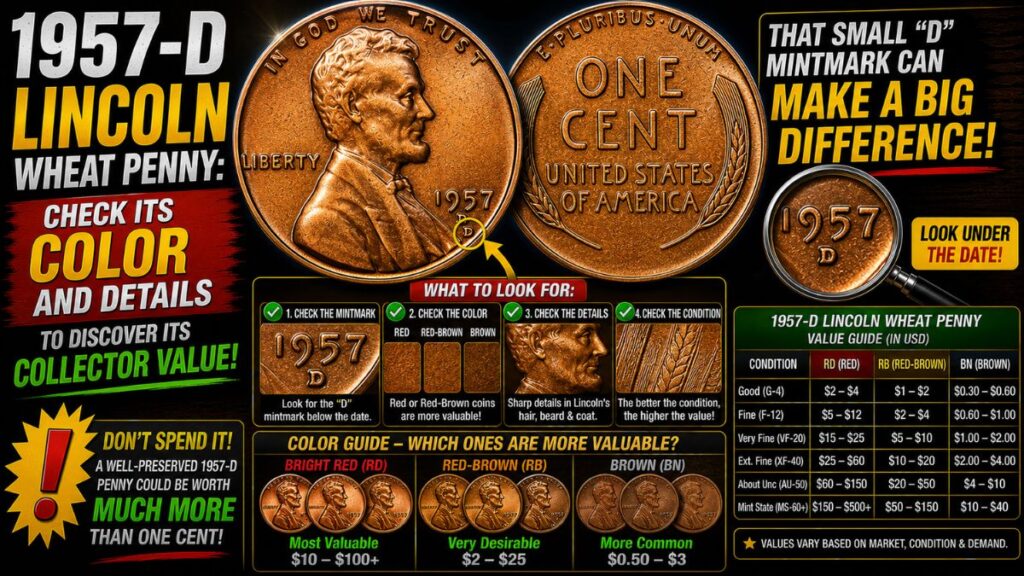
Could a penny that has been sitting in an old coin jar, family collection, or forgotten drawer be worth more than one cent? If you find a 1957-D Lincoln Wheat Penny, its color, condition, and small design details can help you determine whether it deserves a closer examination.
Most 1957-D Lincoln Wheat Pennies are common coins. The Denver Mint produced them in large quantities, and many examples remain available to collectors today. A typical circulated coin with ordinary wear is generally worth only its face value or a modest amount to someone assembling a collection.
However, not every example looks the same. Some pennies retain attractive original red color, while others have developed brown or mixed red-and-brown surfaces over time. Coins with exceptional preservation can be more desirable, and verified varieties or genuine mint errors may attract additional collector interest.
The important point is that age alone does not make a penny rare. A coin’s value depends on its actual condition, originality, identifiable characteristics, and the prices collectors are willing to pay for comparable examples.
The 1957-D penny offers a useful lesson in coin collecting because even small differences in color and surface quality can matter. Learning what to inspect can help you separate an ordinary old penny from an example that might deserve professional evaluation.
Understanding the 1957-D Lincoln Wheat Penny
The 1957-D Lincoln Wheat Penny is part of the Lincoln Wheat Cent series, which began in 1909. The coin features Abraham Lincoln on the obverse, or front, and two wheat ears on the reverse, or back.
The letter D identifies the Denver Mint as the facility where the coin was struck. On this issue, the mint mark appears below the date on the obverse.
The wheat design makes the coin easy to recognize. Two curved wheat stalks frame the words ONE CENT and UNITED STATES OF AMERICA, while the upper portion of the reverse displays the motto E PLURIBUS UNUM.
By 1957, the Wheat Cent design had been in use for nearly five decades. Although the design was familiar to the public, collectors still paid attention to differences in condition, strike quality, and surface preservation.
The 1957-D cent was made primarily of copper, with a composition of 95% copper and 5% tin and zinc. Its original copper surface could appear reddish when new, but exposure to air, moisture, handling, and storage conditions gradually changed the appearance of many coins.
This is why two pennies with the same date and mint mark can look very different today. One might have a dull brown surface and noticeable wear, while another may retain much of its original red color and mint luster.
Both are genuine examples of the same coin issue, but their collector appeal may differ substantially.
How Much Is a 1957-D Lincoln Wheat Penny Worth?
The value of a 1957-D Lincoln Wheat Penny depends mainly on its condition, color designation, and whether it has a verified variety or mint error.
Most circulated examples are common. If a penny shows ordinary wear, has no unusual characteristics, and lacks exceptional collector appeal, its value is usually modest.
An uncirculated example may be worth more because it has avoided the wear associated with everyday use. A coin in a particularly high grade, with attractive original surfaces and minimal contact marks, can be more desirable.
Original red color can also influence collector interest. Copper coins that retain much of their original reddish appearance are often sought by collectors, especially when the color is accompanied by strong luster and excellent preservation.
However, a red-looking penny is not automatically valuable. Cleaning, artificial coloring, environmental effects, and other surface alterations can create misleading appearances. The color must be considered alongside originality and condition.
Verified varieties and genuine mint errors are another category. A coin with a recognized doubled die or a significant manufacturing error may attract a premium, but the specific feature must be established rather than assumed.
There is no single price that applies to every 1957-D penny. A worn brown coin, a high-grade red example, and a coin with an authenticated mint error represent different collecting situations.
For a realistic estimate, compare your penny with recent completed sales of similar coins. Pay attention to the exact grade, color designation, and any recognized variety or error.
Why the Letter D Matters
The D mint mark is an important part of identifying the 1957 Lincoln Wheat Penny.
The United States Mint operated facilities that produced coins for circulation, and the mint mark helps distinguish the origin of particular issues. On a 1957-D cent, the D appears beneath the date on the front of the coin.
A 1957 penny without a mint mark is associated with Philadelphia production, while a 1957-D penny was struck at Denver.
This distinction matters because collectors often organize Lincoln Wheat Cents by date and mint mark. A complete collection may require separate examples from different facilities, even when the coins share the same basic design.
However, the presence of a D does not make the coin rare. Denver produced the 1957-D cent in large numbers, so the mint mark alone is not a reason to expect a substantial premium.
When checking a coin, make sure the D is part of the original design rather than a mark created by damage or alteration. Examine the area below the date under good lighting and avoid scraping the surface.
The mint mark should be considered alongside the date, color, condition, and other characteristics. It helps identify the coin, but it does not determine its value by itself.
Why Color Is So Important for Copper Pennies
Copper is a reactive metal, and its appearance can change as it interacts with its environment. A newly struck copper penny typically has a reddish surface, but that color can gradually shift toward brown.
This process is one reason collectors pay close attention to the color of Lincoln Wheat Cents. Two coins with similar wear may have different levels of visual appeal because one retains more of its original red color.
The color of a 1957-D penny is commonly described using three categories: Red, Red-Brown, and Brown.
These categories help collectors communicate how much original red coloration remains. They do not replace the coin’s numerical grade, and they do not guarantee a particular price.
A high-grade red cent may be desirable because it combines strong preservation with attractive original coloration. A brown example can also be collectible, especially if it is sharply struck and well preserved.
The crucial distinction is between natural, original color and a surface that has been changed through cleaning or artificial treatment.
A coin that looks bright red because it has been chemically altered should not be treated as equivalent to an original red coin. Surface originality is an important consideration in copper coin collecting.
Understanding these differences can help you assess the 1957-D penny more accurately and avoid placing too much emphasis on color alone.
What Does Red Mean on a 1957-D Penny?
A Red, or RD, designation generally indicates that a copper coin retains at least 95% of its original red coloration under the standards commonly used for certification.
For a 1957-D Lincoln Wheat Penny, this means the surface remains predominantly reddish rather than having changed significantly to brown.
Red examples can be attractive because they preserve much of the appearance associated with a newly struck copper coin. When a red penny also has strong mint luster, minimal contact marks, and sharp details, it may be more desirable to collectors.
However, the designation is not a measure of rarity by itself. The 1957-D cent was produced in large quantities, and surviving red examples exist in a range of grades.
A lower-grade red coin and an exceptionally well-preserved red coin can have very different market values. Similarly, a coin with an attractive red appearance may still have scratches, spots, or other problems that reduce its appeal.
It is also important to distinguish original red color from artificial brightness. Copper can be cleaned or treated in ways that make it look unnaturally vivid, but such treatment may damage the surface and reduce collector interest.
If your penny appears strongly red, examine it under neutral lighting and look for consistent color and natural-looking luster. Avoid making a definitive assessment based only on a photograph, since lighting and camera settings can change how copper appears.
What Does Red-Brown Mean?
Red-Brown, commonly abbreviated RB, describes a copper coin that retains some original red coloration but has developed brown areas.
This appearance is normal for many copper cents that have been stored for decades. Different parts of a coin may change color at different rates, depending on exposure, handling, and storage conditions.
A 1957-D penny with red and brown areas may still be attractive, particularly if the color is natural and the coin has excellent detail.
The Red-Brown category falls between the Red and Brown designations. It can help collectors distinguish a coin that retains meaningful red coloration from one that has become predominantly brown.
However, the distinction should not be treated as a simple ranking of value. A Red-Brown coin in exceptional condition may be more desirable than a Red coin with severe marks or surface problems.
The numerical grade, quality of the strike, surface preservation, and overall eye appeal remain important.
When inspecting your penny, look for naturally varying shades rather than trying to judge it by the intensity of one small patch. Color should be considered across the entire surface.
If the coin has unusual spots, streaks, or abrupt color changes, do not immediately assume that these features indicate a valuable variety. They may result from environmental exposure or other surface changes.
A Red-Brown designation can be useful when describing a coin, but professional evaluation may be needed when the distinction could significantly affect its market value.
What Does Brown Mean?
A Brown, or BN, designation generally applies when a copper coin has become predominantly brown rather than retaining most of its original red coloration.
Many 1957-D Lincoln Wheat Pennies fall into this category because copper changes color over time. Brown coloration is not automatically evidence of damage, poor storage, or a defective coin.
A naturally toned brown penny can still be an appealing collectible. It may have a pleasing, even surface and sharply defined design details despite having lost most of its original red appearance.
The coin’s grade remains important. A heavily worn brown cent is different from an uncirculated brown cent with strong luster and minimal contact marks.
A brown coin may also be more suitable for collectors who prioritize completing a date-and-mintmark set rather than pursuing the most colorful examples.
It is a mistake to assume that every brown penny is worthless or that every red penny is valuable. Color is one part of a broader evaluation.
If your 1957-D cent is brown, examine its surfaces and design before deciding whether it deserves to be kept. A well-preserved coin can still be interesting even when its original red coloration has largely disappeared.
How to Check Your Penny’s Color Correctly
The best way to inspect the color of a 1957-D Lincoln Wheat Penny is to use consistent lighting and avoid handling the coin unnecessarily.
Start by placing the penny on a clean, soft surface. Hold it by the edges if you need to lift it, and avoid rubbing the front or back.
Use natural, indirect daylight or a neutral white light. Very warm bulbs can make copper look more orange, while some cool lights can make it appear darker or more subdued.
Look at the entire obverse and reverse rather than focusing on one bright area. A coin may have red coloration on the protected parts of the design but brown areas across the open fields.
Rotate the coin gently under the light. Original mint luster often produces a changing sheen as the angle shifts. A flat, uniformly shiny appearance may warrant closer examination, although lighting alone cannot prove that a coin has been cleaned.
Check for spots, streaks, fingerprints, and uneven discoloration. These characteristics may affect the coin’s appeal and can help explain why its color does not look uniform.
Do not try to restore red color by polishing, rubbing, or applying chemicals. Such actions can damage the coin and reduce its desirability.
The purpose of this inspection is to observe the penny as it is, not to change its appearance. If the color designation would have a major effect on its potential value, consider obtaining a professional opinion.
How Original Red Color Can Affect Collector Value
Original red color can contribute to the desirability of a 1957-D Lincoln Wheat Penny, particularly when it is paired with exceptional preservation.
Collectors who specialize in copper cents often seek examples that retain their original appearance. A red coin with strong luster and few marks can stand out from more common brown examples.
However, color does not work independently of grade. A coin with bright red coloration but numerous scratches, spots, or signs of cleaning may be less desirable than a coin with more subdued color and better surfaces.
The availability of comparable coins also matters. Because the 1957-D cent was produced in large quantities, collectors have many examples to choose from. A premium generally requires a meaningful distinction, such as an exceptional grade, attractive surfaces, or a recognized variety.
A color designation can help communicate that distinction, but it is not proof that a coin is rare.
When researching prices, compare coins with similar color classifications and grades. A certified Red example should not automatically be used as a benchmark for a Brown coin, and a high-grade example should not be compared directly with a circulated one.
The best estimate reflects the specific coin you have rather than the highest price associated with the date.
Why Originality Matters More Than Brightness
A penny’s appearance can be changed after it leaves the Mint. Cleaning, polishing, chemical treatment, and environmental exposure may all affect its surface.
For this reason, collectors distinguish original color and luster from a surface that has been artificially altered.
A naturally red copper cent has retained much of its original coloration. A cleaned coin may appear unusually bright but show fine scratches, unnatural shine, or other evidence of treatment.
These signs are not always easy for beginners to interpret. Some lighting conditions make ordinary surfaces look reflective, while certain forms of discoloration may be difficult to distinguish from natural toning.
Avoid trying to diagnose a coin by rubbing it with a cloth or applying household products. Such methods can create damage that is difficult or impossible to reverse.
A professional grader may identify cleaning or other surface problems that are not obvious to an inexperienced observer.
If your 1957-D penny appears unusually bright, treat that as a reason to inspect it carefully rather than as proof of a high value.
Collectors generally want a coin that is both attractive and original. Preserving its existing surface is safer than trying to make it look newer.
The Importance of Condition and Grade
The numerical grade describes the coin’s overall state of preservation. It reflects factors such as wear, surface marks, luster, and design detail.
For the 1957-D Lincoln Wheat Penny, condition can make a substantial difference in collector interest.
A heavily circulated cent may show flattened hair details, worn wheat lines, scratches, and reduced luster. These features are normal for a coin that spent years in circulation.
An uncirculated coin has not experienced ordinary circulation wear, but it may still have marks from contact with other coins during production, storage, or transport.
Higher-grade examples generally have better-preserved surfaces and fewer distracting marks. A coin with strong luster and sharp details can be more appealing than one with similar color but weaker overall preservation.
The obverse should be examined around Lincoln’s cheek, hair, and the open fields. These areas can reveal contact marks and signs of wear.
On the reverse, inspect the wheat ears, lettering, and central inscriptions. Look for clear lines and well-defined details rather than relying only on the coin’s color.
A numerical grade should not be assigned casually based on a quick glance. Professional grading involves consistent standards and a broader assessment of the coin.
For most circulated 1957-D pennies, the grade may not change the value enough to justify certification. For an unusually well-preserved specimen, the distinction can be more important.
How to Recognize an Uncirculated 1957-D Penny
An uncirculated 1957-D penny has not experienced ordinary circulation wear. It may retain original mint luster and show sharp design details, although its surfaces can still have contact marks.
The first step is to inspect Lincoln’s portrait. The hair and facial details should be checked for flattening, but small marks may be present even on a coin that has never circulated.
Next, look at the open areas around the portrait. These fields can show scratches or contact marks that influence the coin’s grade.
Turn the penny over and examine the wheat stalks and lettering. Strong detail is desirable, but the coin’s overall condition matters more than any single feature.
Original luster is another clue. As the coin moves under light, its surface may show a changing sheen. This is different from simply appearing glossy, although determining whether the luster is original can require experience.
An uncirculated coin may also have spots or uneven color. Such features do not necessarily mean it circulated, but they can affect its attractiveness and market value.
Do not assume that a penny found in an old envelope or collection has remained uncirculated. Storage alone does not establish grade.
If your coin appears exceptionally well preserved, compare it with certified examples and consider whether professional grading would be worthwhile.
Checking the Date and Mint Mark
Before evaluating color or condition, confirm that the coin is actually a 1957-D Lincoln Wheat Penny.
The date appears on the obverse, below Lincoln’s portrait. The D mint mark is positioned beneath the date.
Use a magnifier if necessary, but avoid excessive pressure or scraping. The date and mint mark should be readable without altering the coin.
The distinction between a 1957 Philadelphia cent and a 1957-D Denver cent matters to collectors who assemble complete date-and-mintmark sets.
However, the mint mark does not automatically indicate rarity. The 1957-D cent was a regular issue produced in large quantities.
If the D appears unusually shaped, damaged, or poorly defined, do not assume that it is a rare mint-mark variety. Wear, corrosion, contact marks, and lighting can change how small letters appear.
A genuine variety requires a recognizable and repeatable difference from normal production. A random-looking mark near the date is not enough.
Once the date and mint mark are confirmed, move on to the coin’s color, grade, and other characteristics. Accurate identification is the foundation of a useful value estimate.
What Is a Doubled Die Lincoln Wheat Penny?
A doubled die is a variety created during the preparation of a coin die. Misalignment between impressions during die production can leave a doubled image that appears on coins struck by that die.
Collectors look for genuine doubling in design elements such as lettering, numbers, and other details. The appearance varies depending on the particular variety.
However, not every apparent doubling is a doubled die. Machine doubling can occur during the striking process and often creates a flattened or shelf-like secondary image. This is generally treated differently from a recognized doubled-die variety.
Scratches, worn lettering, reflections, and damage can also create misleading shapes.
For a 1957-D Lincoln Wheat Penny, do not assume that a slightly unusual date or letter represents a valuable doubled die. The exact feature must be identified and compared with reliable examples.
A recognized variety can increase collector interest, but its value depends on its identification, grade, availability, and demand.
If you suspect doubling, examine the coin under magnification and consistent lighting. Look for a distinct and repeatable design feature rather than a vague shadow around a letter.
Professional evaluation may be appropriate if the feature appears significant. Until then, it is best to describe what you observe without assigning a rare-variety label.
Other Varieties and Mint Errors to Watch For
A mint error occurs when a problem during production changes the coin’s appearance or structure. Such errors can attract collectors because they differ from ordinary examples.
Possible error categories include off-center strikes, broadstrikes, clipped planchets, and certain planchet or striking abnormalities. Their appearance and significance vary considerably.
A genuine off-center strike may show part of the design displaced relative to the coin’s blank area. A broadstrike may have an unusual shape because the coin was struck without the normal restraining collar. A clipped planchet may have a missing section caused by the blank-cutting process.
These descriptions are examples of error categories, not claims that every type is documented for the 1957-D issue.
The main challenge is distinguishing a manufacturing error from damage that occurred after the coin left the Mint.
A coin that has been cut, bent, squeezed, scratched, or corroded may look unusual but does not automatically qualify as a mint error.
Before assigning a premium, inspect the feature carefully and seek an expert opinion if necessary. The error should be consistent with the coin-making process and supported by convincing evidence.
Even a genuine error may have only modest value if it is minor or does not attract strong collector demand.
The most reliable approach is to identify the specific error rather than assuming that anything unusual is rare.
Why Not Every 1957-D Penny Is Valuable
The 1957-D penny can be interesting to collectors without being rare. The distinction between an old coin and a scarce coin is essential when estimating value.
Millions of examples were produced, and many remain available. A typical circulated penny may have little value beyond its face value or a modest amount to a collector completing a set.
The fact that the coin is nearly seventy years old does not automatically make it expensive. Coins are valued according to supply, demand, condition, and identifiable characteristics.
Color can make a difference, but red coloration alone does not guarantee a premium. The coin must also have desirable preservation and original surfaces.
Likewise, an unusual-looking date, mint mark, or letter is not enough to establish a valuable variety. The feature must be recognized and verified.
Online listings sometimes show high asking prices for common coins. These listings can create the impression that every example is worth a large amount, but the seller’s requested price is not proof of market value.
Actual completed sales of comparable coins provide a more useful benchmark.
If your penny is ordinary, that does not make it uninteresting. It can still be part of a date-and-mintmark collection or serve as a useful example for learning how copper coins age.
How to Estimate the Value of Your 1957-D Penny
A reliable estimate begins with careful identification and a realistic assessment of the coin.
First, confirm the date and mint mark. Make sure the coin is a 1957 cent struck at Denver.
Second, assess its color. Decide whether it appears predominantly red, a mixture of red and brown, or predominantly brown. Remember that this is a preliminary observation rather than a formal certification.
Third, examine the condition. Look for wear, contact marks, scratches, spots, rim damage, and signs of cleaning.
Fourth, inspect the design. Check Lincoln’s portrait, the date, the mint mark, the wheat ears, and the inscriptions for sharpness and unusual characteristics.
Fifth, investigate any suspected variety or error. Do not assign a label until the feature has been compared with reliable examples.
Sixth, research recent completed sales of coins that match your example as closely as possible. The most useful comparisons share the same date and mint mark, a similar grade, and the same color designation or verified variety.
Finally, consider the cost of professional grading. Certification may be useful for an exceptional coin, but the fees and related expenses can exceed the likely value of an ordinary penny.
This process is more dependable than relying on a single price guide or a headline claiming that a common coin could be worth thousands.
Why Actual Sales Matter More Than Asking Prices
Coin prices can vary depending on the coin’s grade, color, originality, and demand at the time of sale.
An advertised price represents what a seller hopes to receive. It does not establish that a buyer has paid that amount.
Completed sales provide stronger evidence of what collectors have actually been willing to pay. Even then, the comparison must be appropriate.
A certified high-grade Red 1957-D cent should not be compared directly with a worn Brown example. A coin with a recognized error should not be used as a benchmark for a normal penny.
Pay attention to the grade, color designation, certification details, and any special characteristics. Also consider the date of the transaction, since collector demand can change.
Auction totals may include buyer premiums or other charges, so the final amount paid may differ from the amount received by the seller.
If there are few comparable transactions, acknowledge the uncertainty rather than selecting an unusually high figure.
For a common circulated penny, research may confirm that the coin has little financial premium. For a well-preserved red example or a verified variety, comparisons can help determine whether further evaluation is justified.
Should You Get a 1957-D Penny Professionally Graded?
Professional grading can be useful when a coin appears to have exceptional preservation, unusually attractive original red color, or a potentially significant variety.
A grading service evaluates the coin under established standards and may authenticate it, assign a numerical grade, and provide a color designation for copper coins.
Certification can make a coin easier to describe and compare with similar examples. It can also provide buyers with greater confidence when a coin has meaningful collector value.
However, grading is not necessary for every penny.
A worn 1957-D cent with ordinary color and no unusual characteristics is unlikely to justify the expense. Grading fees, shipping, insurance, and other costs can easily exceed the coin’s market value.
Before submitting a coin, compare it with certified examples and estimate a realistic selling price. Consider whether the possible premium would justify the total cost.
If you suspect a doubled die or another mint error, an initial assessment from a knowledgeable dealer or specialist may help you decide whether formal certification is worthwhile.
Avoid sending a coin for grading simply because it looks shiny. Originality, surface quality, and the complete condition matter more than brightness alone.
How to Store and Protect Your Penny
Proper storage helps preserve the color and condition of a 1957-D Lincoln Wheat Penny.
Handle the coin by its edges whenever possible. Oils and moisture from fingers can affect copper surfaces, while dropping the penny may create scratches or dents.
Do not clean or polish the coin. Rubbing can leave fine scratches, and chemical products may change the color or damage the surface.
Store it in a holder suitable for coins. A good holder reduces unnecessary handling and helps prevent contact with other coins.
Keep the penny in a stable environment away from excessive humidity, harsh chemicals, and other substances that may affect copper.
Avoid storing loose coins in containers where they can rub against each other. Repeated contact can create marks that reduce their visual appeal.
If the penny appears to retain original red color, careful storage is particularly important. Unnecessary handling or exposure to damaging conditions can change the surface over time.
If you suspect a valuable variety or error, leave the coin unaltered until it has been evaluated. Do not scrape, polish, or apply chemicals in an attempt to improve its appearance.
Preservation is the safest strategy because the original surface cannot simply be recreated once it has been damaged.
Building a Collection Around the 1957-D Lincoln Wheat Penny
The 1957-D cent can be a useful addition to a Lincoln Wheat Penny collection, even if it is not a rare coin.
Some collectors assemble a date-and-mintmark set, collecting examples from different years and mint facilities. Others focus on condition and seek the sharpest, cleanest examples available.
Color collecting is another option. A collector may compare Red, Red-Brown, and Brown cents to learn how copper changes over time and how preservation affects desirability.
Some collectors also specialize in recognized varieties or mint errors. This approach requires careful identification because many apparent errors are simply damage or ordinary production effects.
You do not need an expensive coin to begin learning. Common examples are useful for studying the design, identifying mint marks, and understanding the difference between wear and strike weakness.
Keeping notes about the date, mint mark, color, condition, and any unusual features can improve your knowledge over time.
A collection can be rewarding even when its individual coins have modest market values. The process of identifying, comparing, and preserving coins is an important part of the hobby.
The 1957-D penny is a good example of how a common coin can still offer lessons in copper coloration, grading, and collector evaluation.
Common Mistakes When Evaluating a 1957-D Penny
Several mistakes can lead collectors to overestimate or underestimate a coin’s value.
One common error is assuming that age creates rarity. The 1957-D penny is old, but it was produced in large quantities, and many examples remain available.
Another mistake is judging value by color alone. Red coloration can attract interest, but the coin’s grade, surface quality, and originality are equally important.
A third mistake is confusing brightness with original luster. Cleaning or polishing can make copper look shiny while reducing its collector appeal.
Collectors also sometimes mistake damage for a mint error. An unusual mark or distorted letter must be evaluated carefully before it is described as a variety.
Finally, many people rely on high online asking prices rather than actual sales. A listing does not prove that the coin has sold for the advertised amount.
To avoid these problems, identify the coin accurately, inspect it under consistent lighting, preserve its surface, and compare it with similar coins.
A realistic assessment is more useful than an exaggerated estimate, especially when deciding whether to spend money on grading or authentication.
A Practical Checklist Before Spending Your 1957-D Penny
Before spending a 1957-D Lincoln Wheat Penny, take a few moments to inspect it.
- Confirm that the date reads 1957.
- Check for the D mint mark below the date.
- Examine the color under neutral lighting.
- Decide whether the coin appears Red, Red-Brown, or Brown, remembering that your assessment is preliminary.
- Inspect Lincoln’s portrait and the open fields for wear, scratches, and contact marks.
- Check the wheat ears and lettering for sharpness.
- Look for signs of cleaning, artificial color, corrosion, or other surface changes.
- Investigate any suspected doubled die or mint error before calling it rare.
- Compare the coin with recent completed sales of similar examples.
- Consider professional grading only if the potential collector premium justifies the cost.
If the penny is heavily circulated and shows no unusual characteristics, it is probably a common example with modest value.
If it retains attractive original red color, has exceptional preservation, or displays a verifiable variety, it may deserve a closer look.
The checklist helps you make that decision without spending money unnecessarily or damaging the coin.
Frequently Asked Questions About the 1957-D Lincoln Wheat Penny
How much is a 1957-D Lincoln Wheat Penny worth?
Most circulated examples are common and have modest value. Uncirculated coins, especially those with attractive original red color and exceptional preservation, may command premiums. The exact amount depends on grade, color, originality, and collector demand.
Is the 1957-D penny rare?
The standard 1957-D Lincoln Wheat Penny is not generally considered rare. It was produced in large quantities. Examples in exceptional condition or with verified varieties may be more desirable than ordinary circulated coins.
What does the D mean on a 1957 penny?
The D mint mark indicates that the penny was struck at the Denver Mint. It appears below the date on the obverse.
Why is the color of a 1957-D penny important?
Copper changes color over time. Collectors use Red, Red-Brown, and Brown designations to describe how much original red coloration remains. Color can influence desirability, but it must be considered alongside grade and surface originality.
What is a Red 1957-D Lincoln Wheat Penny?
A Red, or RD, designation generally means that at least 95% of the coin’s original red coloration remains under commonly used certification standards. A formal designation should not be assigned based solely on a casual visual inspection.
Is a Red-Brown 1957-D penny valuable?
It can attract collector interest, especially if it has excellent preservation and attractive surfaces. However, Red-Brown color alone does not guarantee a premium. The coin’s grade and market demand also matter.
Is a Brown 1957-D penny worth keeping?
A Brown example may still be useful for a date-and-mintmark collection. Most circulated coins remain inexpensive, but a well-preserved example or a verified variety may deserve further attention.
Is every shiny 1957-D penny valuable?
No. Brightness does not prove that a coin is uncirculated or valuable. Cleaning, polishing, and other treatments can make copper look shiny while damaging its surface.
Can a 1957-D penny be worth hundreds of dollars?
Exceptional certified examples or coins with significant authenticated varieties or errors may command substantial premiums, but ordinary circulated examples generally do not. Any high valuation should be supported by comparable completed sales.
How can I tell if my 1957-D penny has a doubled die?
Look for distinct, consistent doubling in the design rather than a vague shadow or flattened secondary outline. Machine doubling and post-mint damage can be mistaken for doubled dies. Compare the coin with reliable examples and seek expert evaluation if necessary.
Should I clean my 1957-D Lincoln Wheat Penny?
No. Cleaning can leave scratches, alter the color, and reduce collector appeal. Preserve the coin in its current condition until you have determined whether it needs professional evaluation.
Is professional grading worth it for a 1957-D penny?
It may be worthwhile for a coin that appears exceptionally well preserved or has a potentially significant variety. For an ordinary circulated penny, grading costs are likely to exceed its value.
Where can I sell a valuable 1957-D penny?
If your coin appears exceptional, consider a reputable coin dealer, a specialist in Lincoln cents, or an established numismatic auction. Compare recent sales of similar coins and account for any selling costs before setting a price.
What should I check first on a 1957-D penny?
Start with the date and D mint mark. Then inspect the color, original luster, wear, surface marks, and wheat details. Investigate any unusual feature before assuming that it increases the coin’s value.
Conclusion: Check the Color, Study the Details, and Verify the Value
The 1957-D Lincoln Wheat Penny may be a common coin, but its color and condition can make it more interesting to collectors. Original red coloration, strong mint luster, minimal surface marks, and sharply defined details can distinguish an attractive example from an ordinary circulated penny.
The D mint mark identifies Denver production, but it does not make the coin rare on its own. Likewise, a bright red surface does not guarantee a high price, and an unusual mark does not automatically establish a valuable mint error.
The most reliable approach is to examine the coin carefully, protect its original surfaces, and compare it with similar examples that have actually sold. If you discover exceptional preservation or a potentially significant variety, professional evaluation may help determine whether the coin deserves a premium.
If your 1957-D penny is worn and ordinary, it can still be a useful addition to a collection. If it retains original red color or displays a verified feature that sets it apart, it may be worth a closer look.
Check the color, study the details, and verify the evidence before deciding what your penny is worth.