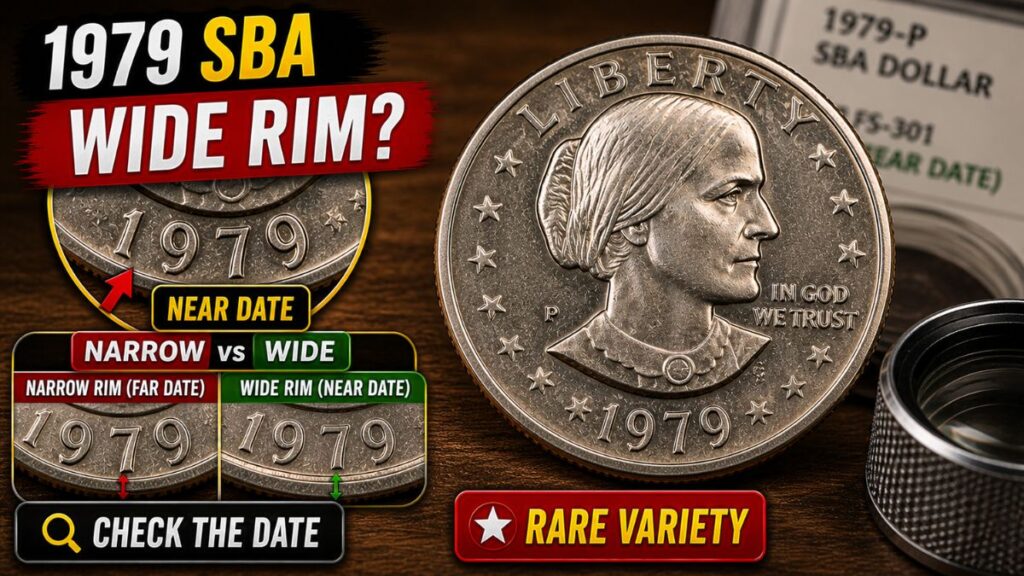
Finding a 1979 Susan B. Anthony Dollar can be exciting, but knowing where to look first may make the difference between an ordinary coin and a potentially valuable collectible. Instead of examining every detail immediately, collectors should begin with one important feature: the position of the date in relation to the outer rim.
The 1979 Susan B. Anthony Dollar is especially interesting because the year includes different varieties that can look similar at first glance. One of the most closely watched is the 1979-P Wide Rim, also known as the Near Date variety. This version has the date positioned noticeably closer to the rim than the more common Narrow Rim variety.
That small difference in placement can be important.
The Wide Rim/Near Date variety is associated with the Philadelphia Mint and does not carry a mintmark. While many 1979 Susan B. Anthony Dollars are common, the Wide Rim variety is much more desirable, particularly in strong condition. Some exceptional certified examples have achieved prices in the thousands, showing why accurate identification matters.
However, the presence of the 1979 date alone does not make a Susan B. Anthony Dollar rare. Collectors must examine the date position, confirm the mint information, distinguish the variety correctly, and evaluate the coin’s condition before making any assumptions about value.
Another variety from the same year that attracts collector attention is the 1979-S Type 2 proof. This coin is identified by its clearer and more defined S mintmark. It is a different variety from the 1979-P Wide Rim and should not be confused with it.
The most important lesson is simple: do not judge every 1979 Susan B. Anthony Dollar by its date alone. The details surrounding the date, mintmark, variety, and preservation determine whether the coin deserves further investigation.
Why the 1979 Susan B. Anthony Dollar Is Important to Collectors
The Susan B. Anthony Dollar was introduced in 1979 as a new United States dollar coin honoring Susan B. Anthony, an important figure in the history of women’s suffrage and equal rights.
The coin was smaller and lighter than earlier large-size dollar coins, making it easier to carry and use. Its compact size was intended to make the denomination more practical for everyday transactions.
The obverse features a portrait of Susan B. Anthony, while the reverse shows an adaptation of the Apollo 11 insignia, depicting an astronaut on the Moon with Earth visible in the background. The design connects the coin to the historic American space program.
Although the Susan B. Anthony Dollar was produced in large quantities, collectors have identified several varieties and production differences that make particular examples more desirable.
This is common in coin collecting. A coin can have a date that appears on millions of examples while still containing individual varieties that are much scarcer.
The 1979 issue is especially interesting because of the differences in the rim and date positioning on Philadelphia coins, as well as the different mintmark styles found on certain San Francisco proof coins.
For collectors, the year offers a useful lesson in the importance of close examination.
A quick glance may show only a 1979 dollar. A careful inspection may reveal a specific variety that belongs in a more specialized collection.
The First Detail to Examine: The Date Position
The central focus of this variety is the location of the date on the obverse.
When examining a 1979 Susan B. Anthony Dollar, look at the relationship between the date and the outer rim. The date should not be judged only by its numbers or font. Its distance from the rim is an important identification feature.
On the common Narrow Rim variety, the date appears farther away from the outer rim.
On the Wide Rim, also called the Near Date variety, the date is positioned noticeably closer to the rim.
This difference may seem minor, especially to someone who has never compared the two varieties side by side. However, collectors who specialize in Susan B. Anthony Dollars use this positioning as one of the main ways to distinguish the varieties.
The key is to compare the date’s location rather than relying on general impressions.
A coin may appear unusual because of lighting, wear, camera angle, or surface discoloration. These factors can make the date look closer or farther from the rim than it actually is.
For that reason, the best identification process involves comparing the coin with clear examples of both varieties under consistent lighting.
Understanding the 1979-P Wide Rim or Near Date Variety
The 1979-P Wide Rim is one of the most recognized collectible varieties associated with the first year of the Susan B. Anthony Dollar.
The P designation refers to the Philadelphia Mint. Unlike coins produced at Denver or San Francisco, Philadelphia coins from this period generally do not carry a mintmark.
The variety is commonly called Wide Rim because the design’s rim arrangement differs from the more common version. It is also known as Near Date because the date is placed closer to the outer rim.
Both names refer to the same general variety.
Collectors should become familiar with both terms because coin descriptions may use either one. A listing may describe a coin as a 1979-P Wide Rim, a 1979 Near Date, or a 1979-P Near Date.
These descriptions are intended to identify the same important date-position characteristic.
However, buyers and sellers should still examine the actual coin carefully. A description alone does not prove that the coin has been correctly attributed.
Why the Wide Rim Variety Is More Desirable
The Wide Rim variety attracts attention because it is significantly scarcer than the common 1979-P Narrow Rim version.
The provided collector information identifies an estimated surviving population of approximately 20,000 Wide Rim examples. That estimate helps explain why the variety receives attention from collectors.
The exact number of surviving examples can be difficult to establish with absolute certainty. Coins may remain in private collections, appear in different grades, or be discovered years after earlier estimates were made.
Nevertheless, the important point is that the Wide Rim is not simply another ordinary 1979 dollar.
Its scarcity creates additional collector interest.
A coin’s value is influenced by several factors, including rarity, demand, grade, surface quality, eye appeal, and authentication. The Wide Rim variety benefits from being a recognized and sought-after collectible issue, but not every example will command the same price.
A worn coin and a highly preserved certified coin can have very different market positions.
How to Recognize the Common Narrow Rim Variety
Before identifying a Wide Rim, collectors should understand the common Narrow Rim variety.
The Narrow Rim version is the more frequently encountered 1979-P Susan B. Anthony Dollar. On this variety, the date appears farther away from the outer rim.
Because the Narrow Rim is common, finding one does not usually create the same level of excitement as discovering a confirmed Wide Rim.
However, the Narrow Rim remains an important part of the series and can still be collected for its historical significance, condition, and overall quality.
The challenge is that the difference between the two varieties can be difficult to judge without a direct comparison.
A collector who has only seen one type may not immediately recognize the distinction.
That is why side-by-side comparison is so useful.
Place a suspected Wide Rim next to a confirmed Narrow Rim example. Examine the space between the date and the rim using similar lighting and viewing angles.
Do not rely on memory alone.
Why Side-by-Side Comparison Is So Helpful
Coin identification becomes more accurate when similar examples are compared directly.
When looking at a single coin, the date position may not seem especially unusual. The eye may adjust to the coin’s proportions, making the difference difficult to notice.
A side-by-side comparison makes the contrast easier to recognize.
Look at the space above and around the date.
Observe how close the numbers appear to the rim.
Compare the overall arrangement of the design.
Make sure both coins are viewed at the same angle and under similar lighting.
A magnifying glass can help, but extreme magnification is not always necessary. In many cases, a clear comparison with an identified example provides more useful information than simply enlarging the coin.
The purpose of magnification is to observe details more clearly, not to create an impression that every tiny surface mark is important.
Why the Mintmark Must Be Checked
The date position is central to identifying the 1979-P Wide Rim, but collectors should also examine the mintmark.
The 1979-P variety was produced at Philadelphia and does not have a P mintmark.
This can confuse beginners because some collectors assume that every coin must carry a letter showing its mint. That is not correct for Philadelphia coins from this period.
A coin without a mintmark is not automatically an error.
The absence of a mintmark must be interpreted alongside the date, design, and other identifying characteristics.
If the coin has a D mintmark, it represents Denver production and should not be identified as a 1979-P Wide Rim simply because the date appears close to the rim.
Likewise, a coin with an S mintmark requires a different identification process, particularly if it is a proof coin.
Mintmark identification helps narrow the possibilities before the collector examines the variety.
The Difference Between 1979-P and 1979-S
The 1979-P Wide Rim and the 1979-S Type 2 proof are different collectible varieties.
The 1979-P Wide Rim is associated with Philadelphia and is identified primarily through the date’s position near the rim.
The 1979-S Type 2 is a proof variety associated with San Francisco and is identified through the appearance of its S mintmark.
These two varieties should not be mixed together.
The mint of production, coin finish, design characteristics, and identification process are different.
A collector should first establish whether the coin is a circulation strike or a proof. After that, the mintmark and other details can be evaluated.
This prevents a common error in online coin discussions, where different 1979 varieties are sometimes grouped together under one broad claim about value.
What Makes the 1979-S Type 2 Proof Interesting?
The 1979-S Type 2 proof is another variety that collectors watch closely.
Proof coins are produced using a process intended to create specially prepared examples with carefully finished surfaces and sharper design details. They are generally made for collectors rather than ordinary circulation.
The 1979-S Type 2 proof is associated with a clearer and more defined S mintmark.
This mintmark appearance helps distinguish it from the other 1979-S proof type.
However, identifying the Type 2 proof requires more than simply seeing an S on the coin. The collector must examine the mintmark style and confirm that the coin is genuinely a proof example.
A circulated-looking coin with an S mintmark should not automatically be described as a Type 2 proof.
The coin’s surfaces, strike characteristics, and overall appearance should be evaluated together.
How to Identify the 1979-S Type 2 Mintmark
The S mintmark on the 1979-S Type 2 proof is described as clearer and more defined than the mintmark found on the other proof type.
The difference can be subtle, especially for new collectors.
A magnifying glass and good lighting can make the mintmark easier to inspect. However, the collector should avoid assuming that every unclear or damaged S represents a particular variety.
Surface wear, scratches, dirt, and photographs can affect the appearance of the mintmark.
The most reliable approach is to compare the coin with authenticated examples and established identification references.
If the coin appears to be a valuable proof variety, professional authentication can provide additional confidence.
Why the Date Position Is More Important Than Surface Shine
A common mistake in coin collecting is to focus on brightness.
Some people believe that a highly reflective Susan B. Anthony Dollar must be rare or valuable. In reality, shine can result from several different causes, including original proof surfaces, lighting, polishing, or cleaning.
The Wide Rim variety is identified by the date’s position, not simply by how bright the coin looks.
A circulated coin may have a dull surface but still possess the correct Wide Rim characteristics.
A polished coin may appear bright but be an ordinary Narrow Rim example.
This is why collectors should prioritize design features over surface appearance.
The date position, mintmark, coin type, and condition should be considered before the coin’s shine becomes part of the discussion.
Why Cleaning Can Reduce a Coin’s Value
Cleaning is one of the biggest risks when examining an old or potentially valuable coin.
Some people believe that removing dirt will make a coin more attractive and increase its value. Unfortunately, cleaning can damage the original surface and reduce collector appeal.
Abrasive cleaning may create fine scratches.
Chemical cleaning can produce unnatural coloration or surface changes.
Polishing can remove the original appearance that collectors expect to see.
A coin that has been cleaned may still be collectible, but it can be worth less than an otherwise similar example with original surfaces.
For this reason, never clean a suspected 1979 Wide Rim or 1979-S Type 2 proof before authentication.
Keep the coin in its existing condition and allow a qualified professional to evaluate it.
What the $6,995 Auction Result Really Means
The supplied description refers to a documented $6,995 auction result for a 1979-P Wide Rim graded MS67+.
This figure is important because it demonstrates that an exceptional example of the variety can attract substantial collector interest.
However, the result must be understood in context.
The price relates to a specific coin with a specific grade and certification. It does not mean that every 1979-P Wide Rim is worth $6,995.
A circulated Wide Rim coin may have a much lower value.
An example with scratches, discoloration, cleaning, or weak overall preservation may not compare directly with a highly graded MS67+ specimen.
Even two coins with the same numerical grade can differ in eye appeal and market demand.
Therefore, an auction record should be used as a reference point rather than a guaranteed valuation.
Understanding the Meaning of MS67+
The designation MS67+ indicates a very high level of Mint State preservation.
MS means Mint State, which is used for coins that have not circulated in the ordinary sense. The numerical grade reflects the condition of the coin, while the plus designation indicates that the coin is considered to have qualities approaching the next grade level.
A coin graded MS67+ is not simply an average uncirculated example.
At this level, small differences in marks, luster, strike, and eye appeal can matter significantly.
That is why the auction price of a certified MS67+ Wide Rim cannot be applied to a worn coin found in a change jar.
The grade is an essential part of the reported result.
Without matching the variety and condition, the comparison becomes misleading.
Why Circulated Wide Rim Coins Can Still Be Interesting
The Wide Rim variety can attract attention even when it is circulated.
This is because variety rarity and condition rarity are separate concepts.
A coin may be scarce because relatively few examples of the variety exist, even if many surviving examples show wear.
A circulated Wide Rim may not command the same price as a high-grade certified example, but it can still be more desirable than a common Narrow Rim coin in similar condition.
Collectors who specialize in varieties may be interested in owning an authentic example regardless of whether it reaches a top grade.
The key is to identify the variety correctly.
A collector should not reject a potentially genuine Wide Rim simply because it has been used in circulation.
At the same time, circulated condition should be considered honestly when discussing value.
What the $1,955 Auction Result Means for the 1979-S Type 2
The supplied description also refers to a documented $1,955 auction result for a 1979-S Type 2 proof graded PR70.
This result demonstrates the potential market interest in an exceptionally preserved example of the variety.
The PR70 designation is significant because it represents a top proof grade.
A coin with this grade is expected to have extremely strong preservation and appearance under the applicable grading standards.
The auction result therefore relates to a particular proof coin with a specific variety and grade.
It should not be interpreted as the value of every 1979-S Susan B. Anthony Dollar.
A different proof type, a lower-grade coin, a damaged coin, or a coin with uncertain authenticity may have a very different market value.
Collectors should always separate the variety from the grade and the grade from the auction result.
Why Proof Coins Need Special Attention
Proof coins can have characteristics that distinguish them from circulation strikes.
Their surfaces may appear more reflective, and the design details can be sharper. Some proof coins display contrasting fields and raised design elements, depending on their production and preservation.
However, proof appearance alone does not establish a specific variety.
A coin may look shiny because of cleaning or lighting.
A circulation strike may appear attractive without being a proof.
The collector must consider the entire coin, including its strike, surfaces, mintmark, and identifying characteristics.
When examining a suspected 1979-S Type 2, the S mintmark is particularly important, but it should be evaluated in context.
How to Examine Your 1979 Susan B. Anthony Dollar
A careful inspection does not require expensive equipment.
Start by placing the coin on a clean, soft surface.
Avoid rubbing it against a table or hard material.
Use natural or neutral lighting.
Hold the coin by its edges.
Examine the obverse and locate the date.
Look at the distance between the date and the outer rim.
Check whether the coin has a mintmark.
If there is no mintmark, consider whether it could be a Philadelphia issue.
If there is an S mintmark, determine whether the coin appears to be a proof and examine the mintmark style.
Record your observations before attempting to estimate value.
This process helps prevent the collector from making a quick judgment based only on the coin’s age or appearance.
A Step-by-Step Wide Rim Identification Method
The following process can help you examine a possible 1979-P Wide Rim.
First, confirm that the coin is dated 1979.
Second, check that it does not carry a mintmark.
Third, inspect the position of the date relative to the outer rim.
Fourth, compare the date position with a confirmed Narrow Rim example.
Fifth, examine the coin for damage or alterations that could make the date position difficult to interpret.
Sixth, inspect the overall surface and strike.
Seventh, use magnification if necessary.
Eighth, compare the coin with authenticated Wide Rim examples.
Ninth, seek professional evaluation if the coin appears to be a genuine scarce variety.
This process is more dependable than relying on a general statement that a 1979 dollar is rare.
Why Lighting Can Cause Identification Problems
Lighting can change how a coin appears.
Strong light from one direction may create shadows around the date and rim. These shadows can make the date seem closer to the edge.
A photograph taken at an angle may distort the apparent relationship between the date and the rim.
Reflections can also hide important design details.
For accurate identification, examine the coin under even lighting and hold it as straight as possible.
If you take photographs, use more than one angle and avoid excessive digital editing.
The goal is to document the coin rather than create a dramatic image.
Why Magnification Should Be Used Carefully
Magnification can help collectors examine small details, but it can also encourage overinterpretation.
When a coin is viewed at high magnification, tiny scratches and surface marks may appear significant even when they have no collectible importance.
Use magnification to inspect the date position, mintmark, and possible variety characteristics.
Do not assume that every small line is a mint error.
The most valuable identification features are those that can be explained, repeated, and compared with recognized examples.
Magnification is a tool, not a substitute for knowledge.
How Wear Can Affect the Date Position
Wear can influence the appearance of the date and surrounding design.
A circulated coin may have flattened details, surface marks, or discoloration. These factors can make the date more difficult to interpret.
However, normal wear does not transform a Narrow Rim into a Wide Rim.
The underlying design arrangement remains important.
If the coin is heavily worn, compare it carefully with other examples and avoid making a definitive identification based on a blurry photograph.
A professional may be able to evaluate the coin more accurately when the variety is difficult to distinguish.
The Importance of Original Surfaces
Original surfaces can be important when determining a coin’s condition and desirability.
A coin that has remained untouched may retain characteristics that help collectors evaluate its quality.
A coin that has been polished or chemically treated may have an altered appearance.
This is especially important when discussing high-grade examples.
The reported MS67+ and PR70 auction results involve coins whose condition and surfaces were sufficiently strong to receive very high certified grades.
An ordinary coin that has been artificially brightened should not be compared directly with those examples.
Preserving the coin’s original state is therefore one of the most important steps in the identification process.
How to Avoid Confusing Damage With a Variety
Collectors should learn to distinguish genuine design characteristics from damage.
A scratch across the date may look like doubling.
A dent near the rim may make the date appear distorted.
A polished surface may create unusual reflections.
A damaged mintmark may appear different from the original design.
These features do not automatically indicate a recognized variety.
A genuine variety usually has a consistent characteristic associated with the production process.
When in doubt, compare the suspected feature with established examples and seek a qualified opinion.
Why the Date Alone Is Not Enough
A 1979 Susan B. Anthony Dollar may be old enough to attract attention, but age does not establish rarity.
Many coins from 1979 were produced in large numbers.
The value of a particular coin depends on more than its date.
Collectors should ask several questions:
Is the coin from Philadelphia, Denver, or San Francisco?
Is it a circulation strike or a proof?
Does it have the Wide Rim or Narrow Rim design?
If it is a proof, does it have the Type 2 mintmark?
What is the coin’s condition?
Has it been cleaned or damaged?
Is the variety authenticated?
These questions create a more accurate foundation for evaluating the coin.
Why Mint Location Changes the Identification Process
Mint location is important because different facilities produced different versions of the Susan B. Anthony Dollar.
Philadelphia coins generally lack a mintmark.
Denver coins carry a D.
San Francisco coins carry an S, including proof issues.
The mintmark can help identify the coin’s origin and narrow down the possible varieties.
However, collectors should not treat the mintmark as the only identifying feature.
A D or S does not automatically make a coin rare.
The mintmark must be considered together with the coin’s type, date, variety, and condition.
Why the 1979-P Wide Rim Is Often Misidentified
The Wide Rim and Narrow Rim varieties can appear very similar to inexperienced collectors.
The difference is not always dramatic, particularly when the coin is worn or the photograph is unclear.
Some online listings may use terms such as “Near Date” without providing enough evidence to support the attribution.
Buyers should therefore be cautious when purchasing an allegedly rare coin based only on a seller’s title.
The coin should be examined directly whenever possible.
Clear photographs can help, but professional certification provides stronger support when the potential value is significant.
Why a Seller’s Asking Price Is Not Proof of Value
An online seller may list a 1979 Susan B. Anthony Dollar for a very high price.
That does not mean the coin is worth that amount.
An asking price reflects what the seller hopes to receive. It does not necessarily represent a completed transaction.
Collectors should pay greater attention to documented auction results involving coins with matching varieties and comparable grades.
Even then, market prices can change.
The $6,995 result for an MS67+ 1979-P Wide Rim and the $1,955 result for a PR70 1979-S Type 2 are examples associated with specific certified coins.
They should not be treated as guaranteed prices for every coin in the same date group.
How Grade Influences the Value of the Wide Rim
A Wide Rim coin’s grade can influence its desirability.
A heavily circulated example may show wear and surface marks.
An uncirculated coin may retain more original detail.
A very high-grade coin may have fewer marks, stronger surfaces, and better eye appeal.
At the highest grades, even small imperfections can influence the final assessment.
This is why collectors should avoid estimating value based only on the variety.
The variety identifies what the coin is, while the grade helps explain the condition in which it survives.
Both factors must be considered.
Why Certification Can Be Important
Certification can provide independent documentation of a coin’s authenticity, variety, and grade.
This can be particularly useful for rare or expensive examples.
A certified coin is not automatically guaranteed to increase in value, but certification can make it easier for buyers and sellers to understand what is being offered.
For a suspected Wide Rim or Type 2 proof, certification may be especially helpful when the variety is difficult to distinguish.
Before paying for professional services, collectors should consider the coin’s potential value and the cost of authentication or grading.
The decision should be based on realistic expectations rather than an assumption that every 1979 dollar is valuable.
What to Do If You Think You Found a Wide Rim
If you believe you have found a 1979-P Wide Rim, begin by preserving the coin.
Do not clean it.
Do not polish it.
Do not scratch the rim to make the date position clearer.
Do not attempt to alter the surface.
Take clear photographs of the obverse and reverse.
Record whether the coin has a mintmark.
Compare the date position with a confirmed Narrow Rim example.
If the characteristics appear consistent with the Wide Rim variety, consider having the coin examined by a professional.
The goal is to confirm the identification before making any selling decision.
What to Do If You Think You Found a 1979-S Type 2 Proof
A suspected 1979-S Type 2 proof should also be handled carefully.
Confirm the date.
Check for the S mintmark.
Examine the mintmark’s shape and clarity.
Determine whether the coin has proof characteristics.
Look for scratches, cleaning, or other surface issues.
Compare the coin with known examples of the different 1979-S proof types.
If the coin appears to be a strong candidate, professional authentication can help confirm the variety and grade.
Do not assume that a clear-looking S automatically proves the coin is a Type 2.
The complete identification must be considered.
Can a Circulated Wide Rim Still Be Valuable?
A circulated Wide Rim can carry a premium because the variety itself is scarcer than the common Narrow Rim.
However, the amount of that premium depends on condition, demand, authenticity, and other factors.
A coin with significant wear may be less valuable than a sharply preserved example.
The presence of scratches, environmental damage, or cleaning can also influence the market.
Collectors should therefore separate two questions:
First, is the coin genuinely the Wide Rim variety?
Second, what condition is the coin in?
The first question concerns identification.
The second concerns quality and potential market value.
Both are necessary.
Why the Rarity Estimate Should Be Treated Carefully
The estimate of approximately 20,000 surviving Wide Rim examples helps communicate that the variety is much scarcer than the common issue.
However, population estimates are not always fixed forever.
Coins may be discovered in old collections, submitted for certification, or reclassified as identification methods improve.
Some coins may also be counted differently depending on the source and classification system.
Therefore, collectors should view the estimate as an indication of scarcity rather than an exact count of every surviving coin.
The broader conclusion remains useful: the Wide Rim variety is substantially less common than the ordinary 1979-P version.
How the Coin’s History Can Affect Its Condition
A Susan B. Anthony Dollar may have spent years in circulation, remained in a collection, or been stored in an environment that affected its surfaces.
Coins stored in poor conditions can develop discoloration or surface problems.
Coins carried in pockets can receive scratches and contact marks.
Coins stored carefully may retain stronger details.
The coin’s history is not always known, but its physical condition can provide clues.
A collector should not assume that a coin is in excellent condition simply because it was found in an old collection.
The actual surfaces must be examined.
Why You Should Not Use Household Materials to Improve the Coin
Household cleaning materials can cause permanent damage.
Even a soft-looking cloth may create fine scratches if the coin’s surface contains dirt or particles.
Toothpaste and other abrasive substances can remove the original surface texture.
Chemical solutions can produce unnatural coloration.
The safest choice is to leave the coin alone.
If the coin requires professional conservation or evaluation, allow an experienced specialist to determine whether any treatment is appropriate.
For most potentially valuable coins, preservation is more important than making the coin appear brighter.
The Role of Eye Appeal in Collecting
Eye appeal refers to the overall visual attractiveness of a coin.
Collectors may consider the balance of surfaces, original luster, strike quality, color, marks, and general presentation.
Two coins with the same variety and grade can still receive different levels of attention from buyers.
However, eye appeal should not be confused with rarity.
A beautiful Narrow Rim is not automatically a Wide Rim.
A shiny coin is not automatically a proof.
A coin with attractive color is not automatically valuable.
Identification comes first.
Once the variety and authenticity are established, eye appeal can become part of the broader condition discussion.
Why Collectors Should Keep Their Expectations Realistic
The possibility of discovering a rare coin can be exciting, especially when auction results reach thousands of dollars.
But realistic expectations are important.
Most 1979 Susan B. Anthony Dollars will not match the most expensive certified examples.
A coin’s value depends on its exact characteristics.
A common Narrow Rim, a circulated Wide Rim, a high-grade Wide Rim, and a PR70 Type 2 proof belong to different categories.
The best way to avoid disappointment is to focus on accurate identification rather than assuming the highest possible value.
This approach also protects collectors from misleading advertisements and unrealistic online claims.
How to Photograph a 1979 Susan B. Anthony Dollar
Clear photographs can help document a coin.
Place the coin on a neutral, clean surface.
Use even lighting.
Avoid strong reflections.
Photograph the full obverse and reverse.
Take a closer image of the date and rim.
If the coin has an S mintmark, photograph that area clearly.
Avoid using filters that change the coin’s color or sharpen details unnaturally.
A photograph should show the coin as accurately as possible.
Even high-quality photographs cannot replace professional authentication, but they can make preliminary comparisons easier.
Why the Reverse Should Not Be Ignored
Although the date position is the main feature of the Wide Rim variety, collectors should still examine the reverse.
Look at the Apollo 11 design.
Inspect the lettering and surface condition.
Check for scratches, damage, or unusual marks.
A coin’s overall condition includes both sides.
A strong obverse does not automatically mean that the reverse is equally well preserved.
When evaluating a high-grade coin, surface quality on the entire piece matters.
The reverse can also help identify signs of cleaning or damage that may not be obvious from the front.
How to Store a Potentially Rare Susan B. Anthony Dollar
Storage is important after discovering a potentially valuable coin.
Keep the coin in a suitable holder designed for numismatic materials.
Avoid holders that contain harmful materials capable of reacting with the coin over time.
Store the coin in a dry, stable environment.
Do not place it loose with other coins where contact marks may develop.
Handle it by the edges whenever possible.
Good storage will not turn an ordinary coin into a rare one, but it can help preserve the condition of a coin that already has collectible value.
Why Professional Opinions Matter for Major Varieties
Some varieties can be identified by experienced collectors with confidence, while others require more specialized knowledge.
The 1979-P Wide Rim may be easier to recognize when compared with a clear example, but worn coins and poor photographs can create uncertainty.
The 1979-S Type 2 proof can also require careful mintmark examination.
When the financial stakes are high, professional review can help avoid errors.
This is especially important before selling a coin or paying a large amount for one.
An accurate attribution protects both parties in a transaction.
What Beginners Should Learn From the 1979 Dollar
The 1979 Susan B. Anthony Dollar teaches several valuable collecting lessons.
The first is that small design differences can have major importance.
The second is that a coin’s date does not automatically establish rarity.
The third is that mintmarks can help identify the coin’s origin.
The fourth is that varieties and grades must be considered separately.
The fifth is that auction records apply to specific coins, not every example of the same date.
The sixth is that cleaning can damage collectible surfaces.
The seventh is that professional authentication becomes more important as potential value increases.
These lessons can help new collectors examine other coins with greater care.
Common Mistakes When Searching for the Wide Rim
One common mistake is looking only at the date and ignoring its position.
Another is assuming that every 1979 coin without a mintmark is a Wide Rim.
A third mistake is confusing the 1979-P Wide Rim with the 1979-S Type 2 proof.
Some collectors also rely too heavily on photographs or online descriptions.
Others clean the coin before confirming its identity.
Another mistake is using the highest auction result as the expected value of an ungraded coin.
Avoiding these errors requires patience and a consistent identification process.
Is Every 1979 Susan B. Anthony Dollar Worth More Than Face Value?
No.
The 1979 issue includes many ordinary coins that do not carry a major premium.
Some varieties and high-grade examples can be more desirable, but collectors must identify the specific characteristics that create that demand.
A common circulated coin should not be valued the same way as a scarce, certified variety.
The coin’s condition, mint, variety, and authenticity must be considered together.
This is why a careful examination is more useful than a general claim about the entire 1979 series.
What Is the Best First Step for a New Collector?
The best first step is to learn the difference between the common and scarce varieties.
For the 1979-P dollar, study the date position.
For the 1979-S proof, study the mintmark styles.
Then practice comparing examples under consistent lighting.
Do not begin by assuming that every unusual mark represents an error.
Build identification skills gradually.
Over time, collectors become more comfortable recognizing meaningful differences and ignoring features caused by damage, lighting, or wear.
Frequently Asked Questions About the 1979 Susan B. Anthony Dollar
What is the 1979-P Wide Rim Susan B. Anthony Dollar?
The 1979-P Wide Rim is a collectible variety produced at the Philadelphia Mint. It is also called the Near Date variety because the date is positioned noticeably closer to the outer rim than on the common Narrow Rim version.
How can I identify the Wide Rim variety?
Confirm that the coin is dated 1979 and has no mintmark. Then examine the position of the date in relation to the outer rim. Compare it with a confirmed Narrow Rim example under clear lighting.
Is the Wide Rim also called the Near Date variety?
Yes. Wide Rim and Near Date are commonly used names for the same general 1979-P variety.
Is the 1979-P Wide Rim rare?
It is considerably scarcer than the common 1979-P Narrow Rim. The supplied collector information estimates approximately 20,000 surviving examples, although population estimates can change as additional coins are identified.
How much is a 1979-P Wide Rim worth?
Value depends on the coin’s authenticity, condition, grade, surface quality, and market demand. Exceptional certified examples have achieved substantial prices, but an auction result for a high-grade coin should not be applied to every Wide Rim.
What was the reported auction result for an MS67+ Wide Rim?
The supplied information identifies a documented auction result of $6,995 for a 1979-P Wide Rim graded MS67+. This result relates to that specific certified coin and does not represent the guaranteed value of every example.
What does the P mean on a 1979 Susan B. Anthony Dollar?
The P refers to the Philadelphia Mint. However, 1979-P Susan B. Anthony Dollars generally do not display a P mintmark.
Is a 1979 Susan B. Anthony Dollar without a mintmark automatically rare?
No. The absence of a mintmark can indicate Philadelphia production. The coin must be examined for the Wide Rim variety and other relevant characteristics.
What is the 1979-S Type 2 proof?
The 1979-S Type 2 is a proof variety associated with San Francisco. It is identified by its clearer and more defined S mintmark compared with the other 1979-S proof type.
How much did a 1979-S Type 2 proof sell for?
The supplied information identifies a documented $1,955 auction result for a PR70 1979-S Type 2 proof. The result applies to that specific variety and grade, not to every 1979-S coin.
Does every 1979-S dollar have the Type 2 mintmark?
No. The 1979-S issue includes different proof mintmark types. Collectors should examine the mintmark carefully rather than assuming every S mintmark represents Type 2.
Can I identify the Wide Rim using a photograph?
A photograph may help with an initial comparison, but lighting, angle, and image quality can create confusion. A direct examination and professional authentication provide greater confidence.
Should I clean my 1979 Susan B. Anthony Dollar?
No. Cleaning, polishing, or using chemicals can damage the original surface and reduce collector appeal. Leave a potentially valuable coin in its existing condition.
Can a circulated Wide Rim be valuable?
Yes, a genuine Wide Rim can carry a premium because the variety is scarcer than the common Narrow Rim. However, value depends on condition, authenticity, and market demand.
Does a shiny surface prove that a coin is rare?
No. Shine can come from original surfaces, proof production, lighting, polishing, or cleaning. The date position and other identifying features are more important than brightness alone.
Should I have a suspected Wide Rim professionally graded?
If the coin appears genuine and potentially valuable, professional authentication and grading may be worthwhile. This is especially useful when the variety is difficult to confirm or when a major financial decision is involved.
Can the highest auction price tell me what my coin is worth?
No. Auction results apply to specific coins with particular varieties, grades, and conditions. Your coin may differ in ways that significantly affect its value.
What should I check first on a 1979 Susan B. Anthony Dollar?
Begin with the date and mintmark. If the coin is a 1979 example without a mintmark, examine the date’s position relative to the rim to determine whether it may be the Wide Rim variety.
Is the 1979-P Wide Rim the same as the 1979-S Type 2 proof?
No. The 1979-P Wide Rim is identified through the date position and is associated with Philadelphia. The 1979-S Type 2 is a San Francisco proof variety identified through its mintmark style.
What should I do if I believe I found a rare variety?
Handle the coin carefully, avoid cleaning it, document the date and mintmark, compare the relevant design features, and seek professional authentication before making a major selling decision.
Final Thoughts on the 1979 Susan B. Anthony Dollar
The 1979 Susan B. Anthony Dollar is a strong example of why careful coin identification matters.
At first glance, many examples from the year may appear identical. However, the date position, mintmark, proof characteristics, and overall condition can separate an ordinary coin from a more desirable variety.
The 1979-P Wide Rim, also called the Near Date variety, deserves special attention because the date sits noticeably closer to the outer rim than on the common Narrow Rim version. The variety is considerably scarcer, and exceptional certified examples have achieved prices in the thousands.
The 1979-S Type 2 proof is another important variety to examine. Its clearer and more defined S mintmark distinguishes it from the other 1979-S proof type. The reported auction result for a PR70 example demonstrates the potential interest in a top-quality certified coin, but it does not establish a fixed value for every 1979-S dollar.
The most important lesson is not to assume that every 1979 Susan B. Anthony Dollar is rare.
Start with the date.
Check the mintmark.
Examine the date position.
Compare the coin with reliable examples.
Study the condition.
Avoid cleaning or polishing.
Seek professional authentication when the coin appears potentially valuable.
A small design difference can sometimes make a significant difference in collector interest, but accurate identification must come before any value claim. By examining the coin carefully and avoiding exaggerated assumptions, collectors can make more informed decisions and better appreciate the historical and numismatic importance of the 1979 Susan B. Anthony Dollar.