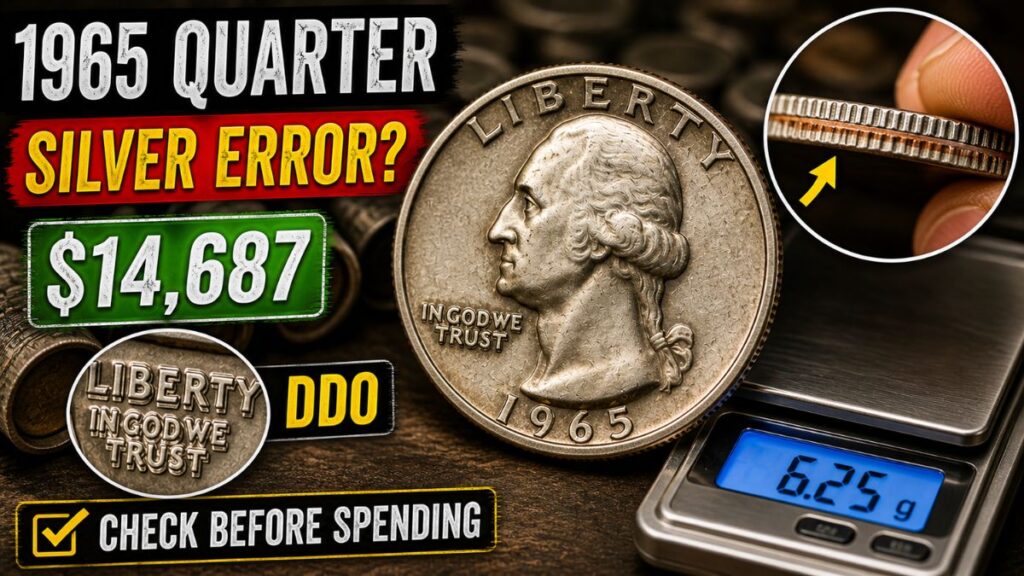
Before spending an old-looking 1965 Washington quarter, take a moment to examine it carefully. Although most 1965 Washington quarters are common coins worth close to their face value, certain varieties, major mint errors, and exceptionally high-grade examples can be worth substantially more.
The 1965 Washington quarter is particularly interesting because it represents an important transition in American coinage. It was the first year of regular copper-nickel clad Washington quarters, following the end of regular 90% silver quarter production in 1964.
This historical change often creates confusion among collectors. Some people assume that every quarter from the 1960s contains silver, while others believe that every 1965 quarter is automatically rare. Neither assumption is accurate.
The standard 1965 Washington quarter has a copper-nickel clad composition and a standard weight of approximately 5.67 grams. Its value generally depends on its condition, minting characteristics, variety, and demand among collectors.
However, documented examples of unusual 1965 quarters have achieved significantly higher prices. These include doubled-die varieties, wrong-planchet errors, and exceptional high-grade specimens. One reported 1965 quarter struck on a five-cent planchet sold for $5,175, while an exceptional high-grade example reached a documented auction record of $12,650.
These prices should not be interpreted as the value of every 1965 quarter. They relate to specific coins with particular characteristics. Proper identification is essential before making any assumptions about value.
This guide explains the history, composition, varieties, errors, grading factors, authentication process, and practical identification steps associated with the 1965 Washington quarter.
The Historical Importance of the 1965 Washington Quarter
The year 1965 was a major turning point in United States coinage. The country was experiencing a shortage of silver, and the rising price of the metal created pressure on the traditional composition of circulating coins.
Before 1965, regular Washington quarters were made from 90% silver and 10% copper. Beginning in 1965, the regular quarter changed to a copper-nickel clad composition.
This transition was introduced to reduce dependence on silver while continuing to produce a durable coin for everyday commerce. The new composition helped the United States Mint manufacture quarters without using the same amount of silver found in earlier issues.
Because of this change, 1965 quarters occupy an important place in the history of American money. They are connected to the transition from traditional silver coinage to modern clad coinage.
Collectors often study 1965 quarters because they provide an opportunity to examine the differences between the two eras. The year also attracts attention because of unusual errors and varieties associated with the transition period.
However, historical importance and monetary rarity are not the same thing. A coin can be historically interesting without being worth a large premium.
Was the 1965 Washington Quarter Made of Silver?
No. Regular 1965 Washington quarters were produced using copper-nickel clad composition rather than the 90% silver composition used for regular quarters through 1964.
This is one of the most important facts to understand when evaluating a 1965 quarter.
The standard 1965 quarter weighs approximately 5.67 grams. Its composition includes outer layers of copper-nickel bonded to a copper core.
By comparison, earlier 90% silver Washington quarters generally had a different weight and metallic composition. Therefore, the date and weight can help collectors distinguish a regular 1965 clad quarter from earlier silver issues.
Nevertheless, weight alone is not sufficient to prove the authenticity or composition of an unusual coin. A damaged, altered, contaminated, or counterfeit coin can produce misleading results.
Collectors should examine the date, edge, dimensions, surface, and weight together. When a coin appears unusual, professional examination is the safest way to confirm its characteristics.
Why Silver Confusion Surrounds the 1965 Quarter
Many people associate older United States quarters with silver because regular quarters dated 1964 and earlier were made from 90% silver. This creates confusion when collectors encounter a 1965 quarter that looks darker, brighter, or different from other examples.
A coin’s appearance does not always reveal its composition. Environmental exposure, chemical reactions, circulation wear, and surface contamination can change the color of a coin.
Some 1965 quarters may also show unusual edge characteristics because of damage or wear. These visual differences should not automatically be interpreted as evidence of silver content.
The most reliable approach is to begin with the date and standard specifications. A regular 1965 Washington quarter is expected to be a copper-nickel clad coin weighing approximately 5.67 grams.
If a coin appears to have an unusual composition, it should be tested using appropriate professional methods rather than relying on color, sound, or an informal home test.
The Standard Weight of a 1965 Washington Quarter
The standard weight of a regular 1965 Washington quarter is approximately 5.67 grams.
This measurement can help collectors identify possible differences, but it should be used only as an initial screening tool. Small variations may result from manufacturing tolerances, wear, dirt, or damage.
A scale with suitable precision can be useful when examining a possible wrong-planchet error. However, weight does not independently establish whether a coin is rare.
For example, a coin with an unusual weight might have been struck on an incorrect planchet, but it could also be damaged, altered, or counterfeit. A professional examiner would consider the coin’s diameter, thickness, edge, design, and metal characteristics.
Collectors should avoid cutting, drilling, scraping, or chemically testing a potentially valuable quarter. Such actions can destroy important evidence and reduce the coin’s value.
The Design of the 1965 Washington Quarter
The 1965 Washington quarter retains the familiar design associated with the Washington quarter series.
The obverse features a portrait of George Washington, while the reverse shows an eagle and surrounding inscriptions. The overall design connects the 1965 issue with earlier Washington quarters, even though the metal composition changed.
The design itself does not automatically indicate rarity. Millions of standard quarters share the same basic appearance.
Collectors should look for differences that may be related to die varieties or striking errors. These differences must be distinguished from ordinary wear, scratches, dents, and post-mint damage.
A magnifying glass, good lighting, and comparison with a normal example can help identify unusual features. However, a professional opinion may be necessary when the difference appears significant.
The Difference Between a Variety and a Mint Error
A coin variety and a mint error are related but distinct concepts.
A variety generally refers to a recurring difference in a die or design that can be identified across multiple coins. A doubled-die variety is one example.
A mint error, by contrast, usually results from a problem during the manufacturing process. Examples include wrong-planchet strikes, off-center strikes, clipped planchets, and other striking mistakes.
Both varieties and errors can attract collectors, but their value depends on rarity, visibility, demand, condition, and authenticity.
Not every unusual mark is a variety or error. Post-mint damage can create features that appear interesting but have little numismatic significance.
Understanding this difference helps prevent incorrect identifications and unrealistic value expectations.
1965 Doubled-Die Obverse Varieties
Professional numismatic references identify multiple 1965 Washington quarter doubled-die obverse varieties. Among the varieties discussed by PCGS are DDO FS-101 and DDO FS-102.
A doubled die is created during the die-making process when design elements are impressed more than once in slightly different positions. Coins struck from that die may show repeated or separated details.
This is different from machine doubling, which can occur during the striking process and often produces a flatter, shelf-like appearance.
The visibility and location of doubling are important when examining a possible doubled die. Collectors should inspect the date, lettering, and other relevant design elements, depending on the specific variety.
A genuine doubled-die variety should be compared with documented examples. Similar-looking doubling can result from damage, die deterioration, mechanical movement, or other causes.
Understanding the 1965 DDO FS-101 Variety
The designation DDO FS-101 refers to a specific doubled-die obverse variety. Such designations help collectors and specialists identify individual varieties consistently.
A collector should not identify a coin solely because the lettering appears thick or distorted. The doubling must match the recognized characteristics of the variety.
Magnification can help reveal separation between design elements. However, photographs taken from poor angles or under uneven lighting can exaggerate ordinary features.
The coin should be examined from multiple angles and compared with reliable reference images or an experienced specialist’s assessment.
If a possible FS-101 example appears to have substantial value, professional authentication is advisable before selling or purchasing it.
Understanding the 1965 DDO FS-102 Variety
DDO FS-102 is another documented 1965 doubled-die obverse variety. It has received collector attention because of its recognized variety status and examples found in higher grades.
A reported auction record for an authenticated FS-102 example reached $1,650 in MS65 condition. This figure relates to a specific identified and graded coin, not to every 1965 quarter showing apparent doubling.
The grade, authenticity, variety attribution, and overall appearance all influence the value of a doubled-die quarter.
Collectors should also remember that auction records can change over time. A historical sale does not guarantee the price a similar coin would receive in a future transaction.
The best approach is to confirm the variety and then compare the coin with recent sales of genuinely comparable examples.
How to Recognize Possible Doubled Die Characteristics
When examining a possible doubled-die quarter, begin with the obverse design. Use magnification to inspect the date and lettering for clear separation or repeated design elements.
Important observations may include:
- Distinct separation between parts of letters.
- Repeated edges on specific design elements.
- Consistent doubling in recognized locations.
- Features that appear raised as part of the die design.
- Similar characteristics across multiple areas identified for the variety.
A single thick letter or blurry digit is not enough to establish a doubled die.
Collectors should distinguish true hub doubling from machine doubling. Machine doubling often appears flattened or shelf-like and may not have the same collector significance as a genuine doubled-die variety.
Because identification can be complicated, professional attribution is recommended for a coin suspected of being a major doubled-die variety.
Machine Doubling Versus True Doubled Dies
Machine doubling is one of the most common sources of confusion among beginning collectors.
It can occur when the die or planchet moves slightly during striking. The resulting feature may look like a second image, but it is not necessarily a doubled die.
True doubled-die characteristics originate during the die-making process. The design may show clear separation or a secondary image in specific areas.
Machine doubling often removes or flattens part of the original design rather than producing a clearly separated secondary impression.
The distinction is important because genuine doubled-die varieties may have substantial collector interest, while ordinary machine doubling often has limited additional value.
Collectors should avoid making a high-value claim based on a photograph alone. A specialist can examine the details and determine whether the characteristics match a recognized variety.
The 1965 Quarter Struck on a Five-Cent Planchet
One of the most dramatic documented errors associated with the 1965 Washington quarter is a coin struck on a five-cent planchet.
A planchet is a prepared metal blank intended to be struck into a coin. When a planchet intended for another denomination enters the quarter production process, the resulting coin may display unusual dimensions, weight, and design characteristics.
A 1965 Washington quarter struck on a five-cent planchet is not a normal composition variation. It represents a major wrong-planchet error.
A documented example sold for $5,175. This auction result demonstrates why authenticated wrong-planchet errors can attract substantial collector interest.
However, the sale price applies to the specific error coin involved in that transaction. It does not mean every 1965 quarter with an unusual weight or appearance is worth thousands of dollars.
Professional examination is essential for determining whether a suspected wrong-planchet error is genuine.
What Is a Wrong-Planchet Error?
A wrong-planchet error occurs when a coin is struck on a blank intended for a different denomination or coin type.
The error can affect the coin’s weight, diameter, thickness, edge, and overall appearance. In some cases, the design may extend beyond the planchet or appear unusually compressed.
A genuine wrong-planchet error should be consistent with the physical properties of the planchet and the striking process.
Collectors should not assume that a lightweight coin is automatically a wrong-planchet error. Weight differences can result from damage, metal loss, corrosion, or alteration.
A professional service may evaluate the metal composition, dimensions, striking characteristics, and design relationship to determine whether the error is legitimate.
Why the Five-Cent Planchet Error Is Important
The five-cent planchet error is interesting because the quarter design was struck onto a blank intended for a different denomination.
Such a mismatch can create characteristics that differ substantially from a standard quarter. The coin may have an unusual weight, diameter, or appearance, depending on the specific planchet used.
The rarity of a wrong-planchet error depends on how often the mistake occurred and how many examples survived. The condition of the coin and the clarity of the error also influence collector demand.
A documented auction result can demonstrate market interest, but it should not be treated as a guaranteed valuation.
Collectors should focus on verifying the exact error before considering any financial conclusion.
The $5,175 Auction Example
A documented 1965 Washington quarter struck on a five-cent planchet sold for $5,175.
This result is significant because it demonstrates the potential value of a genuine and authenticated major mint error. It also shows why collectors should examine unusual coins rather than automatically spending them.
Nevertheless, auction results must be interpreted carefully. The final price may reflect the coin’s authentication, condition, eye appeal, rarity, and the level of competition among bidders.
A coin with a similar date but without the same error will not necessarily have comparable value.
Collectors should also distinguish between a completed auction result and an online listing. A listing price represents what a seller hopes to receive, while a completed sale provides evidence of what a buyer actually paid in that transaction.
The $12,650 High-Grade 1965 Quarter
An exceptional high-grade 1965 Washington quarter has a documented auction record of $12,650.
This result relates to an unusually well-preserved example and should not be confused with the value of an ordinary circulated quarter.
Condition can make a major difference in the collectible market. Coins with strong luster, clean surfaces, sharp details, and limited marks may attract greater interest than heavily circulated examples.
However, a high grade alone does not mean every coin with the same date will be valuable. The grading standard, certification, eye appeal, and rarity of the specific issue all matter.
Collectors should avoid assuming that a circulated quarter can receive the same price as an exceptional certified specimen.
Why Condition Matters So Much
Coin grading evaluates the condition and preservation of a coin. Factors include wear, surface marks, luster, strike quality, and overall appearance.
A circulated 1965 quarter may show scratches, contact marks, dullness, and wear on raised areas. These characteristics are normal for coins that have been used in commerce.
An uncirculated coin may retain more of its original mint luster and design detail. Higher-grade examples can attract stronger collector demand, especially when the population of comparable coins is limited.
Nevertheless, condition is only one factor. Authenticity, variety, error status, and market demand must also be considered.
A coin should not be cleaned to improve its appearance. Cleaning can leave scratches or alter the original surface, potentially reducing its desirability.
Understanding MS65 Condition
The designation MS65 generally refers to a coin graded Mint State 65. It indicates an uncirculated coin with a particular level of surface preservation and overall quality.
A coin graded MS65 is not necessarily flawless. It may have some marks or imperfections, but it meets the grading service’s standards for that grade.
The same variety can have different values at different grades. An MS65 example may be worth considerably more than a circulated specimen, depending on collector demand and availability.
It is important to understand that numerical grades are assigned by professional grading services according to their standards. A collector’s personal opinion that a coin “looks like MS65” does not establish an official grade.
How to Check a 1965 Quarter at Home
A careful home inspection can help identify coins that deserve further evaluation. You do not need expensive equipment to begin, but good lighting and a magnifying glass are useful.
Start by placing the quarter on a clean, soft surface. Handle it by the edges to reduce the risk of fingerprints and additional marks.
Examine the following:
- The date.
- The obverse lettering.
- The reverse design.
- The edge.
- The surface texture.
- The weight.
- Any unusual design displacement.
- Signs of damage or alteration.
Compare the coin with a normal 1965 quarter. Differences are easier to recognize when you have a standard example available.
Do not clean the coin during the inspection. Leave dirt and surface conditions undisturbed until a professional has evaluated it.
Inspecting the Date
The date is the first feature to confirm. Make sure the coin is actually dated 1965 and not a different year that has been damaged or misread.
A date that appears doubled should be examined carefully. Wear, scratches, corrosion, and lighting can create misleading shapes around the digits.
True doubled-die varieties have identifiable characteristics that must be compared with recognized references. Not every distorted digit indicates a valuable variety.
If the date appears altered, inspect the surrounding surface for tool marks or unnatural texture. A counterfeit or modified coin may show inconsistencies that are not found on genuine examples.
The date is essential for identification, but it is only the beginning of the evaluation.
Inspecting the Obverse Lettering
The obverse lettering can be examined for possible doubled-die characteristics. Use a magnifying glass and rotate the coin under steady lighting.
Look for clear separation or repeated details rather than general thickness or blurriness. Pay attention to the locations associated with documented 1965 varieties.
A feature that appears only under one lighting angle may be a reflection or surface irregularity. Genuine design doubling should be evaluated in relation to the structure of the lettering and die characteristics.
If you are uncertain, photograph the area in focus and seek an opinion from a qualified specialist.
Avoid using sharp tools to highlight or scrape the letters. Such actions can damage the coin and make authentication more difficult.
Inspecting the Reverse
The reverse should also be examined for unusual characteristics. Look at the eagle, lettering, rim, and other design elements.
Not every 1965 variety is identified by the same features. Some errors may affect the edge, planchet shape, or overall strike rather than a specific letter.
The reverse can also reveal signs of post-mint damage, including scratches, dents, chemical discoloration, or alterations.
Compare the coin with a standard example under similar lighting. This makes it easier to distinguish normal design characteristics from unusual features.
A complete evaluation requires both sides of the coin. Focusing only on the obverse may cause an important error characteristic to be overlooked.
Examining the Edge
The edge can provide valuable information about a coin’s construction and possible errors.
A regular clad quarter has an edge consistent with its layered composition. Unusual color, exposed metal, cracks, cuts, or missing sections should be examined carefully.
A damaged edge may result from circulation, machinery, tools, or deliberate alteration. It should not automatically be identified as a mint error.
Wrong-planchet errors can also produce unusual edge characteristics, depending on the blank used during striking.
Collectors should avoid filing, scraping, or cutting the edge. Professional examiners can evaluate the edge without causing unnecessary damage.
Using a Digital Scale
A digital scale can help you compare the weight of your quarter with the expected standard of approximately 5.67 grams.
For meaningful results, use a scale with suitable precision and ensure that the coin is clean of loose debris without attempting to wash or polish it.
Record the measurement and compare it with the expected specifications. A difference may justify further examination, but it does not establish an error by itself.
Possible explanations for an unusual weight include:
- A genuine wrong-planchet error.
- Damage or metal loss.
- Environmental deposits.
- A counterfeit.
- A measurement problem.
- Normal variation.
Weight should always be considered together with diameter, thickness, edge, and design characteristics.
Why Color Cannot Prove Silver Content
A 1965 quarter may show different colors because of environmental exposure, toning, chemical reactions, or surface changes.
A gray or silver-like appearance does not prove that the coin contains silver. Similarly, a copper-colored edge does not independently establish a particular error.
The composition of a regular 1965 quarter is copper-nickel clad. If a coin appears to have an unusual metal composition, professional testing is preferable to visual judgment.
Collectors should be particularly cautious with claims that a 1965 quarter is valuable simply because it “looks like silver.”
The date, physical specifications, and professional analysis are more reliable than appearance alone.
Common Damage That Can Look Like a Mint Error
Many ordinary coins develop unusual marks after leaving the mint. These marks can sometimes resemble errors in photographs.
Common examples include:
- Scratches from contact with other coins.
- Dents from machinery.
- Flattened rims.
- Chemical discoloration.
- Corrosion.
- Surface peeling.
- Heat damage.
- Altered lettering.
- Cuts or filing.
- Damage from coin-counting equipment.
Post-mint damage generally does not carry the same value as a genuine mint error.
The key question is whether the feature could have occurred during production. A qualified specialist can help evaluate the shape, metal flow, surface texture, and location of the feature.
Why You Should Never Clean a Suspected Rare Quarter
Cleaning is one of the most damaging actions a collector can take when handling a potentially valuable coin.
Some people believe that removing dirt or discoloration will make a coin more attractive. However, cleaning can leave hairline scratches, remove original luster, and change the surface in ways that professional graders can detect.
Chemical treatments can also damage the metal and create unnatural colors.
If your 1965 quarter appears unusual, preserve it exactly as you found it. Place it in a suitable protective holder and seek professional advice.
A coin’s original condition may provide important information about its history and authenticity.
Authentication for Rare 1965 Quarters
Authentication is particularly important when a coin appears to be a major error or valuable variety.
A professional examination can help determine whether the coin is genuine, whether the error occurred at the mint, and whether the coin has been altered.
The process may include evaluation of:
- Weight.
- Diameter.
- Thickness.
- Edge characteristics.
- Metal composition.
- Die characteristics.
- Surface condition.
- Strike quality.
- Signs of alteration.
Recognized third-party grading services may authenticate and grade qualifying coins. Experienced error-coin specialists can also provide useful preliminary opinions.
Authentication does not guarantee a particular sale price. It establishes a stronger basis for identification and buyer confidence.
Choosing a Professional Grading Service
Collectors should consider an established grading service when a 1965 quarter may have significant value.
A grading service can evaluate the coin’s authenticity and assign a grade according to its standards. If the coin is a recognized variety or error, attribution may also be available depending on the service.
Before submitting a coin, review the service’s requirements, fees, turnaround times, and eligibility rules.
A valuable coin should be handled carefully during submission. Avoid placing it in a holder that can scratch the surface or leave residue.
Professional certification can help buyers understand what they are purchasing, but collectors should still review the coin’s identification and certification information carefully.
What Determines the Value of a 1965 Washington Quarter?
Several factors influence the value of a 1965 Washington quarter.
The first is authenticity. A genuine coin is essential for any meaningful valuation.
The second is rarity. A common quarter generally has limited collector value, while a scarce variety or major error may command a premium.
The third is condition. Higher-grade examples may be more desirable, especially when few comparable coins exist.
Other factors include:
- Recognized variety attribution.
- Error type.
- Visibility of the error.
- Surface quality.
- Strike quality.
- Provenance.
- Certification.
- Collector demand.
- Recent comparable sales.
No single characteristic guarantees a high value. A date, unusual color, or apparent doubling should be evaluated in context.
Why Auction Records Must Be Interpreted Carefully
Auction records can be useful when researching coin values, but they must be understood correctly.
A reported $5,175 sale for a quarter struck on a five-cent planchet applies to a specific authenticated error coin. A $12,650 record for an exceptional high-grade example applies to a particular coin in a particular condition.
These results do not establish the value of every 1965 quarter.
The final price can be affected by the coin’s grade, certification, eye appeal, rarity, auction venue, timing, and bidder competition.
Collectors should compare coins that match in date, variety, error type, grade, and authenticity. A general search for the highest price can lead to unrealistic expectations.
Asking Prices Versus Completed Sales
Online marketplaces often contain listings with very high asking prices. These listings do not necessarily show what buyers are willing to pay.
A completed auction sale is more useful because it provides evidence of an actual transaction. Even then, the sale must be compared with similar coins.
An ordinary circulated 1965 quarter should not be valued using a record price from an exceptional error or high-grade example.
Before selling, consider obtaining an evaluation from more than one qualified source. This can help you understand the difference between a speculative estimate and a realistic market offer.
Where to Sell a Rare 1965 Quarter
If a 1965 quarter is authenticated as a valuable variety or error, several selling options may be available.
These can include established coin dealers, specialized numismatic auctions, coin shows, and reputable online marketplaces.
A local dealer may offer convenience and a faster transaction. However, the offer may be below the amount a coin could potentially achieve at auction because the dealer needs to account for business costs and resale risk.
An auction can expose a coin to collectors who specifically seek errors or varieties. However, fees, timing, and buyer demand influence the final outcome.
Before selling, ensure that the coin’s identity and condition are clearly documented. Avoid rushing into a transaction based on a viral claim or an unsolicited message.
How to Store a Potentially Valuable Quarter
Proper storage helps protect the coin from additional damage.
Use a holder designed for numismatic materials. Avoid materials that may contain harmful chemicals or soften over time.
Keep the coin away from:
- Excessive humidity.
- Household chemicals.
- Adhesive tape.
- Rubber bands.
- Abrasive materials.
- Loose contact with other coins.
- Direct handling of the surfaces.
Hold the coin by its edges whenever possible. Fingerprints can affect the appearance of uncirculated and prooflike surfaces.
If the coin is particularly valuable, professional encapsulation may provide additional protection and identification.
The Role of Provenance
Provenance refers to information about a coin’s history or ownership. While not every coin has extensive documentation, a clear record can sometimes help establish credibility.
Information about where the coin was found, how it was acquired, or whether it previously appeared in a recognized collection may be useful.
However, provenance alone does not prove authenticity. A coin still needs to be examined based on its physical characteristics.
Collectors should preserve any relevant documentation, receipts, certificates, or auction records associated with a potentially valuable quarter.
Mistakes to Avoid When Searching for Rare Quarters
One common mistake is assuming that every 1965 quarter is rare because it was produced during a composition transition. The year is historically important, but most examples are ordinary clad coins.
Another mistake is believing that a coin with a silver appearance must contain silver. Color is not a reliable composition test.
Some collectors also mistake machine doubling for a genuine doubled die. This can lead to unrealistic valuations.
Other errors include:
- Cleaning the coin.
- Scraping the surface.
- Weighing it on an inaccurate scale.
- Trusting unverified social media claims.
- Comparing the coin with unrelated auction records.
- Selling without professional evaluation.
- Treating asking prices as completed sales.
Careful research and patience can prevent these problems.
Building a 1965 Washington Quarter Collection
Collecting 1965 Washington quarters can be an educational and rewarding hobby even when the coins are not rare.
Collectors may focus on varieties, mint errors, high-grade examples, or the broader transition from silver to clad coinage.
A collection can include:
- Normal circulated 1965 quarters.
- High-grade uncirculated examples.
- Documented doubled-die varieties.
- Major striking errors.
- Wrong-planchet errors.
- Coins with interesting provenance.
- Examples from different preservation levels.
The goal does not have to be immediate financial gain. Learning how coins were produced and how varieties are identified is an important part of numismatics.
A careful collector can develop expertise over time by comparing coins, studying recognized varieties, and consulting experienced specialists.
Frequently Asked Questions About the 1965 Washington Quarter
Is a 1965 Washington Quarter Made of Silver?
Regular 1965 Washington quarters were made from copper-nickel clad composition, not the 90% silver composition used for regular quarters through 1964.
What Is the Standard Weight of a 1965 Quarter?
The standard weight is approximately 5.67 grams. Weight can help with preliminary identification but cannot independently prove authenticity or error status.
Are All 1965 Washington Quarters Rare?
No. Most 1965 Washington quarters are common and generally worth close to face value unless they possess an unusual variety, major error, or exceptional condition.
What Makes a 1965 Quarter Valuable?
Value can come from a recognized doubled-die variety, a major mint error, an unusual wrong-planchet strike, exceptional grade, or strong collector demand.
What Is the 1965 DDO FS-102 Variety?
DDO FS-102 is a documented 1965 doubled-die obverse variety. An authenticated example in MS65 has a reported auction record of $1,650.
How Much Did a 1965 Quarter on a Five-Cent Planchet Sell For?
A documented example of a 1965 Washington quarter struck on a five-cent planchet sold for $5,175. The price applies to that specific authenticated error coin.
Can a 1965 Quarter Be Worth $12,650?
A documented exceptional high-grade 1965 quarter reached an auction record of $12,650. This does not mean ordinary circulated examples have the same value.
How Do I Check for a Doubled Die?
Examine the date and lettering under magnification and compare the characteristics with recognized doubled-die references. Professional attribution is recommended for suspected valuable varieties.
Is Machine Doubling the Same as a Doubled Die?
No. Machine doubling generally results from movement during striking, while a true doubled die originates during die production. The two features can look similar but have different numismatic significance.
Can Color Prove That a 1965 Quarter Contains Silver?
No. Color alone cannot establish composition. Environmental exposure and surface changes can make a clad coin appear silver-like.
Should I Clean My 1965 Quarter?
No. Cleaning can damage the surface and reduce collector value. A potentially rare coin should be preserved in its existing condition.
Can Weight Prove a Wrong-Planchet Error?
No. Weight is only one screening characteristic. Diameter, thickness, edge, design, metal composition, and professional examination are also important.
Where Should I Authenticate a Rare 1965 Quarter?
Consider an established third-party grading service or a qualified numismatic specialist experienced with doubled dies and mint errors.
Should I Sell a Suspected Error Immediately?
It is better to obtain a reliable identification first. Avoid selling based solely on social media claims, photographs, or an unverified price estimate.
Are Online Listings Reliable for Coin Valuation?
Online listings show asking prices, not necessarily completed sales. Actual auction results for comparable authenticated coins are generally more useful for research.
Why Is 1965 Important in U.S. Coinage?
It was the first year of regular copper-nickel clad Washington quarters, following the end of regular 90% silver quarter production in 1964.
Conclusion: Check Your 1965 Quarter Carefully Before Spending It
The 1965 Washington quarter is historically important because it marks the transition from regular silver quarter production to copper-nickel clad coinage. Its standard composition is not silver, and its standard weight is approximately 5.67 grams.
Most 1965 Washington quarters are common and worth close to face value. However, documented doubled-die varieties, major mint errors, and exceptional high-grade examples can command substantially higher prices.
The 1965 DDO FS-101 and FS-102 varieties demonstrate why collectors should examine the lettering and date carefully. The reported $1,650 auction record for an FS-102 example shows the potential interest in authenticated varieties.
The quarter struck on a five-cent planchet, which sold for $5,175, represents a different category of rarity. Meanwhile, the documented $12,650 auction record for an exceptional high-grade example highlights the importance of condition.
These prices should never be applied automatically to ordinary 1965 quarters. Each coin must be evaluated according to its authenticity, condition, variety, error characteristics, and market demand.
If you have a 1965 Washington quarter, inspect the date, lettering, reverse, edge, and overall design. You can use weight as an initial screening tool, but do not rely on color or weight alone.
Most importantly, never clean, scrape, cut, or alter a potentially valuable coin. If something appears unusual, preserve it carefully and seek professional authentication.
Your 1965 quarter may be an ordinary coin, a collectible variety, or a genuine mint error. The only reliable way to find out is through careful examination and accurate identification.