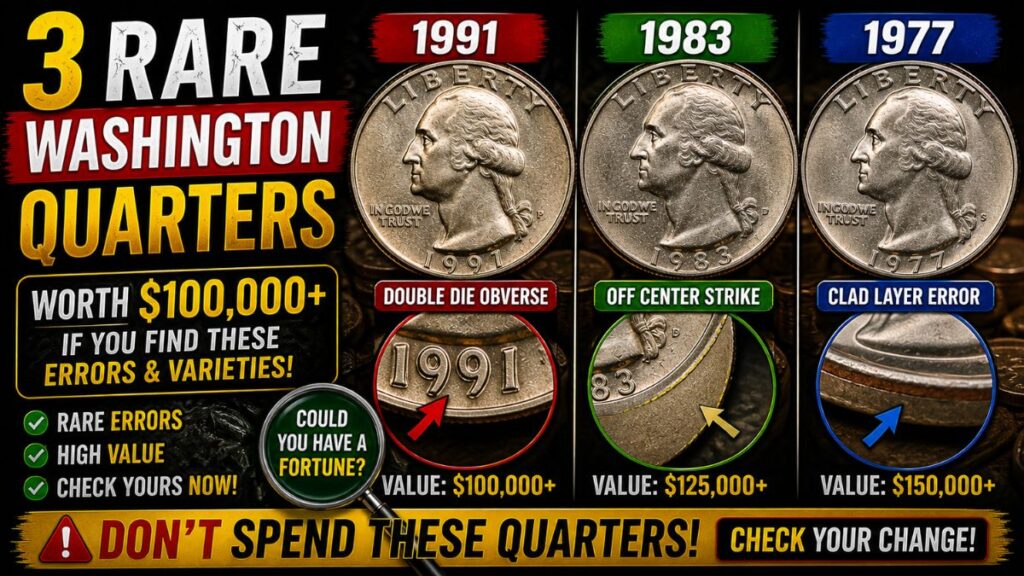
A Washington quarter may look like an ordinary 25-cent coin, but certain dates, mint marks, errors, and varieties can make particular examples much more interesting to collectors. That is why older quarters should not always be judged by face value alone.
The 1991, 1983, and 1977 Washington quarters are especially interesting because each year has coins that collectors may want to examine closely for unusual characteristics. However, an important distinction must be made immediately: not every quarter from these years is rare, and a normal example is generally not worth anywhere near $100,000.
The possibility of an exceptionally high value comes from specific varieties, errors, condition, rarity, and authentication. A headline about a quarter potentially being worth $100,000 or more does not mean every coin with the same date has that value.
This distinction is essential when searching through old change.
A 1991 quarter with an important minting error can be dramatically different from an ordinary 1991 quarter. The same is true for certain 1983 and 1977 issues. Collectors look at the date, mint mark, design details, condition, surfaces, and unusual minting characteristics before deciding whether a coin deserves further examination.
That means the best strategy is not simply to search for old quarters.
The better strategy is to know exactly what to look for.
The three dates discussed here can serve as useful starting points for a careful Washington quarter search. They also demonstrate why condition, rarity, and authentication matter so much in the coin market.
If you have a collection of older quarters, a jar of change, inherited coins, or rolls that have been sitting untouched for years, these dates are worth examining carefully.
Why 1991 Washington Quarters Deserve Attention
The 1991 Washington quarter belongs to the later portion of the original Washington quarter series that began in 1932.
By the early 1990s, Washington quarters were familiar circulation coins. Millions of ordinary examples existed, meaning that simply finding a 1991 date does not make a quarter rare.
The important question is what kind of 1991 quarter you have.
The mint mark can immediately narrow the possibilities.
Philadelphia and Denver produced circulation quarters during this period, while San Francisco produced proof coins for collectors. A 1991 quarter can therefore appear in different forms depending on where and how it was struck.
For someone searching through circulation coins, the main attraction is not the date alone.
Instead, attention should go toward unusual errors, varieties, and exceptionally preserved examples.
A coin with a major minting error can be dramatically more desirable than a normal example from the same year.
This is one reason experienced collectors examine both sides of a coin carefully.
The 1991 Quarter and the Importance of Mint Marks
The mint mark is one of the first details to check.
A small letter can tell you where the coin was produced.
For Washington quarters, the mint mark can be found on the obverse near the lower portion of the design, although its exact appearance and location should be considered in the context of the period being examined.
When searching 1991 quarters, separate the coins by mint mark before examining them for more complicated characteristics.
This makes the process much easier.
A useful system is to create three basic groups:
1991 Philadelphia issues.
1991 Denver issues.
1991 San Francisco proof issues.
Then examine each group individually.
A proof coin should not automatically be assumed to be rare simply because it looks different from a circulation strike. Proof coins were deliberately produced for collectors and can have highly reflective fields and sharply defined details.
The key is always identification.
What Makes an Error Quarter Interesting?
A mint error occurs when something goes wrong during the production process.
Errors can involve the planchet, dies, striking process, or other stages of manufacture.
Some errors are dramatic and easy to notice.
Others are extremely subtle.
A coin might have an unusual strike, missing design element, off-center appearance, wrong planchet, doubled feature, or another characteristic that distinguishes it from normal examples.
But not every unusual-looking coin is a genuine mint error.
Coins can be damaged after leaving the Mint.
This is one of the most important concepts for new collectors.
A quarter can become bent, scratched, scraped, flattened, discolored, or exposed to chemicals during decades of circulation.
Those conditions may make a coin look unusual without making it rare.
A genuine mint error must show evidence consistent with a manufacturing mistake.
Why Condition Matters So Much
Condition can dramatically affect the value of a collectible quarter.
A coin that spent years circulating can accumulate scratches, contact marks, worn details, and other signs of handling.
An uncirculated example may retain much sharper details and cleaner surfaces.
For common coins, condition can make some difference.
For rare errors and varieties, the difference can become much more significant.
Collectors may compete strongly for exceptional examples of scarce coins.
That means two coins with the same date and mint mark can have completely different values.
One may be a heavily circulated example with ordinary surfaces.
Another could be an exceptionally preserved example of a rare variety.
This is why statements such as “1991 quarter worth $100,000” should always be treated carefully.
The real question is:
Which 1991 quarter?
What error or variety does it have?
Is it authentic?
What grade is it?
What are its surfaces like?
And what evidence exists for its rarity?
The 1983 Washington Quarter
The 1983 Washington quarter is another date that attracts attention from collectors.
The year is particularly interesting because high-grade examples can be desirable, while certain errors and varieties can also generate collector interest.
However, the same warning applies.
A normal 1983 Washington quarter is not automatically a five-figure or six-figure coin.
The date is only the beginning of the investigation.
Mint mark, condition, strike quality, and unusual characteristics all need to be considered.
One reason 1983 quarters are frequently discussed among collectors is the existence of particularly valuable high-grade examples and errors.
A well-preserved coin can be much more interesting than an ordinary circulated example.
This is particularly true when the coin retains strong original surfaces and sharp details.
Why 1983 Quarters Can Be Important in High Grade
Coin collectors often divide their attention between rarity and condition.
Some coins are rare because very few were produced.
Others become especially desirable because very few survived in exceptional condition.
A coin can therefore have a relatively substantial original mintage and still be difficult to find in top grades.
This is especially relevant when looking at quarters from the early 1980s.
Many coins from this period circulated heavily.
Others were stored in ways that resulted in marks, scratches, or environmental damage.
Finding a 1983 quarter with unusually clean surfaces can therefore be interesting even before considering whether it has an error.
However, high grade does not automatically mean enormous value.
The market depends on demand, rarity, certification, and the exact characteristics of the coin.
Checking the 1983 Mint Mark
As with the 1991 quarter, begin with the mint mark.
Separate your 1983 quarters by production facility.
Then examine the coins for obvious abnormalities.
Look at the lettering.
Inspect the date.
Check Washington’s portrait.
Examine the reverse.
Look at the rim.
Pay attention to the overall shape of the coin.
A genuine error may affect one of these areas.
At the same time, damage can also affect them.
That is why careful examination is necessary.
What a Damaged Quarter Can Look Like
A quarter that has been in circulation for decades can experience all kinds of abuse.
It may have been pushed through a vending machine.
It could have been dropped on a hard surface.
It might have been squeezed against other coins.
It could have been exposed to chemicals.
Someone may have deliberately altered it.
A person may even have attempted to create a rare-looking appearance after the coin left the Mint.
These possibilities make authentication important.
For example, an apparent doubling effect may actually be mechanical damage.
A strange rim may be caused by a later impact.
A discolored surface may result from environmental exposure.
An unusual shape may have nothing to do with the Mint.
Therefore, the first question should always be whether the feature is consistent with a genuine production error.
The 1977 Washington Quarter
The 1977 Washington quarter is the third date in this group.
Like the 1991 and 1983 issues, the 1977 quarter was produced in large numbers, so most examples are ordinary.
Nevertheless, certain varieties and errors can make individual examples much more interesting.
The 1977 date is particularly useful for teaching collectors another important lesson: age alone does not determine rarity.
A 1977 quarter is nearly half a century old, but that does not make every example valuable.
Many millions of coins from the period survive.
What matters is what makes a particular coin different.
That could be an unusual mint error, a scarce variety, an exceptional grade, or a combination of factors.
How to Start Searching 1977 Quarters
Start with the date.
Then check the mint mark.
After that, inspect the coin’s surfaces.
A good light source is extremely helpful.
Tilt the quarter slowly.
Look at the fields around Washington’s portrait.
Examine the lettering.
Inspect the reverse.
Check the edge.
Look at the rim.
Do not rush.
A rare characteristic may not be obvious when the coin is viewed quickly.
Magnification can help, particularly when looking at small details.
A basic coin loupe is enough for many preliminary examinations.
However, magnification does not prove authenticity.
It simply allows you to see details more clearly.
The Difference Between an Error and a Variety
These terms are sometimes used interchangeably by beginners, but they can describe different things.
A mint error generally refers to a mistake occurring during production.
Examples can involve the wrong planchet, an off-center strike, a major striking problem, or other manufacturing abnormalities.
A variety generally refers to a recurring difference in the design or die characteristics.
Doubled dies are an important example of a variety.
The distinction matters because collectors often identify coins based on specific characteristics.
A coin that is merely damaged does not become a recognized variety.
Understanding this difference will help you avoid many false identifications.
Why $100,000 Claims Need Careful Interpretation
The phrase “worth $100,000+” creates an obvious sense of excitement.
But it can also be misleading if the underlying information is not explained.
A six-figure price may refer to an extremely rare example with a particular error and exceptional condition.
It does not mean that every 1991, 1983, or 1977 quarter is worth anywhere near that amount.
Even within a rare variety, prices can differ significantly.
One example may be circulated.
Another may be uncirculated.
One may have attractive surfaces.
Another may have problems.
One may be professionally certified.
Another may not have been authenticated.
One may sell during an auction with intense collector competition.
Another may sell during a different market environment.
Therefore, a large auction result should be treated as evidence of what happened with that specific coin rather than a guaranteed valuation for every similar-looking coin.
Why Authentication Is Essential for High-Value Quarters
If you believe you have discovered a quarter potentially worth thousands or more, authentication becomes extremely important.
This is particularly true for a coin that could theoretically reach six figures.
A valuable coin may be examined by professionals who evaluate its authenticity, condition, variety, and other characteristics.
Professional certification can provide buyers with more confidence.
It can also help establish a standardized grade.
For an ordinary quarter, paying for professional certification may not make financial sense.
For a potentially rare error, the situation can be completely different.
The cost of professional examination is small compared with the potential financial consequences of incorrectly selling or buying a major rarity.
Never Clean a Potentially Rare Quarter
One of the most important rules in coin collecting is simple:
Do not clean your coins.
A person who discovers an old quarter may naturally think it would look better if polished.
That can be a serious mistake.
Cleaning can create scratches and unnatural surfaces.
Chemical treatments can change the appearance of the metal.
Polishing can remove original surface characteristics.
Collectors generally prefer coins that retain their natural surfaces.
A coin that looks dull because of age should not automatically be polished.
If it could be rare, leave it alone.
Handle it by the edges and protect it from unnecessary contact.
Why Natural Appearance Matters
A coin’s surface tells part of its story.
Environmental exposure can produce toning.
Circulation creates wear.
Storage conditions can leave marks.
Handling can produce contact points.
Professional graders consider these factors when evaluating a coin.
A cleaned coin may appear brighter but actually become less desirable.
This is especially important with rare quarters because collectors often care deeply about originality.
If you think you have found an unusual 1977, 1983, or 1991 quarter, preservation should come before appearance.
A Simple Way to Search Your Collection
You do not need an expensive setup.
Start with a clean table and good lighting.
Use a soft surface so coins are not accidentally scratched.
Separate the coins by date.
Create groups for 1977, 1983, and 1991.
Then separate each date by mint mark.
Once sorted, examine both sides of every potentially interesting example.
Look for:
Unusual doubling.
Off-center strikes.
Unusual rims.
Wrong-planchet possibilities.
Strange design characteristics.
Major die breaks.
Unusual lettering.
Missing or abnormal design elements.
Exceptional preservation.
Do not assume that every unusual characteristic is valuable.
Instead, identify the feature and then determine whether it is recognized as a genuine minting variety or error.
What to Look for on the Obverse
The obverse is the front side of the Washington quarter.
Begin with Washington’s portrait.
Look at the date.
Examine the lettering.
Check the rim.
Inspect the fields surrounding the portrait.
Look for unusual raised areas or design doubling.
If something appears unusual, compare it with a normal quarter from the same date.
This comparison can be extremely helpful.
Sometimes what looks unusual on its own becomes obviously normal when placed beside another example.
Other times, the difference becomes easier to recognize.
What to Look for on the Reverse
Turn the coin over and inspect the reverse carefully.
Look at the eagle and surrounding lettering on older Washington quarter designs.
Check the rim.
Examine the fields.
Look for unusual doubling, die damage, or striking abnormalities.
The reverse can sometimes provide the clue that separates an ordinary coin from an interesting one.
That is why examining only the front of a coin is not enough.
A complete inspection always involves both sides.
Why the Edge Should Not Be Ignored
Collectors sometimes focus entirely on the obverse and reverse.
The edge can also provide useful information.
Examine it under good lighting.
Look for anything that appears inconsistent with a normal quarter.
However, be careful when interpreting unusual edge characteristics.
Damage can affect the edge easily because it is exposed to contact.
A coin dropped onto a hard surface may develop a flattened or distorted rim.
That does not automatically indicate a mint error.
Again, the question is whether the characteristic is consistent with how the coin was manufactured.
Why Weight Can Help but Cannot Prove Everything
A precision scale can be useful when searching for unusual coins.
Weight can help identify potential planchet differences.
If a quarter weighs significantly differently from what is expected, it may deserve additional investigation.
But weight alone is not proof of a valuable error.
A coin can lose material through damage.
It can accumulate material.
It can be altered.
A planchet can also have production variations within expected limits.
Therefore, weight should be considered one piece of evidence.
It should not be used as the only test.
Why Magnification Helps
Some valuable characteristics are small.
A magnifying glass or coin loupe can reveal details that are difficult to see with the naked eye.
This is especially helpful when examining lettering and dates.
However, extreme magnification can sometimes create confusion.
Every scratch can suddenly look dramatic.
A normal design can appear distorted.
Surface damage can look like doubling.
Use magnification to inspect a coin, not to force a rare identification.
Good lighting and comparison with known normal examples are equally important.
The Role of High-Grade 1991 Quarters
A 1991 quarter in excellent condition can be more desirable than a heavily circulated example.
This is especially true when the coin has characteristics that collectors actively seek.
The difference between ordinary uncirculated condition and truly exceptional condition can be substantial.
Professional grading provides a standardized way to describe condition.
For coins that are potentially valuable, certification can make a significant difference in marketability.
However, collectors should remember that grading does not create rarity.
A common coin remains common even when it is in excellent condition.
The question is always the combination of rarity and condition.
The Role of High-Grade 1983 Quarters
The same principle applies to 1983 quarters.
A coin that spent years circulating may show extensive contact marks.
An example that was protected shortly after production may retain much stronger surfaces.
That makes high-grade examples particularly interesting to specialists.
But once again, high grade alone does not guarantee a $100,000 value.
A coin’s price depends on what collectors are willing to pay for that particular combination of date, mint, variety, grade, and quality.
The Role of High-Grade 1977 Quarters
1977 is another date where preservation can matter.
A quarter that has survived nearly fifty years without significant circulation damage can be much more attractive than an ordinary example.
Collectors may look for strong details and clean surfaces.
But the same caution applies.
Age plus condition does not automatically equal extraordinary value.
A specific rare error or variety can change the equation dramatically.
Without such a characteristic, most examples remain ordinary collectible coins rather than major rarities.
Why Mint Marks Matter
The mint mark is one of the easiest details to overlook.
Yet it can be extremely important.
Two coins with the same date can have different production histories depending on the Mint facility.
This can affect rarity and collector interest.
That is why experienced collectors never identify a quarter solely by its year.
They record the complete basic identity:
Date.
Mint mark.
Denomination.
Type.
Then they examine varieties and errors.
For serious collecting, this systematic approach is much more reliable than simply searching for an old-looking coin.
How Counterfeits Can Enter the Market
Rare coins have financial value, and valuable objects naturally attract attempts at imitation.
A counterfeit can be created from scratch.
An ordinary coin can be altered.
A mint mark can potentially be manipulated.
A damaged coin can be presented as an error.
This is another reason professional authentication matters.
The more expensive a coin is claimed to be, the more evidence should be required.
A photograph can be useful for an initial opinion, but it cannot replace physical examination when the financial stakes are high.
Why Coin Collecting Requires Patience
Searching coins can be exciting, but rushing can create mistakes.
A collector may see doubling and immediately assume a famous variety.
Another person may see an unusual color and assume a special composition.
Someone else may see a damaged rim and believe they found an off-center error.
Patience solves many of these problems.
Take photographs.
Compare with normal examples.
Measure when appropriate.
Inspect both sides.
Research the exact variety.
And if the coin appears genuinely valuable, seek professional authentication.
The objective is not to call every unusual coin rare.
The objective is to correctly identify the small number that truly deserve attention.
Common Mistakes Made by New Collectors
One of the most common mistakes is believing that age automatically creates value.
It does not.
Another mistake is assuming that a high auction price applies to every example of the same date.
It does not.
A third mistake is cleaning coins.
That can permanently damage collectible surfaces.
Another mistake is confusing damage with errors.
This happens frequently because damaged coins can look dramatic.
Finally, collectors sometimes overlook the mint mark.
A small letter can make a major difference in identification.
Avoiding these mistakes makes the search much more productive.
Why the 1991, 1983, and 1977 Dates Are Worth Remembering
These three dates are useful search targets because they can introduce collectors to several important areas of Washington quarter collecting.
The 1991 quarter can lead collectors toward the study of modern errors, varieties, proof issues, and high-grade examples.
The 1983 quarter demonstrates how condition and unusual minting characteristics can affect collector interest.
The 1977 quarter provides another opportunity to study errors, varieties, mint marks, and preservation.
None of these dates should be treated as automatic jackpot coins.
Instead, they should be treated as dates worth checking carefully.
That distinction protects collectors from unrealistic expectations while still allowing them to discover genuinely interesting coins.
What If You Find a Quarter That Looks Extremely Valuable?
The first step is to stop.
Do not spend it.
Do not clean it.
Do not sell it to the first person who offers money.
Do not post your personal information publicly.
Instead, preserve the coin safely.
Take clear photographs.
Record the date and mint mark.
Examine both sides.
If possible, compare the coin with established examples of the suspected error or variety.
Then consider professional authentication.
If the coin is genuinely rare, having independent verification can be extremely important.
Why Selling Too Quickly Can Be a Mistake
Suppose someone finds an unusual 1983 quarter and immediately sells it for a few hundred dollars.
Later, another collector determines that it was a much rarer variety.
The first seller may have lost a significant opportunity.
The opposite can also happen.
Someone might see a normal damaged quarter and believe it is worth $100,000.
They could spend money on unnecessary services or attempt to sell it based on an unrealistic expectation.
Verification helps prevent both situations.
Knowing what you actually have is the foundation of a sensible decision.
How Professional Grading Works in General
Professional grading services examine coins for authenticity and condition.
The coin is assigned a grade using a standardized scale.
For certain varieties and errors, attribution may also be provided.
A certified holder then protects the coin and records its identification.
This can make a major difference when selling a valuable coin.
However, certification does not guarantee a future selling price.
Markets change.
Collector preferences change.
Auction conditions vary.
Certification provides information and authentication, not a guaranteed investment return.
Why Provenance Can Matter
For exceptionally rare coins, ownership history can sometimes provide additional context.
A documented history of where a coin came from can help establish confidence.
However, provenance alone does not make an ordinary coin rare.
The physical characteristics still matter.
Authentication, variety, condition, and manufacturing evidence remain central.
Could a $100,000 Quarter Really Exist?
Yes, exceptional Washington quarters and other U.S. coins have reached very high prices in the marketplace.
But the phrase should always be interpreted carefully.
A $100,000 result generally involves an unusually rare coin, exceptional condition, important error, scarce variety, or some combination of these characteristics.
It does not mean that every quarter from the same year is valuable at that level.
For a 1991, 1983, or 1977 quarter to be seriously considered in that category, there would need to be strong evidence supporting its rarity and authenticity.
That is why the search should focus on characteristics rather than headlines.
The Most Important Rule: Identify Before You Value
This principle can be applied to every coin in your collection.
First identify the coin.
Then determine whether it is a recognized variety or error.
Then establish condition.
Then investigate market evidence.
Only after those steps should you discuss value.
Starting with the price often causes confusion.
If someone says, “This quarter is worth $100,000,” the natural response should be:
“What makes this particular quarter worth $100,000?”
The answer should identify the exact characteristic.
That could be a specific error.
A rare variety.
An unusual planchet.
An exceptional grade.
Or a combination of factors.
Frequently Asked Questions About 1991, 1983, and 1977 Washington Quarters
Is every 1991 Washington quarter valuable?
No. Most 1991 Washington quarters are ordinary coins. Potentially valuable examples would need a recognized error, variety, unusual characteristic, or exceptional condition.
Is every 1983 Washington quarter worth a lot of money?
No. The date alone does not make a 1983 quarter rare. Specific varieties, errors, and exceptionally high-grade examples can be more desirable.
Is every 1977 Washington quarter rare?
No. Millions of ordinary 1977 quarters exist. The important coins are specific examples with unusual characteristics or exceptional preservation.
Can a 1991 quarter really be worth $100,000 or more?
An exceptional quarter can potentially reach a very high price when it has the right combination of rarity, error or variety, condition, authenticity, and collector demand. A normal 1991 quarter should not be valued anywhere near that amount simply because of its date.
Can a 1983 quarter really be worth $100,000?
A six-figure valuation would require an exceptional and well-documented example. The date alone does not justify such a valuation.
Can a 1977 quarter be worth $100,000?
A normal 1977 quarter is not a $100,000 coin. An extraordinary error or extremely rare variety would need to be established before considering a valuation of that magnitude.
How do I know if my quarter has a mint error?
Look for characteristics that are consistent with a manufacturing mistake, such as an unusual strike, off-center design, wrong-planchet possibility, or other recognized error. Professional examination is recommended for valuable-looking coins.
Does damage make a quarter rare?
Usually not. Scratches, dents, chemical discoloration, bent rims, and other post-mint damage generally do not create collectible mint errors.
Should I clean an old Washington quarter?
No. Cleaning can damage the original surface and potentially reduce collector desirability.
Does a mint mark increase a quarter’s value?
A mint mark can be important because it identifies where a coin was produced and can help distinguish different issues. Its presence does not automatically make a coin valuable.
Is an old quarter automatically worth more than 25 cents?
Not necessarily. Many old quarters are common. Value depends on factors such as rarity, condition, demand, errors, varieties, and authenticity.
Can a magnet identify a valuable quarter?
A magnet can sometimes provide useful information about a coin’s composition, but it cannot by itself authenticate a valuable error. Additional examination is necessary.
Should I weigh my quarter?
Weight can be a useful screening tool, particularly when investigating possible planchet errors. However, weight alone cannot establish rarity or authenticity.
Why is professional authentication important?
Authentication can help determine whether a suspected error or variety is genuine and can establish the coin’s condition. This is particularly important when a coin could be worth a substantial amount.
Are online coin values guaranteed?
No. Online prices can include asking prices, estimates, or auction results for specific coins. A particular historical sale does not guarantee the same price for another coin.
What should I do if I think I found a rare quarter?
Protect the coin, avoid cleaning or altering it, record the date and mint mark, examine both sides carefully, and consider professional authentication before making a major financial decision.
Final Thoughts on These Three Rare Washington Quarters
The 1991, 1983, and 1977 Washington quarters demonstrate why coin collecting is about much more than simply looking for old money.
A quarter can carry the same date as millions of other coins and still contain a characteristic that makes one individual example dramatically more interesting.
That is the key idea to remember.
Do not look at a 1991 quarter and immediately assume it is valuable.
Do not look at a 1983 quarter and assume its age makes it rare.
Do not look at a 1977 quarter and assume every unusual mark is a mint error.
Instead, investigate.
Check the mint mark.
Examine the obverse.
Study the reverse.
Inspect the edge.
Use magnification.
Consider the weight when appropriate.
Compare the coin with normal examples.
Most importantly, learn to distinguish genuine mint characteristics from damage that happened after the coin entered circulation.
The possibility of a six-figure Washington quarter is exciting, but extraordinary prices belong to extraordinary coins. A headline mentioning $100,000 should always lead to another question: what exact feature makes that particular coin rare?
That question protects collectors from unrealistic claims while helping them recognize genuinely important discoveries.
If you have old quarters stored away, there is no reason to assume that every coin is valuable. But there is also no reason to ignore them completely.
The 1991, 1983, and 1977 dates can be excellent candidates for careful examination, particularly when a coin appears unusually well preserved or shows characteristics that do not match a normal example.
And if you discover something that genuinely appears unusual, resist the temptation to clean it, polish it, scrape it, or spend it.
Preserve it first.
Identify it second.
Authenticate it third.
Only then should you begin thinking seriously about its potential market value.
That approach turns a simple handful of Washington quarters into something much more interesting: an opportunity to discover the history, manufacturing details, and rare varieties hidden inside America’s everyday pocket change.