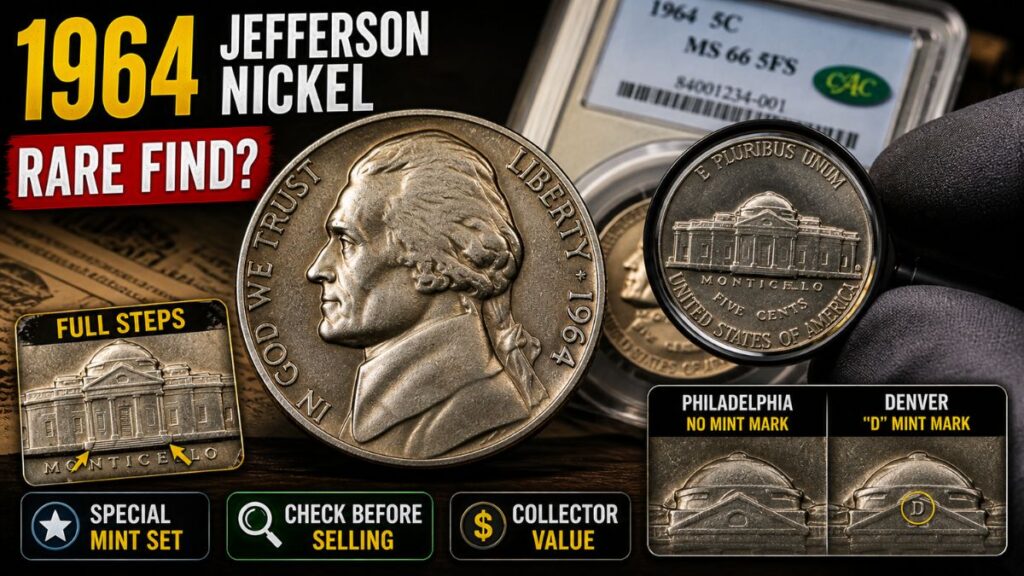
Finding an old Jefferson nickel in a collection, inherited coin box, jar of change, or even ordinary pocket change can be an exciting experience. When the date reads 1964, that excitement can grow quickly because this was an important year in American coinage and because a small number of unusual 1964 Jefferson nickels are highly sought after by collectors.
However, there is an important distinction that every collector should understand before assuming a 1964 nickel is rare. The date by itself does not automatically make the coin valuable. Millions of Jefferson nickels were produced in 1964, making ordinary examples relatively common today. What can transform an otherwise ordinary nickel into a major collectible is a combination of factors such as an unusual strike, a recognized variety, exceptional preservation, strong Full Steps detail, or an exceptionally rare special issue.
That distinction is at the heart of the 1964 Jefferson nickel story.
The Jefferson nickel had already been part of American coinage for more than two decades by 1964. It featured Thomas Jefferson on the obverse and Monticello on the reverse, continuing a design that millions of Americans encountered in everyday commerce. Yet the coinage environment of the early 1960s was unusual. The United States was experiencing strong demand for circulating coins, and the Mint was producing enormous quantities of certain denominations.
As a result, 1964 became one of the most heavily produced years in the history of the Jefferson nickel series.
This creates an interesting situation for collectors. A normal 1964 nickel may be easy to find, while a particular 1964 issue with unusual characteristics can be dramatically more desirable.
For anyone who has found one, the first step should therefore be identification rather than valuation.
The date, mint mark, condition, strike quality, surface preservation, and any unusual characteristics should all be examined carefully. A coin that looks ordinary at first glance can sometimes deserve a closer inspection, but a coin that has merely become shiny or discolored through circulation should not automatically be treated as a rarity.
Understanding what makes a 1964 Jefferson nickel interesting can help collectors avoid both disappointment and costly mistakes.
The Story Behind the 1964 Jefferson Nickel
The Jefferson nickel was introduced in 1938, replacing the Buffalo nickel. The new design honored Thomas Jefferson and placed his portrait on the obverse. The reverse featured Monticello, Jefferson’s Virginia home.
By 1964, the design had become a familiar part of American currency.
The coin was made from the traditional copper-nickel composition used for Jefferson nickels during this period. A standard Jefferson nickel weighs approximately 5 grams and has a diameter of about 21.2 millimeters. Its composition is approximately 75 percent copper and 25 percent nickel.
Unlike a silver coin, the regular 1964 Jefferson nickel does not contain a significant amount of silver simply because of its age.
That is an important point because collectors sometimes assume that every older American coin automatically contains precious metal. Jefferson nickels from 1964 belong to the pre-1965 period, but the nickel itself retained its copper-nickel composition.
The year 1964 was nevertheless significant because of the enormous pressure placed on the United States Mint to produce more coins.
The country was experiencing a coin shortage, and the Mint responded with exceptionally high production levels. This is one reason the 1964 date appears so frequently in the Jefferson nickel series.
For modern collectors, that high production creates a fascinating contrast: the date is historically important, but the ordinary coin is not necessarily scarce.
The rare examples are usually rare for another reason.
Why So Many 1964 Jefferson Nickels Exist
When people hear that a 1964 Jefferson nickel can be collectible, one of the first questions is often, “How rare is a 1964 nickel?”
The answer depends entirely on which 1964 nickel is being discussed.
The regular circulation strikes were produced in enormous quantities. The Philadelphia Mint produced a huge number of 1964 Jefferson nickels, while the Denver Mint also produced an enormous quantity marked with a D.
This means that simply finding a 1964 nickel is not enough to establish rarity.
In fact, large numbers of these coins survived because nickels were not typically melted or discarded in the same way some other coins might have been. Many remained in circulation for years, while others were saved by families, collectors, or people who simply kept older coins.
The large surviving population makes ordinary circulated examples relatively accessible.
But high production does not mean every individual coin is identical.
Minting is a mechanical process, and differences can occur in striking pressure, die preparation, planchet quality, die wear, surface preservation, and other production characteristics. Some coins may also survive in unusually high grades.
That is where the collector interest becomes much stronger.
A common date can still contain uncommon individual coins.
How to Identify a 1964 Jefferson Nickel
The first step when examining a possible 1964 Jefferson nickel is straightforward: confirm the date.
Look at the obverse, where Thomas Jefferson’s portrait appears. The date is located toward the lower portion of the obverse.
Once the date is confirmed as 1964, inspect the area around the date and the reverse design for additional information.
The mint mark is particularly important.
A 1964 Jefferson nickel may be encountered with a D mint mark indicating production at the Denver Mint, or without a mint mark for Philadelphia production.
The absence of a mint mark should not automatically be interpreted as an error.
This is a common misunderstanding among inexperienced collectors. A Philadelphia-minted coin from this period can legitimately lack a mint mark. Therefore, seeing “1964” without a letter does not by itself make the coin rare.
Likewise, seeing a D does not automatically mean the coin is valuable.
The next step is to examine the coin’s overall condition and strike.
That is where the difference between an ordinary example and a potentially important collectible can become apparent.
What the Mint Mark Can Tell You
Mint marks provide valuable information about where a coin was produced.
On a 1964 Jefferson nickel, a D indicates the Denver Mint. A coin without a mint mark represents Philadelphia production.
For collectors, this information is useful because different mint facilities can have different production characteristics, varieties, and populations of surviving coins.
But the mint mark is only one part of the identification process.
A collector should never use a simple rule such as “1964-D equals rare” or “no mint mark equals rare.”
Neither statement is accurate.
Instead, think of the mint mark as an identification clue.
Once the mint is established, examine the coin for recognized varieties, unusual doubling, strike characteristics, condition, and other features.
This approach is much safer than relying on a viral claim or a photograph of an expensive coin.
The Most Important Question: Is Your 1964 Nickel Actually Rare?
This is where the story becomes especially interesting.
A regular 1964 Jefferson nickel is generally not considered rare simply because of its date. Its enormous production means that many examples remain available.
But there are 1964 Jefferson nickels that are genuinely scarce.
Among the most famous are unusual special-strike examples associated with the 1964 issue.
These coins are especially important because they are not simply normal circulation strikes in better condition. Their characteristics, appearance, and surfaces can be significantly different.
The distinction matters enormously.
A normal circulated nickel that happens to be shiny is not automatically a special strike.
Likewise, a coin that has been polished, cleaned, or otherwise altered after leaving the Mint cannot be treated as a special Mint product merely because its surface looks unusual.
This is why authentication and careful examination are so important when dealing with a potentially rare 1964 Jefferson nickel.
The Famous 1964 Special Strike Jefferson Nickel
One of the most intriguing areas of the 1964 Jefferson nickel series is the group of coins generally referred to by collectors as 1964 SMS or Special Strike nickels.
These coins are extremely unusual compared with the ordinary 1964 circulation strikes.
Their surfaces can display a distinctive appearance, often with unusually smooth or satin-like characteristics. The strike can also appear remarkably sharp.
The rarity of these pieces is what makes them so interesting.
Only a small number are believed to exist, and their exact origin has been the subject of discussion among numismatists. Because of that scarcity, authenticated examples can command prices far beyond those of ordinary 1964 Jefferson nickels.
This is one of the most important lessons for anyone who discovers a 1964 nickel that looks different from the coins they normally see.
Do not immediately assume that an unusual surface means you have found a Special Strike.
But do not dismiss it either.
If the coin genuinely exhibits characteristics consistent with a recognized rare issue, professional examination can become extremely important.
What Makes a Special Strike Different?
Understanding the difference between a normal circulation strike and a special strike requires looking beyond the date.
A circulation coin was produced primarily for use in commerce. The Mint struck enormous quantities of these coins, and they were expected to enter everyday circulation.
A special strike, by contrast, can exhibit unusual characteristics related to how the coin was produced and finished.
The surfaces may appear different.
The strike may be sharper.
The overall appearance may be more distinctive.
The preservation may also be extraordinary.
These differences can be subtle in photographs, especially when lighting, camera settings, and image processing affect the appearance of the coin.
That is why photographs alone should not be treated as conclusive proof.
A collector who believes they have discovered an unusual 1964 Jefferson nickel should compare the coin carefully with established examples and, when the potential value justifies it, have the coin examined by a respected professional grading and authentication service.
Condition Can Change the Value Dramatically
Even when two coins have the same date and mint mark, they can have dramatically different collector appeal.
Condition is one of the most important factors.
A Jefferson nickel that spent years circulating can show scratches, contact marks, flattening, discoloration, and wear. Important design details may become weaker as the coin passes from hand to hand.
An uncirculated example can retain much more of its original detail.
The difference becomes even more important at the highest grades.
Coins that are exceptionally well preserved can be far scarcer than ordinary uncirculated examples because even minor contact marks can prevent a coin from reaching a top grade.
For Jefferson nickels, collectors often pay particular attention to the reverse steps of Monticello.
This feature is commonly associated with the term “Full Steps.”
When the steps are clearly defined and complete, the coin can be more desirable than an otherwise similar example where the steps are weak or interrupted.
However, strong Full Steps detail does not automatically make every 1964 nickel extremely valuable.
The date, mint mark, overall grade, strike, surface quality, and market demand still matter.
What Does “Full Steps” Mean?
The reverse of the Jefferson nickel features Monticello.
Beneath the building is a series of steps.
During the striking process, these steps can fail to appear completely because of die wear, insufficient striking pressure, planchet characteristics, or other production factors.
When the steps remain sharply defined and uninterrupted, collectors may describe the coin as having Full Steps.
This can be an important condition-related characteristic.
For someone examining a 1964 Jefferson nickel, the reverse deserves just as much attention as the obverse.
Use good lighting and magnification if available.
Look closely at the steps beneath Monticello.
Do not assume that a dark line or apparent break is a major variety. Dirt, scratches, contact marks, or lighting can create misleading impressions.
The strongest candidates should be examined carefully before any value conclusion is made.
Why a Shiny 1964 Nickel Is Not Automatically Valuable
One of the most common mistakes made by new collectors is confusing brightness with originality.
A nickel may look extremely shiny because it has been polished.
Unfortunately, polishing can reduce collector value rather than increase it.
A coin that has been aggressively cleaned may have an unnatural surface appearance, visible hairlines, or a bright reflective finish that does not resemble an original Mint surface.
The same problem can occur when household chemicals or abrasive materials are used.
For that reason, collectors should never polish a potentially valuable 1964 Jefferson nickel.
If a coin already looks unusual, preserve it exactly as found until its characteristics can be evaluated.
The safest approach is simple: do not clean it.
Weight Can Help With Identification
A standard Jefferson nickel from this era weighs approximately 5 grams when properly measured.
A digital scale capable of measuring to a small fraction of a gram can therefore be useful as a preliminary screening tool.
However, weight is not a definitive authentication method.
Coins can lose small amounts of material through circulation and environmental exposure. Scales can also vary in accuracy. Dirt, residue, or damage can affect measurements.
Most importantly, weight alone cannot prove that a coin is a rare variety or special strike.
It is best treated as one piece of evidence among several.
If a 1964 nickel has a normal-looking design but an unusual weight, that may justify additional investigation.
If everything else about the coin is ordinary, the weight alone should not be used to assign an extraordinary value.
Examine the Edge Carefully
The edge of a Jefferson nickel is another useful area to inspect.
Unlike a quarter or dime with reeding, the regular Jefferson nickel has a plain edge.
Look around the entire edge for unusual damage, filing, plating, or other abnormalities.
However, be careful when interpreting what you see.
A damaged edge is not necessarily a mint error.
Coins can be dropped, squeezed, scratched, or damaged by machinery after leaving the Mint.
Collectors need to distinguish genuine mint-made characteristics from post-mint damage.
That distinction is critical for any potentially valuable coin.
Mint Errors Versus Damage
A genuine mint error occurs during the manufacturing process.
Post-mint damage happens after the coin leaves the Mint.
The two can sometimes look surprisingly similar.
For example, an unusual mark near the date might be caused by a die problem, but it could also be the result of a scratch acquired during circulation.
A distorted edge might indicate a production problem, but it could also be damage caused by a machine or tool.
A raised feature can sometimes be part of the original striking process, while a depression may have another explanation.
This is why experienced collectors avoid declaring a coin rare simply because something looks unusual.
The important question is not merely “Does this look different?”
The better question is “Can the difference be explained by a documented minting characteristic?”
That is a much higher standard.
Looking for Die Varieties on a 1964 Nickel
Die varieties are another area worth examining.
Coins are struck using dies, and dies can develop characteristics that appear repeatedly on coins struck by that particular die.
These characteristics can include doubled details, repunched elements, die chips, die cracks, and other features.
Not every unusual mark is a recognized variety.
This is particularly important in the age of online coin videos and social media, where photographs of minor imperfections can sometimes be presented as major errors.
A legitimate collectible variety generally requires careful attribution.
If you believe your 1964 Jefferson nickel contains unusual doubling, compare the feature with known examples rather than assuming that any apparent doubling is valuable.
True hub doubling and ordinary machine doubling can look different, and distinguishing them requires experience.
The Importance of Strong Strike Quality
Strike quality is another factor collectors consider.
A coin can be technically uncirculated but still lack strong detail because of the way it was struck.
On Jefferson nickels, the reverse steps of Monticello are particularly useful when evaluating strike strength.
The sharper the design details, the more appealing the coin can be to collectors seeking high-quality examples.
However, strike quality should not be confused with grade.
A coin’s grade considers its overall state of preservation, while strike quality describes how completely the design was impressed into the metal.
A high-grade coin with weak strike detail and a high-grade coin with exceptionally strong detail can have different levels of collector demand.
Why 1964-D Jefferson Nickels Get Attention
The 1964-D Jefferson nickel is especially familiar because Denver produced an enormous quantity during the high-demand coinage period.
That means the D mint mark itself does not make the coin rare.
Nevertheless, collectors still examine 1964-D nickels carefully because individual examples can exhibit interesting varieties or exceptional condition.
A high-quality 1964-D nickel with strong detail can be much more collectible than a heavily circulated example.
Collectors may also study die varieties associated with the date and mint mark.
The key point is that the mint mark provides a starting point, not the final answer.
If you find a 1964-D nickel, record that information and continue examining the coin.
What About a 1964 Nickel Without a Mint Mark?
A 1964 Jefferson nickel without a mint mark represents Philadelphia production.
This is completely normal.
There is no reason to assume that a missing D is an error.
The absence of a mint mark on a Philadelphia Jefferson nickel is expected for this period.
Collectors should therefore focus on the characteristics that actually separate ordinary coins from scarce examples.
That includes condition, varieties, strike quality, and unusual special issues.
This simple point can prevent many mistaken identifications.
How Circulation Affects a 1964 Nickel
Think about how many hands a nickel can pass through during its lifetime.
A coin could be used in a vending machine, placed in a cash register, dropped on pavement, carried in a pocket, stored in a drawer, and eventually deposited in a bank.
Every one of these experiences can leave marks.
Contact marks can appear across the surfaces.
The high points of Jefferson’s portrait can become worn.
The lettering can lose sharpness.
The reverse details can become softer.
The steps beneath Monticello may become incomplete.
For collectors, these changes are important because preservation directly influences desirability.
A heavily circulated 1964 nickel can still be an interesting piece of history, but it generally does not have the same collector appeal as a superbly preserved example.
What Does a Normal Circulated 1964 Nickel Look Like?
A normal circulated 1964 Jefferson nickel may show considerable wear.
Jefferson’s hair and facial details may appear softer.
The reverse building can show flattened areas.
The steps beneath Monticello may be difficult to distinguish.
The surface can contain scratches and contact marks.
The edge may show signs of ordinary handling.
Such a coin can still be worth keeping if you enjoy collecting American coinage, but its age alone does not turn it into a major rarity.
This is why collectors should resist the temptation to assign a huge price to every old nickel.
Rarity must be demonstrated.
Why Provenance Can Matter
Sometimes the history of a coin can provide useful context.
If a 1964 Jefferson nickel has been kept in an old collection for decades, that information can be interesting.
However, provenance is not proof of authenticity.
A story such as “my grandfather kept this coin since the 1960s” may be meaningful historically, but the coin still needs to be evaluated on its physical characteristics.
For a rare coin, documented provenance can potentially add confidence or context, especially when combined with professional authentication.
But a personal story should never replace examination.
Why Photographs Can Be Misleading
Modern smartphones make it easy to photograph coins in extraordinary detail.
That can be useful, but it also creates problems.
A coin photographed under bright lighting can appear much more reflective than it actually is.
Shadows can make ordinary die characteristics look dramatic.
Digital sharpening can exaggerate small marks.
Angles can make lettering appear doubled.
Color balance can make a normal nickel appear unusually bright or dark.
Therefore, photographs should be treated as an initial tool, not definitive proof.
If a 1964 nickel appears potentially rare, inspect it under natural or neutral lighting and, when appropriate, seek professional examination.
Do Not Clean a Potentially Valuable Nickel
This advice is worth repeating because cleaning is one of the easiest ways to damage a collectible coin.
Do not use silver polish.
Do not use toothpaste.
Do not use abrasive cloths.
Do not scrape the surface.
Do not use metal polish.
Do not attempt to remove discoloration with household chemicals.
A collector generally wants to see the coin in its original state.
Cleaning can leave scratches and unnatural surfaces that permanently change the appearance of the coin.
If you discover an old 1964 Jefferson nickel that looks unusual, place it somewhere safe and handle it carefully by the edges.
Preservation should come before experimentation.
How to Handle a 1964 Jefferson Nickel Safely
The safest way to handle a potentially collectible coin is by its edges.
Avoid touching both faces unnecessarily.
Natural oils from fingers can leave residues on the surface.
For an ordinary circulated nickel, this may not matter much.
For a potentially rare example, preserving the original surface is far more important.
If the coin is loose, store it in an appropriate non-reactive holder designed for coins.
Avoid PVC-containing materials that can cause problems over time.
The goal is to protect the coin without altering it.
When Should You Consider Professional Authentication?
Professional authentication becomes especially important when a coin appears to be a major rarity.
Suppose your 1964 Jefferson nickel has an unusual appearance, extraordinary strike characteristics, or features that seem consistent with a rare special issue.
That is the point where professional evaluation can make sense.
Authentication can help determine whether the coin is genuine, whether its characteristics are original, and how it should be classified.
This is particularly important because rare coins attract imitations, altered coins, and misleading descriptions.
A genuine rare 1964 Jefferson nickel and an ordinary coin that has been modified can look surprisingly similar to an inexperienced collector.
Professional examination can help separate the two.
How Professional Grading Can Affect Collector Interest
Once authenticity has been established, condition becomes another major consideration.
Professional grading services evaluate coins according to established grading standards and encapsulate qualifying examples.
A certified grade can make it easier for buyers and sellers to understand the coin’s condition.
For extremely rare coins, authentication and grading can be particularly valuable because the financial difference between a genuine rare piece and an ordinary example can be enormous.
However, grading should not be viewed as a guarantee of a particular selling price.
The market can change.
Different buyers may value the same coin differently.
Auction results can vary depending on timing, venue, presentation, and demand.
A grade is an assessment of condition, not a promise of future profit.
How Much Could a Rare 1964 Jefferson Nickel Be Worth?
This is one of the first questions people ask after finding an unusual coin.
The honest answer is that the value depends on exactly what you have.
A normal circulated 1964 Jefferson nickel is generally a modest collectible.
A high-grade example can be worth more.
A coin with a recognized variety may attract additional interest.
An exceptionally preserved example with desirable Full Steps characteristics can command a stronger premium.
A genuine 1964 Special Strike Jefferson nickel can be an entirely different category because of its extreme scarcity.
This is why quoting one fixed price for “a 1964 nickel” is misleading.
The date is only the beginning of the identification process.
The exact variety, mint, strike, condition, authenticity, and market demand all matter.
Why Online Price Claims Should Be Treated Carefully
The internet contains many claims about old coins being worth thousands, tens of thousands, or even much more.
Some of those claims are based on genuine auction results.
Others may confuse asking prices with actual sales.
An asking price is simply what someone hopes to receive.
A completed sale provides stronger evidence of what a buyer actually paid under those particular circumstances.
Even then, one transaction does not establish a permanent market value for every coin of the same date.
Two coins with the same date can differ dramatically in grade and quality.
Therefore, collectors should avoid assuming that their 1964 nickel is worth the same amount as the most expensive example they find online.
Why Auction Prices Do Not Guarantee Your Coin’s Value
Imagine that an authenticated rare 1964 Jefferson nickel sells for a very high amount.
That result can be exciting, but it does not mean every 1964 nickel is worth the same.
The sold coin may have had exceptional preservation, a recognized special-strike designation, extraordinary eye appeal, or other characteristics that your coin does not possess.
The market price reflects the specific coin.
This is why responsible coin collecting focuses on identification before valuation.
First determine what the coin is.
Then determine its condition.
Then research comparable examples.
Only after those steps can a meaningful value discussion begin.
What Collectors Should Look for on the Obverse
When examining your 1964 Jefferson nickel, start with the obverse.
Confirm the date.
Look at Jefferson’s portrait.
Examine the lettering.
Check for unusual doubling or die characteristics.
Inspect the surface for scratches, cleaning, discoloration, or contact marks.
Look carefully at the overall texture.
Do not rely on one unusual mark.
A potentially important variety should normally display a characteristic that can be explained by the minting process and compared with known examples.
What Collectors Should Look for on the Reverse
Next, study the reverse.
Monticello is the central design feature.
Look at the building’s architectural details.
Pay special attention to the steps.
Examine the lettering and denomination.
Check the surfaces for unusual marks or evidence of cleaning.
Compare the overall appearance with other Jefferson nickels from the same period.
The reverse can reveal information that is not obvious from the obverse.
This is particularly important when evaluating strike quality and possible special-strike characteristics.
A Simple At-Home Examination Process
If you have found a 1964 Jefferson nickel and want to determine whether it deserves further investigation, use a careful process.
First, confirm the date.
Second, determine whether there is a D mint mark.
Third, inspect both sides under good lighting.
Fourth, examine the reverse steps beneath Monticello.
Fifth, look for unusual doubling or other recognizable characteristics.
Sixth, check the edge.
Seventh, weigh the coin as a preliminary test if you have an accurate scale.
Eighth, consider whether the surfaces appear original.
Ninth, compare the coin with reliable references or authenticated examples.
Finally, if the coin still appears unusual, consider professional authentication.
This process is much more reliable than making a value estimate from a single photograph.
What Not to Do If You Think You Found a Rare Nickel
Do not clean it.
Do not polish it.
Do not scrape suspicious areas.
Do not attempt to remove marks.
Do not bend it.
Do not drill or alter it.
Do not sell it immediately to the first person who expresses interest.
Do not assume a social-media valuation is accurate.
Do not tell yourself that an unusual-looking coin must automatically be worth a fortune.
Instead, preserve the coin and investigate carefully.
A few extra minutes of careful examination can prevent an expensive mistake.
Why 1964 Is Such an Interesting Date for Jefferson Nickel Collectors
The 1964 Jefferson nickel represents an important moment in American coinage.
The country was dealing with unusually high demand for coins, and the Mint responded with massive production.
That historical context makes the date interesting even when the individual coin is common.
For collectors, it also creates a fascinating challenge.
There are enormous numbers of ordinary examples, but the truly unusual pieces can be much harder to find.
This is a recurring theme in numismatics.
Rarity is not always about age.
Sometimes it is about a particular production event, an unusual issue, an error, a variety, or an exceptionally small surviving population.
The 1964 Jefferson nickel demonstrates that principle particularly well.
Could a 1964 Nickel Be Found in Everyday Change?
Yes, it is possible to encounter older Jefferson nickels in collections or accumulated change, although the likelihood of finding a specific rare variety is much lower than simply finding the date.
Because so many 1964 nickels were produced, the date itself is not an extraordinary discovery.
The exciting part begins when the coin shows characteristics that distinguish it from ordinary examples.
This is why collectors inspect rolls, inherited collections, old jars, and accumulations of coins.
Most finds will not be major rarities.
But careful searching can occasionally uncover coins worth investigating further.
The Difference Between Old and Rare
This is perhaps the most important lesson for anyone starting a coin collection.
Old does not automatically mean rare.
A coin can be more than half a century old and still exist in enormous numbers.
Conversely, a relatively modern coin can become highly collectible if only a small number were produced with a particular error or variety.
The 1964 Jefferson nickel is a perfect example.
Its age makes it historically interesting.
Its enormous production makes the ordinary issue common.
Its rare special characteristics create the possibility of much greater collector interest.
Understanding this distinction helps collectors evaluate coins realistically.
Could a 1964 Jefferson Nickel Be Worth Thousands?
Some unusual and extremely scarce 1964 Jefferson nickels have achieved substantial prices in the collectible market.
But it is important to understand what creates those values.
It is not simply the number 1964.
The coin must have the characteristics that make the particular example scarce and desirable.
For instance, an authenticated special-strike example is in a completely different category from a heavily circulated 1964 nickel.
Similarly, an exceptional high-grade example can have a premium that an ordinary circulated specimen does not.
Therefore, if someone tells you that “all 1964 nickels are worth thousands,” that claim should be treated with skepticism.
The exact coin matters.
Could a Normal 1964 Nickel Be Worth a Fortune?
Generally, no.
A normal circulated 1964 Jefferson nickel should not be confused with the extraordinary examples that sometimes appear in major collections or auction records.
The rarest examples are valuable because they are rare.
A regular coin does not become rare simply because someone advertises it at a high price.
This distinction is particularly important for online marketplaces, where asking prices can sometimes be disconnected from actual market activity.
Collectors should focus on confirmed characteristics and realized sales rather than dramatic headlines.
Why Condition Matters More Than Many Beginners Realize
Imagine two 1964 Jefferson nickels produced at the same mint.
One circulated for decades.
The other was stored carefully and remained nearly untouched.
Even though they share the same date and mint, their collector appeal can be very different.
The better-preserved coin can show sharper design details, cleaner surfaces, and stronger overall eye appeal.
At the highest levels, small differences can become extremely important.
A tiny mark can separate one grade from another.
That is why collectors who specialize in Jefferson nickels pay close attention to surface preservation and strike quality.
The Role of Eye Appeal
Eye appeal is difficult to reduce to a single measurement.
Collectors often respond to coins that have attractive original surfaces, balanced coloration, sharp details, and minimal distractions.
A technically high-grade coin can still have unattractive marks or surface issues.
Another coin may have especially pleasing visual quality.
For rare coins, this can influence buyer interest.
However, eye appeal should never replace objective identification.
A beautiful ordinary 1964 nickel is still an ordinary nickel unless it has a documented characteristic that makes it scarce.
What Makes the 1964 SMS Nickel So Interesting
The 1964 Special Strike Jefferson nickel remains one of the most fascinating possibilities associated with the year.
Its unusual surfaces and scarcity distinguish it from the enormous population of regular circulation strikes.
Collectors interested in these coins should be especially cautious because rarity creates an incentive for altered or misrepresented coins to enter the marketplace.
An unusual surface alone is not enough.
Authentication is critical.
If a coin appears to match the general characteristics associated with a 1964 Special Strike, it deserves serious examination rather than a casual value estimate.
Why Authentication Protects Both Buyers and Sellers
Authentication serves two purposes.
For buyers, it provides confidence that the coin is genuine and accurately represented.
For sellers, it can provide documentation that helps potential buyers understand exactly what is being offered.
This is particularly important for coins that may carry substantial premiums.
Without authentication, a seller may struggle to convince serious collectors that an unusual coin is genuine.
Likewise, a buyer may hesitate to pay a significant amount for a raw coin with an uncertain history.
Professional certification can therefore make the transaction more transparent.
Should You Sell a 1964 Jefferson Nickel Immediately?
If you believe you have discovered an unusual 1964 nickel, rushing to sell is generally not the best approach.
First identify the coin.
Then examine its condition.
Then determine whether its characteristics match a recognized variety or special issue.
If the coin appears potentially valuable, obtain an appropriate professional opinion.
Only after understanding what you actually have should you consider selling.
This is especially important because a rare coin can be worth substantially more than its face value, and an uninformed seller may not realize what they are holding.
How to Prepare a Coin for Evaluation
If you decide to have the coin examined, keep it in its original condition.
Do not clean it before evaluation.
Store it safely.
Take clear photographs if requested.
Record the date and mint mark.
If you have a scale, note the weight.
Write down anything unusual you have observed.
For example, you might note that the Monticello steps appear unusually sharp or that the surfaces look different from ordinary 1964 nickels.
These observations can help guide further examination without altering the coin.
What If Your 1964 Nickel Is Damaged?
Damage does not necessarily make a coin worthless, but it usually reduces collector appeal unless the damage itself is part of a recognized mint error.
This distinction is extremely important.
A scratch made by a tool after the coin left the Mint is not the same thing as a mint-made die characteristic.
A bent edge caused after circulation is not automatically a striking error.
Collectors must determine when and how the unusual feature occurred.
This is one reason experienced numismatists are cautious when evaluating dramatic-looking coins.
Why Coin Collecting Rewards Patience
Finding an old coin can create an immediate temptation to search for its highest possible value.
A better approach is patience.
Take time to identify it correctly.
Study the design.
Examine the surfaces.
Compare it with known examples.
Learn about the minting process.
If necessary, obtain professional assistance.
This method reduces the chance of confusing an ordinary coin with a rare one and also reduces the risk of damaging a potentially valuable specimen.
Coin collecting is not only about finding expensive pieces.
It is also about understanding why particular coins became historically and numismatically important.
What a 1964 Jefferson Nickel Can Teach New Collectors
The 1964 nickel offers several valuable lessons.
First, a date alone does not determine rarity.
Second, production volume matters.
Third, condition matters.
Fourth, mint marks matter.
Fifth, varieties and special strikes can change the entire story.
Sixth, authentication is essential when significant money is involved.
Seventh, cleaning can permanently hurt a coin’s collectible condition.
These lessons apply far beyond Jefferson nickels.
They are fundamental principles of responsible coin collecting.
A Practical Checklist for Your 1964 Jefferson Nickel
If you have a 1964 Jefferson nickel in your possession, work through this checklist carefully.
Confirm the 1964 date.
Check whether the coin has a D mint mark.
Inspect Jefferson’s portrait and lettering.
Examine the reverse and Monticello.
Look closely at the steps.
Check for unusual doubling or recognized die characteristics.
Inspect the edge.
Measure the weight if you have an accurate scale.
Look for evidence of cleaning or alteration.
Compare the coin with authenticated examples.
If the coin appears genuinely unusual, consider professional authentication.
This checklist does not guarantee that you will discover a valuable coin, but it provides a sensible way to separate ordinary examples from coins that deserve additional attention.
Frequently Asked Questions About the 1964 Jefferson Nickel
Is every 1964 Jefferson nickel rare?
No. Large numbers of Jefferson nickels were produced in 1964, so the ordinary circulation issue is generally common. Specific varieties, special strikes, and exceptionally high-grade examples can be much more collectible.
Does a 1964 nickel have silver in it?
A regular 1964 Jefferson nickel was made primarily from a copper-nickel alloy, not silver. Its traditional composition is approximately 75 percent copper and 25 percent nickel.
How much does a normal 1964 Jefferson nickel weigh?
A standard Jefferson nickel from this period weighs approximately 5 grams when new. Small differences can occur because of wear, production tolerances, and damage.
Is a 1964 nickel without a mint mark rare?
No. A 1964 Jefferson nickel without a mint mark can be a normal Philadelphia issue. The absence of a mint mark alone does not establish rarity.
What does the D mean on a 1964 Jefferson nickel?
The D indicates that the coin was struck at the Denver Mint.
What is a 1964 SMS Jefferson nickel?
The term 1964 SMS is commonly used by collectors for an exceptionally rare group of special-strike Jefferson nickels from 1964. These coins can have distinctive surfaces and sharp details and are substantially rarer than normal circulation strikes.
How can I tell whether my 1964 nickel is an SMS coin?
Appearance alone is not enough to establish that a coin is a genuine 1964 Special Strike. Surface characteristics, strike quality, provenance, and professional authentication should all be considered.
Does a shiny 1964 nickel mean it is valuable?
Not necessarily. A shiny appearance can result from cleaning or polishing. Original Mint surfaces and post-mint alterations need to be distinguished carefully.
Should I clean my 1964 Jefferson nickel?
No. If the coin could potentially be collectible, avoid cleaning, polishing, scraping, or using chemicals on it.
Are Full Steps important on a 1964 Jefferson nickel?
Yes. Clearly defined steps beneath Monticello can increase collector interest, particularly on high-grade coins. However, Full Steps alone do not make every 1964 nickel extremely valuable.
Can a 1964 Jefferson nickel be worth thousands of dollars?
Certain exceptionally rare or high-grade examples can command substantial premiums, but the date alone does not make a nickel worth thousands. The exact variety, condition, authenticity, and market demand must be established.
What is the most important thing to check first?
Start with the date and mint mark, then examine the overall condition and both sides of the coin. Pay particular attention to unusual varieties, special-strike characteristics, and the Monticello steps.
Can weight prove that my nickel is rare?
No. Weight is only a preliminary screening tool. It cannot independently prove that a coin is an error, special strike, or rare variety.
Should I trust a high price I see online?
Be cautious. Asking prices are not the same as completed sales, and an auction result for a rare, certified coin does not establish the value of every coin with the same date.
Should I get a potentially rare 1964 nickel professionally graded?
If the coin appears genuinely unusual or potentially valuable, professional authentication and grading can be worthwhile. This is especially important for suspected major rarities.
What should I do if I find a 1964 nickel in an old collection?
Handle it carefully, avoid cleaning it, document the date and mint mark, examine both sides under good lighting, and investigate any unusual characteristics before deciding what to do with it.
The Bottom Line on the Rare 1964 Jefferson Nickel
A 1964 Jefferson nickel can be an exciting discovery, but the date itself is not enough to make the coin rare.
Millions of Jefferson nickels were produced during this important period, meaning that ordinary 1964 examples are still encountered by collectors. The real excitement comes from identifying the characteristics that separate an ordinary coin from a scarce one.
Special strikes, recognized varieties, exceptional condition, strong Full Steps detail, and authentic mint-made characteristics can all change the collector appeal of a 1964 Jefferson nickel.
Among the most intriguing possibilities are the exceptionally rare 1964 Special Strike examples. These coins demonstrate why careful identification is so important. A coin can share the same date as millions of ordinary nickels while belonging to an entirely different category of rarity.
If you have found a 1964 Jefferson nickel, resist the temptation to clean it or immediately assign it a dramatic value. Start with the basics. Confirm the date, check the mint mark, inspect the obverse and reverse, study the Monticello steps, examine the surfaces, and look for characteristics that can be connected to the actual minting process.
Most importantly, remember that rarity must be demonstrated rather than assumed.
A 1964 Jefferson nickel can be an ordinary piece of pocket change, a nice addition to a collection, a high-grade condition rarity, or, in exceptional circumstances, an extraordinarily scarce numismatic discovery.