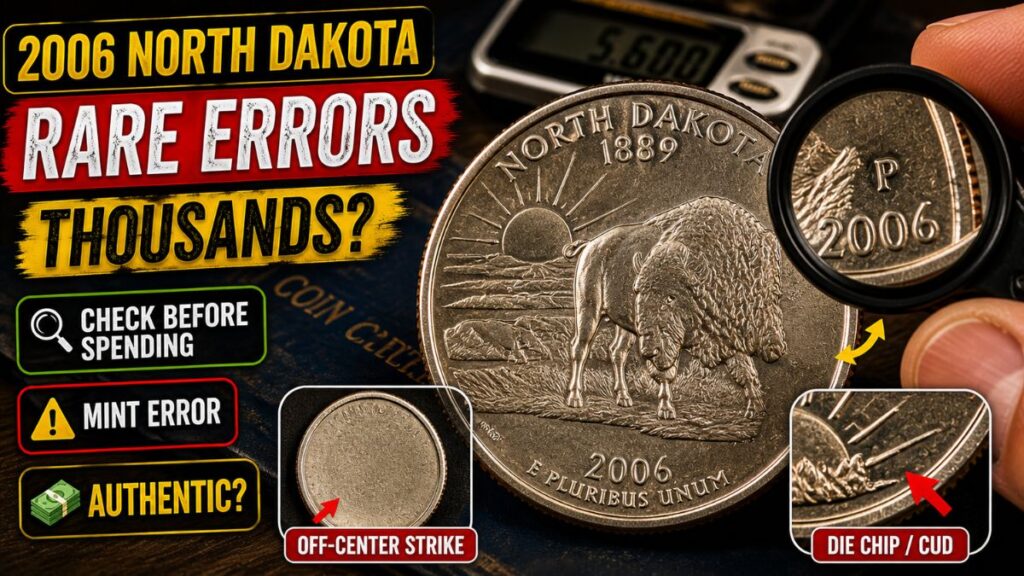
A 2006 North Dakota State Quarter may look like an ordinary piece of pocket change, but certain genuine mint errors can make this coin significantly more interesting to collectors. While most North Dakota quarters remain worth their face value of 25 cents, unusual production mistakes can sometimes create collectible coins worth hundreds or even thousands of dollars.
That difference is what makes coin collecting so exciting. A coin that appears completely ordinary at first glance may contain an unusual striking error, a damaged planchet, missing metal, or another manufacturing mistake. However, not every unusual-looking quarter is rare, and not every internet price applies to every coin.
The most important step is learning how to distinguish a genuine mint-made error from ordinary damage, wear, environmental deterioration, or misleading online claims.
The 2006 North Dakota State Quarter was part of the United States Mint’s 50 State Quarters Program. Its reverse design features two American bison in a landscape associated with the North Dakota Badlands. The coin is familiar to many collectors and casual users, which means that millions of examples can still be found in circulation or stored in household coin collections.
The real collecting opportunity comes from identifying unusual examples. Documented errors include off-center strikes, clipped planchets, missing clad layers, and other major production mistakes. One particularly dramatic 2006-P North Dakota quarter struck on a steel washer reportedly sold for $8,625 at Heritage Auctions. Another 2006-P quarter struck approximately 30% off-center on a clipped planchet sold for $1,200.
These auction results refer to specific authenticated error coins. They do not mean that every 2006 North Dakota quarter is valuable.
This guide explains what to look for, how mint errors occur, why authentication matters, and how collectors can evaluate a possible error without damaging the coin.
Understanding the 2006 North Dakota State Quarter
The North Dakota State Quarter was released in 2006 as part of the 50 State Quarters Program. Each state received a commemorative reverse design representing an important aspect of its history, geography, culture, or identity.
The North Dakota design includes two American bison positioned within a landscape inspired by the state’s natural environment. The design connects the coin to the state’s wildlife and the distinctive scenery of the Badlands.
The obverse carries the standard Washington quarter design used during the program. Depending on the coin, the mint mark may identify production at Philadelphia or Denver. A collector should inspect the date, mint mark, reverse design, edge, and overall condition when examining an example.
Most coins from this issue were produced as regular circulating quarters. They were not created as rare collectibles, and the majority do not have significant value above their face value.
The presence of the year 2006 alone does not make a North Dakota quarter rare. Collectors must look for a specific variety, error, unusual composition, or exceptional condition.
This distinction is essential because online videos and social media posts sometimes present ordinary state quarters as if they are automatically worth large sums. A valuable coin requires identifiable characteristics and, for major claims, reliable authentication.
Why Most 2006 North Dakota Quarters Are Worth 25 Cents
The majority of 2006 North Dakota State Quarters are common circulation coins. Their primary value is generally their face value of 25 cents, although uncirculated examples or coins with particular collecting qualities may have a modest premium.
A coin’s value depends on several factors, including:
- Whether it contains a genuine mint error
- The mint mark and production details
- The coin’s condition and surface quality
- The strength and visibility of the error
- Whether the coin has been professionally authenticated
- Collector demand
- Whether a comparable coin has actually sold at auction
A normal quarter with scratches, stains, discoloration, dents, or damaged edges usually does not qualify as a valuable mint error. Damage that happens after the coin leaves the mint is generally different from a mistake that occurs during manufacturing.
For example, a quarter might be bent by machinery, scratched inside a vending machine, exposed to chemicals, or struck by another object. These conditions can make the coin look unusual without increasing its collector value.
A genuine mint error occurs during the production process. Identifying the difference requires careful observation and sometimes professional examination.
What Makes a Mint Error Valuable?
Mint errors can be collectible because they are unintended results of the coin manufacturing process. The rarity, visibility, type, and authenticity of an error all influence its desirability.
Not every production mistake is equally valuable. A minor imperfection may attract little attention, while a dramatic error that clearly affects the design or planchet can generate substantial collector interest.
The most important factors include the following.
First, the error should be genuine. A coin that has been altered after leaving the mint is not equivalent to an authentic mint error.
Second, the error should be identifiable. Collectors need to understand what happened during production and how the result differs from a normal coin.
Third, the error should be relatively scarce. If thousands of similar examples exist, the premium may be limited. If only a small number are known, demand may be stronger.
Fourth, the coin should be preserved carefully. A genuine error with heavy damage may be worth less than a similar error in better condition.
Finally, the coin’s value must be supported by the market. A social media claim or an unrealistic asking price is not the same as a documented auction sale.
The 2006-P North Dakota Quarter Struck on a Steel Washer
One of the most dramatic examples associated with the 2006 North Dakota quarter is a 2006-P coin reportedly struck on a steel washer. This example sold for $8,625 at Heritage Auctions.
A coin struck on an incorrect object or planchet can be visually unusual because the material, shape, size, and weight may differ from those of a standard quarter.
A washer is a metal component with a hole or opening, usually manufactured for mechanical purposes. If a coin-like object involving a washer enters the striking process, the resulting piece may display characteristics that are very different from a normal quarter.
However, collectors must be cautious when examining unusual metal objects. A circular piece of metal is not automatically a mint error. It must be examined for evidence that it was struck as part of the minting process.
The reported $8,625 result applies to that particular authenticated example. It should not be interpreted as a standard value for every 2006-P North Dakota quarter.
The condition, shape, weight, striking characteristics, and authentication of the individual coin all matter. A similar-looking object found outside the minting process could have no meaningful numismatic value.
Why a Steel Washer Error Is So Interesting
An unusual striking error can attract collectors because it reveals how the minting process may be disrupted. Standard quarters are made using prepared planchets that are intended to have specific dimensions, composition, and weight.
When an incorrect object enters the production process, the dies may strike a surface that was never intended to become a coin. This can create unusual design placement, incomplete details, irregular edges, or unexpected metal characteristics.
The collector appeal comes from the combination of rarity and visible evidence. A dramatic error may be easier to recognize than a small defect, especially when the design is clearly affected.
Nevertheless, visual appearance alone cannot establish authenticity. Some objects may be altered to resemble errors. Others may be damaged after production.
A professional examination can help determine whether the piece has characteristics consistent with a genuine mint-made error.
The 30% Off-Center North Dakota Quarter
Another documented example is a 2006-P North Dakota quarter struck approximately 30% off-center on a clipped planchet. This coin reportedly sold for $1,200.
An off-center strike occurs when a planchet is not positioned correctly between the dies during striking. Instead of receiving the design in the normal centered position, the image is shifted toward one side.
The degree of off-center striking can vary. A very minor shift may be difficult to notice and may have limited collector appeal. A major displacement can leave part of the design missing and create a clearly recognizable error.
The 30% figure describes the approximate degree of displacement. It does not mean that every quarter with a slightly shifted design is worth a similar amount.
The clipped planchet is another important part of this example. The combination of a clip and a major off-center strike can make the coin more distinctive than an ordinary off-center example.
Collectors should evaluate the entire coin rather than focusing only on one unusual feature.
Understanding Off-Center Striking Errors
Off-center errors are among the mint mistakes that collectors frequently search for. They occur when the planchet is incorrectly positioned during the striking process.
A normal coin receives the design in a carefully aligned position. With an off-center strike, part of the design may move toward the edge, and a section of the planchet may remain blank.
The severity of the error is important. A quarter that is only slightly off-center may not command a large premium. A coin with a major displacement and clear missing design elements may be more desirable.
Collectors should look for:
- A design noticeably shifted toward one edge
- A blank area where the design should normally appear
- A partial date or missing design detail
- A consistent striking appearance rather than random damage
- Evidence that the unusual shape occurred during production
The date may be partially missing on a significant off-center strike. This can make identification more difficult, especially if the mint mark is also absent.
A coin with a large blank area should not automatically be considered an off-center error. The shape and details must be studied carefully.
How to Identify a Genuine Off-Center Strike
Start by examining both sides of the quarter. Determine whether the design is displaced in a way that appears consistent with a striking error.
Look at the rim and the transition between the struck and unstruck areas. Genuine off-center strikes often show a clear relationship between the design and the edge of the planchet.
Next, inspect the date and mint mark. If they are present, record exactly what you see. If part of the date is missing, do not attempt to recreate it or alter the coin.
Compare the coin with a normal 2006 North Dakota quarter. The comparison can help you recognize the normal position of the design and identify what appears different.
Avoid using household tools to measure or reshape the coin. Bending, scraping, polishing, or pressing the metal can destroy evidence and reduce potential value.
If the error appears substantial, preserve the coin in its current condition and seek an opinion from a qualified error-coin specialist or professional grading service.
What Is a Clipped Planchet?
A clipped planchet is a coin blank that has been improperly cut from the metal strip before striking. The result is a coin with a missing section along its edge.
The clip may have different shapes, depending on how the metal strip was cut. Some clips appear curved, while others may have more irregular forms.
A genuine clipped planchet error usually displays characteristics related to the manufacturing process. These characteristics can help distinguish it from a coin that was damaged after leaving the mint.
Collectors should inspect the edge and the area around the clip. The metal may show specific features associated with the way the blank was cut.
A damaged quarter can sometimes look clipped, especially if a portion of the edge has been removed by force. Professional examination is important when the difference is uncertain.
The size and shape of the clip influence desirability. A clear, substantial, and authentic clip may be more interesting than a very small or questionable imperfection.
Blakesley Effect and Clipped Planchets
Some genuine clipped planchets may display a feature commonly known as the Blakesley effect. This is a weakness or flattening in the rim opposite the clipped area.
The feature can occur because of the way the metal responds during the striking process. It may help specialists evaluate whether an apparent clip is genuine.
However, the presence or absence of one feature should not be used as the only authentication method. Coins can vary, and damage may create misleading appearances.
A collector should examine the entire edge, the rim, the design, and the overall striking characteristics.
The most reliable approach is to avoid making a final judgment based on one photograph or one visual detail.
Missing Clad Layers on North Dakota Quarters
Modern U.S. quarters are generally made using layered metal construction. A clad coin contains an outer layer of one metal bonded to a core of another material.
A missing clad layer error occurs when part of the intended outer layer is absent or improperly bonded during production. This can expose the underlying metal and create a different appearance.
Collectors may notice an unusual color, exposed surface, or difference in texture. However, discoloration alone does not prove that a clad layer is missing.
A coin can change color because of circulation, chemicals, heat, cleaning, environmental exposure, or contact with other metals. These conditions can imitate some visual aspects of a missing clad layer.
A genuine missing clad layer should be evaluated based on the appearance of the exposed material, the shape of the affected area, the edge, and the overall manufacturing characteristics.
The coin should not be scraped to test the surface. Scraping can cause permanent damage and may remove evidence needed for authentication.
How to Recognize a Possible Missing Clad Layer
Begin by comparing the suspected coin with a normal quarter from the same period. Examine the color on both sides and inspect the edge under good lighting.
A possible missing clad layer may show a distinct difference in surface color or texture. The affected area may not resemble ordinary tarnishing or staining.
Look for whether the change appears integrated into the coin’s structure. A surface stain may sit on top of the metal, while a genuine composition-related error may affect the appearance of the underlying material.
Do not rely on color alone. Lighting, camera settings, oxidation, and handling can alter the appearance of a coin.
Weight can sometimes provide useful screening information, but it is not conclusive by itself. A scale may be inaccurate, and other production differences can influence the result.
Professional testing is recommended when a missing clad layer is suspected.
Why Color Alone Cannot Prove a Mint Error
Many coin collectors are attracted to quarters that appear copper-colored, silver-colored, dark, or unusually bright. Color can provide a reason to investigate, but it cannot establish that a coin is a valuable error.
Environmental exposure can change the surface of a coin. Chemicals, heat, moisture, cleaning products, and storage conditions may cause discoloration.
Some coins may also have surface treatments or alterations intended to make them look unusual. These modifications do not automatically create collector value.
A genuine error should be supported by physical evidence, not just an unusual appearance in a photograph.
When inspecting a North Dakota quarter, use neutral lighting and examine both sides. Avoid relying on heavily edited online images or exaggerated descriptions.
If the coin appears unusual, preserve it and seek a professional opinion rather than attempting a home experiment.
Other Possible Errors on 2006 North Dakota Quarters
The supplied examples include off-center strikes, clipped planchets, missing clad layers, and a quarter struck on a steel washer. Other production errors may also exist, but each suspected example must be evaluated individually.
Potential errors can involve the planchet, dies, striking alignment, metal composition, or other stages of the manufacturing process.
A collector should not assume that every unusual marking represents a recognized error. Some apparent varieties are simply the result of wear, damage, die deterioration, machine doubling, or environmental exposure.
The type of error matters because collectors use established categories to describe and evaluate coins. A vague claim such as “rare defect” is not enough to establish a coin’s value.
Documentation, comparison with known examples, and professional evaluation can help determine what a collector has found.
The safest approach is to describe the visible characteristics without immediately assigning a high price.
Mint Errors Versus Post-Mint Damage
One of the biggest challenges in collecting error coins is distinguishing a manufacturing mistake from damage that occurred after the coin was released.
Post-mint damage can happen in many ways. Coins may be crushed, scratched, bent, exposed to chemicals, struck by machinery, or damaged during transportation and circulation.
A damaged coin can look dramatic, but appearance does not necessarily indicate rarity.
For example, a quarter with a missing edge might have been clipped during production, or it might have been cut or damaged later. A dark patch might indicate a missing clad layer, or it might simply be discoloration.
The distinction requires careful examination of the metal and the affected area.
Collectors should ask several questions:
- Does the feature appear consistent with a known mint error?
- Is there evidence of post-mint damage?
- Does the edge support the suspected error?
- Does the coin match documented examples?
- Has an experienced specialist examined it?
When uncertainty remains, authentication is more reliable than guessing.
Checking the Date and Mint Mark
The first step in examining a North Dakota quarter is to confirm the date. The issue discussed here is dated 2006.
Next, inspect the mint mark. The mint mark can help identify where the coin was produced and may be relevant when researching a particular error.
Do not assume that a specific mint mark automatically makes a quarter valuable. The mint mark is only one part of the identification process.
Record the visible details carefully. If the date is incomplete because of an off-center strike, note which digits are visible. If the mint mark appears unusual, avoid altering the surface or trying to remove dirt.
A magnifying glass can help with inspection, but strong magnification should not be used to justify unsupported conclusions.
Photographs taken under natural or neutral lighting may be useful when asking a specialist for an initial opinion. However, photographs cannot always reveal the full condition or composition of a coin.
Inspecting the Edge of the Quarter
The edge can provide important information about a suspected error. Modern clad quarters normally have a layered appearance that can be examined around the circumference.
Look for unusual gaps, missing material, irregular cuts, exposed layers, or other features that appear connected to the manufacturing process.
A damaged edge may show sharp scratches, tool marks, crushing, or deformation. These signs can suggest that the coin was altered after production.
A genuine clipped planchet may have a distinctive edge structure. A missing clad layer may affect the visible material around the rim.
Do not file, scrape, or polish the edge. Any attempt to expose additional metal can damage the coin and destroy useful evidence.
If the edge looks unusual, photograph it from several angles and preserve the quarter in its existing condition.
Examining Both Sides of the Coin
A mint error may affect one side, both sides, or the overall shape of the coin. Therefore, collectors should never examine only the reverse.
Inspect the obverse for the date, Washington’s portrait, lettering, and mint mark. Then study the reverse design featuring the North Dakota landscape and American bison.
Look for design displacement, missing details, unusual blank areas, irregular edges, or differences in the metal.
A genuine error often creates a relationship between the features on both sides. For example, a major off-center strike may affect the placement of the design on both the obverse and reverse.
A coin that looks unusual on one side but normal on the other may still deserve investigation, but the entire piece must be considered.
Use a soft surface while handling the coin. Avoid touching the surfaces unnecessarily because oils and dirt can affect the appearance.
Why You Should Never Clean a Suspected Error Coin
Cleaning is one of the most common mistakes made by inexperienced collectors. A person may believe that removing dirt or discoloration will make the coin more attractive, but cleaning can permanently damage the surface.
Polishing may create unnatural brightness and hairline scratches. Chemical treatments can change the metal’s appearance. Scraping can remove material and destroy evidence of a possible error.
Even if a coin is not valuable, cleaning generally makes it less desirable to collectors.
A suspected mint error should be left in its original condition. Store it in a suitable non-damaging holder and avoid unnecessary handling.
If the coin requires examination, provide it exactly as found. A professional can assess the surface more accurately when it has not been altered.
The same rule applies to coins with unusual color, missing metal, or suspected composition errors.
Weight as a Screening Tool
Weight can sometimes help identify unusual coins, especially when a suspected error involves missing metal or an incorrect planchet.
However, weight is only a screening tool. It cannot independently prove that a coin is a genuine mint error.
Small differences can result from manufacturing tolerances, wear, dirt, measurement errors, or damage. Household scales may not be accurate enough for reliable numismatic analysis.
A collector should record the weight carefully but avoid treating one measurement as definitive evidence.
If the weight appears significantly different from a normal quarter, the next step should be professional evaluation. Specialists can use more appropriate methods to assess composition and manufacturing characteristics.
Never drill, cut, bend, or otherwise alter a coin to investigate its material. Destructive testing can eliminate important evidence and reduce any potential value.
How Authentication Works
Authentication is the process of determining whether a coin is genuine and whether its unusual features are consistent with a recognized mint error.
Professional examiners may consider the coin’s dimensions, weight, composition, surface, edge, strike characteristics, and overall appearance.
They may compare the coin with known examples and assess whether the suspected error could have occurred during production.
Authentication is especially important when a coin is claimed to be worth hundreds or thousands of dollars. High-value claims should not be based only on online comments or visual similarity.
A professional evaluation may also help identify whether a coin has been altered. Some pieces are intentionally modified to resemble rare errors, while others are ordinary damaged coins that have been misunderstood.
The cost of authentication should be considered in relation to the coin’s potential value. Not every unusual quarter requires an expensive service, but major claims deserve appropriate scrutiny.
Why Auction Prices Must Be Interpreted Carefully
Auction records can help collectors understand the market, but an auction result applies to a specific coin under specific conditions.
The reported $8,625 sale for a 2006-P North Dakota quarter struck on a steel washer represents that individual authenticated piece. The reported $1,200 sale for a 30% off-center quarter on a clipped planchet applies to another specific example.
These results cannot be used as guaranteed prices for all North Dakota quarters.
Important differences may include:
- The exact type of error
- The size and visibility of the error
- The coin’s condition
- Authentication and certification
- The strength of the strike
- The quality of the planchet
- Collector demand at the time of sale
- The auction venue and bidding activity
An asking price is not the same as a completed sale. Someone may list a coin for a very high amount without finding a buyer.
Collectors should focus on documented realized prices for genuinely comparable coins rather than relying on viral claims.
Why Viral Coin Values Can Be Misleading
Social media posts often use large numbers to attract attention. A headline may suggest that an ordinary quarter is worth thousands, but the underlying example may contain a rare error that most coins do not have.
Some videos fail to explain the difference between a normal coin and an authenticated error. Others use an auction record without describing the exact characteristics of the sold example.
This can create unrealistic expectations among people searching their pocket change.
A responsible collector should ask:
- Is the coin the same date and mint mark?
- Does it have the same error?
- Is the error genuine?
- Was the price from a completed sale?
- Was the coin authenticated?
- Is the quoted price based on a comparable condition?
Without these details, a price claim should be treated cautiously.
The goal of collecting should be accurate identification, not simply chasing the largest number mentioned online.
Condition and Its Effect on Value
Condition is important even when a coin has a genuine error. A heavily worn or damaged error coin may be worth less than a well-preserved example of the same type.
Collectors commonly examine the sharpness of the design, surface marks, scratches, discoloration, rim condition, and signs of circulation.
An error can remain valuable despite wear, especially if it is rare and dramatic. However, condition may still influence demand and final sale price.
Do not clean a coin to improve its appearance. Cleaning can create damage that affects both authenticity and desirability.
Store the coin in a protective holder made from materials suitable for long-term coin storage. Avoid loose contact with abrasive surfaces or materials that may react with the metal.
If the coin is submitted for professional evaluation, its existing condition should be preserved.
Circulated Versus Uncirculated North Dakota Quarters
Circulated quarters have been used in everyday transactions and may show wear on the highest parts of the design. Uncirculated coins have generally avoided normal circulation and may retain sharper details.
A regular circulated 2006 North Dakota quarter is usually worth its face value. An uncirculated example may have a small premium depending on quality and collector interest.
A genuine mint error can change the situation. An error coin may have significant value even if it has circulated, but condition remains one of the factors collectors consider.
A coin with an important error should not be handled aggressively to make it look new. Natural preservation is generally preferable to artificial enhancement.
When comparing prices, make sure the examples have similar condition and error characteristics.
Common Mistakes Made by New Coin Collectors
New collectors often make several avoidable mistakes when searching for rare quarters.
One common mistake is assuming that every old-looking coin is valuable. Age alone does not establish rarity.
Another mistake is confusing damage with a mint error. Scratches, dents, discoloration, and edge damage can look unusual but may have occurred after production.
Some collectors also rely on weight alone. Weight can provide useful information, but it is not enough to prove a specific error.
Cleaning is another serious mistake. A collector may attempt to remove dark spots or polish the coin, unintentionally reducing its desirability.
Finally, some people trust viral price claims without checking the exact coin involved. A documented auction result must be connected to a comparable, authenticated example.
Patience and careful observation are more useful than rushing to sell or alter a suspected error.
How to Store a Potentially Valuable Quarter
Proper storage helps protect a coin’s condition. A suspected error should be placed in a suitable holder that does not scratch the surface or expose it to damaging materials.
Avoid storing coins loose in containers where they can rub against one another. Contact with other metal objects may cause scratches and surface marks.
Keep the coin away from excessive moisture, heat, chemicals, and direct contact with household cleaning products.
Handle the edge whenever possible rather than touching the main surfaces. Clean hands are helpful, but even clean fingers can leave oils on the metal.
Do not use adhesive tape, paper clips, rubber bands, or unsuitable plastic materials for long-term storage.
If you believe the coin could be valuable, preserve it carefully until it can be examined by a qualified specialist.
Is Every 2006-P North Dakota Quarter Valuable?
No. The 2006-P mint mark does not automatically make a North Dakota quarter rare or valuable.
The Philadelphia mint produced ordinary examples as well as coins that may contain production errors. A valuable example must have a specific characteristic that distinguishes it from normal pieces.
The reported steel washer error and the off-center clipped planchet example demonstrate that unusual coins can exist. They do not mean that every quarter from Philadelphia has a premium.
Collectors should examine the date, mint mark, design, edge, and physical characteristics rather than focusing on the mint mark alone.
A normal 2006-P quarter without a recognized error generally remains a common circulating coin.
Can a North Dakota Quarter Be Worth Thousands?
A genuine and authenticated major mint error can potentially bring a substantial premium. The supplied examples include a reported $8,625 sale for a quarter struck on a steel washer and a reported $1,200 sale for a 30% off-center clipped-planchet quarter.
However, these values are not guaranteed. They refer to specific coins with specific characteristics.
A quarter must be evaluated individually. Even two coins that appear similar may differ in authenticity, condition, error severity, and collector demand.
The best approach is to avoid assuming a high value before the coin has been identified and authenticated.
If your coin appears to have a major error, preserve it and seek a professional opinion. Do not make a rushed sale based on a viral price claim.
What to Do If You Find a Suspected Error
If you believe your 2006 North Dakota quarter has a genuine mint error, follow a careful process.
First, do not clean or alter the coin. Keep it in the condition in which you found it.
Second, examine both sides under good lighting. Check the date, mint mark, rim, edge, and reverse design.
Third, take clear photographs from multiple angles. Include the entire coin as well as close-up images of the unusual area.
Fourth, compare the suspected feature with established examples of the same error type. Avoid assuming that visual similarity proves authenticity.
Fifth, consult a qualified coin dealer, error specialist, or professional authentication service if the error appears significant.
Finally, research documented sales of comparable coins. Do not rely on a price attached to a different error or a different condition.
This process can help you avoid unnecessary damage and unrealistic expectations.
Why Professional Authentication Matters
Professional authentication is especially important when the potential value is high. A major error can be difficult to evaluate accurately from photographs alone.
An experienced specialist can assess whether the coin’s physical characteristics are consistent with the claimed error. They may also identify damage, alterations, or other explanations for the unusual appearance.
Authentication can provide greater confidence when selling, insuring, or documenting a collectible coin.
However, not every service offers the same expertise in mint errors. Collectors should seek professionals familiar with error coins and modern U.S. coinage.
The goal is not simply to receive a high valuation. The primary objective is to establish what the coin actually is.
A trustworthy evaluation should explain the reasoning behind the identification rather than promise a specific price without evidence.
The Difference Between an Error and a Variety
A mint error generally results from an unintended problem during production. A variety, by contrast, may involve a recurring difference in a die or design that affects multiple coins.
The distinction matters because collectors use different categories to describe unusual pieces.
An off-center strike is typically considered a striking error. A clipped planchet is related to the preparation of the blank. A missing clad layer involves the coin’s metal construction.
Not every difference in lettering, design, or surface appearance should be described as an error. Some differences may result from normal production variation or die wear.
Correct terminology helps collectors communicate accurately and avoid exaggeration.
When researching a suspected North Dakota quarter, focus on the physical feature rather than immediately applying a valuable label.
How Technology Can Help Coin Collectors
Modern technology can assist with preliminary coin examination. A smartphone camera, magnifying lens, and accurate scale may help document a suspected error.
High-resolution photographs can reveal design placement, edge details, and surface characteristics. However, camera images may also exaggerate colors, shadows, and marks.
Digital scales can provide weight measurements, but they should be calibrated and used carefully. A measurement alone cannot establish authenticity.
Online communities may offer opinions, but informal comments should not replace professional authentication for valuable claims.
Technology is most useful when it supports careful documentation. It should not be used to create misleading images or to alter the appearance of the coin.
A clear record of the coin’s condition and characteristics can help a specialist evaluate it more effectively.
The Role of Patience in Coin Collecting
Coin collecting rewards patience. Many people search large quantities of coins and find nothing unusual. Others discover an interesting piece only after learning how to recognize specific characteristics.
A collector should avoid rushing because of an exciting headline. The most important part of the process is accurate identification.
If a coin appears valuable, take time to inspect it carefully and research the type of error. Preserve the coin and consider professional advice before selling.
Patience also helps collectors understand the difference between an unusual coin and a rare coin.
A damaged quarter may look dramatic but have little value. A subtle but genuine error may be more desirable to specialists.
The ability to observe carefully is often more useful than simply searching for the highest possible price.
Frequently Asked Questions About the 2006 North Dakota Quarter
Is a 2006 North Dakota quarter automatically rare?
No. Most 2006 North Dakota quarters are common circulation coins worth approximately their 25-cent face value. Only specific errors, unusual varieties, or exceptional examples may carry a significant premium.
What is the most valuable North Dakota quarter mentioned here?
The supplied information describes a 2006-P North Dakota quarter struck on a steel washer that sold for $8,625 at Heritage Auctions. This price applies to that particular authenticated error coin.
What other North Dakota quarter error sold for $1,200?
A 2006-P North Dakota quarter struck approximately 30% off-center on a clipped planchet reportedly sold for $1,200. The result applies to that specific coin and its documented characteristics.
What should I check first on my North Dakota quarter?
Begin with the date, mint mark, both sides of the design, the edge, and any unusual missing metal or design displacement. Examine the coin under good lighting without altering it.
Can an off-center quarter be valuable?
Yes, a genuine off-center strike can have collector value, particularly when the displacement is substantial and clearly visible. The amount depends on authenticity, severity, condition, and demand.
What is a clipped planchet?
A clipped planchet is a coin blank that was improperly cut from the metal strip before striking. It may have a missing or curved section along its edge.
Can discoloration prove a missing clad layer?
No. Discoloration can result from environmental exposure, chemicals, heat, or other causes. A suspected missing clad layer requires careful examination and potentially professional authentication.
Should I clean a suspected error quarter?
No. Cleaning, polishing, scraping, or chemical treatment can damage the coin and destroy important evidence. Keep the coin in its original condition.
Is a 2006-P mint mark enough to make the coin valuable?
No. The mint mark identifies production location but does not automatically indicate rarity. A specific, genuine error must be identified before a premium can be considered.
Can weight confirm a mint error?
Weight can be useful as an initial screening tool, but it cannot independently confirm a mint error. Professional examination may be necessary to evaluate composition and manufacturing characteristics.
Are online prices for North Dakota quarters reliable?
Not always. Some online claims may refer to a specific authenticated error coin, an asking price, or an exaggerated estimate. Always distinguish documented completed sales from unsupported claims.
Should I sell a suspected error immediately?
It is better to identify and authenticate the coin first. A rushed sale may result in accepting an inappropriate price, especially if the coin has a genuine major error.
Where should I store a suspected valuable quarter?
Use a suitable protective coin holder and keep it away from moisture, chemicals, heat, and abrasive materials. Avoid unnecessary handling and do not clean the coin.
Conclusion: Check Carefully Before Spending Your North Dakota Quarter
The 2006 North Dakota State Quarter is usually worth only 25 cents, but genuine mint errors can create exceptional collecting opportunities. Major off-center strikes, clipped planchets, missing clad layers, and unusual striking mistakes may attract significant attention when they are authentic and well documented.
The reported $8,625 steel washer error and the $1,200 off-center clipped-planchet example show why collectors examine ordinary-looking coins carefully. However, these auction results belong to specific coins and should never be treated as guaranteed values for every North Dakota quarter.
If you find a 2006 North Dakota quarter that looks unusual, start with the basics. Check the date, mint mark, edge, design placement, and both sides of the coin. Look for genuine production characteristics rather than relying only on color, weight, or viral claims.
Most importantly, do not clean, scrape, bend, polish, or otherwise alter the coin. Preserve it carefully and seek professional authentication if the suspected error appears significant.
Your next North Dakota quarter may be completely ordinary—or it may contain a fascinating mint-made mistake. The only way to know is through careful inspection, accurate identification, and responsible collecting.